This CE Center article is no longer eligible for receiving credits.
Landscape architecture by definition is the design of outdoor spaces. The American Society of Landscape Architects (ASLA) provides a detailed explanation in response to the question, “What is landscape architecture?” It states that landscape architects have a significant impact on both the natural environment and the people who live in the surrounding communities. As we adjust our design criteria for meeting COVID-19 recommendations for safe social distancing as well as spending more time outside, there are several options available for landscape architects to create attractive outdoor spaces that allow people to enjoy social interaction outside, both safely and comfortably.
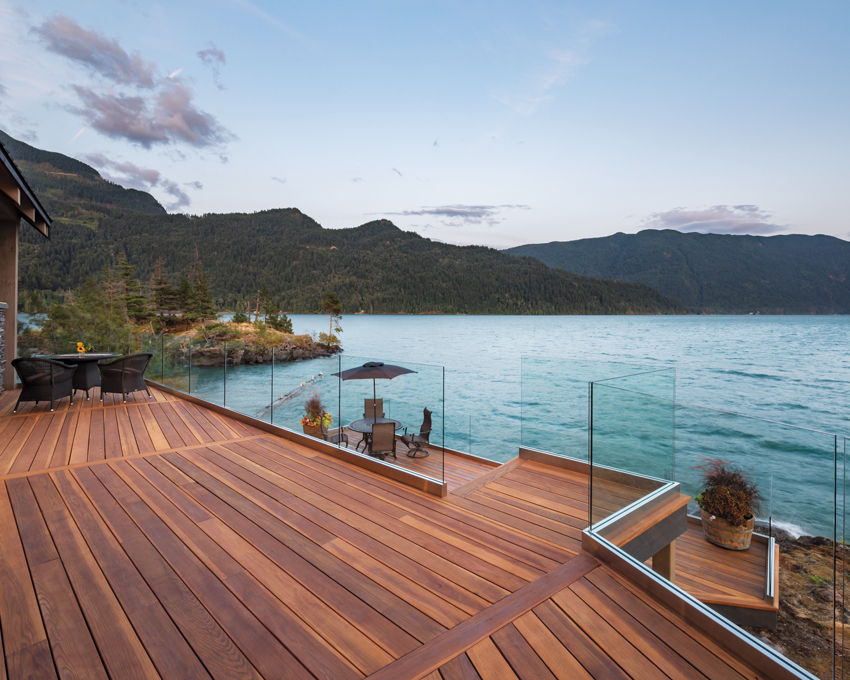
Photo courtesy of Humboldt Sawmill Company
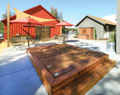
Redwood was used for this multilevel lakefront deck.
During the pandemic of 2020, we experienced social isolation because of various restrictions that limited access to our normal patterns of work, play, and socialization. Yet even during the tightest restrictions, outdoor locations were considered the safest environments for social interaction. Many news articles have pointed out that it took a pandemic to finally force Americans to rethink the way we relate to the outdoors. And as the pandemic restrictions have lifted, many people still feel “safest” interacting and socializing outside.
Post-pandemic, as we look forward to the restoration of healthy socializing and community engagement, designers and landscape architects are presented with more opportunities to provide outdoor spaces that:
- Improve and regenerate environmental conditions;
- Benefit people’s health;
- Enhance safe social interaction; and
- Are sustainable and economically beneficial.
Well-designed outdoor spaces can meet the goals of social distancing while providing comfortable and desirable environments for users to frequent.
In addition to providing ideas for creating outdoor spaces that contribute to the health and welfare of communities, this course will also address ways in which outdoor spaces can meet both LEED and Sustainable SITES guidelines.
Sustainability has expanded its definition and applications beyond material content and safety, material resource resiliency, and design adaptability. The most recent versions of LEED include considerations relating to human health and well-being as well as social and cultural connections. Both LEED for Neighborhood Development (LEED ND) and Sustainable SITES provide performance measures for designing functional and regenerative landscapes that increase outdoor opportunities.
Key design criteria of both SITES and LEED, which focus on sustainability in the design elements for outdoor spaces, include Materials Selection, Environmental Quality, Human Health and Well-Being, and Energy and Optimization. This course will explore the ways that designers can create an attractive and sustainable outdoor environment compliant with these LEED and SITES criteria, while also effectively addressing health and community benefits.
So, how can we create outdoor spaces that provide safe and comfortable outdoor environments while also contributing to environmental sustainability?
Redwood: An Environmentally Friendly, Renewable Resource
Redwood is an aesthetically beautiful wood that is an environmentally friendly, renewable resource. Sourced from Forest Stewardship Council (FSC C013133) certified forests and manufactured with 100 percent natural materials, redwood lumber and timbers are renewable resources that are also nontoxic and safe for children and pets due to their natural preservative properties that make the wood naturally resistant to insects and decay. Redwood lumber and timbers meet environmental concerns through both the FSC certification and the USDA Forest Service Life-Cycle Analysis.
FSC certification indicates that the forest from which the wood is harvested has been environmentally managed. FSC certification ensures that products come from responsibly managed forests that provide social and economic as well as environmental benefits. The FSC U.S. National Standard (v1.0) guides forest management certification in the United States.
Redwood lumber and timbers will count toward credit achievement under both the LEED rating system and the Sustainable SITES initiative based on the following criteria.
The applicable LEED rating criteria include:
- Renewable Resource: Redwood is a sustainable natural wood product.
- Certified Wood: FSC certification indicating that redwood forests are environmentally managed.
- Low Carbon Footprint: Environmental product declarations (EPDs) are available for redwood noting low carbon footprint in the milling and processing of products.
- Heat Island Effect: Redwood forests help to mitigate the heat island effect and the effects of climate change.
The applicable Sustainable SITES rating criteria for redwood include:
- Renewable Resource: Redwood is environmentally managed.
- Materials Selection: Redwood has a positive life-cycle assessment (LCA).
- Environmental Quality: Redwood is an environmentally managed and durable product.
- Energy and Optimization: The processing of redwood is a low-carbon-footprint operation.
- Human Health and Well-Being: Redwood products are used to create attractive outdoor spaces that invite frequent use, thus benefiting human health and well-being.
An LCA has been done by the USDA Forest Service on the manufacturing process of redwood decking from harvesting through to final disposal of the product. This study evaluated material flows, energy use, and cumulative energy consumptions associated with the manufacturing process. The conclusions were that low carbon emissions during the manufacturing process for redwood decking and carbon storage during the service life of a redwood deck are both positive environmental attributes to be considered when selecting a decking product
The LCA measures the total impact that a material has on the environment, taking into consideration the resources used to create it, the pollution created by its production, and the product’s end-of-life impact.
Redwood has an extremely low LCA because it is both renewable and recyclable. Redwood forests are replanted after harvesting so they are renewable, and redwood decking can be recycled at the end of its life cycle. The wood can be repurposed into wood chips or reused on other projects, and the wood has a long service life.
Redwood Is Sustainably Harvested
Redwood is grown and harvested in compliance with FSC as well as California Forest Practice Rules, which are some of the most stringent regulations in the world. When redwoods are harvested, the stump is able to send out shoots of new growth fairly rapidly because the full root system that drives the growth has remained. There are two harvesting practices that comply with sustainable forestry methods:
- Preserving old growth and harvesting from new growth.
- For each mature tree that is cut down, a number of seedlings are planted in its place.
Redwood Reduces Carbon Emissions
All wood has the capacity to remove carbon from the air and store it in wood fibers even after the wood has been harvested and made into lumber. Studies have shown that redwood is very efficient at removing carbon from the atmosphere, with up to half a ton of carbon being stored in one redwood deck. Redwood’s carbon storage is also maximized through its sustainable forestry practices because faster-growing younger trees are better able to take in carbon than older trees.
The American Wood Council also has prepared reports on EPDs of U.S. redwood lumber. It evaluated redwood from extraction through transport to the facility (log delivery) and manufacturing process, which includes sawmilling, drying, planing, and packaging. The EPDs for products provide a basis for evaluation of the environmental performance of the product but does not “judge” whether the product meets any environmental quality standards. It does provide information about the environmental impacts from some or all of a product’s life-cycle stages.
Architects and designers should note that the key results of new LCA and related EPD results for redwood lumber are not the same as the LCA/EPD for redwood decking. There have been two separate studies done, one for lumber and one for decking.
Designing Outdoor Spaces Using Modular Systems
Many of today’s products provide design flexibility through modular systems. Modular decking and modular pavement systems provide landscape architects with a variety of surface options for creatively designing outdoor spaces both on-grade and on rooftops. Modular cubes and modular outdoor structures such as pergolas present opportunities for creating privacy and separation by providing options for vertically defining outdoor spaces.
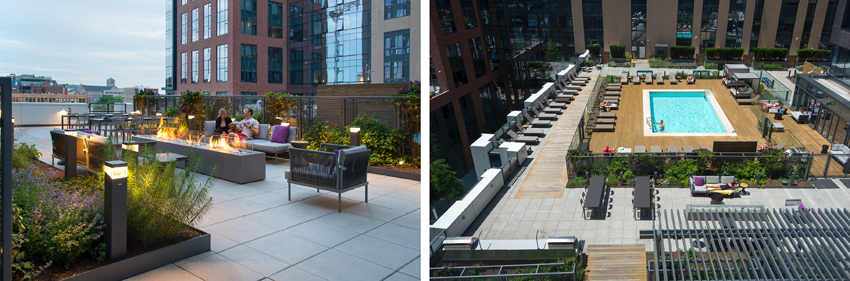
On the ground level, modular pavers can be used to define entrances, pathways, parking spaces, sitting spaces, and large open areas. Modular wood elements can be mixed with pavers or used by themselves to create unique aesthetics. Modular cubes provide spaces for plantings in rooftop gardens, decks, or parklets. Modular structures provide opportunities to create outdoor rooms for shade and privacy.
Surfaces for rooftop and ground-level spaces can be designed using wood, stone, or concrete pavers to create unique custom looks. All these materials can be applied either on a rooftop or over a prepared ground-level subgrade over a pedestal support system.
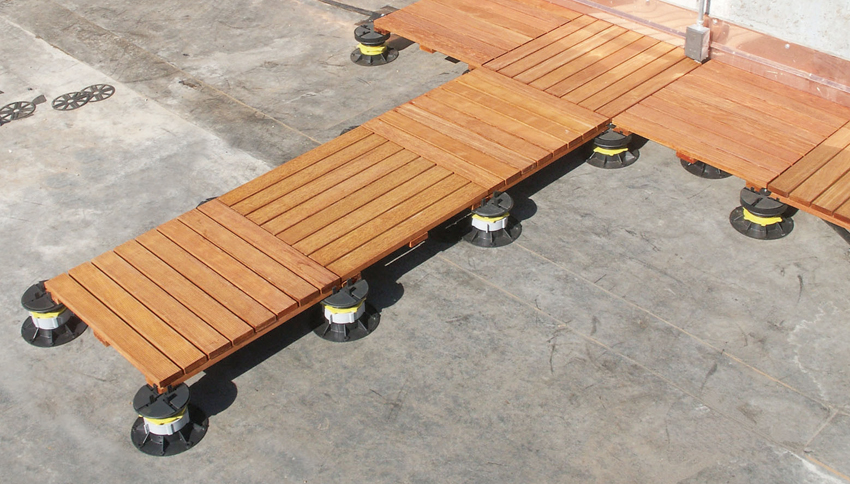
Photo courtesy of Bison Innovative Products
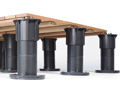
Adjustable pedestals support wood tiles.
Versatile Modular Deck Systems Provide Flexibility
Modular and versatile deck systems give architects and designers the design flexibility to create unique and beautiful rooftop environments as well as ground-level outdoor spaces. Designers can include a mix of pavers and surface materials, including wood, stone, structural porcelain, crushed rock, grating, artificial turf, and concrete, as well as planter cubes and benches to create unique, custom looks. The versatile, adjustable pedestal deck systems can be utilized over any structural surface, including bare structural decks, rooftop decks, roof membranes, green roofs, terraces, compacted grade-level surfaces, pavements, pool surrounds, and within water features.
These deck systems provide solutions for designers to expand social functions outside by utilizing unused space in the city, constructing a new porch or backyard in the suburbs, or creating a large decking area for outdoor dining. Creative outdoor spaces allow for an extension of indoor areas or the creation of a new outdoor oasis of its own. Outdoor spaces can contain kitchens, fire pits, bars, living areas, gardens, and, if large enough, play areas.
Outdoor decks connect guests to the natural environment through the use of natural materials, such as wood and stone, and provide opportunities to incorporate vegetation and greenery into the space through the use of planter cubes and pots. This exposure to the outdoors benefits the health and well-being of people, as regular interactions with the natural environment are proven to lower blood pressure, reduce stress, expedite healing, and improve one’s mood and focus.
Through the use of a modular decking systems, designers can create an abundance of different design visions without the need for custom or costly materials. These deck systems allow for quick and easy installation through fastening kits that facilitate swift and secure installations of wood surface tiles and paver-tray-backed pavers without harm to the wood tiles or pavers.
Deck System Components
Deck systems are comprised of two major components: pedestals and tiles/pavers. The pedestals are designed to elevate and support a variety of tiles/paver surfaces, including structural porcelain, stone, granite or concrete pavers, wood tiles, composite materials, fiberglass grating, or conventional joist and plank systems.
As a component of the deck system, the pedestals offer tremendous design flexibility coupled with ease of installation. This adjustable component provides a unique and viable alternative to traditional deck-building systems for the following key reasons:
- They are available in a range of heights and weight-bearing capacities to suit a variety of applications.
- They are one of the most labor- and cost-efficient methods of creating a flat, level structure over a sloped surface.
- They use a gravity system that protects roofing and waterproofing materials without damaging or harming the surface below.
- They can support decks over occupied space, allowing space for electrical systems, duct work, or irrigation to pass underneath.
The pedestals are made with high-density polypropylene plastic (comprised of 20 percent post-industrial recycled content) that are 100 percent recyclable. The recycled material content of the pedestals provides points toward both LEED and SITES certification. The pedestals are screw adjustable and easily leveled with tapered base-leveling discs and/or shims, allowing the creation of level surfaces over a variety of conditions, including sloped surfaces. The pedestals can elevate and support wood tiles, concrete pavers, and an assortment of other surfaces when sophisticated, commercial-grade decking is required. They are also sturdy enough to support site furnishings, such as planters, tables, and benches, and structures such as pergolas.
The pedestals come in residential, commercial, and industrial grades with each grade having different characteristics. Deciding which grade to specify is dependent upon the load and elevation requirements of the installation.
Fastening kits and splines facilitate quick and secure pedestal deck system installations. The fasteners attach kerf-cut wood, concrete, and stone pavers or paver-tray-backed porcelain tiles to the pedestals without penetrating or damaging the roof surface. While the fasteners are hidden, they can be accessed to allow for easy removal of individual wood tiles or pavers if roof maintenance, drain access, or replacement is required. Some pedestal systems can also be designed to resist wind uplift; consult with individual manufacturers and engineers for confirmation on the capabilities of specific systems.
Pedestal systems can support decks over occupied space, allowing cavity space for electrical systems, duct work, and irrigation. A pedestal-supported system is an ideal method to incorporate a water-feature application onto a rooftop garden. The system conceals the water supply between the pedestals and beneath surface materials, allowing water to drain to the surface below for recycling. The sound of water provides a healthy, relaxing atmosphere in an outdoor setting. Additionally, the pedestal supports are impervious to water, mold, freeze-thaw cycles, and most chemicals. These pedestal systems also provide designers with the opportunity to include recessed lighting below the surface. Lighting can be selectively located to enhance the ambiance of the environment and improve visibility and safety during nighttime and/or dark conditions.
The pedestal system is one of the most labor- and cost-efficient methods of creating a flat, level deck over a sloped or uneven sub-surface. Using a gravity system, the supports protect roofing membranes and waterproofing and do not damage or harm the surface below. Rooftop decks are a way for residential, hospitality, or public spaces to expand outdoor experiences and create valuable outdoor spaces. Pedestal systems can be installed to accommodate wind-uplift requirements. Wind-uplift systems are designed to resist high-velocity wind zones when installed to the manufacturer’s specifications. Pedestals elevate the deck surface to provide an even and level transition from one space to another. This allows easy access for patrons with different levels of mobility.
Modular Wood Tiles for Ground or Rooftop Applications
Tiles and pavers are the second component of the adjustable deck system. Typically made from dense hardwoods, wood tiles are commercial grade and available in responsibly harvested standard and FSC-certified species. Wood tiles that are made from tropical hardwoods contain a rich variety of graining and coloration, are exceptionally dense, and are resistant to insects. These commercial-grade, responsibly harvested wood tiles weather well and are available in a variety of species. Wood species include fused bamboo, cumaru, garapa, ipê, and massaranduba. Wood tiles can be crafted from premium-grade remnants and harvested in an environmentally responsible method designed to preserve the economic viability of rainforest hardwoods.
The density of tropical hardwood species makes for minimal maintenance. If maintaining the wood color is desired, wood tiles can be periodically cleaned and sealed. Left to weather naturally, the wood tiles will develop a silvery-gray patina.
Wood tiles are ideal for blending the warm beauty and upscale appearance of real wood with durability and low maintenance. Weighing one-third as much as concrete tiles, wood tiles are a good alternative when surface material weight is a factor. Wood tiles can be laid in a parquet or linear pattern, or mixed with pavers, river rock, stone, plank decking, or other options to create a unique aesthetic. Wood tiles are available in a variety of finishes, including ribbed or smooth, and multiple plank counts, allowing for a particular look.
Because they are modular, the wood tiles meet SITES Criteria 5.3: Design for Adaptability and Disassembly. The wood tiles also meet SITES Criteria 5.8, as they support safer chemistry.
Pavers and Paver Trays
Pavers are a beautiful surfacing option for rooftop environments. Available in a wide variety of sizes with a wood, stone, or concrete appearance, 2-centimeter pavers create aesthetic appeal for rooftop decks, outdoor areas, and pool surrounds. When installed over pedestal supports, 2-centimeter pavers should be backed by paver support trays to enhance the impact resistance and provide additional strength. The 2-centimeter paver and paver-tray system provides weather resistance and protection as well as valuable rooftop outdoor space for buildings and ground-level outdoor areas. Paver trays provide simple, lightweight, and durable support for 2-centimeter porcelain, natural stone, and concrete pavers. Paver trays made from galvanized steel meet the testing requirements for noncombustible surface materials. The paver support trays are designed to enhance impact and wind-uplift resistance and provide additional strength to paver surface materials. Paver trays can be adhered to the desired surface pavers on-site before or during installation. They are available in a variety of standard and special-order sizes, including 24-inch x 24-inch, 24-inch x 18-inch, 24-inch x 16-inch, 24-inch x 12-inch, 20-inch x 20-inch, and 18-inch x 18-inch. Paver trays can be combined to accommodate larger-format pavers. Consult individual manufacturers for recommended configurations.
Creating Outdoor Spaces with Deck Systems
Modular surface materials, pedestals, and accessories allow for a unique design with quick and easy installation. The pedestal deck system provides an affordable way to create a usable outdoor space particular to a project’s needs and aesthetic. The system provides designers with tools to design and enhance underutilized outdoor spaces, turning an otherwise wasted space into a functional outdoor amenity, such as a kitchen, bar, lounge, or garden area.
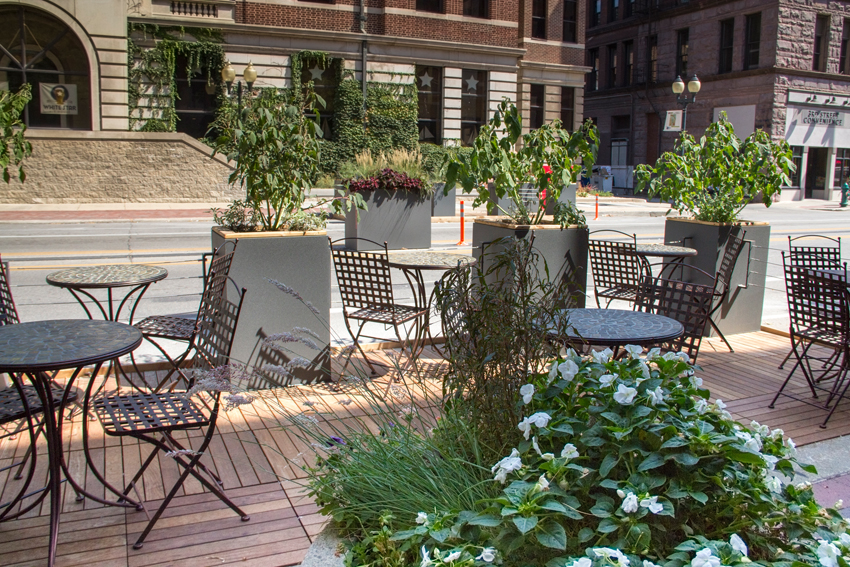
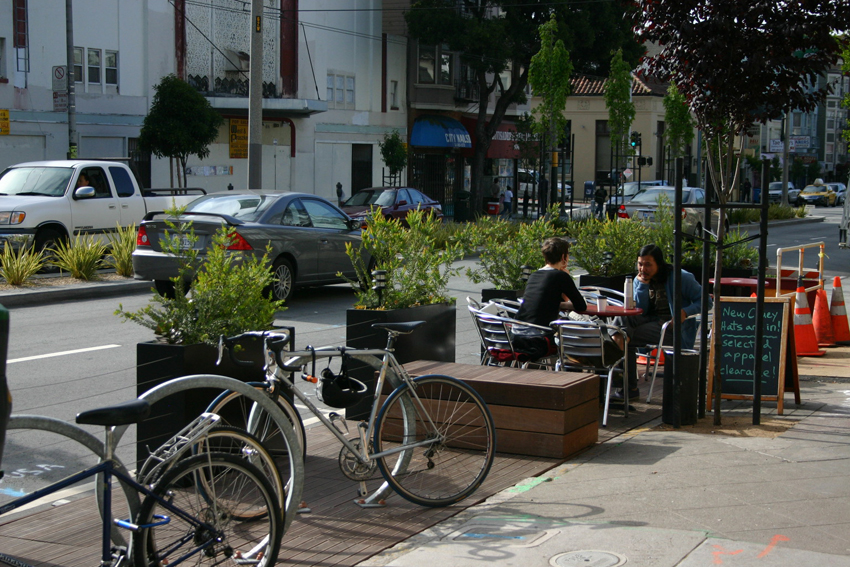
Ground-level and street-level sidewalks and storefronts can be expanded through the design of mini-decks, parklets, or popup parks, all of which enhance urban communities. The mini-decks, parklets, and popup parks can be designed using pedestal systems and modular wood tiles placed over existing ground and street-level spaces. Green roofs can expand usable space to include gardens and walkways. Designs that include green roofs demonstrate imagination in the use of materials that minimize maintenance and a project’s environmental footprint. Incorporating a pedestal system can provide pedestrian access to green roofs. These exterior spaces provide areas that support social connections, mental restoration, and physical activities, which meet criteria under Site Design: Human Health and Well-Being in the Sustainable SITES guidelines.
Redwood: A Durable and Aesthetically Beautiful Material
The natural beauty, durability, strength, and warmth found in real redwood lumber and timbers are what make it an excellent wood for outdoor projects. Redwood has shear strength up to five times greater than plastic or composite decking. Redwood is a lightweight wood that is easy to work with, thus helping to lower overall construction costs.
Redwood lumber is available in a wide selection of grades, and it can be used for many common building applications, including decking, fencing, pergolas, building siding and trim, and many other landscape uses.
Redwood lumber and timbers may be used by architects and designers interested in designing to low- (or no) fossil-fuel, greenhouse-gas-emitting energy performance standards. The range of uses include commercial, industrial, and residential properties. Redwood is available in 1-inch and 2-inch dimensional lumber and in 4-inch, 6-inch, 8-inch, and larger timbers.
Timbers are the largest pieces of solid-sawn lumber produced by sawmills. Timbers are typically 5 inches thick and larger. Redwood is one of the lightest yet structurally strong softwoods found in North America, making it an ideal wood for a wide range of structural applications where large timbers are required. Structural applications for redwood timbers have been used for shade structures, gazebos, pergolas, arbors, and deck framing in outdoor design projects.
Redwood Grades
Redwood lumber and timbers are available in a wide variety of grades, including sapwood and heartwood grades. The term “grade” in lumber refers to the strength, durability, and appearance of the wood. Grades of redwood lumber are determined using criteria outlined by the Redwood Inspection Service (RIS). The grades provide guidance in determining the best use for the redwood based on its durability and appearance. Appearance is an important factor in selecting both color and the presence of knots. Durability is important in determining whether the lumber is appropriate for in-ground contact or can only be used aboveground.
Redwood is graded for its durability or resistance against insects and decay. These factors are actually easily distinguished by the color of the wood. The reddish-brown heartwood from the inner portion of the tree contains extractives that provide resistance to insects and decay. Thus, all heartwood grades of redwood will have the word “heart” in the grade name. Heartwood grades include Heart Clear, Heart B, Deck Heart, Construction Heart, and Merchantable Heart.
Garden grades of redwood contain more knots and natural characteristics than are allowed in higher, architectural grades. Garden grades of redwood include Deck Heart, Construction Heart, Deck Common, Construction Common, Merchantable Heart, and Merchantable. These are the grades that are more frequently used for decks, fences, and garden structures where knots or other visual characteristics have little to no effect.
For the finest uses, the architectural grades of heartwood are appropriate. Architectural grades include Heart Clear, Heart B, Clear, and B Grade, and may be available kiln dried (preshrunk and stress free) for fine exterior and interior uses. These are the choice grades for applications where attractiveness and tight joinery are desired as well as dimensional stability.
Sapwood is the cream-colored wood that develops in the outer growth layer of the tree, but it does not possess the same resistance to decay and insects that redwood heartwood does. However, redwood that contains sapwood can be used in construction aboveground where there is little danger of damage from insects or decay. Sapwood grades include Clear, B Grade, Deck Common, Construction Common, and Merchantable. These sapwood grades can be used for decking that does not contact the ground, garden shelters, and other aboveground outdoor applications, such as benches and seating.
Appearance is the other major factor in the grading of redwood. The rich, warm texture and grain pattern of redwood hold true even with age. Freedom from knots, or clearness, is the determinant for the highest grades. Other grades are categorized by the number, size, and nature of knots as well as the presence of other characteristics such as stains or manufacturing defects that may occur during the milling process.
Redwood decking also features Class B flame spread and is approved for use in California’s Wildland Urban Interface (WUI) fire-hazard severity zones without restriction. In order to provide a Class A flame-spread rated product, redwood lumber and timbers can be treated with an exterior fire retardant. The result is a Class A exterior decking product. The product is covered by a limited lifetime warranty. In addition to decking, accessory items such as joists, railings, and other specialty items are available.
The Class A flame-spread rating means that the treated redwood product can be used under even the most stringent Wildland-Urban Interface (WUI) building codes throughout the United States, including the International Code Council’s International Wildland-Urban Interface Code (IWUIC). The IWUIC code requires decks to be constructed of approved fire-retardant treated wood specified for exterior use. Under such guidelines, only a Class A flame-spread rated exterior wood product would qualify for usage.
Ideas For Creating Interesting and Well-Designed Outdoor Environments
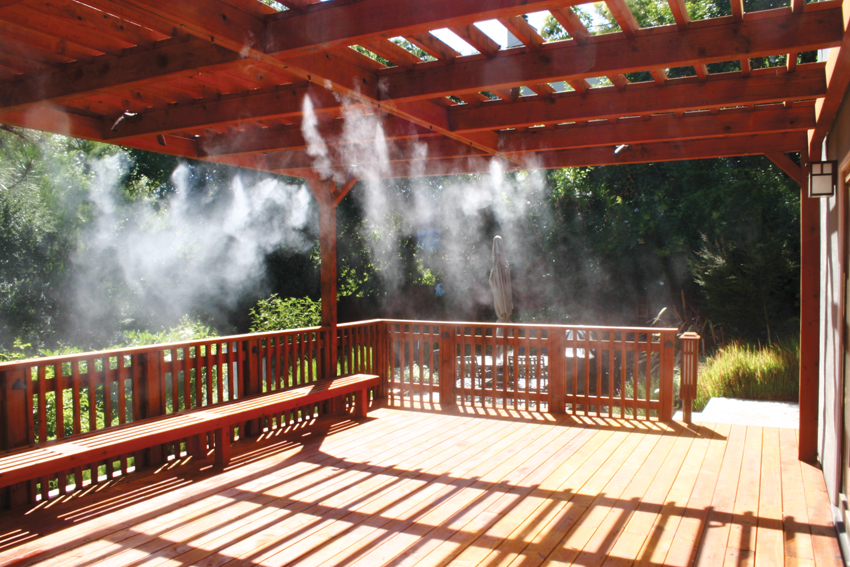
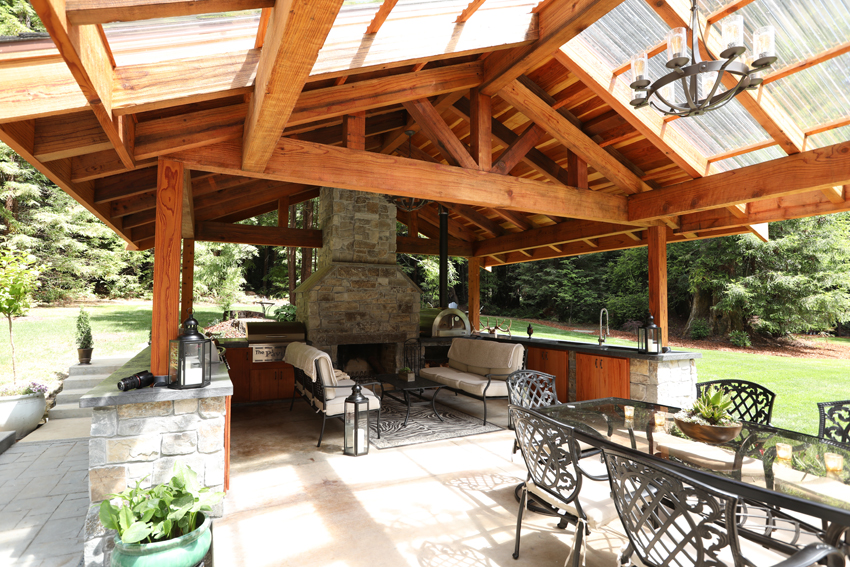
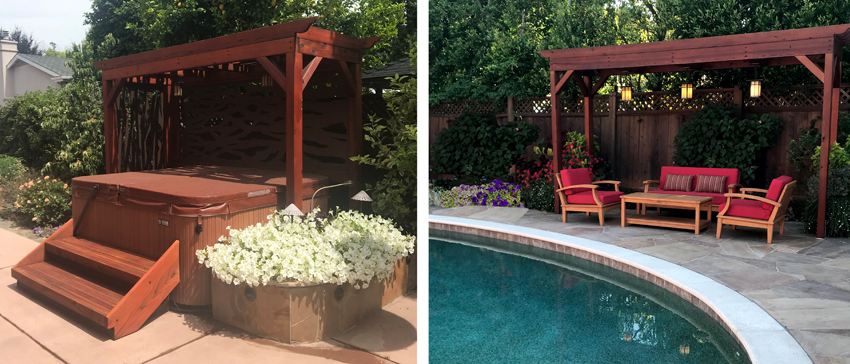
Architects and designers can create decks and pergolas using redwood lumber and timbers to expand residential and commercial outdoor environments. Pergolas provide shade and when combined with plantings can reduce heat island effects. Pergolas also help homeowners and businesses to take their social gatherings outside.
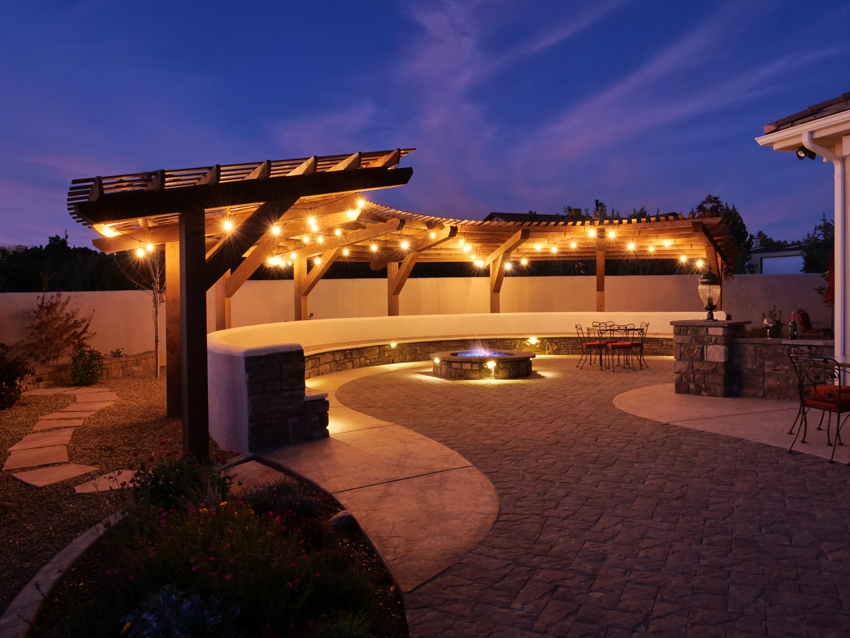
Photo courtesy of Humboldt Sawmill Company
Redwood timbers were used to create this pergola located in Farmington, New Mexico.
Site Furnishings for Enhancing Landscape Spaces
Site furnishings such as benches, tables, and planters provide enhancements to any outdoor space, as they provide more inviting spaces for leisure activities and social interaction. Modular planters provide flexible options for the addition of plantings in roof gardens, small urban spaces, popup parks, and around building plazas. Planters are available in a variety of materials, including metals, cast stone, concrete, resin, fiberglass, and wood. Aluminum planters offer the durability of metal with a lighter weight making them easy to move as well as place onto rooftop decks.
Modular cubes that are constructed of lightweight, recycled aluminum are durable, low maintenance, and designed to withstand extreme temperatures. This makes them ideal for rooftop locations that are subject to extreme winds, sun, and weather. These cubes are painted using an industrial-strength powder-coating technology developed with modern aesthetics in mind. Powder coating is a dry finishing process that is applied electrostatically and cured under heat, creating a more resilient finish than conventional paint. The process does not emit any volatile organic compounds (VOCs) into the air and allows the aluminum planter cubes to be coated with any RAL paint code color.
RAL is a European color-matching system that defines colors for paint, coatings, and plastics. RAL is the abbreviation for Reichs-Ausschuß für Lieferbedingungen und Gütesicherung. RAL is essentially a quality-assurance system for colors. The system contains more than 1,625 colors, some real colors and some metallic. RAL DESIGN color codes have seven digits, whereas RAL CLASSIC color codes only have four digits. Seven-digit color numbers in the RAL DESIGN SYSTEM provide direct information about the visual appearance of the corresponding shade. The first three figures identify the position of the shade on the color circle, and the next two figures describe the lightness of a shade (0 = black / 100 = white). The system is recognized internationally.
The aluminum planter cubes typically contain 20 percent recycled content, are 100 percent recyclable, include drain holes and irrigation sleeves, and are made in the United States. They come in a variety of size and color choices, providing a number of design options for landscape architects.
Modular wood cubes provide another material option for introducing plants onto a rooftop garden or ground-level exterior space. Ipê wood planter cubes and ipê wood planter cube tops offer a selection of modular design options to incorporate seating, storage, and planters into a ground-level or rooftop space. With the long-lasting durability of dense hardwoods, these wood planters and tops can withstand harsh environments. The warm wood tones and varied grain patterns provide a natural complement to wood decking. The wood planters have a polyurethane lining and drainage holes, making plant care and maintenance easy. Custom sizes and species are available as well. The planters have drain holes and irrigation sleeves that make caring for plants or vegetables convenient. As a storage unit, they can be used for seasonal items like cushions or throw pillows.
Lightweight aluminum trays expand the design options for rooftop environments. Used as a containment system for architectural rocks or other deck elements, the low-clearance aluminum trays integrate seamlessly with the modular planters and wood tiles, providing designers with a palette of materials for designing rooftop environments. The trays are corrosion resistant, made in the United States, and available in a variety of standard and custom sizes that offer modular integration with a pedestal deck system.
Taking it Outside with Popup Parks
Popup parks are typically created by reclaiming a car-designated zone for pedestrian use. Popup parks vary in size from a one-car parking space of about 150 square feet, to many spaces linked together, to a whole block or lane. Installations include pedestal supports with wood tile, stone, or concrete paver surfaces covering the existing pavement. Popular accessories include attachment hardware, planters, railing, and benches. Some manufacturers offer all of the built elements required for a popup parks installation. This creates a smooth installation as well as offers a consistent warranty for the entire system. Level platforms are built on top of existing pavement and populated with planters, railing, benches, furniture, and other accessories. Many parks offer seating areas, gardens, bike parking, and exercise and other amenities.
Popup parks were first recognized in San Francisco and New York in programs like Pavement to Parks. In some cases, these parks were defined as “removable” to expedite design, review, permitting, and construction. Popup parks have low installation and maintenance costs and are usually small scale, affordable, flexible, and often temporary or mobile. Frequently paired with nearby businesses to help with their use and upkeep, popup parks can be hosted or sponsored by local groups or organizations that pay to design and build them and agree to keep them maintained. They can be installed in a way that does not require reconfiguring the streetscape, doing extensive demolition, or altering utilities.
Taking it Outside
As we look to return to more socializing in this post-pandemic world, communities are finding funding for new projects as well as restarting projects that had been tabled during 2020. To spur economic growth, states and municipalities are funding projects that provide more outdoor experiences that people will feel comfortable using. Funding is being made available for projects that facilitate outdoor dining and socializing, provide shelter during inclement weather so that they can be used throughout the year, and encourage healthy outdoor experiences. These new projects can be completed with a focus on sustainability, meeting LEED and SITES criteria, and benefitting both people and the environment.
There are a number of LEED and SITES strategies that can have a positive impact on a person’s health and well-being as well as the environment. On-site plazas, roof gardens, and outdoor decks that are easily viewed and accessible from a building interior benefit building users and occupants while also providing LEED and SITES credits. Wood decking, clay paver plazas, metal and wood planters, and wood tiles are products that provide designers with multiple options for landscape architectural placemaking. Products that are sustainably produced and transported and provide reduction in heat island effect help to meet LEED and SITES criteria while also yielding environmental benefits. Outdoor spaces that provide opportunities for physical activity, social interaction, safe site accessiblity, and equitable use of a site meet multiple criteria in the Human Health and Well-Being section of the Sustainable SITES rating system. Landscape architectural designs that expand user opportunities outside of the building provide wholistic benefits to both people and the environment.
Elena M. Pascarella, RLA, ASLA, is a practicing landscape architect, continuing education presenter, and consultant engaged in a private practice based in Rhode Island. The firm’s portfolio can be viewed at www.landscapeelementsllc.com.