This CE Center article is no longer eligible for receiving credits.
The design of bathroom spaces in buildings of many types has risen to higher levels of attention and quality in recent times. Today, perhaps more than ever, successful bathroom design revolves around the notion of creating a personal “oasis,” or “resort” that provides an escape from the outside world. As an intimate refuge, the bathroom is seen as a natural, secure space that enables one to relax and regain a sense of equilibrium. People travelling to many hotels and spas find such spaces offering a sense of wellness that give guests the opportunity to relax and escape from the stresses of everyday life. This may be fueling the desire in more people who would like these same beneficial and invigorating experiences in the comfort of their own homes.
Depending on the wishes and requirements of the bathroom users, features like whirlpool tubs, soaking tubs, steam showers, and saunas are now also available for use in private bathrooms. However, because of their usual space limitations, many guest bathrooms and powder rooms face unavoidable design challenges that can leave them looking cramped or sparsely furnished. Depending on the available space, budget and personal preferences, good quality design can transform even the smallest powder room into a comfortable place to unwind.
By contrast, the family bathroom is usually larger but has to meet the needs of all generations. It's the one room in the house where young children can have great fun and later, as teenagers, have notably different needs in the mornings. All of this means that the bathroom's furnishing should meet the highest requirements in terms of durability, practicality and robustness.
Of course, while many people may dream of a beautiful bathroom of whatever type, when it comes to actually creating one, they often experience a rude awakening unless guided by the talent and skill of the designer. Among the many decisions and selections to be made, the role of fixtures being elevated to the status of furniture as part of the permanent design features reign high.
 |
| Furniture treatments elevate the bathroom design as a true part of personal living space. |
|
Photo courtesy of Duravit USA, Inc. |
Bathroom Design Trends
So what are the emergent design criteria when creating a high quality bathroom for clients today? First, a well-designed personal bathroom seeks to evoke the mood of being away on vacation and attempts to preserve and restore this temporary sensation of deep relaxation. The design aim is often to provide the opportunity for the greatest amount of enjoyment and fun in the smallest amount of space. The private bathroom continues to develop into an area for recuperation with room for healthcare and very personal bathing rituals. As part of an intimate living space, the bathroom is a room in which people can boost their energy levels and create a place for greater quality of life. In other words: have a vacation-like escape in one's own bathroom spa.
Next, consideration of the practical side of a typical bathroom shows that long term implications need to be considered. Most people use one and the same bathroom several times a day for 15 to 20 years. The furnishing for a well-designed bathroom must therefore feature a design approach that will be more timeless in appearance than one that quickly becomes dated. International architect and product designer Philippe Starck has been celebrated for his work in that regard achieving designs that are elegantly straightforward and, at the same time, ingenious in concept, enjoying a lasting look over time. However, any design focus should never be an excuse for a lack of function. Every designer bathroom also has to be easy to use and provide real practical value. This is true if the space is large or if the concept of high design and an oasis of wellness are sought in a small amount of space.
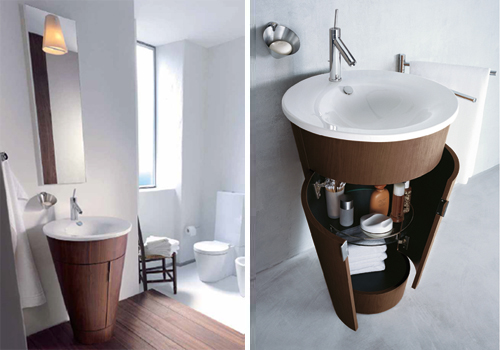 |
Architect Philippe Starck has successfully created timeless, simple, functional design solutions using furniture in bathroom spaces.
Photos courtesy of Duravit USA, Inc. |
Focusing on the right character or nature of the design is also being recognized as critical to the end user as well as to the relationship of the bathroom with the rest of the building. It is equally important as it relates to building context. An urban building for example will likely have different bathroom spaces than a more rural or resort location, meaning that the size, connection to the outdoors, and therefore, the overall character may be different. For German designer Michael Sieger, a welcoming feel is a crucial aspect to the character of any well-designed bathroom. He believes it follows that the bathroom will become the focal point of the larger private living area and will be opened to embrace sleeping, fitness and wellness: “A bathroom is a dream bathroom if it adopts this principle of opening up and elevates bathroom living to a new level of family relaxation and communication.” This is why the design of a dream bathroom should be oriented around creating a welcoming atmosphere. He also believes that furniture plays a key role in “the bathroom's new living-room quality”: “High-quality wooden surfaces, such as Mahogany, Bleached Oak or Rosewood, give the bathroom a lively warmth and personality. The natural warmth of wood stands in contrast to the white ceramic and acrylic surfaces of the washbasins, WCs, bidets and bathtubs and introduces a sense of the living room into the bathroom.” However, according to Sieger, it is not just washbasins that should feature a furniture surround but even tubs and shower trays can be elevated to furniture status: “This gives the bathroom just the right 'living character' to become a dream bathroom.”
 |
There is a growing trend to integrate the bathroom area with the spaces around it to create a complete personal spa and wellness are.
Photo courtesy of Duravit USA, Inc. |
Martin Bergmann from the Vienna-based design trio EOOS applied this living character concept to a soaking tub that could be covered with a useful but elegant upholstered covering when not otherwise being used. “We wanted to give the tub an additional new function so that people could use it in a greater variety of ways” He has helped to develop a fold-out upholstered relaxation deck that covers over a tub and can be used as a piece of furniture for sitting or lounging on. In doing so, he succeeded in creating a vital element that was still missing from a bathroom. “For example, you can quickly make the dirty mountain-biking outfit disappear inside the tub or you can relax on top after taking a bath.” The bathing area thus becomes an ensemble with a wide variety of different uses and the tub “isn't immediately recognizable”. He goes on to point out that “A well-designed bathroom creates new possibilities for everyday use. The individual lives with the bath—even after the ritual bathing experience. At the same time, these functions can also be deliberately linked with the rituals of lying down and relaxing. It's not the designer but the user who decides about the symbolic quality of the bath.”
 |
A soaking or system tub that can be covered and used for other living purposes allows more integration of spaces.
Photo courtesy of Duravit USA, Inc. |
As part of the emerging trends in bathroom design, light and color are, as always, dramatically critical. “Light and color are an important element of our quality of life and influence our sense of wellbeing to a high degree” according to Andreas Struppler, a prominent architect and designer from Munich, Germany. This is why he sees light as being the key factor in the dreamlike quality of a bathroom: “In the bathroom, where the day begins and ends, the right light ensures a good start to both the day and the night.” According to the experts, the lighting concept should be designed so that, on a purely functional level first, it provides sufficient support for difficult visual tasks and, at the same time, facilitates orientation for older people and children at night. “Secondly, it has to be able to appeal to the emotions and generate feelings and atmosphere,” says Struppler. The latter, referred to by the designer as “emotional lighting,” is important for ensuring that the day draws gently to a close: “When the lights shine onto the surrounding ceilings and walls and bathe them in a soothing blue, stimulating red, uplifting green or a program with all colors in alternation, the reviving effect of a relaxing bath is stepped up a notch.” For him, the bathroom only excels when light and color interact successfully to create a profusion of color, when every shade creates a different atmosphere.
 |
Lighting can be used to create different moods and enhance the experience of personal space.
Photo courtesy of Duravit USA, Inc. |
Using Warm Wood Finishes In Bathroom Furniture
Creating a bathroom environment that is both an inviting retreat and a functional, open living area, takes more than just laying out fixtures. Certain choices in material and finishes can be used to ensure a sense of warmth and comfort. Natural wood, for example, provides a very desirable material with which to create a unique space with spa-like qualities. Diverse in its attributes, wood is adaptable, elegant, welcoming—even luxurious. The result: furniture in choice wood tones transforms the bathroom from a sterile and cold area of the past into a space that exudes natural warmth.
Finished properly, wood also boasts extremely hygienic and easy-care properties. Many people still believe incorrectly that wood and the bathroom are mutually exclusive. However, in this respect, bathroom furniture cannot be compared with home furniture. Bathroom furniture is manufactured specifically for wet areas and is resistant to both water and increased humidity.
When common bathroom fixtures such as washbasins, bathtubs and shower trays are fitted with wood paneling, drawers, or shelves, then they become items of furniture in their own right. These water focused elements can also be complemented by dry storage areas such as wall cabinets with valuable space for keeping supplies, accessories, or other needs. Equally practical and space enhancing are wall-mounted shelves and bathroom-specific mobile storage units. Providing the same wood surfaces across all of these items creates an integral design appearance that brings together all of the different aspects of the bathroom, making it a space that is as well-designed as the living area.
 |
Furniture grade wall mounted bathroom storage units and mobile units on casters provide flexibility and an abundance of storage.
Photos courtesy of Duravit USA, Inc. |
Of course, not all wood surfaces are the same. To create the ultimate personalized retreat, designers can usually pick from a variety of wood veneer options such as Bleached Oak, American Cherrywood, Rosewood, Ebony, or dark Oak. It is also common to find a variety of décor finishes available, ranging from lighter hues, patterns and colors, to darker ones. Thanks to this wide spectrum of options, bathroom furniture not only reflects different lifestyles, it also gives definition to the bathroom. Whether light or dark, uniform or with a pronounced grain, the user will experience the natural color of the wood throughout the lifetime of the bathroom.
Bathroom Furniture Material Science
Using wood products successfully for bathroom furniture starts with a basic understanding of the science behind the materials used. Depending on the product and its needs, there are three primary wood based materials that are commonly used as the base for creating flat panels that are later fabricated into finished products. Not surprisingly, these basic materials used for bathroom furniture are the same as those used for other types of furniture – the difference is in the treatment and attention to details. Each of these three panel materials relies on technology and engineering to provide their inherent strength and resistance to warping or shrinking.
1. Plywood is a common manufactured wood panel made from thin sheets of wood veneer that are glued together, typically with adjacent layers (plies) placed with their grain at right angles to each other. It is flexible and workable but can be more expensive for furniture making than some of the other wood panel options available. Compared to using solid pieces of wood, however, plywood is preferred because of its resistance to cracking, shrinkage, splitting, and twisting or warping and exhibits a generally high degree of strength. It is also possible to form plywood under pressure into curved forms that retain the intrinsic strength of the material, making it a particularly good choice for those applications. For flat panels that will be covered over or laminated, there are other less expensive and better performing choices.
 |
Plywood can be molded and shaped for use in bathroom furniture that calls for such curvilinear shapes.
Photo courtesy of Duravit USA, Inc. |
2. Particle board, sometimes also referred to as chip board, is an engineered manufactured wood product that is made from a combination of small wood chips and resin. It can actually be quite environmentally friendly when the wood is recycled and the resin is selected according to environmentally safe standards. It is less expensive than many other options so it is a popular choice for a base material in furniture. Its structural strength will vary depending on the density of the material but it does generally perform very well for furniture panels and shelving. It also provides a very good and stable base for laminated overlays that will provide a finished look and protect it from moisture. Particleboard does have some advantages over other materials when it comes to constructing a cabinet box and shelves. For example, plywood has the potential to feather off in sheaves when extreme weight is placed on door hinges that are screwed into it. By contrast, particle board has been shown to hold screws in place better under similar weight conditions. Additionally, particle board is favored for cabinet shelves since it will not typically bow under the weight like plywood may.
3. Medium-density fiberboard (MDF), is also an engineered wood product formed by breaking down hardwood or softwood into their basic wood fibers. These fibers are then combined with a wax and resin binder and formed into panels by applying high temperature and pressure. The end result is a very smooth surface suitable for painting or for laminating over. The density of the fibers can vary, hence the designations of Low, Medium, or High Density Fiberboard. The commonly used Medium Density Fiberboard is typically denser than plywood and usually stronger and denser than average particle board making it well suited to many furniture and cabinetry applications.
 |
Medium Density Fiberboard (MDF) is an economical and functional choice as a panel material in many types of furniture.
Photo courtesy of Duravit USA, Inc. |
Paramount to the successful functioning and durability of bathroom furniture is the use of a protective layer on top of the selected base material. One of the most common ways to do that is to provide a laminated covering that is in reality multiple layers of very thin material that give the laminate its strength and water resistant properties. As with most laminated products, there is a wide choice of appearance possibilities that fundamentally fall into two categories. First real wood veneer is an option where a thin slice of real wood is laminated between an outer protective layer of clear melamine and an inner set of layers of kraft paper that is impregnated with resin. This whole assembly is laminated onto particle board or another base material to provide the look and coloring of the selected wood veneer. The second option is for a décor finish that provides a pattern, color, or simulated grain of real wood. This look is printed onto heavy decor paper that is also laminated between an outer clear protective layer and inner layers of kraft paper impregnated with resin.
An alternative to using a laminate finish is to use a high quality lacquer paint finish that can seal and protect the base material. This treatment allows for very solid and dense colors whether in traditional white or black or in selected colors that may be offered by manufacturers. The characteristics of the lacquer paint finish usually mean a high gloss surface is achieved that is consistent with the design intents of certain bathroom spaces.
Combining Ceramic Or Enameled Steel Fixtures With Bathroom Furniture
Using ceramic or enameled steel sinks and other fixtures adjacent to wood finishes provides a combined look that is quite appealing in many situations. Wood finished vanity units, for example, that are designed to accept wash basins can create very balanced and appealing wood/basin combinations that form a harmonious whole. The washbasin might be designed to sit on top of the furniture unit and serve as a washbowl as has been commonly used for some time. In that case the top of the vanity may be exposed to splashing water and will need to be finished accordingly. That can mean using a properly laminated surface or a lacquer painted surface as long as either one is appropriately water resistant and protective.
 |
Wash basins can be designed to sit on top of a vanity furniture piece or be mounted beneath in an under-mount design.
Photos courtesy of Duravit USA, Inc. |
The alternative is to use an under-mount wash basin that is secured to the underside of the vanity top. In that case, the details of securing the undermount sink in place become critically important. The common details for doing this require that a finish surface passes over the top of the washbasin. That often means that the laminate itself passes over the basin unit while the base material is routed out to accept the basin and expose the underside of the laminate. The basin is then adhered in place and sealed all around the perimeter. The edge of the laminate is trimmed and the result is a very clean appearance without a surface gap or edge on the top of the vanity. This approach necessarily precludes the use of a lacquered top since there would be no surface to cover over the edge of the basin. It may also preclude certain wood and laminates from different manufacturers. When considering this type of solution, however, it is worth noting that it may be possible to select a vanity unit with the basin pre-installed under factory conditions rather than relying on combining differing trades in the field.
Beyond wash basins and vanities, wood paneling can be combined with other fixtures as well. An example might be the side of a bathtub that is receiving a panel to transform it from a purely fixture appearance into a full part of the furniture appearance of the bathroom. In this case a compressed laminate might not act as an overlay to a base material, but cover directly over the fixture itself. Therefore, only a very thin layer of material is needed to cover over a self supporting section of a free standing whirlpool tub or spa unit. This is a particularly attractive idea that eases field installation since the tub doesn't then have to be enclosed and tiled to finish it. Further, such wood-paneled bathtubs have the ability to create an inviting atmosphere in the bathroom.
Using Glass And Mirrors
Finally, for those designs that call for lighter appearances, particularly in smaller bathrooms, the use of glass or mirror panels set in chrome or other lighter finishes may be more appropriate. The addition of a shower, for example may be desired in a powder room to make it a fully-functional that, if necessary, can also be used as a second bathroom for overnight guests. A shower enclosure takes up a lot of valuable space in the bathroom, however, but the EOOS design group questioned if it really had to. They developed a design for an innovative folding shower enclosure built from a brilliant chrome frame with glass and mirror panels. Two large self-locking glass door panels are fitted in the frame, using clear or translucent glass or with an optional mirror on one side. After showering, these doors can simply be folded or swung back against the wall. This avoids the shower stall from protruding into the room, the faucet hardware and shower head are covered and the bathroom appears much larger, particularly when mirrored glass is used. Hence, with ingenious planning and the right product and material choices it is undoubtedly possible to transform a relatively few square feet into a truly amazing bathroom. The treatment and mounting of the glass obviously become important in the design and fabrication of the furniture. However, since safety is paramount the norm is to use tempered glass that shatters into blunt pieces rather than sharp splinters in all bathroom furniture wherever glass or mirrors are called for.
 |
A shower stall that uses fold out glass panels can provide an elegant space saving solution in tight spaces.
Photo courtesy of Duravit USA, Inc. |
Bathroom Furniture Production
A complete understanding of how to design with and specify bathroom furniture requires and understanding of how the furniture is made or produced. The first thing to take into account is that the manufacturing process typcially includes the use of fully mechanized computer controlled equipment to conduct steps that require precision and repetition. But equally important, is the fact that a great deal of the process of producing every piece is done by hand with a strong focus on craftsmanship. A manufacturer that offers a wide range of choices is actually best able to serve the market by using many hand production techniques. Further, since bathroom furniture is subjected to more wear and tear from a damp surrounding environment compared to elsewhere, every millimeter counts. Accordingly, successful bathroom furniture is necessarily characterized by high precision and careful craftsmanship. For example, a properly defined and executed miter joint significantly increases the stability of the furniture so using precision machinery and skilled craftsmen to produce it become paramount to its long term durability. Quality control and inspections all along the way help insure that the end product is produced as intended, but most manufacturers will follow a similar process to the one outlined below to try to assure quality in the first place.
Panel Preparation
A typical manufacturing facility will receive and store basic furniture materials such as uncut particle board, MDF or plywod panels, in an appropriate storage area. If the panels are already laminated, then they are stored by color, pattern, or other defining characteristics. Once a bathroom furniture order is received with the selection and specification details defined, the needed panels are identified and often tagged with a bar code. The selected panels are then moved and processed by computer controlled machinery passing from storage on rollers that keep them flat and align them for latitudinal and longitudinal panel cutting. This results in the pieces being cut to precise uniform sizes that will fit together to create tops, sides, or other parts of the selected furniture.
Since the edges of these panels are critically important to the long term performance of the furniture, the newly cut panels are next processed to receive edge trims that are shock resistant and long lasting, all in a color and profile consistent with the furniture style. If real wood veneer is being used, then the trim will likely be real wood as well. If a decor veneer is being used, then the trim could be acrylic or ABS platic in an appropriate color or pattern. In either case, the panel edges are trimmed by machine and prepared as appropriate to receive the trim material. The selected trim comes from a roll and is fed alongside the prepared edge of the panel. Then, with heat and oxygen the adhesive gets liquefied forming a full surface connection between the wooden panel and the trim. Once the adhesive is dry, then the panel edges are sealed completely around their perimeter.
Other machining actions take place as needed to completely prepare the panel for assembly. These include cutting, milling, and drilling the panels to accomodate various furniture and hardware needs. For example, slots could be milled for fixing hardware or handles. Openings could be cut out of a vanity top panel to receive a washbasin. Corners could be precision mitered or holes could be drilled where needed for specific attachment and assembly requirements.
After the machining processes are completed, the prepared panels are now components of furniture such as body, fronts and cover panels. However, before moving further, they are typically inspected and treated by hand. These hand processes might include finishing work such as smoothing or grinding edges, removing any residual glue, size checking, repair or plugging as needed, etc. Once everything is deemed to be finished properly, then they can get moved to an intermediate storage area to wait for assembly. Now the production flow gets separated. Depending on the product, it will either get assembled along a line production process or a cell process.
 |
Although many tasks are mechanized in bathroom furniture production, the majority of the finishing and detail work requires attention by hand from craftsmen.
Photo courtesy of Duravit USA, Inc. |
Line Production
Line Production is appropriate for products that require a series of specialized tasks in distinct working steps. For the most part, it is an uncomplicated process where products move from point to point allowing the piece of furniture to get finished step by step, usually by craftsmen using hand or power tools. At each work station, a different process takes place along a “conveyor belt” system such as adding in and securing hardware, assembling a drawer, or connecting other parts together. If additional pieces are needed at any given point, then it is likely that they come from the intermediate storage area by automated transfer.
Once all of the parts (body pieces) are assembled, then they may be glued and bonded together in a press to become a nearly finished piece of furniture. At that point, the final finshing and fine-tuning is done traditionally by hand. After a thorough cleaning, all drawers, compartments and doors are checked and properly aligned. Fittings are mounted along with any remaining handles, feet or casters. Shelves may not be fully installed but rather secured for transport. Any included electrical work such as integral light fixtures are are wired and secured.
Cell Production
Cell production takes its name from the concept of assembling a product in one specific production area or “cell” of the production facility. It is appropriate for specialized products that require a series of specific tasks by a limited number of craftsmen. In this process the furniture piece gets assembled and finished all in one working place, usually all by hand. Typically it is used for special furniture models or for complex pieces, which cannot be produced within line production techniques.
As an example of cell production, consider a barrel style vanity sink designed by Phillippe Starck. It is made out of plywood requiring that about nine wooden pieces get glued together crosswise and get bent under high pressure. Once that process is completed, doors get cut out of the curved plywood parts and get numbered to identify which barrel they came from before being trimmed and fitted. Then all wooden pieces including milled shelves, the back wall and the front parts get finished in the same work area. Finally, hinges, glass shelves, handles and adjustable feet get fixed in place and the doors gets mounted and adjusted. The finished barrel sink gets some final quality control checks and is prepared for delivery.
Other examples of cell production might include a mirror cabinet production area or a paint shop within a manufacturing facility. Parts that require painting with particular attention to detail can come to this cell area of the facility and be painted, inspected and sent to the appropriate production locationa as appropriate. In this way, the quality of the paint can be controlled and effects such as a high gloss look can be achieved uniformly.
Laminated bathtub panels can also can get produced in a cell area. Once the laminated pieces are cut and finished, then mounting pieces, magnetic plates, feet and any other accessories can be fixed in place. Typically these pieces are glued or fixed in place with appropriate tapes. Before they are completed, these panels will be allowed to dry, any edges will go through grinding and smoothing, a quality control check, and packaging.
Picking, Packing, and Shipping
From beginning to end, it is common for bathroom furniture to require about 3 weeks of production work. Once finished, it will be stored in temporary staging area or warehouse depending on the manufacturer. Most will conduct a final quality control check for function and completeness before picking an order out for packaging and delivery. Only if it passes the quality control check, however is it permitted to leave the factory. Some manufactuers will do this final quality control check at the end of production and deliver the finished products immediately rather than hold pieces in a warehouse. That may improve delivery time, but it is always best to check with the manufacturer first.
Specifying Bathroom Furniture
With an understanding of the design opportunities, material basics, and production processes, writing a specification for bathroom furniture becomes a matter of making some fundamental decisions and coordinating some specific choices with the overall design.
Quality Assurance
Performance criteria and testing standards are promoted by the Kitchen Cabinet Manufacturers Association (KCMA) which is a voluntary, non-profit trade association representing North American cabinet manufacturers and suppliers to the industry. KCMA is an influential advocate for the industry and since 1955 has administered the nationally-recognized performance standard for cabinets known as ANSI/KCMA A161.1. All quality bathroom furniture should have no problem complying with this recognized standard.
Products
When it comes to specifying products, it is appropriate to specify choices and criteria for the furniture materials used in specific furniture/fixture pieces. Obviously, this needs to be coordinated with any other bathroom fixture selections to be sure that all items are coordinated and work together. In that regard, it may be prudent to specify that all items need to be supplied from the same manufacturer. The material selections would then logically be identified to match all pieces that are part of a particular bathroom design such as bathtubs, sink counters, fixed or mobile storage units, spa tubs, etc. If mirrored cabinetry is used, that should also be clearly specified and the mirror locations identified.
Regarding finishes, those also need to be identified. If lacquered painted surfaces are to be used, the color and paint characteristics should be called out. If wood veneer laminated products are used, then the specific wood species and color needs to be identified and selected. Where décor style is used the color or pattern of the laminate similarly must be identified and selected.
 |
Bathroom furniture can be specified in a range of real wood, décor, or lacquer paint finishes.
Image courtesy of Duravit USA, Inc. |
Installation
Installation of bathroom furniture is consistent with installing bathroom cabinetry and other fixed in place furniture. Of course, it is always advisable to consult manufacturer's installation instructions and recommendations for assurance that particular products are installed correctly, securely, and in a way that will not compromise performance over time.
Proper cleaning and care is of course important, not only for the installing contractor but for the end user. It's appropriate to wipe the furniture with a damp microfiber cloth and to regularly ventilate the bathroom. And to ensure that wood in the bathroom retains its look for a long time, direct, prolonged contact with water should, of course, be avoided.
Conclusion
The choice of using furniture grade fixtures with a wood finish not only enhances the bathroom experience consistent with current trends, it helps the bathroom become better integrated with the rest of the building spaces around it. Understanding the basic materials and production processes allows for specifications to be written that take advantage of the best quality and latest available offerings. In the end, the overall design and performance characteristics of the finished bathroom can allow for a timeless solution that can be functional and enjoyable for the users for many years to come.
Peter J. Arsenault, FAIA, NCARB, LEED-AP practices, consults, and writes about sustainability, design and practice issues nationwide. www.linkedin.com/in/pjaarch
 |
Founded in 1817 in the heart of the Black Forest, Duravit is a leading manufacturer of ceramic sanitaryware, bathroom furniture, whirlpool tubs and wellness products. Duravit’s collaborations with internationally renowned designers such as Philippe Starck, Norman Foster and sieger design yield forward-thinking, environmentally-conscious and award-winning products that bring the bathroom to life. For more information please contact Duravit USA, Inc.: 888-DURAVIT or pro.duravit.us.
|