Use Cementitious Wood Fiber for Great Acoustical Design
Sustainable panels and roof decks help spaces sound better
Sponsored by Armstrong World Industries | By Jeanette Fitzgerald Pitts
This CE Center article is no longer eligible for receiving credits.
The acoustical design of a space dramatically impacts the audience experience at any performance, presentation, or athletic event. Great acoustics set the stage to give audience members and performers goose bumps, literally, and help to ensure that a space can function as it is intended. In large classrooms, good acoustics make it possible to hear the lecture from any seat, while mitigating chatter from the back rows. Audiences can experience the power of the voices in a church choir, without echo, or the crispness of an instrumental solo, without distortion. With good acoustics, a space can even accommodate very different uses, very well. Imagine a cafetorium (a space in an elementary school that splits time as a cafeteria and auditorium) that is able to both manage the lunchtime roar and project those tiny voices out into the Holiday Concert crowd.
The acoustical design of a project, whether planned or haphazard, rarely has a neutral or negligible impact on the functionality of the space. While great acoustical design can create exceptional aural experiences or more flexible multi-use spaces, poor acoustical design can be quite detrimental. Poorly planned sound management can be distracting and even uncomfortable for audiences.
All images courtesy of Armstrong Ceiling and Wall Solutions
CWF clouds panels are a popular application when repurposing existing building stock, as shown here at the Salo Breakroom in Minneapolis.
Achieving Great Acoustics
It may be prudent to first discuss a few properties of sound itself. Sound is defined as a vibration of a medium (like a guitar string or a vocal cord) which creates a wave that travels through gas, liquid, and elastic solid. The number ofwaves that occur per second is referred to as the frequency. Frequency is measured in terms of hertz (Hz). One Hz is equal to one wave cycle per second. The volume of the sound, which we would describe as loud or soft, is measured in decibels (dB), a logarithmic way of describing the ratio of sound pressure. Every increase of 10dB is equivalent to a 10-fold increase in sound intensity (which is roughly equivalent to doubling the loudness).
At Sun-N-Fun Lifestyle Wellness Center in Sarasota, Florida, a cementitious wood fiber deck includes acoustic dampening and effective insulation in an easy-to-install composite panel.
In discussing the strategies and tools for optimizing the acoustical experience and minimizing distracting and uncomfortable sounds in a space, this article will be concerned with the sound frequencies that are within range of being heard by the human ear and are sufficiently loud enough to be heard. The audio range of hearing for a healthy, young person is 20 to 20,000 Hz. As a reference for applicable decibel levels, a human whisper is approximately 20dB, normal speech falls around 60 dB, and painful damage to the ear can occur at 140 dB.
Managing Sound Movement: Reflect, Transmit or Absorb
Sound moves through a building in a variety of ways. It can be reflected, bouncing around in a particular area. It can transmit through walls, floors or ceilings. It can bend and flow around an object or squeeze through a small space. Most commonly, sound is transmitted through air. An intentional plan for the acoustic performance of any space is an important element of good architectural practice.
When sound waves collide or overlap in a common space, the interference can cause distortion. Too much distortion can lead to the common complaints of being unable to "talk" to companions at dinner or understand the announcer at the game. Turning up the volume on the sound system only exacerbates the problem. To protect against distortion as the sound moves from the source out across the audience, it is important to keep objects and obstructions out of the sound path and ensure that the sound system has good pattern coverage over the space. This will prevent feedback and many other sound distortions.
At some point, a sound wave in a building will collide with a wall, ceiling, floor or other object. When a sound wave hits a material, three things can happen: the sound can be reflected, transmitted, or absorbed. When it comes to sound management, the magic is in the material.
Consider sound reflection. Hard, smooth walls simply bounce the sound back into the central space, almost assuring that sound waves will interfere with one another and muddy sound clarity. The term sound reverberation refers to instances when the reflected sound is perceptible even after the source of the sound has ceased. Careful planning for the acoustics of a space include a balance of reflective surfaces and sound-absorbing surfaces.
Sound transmits through elastic material, although sound travels differently through different materials. For example, sound waves travel at a rate of 1,128 feet per second through air (at 70 degrees F), 11,700 feet per second through wood, and 18,000 feet per second through steel. Sound can travel through thin walls, water and more. To try to control the transmission of sound through a space, architects can specify inelastic materials, such as lead, which is, incidentally, considered a hazardous material, or they can increase the mass of the object through which sound is transmitting. A wall of solid concrete three feet thick will reduce the volume of a sound by 60dB, because it forces the sound waves to work harder and expend more energy to pass through the thick concrete wall. Unfortunately, budgets, space limitations, and design practicality may prohibit concrete encased classrooms or gymnasiums.
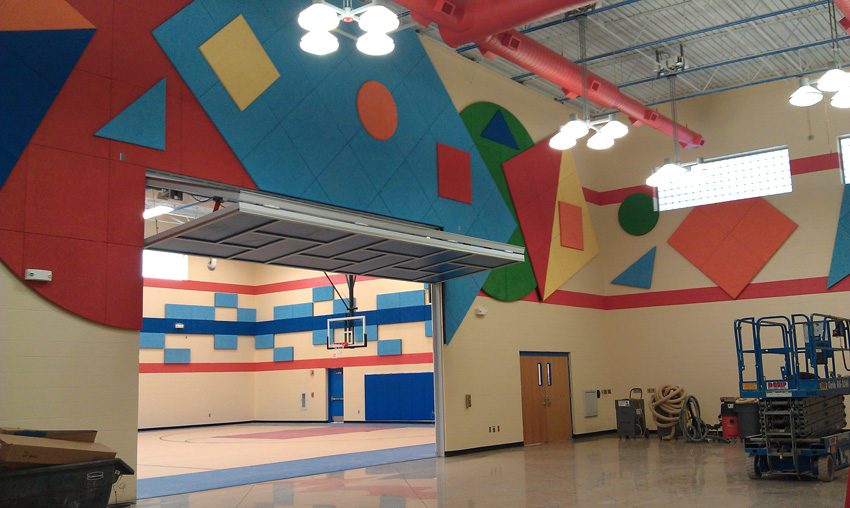
Lincoln Elementary School in Augusta, Kansas, uses porous materials on the walls to effectively absorb sound.
Another way to control airborne sound in a space is to use porous materials that absorb sound on the walls and ceiling of a building. The sound waves get trapped within the fibers of the material, where the sound energy is converted into small amounts of heat. Today, there are many acoustical absorption solutions that are practical, effective, and aesthetically pleasing.
When selecting the right acoustical treatment for a space, the material matters. Different materials absorb different sound frequencies, so it is important to ensure that the specified acoustical product absorbs the actual sound frequencies that will be present in the space. Materials also vary in the physical amount of sound energy that they can absorb, overall durability, fire resistance, environmental footprint and aesthetic appeal.
The acoustical design of a space dramatically impacts the audience experience at any performance, presentation, or athletic event. Great acoustics set the stage to give audience members and performers goose bumps, literally, and help to ensure that a space can function as it is intended. In large classrooms, good acoustics make it possible to hear the lecture from any seat, while mitigating chatter from the back rows. Audiences can experience the power of the voices in a church choir, without echo, or the crispness of an instrumental solo, without distortion. With good acoustics, a space can even accommodate very different uses, very well. Imagine a cafetorium (a space in an elementary school that splits time as a cafeteria and auditorium) that is able to both manage the lunchtime roar and project those tiny voices out into the Holiday Concert crowd.
The acoustical design of a project, whether planned or haphazard, rarely has a neutral or negligible impact on the functionality of the space. While great acoustical design can create exceptional aural experiences or more flexible multi-use spaces, poor acoustical design can be quite detrimental. Poorly planned sound management can be distracting and even uncomfortable for audiences.
All images courtesy of Armstrong Ceiling and Wall Solutions
CWF clouds panels are a popular application when repurposing existing building stock, as shown here at the Salo Breakroom in Minneapolis.
Achieving Great Acoustics
It may be prudent to first discuss a few properties of sound itself. Sound is defined as a vibration of a medium (like a guitar string or a vocal cord) which creates a wave that travels through gas, liquid, and elastic solid. The number ofwaves that occur per second is referred to as the frequency. Frequency is measured in terms of hertz (Hz). One Hz is equal to one wave cycle per second. The volume of the sound, which we would describe as loud or soft, is measured in decibels (dB), a logarithmic way of describing the ratio of sound pressure. Every increase of 10dB is equivalent to a 10-fold increase in sound intensity (which is roughly equivalent to doubling the loudness).
At Sun-N-Fun Lifestyle Wellness Center in Sarasota, Florida, a cementitious wood fiber deck includes acoustic dampening and effective insulation in an easy-to-install composite panel.
In discussing the strategies and tools for optimizing the acoustical experience and minimizing distracting and uncomfortable sounds in a space, this article will be concerned with the sound frequencies that are within range of being heard by the human ear and are sufficiently loud enough to be heard. The audio range of hearing for a healthy, young person is 20 to 20,000 Hz. As a reference for applicable decibel levels, a human whisper is approximately 20dB, normal speech falls around 60 dB, and painful damage to the ear can occur at 140 dB.
Managing Sound Movement: Reflect, Transmit or Absorb
Sound moves through a building in a variety of ways. It can be reflected, bouncing around in a particular area. It can transmit through walls, floors or ceilings. It can bend and flow around an object or squeeze through a small space. Most commonly, sound is transmitted through air. An intentional plan for the acoustic performance of any space is an important element of good architectural practice.
When sound waves collide or overlap in a common space, the interference can cause distortion. Too much distortion can lead to the common complaints of being unable to "talk" to companions at dinner or understand the announcer at the game. Turning up the volume on the sound system only exacerbates the problem. To protect against distortion as the sound moves from the source out across the audience, it is important to keep objects and obstructions out of the sound path and ensure that the sound system has good pattern coverage over the space. This will prevent feedback and many other sound distortions.
At some point, a sound wave in a building will collide with a wall, ceiling, floor or other object. When a sound wave hits a material, three things can happen: the sound can be reflected, transmitted, or absorbed. When it comes to sound management, the magic is in the material.
Consider sound reflection. Hard, smooth walls simply bounce the sound back into the central space, almost assuring that sound waves will interfere with one another and muddy sound clarity. The term sound reverberation refers to instances when the reflected sound is perceptible even after the source of the sound has ceased. Careful planning for the acoustics of a space include a balance of reflective surfaces and sound-absorbing surfaces.
Sound transmits through elastic material, although sound travels differently through different materials. For example, sound waves travel at a rate of 1,128 feet per second through air (at 70 degrees F), 11,700 feet per second through wood, and 18,000 feet per second through steel. Sound can travel through thin walls, water and more. To try to control the transmission of sound through a space, architects can specify inelastic materials, such as lead, which is, incidentally, considered a hazardous material, or they can increase the mass of the object through which sound is transmitting. A wall of solid concrete three feet thick will reduce the volume of a sound by 60dB, because it forces the sound waves to work harder and expend more energy to pass through the thick concrete wall. Unfortunately, budgets, space limitations, and design practicality may prohibit concrete encased classrooms or gymnasiums.
Lincoln Elementary School in Augusta, Kansas, uses porous materials on the walls to effectively absorb sound.
Another way to control airborne sound in a space is to use porous materials that absorb sound on the walls and ceiling of a building. The sound waves get trapped within the fibers of the material, where the sound energy is converted into small amounts of heat. Today, there are many acoustical absorption solutions that are practical, effective, and aesthetically pleasing.
When selecting the right acoustical treatment for a space, the material matters. Different materials absorb different sound frequencies, so it is important to ensure that the specified acoustical product absorbs the actual sound frequencies that will be present in the space. Materials also vary in the physical amount of sound energy that they can absorb, overall durability, fire resistance, environmental footprint and aesthetic appeal.
Introducing Cementitious Wood Fiber (CWF)
A powerful material for any architect's acoustical control arsenal is cementitious wood fiber (CWF). CWF is a cement-wood composite comprised of wood fibers, also referred to as excelsior, which are coated with an inorganic hydraulic cement binder and infused with several dissolved mineral compounds, including sodium silicate. The composite is formed with heat and pressure.
The resulting CWF material is often used in LEED-certified projects and other green buildings. The environmental credentials of CWF will be addressed in greater detail later in this article. But there are many other characteristics of CWF that make it an appealing building material. It is incredibly durable. During the manufacturing process, the cement and sodium silicate bond to the wood fibers and harden, giving the CWF products an impressive strength and durability.
There is much more to this material than its durable, sustainable nature. When the water in the mineral solution evaporates, the sodium silicate leaves behind an internal glass matrix in the structure that acts like the resin in fiberglass, fortifying the structure. Mold can't grow on it, bugs can't eat it and it is decay and fire resistant. But perhaps the most noteworthy characteristic of CWF is the exceptional acoustical properties of the material.
Acoustical Properties of CWF
CWF is an excellent sound absorber. This porous material is capable of absorbing low, midrange, and high frequencies using a single panel or product. This broad versatility is unique and it equips CWF to best accommodate a wide range of activities that may take place in multi-purpose areas, as well as providing a more comprehensive sound-absorbing solution for auditoriums, public spaces, and performance arenas.
The audible frequency range that is perceptible to the human ear spans from 20Hz to 20,000Hz. This significant spectrum can be effectively broken down into seven different categories or frequency bands. They are as follows: sub-bass (20-60Hz), bass (60-250Hz), low midrange (250-500Hz), midrange (500-2,000Hz), upper midrange (2,000-4,000Hz), presence (4,000-6,000Hz) and brilliance (6,000-20,000Hz).
These frequency categories are important to identify when discussing sound absorption, because the way that a material absorbs sound is dependent upon the frequency of the sound. This means that although two materials may look identical, one may be designed to absorb high frequencies exclusively, while the other is better suited to absorb low or midrange frequencies.
Luckily, there are metrics that measure how a material performs at different frequencies on the spectrum. The ability of a material to absorb sound at a specific frequency is quantified in a metric called the Sound Absorption Coefficient. The Sound Absorption Coefficient details the percentage of the sound energy that a material absorbs at a specific frequency. Oftentimes, a table of Sound Absorption Coefficients will detail how a specific product performs at 125Hz, 250Hz, 500Hz, 1,000Hz, 2,000Hz and 4,000Hz. The actual coefficient is the percentage of the sound that is absorbed at that specific frequency. The portion of the sound waves that are not absorbed are reflected back into the space. For example, a Sound Absorption Coefficient of 0.6 at 500Hz indicates that the material absorbs 60 percent of the sound waves at 500Hz and reflects the other 40 percent.
There is also a metric that describes how a material absorbs sound in general. The Noise Reduction Coefficient (NRC) represents the average of the sound absorption coefficients of a material at frequencies between 250Hz and 2,000Hz. NRC values range from 0.00 to 1.00. An acoustical material that absorbs 100 percent of the sound it contacts has an NRC value of 1.00.
Here are some examples of NRC values of typical building materials. Unpainted brick has an NRC value of 0.04, meaning it absorbs 4 percent of the sound waves between the frequency of 250 Hz and 2,000Hz and reflects 96 percent of those sound waves back into the space. Plywood paneling 3/8-inch thick absorbs 14 percent of the sound that reaches it with an NRC value of 0.14. Heavy carpet on concrete has a much higher NRC value of 0.30. CWF products can produce NRC values near or equal to 1.00, absorbing 100 percent of the sound waves between 250Hz and 2,000Hz with which it comes in contact.
These CWF products are available in 1-inch, 11/2-inch, and 2-inch thick panels. The thickness of the product affects its ability to absorb different frequencies. Typically, as the thickness increases so does the ability to absorb low frequency sounds. For example, at the bass frequency band of 250Hz, a 11/2 inch thick panel has an NRC value of .84 and a 2 inch panel has a higher NRC value of .89.
CWF Acoustical Product Solutions
When specifying the materials to manage the acoustical performance of a project, sound-absorbing products made from CWF are available in acoustical wall and ceiling panels, acoustical clouds and baffles, and structural acoustical roof deck solutions.
CWF panels can be shaped and painted in a variety of colors to create aesthetic, acoustical treatments and custom installations.
Sound-absorbing products made from CWF are available in acoustical wall panels, acoustical ceiling panels, and acoustical roof decks.
The acoustical properties of CWF panels at Northside Christian in New Albany, Indiana, make it an unmatched solution for performance spaces.
Acoustical Wall and Ceiling Panels
CWF acoustical wall panels and ceiling panels are literally panels of the sound-absorbing CWF compound. These panels are placed on walls or in the ceiling of gymnasiums, auditoriums, schools, open office spaces, hotel lobbies, multi-use spaces and any public space where improved acoustical performance is necessary. They actively absorb sound waves that are present and convert the sound energy into small amounts of heat, controlling the overall level of noise in a space and diminishing the opportunities for sound distortion from interference and echoes.
These panels are available in a variety of sizes, shapes, and decorative finishes to best match the aesthetic and sound absorption needs of the space. Panels can be used in their natural wood color, painted, or wrapped in fabric.
Ceiling-Mount Options
Ceiling-mounted acoustical panels can be specified as direct-attached, lay-in, or cloud panels. Direct-attach panels offer a unique ceiling aesthetic, without the use or appearance of a ceiling grid, and can be mechanically attached to a variety of ceiling substrates that include: the joists, the underside of the roof deck, drywall suspension systems, metal and wood furring structures and other commonly used support systems. Lay-in ceiling panels are easily installed in standard ceiling grid systems. Cloud panels and baffles offer acoustical design solutions in areas where a ceiling grid is not practical. These cloud panels and baffles are designed to accommodate a floating system with no visible suspension and are rapidly gaining adoption in open plenum systems.
Compare CWF Panels with Other Acoustic Materials
Acoustical wall and ceiling treatments are available in many different types of materials, including fiberglass, foam, and perforated metal, but only the CWF products offer the benefit blend of excellent sound absorption, durability, fire resistance, and aesthetic appeal in a truly sustainable solution.
At Lampasas High School in Lampasas, Texas, color is used as an aesthetic complement to the other benefits of excellent sound absorption, durability, fire resistance, and a textural aesthetic appeal.
Foam
Perhaps the most basic acoustical panel solution is manufactured from acoustical foam. These panels are often non-decorative and regularly found in industrial applications, where aesthetic design is not a concern. In their most basic form, foam panels are not designed to withstand much daily abuse, making it risky to install them in school gymnasiums or any high traffic areas. Acoustical foam panels can also have a more limited functional range. While these products can absorb high and mid-range frequencies, they are not capable of absorbing bass frequencies lower than 500Hz. Before specifying acoustical foam, it will be important to verify the range of frequencies expected to be present in the space.
Fiberglass
Fiberglass is a material commonly used to absorb sound waves in wall and ceiling panel-based solutions. While it provides effective sound management and is able to accommodate a broad range of frequencies with relatively even absorption, the fiberglass material possesses some inherent physical weaknesses that compromise the overall durability of these panels. Made from silicon rock (glass) that has been melted and spun into wool, fiberglass panels are not readily able to withstand much abuse without denting or requiring some type of repair and the material can become brittle over time, making it increasingly fragile.
Perforated Metal
A perforated metal acoustical panel typically consists of a metal or aluminum frame surrounding a perforated metal skin that encapsulates acoustical fiberglass. The sound waves penetrate the perforations in the metal skin and are absorbed by the fiberglass inside. These panels can offer unique aesthetic appeal and the effective noise reduction provided by the fiberglass material in a solution that is more durable than a fiberglass panel with a fiberglass exterior. Perhaps the more glaring shortcoming of a perforated metal panel is its limited ability to contribute toward green building initiatives.
CWF
CWF acoustical panels provide fairly even absorption for a broad range of frequencies on the audio spectrum with NRC values nearing or equal to 1.00, indicating that the panels absorb 100 percent of the sound waves present within the range of 250Hz and 2,000Hz. They are available in a wide variety of designs and finishes. These formed wood-cement-mineral composites are incredibly tough and abuse resistant, easily withstanding the daily wear and tear that may occur in school gymnasiums, auditoriums, or corporate offices. CWF panels are flame resistant and have a Class A/I flame spread rating. These panels possess many sustainable characteristics and are often specified on LEED projects as they can contribute points to the LEED rating system on a variety of criteria.
Structural Acoustical Roof Decks
Roof decking supports the roof elements but does not provide the weatherproofing layer. Before acoustical roof decks were developed, whenever a project space needed to be designed to deliver an impressive acoustical experience, a specifier would select a desirable roof deck and then add the necessary acoustical treatments to the space in the form ofwall or ceiling panels. Now specifiers can eliminate a step in the design and construction processes and help to ensure proper installation by selecting roof decks that arrive on-site as a composite of the acoustical panel and insulation.
At the Lexington Park Library in Lexington Park, Maryland, CWF was used to create beautiful interiors and eliminate a step in the construction process, providing a composite acoustical roof deck that includes an R-value of 44.
There are two types of acoustical roof decks on the market today. One is made from CWF and the other is steel. Roof decks made from CWF provide the same exceptional and even sound absorption that the CWF wall and ceiling panels provide with NRC values reaching up to 1.00. Beyond creating great acoustics in a space, the structural solution is able to offer additional features and benefits that enhance the energy performance of the project and the ease with which the CWF material is installed.
Insulated Solution for Sloped Roofs
There are CWF products designed for either flat or sloped roofs, but the mechanics of installing a flat roof deck and a sloped roof deck are very different. When working with a flat roof, the normal practice is to install the flat roof deck and then roll out the required layer of insulation, stapling or screwing the insulation in place. In sloped roof deck scenarios, laying a separate layer of insulation against a pitch of any grade can be both difficult and dangerous for everyone involved.
Left: CWF structural, acoustic roof deck panels are available for sloped or low-sloped roof lines in spans of up to 12 feet.
Middle: Fabric-wrapped acoustical CWF panels provide additional aesthetic options.
Right: CWF interior products are available in a wide range of colors and surface treatments.
As an alternative solution for sloped applications, CWF roof decks are available in a composite product that includes both the CWF substrate for acoustical management and a layer of insulating foam that provides thermal regulation. With the insulation already attached to the roof deck panel, the need to apply a separate layer of insulation is eliminated. The foam layer can range from 11/2 inches to 8 inches thick depending upon the specific needs and location of the project.
Reduce Moisture Drive
The CWF-insulating foam composite can achieve more than thermal management. Pair the CWF material with a layer of a special foam insulation, extruded polystyrene (XPS), and effectively give the roof deck a water-tight seal that acts as a barrier against moisture drive. Moisture drive refers to the movement of moisture or water vapor from the interior of the building to the outside. This phenomenon is an important design consideration in specific applications such as indoor swimming pools, or ice rinks. Consult the manufacturer to ensure that both design and installation will work together for the long term.
A CWF composite roof deck panel that offers spans of up to 12 feet was used in the Lemberg Children's Center at Brandeis University. CWF panels include a wide range of finishes, shapes, and colors.
Slip-Resistant, Nailable Surface
The CWF roof deck panel can also be equipped with a sheathing of oriented strand board (OSB). The CWF material will face the interior of the space with a layer of foam insulation above it and then a layer of OSB comprising the outermost layer. The OSB sheath provides a slip-resistant surface for installers to walk on during the installation of the roof and, simultaneously, provides a nailable surface making it easy to attach the roofing membrane directly to the CWF roof deck.
Comparing Steel and CWF Roof Decks
There are many similarities between the steel and CWF acoustical roof deck solutions available. Both CWF and steel acoustical roof decks can satisfy the basic requirements for acceptable structural integrity. These roof deck materials can meet specified design load criteria, which outlines the load that a deck must be able to carry per square foot, and diaphragm requirements, which define the amount of force that a roof deck must be able to withstand.
When it comes to acoustical performance, CWF and steel roof decks are distinct. The way each roof deck system manages sound, installation requirements, and the impact that variations in installation can have on the overall performance of these systems are all important considerations for a specifier. CWF roof decks are constructed from sound absorbing CWF material. Depending upon the needs of the application, layers of foam installation and an OSB sheathing may also be present, but the sound is absorbed by the CWF panel. Steel acoustical roof decks rely on special filler that will absorb the sound waves that travel through holes in the steel structure. Variations in the way steel roof decks are installed can effect whether the sound-absorbing filler is included in the roof deck, which dramatically affects the acoustical performance of the roof deck on the project. Without the sound-absorbing filler, the steel roof deck does not perform acoustically as tested. But much more critically, when the sound-absorbing filler is installed as frequently directed, the end result is exposed foam plastics inside the building—a code violation throughout the country. Code requires a 15-minute thermal barrier between the foam plastics and the inside of the building, but installation of this barrier reduces the acoustic efficacy of the installation to an NRC of approximately 0.35.
CWF: The Sustainable Solution
CWF panels are made from renewable wood sources, magnesium from sea water, and recovered magnesium waste. CWF panels contain no toxic binders, no asbestos, or formaldehyde and are naturally degradable in a landfill.
The truly sustainable nature of CWF acoustical products is surprising to some designers because of a commonly held misconception about the material. CWF products were originally developed as a substitute for asbestos-cement. Interest in CWF was sparked by a post-World War II shortage of the asbestos fibers used in asbestos-cement. As knowledge of the health hazards caused by asbestos spread, CWF became an even more attractive alternative. The similar uses and timeframes of development have caused some confusion in the industry, but there is no asbestos in CWF. In replacing a hazardous material, the industry found something that is naturally sustainable and often used in green building.
CWF Contributes Toward LEED Credits
Many aspects of CWF acoustical panels and roof decks contribute toward green building. The premiere resource in the United States for defining green building is the Leadership in Energy and Environmental Design (LEED) green building rating system. CWF acoustic panels and acoustic roof deck products can contribute a number of credits in LEED for New Construction (NC) and LEED for Existing Buildings and LEED Schools rating systems. LEED-appropriate characteristics of CWF include: being made from rapidly renewable resources that are locally mined or harvested, minimizing the packaging and waste present on a construction site, improving the thermal efficiency of a space, and improving the acoustical performance of a classroom, to name a few.
Made from Rapidly Renewable Resources
The wood fibers used in CWF can come from a rapidly renewable resource, such as the Trembling Aspen (Populous Tremuloides). The growth time for the Trembling Aspen is ten to fifteen years for pulping and stranding, which is comparable to the growth time of either bamboo or cork. This particular Aspen tree is also considered to be self-propagating. New planting is not required for reproduction. Instead, when a tree is cut, three new trees will begin to grow back from the original tree's root structure.
White Earth Tribal Community College in Mahnomen, Minnesota, uses a printed CWF panel to create the desired reverence for the natural world. The wood fibers used in CWF come from the Trembling Aspen tree, a rapidly renewable resource.
To determine if the CWF product is made from a rapidly renewable resource, look for products or manufacturers that are affiliated with the Forest Stewardship Council (FSC). This program contains a comprehensive system of objectives and performance measures that integrate the perpetual growing and harvesting of trees with the protection of wildlife, plants, soil and water quality.
Regionally Mined, Harvested and Manufactured
LEED and many other green building programs emphasize the importance of using materials that are regionally mined, harvested and manufactured. All of the raw materials found in CWF are readily found and extracted throughout the mid-western United States. For example, Trembling Aspen trees used for the wood fibers are commonly found in Wisconsin and the magnesium oxide, sodium silicate, and calcium carbonate used in the natural binder are mined in Michigan, Illinois, and Ohio respectively.
Minimal Construction Site Waste
CWF acoustical products are manufactured and shipped in a manner specifically designed to minimize waste at the construction site. These panels or roof decks are shipped without the need for boxing and minimal crating. This minimalist approach to packaging also minimizes the packaging waste at the construction site and the subsequently necessary packaging disposal. In addition, products can arrive cut to 1-foot length increments. This reduces or eliminates the field cuts and waste created at the construction site. CWF products are biodegradable and can be composted, eliminating landfill needs.
Improve Thermal Efficiency
The R-value of a building material or insulation is the measure of how well that material resists heat flow from one side of the material to the other. The higher the R-value, the better the thermal management of the material or, said another way, the better the material is at resisting heat transfer. The composite acoustical roof deck with insulation can provide R-values as high as R-44. This impressive thermal management contributes toward improving the overall energy efficiency of the project and, subsequently, contributes toward earning LEED credits for the overall efficiency of the space.
Improve Acoustical Performance of Classroom
One of the prerequisites for the LEED Schools program is entitled Minimum Acoustical Performance. This credit is concerned with creating classrooms that are quiet enough for teachers and students to communicate effectively with one another. CWF acoustical products are designed specifically to enhance the acoustical performance of any space, including classrooms, and can be applied toward satisfying these design objectives.
These are just a few of the areas where CWF panels and roof decks can contribute toward LEED credits. In total, there are at least thirteen specific LEED credits that CWF acoustical products can help satisfy. They are:
EA Prereq 2—minimum energy performance.
EA credit 1—optimized energy performance.
MR Credit 2—construction site waste management.
MR Credit 4—Recycled Content
MR Credit 5—Regional Materials
MR Credit 6—Rapidly Renewable Resources
MR Credit 7—Certified Wood
EQ Performance 3 (LEED for Schools)—Minimum Acoustical Performance
EQ Credit 3.1 and 3.2—Construction IAQ Plans
EQ Credit 4.1—Low-Emitting Materials, Adhesives and Sealants
EQ Credit 4.4—Low-Emitting Materials, Composite Wood and Agrifiber Products
EQ Credit 10 (LEED for Schools)—Mold Prevention
EQ Credit 11 (LEED for Schools)—Low-Impact Cleaning and Maintenance Equipment Policy
In the pursuit of doing what is right for the environment, the project space, and the project budget, it is rare that one product can offer the best solution for each area of concern. CWF acoustical interior panels and roof decks are environmentally-sustainable products that improve the acoustical experience of a space in a cost effective way. It is a solution that can be cheered and it will create a space in which the applause can be heard clearly.
Armstrong Commercial Ceiling and Wall Solutions is the global leader in acoustical ceilings and wall systems with the broadest portfolio of standard and custom metal and wood options available, including clouds, canopies, baffles, and blades. armstrongceilings.com/commercial.
Armstrong World Industries is a leader in the design and manufacture of innovative commercial ceiling and wall systems. At home, at work, in health-care facilities, classrooms, stores, and restaurants, Armstrong Ceiling & Wall Solutions offer interior options that help
create healthy, sustainable spaces that protect people and cultivate well-being and comfort so they can be at their best.
Armstrong is committed to developing new and sustainable ceiling solutions, with design and performance possibilities that empower its customers to create beautiful, high-performance residential and commercial buildings. Armstrong continues to grow and prosper for the benefit of all its stakeholders.
armstrongceilings.com/commercial
Originally published in Process Heating
Originally published in June 2013
LEARNING OBJECTIVES
Describe how cementitious wood fiber (CWF) material improves the acoustical performance of a space.
Compare and contrast the performance of CWF acoustical panels with the performance of fiberglass and metal panels.
Explain how insulated acoustical roof decks improve the thermal efficiency of a project.
Identify the green building credits that CWF products can contribute toward earning in the LEED-NC and LEED-Schools rating systems.