This CE Center article is no longer eligible for receiving credits.
Overview
The definition of good building design is evolving rapidly to include the reduced use of energy from fossil fuels. Architects and engineers are responding aggressively and appropriately by protecting beneficial site features, optimizing the building envelope, and maximizing the efficiency of operating systems. In addition, a very real and increasingly affordable design solution is the integration of a solar energy system that creates electricity. Through the use of Photovoltaic (PV) solar cells that use light ("photo") to generate electricity ("volt") and the related system components, architects and engineers are finding creatively integrated, economically attractive, and even award winning ways to take 21st century building design to the next level. The motivation for their growing use often comes from realizing that PV requires very little maintenance, creates no air pollution, and does not deplete materials. And it is possible to generate enough electricity from PV to power an entire building and even sell some back to the local utility grid.
What is a BIPV System?
Integrating this timely technology into a building design has come to be referred to as Building Integrated Photovoltaic (BIPV) systems and it has been defined by the AIA "Fifty to Fifty" program as "the integration of PV into the building envelope, often serving as the exterior weather skin." The advantage of this integration is that the PV modules serve the dual function of power generator and building skin, replacing or supplementing conventional building envelope materials. Currently, building integrated photovoltaic materials are being designed or manufactured into a variety of materials including window, wall and roof systems.
Overview
The definition of good building design is evolving rapidly to include the reduced use of energy from fossil fuels. Architects and engineers are responding aggressively and appropriately by protecting beneficial site features, optimizing the building envelope, and maximizing the efficiency of operating systems. In addition, a very real and increasingly affordable design solution is the integration of a solar energy system that creates electricity. Through the use of Photovoltaic (PV) solar cells that use light ("photo") to generate electricity ("volt") and the related system components, architects and engineers are finding creatively integrated, economically attractive, and even award winning ways to take 21st century building design to the next level. The motivation for their growing use often comes from realizing that PV requires very little maintenance, creates no air pollution, and does not deplete materials. And it is possible to generate enough electricity from PV to power an entire building and even sell some back to the local utility grid.
What is a BIPV System?
Integrating this timely technology into a building design has come to be referred to as Building Integrated Photovoltaic (BIPV) systems and it has been defined by the AIA "Fifty to Fifty" program as "the integration of PV into the building envelope, often serving as the exterior weather skin." The advantage of this integration is that the PV modules serve the dual function of power generator and building skin, replacing or supplementing conventional building envelope materials. Currently, building integrated photovoltaic materials are being designed or manufactured into a variety of materials including window, wall and roof systems.
Understanding Power vs. Energy
A review of basic electrical concepts and terminology is helpful in understanding the design implications of a BIPV system. The word Power is used to describe the generic measure of raw electricity and is identified as the amount of Current x the Voltage of that current (P = I x V measured in watts. A thousand watts of power is simply termed a kilowatt (1 kW) and a million watts (or 1000 kW) is termed a megawatt (1 MW). The word Energy is used to infer the amount of Power produced over Time (E = P x T) and is usually measured in watt-hours (Wh). A thousand watts of power produced over the course of one hour is 1 kilowatt-hour (kWh) of energy while a million watt-hours (or 1000 kWh) is a megawatt-hour (1 MWh) of energy.
Elements of a BIPV system
In order to include BIPV in a building design, first an understanding of the separate elements of the system is in order.
- Photovoltaic (PV) Cells: Sometimes also called solar cells, these are the basic building blocks of any BIPV system. An individual PV cell is the electricity-producing device made of silicone semiconductor materials similar to those used in computer chips. These cells are usually quite small, ranging in size from smaller than a postage stamp to several inches across and typically produce about 1 or 2 watts of power each. There are two basic commercial PV cell technologies available on the market today with differing characteristics, advantages and disadvantages: crystalline based products and thin-film products.
- Crystalline Systems: one of the original and a commonly seen type of PV technology, these solid silicone crystal cells require a very controlled backing and covering. Crystalline systems are typically used in pre-manufactured panels, hence the common term "solar panels." They require some type of grounded rack system to support the panels which may in turn require either roofing or wall penetrations or a ballasted system. They tend to work best with flat or low slope roofs and standing seam metal roofing. By incorporating them with lower tilt angles, they avoid the compromise of shading from adjacent panels and wind forces being transferred to the building.

|
Some commonly available crystalline PV cells |
Advantages of crystalline systems compared to thin film systems include generally higher efficiencies in electrical production and higher power density. As a result, crystalline systems require a fewer total number of cells. There are also a large number of manufacturer choices available. Disadvantages include higher manufacturing cost per watt of power produced and higher weights (approx 2.5 lbs per square foot). Crystalline systems also perform poorly in high temperatures, in shaded situations, or when sunlight is diffuse.
-

|
| Thin film flexible PV cells |
Thin film Systems: Thin-film PV cells use layers of semiconductor materials that are only a few micrometers thick. This technology typically combines the backing, PV materials, and covering into one laminated, flexible material that can be directly adhered to flat, low slope, and some steep slope roofs as well as building façades, or glazing. When used on roofing systems, they work best with single ply membranes such as thermoplastic polyolefin (TPO), granulated membrane sheets, or metal roofing with 16" ribs. Thin film systems typically do not require racking systems, penetrations or ballast.
Advantages of thin film systems compared to crystalline systems include lower manufacturing cost per watt of power produced and lower weight of the system (less than 1 lb per square foot) due in part to avoiding the need for racking or mounting systems and grounding. Thin film systems also provide superior performance in high temperatures, good shade tolerance, and good performance in ambient/diffuse light. Thin film systems are usually more easily worked into the aesthetics of a building as well. Disadvantages of these systems include lower efficiencies and lower power density meaning that the system may require more total cells. They also require a bit of time for the power output to stabilize and are available from a smaller number of manufacturers currently.
-

|
| PV Cells are clustered into modules which are further clustered into arrays |
PV Modules and Arrays: To create enough power to be useful, individual PV cells are connected together to form larger units simply called modules. Crystalline PV cells are typically combined into a module that holds about 40 cells and can generate in the range of 50 − 250 watts of electrical power. A thin film module size will vary and can produce electricity in the range of 60 − 144 watts. By combining modules into even larger interconnected units, full solar "arrays" are assembled to produce the desired amount of electrical power usually measured in kilowatts (kW). Because of this true modularity, PV arrays are able to be sized to meet almost any electric power need, small or large.
- Building Integration Components: In some fashion, the PV modules and arrays need to be attached and supported to some part of the building. It may be that a rack and mounting system frame or structure needs to be accommodated for a crystalline solution or it may literally be a "peel and stick" thin film solution to a conventional building material. Some manufactured systems come with the PV system already incorporated making the coordination easier and the integration more complete.
- Balance of System: By themselves PV modules or arrays do not represent an entire PVsystem, in fact the modules typically make up about 50% of the total system cost with racking and mounting systems accounting for another 12% if required. There are other elements to take into account and allow for in the design of a building all of which are collectively referred to as the "balance of system" (BOS) components:

|
| Beyond (1) the PV modules and arrays, a complete BIPV system typically
includes (2) a racking / mounting system, (3) a DC Combiner Box, (4) DC to AC Inverter
(5) Power meter/disconnect/distribution panel, and (6) a monitoring system. |
- Wiring, Installation and Electrical Connections: All PV systems need to be installed, wired and connected to junction or connector boxes, circuit breakers and other parts of the system. In designing the system into the building, these elements need to be accommodated. The cost of this part of the system will vary, but can be estimated to be around 20% of the total system.
- Power Inverter: The electricity coming from the PV array is naturally generated as direct current (DC) while most equipment used in buildings is based on machine generated alternating current (AC). Hence, some power conversion equipment such as an inverter will be needed to convert the DC output of the PV modules into AC. This equipment will need to be selected, sized and located in the building to be compatible with the electrical requirements of the building and the utility grid and could account for another 7 − 8 % of the system cost.
- Electrical System Interface Equipment: The converted electrical power needs to properly and appropriately connect to the building's overall electrical system. This will include work at the power meter, disconnect and distribution panel for the building along with a power regulator to control the PV power level and keep it predictable. Since the most popular installation is to have the building also tied to the utility grid, the entire interface will need the proper engineering and clearance space to meet the standards and requirements of the prevailing Codes, the local utility, and good electrical engineering practices, all of which may account for around 10% of the total cost. Adding an inexpensive power monitor for the system (< 1% of the system cost) is always a good and recommended idea.
- Stand-alone Alternative: While considerably less popular for full building design at the moment, small PV installations may be designed to "stand alone" without any connection to the utility grid. These systems will still require everything above (except the utility connection equipment), but will also need a battery storage bank with a charge controller to regulate the power into and out of the batteries. Additionally, a back up electrical system may be required such as a stand alone generator.
Basic Design Options for BIPV Systems
BIPV arrays and systems can be designed into new buildings or be retrofitted into existing ones based on some fundamental, initial decisions made during the design process. The first is orientation of the BIPV arrays in relation to the sun. Ideally, crystalline arrays in particular work best with direct sunlight and should face towards the sun as much as possible. Installations that seek to optimize solar exposure (and hence electrical output) set the array at an angle approximately based on latitude facing the equator, and may be adjusted seasonally as the sun moves higher or lower in the sky. Movable solar tracking systems can also be used to optimize solar exposure continuously across the day all year round, so that the total energy output of the PV cells is raised − of course, so is the system cost. However, thin film systems have the tolerance to be mounted in any direction, even parallel to the existing roof slope, without regard to the sun angle. If the roof slope is a typical ¼"/ft, these panels will generally work well. Therefore some designers using BIPV systems are taking the approach of accepting a less optimum, flatter fixed angle of installation and instead design for a larger overall array to make up the difference in electrical output, often at a lower overall cost. This approach allows for greater design flexibility, but needs careful attention to the math to be sure the basic layout and system design will work as anticipated.
With a basic orientation approach in mind, the location(s) of a BIPV array is the next fundamental decision to make. Part of the location choice will be based on a desire to either blend the BIPV with traditional building materials and designs or use it to create a high-tech, future-oriented appearance. While most arrays are installed primarily in one building location, it is worth noting that some can be split to several areas of a building.
-
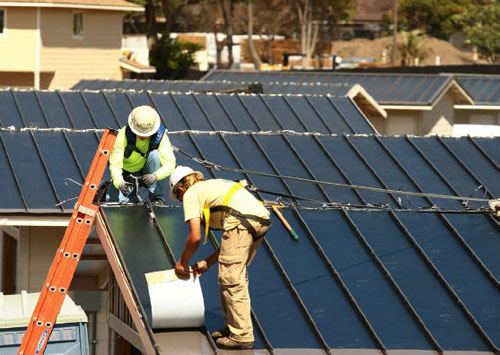
Roof integrated systems usually offer the greatest exposure to the sun. On sloped roofing systems, they are very visible so the aesthetic integration becomes an important design consideration. Yet, on flat roofed buildings, the array can be almost invisible to the users and the public which may ultimately be desirable to the overall design scheme of the building.
|
Thin film PV integrated with metal roofing |
-
|
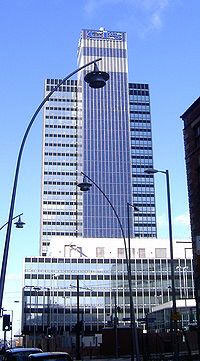
| CIS Tower, Manchester, UK, includes a vertical wall PV façade. |
Wall mounted systems means that they are typically on vertical surfaces. This type of installation works best on tall buildings with clear sun exposure, obviously. Incorporating the PV array into the building skin can be a visually exciting effect but it also requires careful attention to detail.
- Glazing mounted systems have been used to filter sunlight coming into a building while also capturing some of it for electricity. Typically, this type of system will rely on circular or semi circular crystalline PV cells incorporated into the glazing. Semitransparent arrays of these spaced crystalline cells in windows or skylights can provide diffuse, interior natural lighting.The details of concealing the wiring and making electrical connections in glazed systems do require particular attention to work aesthetically.
- Awning type systems may use fixed, angled modules that act to shield windows from direct sunlight, capturing it instead for the electricity generation.
|
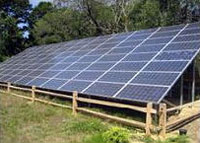
| Stand-alone PV Array |
If the building does not lend itself to any of these integrated options, then the alternative is for an array to be located separately from the building, usually on the ground, but connected by cable to supply electrical power.
Design Parameters for Roof Mounted BIPV systems:
For many building types, BIPV roof mounted systems have started to emerge as the most popular, available, affordable, and effective solution. For a design project that moves in that direction, it becomes important then to understand the other parameters that will influence the BIPV design and final decision making process.
-

|
| Michigan Alternative and Renewable Energy Center (30kW),
Grand Valley State University, Muskegon, MI was driven by owner criteria. |
Owner / User Criteria: Very often, the motivation for including a BIPV system comes from the interest or requirement of a building owner or user. It is important to ascertain and understand what the specific goals and objectives are behind that motivation, just as with any design criteria. For example, is the objective to pay less for electricity or to avoid fossil fuel use or both? Government and defense agencies have been leaders in incorporating BIPV for quite awhile with a view to both of these long term benefits as well as the added ability to control their own electrical generation. Similarly, institutions with an educational or not-for-profit mission often see not only the cost savings, but also the educational and promotional aspects of installing a system. In these cases, they may prefer greater visibility and observation of the system. Commercial and industrial owners and users are typically more concerned with the economic rationale for the system as it relates to their stake in the building. If they intend to own and operate the building for a long time, their point of view is likely to be different than if they intend to lease it to tenants who pay their own utility costs. High-profile systems can also demonstrate the building owner's preference or requirement to provide an environmentally conscious work environment. It is important, then, to have the detailed discussions with the client over these goals and objectives while educating them on the options along the way. The resulting decisions and outcomes will directly affect the design process going forward.
- Building and BIPV Electrical Requirements: As part of the electrical engineering work of a new or renovation building project, the total anticipated building electrical usage will normally be estimated. The design decision related to that result is to determine how much of the electrical load is intended to be provided by the BIPV system and for what purpose(s). For example, one owner may be interested in producing enough electricity to power only the lighting needs while another wants to meet 100% of the building needs. A key point, particularly in buildings where air conditioning is a driving electricity user, is the impact of peak energy shaving − if a user is able to keep the peak energy charges down by using the BIPV system instead of purchased energy on the sunniest, hottest days, then this should be looked at as a key electrical system requirement. Conversely, there are some situations where the requirement may be primarily to optimize the amount of electricity sold back to the utility grid. Once the electrical requirements and goals are clarified, then the engineering calculations can inform the preferred electrical output of the BIPV system.
- Available Sunshine: There have been plenty of studies and in place testing done to declare that PV systems work virtually everywhere in the US, even in the often cloudy parts of the Northeast and Northwest. The difference between those locations and the sunny Southwest for example, not only lies in the amount of typical peak sun hours per year but also some other factors such as the limiting effects of higher temperatures on the output of PV cells. The Florida Solar Energy Center is one of the organizations that has studied performance around the country. They have concluded that an identical 2 kW PV system size and configuration located in different regions of the US would achieve an average low of 5.0 kWh/day in the cloudiest areas and a high of 8.5 kWh/day in the sunniest. The implications? of these findings on the design of a BIPV system is to account for the regional variation by adjusting the size of the array or the angle of exposure to the sun or both.

|
| The Florida Solar Energy Center has conducted a study to examine how a 2-
kW photovoltaic system would perform if installed on a highly energy efficient home
across the continental USA. As the image illustrates, solar photovoltaic systems work
just about anywhere in the US. |
- Available Roof Area: An obvious benefit or limitation to the size of a roof installed BIPV is the area of the roof that is actually available for the system. Specifically, how much of the roof is not being used for other purposes (e.g. mechanical equipment, stair towers, walkways, signage, etc.) and is not shaded either by those other uses or by other buildings or site features. A common rule of thumb used to estimate the physical space a PV system might need is that one square foot of PV module in bright sunlight will yield 10 watts of power. A 1,000 watt system (1 kW), however may need 100 − 200 square feet of area, depending on the type of PV module used and other factors that influence the performance. It will also be important to look carefully at the available roof space to determine the best way to fit the modules into an effective array. By looking at different options and alternative layouts for the roof design, it may be possible that there is either enough, an excess, or too little roof area to meet the stated goals and objectives of the BIPV system. In the latter case, obviously something will need to be adjusted. Either the goal will need to be paired back or an additional array elsewhere on the building or remote from it will need to be considered.
-

|
| Flat roof membrane system with integrated ballasted crystalline PV system
avoiding roofing penetrations |
Roofing Membrane: While we have been focused on the PV system thus far, it is clearly important to remember that the roofing system still needs to function as a roof. That means that the integration of the PV must still allow for proper roof membrane installation, proper drainage, roof inspection and maintenance. The best available integrated systems avoid any additional penetrations in the roofing membrane thus maintaining the complete and warranted integrity of the roofing system. Part of the benefit of the PV array is to enhance and extend the life of the roofing membrane, so designing and constructing the total system to work with the roofing is an important part of the design.
- Construction Criteria: Other construction issues need to be considered, particularly for BIPV installations on existing buildings. For example, the weight of the roof mounted system will need to be taken into account. Most thin film systems are very lightweight and are likely not an issue. Crystalline panel systems will need to be looked at in terms what may be getting replaced, removed from, or added to the roof structure. For example, an existing building that has a ballasted built up roof system may already be supporting upwards of 10 pounds per square foot of dead load. The replacement may be a membrane roof that includes a crystalline panel system that serves as the roof ballast and weighs in between 2 and 6 pounds per square foot, thus providing a structural benefit. Other situations may not yield the same results however.
- Codes and Standards: As with most aspects of building design, there are national codes and standards that need to be consulted for the proper and safe design and installation of PV systems. Most of these will either be related to electrical requirements or the type of building envelope requirements that architects are already familiar with such as wind uplift, glass protection, etc. There are sometimes local ordinances that limit or restrict the use or location of solar panels of any type. These need to be reviewed during the normal code review process of the project.
- Local Utility Interface and Net Metering: In addition to the regular electrical design, it will be important that the electrical engineer for the project understands? and coordinates with the local utility company requirements. These can vary notably from place to place and should not be assumed or based on requirements from other locations. This will be particularly important if the building owner intends to take advantage of selling excess electricity back to the utility company through the process referred to as "net metering". Under federal law, and as explained by the US Dept. of Energy "utilities must allow independent power producers to be interconnected with the utility grid, and utilities must purchase any excess electricity they generate. Many states have gone beyond the minimum requirements of the federal law by allowing net metering for customers with PV systems. With net metering, the customer's electric meter will run backward when the solar electric system produces more power than is needed to operate the building. An approved, utility-grade inverter converts the DC power from the PV modules into AC power that exactly matches the voltage and frequency of the electricity flowing in the utility line; the system must also meet the utility's safety and power-quality requirements. The excess electricity is then fed into the utility grid and sold to the utility at the retail rate. In the event of a power outage, safety switches in the inverter automatically disconnect the PV system from the line. This safety disconnect protects utility repair personnel from being shocked by electricity flowing from the PV array into what they would expect to be a "dead" utility line."

|
| Utility net metering allows electricity to be used either for a building or sent
to the utility grid with the owner realizing credits against purchased power. |
Economic and Cost Considerations of BIPV
Every BIPV system will involve a discussion of the cost or initial investment as well as the economic returns on that investment from the system. The initial cost of the system will depend directly on the design choices and decisions discussed above such as the size of the system and the amount of kW you expect to generate in a year, measured in kilowatt hours (kWh). The overall economic outcome will be based on other factors like local electricity rates and available rebates or tax credits. Clearly, the discussion will look at not only the first costs, but also the long term or "life cycle" costs of the entire installation. Outlined below is a typical process to help work through such a cost and benefit analysis with a description of each step.
1.) Initial BIPV Investment: Like all good building projects, the basic costs of BIPV installation need to be identified. Reviewing the different material and installation options and different manufacturing systems will help inform the choice of which system is best suited for a particular project and identify the related cost impacts. These are then offset by other opportunities to make the total investment more appealing.
- Material costs: (add) The choice of crystalline or thin film materials, the size of the overall array, and the design of the balance of system will all have the biggest impacts here.
- Labor costs: (add) BIPV systems and components may be installed by a variety of trades depending on their design and how they are integrated into the building. Certainly there will be electricians needed, but some components may be installed by roofers, glazers, or others with coordination of other trades.
- General Conditions: (add) In certain instances there may be additional permits or fees applicable to BIPV systems or some lift equipment which needs to be accounted for.
- Offset costs: (deduct) There may be tangible material and labor offsets to take into account when estimating the impact on a total building cost. For example there may well be materials that are no longer needed such as roofing ballast or certain exterior finish materials that should be factored out of other building cost estimate line items.
- Federal, State, or Local Tax Credits: (deducts) There are a variety of tax credits available to building owners that install solar electric systems. These may apply to personal income tax, corporate income tax, sales tax, or property tax. Some are able to be taken up front against the cost of the system and some may be taken over the life of the system. The Database of State Incentives for Renewable Energy (www.dsireusa.org) operated by North Carolina State University tracks the tax credits available in all 50 states.
- Utility Company Rebates or other incentives: (deducts) Some utilities and some state programs encourage the use of PV systems through special rebate or other incentive programs that are usually paid out over some number of years. The value of these can be significant and can reduce the system cost notably. DSIRE also tracks this information on their website.
- System leasing: (win - win) An emerging trend is appearing that allows a building owner to take advantage of the benefits of a PV system without incurring any of the first costs. Rather, a third party company will purchase and install the system in exchange for a long term lease arrangement. That lease could provide electrical power to the building owner for a pre-established rate or it could simply provide lease payments back to the owner allowing the third party to sell all of the electricity to the utility grid. This approach may or may not be appropriate to a given project, but if available it is worth analyzing.
1.) Initial BIPV Investment |
+ |
Material Costs |
+ |
Labor Costs |
+ |
General Condition costs (equipment, permits, insurance, etc.) |
- |
Material and labor offset costs (materials replaced by PV) |
- |
Federal Tax Credits |
- |
State or Local Tax Credits (over time in some cases) |
- |
Utility Rebate or Other Incentives (usually over time) |
- |
Leasing Alternative |
= |
Net Investment |
2.) BIPV Electricity Savings and Sale: Let's begin by looking at the first year savings before we consider the return on investment and long term savings. Once the PV system is installed and running, the electricity that it produces is free of any fuel or significant operating costs. That means the building owner or tenant will immediately start to reap a return on the initial investment through lower utility bills. If the owner chooses to take advantage of "net metering" then the utility company may actually pay the PV owner for any excess electricity that is supplied to the power grid. This excess is tracked through the electric meter and the owner pays only for the "net" difference between electricity purchased from the grid and electricity sold back to the grid.
- Average daily energy used: The PV system will be capable of producing a definable amount of electricity. The relevant information here is the amount of energy that will actually be used from the system based on anticipated load profiles and demands throughout the normal operation of the building. While that amount may vary during the year, an average daily figure can be determined. Defining the energy in units of hours at1000 watts or Kilowatt hours (kWh) is most typical.
- Purchased electricity rate: This is simply the full cost of purchasing electricity from the local utility. To be fair, the rate should include the cost of supply and delivery as well as all surcharges and taxes for a full expression of total cost per kWh. ($/kWh).
- Energy Cost Savings: Multiplying the average daily PV energy used times the purchased electricity rate (kWh X $/kWh) determines the average daily energy cost savings. Multiplying that amount times 365 days/year will show the anticipated first year annual energy cost savings.
- Excess energy: Anticipating that there will be times of the day when the PV system is producing more energy than the building needs to use, a certain amount of excess electrical energy can be calculated to be available either in watts or kWh units.
- Sale or credit rate: The utility company will offer a standard rate to apply to the purchase of the excess electricity available. This rate is likely different (i.e. lower) than the full purchased rate since the utility company is only paying for the energy supply, not the delivery. Often the transaction is accounted for in the owner's monthly utility bill as a credit against purchased energy rather than a cash transaction.
- Net metering value: Multiplying the anticipated excess kilowatt hours (kWh) times the sale or credit rate yields the value of the net metering electricity in the first year.
- Total Return: The total annual value of the electricity from the BIPV can be determined by adding the energy cost savings value and the net metering value together.
2.) BIPV Electricity Savings and Credits |
|
Daily average energy (kWh) used from the PV system |
x |
Current purchased Electricity Rate ($/kWh) |
= |
A) Daily Energy Cost Savings |
x |
365 days per year |
= |
B) Annual Energy Cost Savings |
+ |
Yearly Excess PV Energy Produced (kWh) and returned to the utility grid |
x |
credit applied from utility ($/kWh) |
= |
C) First year Annual Value from Net Metering |
|
Total First Year Annual Return B) + C) |
3.) BIPV Return on Investment: Most owners will eventually ask how long it will take to realize a return on their investment. Starting with the initial investment we can determine a simple or "straight line" return by dividing the final cost of the investment against the total annual return. Of course, no one expects the cost of purchased electricity to stay fixed. The good news is that the cost of the BIPV system is fixed - once it is in place, the installation cost is done. Therefore, by allowing an adjustment for increasing prices of electricity at an anticipated amount per year, the annual return is higher every year after the first year. Hence the time for the system to pay for itself is reduced.
It should not be overlooked that once the system has paid for itself in electricity output, then the owner gets to keep 100% of the returns for the remaining life of the system.
3.) BIPV Return on Investment |
|
Initial Investment (from 1.) above) |
/ |
Total Annual Return (from 2.) above) |
= |
Simple Return |
x |
Inflation adjustment |
= |
Adjusted Return |
4.) Life cycle cost impacts: PV systems typically carry a 25-year warranty, but they could be fully functional even after 30years. Further, if they are integrated into roofing or other building systems, they may also extend the life of those other systems. Hence the long term impact and benefits are worth analyzing over the life of the system and the building.
Case Study Example

|
A retail store roof is a good example of being able to use thin film BIPV as
part of the roofing system design. |
A new construction retail store in California is used as an example to illustrate the economics of a specific BIPV installation.
Preliminary Assumptions:
Electric/Utility Assumptions:
Average Electricity Rate: $ .114/kWh
Electricity Inflation Rate: 6% annually
Facility/Roof Assumptions:
Facility Classification: Commercial/Retail
Available Roof/Installation Area: 41,500 SF
Roof Membrane/Material: Singly Ply thermal plastic polyolefin (TPO)
Tax/Financial Assumptions:
Federal Tax Classification: Commercial/Corporate
Federal Tax Bracket: 35%
Federal Investment Tax Credit: 30% of Installed Equipment Cost
Federal Accelerated Depreciation: 5-year Modified Accelerated Cost Recovery System (MACRS)
Utility 5-year PBI Rebate: $0.25/kWh monthly
PV System Summary: |
System Size DC: |
50 kW |
Estimated First Year Energy Production: |
74,743 kWh |
PV Technology: |
Thin Film Laminate on TPO Membrane |
System Installation Elevation: |
0 degrees (Flat on Roof) |
System Installation Azimuth: |
180 degrees (South) |
Installation Environment: |
Facility/Building Roof |
Installation Method: |
Heat Welded to TPO membrane |
|
|
System Price: |
$300,000.00 |
Utility 5-year Rebate |
$92,499.12 |
Federal Investment Tax Credit |
$ 90,000.00 |
Federal 5-year MACRS Depreciation |
$ 89,250.00 |
Break Even Period |
6 years |
Internal Rate of Return (25 year period) |
12.24% |

|
| Twenty-five year analysis of example BIPV system |
Based on this example, the BIPV system will pay for itself after only 6 years and over the 25 year life of the system can be expected to generate in excess of $430,000 worth of energy. [see Figure 13]
Conclusion
Building Integrated Photovoltaic systems have developed and matured to become a viable option in many building situations today. Advances in technology, development of manufactured systems and flexibility in the installation of PV arrays make it possible for architects to design these systems successfully into the broader scheme of an overall building envelope. A growing number of installations demonstrate that it is very possible to put all of the parts of a system together to achieve the goals and objectives of a project including first year and long term affordability. The benefits of reduced energy costs, lower dependence on fossil fuels, and protection of building envelope components can now be realized by building owners as well as everyone else who seeks improvements in the natural environment.
Peter J. Arsenault, AIA, NCARB, LEED-AP is an architect and consultant focused on green and sustainable design based in Upstate New York.
Resources for additional information:
|


www.specjm.com |
Johns Manville has created JM E3co., the eco-leadershipâ„¢ company, to meet the needs of commercial roofing professionals in this new energy economy. The JM E3co. mission is to bring our considerable resources to:
· White, reflective "cool" roofing systems
· Green, vegetative roofing systems
· Solar solutions |
|