This CE Center article is no longer eligible for receiving credits.
There are 2,500 nozzles along the perimeter of the Digital Water Pavilion in Zaragoza, Spain. The nozzles contain solenoid valves and diffusers and sit at the edge of the pavilion's flat roof, greeting visitors with a liquid curtain. When you approach the pavilion, known as the DWP, a motion sensor in the roof detects your body and signals a processor in a digital control system to alter the solenoid valves at the individual jets of water that your body will displace as you walk through the curtain, just enough so you don't get wet. It's the type of architecture often produced for expos, such as the 2008 International Expo in Zaragoza, for which this was built, and it remains wildly popular with some visitors, even in its second incarnation as a café.
To the DWP's architect, Carlo Ratti, this water choreography represents nothing short of the next revolution in architecture - sensing. For Ratti, architecture cannot merely represent the machine or, in the case of the DWP, fluidity; it must either behave like a machine or become liquid. It's as if the glass on Mies van der Rohe's Barcelona Pavilion were dissolved into water and reimagined by some hyperkinetic gamers.
A typical Ratti project embraces the language of the digital age: interactivity, responsiveness, on-demand, pervasiveness, ubiquity, configurability. The DWP's water curtain not only parts for you, it can also be programmed to display an infinite number of patterns and images just by stopping and starting individual valves (the roof also raises and lowers to the ground, but that's another story). Ratti infuses these ideas into all of his projects. He recently proposed using Wi-Fi signals to track human occupancy of buildings to better tune mechanical systems toward providing more efficient heating and cooling. This last project is part of Ratti's work as director of the SENSEable City Laboratory at the Massachusetts Institute of Technology (MIT), but also informs his architectural practice, the Turin, Italy, and Boston-based Carlo Ratti Associati. Ratti's lab at MIT developed the DWP with the school's Design Lab and Smart Cities research group, directed by William J. Mitchell. "For architects, the only way to innovate will be to understand the basics of sensing," Ratti says.
 |
1. Preprogrammed patterns in the water are part of the pavilion's advanced controls system.
2. Recycled water is pumped from underground cisterns to pipes and nozzles in the roof of the Digital Water Pavilion in Zaragoza, Spain.
3. Carlo Ratti, pictured, describes the pavilion as fluid, both literally and as a "reconfigurable, responsive building," unlike static buildings designed to appear fluid.
|
 |
| Photos: © Max Tomasinelli (1); Carlo Ratti Associati (2, 3) |
There are 2,500 nozzles along the perimeter of the Digital Water Pavilion in Zaragoza, Spain. The nozzles contain solenoid valves and diffusers and sit at the edge of the pavilion's flat roof, greeting visitors with a liquid curtain. When you approach the pavilion, known as the DWP, a motion sensor in the roof detects your body and signals a processor in a digital control system to alter the solenoid valves at the individual jets of water that your body will displace as you walk through the curtain, just enough so you don't get wet. It's the type of architecture often produced for expos, such as the 2008 International Expo in Zaragoza, for which this was built, and it remains wildly popular with some visitors, even in its second incarnation as a café.
To the DWP's architect, Carlo Ratti, this water choreography represents nothing short of the next revolution in architecture - sensing. For Ratti, architecture cannot merely represent the machine or, in the case of the DWP, fluidity; it must either behave like a machine or become liquid. It's as if the glass on Mies van der Rohe's Barcelona Pavilion were dissolved into water and reimagined by some hyperkinetic gamers.
A typical Ratti project embraces the language of the digital age: interactivity, responsiveness, on-demand, pervasiveness, ubiquity, configurability. The DWP's water curtain not only parts for you, it can also be programmed to display an infinite number of patterns and images just by stopping and starting individual valves (the roof also raises and lowers to the ground, but that's another story). Ratti infuses these ideas into all of his projects. He recently proposed using Wi-Fi signals to track human occupancy of buildings to better tune mechanical systems toward providing more efficient heating and cooling. This last project is part of Ratti's work as director of the SENSEable City Laboratory at the Massachusetts Institute of Technology (MIT), but also informs his architectural practice, the Turin, Italy, and Boston-based Carlo Ratti Associati. Ratti's lab at MIT developed the DWP with the school's Design Lab and Smart Cities research group, directed by William J. Mitchell. "For architects, the only way to innovate will be to understand the basics of sensing," Ratti says.
|
1. Preprogrammed patterns in the water are part of the pavilion's advanced controls system.
2. Recycled water is pumped from underground cisterns to pipes and nozzles in the roof of the Digital Water Pavilion in Zaragoza, Spain.
3. Carlo Ratti, pictured, describes the pavilion as fluid, both literally and as a "reconfigurable, responsive building," unlike static buildings designed to appear fluid.
|
|
| Photos: © Max Tomasinelli (1); Carlo Ratti Associati (2, 3) |
If you haven't noticed, building-control systems are experiencing a bit of a fetish phase right now. For at least the past 100 years, architects and engineers may have conspired to button up architecture, to design tightly controlled spaces according to precise specifications. But presently, we seem to be launching into a loose era of "new controls" prompted by a proliferation of pervasive sensing technologies designed to simplify building performance down to a set of occupant-driven demand-and-response mechanisms. Most of this terrain falls under the sustainable design movement, which has encouraged high-performance buildings with more controls and fine-tuning of systems in pursuit of energy efficiency, indoor environmental quality, and resource conservation. Once unconventional, such systems for opening windows, dimming lights, or lowering the blinds through the Building Management System (BMS) are now off-the-shelf products. Ratti's DWP may take this controls technology to extremes, but in service to a fuller set of architectural possibilities. Expos and fairs have historically given architecture an arena for the exploration of ideas that eventually become part of the larger industry. The DWP may be relatively frivolous, but it doesn't take much to imagine how such technology could be deployed to make buildings respond quickly to climate conditions or occupancy patterns - two concerns that inform much of the controls industry.
Projects like the DWP take preprogrammed logic and respond to local events, with limited control by occupants. That is more or less how most BMS systems continue to operate, but a shift from the building scale to that of the individual is a key aspect of the new controls. Architects like Jennifer Magnolfi are interested in finding more of a middle ground. Her work as a senior designer for Herman Miller's Architecture and Building Technology Systems group led to her collaboration on the book Always Building: The Programmable Environment (2008), which lays out the company's vision of an interactive workplace. To that end, Herman Miller recently introduced Convia, a system incorporating addressable lighting control and plug-load-demand management, among other things, as a first step in creating adaptable work environments where single-use spaces become obsolete. "If a room can expand and contract with ceilings that can become adaptive meeting spaces, it begins to shift the economic equation of managing space from a cost-per-square-foot basis to cost per time of use," Magnolfi says. "The investment in that space is that much more valuable because it addresses many more needs." From a building owner's perspective, it could translate to potentially constructing a smaller building.
 |
Clemson University researchers have designed various configurations of their "Animated Work Environment," such as composing and presenting, or gaming and lounging.
 1  Halogen presentation lights
 2   Motor
 3   Proximity sensors
 4   Adjustable screen
 5   Projector screen
 6   Web cam |
| Photo: © IMSA of Clemson University |
Â

Other manufacturers, such as Allsteel, offer workstations with integrated technology. Some companies, like Australia's UCI, offer task-air delivery in workstation partitions. But few major furniture companies have identified integrated control systems as a key priority, which suggests the market has yet to fully develop.
While not everyone shares her opinion, Magnolfi, an avid iPhone user, sees a general relaxing of privacy concerns, as people expand their presence into the digital realm. As sensing technologies become more refined in the workplace, it will become easier for building owners to precisely track occupancy levels, she says, leading to better space-utilization planning by architects during early design phases. But that is only part of the equation. Honeywell, one of the building-control industry's heavyweights, can already track occupancy levels in buildings using conventional security cameras. Commonly called "blob detection," Honeywell's EBI control system can discern individual bodies by scanning camera footage, thereby approximating occupancy levels with 92 percent accuracy. The data are then used to manage heating and cooling demands in occupied spaces. With such developments, buildings can become hyperactive sensory domains, with ever-shifting landscapes of comfort conditions and fluctuating services.
 |
Convia offers an energy-management platform that integrates lighting, switches, occupancy sensors, timers, and other devices. Energy-consumption data from the components and zones are gathered and displayed on monitors for easy analysis, as shown here in the U.S. Green Building Council (USGBC) offices.
Photo: USGBC |
One of Keith Evan Green's research interests is the Animated Work Environment, or AWE, a system that suggests a way forward for the kinds of technologies Herman Miller is pursuing. Green directs Clemson University's Intelligent Materials and Systems group, in South Carolina, a collaboration between the school of architecture and programs in electrical, computer, and materials engineering. Instead of static furnishings, he envisions a desk of dynamic panels embedded with screens and contact sensors supporting control mechanisms to respond to your whims based on movement and control. A chair laden with pressure sensors could detect slouching and adjust your desk panels as needed. "We don't want to create an automated work space that takes away the authority of the individual," Green says. "It's a cognitive model."
Few topics have traditionally been as dull in architecture as building controls. Recent talk of controls generally concerned the incompatibility of systems between manufacturers. BMS systems were developed on a proprietary basis and rarely "talked" to one another, let alone to marginal control systems like those for lighting, security, and access. Without belaboring the mind-numbing details of how this technology has developed incrementally, this situation has quite recently changed. Building Automation Controls networks, or BACnet, is the standard around which most of the industry has converged toward a common digital infrastructure, or backbone, that reduces each control point, sensor, or device to an IP address. As the books by MIT's Mitchell suggest, buildings are Web sites, and vice versa. A compelling vision for new buildings, perhaps, but most existing buildings are often saddled with undermaintained proprietary systems. Volker Hartkopf, the director of the Center for Building Performance and Diagnostics at Pittsburgh's Carnegie Mellon University, argues these legacy systems may be our biggest challenge. "Unless we come up with robust systems that can be deployed again and again," Hartkopf says, likening buildings to automobiles, "we won't make any progress." Even many of the new Web-based systems have closed programming logics that will make expandability and adaptability difficult in the future. Regardless, some architects have forged ahead with the building-as-Web-site concept, finding innovative ways to make the new controls part of a comprehensive data-visualization strategy.
 |
 |
1., 2. Every 15 minutes, the Living Light pavilion's LED lighting system goes dark and regenerates patterns based on Seoul's air quality.
3. Living Light's control system depends on two external digital inputs - a Web site that tracks
air quality and SMS text messages from people accessing the site.
Photos: © The Living |
 |
Â
New York-based architects David Benjamin and Soo-in Yang use controls and wireless sensors in most of their projects. "The standards and protocols for ownership, storage, and transfer of data are going to be established soon, with or without architects," Benjamin says. "It's important for us to know a little bit about it." The architects direct the Living Architecture Lab at Columbia University and run a design practice called The Living. For their Living Light project in Seoul, South Korea, they created a translucent acrylic canopy based on a map of the city's neighborhoods and illuminated with strips of LEDs along the edges. The canopy's lighting-control system connects to a server that is fed data from the Web site of the city's air-quality monitoring system, collecting real-time data against the previous day's data. If air quality improves, the corresponding neighborhood panel lights up. When pedestrians request an SMS text from the Web site for the air quality of a particular neighborhood, the lights on the corresponding panel blink. In effect, Benjamin and Yang created an architectural surface layered with interactive meaning.
Visualizing the data generated by sensing and control systems, another hallmark of the new controls, is fast becoming a cottage industry in the sustainable-design realm. "Connecting everything to a common network, exchanging and transmitting data is worthless unless you can translate it into information you can act upon," says Terry Hoffmann, director of building-automation-systems marketing at Johnson Controls. Hoffmann thinks applications - what we do with this information - is the next logical challenge for industry to tackle. A seemingly limitless number of companies, including many start-ups and unlikely players like Google, have rushed into the building-dashboard arena, offering Web-based interfaces for building-management systems. The standard offering reports real-time energy consumption and that dubious holy grail, carbon footprint reduction, but some include water consumption, lighting levels, or humidity.
For example, Automated Logic offers the WebCTRL system to control building mechanical systems and to act as a front end for an entire building-automation system that might include fire systems, security, and lighting. The system has always provided performance data such as humidity and CO2 levels, and temperature, but it never put the data in the context of how a person might actually feel in the space, or what we call comfort. So, the company recently launched an Environmental Index (EI) tool that functions with WebCTRL and provides facility managers with a 100-point rating for gauging occupant comfort. "The system uses the temperature, humidity, and CO2 sensors you already have in your building, so its simplicity is a major advantage," says mechanical engineer Steve Tom, Automated Logic's director of technical information. Other companies, such as Ambient Devices and Shaspa, are pursuing making such data more readily accessible to occupants. Ambient's Orb can be programmed to glow based on electrical-grid demand or to indicate pollen counts in the air, among other inputs.
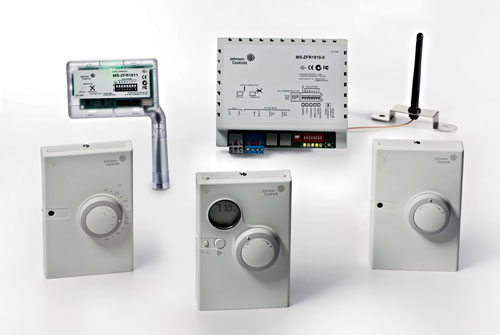 |
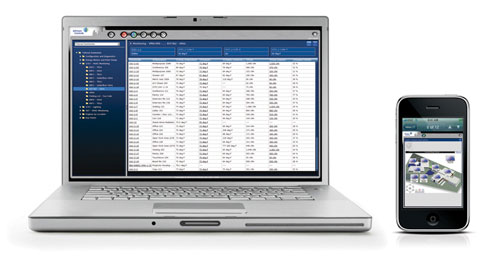
Johnson Controls' wireless Metasys building-management system represents the industry's shift to more controls and devices, more widely dispersed throughout buildings. With each control component recognized as an IP address, facility managers can access data on any Web-enabled device, such as an iPhone or laptop.
Photos: Johnson Controls |
 |
Â
More controls and sensors, however, will require more commissioning and maintenance to ensure that when an orb glows green, it glows accurately. For example, if you wanted to test for CO2 levels in a space, which is an indication of air quality (the more CO2 you have, the more fresh air you need to provide as an offset), you would place one sensor in the room's return-air duct. But in a large, open office, this could be misleading. What's more, if that sensor were not calibrated correctly, you could get false readings that could lead to increased fan use and wasted energy. But having a commissioning agent calibrate every sensor in your building each year can be costly, so it rarely happens. In addition, adding this sensor to every return-air duct could amount to thousands of dollars in costs.
The University of Pennsylvania skirted this issue by installing a new air-monitoring system, Aircuity's OptiNet, in its animal-research laboratories. The system consists of tubes that take small samples of air from discrete locations and transfer the air back to a central sensor suite where it is sampled for CO2, CO, particulates, TVOCs, temperature, and relative humidity. Having one sensor unit eliminates the need to have each of these sensor types deployed separately in each space, as in a conventional system. Aircuity replaces the sensor with factory-calibrated sensors every six months. With such assurances of accuracy, the facility managers at Penn can now reduce airflow rates with the Variable Air Volume systems in the laboratories with less risk, thereby realizing significant savings from reduced fan energy. Joe Monahan, Penn's principal planning engineer, says the system had a two-year payback and reduced energy consumption in the labs by 40 percent. The university is now rolling it out to more buildings. "This is an active approach to controlling mechanical systems, rather than the old passive approach that set air-change minimums," Monahan says. As Penn monitors the system, it can more fully understand how much air is actually needed for its labs. From this, it could establish some diversity factors to traditional design air-change rates - such as, for example, 80 percent of given rates - that would allow it to install smaller systems and realize first-cost savings.
 |
 |
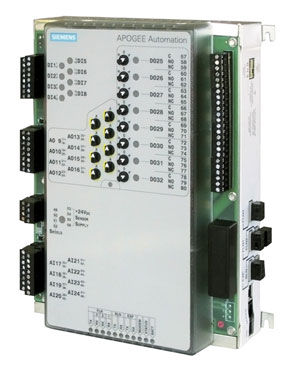
Left: Controllers in Siemens's Apogee wireless system rely on mesh networks to avoid interference.
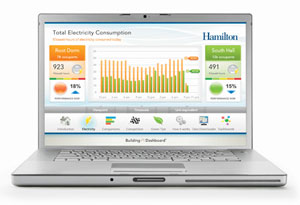
Top: Building Dashboard's Web interface makes energy-consumption reporting more userfriendly.
Photos: Siemens (left); Building Dashboard (top) |
Contrary to the impulse toward centralization, there is an opposite tendency in the industry toward encouraging batteryless microsensors blanketed across buildings and connected wirelessly using the emerging Zigbee wireless standard. Osman Ahmed, a senior principal engineer with Siemens Building Technologies, believes the new controls will be a single control - Micro-Electro Mechanical Systems (MEMS) - that will contain up to five sensor channels and be so small as to be almost invisible. Embedded MEMS in drywall could sense for temperature, humidity, and VOC levels and wirelessly transmit the data to a nearby control device. Although it's not yet commercially available for the company's APOGEE wireless system, Siemens has developed a sensor that can measure mean radiant temperature and is so small it could be embedded in a pane of glass. "You could change the properties of your glass with an applied voltage based on whether you wanted more or less solar gain," Ahmed says.
Ahmed describes MEMS as being like a peanut-butter-and-jelly sandwich. Silicon wafers act as bread to sandwich layers of materials that react only to certain other materials, such as CO2, for example. As a molecule of CO2 passes through the jelly layer in an absorption process, it changes the voltage of the MEMS just enough to register and be transmitted to the larger control device, where it's amplified into a more readable set of data. The CO2 molecule is then released again on the other side of the jelly, which is important, since it ensures the jelly will not become bloated with CO2 molecules and desensitized, Ahmed says. Because they are so small, such devices can generate their own electricity through slight vibrations in duct work or the building in general. Ahmed says this approach to sensing could improve accuracy overall, since the devices will eventually be so cheap that buildings will contain hundreds, if not thousands, of control points that can then be measured and compared to one another. Anomalies would be singled out quickly, and those sensors could be deleted from the network. Ahmed estimates such technologies will reach the market in three to five years, assuming a manufacturing base for such specialized components develops.
If the industry can seem fragmented in its development of these systems, it may have to do with the frontier mentality that has swept in as prices of Web-based technologies have fallen and controls infrastructure has become more consolidated. Before experimental systems like those of Ratti or The Living become everyday projects, industry sources agree they need to offer more assurance that the systems can be maintained, secured, and open enough to be useful. Conversely, if architects ignore such developments, they risk marginalizing architecture's role in the digital world. "We're cultivating new generations of people who are going to be very savvy about hacking things," says Clemson's Green. "Technology is such a part of our lives and we need the mind of the architect to reflect and ponder what we want this to be."