This CE Center article is no longer eligible for receiving credits.
Sustainable concrete is difficult to define. There are many factors that can influence the way concrete is manufactured, designed, built, used, and recycled that ultimately affect the environmental footprint of the structures built with concrete. Whether one is designing a building, pavement, bridge, or dam, concrete is an important component used as foundation and superstructure, and these structures can have a significant impact on our environment throughout their life cycles.

All images courtesy of National Ready Mixed Concrete Association
Figure 1: Rowan is one of San Francisco’s newest and sleekest residential structures. It uses a giant, zigzagging concrete exoskeleton that stands out from other buildings. The exterior is for much more than show—it negates the need for interior columns, maximizing the interior space for residents. Concrete on the project used high volumes of fly ash to reduce environmental footprint.
Design professionals can influence the performance and environmental impact of structures through effective design and project specifications regardless of the materials being used. However, concrete is unique in that it is so versatile both in terms of physical characteristics (size, shape, appearance, etc.) and mechanical properties (strength, stiffness, permeability, etc.) that design professionals can influence quantity of materials used and optimize performance, including environmental impacts, of concrete and concrete structures significantly through design decisions and project specifications. For example, using a higher-grade reinforcement and higher-strength concrete for columns can reduce the section size and thereby the quantity of concrete and reinforcing steel. This results in more efficient and competitive designs, and the overall cost may be reduced.
A holistic approach is important. A focus on green construction should be appropriately balanced with maintaining (or not sacrificing) performance. Sacrificing performance may impact public safety (the intent of building codes) or require structures to be repaired or reconstructed at higher frequencies. This defeats the general purpose of sustainable development in the longer term.

Figure 2: The Wilshire Grand Center in Los Angeles uses a mixed concrete and steel structural system consisting of composite concrete and steel floors that span from an internal concrete core to perimeter concrete-filled steel box columns. Concrete for the 18-foot-thick mat foundation was kept cool by circulating chilled water in 90,000 feet of polypropylene hoses that were eventually filled with grout. Standing at 1,100 feet tall, the Wilshire Gran Center is the tallest building west of the Mississippi.
Prescriptive versus Performance Specifications
Specifications for concrete in construction documents establish project requirements where the contractor and material suppliers must comply. Project specifications that adhere to industry standard specifications, such as ACI 301: Specifications for Structural Concrete, generally applicable for buildings, are supportive of performance-based criteria and sustainable concrete construction and can be adopted by reference in a project specification. However, many project specifications incorporate additional, unnecessary prescriptive requirements that contradict ACI 301 and detract from both performance and environmental benefits.
A prescriptive specification imposes constraints on the concrete mixture proportions or means and methods of construction. Examples of prescriptive criteria include limits on the concrete mixture composition, such as minimum cement content, limits on the quantity and characteristics of supplementary cementitous materials (SCMs), maximum water to cementitious materials (w/cm) ratios, grading of aggregates, etc.
A performance specification outlines the characteristics of the fresh and hardened concrete, depending on the application and aspects of the construction process that are necessary. These requirements should not restrict innovations by the concrete producer or concrete contractor. Performance specifications should clearly specify the test methods and acceptance criteria that will be used to verify and enforce the performance criteria. Performance specifications should provide the necessary flexibility to the contractor and producer to provide concrete mixtures that meet the performance criteria.
The general concept of how a performance-based specification works is as follows:
- There is a qualification and certification system that establishes the standards for concrete production facilities and the people involved.
- The design professional would define the performance requirements of the concrete for the different components of the structure.
- Producers and contractors would partner to ensure that the right mixture is designed, delivered, and installed to meet the performance criteria.
- A submittal would document that the mixture will meet the specification requirements and include prequalification test results.
- While the concrete is being placed, a series of field acceptance tests would be conducted to determine if the concrete meets the performance criteria.
- There would be a clear set of instructions outlining what happens when concrete does not conform to the performance criteria.
The best example of a performance criterion is strength. By specifying compressive strength, a concrete producer can design a mixture to meet the strength criteria through experience and testing. The mixture proportions are not specified, just the target strength—leaving the product formulation entirely in the hands of the manufacturer. It permits the producer to develop a mixture that not only meets the strength requirement but does it economically, where it can minimize cement content, use supplementary cementitious materials (SCMs) such as fly ash and slag cement or other innovative technologies to reduce cost, improve performance such as workability and durability, and reduce environmental impact.
On the other hand, the best example of a prescriptive criterion is minimum cement content. This takes away the ability of the concrete producer to optimize concrete formulation. What we often see in a project specification is a specified compressive strength requirement in addition to a minimum cement content, and very often a contradictory maximum water-cement ratio. Generally, the minimum cement content requirement is much higher than what would be required to meet the specified compressive strength. This results in concrete that is more expensive (as cement is the most expensive ingredient in concrete), may be prone to cracking from high shrinkage or thermal effects, and increases the carbon footprint of concrete (since cement has a relatively high carbon footprint).
Sustainable concrete is difficult to define. There are many factors that can influence the way concrete is manufactured, designed, built, used, and recycled that ultimately affect the environmental footprint of the structures built with concrete. Whether one is designing a building, pavement, bridge, or dam, concrete is an important component used as foundation and superstructure, and these structures can have a significant impact on our environment throughout their life cycles.
All images courtesy of National Ready Mixed Concrete Association
Figure 1: Rowan is one of San Francisco’s newest and sleekest residential structures. It uses a giant, zigzagging concrete exoskeleton that stands out from other buildings. The exterior is for much more than show—it negates the need for interior columns, maximizing the interior space for residents. Concrete on the project used high volumes of fly ash to reduce environmental footprint.
Design professionals can influence the performance and environmental impact of structures through effective design and project specifications regardless of the materials being used. However, concrete is unique in that it is so versatile both in terms of physical characteristics (size, shape, appearance, etc.) and mechanical properties (strength, stiffness, permeability, etc.) that design professionals can influence quantity of materials used and optimize performance, including environmental impacts, of concrete and concrete structures significantly through design decisions and project specifications. For example, using a higher-grade reinforcement and higher-strength concrete for columns can reduce the section size and thereby the quantity of concrete and reinforcing steel. This results in more efficient and competitive designs, and the overall cost may be reduced.
A holistic approach is important. A focus on green construction should be appropriately balanced with maintaining (or not sacrificing) performance. Sacrificing performance may impact public safety (the intent of building codes) or require structures to be repaired or reconstructed at higher frequencies. This defeats the general purpose of sustainable development in the longer term.
Figure 2: The Wilshire Grand Center in Los Angeles uses a mixed concrete and steel structural system consisting of composite concrete and steel floors that span from an internal concrete core to perimeter concrete-filled steel box columns. Concrete for the 18-foot-thick mat foundation was kept cool by circulating chilled water in 90,000 feet of polypropylene hoses that were eventually filled with grout. Standing at 1,100 feet tall, the Wilshire Gran Center is the tallest building west of the Mississippi.
Prescriptive versus Performance Specifications
Specifications for concrete in construction documents establish project requirements where the contractor and material suppliers must comply. Project specifications that adhere to industry standard specifications, such as ACI 301: Specifications for Structural Concrete, generally applicable for buildings, are supportive of performance-based criteria and sustainable concrete construction and can be adopted by reference in a project specification. However, many project specifications incorporate additional, unnecessary prescriptive requirements that contradict ACI 301 and detract from both performance and environmental benefits.
A prescriptive specification imposes constraints on the concrete mixture proportions or means and methods of construction. Examples of prescriptive criteria include limits on the concrete mixture composition, such as minimum cement content, limits on the quantity and characteristics of supplementary cementitous materials (SCMs), maximum water to cementitious materials (w/cm) ratios, grading of aggregates, etc.
A performance specification outlines the characteristics of the fresh and hardened concrete, depending on the application and aspects of the construction process that are necessary. These requirements should not restrict innovations by the concrete producer or concrete contractor. Performance specifications should clearly specify the test methods and acceptance criteria that will be used to verify and enforce the performance criteria. Performance specifications should provide the necessary flexibility to the contractor and producer to provide concrete mixtures that meet the performance criteria.
The general concept of how a performance-based specification works is as follows:
- There is a qualification and certification system that establishes the standards for concrete production facilities and the people involved.
- The design professional would define the performance requirements of the concrete for the different components of the structure.
- Producers and contractors would partner to ensure that the right mixture is designed, delivered, and installed to meet the performance criteria.
- A submittal would document that the mixture will meet the specification requirements and include prequalification test results.
- While the concrete is being placed, a series of field acceptance tests would be conducted to determine if the concrete meets the performance criteria.
- There would be a clear set of instructions outlining what happens when concrete does not conform to the performance criteria.
The best example of a performance criterion is strength. By specifying compressive strength, a concrete producer can design a mixture to meet the strength criteria through experience and testing. The mixture proportions are not specified, just the target strength—leaving the product formulation entirely in the hands of the manufacturer. It permits the producer to develop a mixture that not only meets the strength requirement but does it economically, where it can minimize cement content, use supplementary cementitious materials (SCMs) such as fly ash and slag cement or other innovative technologies to reduce cost, improve performance such as workability and durability, and reduce environmental impact.
On the other hand, the best example of a prescriptive criterion is minimum cement content. This takes away the ability of the concrete producer to optimize concrete formulation. What we often see in a project specification is a specified compressive strength requirement in addition to a minimum cement content, and very often a contradictory maximum water-cement ratio. Generally, the minimum cement content requirement is much higher than what would be required to meet the specified compressive strength. This results in concrete that is more expensive (as cement is the most expensive ingredient in concrete), may be prone to cracking from high shrinkage or thermal effects, and increases the carbon footprint of concrete (since cement has a relatively high carbon footprint).
Influence of Prescriptive Specifications on Sustainability, Performance, and Cost
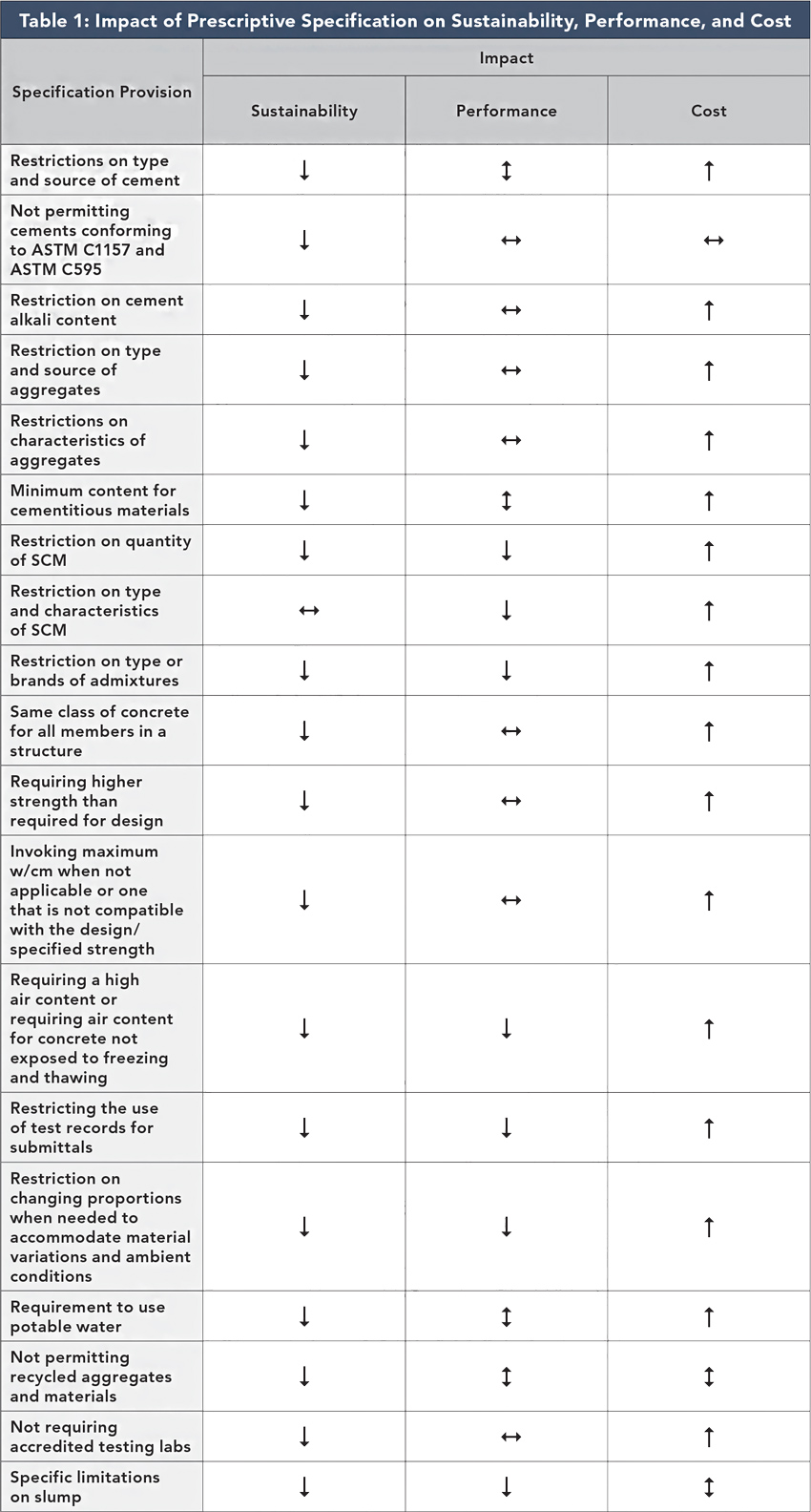
Common prescriptive requirements found in concrete specifications and their effects on performance, including sustainability and cost, are summarized in Table 1. Most of these requirements do not support sustainability goals and often increase the cost of concrete.
The intended concrete performance can be attained without specifying prescriptive requirements. The following is a detailed discussion of how the prescriptive criteria outlined in Table 1 can influence the performance and sustainability of concrete.
Cement type and source: Specifications often restrict the type (e.g., ASTM Type II) of cement or use of certain sources. Unless there is a building code requirement or specific reason for durability or other property, these restrictions should be avoided. These restrictions may force the use of materials that are unfamiliar to the producer, require a greater over-design, cause incompatibility with other materials, and require material to be transported a longer distance. The use of innovative products may be prevented. These restrictions do not support environmental goals and most often increase the cost of concrete.
Cement specification: Specifications often restrict the use of cements to ASTM C150. Blended cements conforming to ASTM C595 and performance cements conforming to ASTM C1157 are optimized for performance by cement manufacturers and often have a lower carbon footprint. These include portland-limestone cements (Type IL) and those blended with pozzolans (Type IP) and slag (Type IS). Permitting the use of blended cements supports sustainability. Cost implications are neutral. Concrete producers still have the flexibility of using additional SCMs to develop mixtures to meet the needs of a project.
Low-alkali cement: Specifications often require the use of a low-alkali cement to minimize the occurrence of deleterious expansive cracking due to alkali-silica reactions. Manufacturing low-alkali cements increases the use of natural resources and energy and can increase waste generation during cement manufacture. It should be noted that a recent revision to ASTM C150 has removed the option to order a low-alkali cement. It is recognized that the total alkali content in concrete from the cement is more significant. Mitigation of alkali-silica reactions can be accomplished using SCMs and admixtures. Requiring the use of low-alkali cement will increase cost and not support environmental goals. It should be noted that alkali-silica reactivity is only a concern when concrete is exposed to moisture; therefore most concrete in buildings is not affected.
Type and source of aggregate: Specifications may restrict the aggregate type and require the use of a specific source, such as crushed versus gravel, mineralogy, specific supplier or source, etc. This could ultimately force the use of materials that the producer may not be familiar with and prevent mixtures from being optimized for performance. The cost of aggregate might increase due to transportation. These requirements will not support sustainable development and can adversely impact performance. There may be situations where imported aggregates may be necessary. Examples of this include higher modulus or for architectural concrete.
Characteristics of aggregates: Specifications often place restrictions on the characteristics of aggregates, such as grading, specific gravity, particle shape and size, etc.. In some areas, local aggregate supplies may not comply with all requirements of referenced specifications, such as ASTM C33, but have a good history of use. This allowance is recognized in the building codes. However, when the requirements prevent the use of local materials or require use of materials that are not commonly used or locally available, it will increase cost and detract from sustainable development without significant benefits in concrete performance.
Limits on cement content: Many specifications impose minimum cement content for different classes of concrete. Requiring minimum cement content constrains the innovation of the concrete producer to optimize concrete mixtures and can result in inherent incompatibility with other requirements of the specifications, such as strength or w/cm. These can result in unintended consequences, such as increased volume changes due to temperature or drying shrinkage that will result in cracking or reduced durability. It is a fallacy to assume that higher cement content results in improved durability. Minimum cement content requirements can impact cost and environmental impacts with questionable benefits to quality, performance, and durability. On the other hand, attempts to force green construction should not set limits on maximum cement content. This could compromise constructability or performance of concrete in the structure resulting in reduced service life.
Quantity of SCM: Some specifications place limits on the quantity of SCMs. Often the use of more than one type of SCM is prohibited. This prevents optimizing concrete mixtures for performance and durability. The only building-code restriction is for exterior concrete subject to application of deicing chemicals. Maximum limits on the quantity of SCM increases cost and does not support sustainable development. Increasingly, projects seeking green certifications impose prescriptive requirements on concrete mixtures, such as minimum replacement for cement or minimum recycled content. These requirements can often impact the performance of fresh and hardened concrete properties, such as setting characteristics, ability to place and finish, and rate of development of in-place properties. In the long run, this may impact the quality of construction or the service life of the structure. The implication to initial cost may be reduced, but it could cost more in the long term. Alternatives to limiting quantities of SCM to lower environmental impact are discussed later in this course.
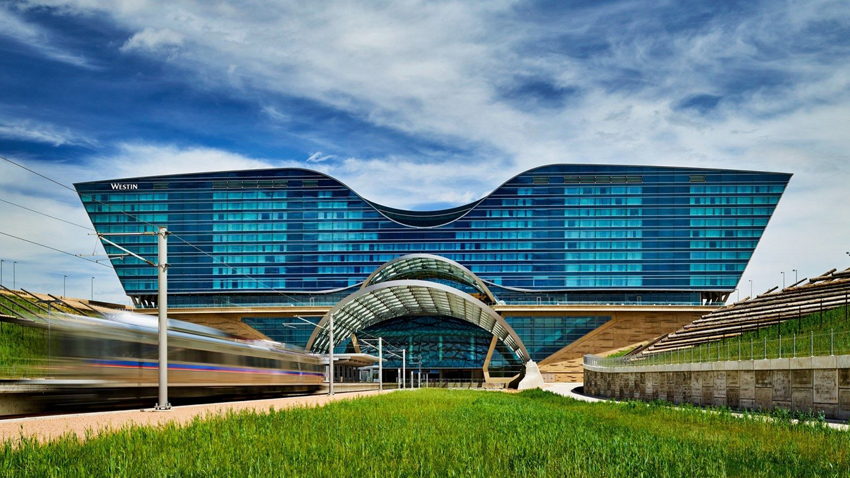
Figure 3: The Denver International Hotel & Transit Center used complex mix designs, including high-strength, self-consolidating, and lightweight concrete, for the transit and hotel canopy abutments, the hotel ballroom’s transfer beams and slab, and the structure’s sloping roof deck. Many of the walls and columns within the structure are “architecturally exposed,” requiring a clean and attractive finish. Beyond being able to fulfill the project’s design challenges, builders chose concrete for its fire resistance and strength.
Type and characteristics of SCMs: Specifications often prohibit the use of some types of SCMs or impose restrictions over and above those in the ASTM material specifications—such as lime content, alkali content, loss on ignition, or grade of slag cement. These will prevent the use of locally available materials that likely have good past performance and will require materials to be imported. The result will increase cost and detract from meeting environmental goals, while the impact on performance is questionable.
Type and brand of admixtures: Most specifications include a list of specific admixture brands and suppliers. Often the listed products are no longer available in the market. Concrete producers often have business relationships with admixture suppliers and experience with use of certain products. Forcing the use of specific products will impact the ability of the concrete producer to provide concrete mixtures of consistent quality and performance.
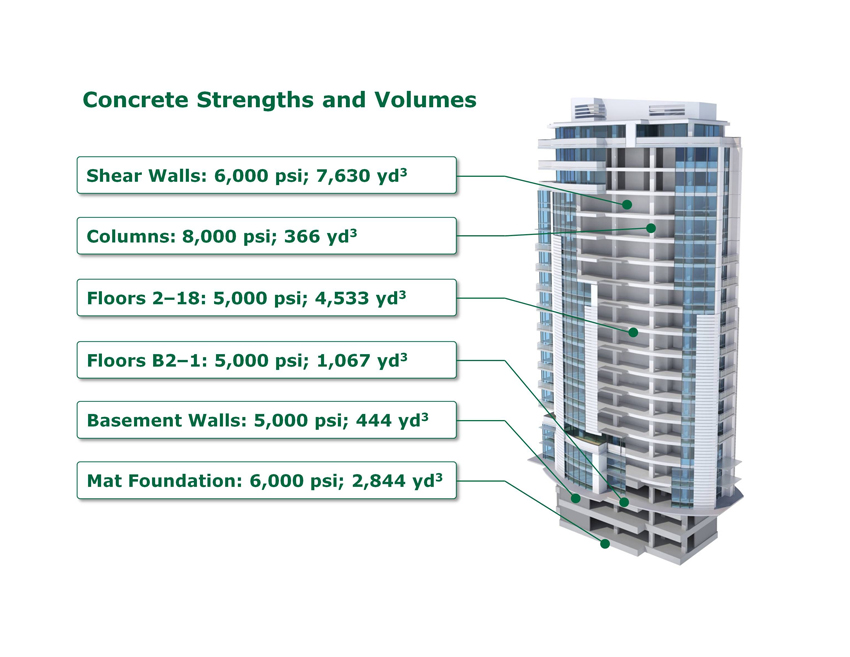
Same class of concrete for all components: Concrete members in a structure are often designed based on different strength levels and exposure classes. The requirements for foundations may differ from beams and columns; slabs may have different requirements. Specifications often indicate the same class for all of the concrete on a project. This can cause problems during placing and finishing. There are considerable cost savings and environmental benefits if the concrete is specified as required for the different structural members on a project. For example, it makes sense to use high-strength concrete for columns and shear walls, but it rarely benefits slabs and beams. Also, exposure classes should be assigned to specific components. For example, concrete that is protected from the environment and not subject to freezing and thawing should not have the same exposure class as concrete that is exposed to weather.
Higher strength than required by design: If a higher strength is specified or required for durability, the designer should use this to his or her advantage when designing the structure and minimize the section size when applicable.
Max w/cm when not required: The building code requires the use of a maximum w/cm for durability and assigns a minimum specified strength that is in alignment with the required w/cm. Many specifications incorporate limits on w/cm for elements not subject to durability concerns. This includes all interior concrete. Imposing a low w/cm limit likely increases the cement content of concrete mixtures and affects the ability to place and finish concrete. The use of a max w/cm, where not required, increases cost and does not support sustainable development.
Air content: Air-content requirements for concrete vary by aggregate size because the volume of paste changes. It is further permitted to reduce the specified air content when the specified strength exceeds 5,000 psi. In many vertical members that will not be critically saturated and require a high design strength, air-entrained concrete may not be required. Air-entrained concrete is not required for interior structural members. Many regions in the southern United States have a long history of durable concrete that is not air entrained, even though temperatures may occasionally dip below freezing. Most specifications state a constant air-content requirement regardless of aggregate size and often increase it, assuming this will improve freeze-thaw durability. Air content reduces strength, and additional cement is required to offset this strength decrease. This can result in increased propensity for thermal and shrinkage cracking. Specifying air content that is not appropriate for a structural member increases cost and materials, while likely reducing performance and sustainability.
Use of test records for submittals: Specifications often indicate that the concrete mixture should be designed to produce an average strength at a fixed value greater than the specified strength. This essentially prohibits the use of past test records that allow for a statistically based average strength. This discourages concrete producers that have good quality control from optimizing concrete mixtures to a lower strength level and thereby conserving materials. This requirement increases cost, does not support sustainable concrete, and could result in unintended problems due to high cementitious materials content.
Restriction on changes to mixtures: Ingredient materials vary, as do environmental conditions during the project. Real-time adjustments are necessary to accommodate these variations and ensure consistent concrete characteristics. Several specifications prohibit such minor changes to concrete unless a submittal, often with supporting test data, is provided to the engineer of record. It is recognized that the engineer of record should be notified for major revisions to mixtures, but prohibition of changes can cause considerable negative impact to concrete performance.
Use of potable water: ASTM C1602 addresses the quality of water that can be used to produce concrete, and it includes provisions to permit the use of non-potable water with proper testing and evaluation. Specifications that prohibit the use of non-potable water increase cost and result in the generation of considerable volumes of waste water. Specifications that require the use of potable water detract from sound environmental management practices at concrete production facilities.
Recycled materials and aggregates: There are applications for concrete that can accommodate the use of recycled aggregates or other materials with minimal impact to concrete quality. Crushed returned concrete can be used as a portion of the aggregate in concrete for some applications to conserve virgin materials and minimize waste. The use of recycled material can contribute to credits in green construction rating systems. The use of crushed concrete as aggregate is recognized in industry standards. Judicious use of these materials will reduce cost and conserve natural resources and landfill space with minimal impact on performance.
Reliable testing: While this may not seem pertinent, improper testing procedures will increase variability and result in greater over-design of concrete mixtures. When concrete producers are aware of improper testing, they protect themselves by increasing the cementitious materials in concrete mixtures. This results in increased cost and does not support sustainable development. Selection of testing agencies should be based on quality of work, conformance to ASTM C1077, and having certified personnel conducting tests. Test reports should be distributed to producers as soon as they are available to help identify potential problems early.
Specific limitations on slump: Slump should be selected by the contractor and concrete supplier based on the placement and finishing requirements of the concrete. With the use of water-reducing admixtures, slump cannot be taken as a representation of the quantity of water in the mixture. The target slump can be provided to the engineer of record in the submittal and be used as a basis for quality assurance. Placing limits on slump usually results in reduced sustainability and performance and can increase cost.
Suggested Specifications
The National Ready Mixed Concrete Association (NRMCA) has developed a Guide to Improving Specifications for Ready Mixed Concrete to help designers improve concrete specifications. The following are a few general recommendations for proposed specification language:
Manufacturer qualifications: Concrete shall be supplied with the following current certifications:
- NRMCA Certified Concrete Production Facility
- NRMCA Producer Quality Certification
- NRMCA Green-Star Certification
- Quality-control personnel with responsibility for concrete mixtures certified as an NRMCA Concrete Technologist Level 3
NRMCA has developed several education and certification programs to help qualify concrete producers to design, batch, and deliver concrete for performance-based products while meeting the strictest environmental requirements.
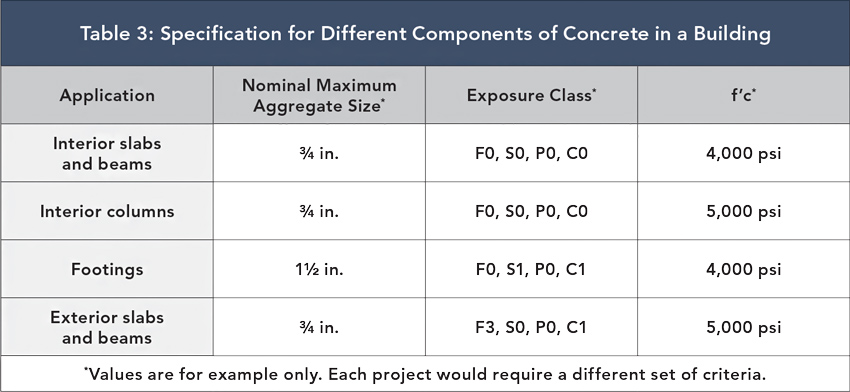
Concrete mixtures: Prepare design mixtures for each class of concrete on the basis of laboratory trial mixtures or field test data, or both according to ACI 301. Design mixtures shall meet the specified strength requirements listed below in Table 3.
This is where the designer can specify physical characteristics and mechanical properties of the concrete along with durability criteria without prescribing the mix design. NRMCA’s guide provides alternate performance tests and criteria for alkali-aggregate reaction (AAR), shrinkage, etc.

Figure 4: The Triangle Building located in Denver used 15 different types of concrete, including shotcrete, cast in place, high strength, and lightweight. Each variety serves a particular purpose and contributes to the building’s LEED Gold certification.
LEED Projects
LEED, along with other green building standards, offers guidance for reducing the environmental footprint of building materials. NRMCA publishes a Guide Specification for Concrete for LEED Projects. The documents focus on the Material and Resources (MR) credits of LEED and how to specify concrete to meet the intent of the credits.
LEED Materials & Resources credits attempt to take a holistic look at materials by adopting life-cycle assessment (LCA) and product disclosure and optimization. LCA is the investigation and evaluation of the environmental impacts of a product, process, or service. LCA evaluates all stages of a product’s life to determine its environmental life-cycle impacts. LCA is the most comprehensive approach to determining the environmental impacts of a building. There is a credit in LEED called Building Life: Cycle Impact Reduction that rewards points if the building has lower life-cycle impacts than a baseline building.
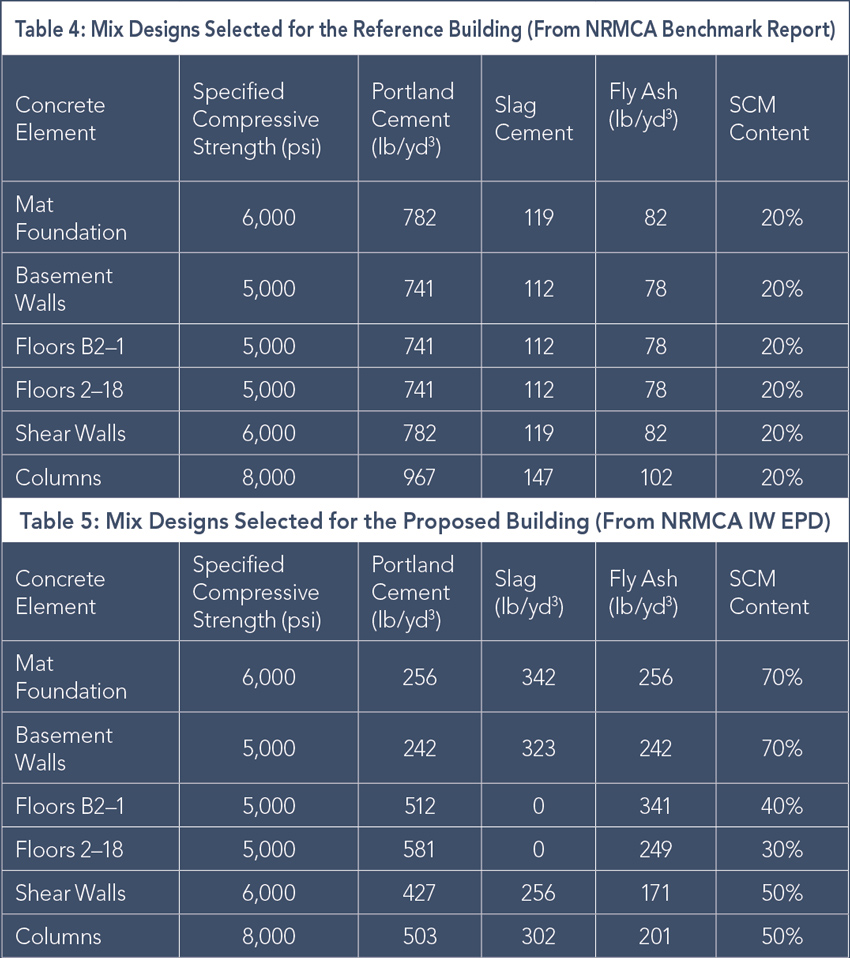
Whole-building LCA credit: Specifications can require that product suppliers submit life-cycle inventory (LCI) data for their products or environmental product declarations (EPDs) to help the design team conduct a whole-building LCA. The concrete industry leads the way in conducting LCAs and publishing EPDs for its products. Many companies have published EPDs for concrete, and most would be willing to publish EPDs specifically for a project. NRMCA has published an LCA report and industry-wide EPD for concrete. Product-specific EPDs, the industry-wide EPD, and regional benchmark impacts for concrete can be found at www.nrmca.org/sustainability/EPDProgram. The Example 2 sidebar helps specifiers understand how concrete can contribute to lowering the overall footprint of a building and help meet the intent of LEED’s Building Life-Cycle Impact Reduction credit.
Product disclosure and optimization credits: Product disclosure means reporting environmental, social, and health impacts through third-party-verified reports, including EPDs, corporate sustainability reports (CSRs), and health product declarations (HPDs), among others.
There are three Building Product Disclosure and Optimization credits, each having various options to lower impacts. The first option, Disclosure, requires that the project use a certain number of permanently installed products that disclose impacts using EPDs, CSRs, and/or HPDs. In LEED, a “product” is defined by the distinct function it serves. This means that concrete has the advantage of contributing significantly because of its wide range of applications and functions. For example, footings, foundations walls, shear walls, bearing walls, columns, beams, slabs, sidewalks, and parking areas, each with a unique mix design, would all be considered different products in LEED and therefore contribute significantly to the number of products required to meet the intent of the credit.
The second option, Optimization, requires a certain minimum value of building products to demonstrate that they perform better than previously disclosed impacts.

Figure 6: The Edith O’Donnell Arts & Technology Building at the University of Texas, Dallas uses a partially exposed concrete structure to take advantage of concrete’s thermal mass properties, which trap heat during cold months and keep structures cooler during warmer weather. Concrete’s long life and durability are important for academic buildings that must address the needs of the university and its students for many decades. Some of the same properties that make concrete strong (its mass and rigidity) also make it virtually soundproof. The beauty of concrete is on full display in the partially exposed structure, including polished concrete floors and beams in the lobby. The project achieved LEED Silver certification.
Influence of Design Decisions
Although project specifications can affect the performance of a project, the single biggest influence an architect and engineer can have on the environmental impacts of a structure is through efficient design. The following are several factors that affect the performance of concrete and concrete structures:
Design loads: Every structure, at a minimum, must be designed to resist forces from gravity, service, wind, earthquakes, water, soil, fire, and blast, among others. If a structure does not meet these minimum requirements, it would be deemed unsafe and therefore unsustainable. Usually a structural engineer designs the structure to resist minimum loads prescribed in a building code. Alternatively, the owner can choose higher loading to resist natural disasters or other loading over and above the building code minimums. Having a structure that can resist disasters without suffering significant damage would be considered more sustainable. After all, a green building that is destroyed during a natural disaster will ultimately increase the environmental burden since the materials in the building (structure, fixtures, furnishings, etc.) will end up in landfills and the building will have to be rebuilt using new materials.
Structural efficiency: Regardless of the design loading, an architect’s and structural engineer’s objective is to design the structural system for optimized performance and minimize waste. There is no point in having a concrete mixture with low environmental impact if the structural member is overdesigned by 20 percent. Not only can efficient design lower the impact of the structural system, but it also tends to reduce the impacts of other materials. For example, minimizing the depth of the beams in the structure can significantly reduce the floor-to-floor heights of a building, thus leading to reduced quantity of exterior cladding and interior finishes, which can lower the environmental impacts of a building significantly.
Durability: A structure that needs constant maintenance and repair results in significant environmental impact. Structures that are exposed to harsh environments must be designed appropriately to resist deterioration. For concrete, this usually means consideration of freezing and thawing cycles, abrasion, chlorides (from road salt or marine environments), or sulfates (contained in soil or water). A combination of good design detailing along with durable concrete mix designs can result in a durable concrete structure. Appropriate concrete cover, corrosion-resistant reinforcement, low-permeability concrete, effective use of SCMs, chemical admixtures that improve corrosion resistance, surface coverings, and crack control are all potential strategies for providing a durable concrete structure. As discussed above, design professionals should assign exposure classes to concrete based on the severity of the anticipated exposure of the structural concrete members. The building code provides specific requirements for concrete mixtures to resist various levels of exposure. In most cases, the requirements are performance based, thus eliminating the need for engineers to specify additional prescriptive criteria.
Constructability: Design decisions can also affect constructability. Smaller members with congested reinforcement take more time and energy and are typically more costly to construct. A project specification that requires a minimum quantity of fly ash greater than normal use could result in delayed strength gain that could add to the construction schedule since floors might not be able to be post-tensioned within a reasonable time frame or a bridge deck might not be able to open to traffic without significant delays. A project specification with a maximum limit on slag cement could result in concrete used for massive members to produce high heat of hydration and significant cracking. A project specification that limits slump to a certain value could result in concrete that cannot be pumped efficiently or finished effectively. All of these consequences of prescriptive specification requirements could render the project unsustainable.
Energy efficiency: Concrete buildings are typically more energy efficient than lighter-framed buildings because of thermal mass. Thermal mass is a material’s ability to store heat and release it over time. There are three characteristics of thermal mass. First, the time lag between peak heating and cooling loads and outside temperature peaks is greater for massive buildings. This feature can be used in buildings by delaying the need for heating or cooling energy to take advantage of off-peak demand. In an office building, this means that heat gain can be delayed until everyone has gone home. Second, massive buildings have lower peak heating and cooling loads, allowing for smaller, more efficient heating and cooling equipment. And third, massive buildings require less overall heating and cooling energy to maintain the same interior temperatures since temperature swings are moderated.
In a research report published by the Massachusetts Institute of Technology (MIT), the effects of thermal mass were explored using LCA for a 12-story, 498,590-square-foot commercial building. The building was analyzed for a 60-year life for two climates, Phoenix and Chicago, and for two different structural materials, concrete and steel. The analysis demonstrated that the greenhouse gas emissions due to the operational energy of the building are responsible for 95–96 percent of life-cycle emissions. Figure 1 demonstrates that the concrete building has approximately the same embodied emissions as steel but lower operating emissions, which can lead to lower life-cycle emissions.
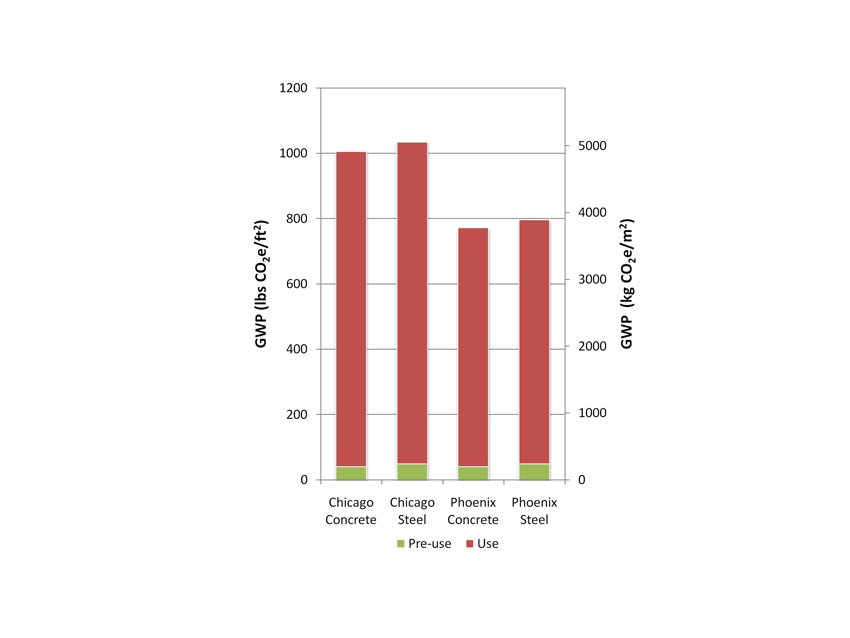
Figure 7: This graph shows the total global warming potential (GWP) over a 60-year lifespan for commercial buildings.
Aesthetics: An architect can specify concrete with color, shape, and texture for nearly any application. This distinguishes concrete from most other materials in the sense that the surface of concrete structural systems can be exposed on the interior or exterior of a building. This helps to reduce the need for additional finish material, thus reducing the environmental impact.
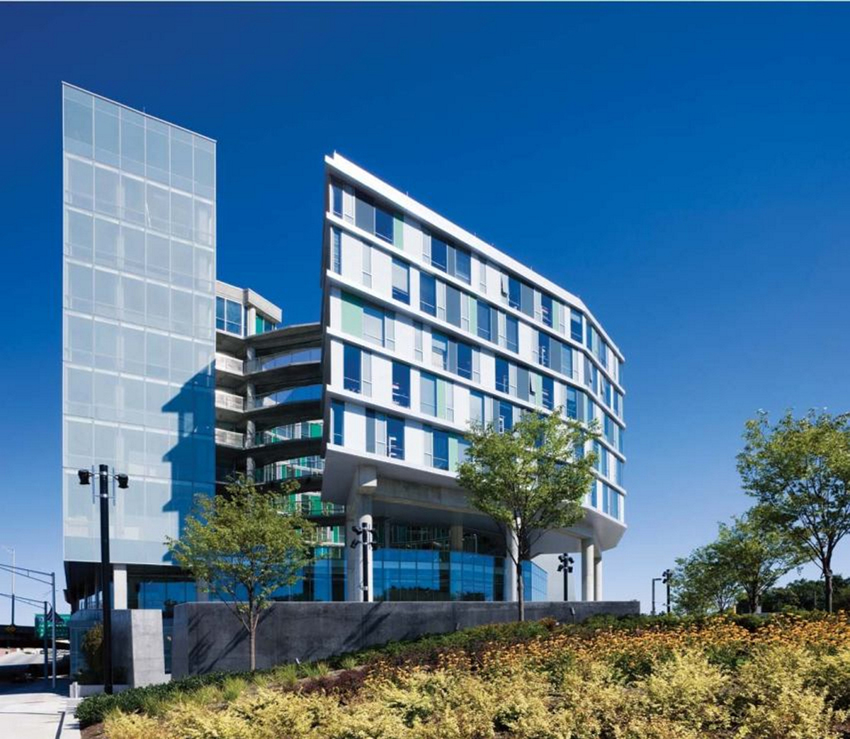
Figure 8: The Gateway at the Maryland Institute College of Art in Baltimore uses concrete to form distinctive circular structures sectioned into three pods of residential units surrounding a private central courtyard. The round shape of the residential wing, one of the building’s central features, was formed by a faceted cylinder elevated on slender concrete columns. Concrete balconies and walkways ring the interior of the hollow residential wing, providing basic circulation as well as vantage points for watching outdoor performances in the courtyard. The flexibility of concrete is on full display in the drum shape of the residential wing. Concrete structural slabs create both the support and shape that the building needs to achieve its unique design.
Conclusion
An environmentally conscious building owner is interested in a concrete structure that provides a long service life without significant defects and has a low environmental footprint—not necessarily how much cement the concrete contains. Using a performance specification, the concrete producer is free to select the mixture proportions and held responsible for meeting the performance criteria. Since performance specifications would allow for mixture optimization and adjustments during the project, there is an incentive for the designer and producer to collaborate for optimal mix technology. With a performance specification, a quality concrete producer can improve product quality, stimulate innovation, reduce construction cost, and minimize construction time—all while reducing environmental footprint.