This CE Center article is no longer eligible for receiving credits.
There is beginning to be a rich consensus that it is better to build
within the framework of environmental design rather than to
ignore the living systems of our planet. Design stewardship
means that professionals are now creating living habitats, buildings
that breathe, environments that protect water resources and capture
daylighting.
In the 1990s as a response to the emerging knowledge that
buildings were wasting natural resources and energy, the AIA
Committee on the Environment provided a list of measures to be
used as metrics when selecting building systems. This article will
describe some of the ways in which manufacturers are meeting the
challenges posed by the AIA as well as the U.S. Green Building
Council, to provide products that are beneficial to the environment.
Consider Building a Living Environment
"Managing the organic environment can be a challenge to the
designer as well as the community that is required to nurture its
growth patterns," says Paul Bambauer, President of IRONSMITH.
Growing living screened façades, planting trees downtown
or creating garden paving systems may require the integration of
natural materials with other building systems, or at a minimum, the understanding of how to manage or design for a changing, living environment. Moreover, according to James Sable at greenscreen®,
designing for nature "is more efficient building energy performance
as well as human well-being. It is the means to embrace nature
rather than protect from nature − by design. Natural spaces are
designed to welcome humans and increase the daily experience of
human life."
Incorporating natural systems also includes low impact design
for water conservation as well as the high impact designs for dark
sky lighting and daylight harnessing. As Jim Engelke, ASLA, LEED
AP, from SOIL RETENTION states, "It's important to recharge
our aquifers because the scope of our development has increased
the amount of impervious surfaces and thus reduced their ability to
recharge themselves. Whether from rooftops or roadways, water is
conveyed off into storm drains to rivers and oceans, but the earth is
not receiving its fair share."
|
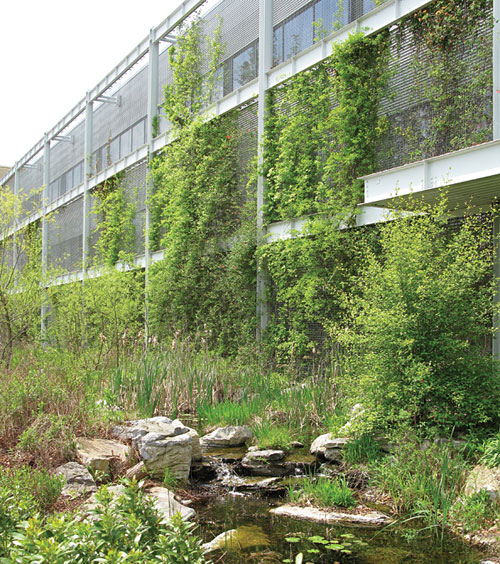
At the National Wildlife Federation Headquarters in Reston, Virginia,
a living habitat is incorporated into the building façade.
Photo courtesy of James Sable / greenscreen® |
Â
Controlling lighting at night, a "dark sky" practice, means
that the design professional can provide both a safe nighttime
environment without prohibiting a view of the night sky and stars
to the surrounding neighborhood. According to April Ruedaflores,
Marketing Manager of Kim Lighting, "Designers should be able to
harness light and place it where it is needed."
|
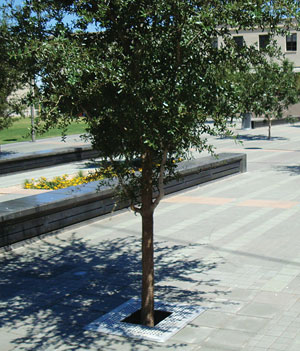
Phoenix Civic Space Park features paver grates with unfinished aluminum
trim rings to provide stormwater management.
Photo courtesy of Carol Brennan Associates |
When using glass flooring to provide daylight harvesting,
Tim Czechowski of Jockimo Inc. remarks, "There is an old saying,
'knowledge is power,' and that in order to choose the very best
glass flooring and glass treads/steps, one must learn as much
information as possible about the product. Glass flooring is a
liability product and in turn, using the safest possible glass flooring
solution possible is critical when specifying it for projects."
In the response to new market demands for materials that
are safe for the environment, new products are now available that
provide even more sustainability. As an example, a thin exterior
surfacing system, with high thermal properties is made from cement
rather than a petroleum product. John Garuti Jr. of Formulated
Solutions LLC notes that it is now possible for chemistry to
"provide the means to redefine a wall system, combining durability,
flexibility, increased permeability and hydrophobicity − all within
a zero-VOC cementitious system."
Codes and standards are growing green, merging and creating
new regulations. "Specifying systems that exceed code will help
meet the new initiatives of the Department of Energy which is
encouraging the U.S. construction market to build energy efficient
buildings. The commercial fenestration market has improved over
50 percent in energy performance in the last 5 to 10 years and
continues to focus on recycled content, life cycle performance
and waste stream avoidance to bring the industry to new heights
of sustainable building." says Mike Turner, Vice President of
Marketing for YKK AP America Inc.
|
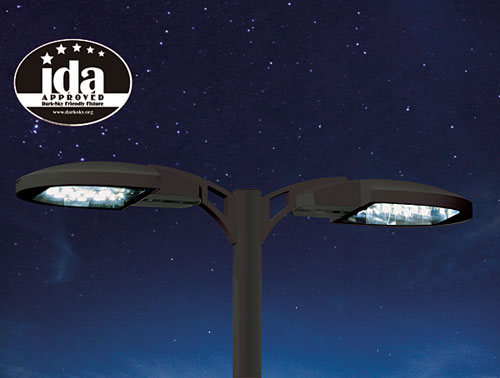
Fixtures that provide dark sky lighting can have a dark sky seal of approval.
Photo courtesy of Kim Lighting |
This article will review a number of strategies for more
sustainable exteriors. The featured exterior products are highlighted
with five of the "Ten measures of Sustainable Design" developed
by the AIA Committee on the Environment. In general, many of
these products meet more of these measures than are listed.1

|
Structural glass flooring can be used to bridge across nature, allowing
natural light to spill into spaces below.
Photo courtesy of Jockimo Inc. |
Â

|
The cementitious finish allows the wall to breathe and increases its
performance in wall systems.
Image courtesy of Formulated Solutions LLC |

|
Example of a corner detail for a building sunshade.
Photo courtesy of YKK AP America Inc. |
Â
STRATEGY #1: Measure 4: Bioclimatic Design -
building living habitats
Sustainable design conserves resources and maximizes comfort
through design adaptations to site specific and regional climate
conditions.
The Vertical Wall −designing for living habitats
and energy efficiency
The headquarters of the National Wildlife Federation is nestled into
a wildlife area. Designed holistically, the massive planted screen
wall on the south facing exposure is both a natural habitat as well
as a mechanical system that reduces heat gain on the wall's exterior
facade. Indigenous deciduous vines were established to provide
leafy shade in the summer and streaming sunlight in the winter. The
three dimensional metal grid was engineered for the climate and
cooling for the southern exposure of the building.
Providing a living green façade on, or adjacent to, buildings
is beneficial for two main reasons. First, they are systems that can
increase the performance of the mechanical system by providing
both shade and natural cooling. When planted screens shelter
rooftop mechanical systems or building facades, they protect
the units from heat island gains and hot rooftop areas. Air that is
tempered around the mechanical system reduces the cooling load;
less energy is required to cool the ambient air to room temperature.
Secondly, planted screens create a transition zone that incorporates
nature into architecture when used to shade a building façade.
Modular, stacking green wall systems should be rigid, light
weight and engineered to meet required spans and design loads.
Planted green walls should have structural capability and can be
attached at the perimeter of a wall system. Systems are available
that can span from 8 feet to 12 feet and that can resist a 90 mph wind
load. Some important criteria for professionals to consider include:
- Remember that green wall panels are designing with a living system that changes as it grows.
- Think about the importance of materials used to create the metal grids and choose systems that use a high percentage of recycled steel as part of a more carbon neutral design strategy.
- Review plant materials with a landscape architect or horticulturist. Living systems can take a while to mature
and depending on the climate zone or urban environment should be chosen for adaptability and longevity.
- Account for the water, nutrient and drainage conditions that will change as the plant grows.
- Don't underestimate the time of growth, and provide information to the building owner on the reasons for
investing in the maintenance of this living system.

|
Photo at installation showing the gap
between the future green façade and
the building. |
A similar view of the National Wildlife
Headquarters after plant growth has
created a living environment away
from the building. |
Â
One of the latest trends in using green walls is
to create vertical gardens in multi-storied buildings.
When designing at elevated surfaces, the professional
needs to design this system as a series of elevated
planters, understanding the solar orientation and
wind loads as well as providing a means to convey
water to raised floor platforms. Some of the future
advances in green grid façade technologies will be
the incorporation of gray water systems to efficiently
support the building's long term integration of the
plant areas, providing nutrients to the plants as well as
water purification.
Vertical planting systems are also an important
opportunity to contribute to community habitat
planting. As shown in studies like Lloyd Crossing,
by Mithun Architects, calculations can be made that
reestablish native habitat, species, birds and plants to
maintain a sense of place, expanding from the familiar
horizontal approach to the building site to include its vertical
wall surfaces. Planted green wall systems can provide the place
for bird songs, providing an acoustic buffer from the street.
From a planning or community perspective, cities are often
requiring more sensitivity toward the creation of place. Parking
structures and large blank walls on commercial buildings can
become assets rather than eyesores by the placement of vertical
green walls. Using planted vertical green walls can assist the
professional in obtaining credits in virtually every category of
LEED® V3 including site development, water efficiency, regional
credits, energy efficiency, recycled content and innovation.
Planted green walls are an innovative way to make an aesthetically
pleasing and natural habitat for the entire biology of the building
site and the neighborhood of a locale in a new built facility.
STRATEGY #2: MEASURE 6: Water Cycle
Sustainable design conserves water and protects and improves
water quality.
The Horizontal Plane −designing for living habitats and water
conservation
Low growing oregano, marjoram and thyme, bring fragrance
when grown in a permeable, flexible and plantable concrete
paving system. Using permeable, flexible, planted paving systems
provides an opportunity to recharge the local aquifers, the source
of drinking water in all areas of the country. These systems can
assist with federal requirements for storm water management,
reduce heat island effects, and in some communities, increase
the proposed building footprint based on additional detention and
infiltration areas per city ordinances and codes.

|
A section of a typical planted cement paving system
Drawing courtesy of SOIL RETENTION |
Â
Most plantable concrete paving systems are cellular. One of
the newest products is made from pre-cast concrete, cast around
a flexible mesh. Installed correctly, this system will provide a
living horizontal plane in a surface that will provide stormwater
management as well as an innovative green parking garden. Plantable
concrete paving systems provide an opportunity for the continuation
of connecting living habitats across a site's infrastructure.
These systems can be as thin as one and one half inches thick,
and be laid as a two foot by two foot precast concrete mat. The
surface below the mat is prepared with a base of crushed rock,
between three and four inches for residential applications and up to
12 inches for commercial projects. Over the aggregate a structured
soil or root zone is placed, comprised of 80 percent sand and 20
percent organic materials. The mat is set over this engineered
soil surface in grids that are fitted and aligned together. Because
the mat layer is thin and set on top of the root zone, the plantings
share irrigation moisture between all of the cells. In contrast, many
individual cellular pavers are deeper and tend to constrict proper
irrigation moisture from transferring cell to cell. In the Construction
Specification Institute Master spec Section 32 12 43 (1997 Section
02795), permeable, plantable paving systems have their own
category and performance standards.
The flexible concrete paving system is designed to expand and
contract with the freeze thaw cycle, has low moisture content, and
can be specified in numerous colors to match the designer's palette.
Beside fragrant herbs, landscape designers can specify other low
growing plants, silvery grasses, new hybrid drought tolerant buffalo
grass or even just an aggregate or bark infill. After planting, the
horizontal surface can be mowed as it grows or in snowy climates,
with proper height adjustments can be scraped by snow plows
with teflon runners and squeegee blades. In icy weather, planted
driveways provide, safe walkways as the concrete warmed by the
sun, transfers heat through the soil providing ice melt that infiltrates
into the ground below instead of ponding.

|
Plantable paving met city ordinances and for LEED® requirements as well
as provided additional green parking for the Red Bull headquarters in
Santa Monica, California.
Photo courtesy of SOIL RETENTION |
The new Red Bull headquarters in Santa Monica, California,
designed for LEED® platinum, by architect Yi Shen with HLW
International, used permeable paving for storm management.
Plantable concrete paving systems can assist with LEED®
credits in numerous ways. In site development categories, they
protect and restore habitats, maximize open space and provide
stormwater design credits for quality and erosion control. They
assist with the reduction of heat island effects for non-roof categories
and some systems can also be used for green roofs. These paving
systems can be used as a permeable water filter that can collect
water for re-use, and planted with water efficient landscaping for
more water savings on the site. They can contribute to an innovation
credit as part of an integrated strategy for design and site planning.
Tests have been performed on these systems that show
that they maintain their stability, even under the weight of large
vehicles, providing proof for city fire departments that this product
meets requirements for deflection standards. This product should
be installed as a system. A common mistake is to believe that the
substructure is not needed in order to grow a paved field of grass. These concrete mats can have up to 45 percent replacement of
portland cement with fly ash, providing assistance with LEED® V3
credits for the highest levels of post-consumer recycled content.
Many of these systems are manufactured throughout the United
Sates and can also assist with credits for regional materials.
As an added bonus, planted concrete paving systems are easy
to install and can increase buildable footprints by reducing detention
requirements. Last year, six or seven church volunteers in Florida
installed over 5,000 sf of pavers a day for their new planted driveway
area. Local planning and building departments are requiring more
stormwater onsite retention to comply with the federal National
Pollutant Discharge Elimination System (NPDESII) statute. In
response, architects and owners are providing alternative parking
areas that also double as infiltration basins.
Planted concrete paving systems provide professionals with
many opportunities for LEED® credits including those for site
development, stormwater design, heat island effect, water efficient
landscaping and recycled content not to mention the many ways to
design with these systems for innovation credits. Professionals and
homeowners are planting natural areas in constructed parking lots
and driveways to increase green space. Installing planted driveway
paving systems can contribute to the reduction of the heat island
effect in urban areas, create more opportunities for storm water
detention, and help the environment with an ecological alternative
to solid asphalt or concrete paving.
| Permeable, Flexible
and Plantable Paving Systems Increase Buildable Area |
A church in the midwest is currently in the midst of a parking
lot expansion, but is limited in the number of parking stalls they
can install by the size of the detention basin required to maintain
the stormwater runoff from the new paving. By choosing a plantable
concrete paving system for the parking stalls they are able
to lower the runoff amount due to infiltration through the pavers,
and reduce the size of the detention basin. They are hoping to
receive full approval by the city to allow for more parking within
the confines of their lot. |
STRATEGY #3: MEASURE 3: Land Use & Site Ecology
Sustainable design protects and benefits ecosystems, watersheds,
and wildlife habitat in the presence of human development.
Trees − managing pedestrian shade and increasing energy efficiency
One tree makes up the CO2 produced in the manufacturing process
for some tree grates in less than three years. After that, trees
continue to benefit the environment by increasing air quality and
decreasing the urban heat island effect.2 Tree grates can be made
from one hundred percent recycled iron extracted from old vehicles
and appliances and they are also one hundred percent recyclable.
That's good for the environment and good for designers who care
about the carbon footprint of materials.
Like planted driveway pavers, the success of a tree planting
system depends on the composition of the soil, the type of tree and
the engineered base. Trees are a living system. They need to be
maintained, watered, and nourished throughout their life span and
expected growth pattern. Planting trees and providing stormwater
detention in urban areas, benefits the ecosystem, watersheds and
wildlife habitat.

|
Phoenix Civic Space Park features aluminum trench grates in a custom
frame for a fountain, and trench grates along a water wall to provide a
space for play and cooling in this hot urban setting.
Photo courtesy of Carol Brennan Associates |
Â
Tree grates and stormwater trench drains should be durable
providing long lasting enclosures that can last over forty years.
These components need to weather in the harshest of urban
environments, withstand salt spray, snow plows, traffic, the grit
of urban rainfalls as well as the hot humidity of summer. They
are most durable when specified in unfinished iron that weathers
to a burnished industrial surface or unfinished aluminum that
can withstand harsh marine environments. When used in an
urban setting they can be installed with pilfer proof tie downs, to
prevent theft.
As with vertical walls and planted paving systems, designing
for an organic environment means educating the community or the
client in the management of the system. Tree grates are sized by
the growth patterns of a tree, and can "grow" as the tree matures
with break panels that are adjusted throughout the lifespan of the
tree. Design flexibility is important and so is the branding of the
environment as tree grates and storm trenches can be imprinted
with the name of the city, a facility or even an amusement park.

|
Two views showing street tree grate retrofits for existing trees in City
Heights Center − San Diego, CA |
Â
When City Heights decided to retrofit their streets, they were
able to do so without cutting down the existing trees at the curb's
edge. By working around the existing tree roots, arborists were
able to engineer constructed soils to maintain a planting channel
or link between the trees so that they can share moisture content
and grow as a natural system. As shown, a section of a tree paver
grate demonstrates that the tree can be protected at its base by tree
grates with openings to provide irrigation and impact damage from
pedestrians and their pets.
The Colorado Tree Study provides a comprehensive list
of the benefits of trees in urban areas.3 According to this study,
trees help with carbon sequestration, reduce pollutants, protect our
water, save energy, extend the life of paved surfaces by blocking
UV rays, increase traffic safety, improve economic sustainability
and affect consumer perceptions and behaviors. Providing trees
along a neighborhood street applies to many LEED® categories,
particularly in the new LEED® s for Neighborhood Development.
STRATEGY #4: MEASURE 8:
Materials & Construction
Sustainable design includes the informed selection of materials and
products to reduce product-cycle environmental impacts, improve
performance, and optimize occupant health and comfort.
Exterior walls −curtain walls and sun shades
Harnessing sunlight requires integrated thinking. Designers must
know the climate they are designing for, the orientation of the building
and the angle of the sun at various times of the year, as well
as educate building owners, operators and occupants. In addition,
lowering the energy requirements of a building will also compensate
for the energy lost through even high end insulating windows.
Numerous studies show that humans are healthier and happier when
they have adequate amounts of daylight and views, but in many
climates, this can place an expensive burden on the thermal flow of
the building.
Manufacturers are engineering new aluminum window
systems and facades with high performing thermal properties. New
façades can also incorporate thermal breaks into the anchors that
attach exterior sunshade devices. Exterior sunshades control the
sunlight entering a building by blocking the high sun angles in the
hottest part of the year and allowing sunshine to enter the building
when it is cold. A passive strategy that reduces the mechanical load
on the building, sunshades are effective because they block heat
rays from striking the building, reduce solar heat gain and thereby
help lower energy consumption.
Sunshades also improve visual comfort for building occupants,
reducing glare as well as adding to the overall aesthetic of the
building façade. Integrating sunshades into aluminum curtain walls
can be challenging. Adding sunshades to a structural system can
often cause thermal bridging creating cold points that compromise
the energy efficiency and condensation resistance of the system.
Energy-efficient aluminum frames and sunshades are now being
engineered to stop thermal bridging.

|
Sunshade with thermal anchor as part of a façade system
Photo courtesy of YKK AP America Inc. |
Â
When choosing an aluminum storefront, curtain wall, or its
many components, architects should minimize the energy flow
between the interior and the exterior by incorporating thermal
barriers into the cladding systems. This can be done by specifying
high performance systems that have good insulating properties (also
knows as U-values). When selecting a thermal barrier the lower
the thermal conductivity of the material the better the system's
performance. A common error when integrating building envelope
components is "short circuiting" the insulating properties of the
system. An example of this is placing a framing system directly
on the slab making the thermal barrier ineffective. Shimming the
system from the base of the slab with low conducting materials, like
high-impact shims, isolates the systems and improves the thermal
performance of the building. Other components like sun shade
devices must also be integrated with the curtain-wall or building
system to prevent thermal bridging.
According to Mike Turner, Vice President of YKK AP
America Inc., "In the past, architects could meet many building
codes with just a single pane of glass, and no thermal barrier. Today,
the aluminum industry is challenge to provide high performance
storefronts, curtain walls, and window enclosures that maintain their
structural integrity, provide good thermal performance and exceed
the current codes in order to meet current and future challenges for
energy savings."
One of the main challenges facing professionals is how
to achieve carbon neutrality, or the design of a zero net energy
building. The U.S. Department of Energy is encouraging research
by providing funding for their goal to create marketable net zero
initiatives by 2025.4 Net zero design initiatives mean that the project
produces at least as much energy as it uses in a year. Near zero
energy is a building that use some nonrenewable energy generation
as a backup.
Structure, air, water, energy − these are the performance
areas that are critical for frame manufacturers. Frames have to
have structural integrity and meet new building codes that provide
protection from hurricanes. They may also provide blast mitigation
as well as meet high standards for energy performance. Sometimes
the codes conflict − for example, the heavier material required for
security may not be optimal for good thermal performance unless a
thermal barrier is incorporated. Heavier glass required for security
installations may also mean thicker, heavier frames to support the
heavy dead loads, increasing the cost of the product. Different
climates can also create different challenges for insulation, thermal
performance and finishes.
A comprehensive evaluation of the requirements must be
made to ensure the systems meet all of the requirements of the
building structure. The American Architectural Manufacturers
Association (AAMA) provides guidance on window performance
in the AAMA 101/A440 standard. Window products classified with
an AW Class designation are required to pass performance tests for
air infiltration, water infiltration and structural performance as well
as life cycle tests to ensure the products will stand up to the needs
of the commercial market.
Aluminum is now one of the most recycled products used in
manufacturing. Aluminum has a long life cycle Sunshade with thermal anchor as part of a façade system and can be recycled over and over again and still maintain structural stability. Using
recycled aluminum means that the manufacturer uses only 5 percent
of the energy that would have been used in raw Aluminum products.
Architects are now specifying recycled content from manufacturers
with very little additional costs for the system in order to meet
LEED® requirements and to reduce the use of raw materials.
The new aluminum sunshade with a thermal break is one
of the first aluminum products to have cradle to cradle (C2C)
certification. C2C certification is defined as the evaluation of the
eco-effectiveness of a product by assessing the materials used in
its production as well as the production process itself, including the
use of renewable energy, water conservation and stewardship, and
the manufacturers' social responsibility.5 Manufacturers are well on
their way to solving the issues of structural and energy efficiency to
meet future codes.
|
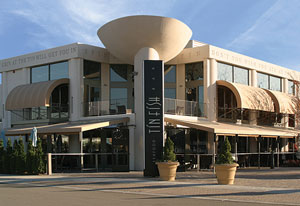
The Tin Fish restaurant in Clinton Township, Michigan designed by Ron
and Roman LLC uses a cementitious thinset exterior surface system on
the exterior walls.
Photo courtesy of Formulated Solutions LLC |
Exterior surfaces −a new material that can reduce the use of
fossil fuels
Thermal comfort is one of the main reasons humans build shelters.
The exterior façade needs to manage moisture, insulate and
temper the climate from the outdoors to the inside. Within this
framework there are many building systems that contribute to
successful thermal cladding. Cement-based, thin exterior surfacing
systems provide a material alternative that reduces the product-cycle
environmental impact while improving performance and increasing
thermal comfort.
Typical of all exterior insulating finishing systems (EIFS), this
system is comprised of a base coat, primer, and a 1/8-inch finish
coat. In a one-coat stucco wall system, the finish and primer are
applied over the stucco base. Unlike acrylic finishes, cementitious
products are not petroleum-based. According to a compilation
of three University studies,6 the initial embodied energy of this
cementitious product is an order of magnitude (10 times) less than
that of acrylic surfacing. Cementitious thinset exterior surfacing
systems are a new class of building material providing:
- Long-term microbial resistance
- corrosion resistance
- chalk resistance
- increased color retention as a result of its resistance to UV degradation
- fire retardation
For all exterior claddings, professionals need to be
knowledgeable about wall construction details, including vapor
and weather barriers, flashing and drainage channels. Both acrylic
EIFS and thin cementitious exterior surfacing systems provide
good thermal barriers but the difference between the two is in the
properties of cement that have environmental advantages over the
petroleum based, acrylic, EIFS finishes. Cement provides both
permeability and hydrophobicity.
As measured by a third party testing agency,7 the permeability
of concrete thin set exterior wall surface has 3.3 to 4.2 times more
water vapor transmission than the acrylic based EIFS products
sampled.
Permeability is expressed in grains of water vapor/hour/
square foot at a known differential vapor pressure. Materials are
classified by both the commercial and residential codes in several
classifications and a class 3 vapor permeable material has a perm
rate greater than 10 perms recommended for use in all climates.8
The higher the perms the faster water vapor will pass through or
allow the wall to breathe, which eliminates mold in the building
wall system. Vapor membranes used as part of a well constructed
wall system have perm rates above 58. Combined with a cement
thin set exterior surface, also with a high perm rate, this integrated
wall system can provide a healthy solution for the prevention of
mold or bacterial growth in hot humid climates without adding
harmful biocides. Cement thin set finishes have also been tested
for hydrophobicity and demonstrate a documented ability to
shed water while allowing water vapor to escape from the
wall system.
Other sustainable aspects of this new product are that it has
zero volatile organic compounds (VOCs) that can be harmful to
human health. This product is cement based and can be finished in
numerous colors. Surfaces can be applied that are either uniform in
appearance or mottled for a more natural, old-world appearance.
The product is part of a sustainable construction process. It is
delivered in bags and ordered by weight. When mixed with water,
this stucco − like wet application is applied to the surface by trowel and will not leach harmful waste products into the soil. The weight
for shipping is less than the acrylic EIFS system and may be eligible
for regional credits in LEED® V3 depending on site location. Unlike
acrylics, this product is supplied in easily disposable paper bags,
there is limited waste on site, and the powdered product can be
stored in unheated enclosures, without damaging its effectiveness.
This surface cladding has also been tested for durability
and is formulated with a polymer modification to give greater
elasticity and flexibility. This modification allows the cement to
resist cracking from thermal changes and building vibrations in
accordance with ICC specifications for use in both EIFS and one
coat stucco applications.
Cementitious thinset exterior surfacing systems are extremely
flexible. The illustration as shown was prepared as it would be on a
job site. The base coat was applied to a flat sheet of foam; mesh was
added and covered by more base coat and allowed to dry overnight.
Then the finish coat was applied. The whole assembly was then
bent into an inverted "U" without any sign of cracking. Flexible,
permeable and durable, this exterior product allows the professional
to select a wall system based on both its performance as well as its
sustainable properties.
STRATEGY #5: Structural glass flooring
Optimizing safety, performance and daylight harnessing
When it comes to dramatic design elements, it is difficult to
imagine anything more dramatic in appearance than the selection
of glass flooring. Glass flooring can be used to bring daylight as
well as drama to any interior, serving as a beautiful and inspiring
focal point. Manufacturers now have the ability to produce and
utilize glass flooring panels for exterior installation that is interior
on one side and exterior on the other. They are able to add a
separate layer of laminated glass to the bottom of the glass flooring
panel via insulated glass technologies. This allows one to take
advantage of the energy efficiencies of insulated glass with glass
flooring panels.
Consider safety as the most important criteria when specifying
glass-flooring. The glass flooring product should be durable and easy
to maintain. To optimize occupant health and comfort, professionals
should consider these main points:
ADA compliant anti-slip walking surface
An anti-slip walking surface needs to exceed the ADA (Americans
with Disabilities Act) requirements of a static coefficient of friction
of 0.5. Various anti-slip surfaces are available and it is important to
verify that the selected surface meets the ADA requirements. One of
these options is a glass aggregate that is melted into the top walking
surface of the glass. This product, being a clear glass, allows for a
clean line of site due to the lack of visual recognition of the anti-slip
surface. Ceramic frit is another product that can be specified as a glass
floor finish. This product is silk screened onto the top of the glass,
much like a t-shirt is printed. The product is then baked onto the top
walking surface during the tempering process. Some manufacturers
have also produced sandblasted finishes, however, these are difficult
to clean and become dirty quickly.
Glass make-up and structural integrity
To assure structural integrity, professionals should work only with an
experienced manufacturer/supplier. A structural glass engineer should
be used to determine the make up of the glass panels. Many manufacturers
offer their own engineering for a small fee. The glass should
be engineered to adhere to the new American Society of Testing and
Materials (ASTM) standard which will be made published in the near
future. It will state that the glass flooring panel should include 3 layers
of glass and 2 layers of lamination. The panels should properly handle
spans associated with deflection rates from standard applied weight.
Modesty/ Privacy
When specifying a glass flooring product, architects should review
the privacy aspects of the installation. In public applications an
"obscure" product should be used so that improprieties do not occur.
This obscure or translucent product should still allow for light to
pass through the glass.
Daylight harvesting
Daylight harvesting is the practice of capturing light from an
exterior wall, by making adjacent walls and floors transparent so
that light can travel freely across room interiors. The glass flooring
product should allow for the maximum amount of daylight to pass.
Therefore, the use of opaque anti-slip material should be avoided.
Daylight harvesting reduces electrical consumption and provides
access to nature by the occupants of a building. Numerous studies
have proven that human performance is increased when exposed to
daylight.
The intent of the Indoor Environmental Quality Credit 8.1:
in the USGBC LEED® V3 reference guide is to provide occupants
with a connection between the indoors and the outdoors. Using
glass flooring panels for daylight harvesting is a means to create
transparency or translucency for this important environmental
strategy.

|
Exterior glass flooring installed over a water feature in a private
residence in Hawaii.
Photo courtesy of Jockimo Inc. |
Â
Exterior installations
Laminated glass products historically have not worked well in exterior
applications when the edges of glass are exposed to the elements.
The development of new and improved lamination products has
eliminated this concern allowing glass-flooring products to be used
outdoors in exterior applications.
STRATEGY #6: MEASURE 7:
Energy Flows & Energy Future
Sustainable design conserves energy and resources and reduces
the carbon footprint while improving building performance and
comfort. Sustainable design anticipates future energy sources
and needs.
LED Lighting − dark sky fixtures that save energy
In a recent Ken Burns documentary on the National Parks, a vivid
image of the sky above Dinosaur National Park, located in Dinosaur,
CO, revealed the majesty of the stars in the night sky. Most Americans
now have to travel to see some of the major constellations because
of light pollution. Manufacturers of light emitting diodes or LEDs
believe that they have the optimal solution to meeting "sustainable
sky" ordinances9 of many communities. LEDs are energy efficient
and do not use any gas in their manufacturing process. The drivers
used for operation contain no lead or mercury. Long life comparisons
between LEDs and other types of lighting systems show that LEDs
when properly installed can last up to 80,000 hours, many more
than High Intensity Discharge (HID), fluorescent or incandescent
light sources. Historically, LEDs have not been used for community
street or site lighting; with recent advancements of LEDs, however,
communities have a new option for saving money and reducing light
pollution. And LEDs can now be used in street and site lighting to
direct light where it is needed to avoid spilling onto adjacent properties,
also known as light trespass.

|
New LED lights save money and energy.
Chart courtesy of Kim Lighting |
Â
In street and site lighting, there are two areas of light safety
design to consider. Designers light the ground plane using low level
luminaires such as bollards and pathway lights, or an entire area
by properly placing controlled, low glare illumination that can be
mounted as high as thirty-five feet from the ground plane.
Sustainable lighting requires that the luminaire, regardless of
the light source, is controlled to light the area required for safety
without sacrificing the view of the night sky above. New LED lights
with modular components or linear strips are designed to harness
and direct LED light output.
LEDs continue to improve and have not reached their full
potential, but it is already evident that they will save energy on many
levels. The potential uniformity with LED allows the customer to use
lower wattage to create safer environments with less money. As an
example: A 150-Watt LED fixture could replace a 250-Watt Metal
Halide product that uses 291-Watts of energy and save $56.00 per
year on energy alone ($0.10/Kwh @ 11-hr per night). The additional
savings are for not having to replace lamps every three years.
Earlier LED light output performance was suitable for low
level and landscape lighting, but with proprietary, micro-emitter
technology and advances in LED technology, the diodes can be
placed in individual modules and angled into any position, focused
to provide the required lighting on the surface area. The DOE and
ENERGY STAR are currently reviewing new criteria for lighting
interior and exterior surfaces, to provide guidance for architects
seeking to choose the most energy efficient strategy for their
purposes.
"By 2011, the ENERGY STAR program will expand to include
a wide variety of LED applications for general lighting. Until then,
the ENERGY STAR program will identify specific types of lighting
applications where LED performance is suitable for inclusion in
the program prior to 2011. Some of these near-term applications
will include street and area lighting, parking garage lighting, cove
lighting, ceiling fan light kits, replacement bulbs, and display, accent
and wallwash lighting."10 ENERGY STAR provides guidance as to
specifying color temperature, spatial uniformity, color maintenance,
rendering and off-state power (which means that the light should not
draw power when turned off).

|
Chart showing options for color selections for LED lighting, including those for wildlife zones.
Chart courtesy of Kim Lighting |
Â
| Arizona State University Study |
As part of a mechanical system, planted screens can shade
a surface of a building providing as much as a forty percent
swing in temperature, providing cooling relief in a tempered
zone between the building and the exterior. In a study at Arizona
State University's School of Architecture, planted green walls
were designed to affect temperature along the light rail waiting
platforms independent of a building structure.
This study demonstrated that the ambient temperature was
8 to 10 degrees lower near the screens and also reduced radiant
temperatures. Researchers used the standard effective temperature
(SETA) index,11 to determine that the use of the green screen
would support an ambient temperature that was acceptable for
thermal comfort. The study measured high temperatures on the
side of the screen with heat radiating sources and established
lower values on the other, as well as a change in the humidity
ratio. The cooling effect was a result of the evapotranspiration
of leafy vines on the planted screen that provided both visual
screening as well as temperature and humidity changes.
In addition, studies from Germany show that biofilters
remove particulates from the urban environment. Using plant
materials in wall systems reduces noise as well as removes dust
from the environment. |
 |
Planted screens cool passengers waiting for their trains in Phoenix, Arizona.
Photo Courtesy of: greenscreen® |
Designers who are concerned that color is limited by choosing
the formerly "blue" LED will now be able to choose from a range
of color temperatures. According to April Ruedaflores, Marketing
Manager at Kim Lighting, "the first LEDs used in site and area
lighting were limited in color temperature ranges." Today's LEDs
can be offered throughout the spectrum, ranging from
5100 Kelvin (bright white) to the very yellow/orange
light similar to High Pressure Sodium color range of
1700 Kelvin (amber). In fact, wildlife organizations
lobbied for these amber colored lights for wildlife
protection in coastal areas. The brighter lights, although
more attractive to humans, disrupted nesting patterns of
many species.
LEDs produce a lot of heat as well as light and as a
single source, they can fail before their projected lifetime
if not well ventilated. Manufacturers are designing
internal thermal management systems to control the heat
by creating housings that have aluminum conduits that
provide a channel for the heat to be exhausted by cooling
ventilators on top of light fixtures. LEDs also have
drivers, similar to the ballast requirement of fluorescent
and HID light sources. Good driver design is important as
the driver also impacts the heat accumulation in the housing. Drivers
also control the voltage output. All drivers are UL tested and drivers
are rated for efficiency. Thermal management by design increases
the LEDs output and longevity as well as the energy efficiency of
LED lighting systems.
LEDs maximize their efficiency in cold climates but the
expected output will depreciate in hot and humid climates.
Although still providing an output greater than the alternatives,
LED manufacturers provide charts indicating performance based on
average outdoor ambient temperatures.
CONCLUSION
According to the AIA Committee on the Environment, "Sustainability
envisions the enduring prosperity of all living things. Sustainable
design seeks to create communities, buildings, and products that
contribute to this vision."12 Professionals are able to take advantage
of new materials, new systems and new methods to assist them in
achieving their vision of environmental sustainable design.
Celeste Allen Novak, AIA, LEED AP principal at rizzolobrown + novak
architects specializes in sustainable design materials and methods and
teaches as an adjunct professor at Lawrence Technological University.
| ENDNOTES |
1Â http://www.aia.org/practicing/groups/kc/AIAS077365
2 Bryan, Harvey, Ph.D. "Outdoor Design Criteria: for the Central Phoenix/East Valley Light Rail Transit System.
School of Architecture, Arizona State University. http://www.design.asu.edu/msenergy/Neeraj/Bryan.pdf
3 Deeks, D'Arcy, 2007 Ironsmith Environmental Impact Study.
4Â http://www.coloradotrees.org/benefits.htm
5Â http://www1.eere.energy.gov/buildings/commercial_initiative/index.html
6Â http://www.encyclopedia.com/doc/1G1-174258995.html
7 Data provided by Formulated Solutions based on research by: Baird, George BSc, MSc, Phd, CEng, Andrew
Alcorn, BBSc, BArch, and Phil Haslam, BBSc, BArch. "The Energy embodied in building materials − updated
New Zealand coefficients and their significance."; Kim, Jong-Jin, assistant Professor of Architecture, and Brenda
Rigdon, project intern, College of Architecture and Urban Planning, The University of Michigan. "Sustainable
Architecture Module: Qualities, Use and Examples of Sustainable Building Materials"; and Hammond, Professor
Geoff and Craig Jones, Sustainable Energy Research Team (SERT), Department of Mechanical Engineering,
University of Bath, UK. "Inventory of Carbon and Energy (ICE)".
8 Rohm and Haas, Technical Report. "Moisture Vapor Transmission Rate Testing." January 30, 2009
9 LaLiberte, Mark. "Understanding Vapor Barriers,"http://www.ecohomemagazine.com/building-science/understanding-
vapor-barriers.aspx?page=2
10Â http://www.darksky.org
11Â http://www.energystar.gov/index.cfm?c=ssl_res.pt_ssl_program
12Â http://www.aia.org/practicing/groups/kc/AIAS077365 |