This CE Center article is no longer eligible for receiving credits.
Advances in building technology for new building security strategies, post 9/11, include ballistic resistant materials developed since the early part of the last century-design choices that have maintained their status at the front lines of the war on terror. This is due in part to strength and durability achieved by time-tested standards in the manufacturing of bullet resistant security panels. While a main part of the response to terror has been staggering funding commitment by the United States government; earmarking more than 12 billion for Homeland Security research and development, ballistics solutions remain at the core of this effort.
Susan Kenzi and Sari Horwitz of the Washington Post, in "Colleges Hottest New Major";
further state "Homeland Security is probably going to be the government's biggest employer in the next decade" said Steven R. David who directs the Homeland Security Certificate Program at Johns Hopkins University.
Experts agree, using tested materials can be one way to design for higher security levels especially in public places. According to Barbara A. Nadel, FAIA, security expert and author ofBuilding Security Handbook for Architectural Planning and Design, McGraw-Hill (2004), oftentimes building owners have not considered planning ahead to accommodate security strategies in building budgets. Owners must leave enough lead-time and designate budgetary commitments for designers to work with security consultants. Barbara A. Nadel, FAIA states, "Working with a team of experts in the schematic phase of a project, designers are able to streamline security strategies leading to better use of ballistic resistant options. An owner can include consultations with local law enforcement agencies, architects, landscape architects, engineers, technical security consultants, and interior designers."
|
Vertical Offset Design, Acrylic
Photo credit: Bullet Guard |
Washington-based Security Design Coalition, advocates a team approach including government officials, the security industry, design professional, and the general public to "work together to insure that our security responses are effective without making our cities and communities look like fortresses."
In the fray of fast track security measures, ballistic resistance design has evolved to meet the challenges of transparent security with a variety of choices; (literally) transparent and opaque materials, composite assemblies, colors, textures and modular applications. There are a number of manufacturers to choose from in the industry, but only some provide bullet resistant rated panel systems as well as in-house testing, contact material suppliers, and fabricators who provide for and install the security design components. Designers follow this process from start to finish; from manufacturer's shop drawings to fabricators specifications review, and installation.
By obtaining the most updated materials testing information, the owner is educated about best choices and appreciates installation strategies. The following steps are also among the primary issues to consider when specifying:
First, the owner determines the security level by risk or threat factor always checking with government agencies to verify guidelines for the area or building type. Second, model your design strategy with several ballistic material configurations to create best sight lines and resistance. Third, review the testing standards and ratings of materials chosen, specifying those, which best fit material requirements for each security scenario.
Ballistic Resistance Design Meets Public Expectations
for Practical Life Safety Issues
Good planning for a terrorist attack impacts the outcome of the damage to property and most importantly human life. The general public understands that while security can be improved in a public place, security measures are to be expected. Appropriate bullet resistant panels in areas with high threat potential has become a key element in designer's specifications for day-to-day operations in the public realm.
|
Sheriff Headquarters, County of Sonoma, CA,
Ross Drulis Cusenberry Architecture
Photo credit: Sharon Risedorph Photography |
Architects, as a part of a security program for a building, help the owner identify and set goals of a cohesive security plan from the get go. Security might have been an employee as security guard and a few strategically located cameras. Today bullet resistant panels and modular systems are used to solve these adaptations, retrofitting security situations.
|
Manufacturers Polycarbonate bullet absorption test
Photo credit: Bullet Guard |
The priority is safety and welfare of the general public. An owner can build to specifications that reduce shattering when building materials are impacted by an attack; glass blowing out, wall materials splintering or spalling and deflecting instead of diffusing ricocheting bullets. Focusing on proximity to human interface areas such as commercial building lobby's, airport terminals, train stations, parking security kiosks, information booths, financial institutions with teller areas, ATM's, and government buildings, architects create new designs, specifying bullet resistant panels for life saving safety.
Central command areas for security strategies create awareness of where to go in case of an attack to get accurate information. Designers typically specify ballistic protection panels in these "safe" areas. To achieve "safe" areas, prioritize open space with a hardened or strong perimeter, maintaining visual and equipment lines. Communication must occur both within the building with security and personnel and to entities outside of the building. A bullet resistant office within the building can be specified to meet this need, for example, with transparent ballistic panels specifications for visual access combined with opaque ballistic panels creating safety barriers. Attacks on a building's utilities or mechanical systems are other examples of safety threats where bullet resistant panels can make the difference to the building function.
|
Ricochet Glass Product, all laminated test samole; glass deflecting bullets
Photo credit: Bullet Guard |
Opaque applications are effective in areas such as surrounding storage cabinetry, incorporated low wall partitions, and areas below counters. Susan Oldroyd, AIA, Ross Drulis Cusenbery Architecture in Sonoma, CA, a court design expert knows, " High security court room spectator areas on first impression, convey the sense of security through the details of the interior finishes and in the hierarchy of the seating arranged for proceedings of the court. Security design is in opaque barriers behind wall paneling, and within the bench itself." Designers specify panels that manufacturers have tested both individually and mocked up in assemblies or systems made with rated ballistic resistant materials. Manufacturers complying with these criteria create an in-house sub-set of standards, which offer added protection in barrier designs.
|
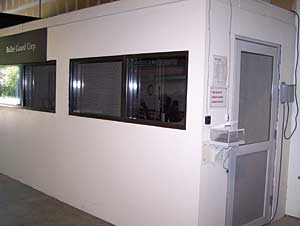
Manufacturers factory tested assembly booth
Photo credit: Bullet Guard |
Applications are specified for many different building types from manufacturer testing information. Ballistic resistant panel systems that are designed to anticipate damage or penetration risks, effectively limit these risks. Panels have been successfully designed for the highest security levels such as drive-up teller windows, lining walls of a police station, and under the counter of courtroom judge's benches, among others.
Hardening Measures in Security Planning
‘Hardening' is the term used to literally describe placing a priority on the strength of the exterior walls of a building, and the process of increasing security of the site or a building perimeter to withstand natural disaster or attack. The use of the building or institution planning security assessment is a team approach; landscape design, architect, engineer, and security consultant. It isn't just about cameras and a security guard keeping watch over the premises. The first order of business is to set goals for the security solutions to be effective.
There is no one example of a material that can use the word proof when associated with ballistics. Bullet resistant materials were first introduced in Chicago in the nineteen twenties. Specifying bullet resistance is preferred and used today to describe bullet resistant fiberglass panels for example used to construct panels protecting the public. Bullet resistant is the terminology used by the protective armoring industry.
|
Polycarbonate with arched voice ports
Photo credit: Bullet Guard |
There are many ballistic products available on the security market, which provide hardening measures. Some of these are ballistic barrier enclosures, custom and modular panels, courtroom shields, interior and exterior aluminum frame and wood doors, secure package pass-thru panels. Designers use interior floor layouts to design mantrap systems and controlled access entries. The architect establishes the location of drive-up window pass-thru booths, transaction and fixed window panel access points in concert with limiting overall site access, visual access while inviting public access to these areas. This is an example of how early site design strategies impact the overall building security plan to incorporate bullet resistant materials.
In a bank building for example, composite panels are chosen with range in a variety of thicknesses depending upon the desired security level or risk factor. One high-level security panel system is steel anchored bullet resistant fiberglass. This can be used in the main teller area of a bank and when combined with special exchange window panels provide a secure yet open environment for banking.
Establishing a Bullet Resistant Standard
There are a number of agencies that test and certify materials to be bullet resisting. The most common are: HPW (H.P. White), NIJ (U.S. Department of Justice), British Standards Institute, European Standard, ASTM (American Society for Testing and Materials). There are many more national and international independent laboratories that test materials to the manufacturers specification. Some agencies are more qualified however to provide testing in the area of body protection; bulletproof vests, and armored vehicles, than ballistic panel systems for buildings.
|
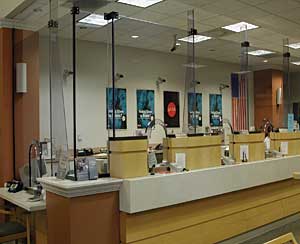
Bank of West Baldwin Park. Vertical Offset Design with Jump Shield
Photo credit: Bullet Guard |
The testing agency that is most commonly specified in the building industry and used by manufacturers is Underwriters Laboratories (UL). The UL bullet resisting section is referred to as Standard 752. Manufacturers refer to the test for in the common abbreviation UL-752. This Standard is accepted in the United States as the industry guide because its tests are consistent and performed independently without prejudice.
Current Levels of Bullet Resistance Under UL-752 |
| Level 1 |
stops |
.9 mm. |
Vel. of 1 175-1295 |
3 shots |
| Level 2 |
stops |
.357 Mag. |
Vel. of 1250-1375 |
3 shots |
| Level 3 |
stops |
.44 Mag. |
Vel. of 1350-1485 |
3 shots |
| Level 4 |
stops |
.3 0 Cal. |
Vel. of 2540-2794 |
3 shots |
| Level 5 |
stops |
7.62 mm |
Vel. of 2750-2794 |
1 shot |
| Level 6 |
stops |
.9mm Uzi |
Vel. of 1400-1540 |
5 shots |
| Level 7 |
stops |
5.56 mm |
Vel. of 3080-3388 |
5 shots |
| Level 8 |
stops |
7.62 mm |
Vel. of 2750-3025 |
5 shots |
|
Adherence to this standard insures that all the materials being tested or certified will correctly meet the various Levels of Protection as determined by the anticipated threat. Most importantly, because UL has its own standards and requires follow-up testing, the manufacturers cannot control the test or change the product after UL certification has been received. This standard of care when specifying UL rated materials can reduce owner's liability, and provide some assurance to the end user against product failure in the event of an attack or disaster. This standard is also critical to developing quality assurances by individual manufacturers.
UL-752 covers materials, devices, and fixtures used to form bullet-resisting barriers, protecting against robbery or holdup or terrorist acts among other disasters. Under UL-752 the term "bullet-resisting" signifies "that protection is provided against complete penetration, passage of fragments of projectiles, or spalling (fragmentation) of the protective material to the degree that injury would be caused to a person standing directly behind the bullet resistant barrier."
Underwriters' testing is done to precise laboratory conditions for extreme cold, extreme heat and room temperature, at precise distances from the weapon, and exact ammunition requirements. This criteria directly impacts the architect's specifications for use of materials.
|
Voice Ports, circular design
Photo credit: Bullet Guard |
Experience has shown, the security industry as a whole, may not agree with the format of these tests but the industry has accepted this consistent method to provide assurance of standards. UL does not recognize standards based upon tests performed at uncontrolled locations such as shooting ranges or in open field tests, which allow for too many variables. The added risk of providing inconsistencies in data feedback serves to prove these test unvaluable or even harmful to the materials purchaser.
Ratings are given to materials that are tested with various weapons ranging from Level 1 the lowest to Level 8. This range is determined by lower velocity handguns at Level 1 to Level 8 is for military rounds. Appropriately, all testing, for any Level designation, has certain criteria that must be met. Meeting this strict criteria will never change; will ultimately not adversely affect Level ratings.
UL ratings are a constant with criteria including some of the following:
- The power range is determined by muzzle energy to foot-pounds. This range goes from
low to high.
- UL consistently tests at three room temperatures, extreme heat, and room temperature and extreme (freezer) cold.
- The tested samples are consistently 12" x 12" in size.
- The material is shot from fifteen feet and the required velocity exceeds "off the shelf"
ammunition.
- The number of shots in each test is determined by the Level being tested.
When using other laboratories, such as H.P. White, each typically tests to what is specified either by the manufacturer or designer. One example of this approach can be applied to Level 1, fiberglass. H.P. White says Level 1 is able to stop a .38 Special handgun, the type normally carried by police officers. UL's Level I will stop a .9mm or a .38 Special handgun. The difference is that H.P. White critera is different and only uses lower velocities, only uses 1 round, but also shoots from 20 feet, five feet further away than UL's standard 15 feet. The UL rating system has effectively raised the bar on industry standards. The security program designers might ask, "Which panel would you prefer to stand behind in the event of a shooting?" The answer is always the rated panel because of the higher standards in testing.
|
Washington Mutual Bank, Vertical Offset Design, UL-752 Polycarbonate
Photo credit: Bullet Guard |
Levels 1-3 are the most commonly used Levels specified. Security concerns include the threat posed by a concealed handgun. Handguns such as .38, 9mm or .357 Magnum easier to conceal than rifles. According to the FBI, 80% of all robberies are committed with lower powered handguns. Because .38 Special and 9mm handguns are so inexpensive and easily obtained and concealed, they are generally the weapons of choice for most perpetrators. Regardless of the variety of weapons portrayed in the movies, most actual robberies and work related violence is committed with one of these weapons.
ASTM (American Society for Testing and Materials) certifies material to be both bullet resistant and Intrusion Resistant. There are 3 classes or levels for Intrusion Resistant materials. The Class or Level is determined during the testing process by how many "steps" it successfully withstands. The more "steps " it passes, the higher its rating. ASTM uses the word Class instead of Level as their classification denominator.
When the main goal is to protect against damage done by means other than guns, the materials may be requested to meet Intrusion or Attack tests. Materials are rated by the type of force being applied to them with various tools such as crowbars and sledgehammers. The protocol followed by those involved in specifications in the security industry is no intrusion or attack tests should be performed using ballistic weapons, due to the confusion of performance expectations of the purchaser. Those agencies that use weapons in these tests are using extremely low velocities that do not compare with accepted bullet resisting velocities. For example, if the intrusion resistant material was tested with a .38 caliber handgun purchasers may conclude it is a bullet resistant material.
Ultimately, UL-752 product compliance measures are in standardized manufacturing. With rated materials, architects are backed by the fact that the materials were tested and rated independently. Rating combinations of materials found in manufactured capture frames for example, are not set by the Underwriter's Laboratory.
In summary, when tested singly UL can give materials performance ratings. Initially specifying the addition of bullet resistant armoring may seem simple and straightforward design approach, but there are issues when ballistic resistance is made to appear no different from other building materials. In actuality, the bullet resistant field is more complex. This is why responsible companies use the security industry recognized Underwriters Laboratories Standard 752 (UL-752) as their guide; understand the difference between listed materials and materials that meet general industry standards. Architectural armorers cannot guarantee stopping all types of bullets with one system, they provide provisional guarantees to make every system as proof as possible to the threat level specified.
|
Choice of Colors for Frame Materials
Photo credit: Bullet Guard |
Some manufacturers supply ratings with assemblies that while not all of the components in a ballistic enclosure are required to be UL listed, the major ones, such as the transparent and opaque materials that make up the bulk of the armoring assembly, should carry that label. As an example, manufacturer's panel attachments may not be UL-752, but they are backed by UL-752 materials.
Design Criteria for Protection Materials
Planning a space for potential attack can be challenge enough, the ability to achieve seamless design for ballistics shielding and achieve an aesthetic balance is another challenge. Manufactures are providing rated backings to panels coated in a variety of designer colors and textures. Manufacturers supply panels, enhancing design intent in a high-end storefronts or the lobby of company headquarters building. Softening the look while hardening the target includes use of powder coat multi-color frame finishes, fabric coverings, wood trims, brass, faux marble, etc.
Bullet Resisting Acrylics are specified with or without the added costs of hard coatings and are applied to one side or both sides of a panel. Combining bullet-resisting polycarbonate/acrylic combinations with hard coat finish gives strength and durability and opens the plan views aesthetically. Designs in lobbies include Level II Polycarbonate with hard coat finish, non-ricochet, and Level III Polycarbonate with hard coat finish, non-ricochet depending on the design threat Level depending upon the location.
|
Modular Interview Booths
Photo credit: Bullet Guard |
Intrusion / Detention Specifying
Specify intrusion / detention material tested and certified by ASTM. Follow Section 1233-93 under ASTM and in H.P. White is HPW-TP-0500.00 for this specification. In either laboratory, the tests are not done like those tests performed for the bullet resistant material. The tests are done in steps that lead to it being rated by Class.
There are 5 Classes in this type of specification. It is important to note, all the ratings are for forced entry. The means used for determining various classes range from striking tools (hammers, sludge, axes) to thermal stress (extinguisher, CO) and chemical deterioration (gasoline, methylene chloride). The more steps it passes, the higher the classification.
Intrusion Detention Specifications |
Low Class II |
1/4"+ |
2 Ply |
Low Class II |
1/2" |
1 Ply |
Medium Class III |
3/8"+ |
2 Ply |
Medium Class III |
3/8"+ |
2 Ply |
High Class III |
1/2"+ |
3 Ply |
High Class III |
1/2"+ |
3 Ply |
High Class III |
1/2"+ |
3 Ply |
|
Bomb Blast Polycarbonate
Bomb blast resistant polycarbonate is available as viable explosives deterrent. Bomb blast represents the ultimate threat level as measured by the concessive blast force against fixed glazing. The test ratings are based on PSI (per square inch) x LBS (pounds) x distance explosives is from polycarbonate.
Bomb Blast Specifications |
Level 1- .530" |
Thickness 20psi |
Approx. 100lbs. TNT @ 1001 |
CG500 |
Level 2- .780" |
Thickness 28psi |
Approx. 150lbs. TNT @ 49.5' |
CG750 |
Level 3- 1.050" |
Thickness 57psi |
Approx. 115lbs. TNT @ 115' |
BR 1000 |
Level 3- 1.300" |
Thickness 57psi |
Approx. 115lbs. TNT @ 115' |
BR 125 |
|
Design efficiency is determined by many factors including sizes of window, strength of frame capture and use of multiple-pane glazing systems. These are significant factors in the performance of the window system against blasts. Ballistic capture frames are recommended to provide the combines strength of the polycarbonate and the frame material usually aluminum or steel.
Transparent Bullet Resisting Materials
GLASS AND GLASS CLAD
Glass comes in Laminated Glass, which is layers of glass stacked together and glued. Glass Clad, is glass with polycarbonate laminated in it. Laminated glass light transparency is 55% (similar to a soda bottle). Transparency of Glass Clad varies with the type of glass used.
The advantage of glass is that it is harder than plastic and cleans with ammonia based cleaner. It is about 2-1/2 times heavier than plastic and is therefore limited to manageable sizes. The use of glass limits voice ports to round stainless steel voice ports. Glass has to be framed and is limited in design capabilities.
Materials using glass are best for exterior applications. The use of glass and glass/clad as an enclosure can be very confining and institutional in appearance.
Current Glass Specifications |
|
Level 1 |
Level 2 |
Level 3 |
| Laminated Glass |
1-3/16" |
1-5/16" |
1-3/4" |
Glass Clad Polycarbonate |
3/4" |
15/16" |
1-3/16" |
|
ACRYLIC
Bullet Resistant Acrylic is available in Levels 1 and 2. It is a cell cast product; it is manufactured in one pour. The light transmission is 93%. It is 43% the weight of aluminum. Super Abrasion Resistant (SAR) has abrasion resistance similar to glass. However, acrylic has many times the breakage resistance of standard tempered glass. If subjected to impact beyond its resistance, Acrylic does not shatter into small potentially injurious slivers as will glass.
|
Yolo County Family Court
Photo credit: Bullet Guard |
Acrylic, when its edges are polished, is sparkling clear, unlike glass which has a heavy
green tint. Because it can be fashioned into a variety of shapes, notched, drilled and fastened, acrylic can give designers unlimited application possibilities. Acrylic comes in two types, abrasion resistant (AR) and Non-AR. AR has a factory-applied coating to the substrate that makes the finish less susceptible to cleaning type scratches. The Non-AR acrylic does not have this second step process. This is a cleaning issue only. If the location is a clean environment, non-AR may be quite suitable and more affordable than AR. Additionally, Non-AR can be periodically rebuffed & most surface scratches removed whereas the AR cannot.
Anti Graffiti Film
Manufacturers have developed a film that makes it easier to deal with graffiti. This film can be applied to Non-AR. Often manufacturers recommend film to be removed and replaced with new film in the field, annually.
Polycarbonate
Polycarbonate is a plastic. It is not bullet resisting unless it is laminated in layers or sheets. It can be laminated with acrylic to achieve bullet resistance.
Acylic Specifications |
Level 1 Acrylic
|
1-1/4" Thickness |
.9 mm |
Level 2 Acrylic
|
1-3/8" Thickness |
.357 Magnum |
Level 3 Acrylic/Polycarbonate |
1-1/4" Thickness |
44 Magnum |
|
Polycarbonate has a light tint appearance, is the strongest plastic and captures the buellet instead of deflecting it, making it desireable for lobby situations where customers may be hit by spall.
Polycarbonate Specifications |
Level 1 |
3/4" |
Thickness |
.9mm |
BR750 |
Level 2 |
1" |
Thickness |
.357 |
BR1000 |
Level 3 |
1-1/4+" |
Thickness |
.44 Magnum |
BR1250 |
Level 4 |
1-1/4" |
Thickness |
12 Ga. Shot gun |
BR1250 |
|
Opaque Bullet Resisting Materials
Opaque materials are used in areas that are not transparent such as cabinets, under counters and walls. The most commonly used opaque materials are steel and fiberglass.
|
Interlock Package Exchange
Photo credit: Bullet Guard |
Steel
UL-752 requires that steel be at least 3/16" open-hearth plate to meet Level 1. There is hardened steel available in higher Levels with UL-752 certification. Steel is very heavy and unless certified its results are unknown. 1/8" or 10 gauge steel does NOT meet UL -752 standards and has no consistency of thickness; it is a cold roll made of old cars and
tin cans.
Various Bullet Resistant Clear (Transparent) Materials
- Acrylic: Bullet resistant acrylic comes in sheet form and can be cut to size for custom
applications. Acrylic is a ricochet product. It is available in UL-752 level I and II ratings.
- Acrylic-AR: Same as acrylic with an abrasion resistant coating. This coating is
typically silicone based.
- Polycarbonate: Bullet resistant polycarbonate comes in sheet form and can be cut to
size for custom applications. It is a laminated product with multiple layers of
polycarbonate. Polycarbonate is a non-ricochet product. It is available in UL-752 Levels
I through III. All bullet resistant polycarbonate laminates have an abrasion resistant
coating on the outside sheets.
- Glassclad Polycarbonate: Glass clad polycarbonate is a mixture of glass and
polycarbonate layers and is laminated together. It is made to order in specific size.
Though not impossible it is impractical to try to cut it after it is laminated. Glass clad
polycarbonates come in various levels of protection including UL-752 Level I through VIII.
(1 through 8).
Fiberglass for Strength and Durability
UL Listed Bullet Resistant Fiberglass Panels are the most specified barrier panels. When given the important task of specifying an anti-ballistic design, it is very important that designers understand some basics about bullet resistant fiberglass panels.
A key question to be answered for ballistic design should be the most obvious; what is the threat level? Within the UL-752 Standard for Bullet Resisting Equipment the 8 threat levels defined earlier govern. Typically the threat level can be determined for any geographic area by consulting with crime statistics kept by local police authorities or by national records kept by the Justice Department. Sometimes the facility owner or facility administrator will have already determined what they believe the threat level to be and provide input for the designer to use a higher-level material. Also, when specifying bullet resistant fiberglass it is important to avoid specifying a panel thickness rather than a UL-752 threat level. Always specify the UL-752 threat level to be defeated since panel thick nesses may vary from one manufacturer to another.
Bullet resistive fiberglass is usually a multi-ply laminate made of woven roving "e-glass" that has been mechanically impregnated with a resin matrix. Industry experience also shows epoxy-based resin systems should be avoided, as they tend to create a highly rigid panel that does not delaminate well. Good delamination of the various plies of fiberglass is the key to defeating the kinetic energy of the projectile. Polyester resins that have been thermo set (cured) under heat and pressure will provide the best delamination.
|
 |
Fixed Counter Enclosure with Interlock Package Exchange
and Continuous Voice Port
Photo credit: Bullet Guard |
Material Limitations Effect Specifications
and Delamination Performance
It is desirable to specify panels that carry a minimum of a One-Hour Fire Rating per ASTM E119-98 or ASTM E119-00 as these panels have been treated with a thirty percent mixture of Calcium Carbonate or Calcium Sulfate in the resin matrix. Such mixtures not only provide the fire rating but also greatly improve the delamination process.
Fiberglass that has been treated with starch oil should be avoided as starch oil by nature is a hydroscopic material and tends to attract moisture, which leads to faster degradation of the panels. Starch oil fiberglass panels should not be used in an outdoor environment as they will attract moisture and soon lose their structural and anti-ballistic integrity.
Lastly and perhaps most important is the need to only specify fiberglass panels that are UL Listed by Underwriters Laboratories according to the test criteria of the UL752 Standard (Tenth Edition, March 10, 2000) This will ensure the highest quality and the best anti-ballistic performance for the security design.
Bullet Resistant Fiberglass is a fiberglass-reinforced resin. The material is manufactured by mechanically injecting starch-oiled woven, ballistic grade fiberglass cloth with a thermo set polyester resin. The impregnated cloth is placed in a hydraulic hot press and pressed into flat rigid sheets.
Fiberglass is used on walls, ceilings and even floors to protect against bullet penetration. It is an opaque material that is subject to the same standards and tests, under UL-752, as the transparent material. Fiberglass is only a fraction of the weight of steel. It can be
cut on the job if necessary to ensure a perfect fit. Fiberglass is used to fortify judge's benches, witness boxes, walls, doors, counters or any area requiring a lightweight bullet resistant barrier.
When used in new construction, it is recommended that butt joints have a 4-inch wide batten strip backing the same product. That provides a 2-inch overlap in either direction to insure the integrity of the protection level desired. This material is very applicable to retro security installations because it is easy to cut and does not add much weight to the floor loads of an existing structure that a steel fabrication might add.
Fiberglass Specifications |
Level 1 |
5/16" |
3.0 lbs/per sq.ft |
96lbs per sheet* |
.9mm |
Level 2 |
7/16" |
4.5 lbs/per sq.ft. |
144lbs per sheet |
.357 Mag. |
Level 3 |
1/2" |
5.0 lbs. " |
160lbs " |
.44 Mag. |
Level 4 |
1-3/8" |
13.5 lbs " |
432lbs. " |
.30 Cal. Carb |
Level 5 |
1-3/8" |
13.5 lbs. " |
432lbs. " |
12 Ga. |
Level 6 |
7/16" |
4.5 lbs. " |
144lbs. " |
Uzi |
Level 7 |
1-3/8" |
13.5 lbs " |
432 lbs " |
5.56 Rifle |
Level 8 |
1-7/16" |
14.5 lbs. " |
464 lbs. " |
7.62 Rifle |
* Sheet sizes are 3' x 6', 4' x 8', 4' x 9', 3' x 8', 3' x 9', 5' x 8', and 5' x 9' |
|
Priorities for Building Typologies
Traditionally financial institutions, police, judicial institutions required ballistic designing, but today media centers, public transportation centers and regional utilities centers are prioritizing ballistics measures. This includes installing protective barriers in the form of landscaping, lighting, and motion sensors, adding panel systems to their building facades, mechanical equipment and intake vents. These public institutions are creating a strategy for controlled access and setting up key people for carrying out the day-to-day security plan while providing more site training for preparedness. Public acceptance of barrier designs is not only subjective but a fact most users welcome.
Many employers are fearful of customer rejection of bullet resisting barriers. But customers are increasingly asking for this protection because they know they are safer in a store with visible security. The fact that fifty percent of workplace homicide victims work in retail establishments is not lost to the consumer. Levels 4-8 are for higher-powered rifles. These Levels are generally used for street facing offices where drive-by shootings may occur. Computer, electronic or telecommunication equipment may be exposed to exterior threat.
Integrated Fabrications Bring Added Security
Protection panels are installed both above and below the countertop. Polycarbonate spreads to capture the bullet. This ability prevents bullets from ricocheting off the protection barriers and possibly hitting objects in the vicinity.
For example if a lobby is under fire, there will be some containment of the projectiles within the material itself. Federal government agencies select design professionals that have experience with security consultants, manufacturers and industry leaders. Through new technology such as virtual design modeling software tools and enhancement technologies, laboratory explosives testing, and ballistic projectile testing designers can project strategic methodologies to bring added security. These are some ways for designers to anticipate disaster effects and create designed preventive measures to be "virtually" tested before specifications are finalized.
Efficient Manufacturing Saves Time and Money
How can owners save money in this area of construction? If an institution is moving, the acrylic panel systems are removable and can be restored at a new location with reuse of the panels saving as much as 40%. This savings is reflected in time, materials, and quantity ordered.
Modular Units Vs Custom
Modular construction is also completely fabricated by the manufacturer, shipped to the job site and installed by other installers or the manufacturer. Modular units are generally floor to ceiling and can be single or double counter top widths in a public space. They are made for interior transaction or lobby use. They can be stand up or sit down and offer numerous options such as privacy panels. Modular units are particularly appropriate when short-term building leases mandate short-term applications or transportability. They are often considered fixtures and not permanent building improvements. Modular Units consists of three parts assembled by the manufacturer.
In the UL-752 fiberglass finished with a plastic laminate for example, is the material combination specified as a custom finished application. This can be used for a counter top with recessed deal trays and include fiberglass inlays. A transaction window might call for a UL-752 clear material panel choice customized with a natural voice port or opening with opaque soffit to match base. Manufacturer's ballistic capture frames which hold the UL rated panels in place, are calculated as to thickness and size of material in ratio to rabbet depth of edge engagement.
These parts are attached together to form one 8 to 10 foot high structure. They can be very basic or customized to a company's logo colors and finishes. Counter tops can be straight, curved or bull nosed. Add-on components consist of doors, solid walls and large item pass-thru.
However there are both opportunities and challenges of fast-track projects, which may not allow the time for proper test results and design. This construction method choice has the advantage of bringing the project to completion in a timely manner thereby increasing the level of security provided for the continuous operation of the facility while it undergoes security installations.
Glossary of Terms
By Michael Gips
Common ballistic terms, meanings, and applications.
1. Threat Side: this is the side of the bullet resistant barrier that the threat would come from. It is typically the lobby or public side.
2.Protected Side: this is the side of the bullet resistant barrier that is protected. It is typically the employee side or the side where the money is kept.
3.Non-Ricochet: do not allow the projectile (bullet) to ricochet thus capturing it within the bullet resistant product. This prevents injury to people or customers on the threat side of the barrier such as a bank lobby, and lowers site liability for the end user.
4.Ballistic Capture: this is the amount of holding area the material is framed in. Various products have requirements that refer to the amount of capture the glazing is held in. For example a bullet resistant UL-752 level I glass would require a minimum 1" of ballistic capture.
5.Level Of Protection: Refers to the ballistic stopping capabilities of the product. There are various levels of protection in the ballistic field and they are monitored by various testing agencies. (See Testing Agencies)
6.Spall and No Spall: "Spall" means to chip or splinter. In the ballistic industry "Spalling" occurs when the projectile (bullet) hits the threat side of a bullet resistant glass product and the chips or splinters of glass can be released into the protected side of the barrier possibly injuring someone. A product can be bullet resistant and still have possible spalling. A no spall product does not allow the chips or splinters to come off of the glass.
7.Architectural Armorer: A company that specializes in armoring buildings.
Terms and details used in Designing Systems.
8.Vertical Offset Design: This is typically a design where the bullet resistant materials are stood vertically above the counter and are staggered or offset front to back from one another. The panels overlap each other by a minimum of 2" and are offset by about 1". (See Detail #1, page 11) This design is good for radius counters and provides good sound transmission through the "offsets". The system is perpendicularly braced with baffles for stability.
9.Butted Design: this is typically a design where the bullet resistant materials are stood vertically above the counter and are butted together end to end. The seams are butted with perpendicular baffles made of the same material as the barrier. These baffles also provide stability to hold the barrier in place. (See Detail #2, page 12)
10.Baffles: a support brace used in ballistic barriers that typically sit perpendicular to the main barrier and helps laterally support the barrier. It also provides a ballistic backer at seems in a butted design. (See Detail #3, page 13)
11.Framed Design: this is when the main ballistic material is supported in a frame system. When framing ballistic materials you must follow the manufacturers recommended capture of the material. Frames can be made of Aluminum or steel. Wood frames are not recommended for bullet resistant systems. Frames that completely capture the glazing are the safest under live fire. Frames with removable stops must have minimum capture and have numerous security screws holding them into place so that the stops do not come off during live fire. (See Ballistic Capture Frame Detail, page 14)
12.Voice Ports: Voice ports allow the transfer of sound naturally through a bullet resistant barrier without the use of an electric intercom system. Voice ports are typically made of the same material as the barrier itself and can be round, rectangular, square, horizontal or vertical. They can also be closeable in exterior applications. Custom voice ports are also available. This can help the architect blend the bullet resistant barrier in with the rest of the architecture. (See Voice Ports Detail #5, page 15)
13. Modular Systems: Modular systems are typically framed systems that can be bolted together to make the entire system. They are used in storefront applications and typically bolt to the floor and span to the ceiling. Modular systems are very popular with check cashiers or financial services companies that lease their space and may want to move the barrier to a new location someday. Modular systems can be modified to fit new opening sizes with ease. (See Modular Details #6, page 16)
14 (Mantrap) Mantrap systems are used in locations where access behind the bullet resistant barrier needs to be limited to certain persons such as employees. Mantrap systems are sometimes used when employees are coming in and out of the system frequently. Typically a mantrap system has two doors to go through prior to actually getting into the protected side. The doors are configured to only open one at a time. A person enters the mantrap first door and the second door will only open when the first door is closed. This would stop an intruder from forcing his way into the protected side by following an employee through door number one. Door number two is opened by someone already in the protected side that can see who is in the mantrap. (See Detail #7, page 17)
15 (Deal Tray) Deal trays are used to transfer things (usually money and or paper) through the bullet resistant barrier. Deal trays are most commonly made of stainless steel but can be made of most solid surface materials that one would construct counter tops out of. Deal trays should be a maximum of 1 ?" deep so as to not allow a gun to be put through. Deal trays should be lined with a bullet resistant material that captures the projectile within it. (Non ricochet) (See Deal Tray Details #8, page 18)
16 (Interlocking Package Exchange) Interlocking package exchanges are used for passing larger items such as packages, sodas, retail items that will not fit through the deal tray. The interlocking package exchanges are usually made from the same material as the bullet resistant barrier. They are outfitted with an interlocking device that allows only one door at a time to be open. Clear package exchanges are the safest for security reasons. Some manufacturers make stainless steel and other opaque package exchanges and unwanted items can be placed in them without the employee seeing.
SYSTEMS
The materials listed above are the core components to all bullet resistant applications.
The components are only as good as the system into which they are placed. The framing of a window is as important as the material in the window. While there are UL listed partial systems available, not all systems are applicable to every structural application nor can they be and still be applied to custom design.
17.Standard Components in a Bullet Resisting System: It is imperative that the framework capture the material correctly, that the transaction tray and the package pass-thru not allow penetration of bullets or gun barrels from the threat side.
18.Frames: Ballistic Capture of no less than 7/8" depending upon the material and the Level. Frames are aluminum alloy 6063 or 6066 depending upon Level and structural requirements. Frames can be extruded tube, special "L" angle or special "U" channel or combinations thereof. Some manufacturers have frames finished in baked-on enamel (powder coat) with many colors available to add a designer look.
19.Transaction or Deal Trays: Stainless steel is most common. Can be faux marble poured for designer look. Must not allow penetration of gun barrel, which is tested by doubled fist. If average sized doubled fist can penetrate, so can hand with gun.
20.Package Pass-thru:Allows articles that are too big to pass through the transaction tray to be transferred between the threat and the safe side. Pass-thrus are available in sizes to accommodate a variety of articles from clipboards to parcel post.
Common Building Types and Application
Government lobbies
Office (attorney, electronic, general)
Lobbies
Post office lobbies
Courthouses, judges benches
Law enforcement offices
Financial institutions
Schools
Pharmacies
Safe rooms
Military transaction windows
Fast food service counters, drive-thrus & walk-ups
Convenience store service counter & walk-ups
Media (news, TV, radio) lobbies
Hospitals & medical facilities
Family support, social services offices
Check cashing, exchange windows
Liquor stores
Computer rooms, web sites.
Money counting rooms
Toll gate transaction windows
Public Entities
1. Taxing authorities
2. Licensing authorities
3. Child / Spousal support offices
4. Department of Motor Vehicles
5. Post Offices
6. Court Rooms
7. Human resource departments
8. Human Assistance /Public Aid offices
9. Water / Power Districts
10. Nuclear Plants
11. Police / Fire departments
12. Hospital Emergency rooms
Private Entities
1. Fast food drive up windows and walk up windows and customer counters
2. Convenience stores
3. Banking Industries
4. Safe rooms for residential
5. Check Cashing
6. Commercial customer lobbies where cash is accepted
|
Bullet Guard is an architectural armorer. We specialize in Design, Manufacture, Fabrication and Installation of bullet resistant systems.
We adhere to UL-752 ballistic standards, while designing user friendly and functional systems that are a aesthetically pleasing to the building design.
Bullet Guard Corporation
3963 Commerce Dr.
West Sacramento, CA 95691 |
|