This CE Center article is no longer eligible for receiving credits.
The Triangle Shirtwaist Factory fire of 1911, in New York
City, was an important turning point in the development of
fire safety codes. Immigrant workers trying to flee the fire
found the doors to the ninth-floor stairs in that Manhattan
building to be locked, and the fire escape was flimsy. A total
of 146 people died.
Another tragedy that assured strict standards for interior
doors and emergency egress was the Cocoanut Grove fire in
Boston in 1942, at a swank nightclub in what is now Bay Village,
near the Theatre District in Boston. On a cold November night
at about 10 p.m., with 1,000 patrons in the palm-tree lined
halls, a young couple unscrewed a light bulb to soften the
glow at their table. A bartender told a busboy to replace
the light, who struck a match to better see what he was doing.
The satin ceiling caught fire, and in moments, a fireball
swept upstairs.
As panic spread, the revolving door that was the primary
entrance was hopelessly jammed, and others found side doors
locked; 442 people died.
In the aftermath, cities across the nation revisited building
codes and made sure evacuation in a fire emergency was paramount
in any structure where large numbers of people gathered. One
new requirement was that revolving doors could no longer be
the primary means of egress, and had to have swinging doors
on either side. Sliding doors and overhead doors could not
be an exit. Emergency egress had to consist of hinged or pivoted
doors, of a minimum width and height, that could be easily
opened with minimal effort and that opened in the direction
of exit travel.
The fire at the Our Lady of Angels School in Chicago in 1958,
in which 92 children and three nuns died, led to even tougher
requirements for egress and fire protection in schools, and
in hospital and healthcare facilities as well. The standards
applied to museums, sports arenas, office buildings, and shopping
and entertainment complexes-any building where large
numbers of people gathered.
The standards were put in place both on the basis of performance
and specifications, and spelled out in great detail in the
three regional groups that promulgated model building codes:
the Southern Building Code Congress International, covering
southern and Gulf Coast states and producing the Standard
Building Code; the Building Officials and Code Administration,
covering the Northeast and Midwest and producing the National
Building Code; and the International Conference of Building
Officials, covering California and the West and producing
the Uniform Building Code.
The other model code used by local jurisdictions was the
National Fire Protection Association, which regulated key
life safety elements such as sprinklers and alarms, and exits,
windows, and doors.
Each of the regional groups had requirements for exit doors
that differed slightly, based on the occupant "load,"
for example, the square footage of a building in proportion
to the number of maximum allowed occupants. But the basic
performance-based standard for a door that was to be used
in an emergency was that it should not require any tool, key
or special knowledge to open from the inside; and that it
would take no more than 15 lbs. of pressure to open any latch,
30 lbs. of pressure to initiate the opening, and 15 lbs. of
pressure to swing it open fully.
New rules were also set for the number of exits. Every accessible
space had to have a minimum of one exit. Two exits were required
in stores, hospitals, educational institutions, hotels, apartments,
and office buildings where the occupancy ranged from 10 to
50, and two exits were also required for all floors with an
occupancy of 10 or more. A minimum of three exits are required
in buildings with an occupancy load of 501 or more, and a
minimum of four are required where the occupancy load exceeds
1,001.
Similarly, the required width of exits broadened according
to occupancy. The spacing of exits was based on the idea that
occupants should not have to travel more than 200 to 300 feet
to get to an exit in an emergency.
Many design professionals may not know
it, but changes in fire and building codes since 2000 have
made it possible to use horizontal sliding-door systems in
a wide variety of applications, opening up new possibilities
for emergency egress and the juncture of internal spaces,
while protecting against fire and smoke, ensuring life safety
and enhancing building security.
The changes mark a radical departure from codes developed
over the 20th century that allowed horizontal, accordion-style
sliding doors in only selected applications, and forced architects
to provide emergency exits and separate internal spaces with
standard, wood or steel-framed, hinged swinging doors, a minimum
of four feet wide.
Today, the acceptance of horizontal, accordion-style sliding-door
systems is for all applications except in certain occupancies
which typically involve the storage of flammable material,
the categorization known in codes as Group H. The sliding-door
systems can be used regardless of the occupancy type or occupancy
"load" of the building or the space being served.
This has liberated design professionals to take new approaches
with openings in required fire separation such as airports,
schools, hospitals and museum galleries, while still maintaining
fire and life safety standards.
Retractable horizontal sliding-door systems-allowing
free-flowing openings some of the time and secure closure
when needed-has not only been approved by the two U.S.
national buildings codes, the International Building Code
and the National Fire Protection Association (NFPA) 5000 Building
Code, but has been deemed ideal and in many cases preferable
to traditional hinged swinging doors. As a result, design
professionals have many more options for this essential component
of their craft: the entrance and exit, the free-flowing passageway,
the atrium and the juncture of spaces.
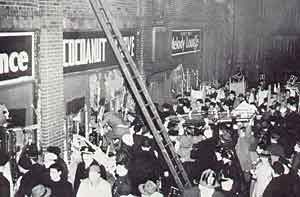
The Cocoanut Grove
nightclub fire in Boston in 1942, which killed
442 people, led to strict standards on emergency
egress and fire protection centered on the
use of hinged swinging doors. |
|
|
Codes Over Time
An important driver of the design of front entrances in the
20th century has been energy concerns, which led to the development
of the revolving door, and later the sliding glass door and
protected vestibule, which provided a seal against the elements,
while accommodating the passage of large numbers of people.
The separation of internal spaces, before the development
of fire codes and increased security requirements, could be
designed with few restrictions, such as the wide-open passageways
separating the galleries at the Louvre Museum in Paris. Ancillary
means of egress was likewise a straightforward affair: standard
swinging doors at stairwells and back-of-house exits, with
little or no requirements for how they would actually function
in an emergency or be used by different groups of people,
such as the disabled, patients in health-care facilities,
or large crowds in entertainment or shopping venues.
All of that changed over the course of the last century,
after tragedies that revealed the need for functional emergency
egress and fire protection, and led to the development of
strict standards in detailed fire and building codes.
The Triangle Shirtwaist Factory fire of 1911, in New York
City, was an important turning point in the development of
fire safety codes. Immigrant workers trying to flee the fire
found the doors to the ninth-floor stairs in that Manhattan
building to be locked, and the fire escape was flimsy. A total
of 146 people died.
Another tragedy that assured strict standards for interior
doors and emergency egress was the Cocoanut Grove fire in
Boston in 1942, at a swank nightclub in what is now Bay Village,
near the Theatre District in Boston. On a cold November night
at about 10 p.m., with 1,000 patrons in the palm-tree lined
halls, a young couple unscrewed a light bulb to soften the
glow at their table. A bartender told a busboy to replace
the light, who struck a match to better see what he was doing.
The satin ceiling caught fire, and in moments, a fireball
swept upstairs.
As panic spread, the revolving door that was the primary
entrance was hopelessly jammed, and others found side doors
locked; 442 people died.
In the aftermath, cities across the nation revisited building
codes and made sure evacuation in a fire emergency was paramount
in any structure where large numbers of people gathered. One
new requirement was that revolving doors could no longer be
the primary means of egress, and had to have swinging doors
on either side. Sliding doors and overhead doors could not
be an exit. Emergency egress had to consist of hinged or pivoted
doors, of a minimum width and height, that could be easily
opened with minimal effort and that opened in the direction
of exit travel.
The fire at the Our Lady of Angels School in Chicago in 1958,
in which 92 children and three nuns died, led to even tougher
requirements for egress and fire protection in schools, and
in hospital and healthcare facilities as well. The standards
applied to museums, sports arenas, office buildings, and shopping
and entertainment complexes-any building where large
numbers of people gathered.
The standards were put in place both on the basis of performance
and specifications, and spelled out in great detail in the
three regional groups that promulgated model building codes:
the Southern Building Code Congress International, covering
southern and Gulf Coast states and producing the Standard
Building Code; the Building Officials and Code Administration,
covering the Northeast and Midwest and producing the National
Building Code; and the International Conference of Building
Officials, covering California and the West and producing
the Uniform Building Code.
The other model code used by local jurisdictions was the
National Fire Protection Association, which regulated key
life safety elements such as sprinklers and alarms, and exits,
windows, and doors.
Each of the regional groups had requirements for exit doors
that differed slightly, based on the occupant "load,"
for example, the square footage of a building in proportion
to the number of maximum allowed occupants. But the basic
performance-based standard for a door that was to be used
in an emergency was that it should not require any tool, key
or special knowledge to open from the inside; and that it
would take no more than 15 lbs. of pressure to open any latch,
30 lbs. of pressure to initiate the opening, and 15 lbs. of
pressure to swing it open fully.
New rules were also set for the number of exits. Every accessible
space had to have a minimum of one exit. Two exits were required
in stores, hospitals, educational institutions, hotels, apartments,
and office buildings where the occupancy ranged from 10 to
50, and two exits were also required for all floors with an
occupancy of 10 or more. A minimum of three exits are required
in buildings with an occupancy load of 501 or more, and a
minimum of four are required where the occupancy load exceeds
1,001.
Similarly, the required width of exits broadened according
to occupancy. The spacing of exits was based on the idea that
occupants should not have to travel more than 200 to 300 feet
to get to an exit in an emergency.
The Sliding Door and Codes
The standards strictly limited the use of horizontal sliding
doors. These systems could not, for example, be the primary
means of egress. Any horizontal sliding-doorsystem that separated
internal spaces also had to meet tough requirements for fire
resistance. The distinction between a fixed wall and a door
was that flammable objects could be stored next to a wall,
but not in the way of a swinging door; moveable partitions
fell into a kind of no-man's land between the two.
Horizontal sliding-doortechnology grew out of a desire to
create a high acoustically rated folding partition which would
produce sound transmission ratings comparable to insulated
walls. In the early 1960s, early models where developed that
used a two-track folding partition system that consisted of
two walls of steel independently suspended from overhead tracks
and a six-inch dead air space. But while built with acoustics
in mind, the horizontal sliding door was also capable of resisting
fire.
In the 1970s, the horizontal sliding door passed the two
major fire testing methods for door assemblies to withstand
the passage of fire, holding up in intense heat rising to
1,700 degrees Fahrenheit and maintaining structural integrity.
In 1986, the National Fire Protection Association committee
that writes the Standard for Fire Doors and Windows first
considered the introduction of a new chapter for the installation
of special-purpose horizontally sliding accordion or folding
doors. A few years later, the NFPA committee that writes the
Means of Egress section considered a recommendation to permit
the use of certain horizontal sliding doors as a means of
egress in selected applications-to protect elevator lobbies,
in buildings where the occupant loads were less than 50, and
as fire and smoke barriers in healthcare facilities.
Sliding doors had been previously accepted for elevator lobbies,
and the committee also determined that doors that slide horizontally
did not present any more of a problem than swinging doors
that open against the direction of travel-the latter
deemed acceptable for buildings serving occupant loads of
less than 50. Finally, horizontal sliding doors served as
effective smoke barriers, which were required under the code
for health care facilities virtually every 75 feet, to facilitate
the "defend in place" approach used with occupants
with special needs in fire emergencies. All of these proposed
changes appeared in the 1988 edition of the Life Safety Code,
and the three regional model building codes subsequently adopted
them as well. The horizontal sliding door was thus acceptable
as an alternative to traditional swinging doors in selected
instances.
The Final Push
In 2000, the three regional building code entities merged
into a single group that produced a single national uniform
code-the International Building Code. Around the same
time, the horizontal sliding door had a final breakthrough:
an acceptable means of egress in all applications, regardless
of occupancy loads, except for storage areas for flammable
materials. The National Fire Protection Association changed
its code as well, essentially to reflect what was in the IBC.
A chief characteristic that convinced the code writers was
that the sliding-door systems could actually be easier to
get through in an emergency than conventional swinging doors,
while providing an effective barrier for fire and smoke, and
serving as a key segregating device in other security emergencies.
"The burden of proof is high. The industry is reactive
to cataclysmic events," said Tim Welch, vice president
of marketing at Won-door, based in Salt Lake City, Utah. "We
did a lot of education and showed that these systems were
reliable, electronically supervised, and functioned well for
egress. So over about 15 years, it's been mainstreamed.
There are no restrictions on use. They can be used in any
occupancy. This is all very new to enforcement professionals
and design professionals."
The idea of doors not swinging for exit travel is a significant
change, maybe one of the more significant changes in the building
code for the last 60 years, Welch said. The change is in recognition
of new technology that makes sliding-door systems ideal as
both fire and smoke breaks and emergency exits, particularly
for the disabled. This latter issue has been a primary concern
for independent living and Universal Design advocates, because
traditional swinging doors proved to be cumbersome for people
in wheelchairs.
Universal Design is the approach to design that allows the
use of the built environment by all people, regardless of
age, ability or situation. It is an attempt to integrate accessibility
requirements such as those under the Americans with Disabilities
Act into one broad approach to make environments usable.
Emergency egress standards developed post-World War II in
particular did not adequately consider the needs of the disabled.
The problem was first recognized by Ed Roberts, a paraplegic
appointed by then-California Governor Jerry Brown to be director
of the state Department of Rehabilitation, who started thinking
about how people with disabilities were supposed to escape
from upper floors and buildings in general in the event of
an emergency or fire. What happens if there's a power
failure? People in wheelchairs obviously couldn't heed
the admonition outside elevators that "in case fire,
use the stairs." Safe staging areas for emergency evacuation
were needed.
Interiors doors that were heavy and swung out or in posed
another problem for those in wheelchairs. Getting the door
open and getting through was unwieldy at best and sometimes
impossible.
Sliding-door systems actually had an advantage in this regard.
Manufacturers developed sensors, integrated processors, and
motor technology that controlled the opening and closing of
the partitions with maximum precision for any circumstance.
Today's sliding-door systems can open with very little
pressure, and have a manual override feature. Backup power
systems are built in. In addition, a person in a wheelchair
can simply bump into accordion-style sliding-door systems
and they will spring open in an emergency. The systems also
automatically stop closing if there's any obstruction,
but then resume closing after a pause to maintain the integrity
of the partition, similar to most elevator doors.
"A large horizontal sliding door in a fire-rated partition
raises a number of questions: is it self-closing? What measures
can be taken to prevent it from being blocked? What are the
implications for someone trying to pass through the doorway
as it is closing?" said A. Vernon Woodworth, AIA, principal
in the Sullivan Code Group at the Boston-based R.W. Sullivan
Engineering.
The use of electronic sensors and controls can address these
concerns, Woodworth said. "This adds a new layer of complexity
to building design and maintenance," he said. But, he
said, "The issue of expectations and habit are key to
behavior in the built environment, and doors are for people
and their use. Side-swinging doors present obstacles for people
in wheelchairs whereas sliding doors do not."
Opening a New Frontier: From Museums
to Courthouses
In recent years, design professionals have been turning to
horizontal accordion-style sliding door systems in museums,
sports arenas, casinos, government facilities, entertainment
and shopping venues, airports, and healthcare facilities.
The use of the systems satisfies fire and building codes but
allows considerable design flexibility. The accordion-style
doors retract into wall recesses and hang from a ceiling track
when closing, but require no track on the floor. The separation
of internal spaces, the design of corridors leading to atriums
and other open areas can thus be seamless and open in ways
that were previously not possible.
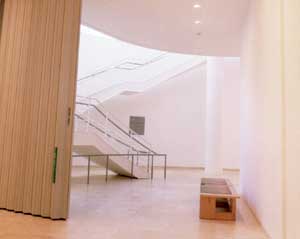
The use of horizontal
sliding-door systems has been popular as invisible
fire breaks at the juncture of internal spaces,
such as galleries at the Getty Museum in Los
Angeles.
Getty Museum, Los Angeles, California.
Architect: Richard Meier & Partners, Architects
Photo credit: Sutton Photography |
|
|
Frank Gehry, FAIA, and his firm, Gehry Partners, LLP, used
10 fire-rated, horizontal accordion-style sliding-door systems
in his acclaimed Guggenheim Museum at Bilbao, Spain, creating
striking interior views among the interior exhibition spaces.
Richard Meier, FAIA, and his firm, Richard Meier & Partners,
Architects used 64 sliding-door systems at the J. Paul Getty
Museum outside Los Angeles to accomplish a similar unobtrusive
design for the collection of antiquities, Impressionist paintings,
decorative art, and contemporary photography.
Tim Love, principal at the Boston-based architectural firm
Utile, Inc., worked on the Getty villa, an extension of the
museum that will open in January 2006, while at Machado and
Silvetti, Associates, Inc., also based in Boston. sliding-doorsolutions
are like "invisible fire breaks," he said: when
retracted, they are actually hard to notice, allowing free-flowing
passage among internal spaces. But they close and serve a
critical function in a fire or other emergency.
The systems are well suited for museums that require this
function and are in place at the Smithsonian and several dozen
other museums, art institutes, and performing arts centers.
Airports face a similar but slightly more practical design
challenge: they must accommodate the rapid movement of thousands
of patrons while complying with life safety requirements and
building security. Horizontal accordion-style sliding doors
can emerge from recessed walls and seal off openings as large
as 60 feet, as is the case at Orlando International Airport.
The systems are in use at the major airports in New York,
Washington, Chicago, Newark, Houston, Miami, and Los Angeles,
as well as others.
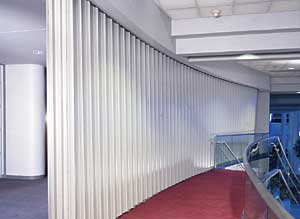
Charlotte Douglas
International Airport, Charlotte, North Carolina
Architect: Odell Associates, Inc.
Photo credit: Art Gentile, KPC Photography
Fire protection and increased security needs
have prompted the use of horizontal sliding-door
systems in government facilities and airports,
such as Charlotte Douglas International Airport.
|
|
|
Government facilities have seen a dramatically increased
need for building security in the wake of the September 11,
2001 terrorist attacks on New York and Washington. At the
Pentagon, where American Airlines Flight 77 slammed into the
side of the building and killed 125 occupants, 38 horizontal
accordion-style sliding doors were in place in the building's
vast network of corridors.
They were there in part because conventional swinging doors
at the end of long corridors were cumbersome for the electric
carts that were used to transport paperwork and supplies.
Some of these doors in the 26-foot-wide corridors had actually
been chained open.
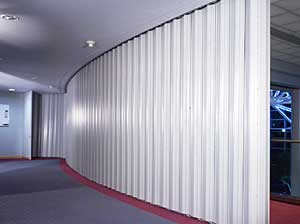
Charlotte Douglas
International Airport, Charlotte, North Carolina
Architect: Odell Associates, Inc.
Photo credit: Art Gentile, KPC Photography
In the retracted position, the systems allow
for the free flow of thousands of travelers,
but close in an emergency and provide a security
barrier. |
|
|
On September 11, the sliding-door systems took on new significance,
activating instantly at the signal of alarm. One general recalled
that he saw a fireball racing down a corridor and felt certain
he would perish, but the horizontal sliding door drew shut,
sealing off the inferno and allowing him to escape.
Courthouses that require free-flowing access for judges and
attorneys but need to be similarly sealed off in a security
emergency have also turned to the systems as a design solution.
Public Venues and Places of Assembly
sliding-door systems are also in use at hotels including
Walt Disney World, the Hyatt, Hilton, Marriott, Fairmont,
Ritz-Carlton, and Intercontinental chains, around atriums
and as a retractable protective barrier around elevator lobbies,
needed to prevent the vertical migration of fire. They are
commonly used in sports facilities for football, baseball,
basketball and hockey, where large numbers of fans must pass
through openings and corridors that must be sealed off in
an emergency while still providing emergency egress.
Shopping malls, with their distinctive fire safety and security
requirements, use horizontal sliding-door systems as long
as 100 feet, that curve and snake along the line of the desired
protective barrier. At virtually every gaming facility in
Las Vegas, the systems take the place of conventional swinging
doors that limit design flexibility and can be cumbersome
for large numbers of guests moving between spaces. At Caesar's
Palace, the system serves as a fire-assembly separator, between
the casino and the shopping center.
|

|
|
Won-Doorâ„¢ products are routinely specified
in major design projects around the world. At
Won-Doorâ„¢ we pride ourselves in making the
most technologically advanced products in the
building construction industry, but we recognize
that our strength is found in the unique level
of commitment and dedication of our people. We
hope you will let us show you how the use of Won-Doorâ„¢
products can make a difference on your next project.
|
|
At hundreds of Wal-Mart stores, the sliding-door systems
serve as emergency egress in back storage areas. Some of the
emergency exits are required to be in the back of the large
stores, and in the event that front entrances are inaccessible,
patrons need to be moved through the storage areas. But the
storage and stockroom areas typically have high ceilings and
require large openings to get products in and out; the sliding-door
systems serve that function but also provide emergency egress
and fire protection. The systems are in use at other large
stores such as Nordstrom, Macy's, Target, and Sears,
and also in smaller sales areas in stores such as Banana Republic
or Brooks Brothers.
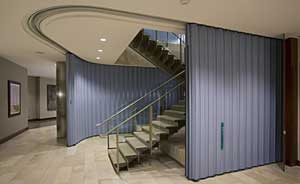
Cerritos Library,
Cerritos, California.
Architect: Charles Walton & Associates
Photo credit: Promotional Design Associates.
With no floor track, the sliding-door systems
can provide hidden fire-rated barriers that
maximize design flexibility, including at
the stairwell. |
|
|
Designers of hospitals, specialized health-care facilities,
and assisted-living complexes have also increasingly turned
to the sliding-doorsolution, particularly as the design of
interior spaces, whether expansive foyers, atriums, and gathering
spaces that take advantage of natural lighting, has been linked
to the psychological well-being of patients. The retractable
systems facilitate interiors that are open and airy rather
than stark and sterile. The same is true in educational institutions,
where stringent fire and building code requirements can sometimes
compromise architectural quality with unsightly permanent
barriers. The systems are in use at university facilities
from Harvard and Duke to Michigan and Stanford.
New applications are also seen in convention centers, theatres,
parking garages, subway systems, and a wide variety of office
buildings.
The Way They Work
Typically, horizontal accordion-style sliding-door assemblies
are custom-designed to be stored in shallow recessed pockets
in walls. These variations on the "pocket door"
are best made to be consistent with the interior finish of
the adjacent space, and stay in the closed, or recessed position,
with the use of simple magnetic latches. The fire door is
installed to ignore obstructions during the first few feet
of closing to allow the pocket cover door to be pushed out
of the way.
Some of the most important features concern electronic surveillance
and power issues.
The door assemblies incorporate the use of a back up battery
system, direct current (DC) motor and an integrated microprocessor
to control the operation of the door during fire emergencies.
AMN Healthcare,
San Diego, California. Architect: Howard Sneed
Architects & Planning.
Photo credit: John Durrant.
Horizontal accordion-style sliding-door systems
are used at stores, malls, casinos, sports
facilities, shopping and entertainment venues,
and office buildings. |
|
|
In a typical system, the 12-volt battery is continuously
charged by the in-house 120-volt electrical system, and the
microprocessor and logic board regularly supervise all critical
operating functions of the door system, two and a half times
per second. In addition, the system replicates a "loaded
stress test" designed to simulate the voltage required
to actually close the door during a real-life emergency. All
fault signals are sounded audibly at the door location and
can be communicated to a remote location in the building or
to an off site central monitoring station.
The vertical "fire-exit-type hardware" attached
at or near the leading edge of the door assembly and is programmed
to respond to light pressure applied in the direction of exit
travel. The building code requires that this force not exceed
five pounds of lateral pressure. Upon activation the door
assembly is programmed to retract a preset distance, typically
36 inches, pause for a moment, and then recycle close. If
the door encounters an obstruction during the closing cycle
it will stop, pause for three seconds and then continuing
the closing cycle. At all times the door can be opened manually.
The horizontal sliding accordion-type fire door is designed
to respond to smoke detector activation, a fire alarm system,
a manual pull station or in some instances even the activation
of a sprinkler flow valve. Upon activation the door assembly
will automatically begin closing. The building code permits
a rate of closing speed not less than six inches and no more
than 24 inches per second.
The Underwriters' Laboratories (UL) listing contains
no limitations on the size of opening width and heights can
be designed up to 23 feet. The typical assembly has separate
listing from UL as a rated fire door assembly for 20 minutes,
one hour, one and a half hours, and three hours. It also meets
the UL 864 requirements for a smoke control assembly.
In terms of installation, the assembly can be designed in
radial configurations and never needs a floor track, both
features that increase design flexibility.
Lag Time in Awareness
The chief reason that horizontal sliding-door systems aren't
used in more applications, manufacturers say, is that design
professionals are not aware of the blanket acceptance of them
in fire and building codes.
"There's always an audible gasp," said Welch,
from Won-door. "I've had 100 design professionals
in a room and there has not been the awareness that the the
publication of the IBC in 2000 said, with a uniform voice,
that you can use a sliding door in any application regardless
of occupancy. It's unheard of. But enforcement officials
felt the technology was better. If it was just as good as
a swinging door, there would be no reason to make a code change."
The International Building Code is clear on the subject.
In Section 1008.1.2, the code states that "egress doors
shall be side-hinged and swinging," but the fifth exception
is this: "In other than Group H occupancies, horizontal
sliding doors complying with Section 1008.1.3.3 are permitted
in a means of egress."
Section 1008.1.3.3 of the International Building Code requires
that the horizontal door systems:
- Shall be power operated and shall be capable of
being operated manually in the event of a power failure;
- Shall be openable by a simple method from both sides
without special knowledge or effort;
- The force required to operate the door shall not
exceed 30 pounds…to set the door in motion and 15 pounds…to
close the door or open it to the minimum required width;
- The door shall be openable with a force not to
exceed 15 pounds… when a force of 250 pounds…is
applied perpendicular to the door adjacent to the operating
device;
- The door assembly shall comply with the applicable
fire protection rating and, where rated, shall be self-closing
or automatic closing by smoke detection, shall be installed
in accordance with NFPA 80 and shall comply with Section
715;
- The door assembly shall have an integrated standby
power supply;
- The door assembly power supply shall be electrically
supervised;
- The door shall open to the minimum required width
within 10 seconds after activation of the operating device.
|
Glossary
of Sliding-Door System-Related Terms
|
| Defend in place: the strategy of keeping occupants
that are less mobile, such as the disabled or those
in healthcare facilities, in a fire- and smoke-protected
sector rather than evacuating them.
Emergency egress: the exits that allow unimpeded
travel out of a structure in an emergency.
Fire-rated or fire resistance: a system including
a door that has been tested to endure intense
heat from fire for several hours; "fire separation"
in this context is the use of a fire-rated door
system to segregate spaces in such an emergency
and prevent the spread of fire and smoke.
Horizontal sliding doors, also horizontal accordion-style
sliding doors: retractable sliding doors that
recess into a wall pocket guided by a ceiling
track, activated on alarm; as distinct from an
overhead door.
International Building Code: the single nationwide
code that resulted from the merger of the Southern
Building Code Congress International (Standard
Building Code); the Building Officials and Code
Administration (National Building Code); and the
International Conference of Building Officials
(Uniform Building Code).
National Fire Protection Association: the other
chief code-writing authority, listing standards
and criteria for emergency egress and all matters
concerning life safety.
Universal Design: the approach to design that
allows the use of the built environment by all
people, regardless of age, ability or situation,
as part of, but not limited to, the standards
of Americans with Disabilities Act.
|
|
As long as the horizontal sliding-door systems meet those
performance standards, they are allowed.
The confusion arises because many design professionals refer
to the provisions of the three regional building codes developed
over the 1990's that allowed horizontal sliding door
systems with restrictions, Welch said.
The first modifications appeared in the 1986 NFPA life safety
code and appeared in print in the 1988 edition of the NFPA
life safety code. "That was a kind of beachhead,"
Welch said. Then the revisions appeared in 1990 in the Building
Officials and Code Administration's National Building
Code, and in 1991 in the International Conference of Building
Officials' Uniform Building Code and in the Southern
Building Code Congress International's Standard Building
Code. In all of those revisions, there were restrictions-limiting
the use of the systems to elevator lobbies, in healthcare
facilities, and in building with an occupancy load of 50 or
less.
By 1996, the Building Officials and Code Administration lifted
those restrictions. But it was only in 2000, when the three
regional codes were combined in the International Building
Code, that the restrictions were lifted uniformly.
The revisions are increasing complexity but also opening
up options for architects who wrestle with emergency egress
and fire protection issues in even the largest occupancy structures.
Spencer M. Johnson, AIA, principal at Cole + Russell Architects
in Cincinnati, recalled that when a fire-rated separation
door was needed for two large openings in the expansion and
renovation of the Cincinnati Convention Center recently, the
initial move was to replace the existing overhead coiling
doors with new overhead doors. The building code required
that one of the doors be capable of being opened by convention
attendees during an emergency, and the overhead doors in place
could not be re-opened even by the staff of the facility;
the vendor had to be called in to raise them back in place.
The new overhead doors were capable of being opened by occupants,
but changes to the structural steel design and the architecture
were required to conceal the overhead coiling drum and support
the coiling door weight.
"The final result was not as eloquent" as a horizontal
sliding-door system, Johnson said. A horizontal sliding-doorsystem
was more expensive than the overhead coiling system, but after
it was value-engineered out and then savings were realized
elsewhere on the project, Johnson said it was the first item
he sought to have reinstated.
Anthony Flint is the Boston-based
author of the forthcoming book "This Land: The Battle
Over Sprawl and the Future of America."