This CE Center article is no longer eligible for receiving credits.
Cover boards have been a standard component
within roof assemblies for more than 20 years, and were developed
to enhance the performance of virtually every type of roof
system. The use of this relatively thin component, which is
typically placed between the roof insulation and the roof
membrane, enhances fire resistance, increases wind uplift
performance and provides greatly improved resistance to hail
and foot traffic.
The evolution of the cover board began
with the inception of fluted steel decks as a roofing substrate.
Early roof deck types − including wood, concrete and
gypsum − are flat, providing a bonding or nailing substrate
for the first layer of roofing. The base sheet, as it is called,
can be nailed or adhered to the flat surface to form the first
layer of the roof assembly. By contrast, a profiled steel
deck is formed in a variety of configurations, with varying
modules of voids or valleys, called flutes. Deck modules1
range from 2-1/2 to 6 inches across, providing a regular pattern
for attachment.
In order to attach a roof assembly on
the profiled deck, some type of flat board is needed to create
a bonding surface. Years ago, such boards were formed from
cork. The cork boards were bonded to the top flanges of the
steel deck with asphalt, over which the roof assembly could
be applied. The cork provided a solid walking surface, a good
bonding substrate, some thermal insulation value and could
be cut to slope for drainage purposes.
Later, other cover board materials entered
the market. These materials were lighter and more fire resistant,
and included expanded perlite, wood fiber board, exterior-grade
gypsum and fiberglass insulation.
With the introduction of foamed plastic
insulation, cover boards took on a dual role − providing
a fire barrier between the steel deck and the plastic insulation
and serving as a suitable bonding layer above the insulation.
Foamed insulations, such as urethane, extruded polystyrene
and polyisocyanurate, fast became the insulation of choice
due to their light weight, fairly good dimensional stability
and ease of forming into a tapered material. Both foamed insulation
and cover board materials were used in combination to form
a slope.
Cover boards have been a standard component
within roof assemblies for more than 20 years, and were developed
to enhance the performance of virtually every type of roof
system. The use of this relatively thin component, which is
typically placed between the roof insulation and the roof
membrane, enhances fire resistance, increases wind uplift
performance and provides greatly improved resistance to hail
and foot traffic.
The evolution of the cover board began
with the inception of fluted steel decks as a roofing substrate.
Early roof deck types − including wood, concrete and
gypsum − are flat, providing a bonding or nailing substrate
for the first layer of roofing. The base sheet, as it is called,
can be nailed or adhered to the flat surface to form the first
layer of the roof assembly. By contrast, a profiled steel
deck is formed in a variety of configurations, with varying
modules of voids or valleys, called flutes. Deck modules1
range from 2-1/2 to 6 inches across, providing a regular pattern
for attachment.
In order to attach a roof assembly on
the profiled deck, some type of flat board is needed to create
a bonding surface. Years ago, such boards were formed from
cork. The cork boards were bonded to the top flanges of the
steel deck with asphalt, over which the roof assembly could
be applied. The cork provided a solid walking surface, a good
bonding substrate, some thermal insulation value and could
be cut to slope for drainage purposes.
Later, other cover board materials entered
the market. These materials were lighter and more fire resistant,
and included expanded perlite, wood fiber board, exterior-grade
gypsum and fiberglass insulation.
With the introduction of foamed plastic
insulation, cover boards took on a dual role − providing
a fire barrier between the steel deck and the plastic insulation
and serving as a suitable bonding layer above the insulation.
Foamed insulations, such as urethane, extruded polystyrene
and polyisocyanurate, fast became the insulation of choice
due to their light weight, fairly good dimensional stability
and ease of forming into a tapered material. Both foamed insulation
and cover board materials were used in combination to form
a slope.
Events of the 1980s
Two significant events occurred in the
1980s that further advanced the use of cover boards.
- The determination that application of hot asphalt or
coal tar directly over foamed insulation could result in
blistering2.
- A change to Factory Mutual (recently renamed FM Global)
Standard 4470 requiring that all insulation be mechanically
attached to the steel deck substrate prior to the application
of an FM-approved roof assembly.
Significantly, the use of mechanical
fasteners and stress plates creates thermal shorts within
the insulation. In colder climates, interior condensation
forms when the warmer air around the metal fasteners is cooled
by the colder exterior temperatures, resulting in moisture
formation on the fasteners. The condensed moisture then drips
into the interior and rusts the interior components of the
screw.
This problem was solved in a variety
of creative ways, such as recessing the screws into the stress
plate hub, the use of plastic fasteners and the application
of a cover board over the foamed insulation to act as a thermal
break between the cold exterior and the warm interior.
As a result of these developments, cover
boards became a standard component in commercial roof assemblies.
In addition, competing board manufacturers began to promote
the use of particular cover board types for their abilities
to enhance the performance of specific roof systems.
Comprehensive rounds of wind uplift and
fire testing have confirmed the claims of better performance
characteristics with the use of some cover boards. Some new
cover board materials, including oriented strand board (OSB)
and water-resistant gypsum board, entered the market and further
broadened the options of interface materials. Materials less
than 1/2-inch thick also became available, some of which offer
performance characteristics similar to boards with twice their
thickness. These options were particularly economical when
adhered with hot asphalt or cold adhesive.
Recent Cover Board Developments
In the 1990s, FM Global expanded the
uplift ratings of approved roofing systems to include enhanced
ratings well above the 90 psf threshold typical before that
time.
Furthermore, the protocol for testing
these systems was changed from the conventional 5- by 9-foot
test table to a much larger 12- by 24-foot table. The larger
table minimizes the contribution of the perimeter frame to
the tested assembly performance and makes passing at higher
pressure levels more difficult. Hence, minor components within
the roof assembly, such as mechanical fasteners and cover
boards, came to play a key role in advancing the performance
of roof assemblies.
Besides increased fastener densities
to improve uplift performance, engineering of newer fasteners
and the use of more types of cover boards created a wide variety
of enhanced wind uplift systems available to the market.
The lessons of Hurricanes Hugo and Andrew
that devastated the Carolina and South Florida coasts have
led to more frequent specification of enhanced systems. In
the case of South Florida, these enhanced systems became a
requirement under the new South Florida Building Code.
Code changes have led to the current
published inventory of enhanced high-wind uplift systems,
which are supported by credible third-party testing. Cover
boards have become a critical component in these assemblies,
and quantifiable advantages of one cover board over another
have been established. Cover board manufacturers invested
significant money in testing to prove the threshold capabilities
of their boards. Assemblies incorporating thinner boards,
fewer fasteners and less adhesive were tested to maximize
performance and minimize costs.
Increased use of cover boards over extended
periods of time has revealed problems with some cover boards
that are sensitive to moisture degradation. In some cases,
minor leaks from the exterior and rising vapor from the interior
would condense at the roof membrane (with a relatively low
permeability) and wet the cover board materials. Rot, collapse
and general deterioration of the cover board would follow,
requiring the removal and replacement of the roof membrane,
cover board and, in some cases, the underlying insulation.
Even some cover boards touted as water
resistant experienced degradation. The water-resistant cover
board materials were not necessarily waterproof, but were
being used in hostile environments where the boards were destined
to fail. In some cases, the water-resistant board was installed
in designs where moisture would clearly be present, such as
the reroofing of roofs with wet and even saturated insulation.
These experiences led to formulation
changes in core materials and the development of surface coatings
to limit moisture-related problems, reduce the quantities
of adhesive required to apply membranes and enhance adhesion
performance. The cost of cover boards increased as more features
were added to improve performance levels.
As often happens in the evolution of
a product, manufacturers offer enhancements or add-ons for
improved performance. Competition eventually develops from
products that combine the add-ons into the basic product,
creating a single product that meets a variety of needs. These
advancements reduce inventory for the distributor and minimize
the potential of using the wrong product in the wrong application.
Besides wetting issues, some gypsum-based
products were known to experience limited moisture release
as a result of the application of hot asphalt, especially
the Type IV asphalt used in SBS (styrene butadiene styrene)
membrane applications.
The core of gypsum-based products is
composed of a matrix that chemically binds water within the
molecular structure of the gypsum. At elevated temperatures,
the chemical process known as calcination releases the chemically
bound moisture at the cover board surface. Sufficient water
can cause blistering of the base membrane as it is applied
directly to the cover board, especially if the base membrane
is impermeable.
Newer fiber-reinforced, gypsum-based
products have been developed to overcome this problem, and
are now compatible with the application of Type IV asphalt,
as with the installation of impermeable membrane systems directly
over the cover board.
The use of a cover board has evolved
from its initial function as a flat surface in a profiled
metal deck to serving as an essential system component that
enhances the capability of virtually every roof system in
resisting wind, hail, fire and foot traffic.
Newer cover boards are being developed
that will further extend their use, even in some more hostile
environments. Thinner, denser boards have been created to
replace older materials that required a greater thickness
to provide similar or better performance levels.
Recent trends in cover boards include
the creation of more water- and mold-resistant boards that
provide excellent adhesion for fully bonded systems. Hot asphalt,
solvent- and water-based adhesives all require a strong bond
to the cover board surface.
To minimize adhesive use, the surface
must be dense enough to hold the adhesive out. Boards also
must resist moderate levels of moisture without degradation,
and surface bonding layers must not delaminate from the core
(delamination reduces the bond strength). In addition, the
cover board must provide maximum fire protection at virtually
any insulation thickness and roof slope.
More recent testing of roof assemblies
for resistance to foot traffic and hail provides further evidence
of the qualities cover boards can bring to high-quality roof
assemblies. FM Global test protocols for hail resistance and
ASTM (American Society for Testing and Materials) standards
for impact and puncture resistance quantify the performance
capabilities of these dense underlayments.
The Future
Cover boards will continue to play a
vital role as a key component within the roof assembly. While
some proposed roofing systems would eliminate the cover board,
the result would compromise overall system performance levels.
The new generation of cover boards and
enhancements to existing materials will make cover boards
more critical, especially in more hostile environments. Similarly,
fast-track construction creates numerous potentials for trapped
water or residual moisture within substrate materials, including
newly poured concrete and wet wood framing.
Residual moisture is a fact of construction
that affects the installed, in-service materials. Consequently,
cover boards become the "last stop" at the roof
plane, holding residual moisture just below the roof membrane.
Trapped moisture, in vapor form, passes very slowly through
most roof membranes. Detail and material changes can be made
to accelerate this moisture migration, but the cover board
must be capable of performing during such prolonged periods
of moisture without a significant loss of performance.
Furthermore, the presence of moisture
must not result in the proliferation of mold within the roof
assembly and the potential to cause further problems should
the mold spores migrate to the building's interior. This
issue is being monitored closely by building owners, tenants
and insurers alike.
The requirements for greater wind uplift
performance with use of low-VOC (volatile organic compounds)
adhesives, the potential for reducing asphalt applications
due to possible health risks and the reduction in use of torch
installations to minimize the risk of fire will all require
further advancements in cover board technology. Roof system
manufacturers, in conjunction with fastener, adhesive, insulation
and cover board manufacturers, must meet the demands for higher
performance levels within a changing market.
Specifying Cover Boards
In specifying cover boards, it is important
to understand that the cover board is part of a total system.
When a fire or wind uplift resistance rating is required,
it is the total system, or assembly, that carries the rating.
Each part of the system must be a tested component within
the assembly. In most cases, a wide variety of cover boards
has been tested and approved with the desired roofing system.
Specifiers should carefully review the
specific project requirements and choose a cover board that
meets the project criteria. Wind, fire, traffic, hail and
impact resistance should all be considered when choosing a
board. The environment in which the board will be placed is
also a critical factor.
If some level of moisture can reasonably
be anticipated, the design should include a means for fast
moisture egress from the assembly, and the cover board should
be capable of performing in this less-than-ideal environment.
The wrong choice of cover board material could result in collapse
and degradation, resulting in a failed roofing assembly.
Specifiers should also make certain that
all components within the roof assembly are compatible with
one another. Manufacturers of all the roof components should
be contacted and directed to provide a letter stating that
adjoining components are compatible and will remain compatible
throughout the anticipated service life of the roof assembly.
Site substitutions are common as a result
of availability, contractor preference or price. A substitution
may result in the application of non-compatible materials
or assemblies that do not provide the intended performance.
Substitution may result in an assembly that does not carry
the intended wind or fire rating. All substitutions should
be reviewed carefully and given the same care and attention
that were provided in the original choice(s).
The trend in high-performance cover boards
has been the use of gypsum-based products that have been rendered
water and mold resistant. Many of the products contain high
levels of recycled materials, assisting in the procurement
of LEED (Leadership in Energy and Environmental Design) credits.
Calcination3 issues have been overcome with some gypsum-based
products, permitting application of membranes in Type IV asphalt
with no blistering of the membrane.
Today's cover boards are available
in thicknesses ranging from 1/4 to 3/4 inch. Boards are fabricated
from various materials and have different properties, such
as fire resistance, void bridging and wind uplift resistance.
Product literature and system approvals from FM Global and
Underwriters Laboratories should be reviewed carefully to
identify the appropriate cover board for a project.
Cover boards are compatible with a wide
variety of adhesives and hot asphalt, as well as mechanical
fasteners. Again, manufacturers' literature and approvals
should be reviewed carefully to determine the appropriate
installation methods for specific projects.
1 A module is the measurement from the center of the high
rib to the center of the next high rib (or flute)
2 National Roofing Contractors Association bulletins
3 The release of chemically bound moisture within the gypsum
crystal when heated
|
About USG
|
|
USG Corporation is a Fortune 500 company with
subsidiaries that are market leaders in their
key product groups: gypsum wallboard, joint compound
and related gypsum products; cement board; gypsum
fiber panels; ceiling panels and grid; and building
products distribution.
United States Gypsum Company, a subsidiary of
USG Corporation, has recently introduced SECUROCKâ„¢
Brand Roof Board. The company also manufactures
SHEETROCK® Brand Gypsum Panels, the leading
and best-known brand of drywall in the United
States, along with a wide variety of joint treatment
products. In addition, U.S. Gypsum makes a variety
of plaster and veneer plaster products, as well
as DUROCK® Brand Cement Board and FIBEROCK®
Brand Gypsum Fiber Panels.
USG Interiors, Inc., another subsidiary of USG
Corporation, is a leading manufacturer of acoustical
ceiling panels, specialty ceilings and suspension
systems.
For technical advice about roof cover boards,
contact USG at 125 S. Franklin St., Chicago, IL
60606-4678, call USG's Architectural Services
Department at 800-USG-4YOU or visit the company's
Web site atwww.usg.com.
|
|
|
|
|
Roof Cover Board Installation
|
|
Roof cover boards can be installed over the insulation
and under the roofing membrane. Their primary
function is to protect, separate and support the
roof membrane.
Roof cover board products function as a fire-
and water-resistant substrate in new or reroof
applications. They may be used with single-ply,
fluid applied, built-up, spray foam, modified
bitumen and standing seam metal roofing systems.
In addition to providing protection for the insulation,
a roof cover board can dramatically enhance fire,
wind, and mold and moisture resistance, as well
as add compressive strength to the entire roofing
system.
Roof cover board products are extremely versatile
and can be used in a variety of applications.
Their key benefits include the following:
Protection and Support
With the roof board placed directly below the
roofing membrane, it provides the primary support
for the membrane and underlying insulation layer.
The roof board also protects the insulation.
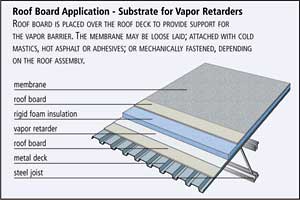
Substrate for Vapor Retarders
Here, the roof board is fastened directly to the
deck and the membrane may be loose laid; attached
with cold mastics, hot asphalt or adhesives; or
mechanically fastened, depending on the system
requirements.
Hot Mop
The roof board can be mechanically fastened, bonded
with mastic or adhesives or hot mopped to foam
insulation. All hot-applied roofing systems can
then be mopped directly onto the unprimed roof
board.
Metal or Tile Roof Thermal
Barrier
The roof board provides a thermal barrier in conjunction
with a standing seam metal or tile roofing system.
It also provides noise reduction and hail resistance.
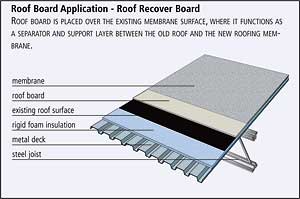
Roof Recover Board
The roof board is placed over the existing membrane
surface, where it functions as a separator and
a support layer between the old roof and the new
roofing membrane.
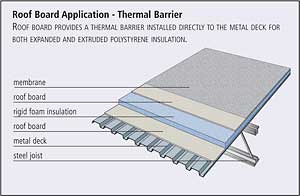
Thermal Barrier
When installed directly to a metal deck, the roof
board provides a thermal barrier for both expanded
and extruded polystyrene insulation.
Fire Barrier Underlayment
The roof board can be used as a barrier board
underlayment below optional rigid foam insulation
on a combustible deck to achieve a Class A, B
or C fire-resistance rating.
|
|
|
Typical Cover Board Options
|
|
There are a variety of different cover board
material types available. These are some of the
most popular cover board options and their specific
benefits.
Fiber Board
One of the most widely used cover board materials,
this board is often made from wood fiber or bagasi
(sugar cane). Fiber board has a porous nature,
good compressive and flexural strength, and an
affinity for moisture, making it a popular choice
under many membrane systems. However, fiber board
is susceptible to moisture absorption, which leads
to strength loss, decay or rot when it is exposed
to moisture for extended periods of time.
Perlite Roof Board
This roof board is composed of expanded perlite
ore, cellulose fibers, asphalt and starch binders.
Traditionally, it has been coated on the top side
surface with an emulsion to inhibit excessive
absorption of the mopping asphalt. This roof board
provides a dimensionally stable and thermally
resistant surface for the application of hot-applied
roofing membranes. It exhibits excellent flame
spread characteristics, which may be important
in the design and installation of some roof assemblies.
Like fiber board, perlite cover board is sensitive
to moisture.
Glass/Mineral Fiber Board
Glass and mineral fiber board is made from fiberized
glass or basalt rock bonded with resinous binders
and compressed to various densities. To prevent
absorption of adhesives or asphalt into the porous
core, a facer is applied at the factory. Some
manufacturers provide boards with special facers
designed for the direct application of torched-on
modified bitumen membranes. The product is dimensionally
stable and has a high degree of heat resistance.
While generally unaffected by moisture, glass
and mineral fiber insulation can lose its structural
integrity if it remains wet for long periods of
time. In addition, the facers may be adversely
affected by exposure to moisture. Due to the inherent
absorptive nature of its bottom surface, it cannot
be back-mopped with hot asphalt for securement
over heat-sensitive insulations.
Asphaltic Core Boards
Developed in recent years, this type of cover
board is often fabricated with an ashphaltic core
sandwiched between a glass fiber reinforcement.
Asphaltic cover boards are designed for use primarily
with hot-applied asphalt membranes and torch-on
systems. Highly resistant to moisture, they are
compatible with all asphaltic systems. However,
the asphalt content makes the board unsuitable
for use under single-ply membranes, which are
affected adversely by contact with asphalt.
Glass Mat-Faced Gypsum
Board
This type of board employs glass mat facings front
and back that are embedded into a water-resistant
treated core, providing moisture and fire resistance.
Fiber-Reinforced Gypsum
Panels
This innovative new type of fiber-reinforced gypsum
panel incorporates the latest cover board technology.
The cover board provides exceptional resistance
to both mold and moisture, along with outstanding
fire performance. This high-performance product
is manufactured with no face layers, providing
excellent wind uplift properties. The product
also features a high compressive strength (up
to 20 times greater than wood fiber board or perlite),
enabling it to protect the roofing system from
potential damage from foot traffic or hail. It
is also made from 95 percent recycled materials.
|
|