This CE Center article is no longer eligible for receiving credits.
BASICS OF ZINC ROOF SYSTEMS
Zinc roofing systems can be successfully installed on warm and cold roof applications. The term "cold roof" used here refers to one with a ventilated substrate rather than a reflecting "cool roof," although some zinc roofing may also have this characteristic. Cold roofs are typically seen in residential homes with gable roofs and involve a roof ventilation system in which air is introduced at the eaves and ventilated at the ridge. Warm roofs are more typical on commercial buildings, although many residential projects today are turning to warm roofs for their energy efficiency and other benefits such as cost and aesthetics. Typically the layers of a warm roof include a metal deck, a vapor barrier and a layer of rigid insulation that's on top the rafters rather than between or below them.
Because a warm zinc roof doesn't have the same air ventilation system as a cold one, and because zinc metal will corrode if moisture isn't wicked from it, proper detailing will avoid roofing failures.
Correct installation of a zinc roofing system is essential for protecting the metal against corrosion. Corrosion can be seen visually as a white chalkiness on the metal surface. Typically, the causes of zinc corrosion are water from condensation adhering to the back of the panel or standing water on the surface due to a lack of slope. Zinc corrosion can also be accelerated by salt spray, acid rain and construction dust, such as masonry dust. Even with these atmospheric conditions, however, zinc roofs and walls have been successfully installed in most climates across the United States. Often success is determined by good communications between the builder and manufacturer to assess and accommodate any environmental factors.
Generally, one of three approaches is used to prevent zinc corrosion from moisture. Skip sheathing is the oldest method and involves placing pine boards beneath the zinc roofing. The boards are spaced apart so that when condensation on the back side of the metal drips off, it will drip behind the pine boards where it can dry from air flow behind it - essentially a cold roof. This approach is still followed in Europe in some places and contributes to the longevity of some European buildings. Another method for protecting against condensation is installing a drainage mat beneath the zinc roofing. The newest protection against corrosion is a special backside polymer coating. The coating is often between 30 microns and 60 microns thick and protects the zinc metal from coming into contact with moisture from condensation. The first generation coatings were white colored, but today gray coatings can be found to aesthetically match the natural patina color of zinc.
What about protecting zinc from corrosion due to sodium in salt spray? Sodium can alter the chemical patina process and result in a lighter or streaked color. Therefore, in seaside locations, zinc products may need regular rinsing with fresh water. According to a spokesperson from Umicore, a producer of zinc worldwide, "Zinc is a natural material and may vary in color from panel to panel. It may also vary in color uniformity within the same panel. Although Umicore (uses) its best efforts to provide a uniform color for each order, it cannot warrant, either expressly or impliedly, that all panels will be free from variation in color." In dry coastal climates, Umicore expects that pre-patina material will not retain its original color and hue.Â
Besides warm versus cold roof considerations, zinc is suitable for all types of roofing applications. Depending upon the length and slope, a zinc roof with a length exceeding the maximum length for one panel will require transverse seams, which are those joints that run perpendicular to the roof slope between the top and bottom of one metal panel.
Standing seam and batten seam roofs are also suitable for zinc applications. In a standing seam roof, the long seams on adjacent zinc panels are bent up, overlapped or even folded to prevent moisture from getting in and to "seam" the panels together. When working with zinc in this manner, the height of the seam is typically one inch, however the height can go to a one-and-a-half inch seam for snowy areas or low slope (1:12) roofing applications.
Batten seam roofs can be adapted to complex domes, and experienced installers need only simple tools for the work. The installer fastens a strip or bar to the structural deck and the zinc roofing panels are attached to it. When working with zinc, if the batten cap (the top of the seam) is to be bent downward, the legs of the cap must be bent at an angle less than 90 degrees. The angle is important to accommodate for thermal expansion and contraction of the metal. A straight 90 degrees could not allow enough play for this movement. The proper leg angle is a common mistake made by inexperienced installers. In some cases the leg is not bent down at all, but is simply capped off.
ZINC CLADDING AND RAINSCREEN
Zinc rainscreen applications are increasingly popular with design professionals. As with a masonry rainscreen, flashing and weep holes need to be provided at the base, as well as the head details, of the exterior wall. An advantage with zinc wall construction is that it doesn't require caulking in the joints or adjacent to the connecting panels. Successful rainscreens keep water from penetrating the wall system, by allowing it to flow down and off an outside wall surface and by wicking away any moisture that does penetrate the wall system before it causes decay and corrosion. This system utilizes an air cavity between the wall and cladding to produce a type of chimney effect that provides air flow and improves energy efficiency. The wall behind the rainscreen is water resistant. Some water will get past the zinc surface and is planned for in the rainscreen design. The flow of air in the cavity between the rainscreen and the wall, allows for the evaporation of water that penetrates the zinc surface wall panels. Additionally, the cavity between the rainscreen and the building wall is drained at the bottom, thus allowing any moisture that gets between the rainscreen and the wall system to both evaporate and drain at the base and head details of the wall.
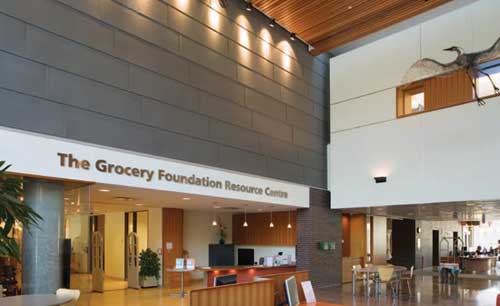 |
Bloorview Kids Rehab hospital in Toronto, Canada includes interior walls
of zinc flatlock shingles. The hospital also has a zinc roof.
Architect: Montgomery Sisam. Installer: Flynn Canada
Photo courtesy of Umicore Building Products |
Â
Flatlock and interlocking panels are two common styles of zinc cladding. For rainscreen applications, flatlock panels are attached to a substrate, and their corners are actually open in order to allow condensation to drain or dry. Flatlock panels are often designed in a running bond pattern as well as stacked bond pattern, a fact that's also true for interior applications. Diagonal diamond shaped patterns are also being used. The size of the patterns will depend on which panels are selected. Interlocking panels are mounted on hat channels placed either vertically or horizontally. These provide the required air flow as well as ability for water and condensation to weep out either at the base of the walls or at fenestration head details.
Zinc building products, including roofing, cladding and rainwater systems, are enjoying new popularity in North America due to recognition of product quality and its long-lasting, low-maintenance benefits for owners. From the distinctive look of the University of Cincinnati campus housing to the curves of the University Town Center in Hyattsville, Maryland, zinc
roofs and wall cladding are now being specified for commercial, public and residential projects.
Design professionals have long recognized the durability of buildings in European cities such as Paris, where the beautiful patina of zinc roofs has crowned the city since the days of Napoleon III in the late 1800s. Today many of the city's rooftops are still over 80 percent zinc and some have been around for more than 100 years.
Stateside, zinc is relatively new to the market and is popping up across the country. Its rise in popularity can be attributed to more building professionals discovering the metal's distinct advantages for design flexibility and life-cycle return on investment. In addition, the positive environmental aspects of zinc are becoming better understood. New Jersey architect Dean Marchetto of Dean Marchetto Architects PC summed up why he thinks zinc popularity is on the rise: "Zinc is a natural material that lasts forever, requires no maintenance, has superior aesthetic qualities with a natural patina, it's affordable, easy to bend and shape, and it's green."
THE VISUAL ALLURE OF ZINC
While two-thirds of the zinc sold worldwide is for flashings and rainwater goods (gutters, downspouts and accessories), zinc roofing systems and cladding are the attention-getters. The material is suitable for a full range of applications from conventional gables, eyebrows and mansards, to more contemporary curved walls, roofs and sun shading devices. The metal has been used for building envelopes for over 150 years and is distinguished by its beautiful patina characteristic that many building professionals are starting to understand.
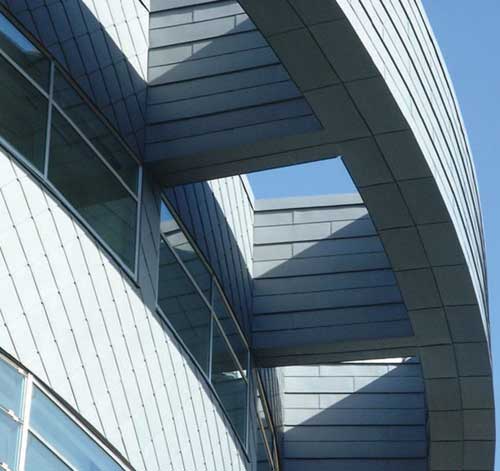 |
Tangeman Hall at the University of Cincinnati in Cincinnati, Ohio.
Architects: GBBN Architects & Gwathmey Siegel & Associates
Photo courtesy of Umicore Building Products |
The gray-colored zinc patina develops over time as the material weathers naturally; it is a process similar to the way copper turns brown then green. With zinc, the patina is actually a layer of zinc hydroxy-carbonate that develops - typically over 2 to 5 years - as the material is exposed to carbon dioxide in the air. The time it takes for the patina to emerge depends upon environmental factors such as air quality. In areas with a higher concentration of pollution, the patina appears more quickly. Likewise, zinc used in interior applications will rarely, if ever, develop a patina. Once formed, however, the layer is compact and insoluble to rainwater which thereafter controls the rate of corrosion. This patina is said to be a self-healing protection for the zinc. If it becomes scratched or is removed, it will naturally redevelop from continued exposure to rainwater and carbon dioxide. The scratch would appear as a shiny area while healing. Once the patina develops, the zinc has a uniform and consistent color of gray for its lifespan.
Zinc manufacturers today offer pre-patina materials (also called pre-weathered) with a dark gray look that is very true to the dull gray that all zincs eventually acquire after natural weathering. They also offer factory-applied transparent coatings that include subtle blues, red and greens. Over time these materials will all develop the natural gray zinc patina. The length of time for this to happen, however, still varies with air quality. Typically, these factory-applied colors will last up to 30 years before gradually changing to the natural gray patina.
Architect Bruce Norelius of Elliott Elliott Norelius Architecture in Maine said the firm began researching zinc after becoming interested in materials being used in Europe. They've used zinc now in several projects where it compared favorably to other metals. "Zinc has very little reflectance. Here in a coastal area by the water, people are conscious of that. Zinc has that low reflectivity and beautiful appearance that gets better with time."Â
Located at number thirty on the Periodic Table, zinc is an essential element. The zinc metal used in building products is an alloy that meets the European standard EN 988. While the U.S. doesn't have a similar standard, most of the zinc building materials sold here adhere to EN 988. The standard dictates the dimensional tolerances of the metal - such as thickness, width, length, saber and flatness - and also dictates the level of trace elements that are contained in the mix. These elements are copper (0.08 − 1.00 percent), titanium (0.06 − 0.20 percent) and aluminum (less than 0.015 percent), all of which contribute to the unique characteristics that distinguish zinc EN 988. The copper slightly increases the mechanical resistance of the alloy, where as the titanium provides increased "creep resistance."Â Creep is an occurrence in which the zinc will actually become thicker at the bottom of a roof than at the top as it ages. It actually "creeps" down the roof over time. Titanium helps protect the zinc against creep. Design professionals can confirm with a supplier that the material specified conforms
to EN 988.
 Beyond the patina, zinc manufacturers are educating building professionals about other misunderstandings related to the product. First, while it is true that the initial cost for zinc building products is higher compared to other choices, overall costs for maintaining the product, when factored by its years of longevity, actually yield a more favorable return on investment for owners when compared to other materials. Second, building professionals experienced at using copper sometimes assume zinc is a similar metal and fail to take into consideration its specific installation needs, therefore some avoidable problems have been a deterrent to the use of zinc. A poor installation can result in corrosion and improper adjustments for the metal's expansion and contraction. Finally, a perception that zinc is not environmentally friendly is being reevaluated. Some of the ways zinc contributes to sustainable building include recycling and recycled content, low or harmless levels of leaching into adjacent soil and the low embodied energy requirements needed for manufacturing. These advantages will be explained further in this article.
FLEXIBLE ZINC
Architectural metals such as stainless steel, copper, aluminum and zinc bend to accommodate curves, textures and other design elements, thereby providing architects with more options for creating unique building forms. Zinc contributes to the architectural styles possible today, a trend seen in such projects as Will Bruder's Nevada Museum of Art in Reno and the entrance to The Centers for Disease Control in Atlanta.
According to Dean Marchetto, "[Zinc] has qualities that lend itself to a modern aesthetic. It can be shaped into a variety of patterns, tiles, sheets and panels which offer architects almost unlimited opportunities in terms of the way it is applied to a building façade or a roof."
A perception that zinc is hard to work with and install is being overcome through manufacturers' efforts to explain the product's specific needs. Many manufacturers work with building professionals during construction to advise on installation, and many strongly recommend or even require training prior to installation.
 |
The University Town Center II in Hyattsville, MD features flatlock and
interlocking zinc panels.
Architect: WDG Architecture, PLLC.
Installer: Roofers Inc, LLC.
Photo courtesy of Umicore Building Products |
Â
One aspect of working with zinc is the metal's expansion and contraction. Zinc will move approximately one inch in thirty feet and so the design must be engineered to meet this thermal movement. To accommodate, a combination of sliding and fixed clips must be installed in zinc roofing and wall systems. Fixed clips alone will not allow sufficient expansion and contraction. The sliding clips, however, consist of two-parts in which one part can slide to accommodate thermal movement.
Temperature is another misunderstood aspect of working with zinc and is particularly important when bending the material on site. The metal is malleable but can become cold and brittle at lower temperatures. Therefore, zinc should not be folded when the metal is at temperatures of less than 45 degrees. Crazing, which is seen as long wrinkles in the material, can occur if this happens. When working in temperatures below 45 degrees, installers must use a heat gun to warm the material to the right temperature for bending and installation. Therefore, it is important to factor temperature into construction scheduling when planning to bend or fold the material on site. Once the material is installed correctly, however, low temperatures do not cause problems because accommodations have been made for thermal expansion and contraction of the metal. Pre-manufactured wall panels and flashing limit the need for bending zinc on the job site. When bending zinc is necessary, installers typically use a heated enclosed area inside the building. This is a standard technique used with all metals in regions with very low temperatures.
BASICS OF ZINC ROOF SYSTEMS
Zinc roofing systems can be successfully installed on warm and cold roof applications. The term "cold roof" used here refers to one with a ventilated substrate rather than a reflecting "cool roof," although some zinc roofing may also have this characteristic. Cold roofs are typically seen in residential homes with gable roofs and involve a roof ventilation system in which air is introduced at the eaves and ventilated at the ridge. Warm roofs are more typical on commercial buildings, although many residential projects today are turning to warm roofs for their energy efficiency and other benefits such as cost and aesthetics. Typically the layers of a warm roof include a metal deck, a vapor barrier and a layer of rigid insulation that's on top the rafters rather than between or below them.
Because a warm zinc roof doesn't have the same air ventilation system as a cold one, and because zinc metal will corrode if moisture isn't wicked from it, proper detailing will avoid roofing failures.
Correct installation of a zinc roofing system is essential for protecting the metal against corrosion. Corrosion can be seen visually as a white chalkiness on the metal surface. Typically, the causes of zinc corrosion are water from condensation adhering to the back of the panel or standing water on the surface due to a lack of slope. Zinc corrosion can also be accelerated by salt spray, acid rain and construction dust, such as masonry dust. Even with these atmospheric conditions, however, zinc roofs and walls have been successfully installed in most climates across the United States. Often success is determined by good communications between the builder and manufacturer to assess and accommodate any environmental factors.
Generally, one of three approaches is used to prevent zinc corrosion from moisture. Skip sheathing is the oldest method and involves placing pine boards beneath the zinc roofing. The boards are spaced apart so that when condensation on the back side of the metal drips off, it will drip behind the pine boards where it can dry from air flow behind it - essentially a cold roof. This approach is still followed in Europe in some places and contributes to the longevity of some European buildings. Another method for protecting against condensation is installing a drainage mat beneath the zinc roofing. The newest protection against corrosion is a special backside polymer coating. The coating is often between 30 microns and 60 microns thick and protects the zinc metal from coming into contact with moisture from condensation. The first generation coatings were white colored, but today gray coatings can be found to aesthetically match the natural patina color of zinc.
What about protecting zinc from corrosion due to sodium in salt spray? Sodium can alter the chemical patina process and result in a lighter or streaked color. Therefore, in seaside locations, zinc products may need regular rinsing with fresh water. According to a spokesperson from Umicore, a producer of zinc worldwide, "Zinc is a natural material and may vary in color from panel to panel. It may also vary in color uniformity within the same panel. Although Umicore (uses) its best efforts to provide a uniform color for each order, it cannot warrant, either expressly or impliedly, that all panels will be free from variation in color." In dry coastal climates, Umicore expects that pre-patina material will not retain its original color and hue.Â
Besides warm versus cold roof considerations, zinc is suitable for all types of roofing applications. Depending upon the length and slope, a zinc roof with a length exceeding the maximum length for one panel will require transverse seams, which are those joints that run perpendicular to the roof slope between the top and bottom of one metal panel.
Standing seam and batten seam roofs are also suitable for zinc applications. In a standing seam roof, the long seams on adjacent zinc panels are bent up, overlapped or even folded to prevent moisture from getting in and to "seam" the panels together. When working with zinc in this manner, the height of the seam is typically one inch, however the height can go to a one-and-a-half inch seam for snowy areas or low slope (1:12) roofing applications.
Batten seam roofs can be adapted to complex domes, and experienced installers need only simple tools for the work. The installer fastens a strip or bar to the structural deck and the zinc roofing panels are attached to it. When working with zinc, if the batten cap (the top of the seam) is to be bent downward, the legs of the cap must be bent at an angle less than 90 degrees. The angle is important to accommodate for thermal expansion and contraction of the metal. A straight 90 degrees could not allow enough play for this movement. The proper leg angle is a common mistake made by inexperienced installers. In some cases the leg is not bent down at all, but is simply capped off.
ZINC CLADDING AND RAINSCREEN
Zinc rainscreen applications are increasingly popular with design professionals. As with a masonry rainscreen, flashing and weep holes need to be provided at the base, as well as the head details, of the exterior wall. An advantage with zinc wall construction is that it doesn't require caulking in the joints or adjacent to the connecting panels. Successful rainscreens keep water from penetrating the wall system, by allowing it to flow down and off an outside wall surface and by wicking away any moisture that does penetrate the wall system before it causes decay and corrosion. This system utilizes an air cavity between the wall and cladding to produce a type of chimney effect that provides air flow and improves energy efficiency. The wall behind the rainscreen is water resistant. Some water will get past the zinc surface and is planned for in the rainscreen design. The flow of air in the cavity between the rainscreen and the wall, allows for the evaporation of water that penetrates the zinc surface wall panels. Additionally, the cavity between the rainscreen and the building wall is drained at the bottom, thus allowing any moisture that gets between the rainscreen and the wall system to both evaporate and drain at the base and head details of the wall.
|
Bloorview Kids Rehab hospital in Toronto, Canada includes interior walls
of zinc flatlock shingles. The hospital also has a zinc roof.
Architect: Montgomery Sisam. Installer: Flynn Canada
Photo courtesy of Umicore Building Products |
Â
Flatlock and interlocking panels are two common styles of zinc cladding. For rainscreen applications, flatlock panels are attached to a substrate, and their corners are actually open in order to allow condensation to drain or dry. Flatlock panels are often designed in a running bond pattern as well as stacked bond pattern, a fact that's also true for interior applications. Diagonal diamond shaped patterns are also being used. The size of the patterns will depend on which panels are selected. Interlocking panels are mounted on hat channels placed either vertically or horizontally. These provide the required air flow as well as ability for water and condensation to weep out either at the base of the walls or at fenestration head details.
For walls, standing seams - either vertical or horizontal - are popular styles for zinc applications. Often, manufacturers will recommend a single lock versus double lock for the seam because this allows for using a thicker gauge material than typically used for a roof. While a double lock standing seam roof might use a 0.7 mm thick zinc, the single lock standing seam allows for increasing that to 0.8 mm on walls. According to Umicore, design professionals should refer to the manufacturer regarding product thickness for zinc projects because it will vary depending on the panel and sought-after aesthetic.
"[Zinc] can easily be used for flashing details on façades and roofs made from zinc panels and shingles, according to Dean Marchetto. "This allows the designer flexibility to design a façade detail in which the flashing can become part of the designed pattern, all in the same material and color."
Textural walls are another application of zinc that is gaining attention for both interior and exterior walls. Corrugated material is perhaps one of the oldest wall cladding applications, one that has a familiar look in rural and marine settings. Exterior corrugated zinc cladding requires a few extra considerations. First, when panels are laid in a shingled style or separated by a reveal, that reveal must include a drainage system behind it. Reveals can be detailed in a similar fashion to a rainscreen system and mounted on galvanized steel hat channels.
LOW MAINTENANCE MEETS LONGEVITY
An assessment of zinc's potential for a favorable return on investment requires examining more than just material purchase and installation costs. In the case of zinc, these upfront costs are typically higher compared to other choices of material. However, compared to similar metal choices, zinc is priced lower than copper, stainless steel, lead-coated copper and zinc-coated copper. As for installation costs, zinc is comparable to other metals such as stainless steel and copper and is more expensive than painted metal. However, some zinc products, such as pre-formed shingles, cost no more to install than other similar choices. More notable is that zinc is cost effective when the total service life and maintenance costs of the product are considered.
Zinc roofs have been used in Europe since the late 1800s and historical results point towards a high rate of longevity. Today's metal alloy has been standardized and improved and, presumably, is an even more durable product than what was installed years ago in Europe. In the U.S, zinc is newer to the market and less long-term data is available. While the longevity of a properly-installed zinc roof will vary depending on such factors as climate and pollution, a zinc roof can have a service life of 60 to 100 years. Comparatively, an asphalt roof has a life expectancy of 18 to 25 years. For wall applications, the service life is even longer due to less exposure to weathering. In fact, some estimates indicate zinc walls can last
300 years.
| University of North Carolina |
The sloped roof on the Hall for Humanities & Research Administration at the University of North Carolina in Greensboro features a zinc roof that was chosen for the beauty of the metal as well as expected long life span. New campus construction projects must undergo a formal lifecycle cost analysis prior to approval. For architecture firm Calloway Johnson Moore & West in Winston-Salem, that meant designing a project with a contemporary feel that would fit into the traditional character of the mostly-brick campus andfit within the goal of a 100-year life span.
This is the second zinc roof project the University has undertaken, and like many universities, the buildings are monitored for performance. The school acknowledges that construction budgets tend to be well-funded but maintenance budgets are not, thereby leading to choices that are long-lasting and low maintenance. The self-healing characteristic of zinc and its pleasing natural color were factors in the decision.  |
| Photo courtesy of Umicore Building Products |
Â
Building professionals should keep in mind that when used in exterior applications, small amounts of zinc are removed from the surface due to weathering from rainfall. The protective patina reforms and the process beings again, however, pollutants in the air will accelerate this process and affect the life span. Replacement of a zinc roof is recommended when 40 percent of the material has been removed. Measuring this weathering is generally done in microns and can vary from 7 microns a year in a heavy industrial area to 1 or 2 microns a year in a very clean environment. The manufacturer can assist building professionals in estimating the life cycle of a particular application based on climate and pollution.
According to a 2004 U.S. study by Ducker Research Company that sought to measure life cycle costs of three types of roofing systems, metal roofs, including zinc, were found to cost 30 cents per square foot per year whereas asphalt cost 37 cents per square foot per year. Single ply roofs studied were 57 cents per square foot per year. Life cycle costs were determined by adding initial installed costs to annual energy costs and annual maintenance costs, and adjusting figures for inflation.
What factors contributed to the difference in life cycle costs? Owners and property managers reported spending little or no maintenance on their metal roofs. As mentioned earlier, the natural, protective zinc patina allows the metal to heal itself after damage from scratching. This eliminates the need for paints and other coatings. In fact, owners often report needing to do little or no maintenance on zinc. Periodic inspections and seasonal gutter cleaning are among the simple steps owners report taking to maintain their zinc roofs. Maintenance needs will vary and should be discussed with the manufacturer, and as is standard practice for all roofs, owners are advised not to walk on the roof after installation.
Some public institutions are turning to zinc in part for its durability and life cycle cost advantages. At the State University of North Carolina, for example, new campus construction projects must be evaluated using a formal life cycle cost analysis. The requirement led the University of North Carolina to look at building new
structures with a goal of a 100-year-life span. That goal led to two new campus buildings with zinc roofs. Andy Sykes of Calloway Johnson Moore & West, PA in North Carolina was project manager for the Hall for Humanities Research and Administration. "Longevity was reason one," he said about recommending a zinc roof. "Reason two was aesthetics. Zinc worked well because of the appearance, the color was more similar to what historical turn-coated lead roofs looked like and blended with the traditional campus roofs." Sykes also said that zinc's self-healing patina was a factor in the decision.
Zinc's longevity is a factor for architect Bruce Norelius when he considers roofing materials. He said that zinc offers his clients the low maintenance they desire with a longevity that's better than asphalt and other materials.
Two obvious factors in the longevity of a zinc application are the quality of installation and experience of the installer. By working closely with a manufacturer's representative and adhering to guidelines, such as those described herein, building owners and managers can avoid corrosion and other issues that might negatively affect maintenance and longevity.
ENVIRONMENTAL QUALITIES OF ZINC
An examination of the environmental impact of architectural zinc and its contributions to sustainable building logically begins with the base element. As an essential element with the atomic number 30, zinc is the 23rd most abundant element in the earth's crust and one that is necessary to the growth of humans, animals and plants. In fact, it is the second most common trace element found in the human body and exists naturally in air, water and soil. Understanding its impact on the environment and its contributions towards sustainable building requires assessing its supply and demand, manufacturing, recycling potential, product attributes, soil concentration and human/animal health impacts.
Of all the metals produced worldwide, zinc ore is ranked fourth in the amount of tonnage produced. According to a United States Geological Survey in 2006, 10 million tons were produced worldwide, with China, Australia, Peru and the U.S. being the top 4 countries in terms of zinc mining production. The U.S. alone that year mined 699,000 metric tons (t) of zinc in 6 states including Alaska, Idaho, Missouri, Montana, New York and Washington. In the same year, 350,000 tons of the metal were recovered from waste and scrap material for reuse in products. Just one year later, the amount recovered had increased by 20 percent and the trend is expected to continue. Nearly a third of the metallic zinc produced today is used in galvanization, a process that protects an object that is prone to corrosion by giving it a protective coating of zinc.
 |
|
Photo courtesy of Umicore Building Products |
Â
The demand for zinc has fueled a robust recycling market for the metal. In fact, about 90 percent of the zinc used worldwide is recycled for additional usage as part of a recycling loop that is efficient for recapturing zinc from end-of-life products. The zinc used in building materials and galvanized steel, are included in this recycling loop, with both scrap material and end-of-life products being candidates for recycling. Nearly 70 percent of the zinc from end-of-life products becomes recycled, according to the International Zinc Association. That represents around 3 million megatons (MT) of zinc being recycled annually, and the numbers are increasing. This recycled zinc goes into products such as sunscreens and paints, and some goes back into building products.
Energy consumption in the manufacturing process contributes to zinc's environmental record from cradle to grave when compared to other metals. Zinc ores are core mined in the traditional method, not strip mined, and during refinement zinc uses a quarter of the energy needed to refine aluminum and half the energy of copper or steel.
Continuing in the production process, the amount of energy used to produce zinc from ore is lower than any other nonferrous metal marketed today. The energy consumption is even lower when the zinc is produced from recycled material. Put another way, zinc requires less "embodied energy" to produce than both steel and aluminum, which means that the amount of energy needed to manufacturer it and supply it to the point of use is lower than these metals. As zinc recycling improves and develops, zinc manufacturers expect to further reduce energy consumption by using more recycled material.
Some design professionals and owners turn to zinc to assist with implementing their goals for environmental conservation. For example, a residential project in Maine utilized a zinc roof, gutters and flashings as part of a rainwater collection and treatment system that allowed the homeowners to use rainwater nearly exclusively for all household needs. The project depended on the metal to facilitate water collection without having a negative effect on the final water quality. While the presence of zinc in drinking water is common and not harmful, it could show a chalky appearance and taste metallic at levels higher than the EPA standard of 5 milligrams per liter. The home's water treatment system handles this possibility.
Other factors to consider when gauging zinc's environmental record is soil concentration from building materials and the metal's related affects on humans, animals and plants that become exposed to varying levels. These factors apply to building inhabitants as well as local populations. As stated previously, zinc is an essential element for sustaining life and is present in trace amounts in living things. The element plays a role in the functioning of 300 different enzymes in the human body and is essential for many biological and metabolic processes as well as antiviral and immune-enhancing activities. People are routinely exposed to zinc by ingesting it in the water and food supply and through the air. The FDA recommends a total daily intake of 11 milligrams for adult men and 8 milligrams for women. To protect workers, OSHA has set an average daily limit of 1 milligram per cubic meter for zinc chloride fumes and 5 milligrams per cubic meter for zinc oxide dust and fumes. These limits predominantly concern the manufacturing environment where such levels are more likely to be experienced. While zinc is not classified as a carcinogenic, the EPA, FDA and OSHA have issued guidelines because the consumption of large amounts of zinc - zinc overdose - as well as zinc deficiency can have adverse health effects. An overdose is considered to be a level that is 10 to 15 times higher than the amount needed for good health. Neither zinc deficiency nor overdose is at all common in the U.S.
Run-off from zinc into surrounding soil at a building site is limited. Not all the zinc that detaches during corrosion becomes run-off. The soluble part, which is zinc sulfate, does run off, and at a rate that is 50 to 80 percent lower than the corrosion rate. On average, the amount of zinc that normally exists in the soil to a depth of 3 feet is greater than the amount of zinc run-off from a building over a 30-year period. Zinc is not bio-available upon contact with soil, making it harmless to humans and animals when run-off enters the ground. Bioavailability is a measure of the amount of a contaminant that is absorbed into the human body after contact, ingestion or inhalation. In the case of zinc in the soil, most of it stays bound to soil particles rather than dissolving in water and entering the water supply. The EPA has not issued any requirements for limitations of zinc discharges under the Clean Water Act.
BUILDINGS THAT LAST
Across the U.S., design professionals increasingly turn to zinc for its inherent beauty, malleability and long-lasting appeal for commercial, public and residential projects. These buildings will stand the test of time, lasting for many, many years while reflecting their natural zinc patina for people to admire. Meanwhile, their owners will also enjoy these investments for their low-cost maintenance needs. Architectural zinc roofs and walls - with their curves, domes, textures and patterns - contribute to the industry's sustainable building ideals and the possibilities of unique design forms. As the misconceptions about zinc are cleared away, more professionals are choosing it for meeting customer demand for long-lasting, low maintenance products that can have a low impact on the environment.
Â
|
Umicore Building Products is the world's leading producer of zinc construction products, which have been used successfully for more
than 150 years throughout Europe and now for more than a decade in North America. Umicore's line of VM ZINC® panels for roofs and wall systems has been used on a wide range of projects including colleges and universities, museums, airports, libraries and an array of prestigious buildings across the country.www.vmzinc-us.com |
|