This CE Center article is no longer eligible for receiving credits.
Installation
When it comes to installation, slimmer modular units are far easier
to move and install than conventional refrigerators that can weigh
up to 800 pounds.
One complaint of design professionals used to be the complicated
installation, but the industry has responded with prepackaged and
labeled parts to simplify the procedure. Still, cabinet preparation is
crucial to a smooth installation. With modular refrigerators, the intent
is that any standard size kitchen cabinet can be replaced by a modular
column, with a gap between two tall cabinets the ideal scenario. Units
should have hinges that can open to 115 degrees to allow the columns to
be fully flush mounted without sacrificing accessibility. Hinges should
also be heavy duty, and be able to support more than 200 pounds of
door weight, particularly if custom wood panels are used. For complete
installation details, the product's spec sheet should be consulted.
Installers familiar with flush-mounted modular units should be used, as
there is a learning curve experienced by non-cabinet installers.
Cooking Appliances
Cooking is the application of heat to food. Indoor cooking is almost
entirely done either in an oven or on a cooktop, and is broadly divided
into gas and electric types. Consumers are interested in appliances
that deliver gourmet results, maximum nutrition with time savings at the right price points. There are no Energy Star ratings applicable
to cooking appliances, though manufacturers do consider energy
efficiency a competitive advantage, and are the prime movers in the
new designs, materials and processes that will boost energy efficiency
while reducing embodied energy over the life cycle of the product.
Design Flexibility with Cooktops
Because they can be installed on an island or other location with ample
counter space, cooktops afford design flexibility. Consumers appreciate
their modularity, which allows placement of interchangeable elements
including griddles, steamers, woks, rotisseries, and deep fryers that can
be switched at will. Many cooktops also incorporate smart features that
can select proper cooking times and temperatures for various foods.
Offered in gas, electric, and dual fuel and in ceramic glass, porcelaincoated
steel, or stainless steel today's cooktops may be designed with
integrated downdraft ventilation, varying burner placement, and front
or side controls. For serious cooks, the space between burners, grate
size, and configuration are important factors. For example, those who
routinely cook with large pots and pans would do better with four
widely spaced burners than five or six crowded together.
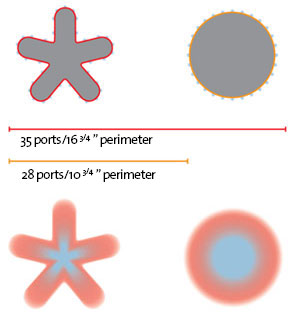
|
The design of a star burner offers greater heat coverage, and a smaller cold spot,
making it ideal for any pan size. |
Gas. Gas cooktops are the choice of many serious cooks. Gas burners
produce heat instantly, and can be easily controlled to change the
flame quickly between low and high heat. When gas burners are
turned off, the heat stops and so does the cooking. Improving on the
traditional gas ring burner are star-shaped burners that distribute heat
more evenly from the center of the pan to its edges. The perimeter
of a star-shaped burner can be up to 56 percent greater than a round
burner of the same diameter, which allows for more flame ports and
thus better flame spread and reduced cold spots. With star burners
boil times are faster too, with a range of from over 24 minutes to 12
minutes and 40 seconds to boil four quarts of water.
When specifying a gas cooktop, the BTU output is a prime
consideration − both maximum and minimum levels. One of today's
biggest cooking trends is professional-style stoves for the home, with
burners that boast large BTU outputs. But burners that put out high
BTUs have large holes, or ports, to dispense the flames − and those
holes are often too big to maintain combustion when turned down to
simmer. Manufacturers have sought to overcome this challenge by
burner-within-a-burner system or placing smaller burners that can cycle
on and off at a low flame alongside the higher BTU burners. Users who
want the widest range of cooking options will want star-shaped burners
with both high and low BTU output (200 BTU/hour to 18,000 BTU/
hour is about the extent of the range), with simmer systems to control
temperature via electronics that cycle the burner on and off to maintain temperatures as low as 100 degrees F that can simmer delicate sauces or
keep food warm without scorching and the need for constant stirring.
Fueled by interest in
nutrition and healthy
living as well as the
celebrity status of chefs and
popularity of lifestyle television
programming, cooking has been
upgraded from mere preparation
of food to a creative and often
social activity. As a result,
kitchens have taken center
stage in the home, combining
design and appliances that
are sophisticated, convenient,
and time saving, and in many
instances mirroring the sleek,
practical aesthetic of the
professional kitchen.
In a new home, the kitchen
is often a key selling point. In an
existing home it's the space most
regularly revamped in order to obtain the latest systems, cabinetry and
appliances. According to Oregon-based CNW Research, which has
studied U.S. consumer spending for more than a decade, kitchens are
at the top of the list in consumer home remodels, and consume more
attention, energy, finances and complex decision-making than any
other home project.
Consumer expectations for kitchens and appliances are
continually evolving. Among the consumer lifestyle trends for 2010 revealed at this year's International Home + Housewares Show are
the Wellness Kitchen, driven by the desire for maximized nutrition
and purified air and water, the Green Kitchen, and Cooking for Fun,
which recognizes the preferences of cooking enthusiasts.
Manufacturers are meeting heightened awareness and
enjoyment of all things culinary with elegant, high tech appliances
that enhance the experience and bring gourmet results home. This
article will explore new trends and technologies in residential
kitchen refrigeration and cooking, focusing on features that offer
added flexibility, improved performance, better food safety and
environmental responsibility.
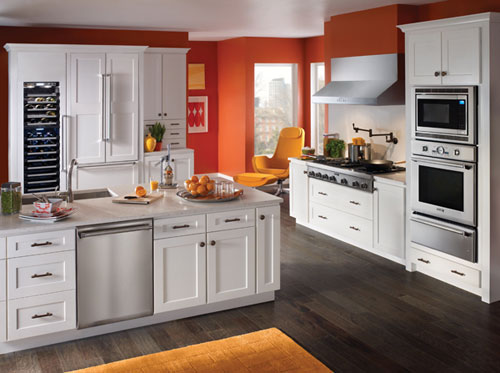
|
|
Photo courtesy of Thermador |
Modular Refrigeration
Introduced in the 1990s, modular refrigeration is a popular trend
in residential kitchens. The term modular refrigeration refers to
stand alone, independent refrigerated units that are available as
fresh food, freezer or wine preservation columns of varying widths,
generally between 18 and 36 inches. They provide considerable
design flexibility, giving architects the option to forego the often
cumbersome refrigerator-freezer combination in favor of two
or more refrigeration columns of any size and configuration and
serving different functions. The units offer multiple design and
installation possibilities, and can be placed wherever they are
needed − separately or side by side − for a kitchen customized
according to a preferred workflow. Some users, say, may select a cook's refrigerator for unprepared items near the stove and one closer to dining room for beverages and condiments, while another
may want a freezer column containing meats next to the oven
and a column for fresh food next to the sink to facilitate vegetable
preparation. Refrigeration is moving out of the kitchen too, as
consumers opt to place products where they are going to use them
− a wine storage unit in a family room or refrigeration in an outdoor
entertaining space.

|
Modular refrigeration enables design flexibility in the kitchen.
Photo courtesy of Thermador |
Â
In addition to liberating the kitchen from the hegemony of the
monolithic fridge/freezer combination, modular refrigeration has
been well received because of the way it looks and performs.
Aesthetics
With the more streamlined look in kitchens, large appliances are
following suit, being disguised and integrated into the overall décor.
While stainless steel finishes are still popular, the predominant design
trend today in home refrigeration is to go one step beyond integration
to true flush mount refrigeration where the unit "disappears" into the
kitchen cabinetry for a cleaner, ultra modern look.
Modular refrigeration harkens back to German engineering,
and the Kuhlschrank, which literally means 'cool cabinet. "It's
a cabinet with a compressor and the cabinet gets cold. Because
modular units are more a part of the cabinetry than an appliance,
they represent a paradigm shift in the way design professionals
think about refrigeration and configuring the kitchen.

|
Temperature and humidity controlled compartments keep food fresher longer.
Photo courtesy of Thermador |
Food Chilling and Storage Performance
Each modular refrigeration column operates with its own motor and
compressor, eliminating air exchange between the refrigerator and
freezer compartments − often the source of odor and/or flavor transfer.
Air temperature is also more evenly distributed and humidity levels are
appropriate for vegetables and fruits to stay crisp and fresh longer.
To achieve equal temperature levels on all shelves,
multi-flow air systems provide a continuous flow of air running
along the interior back wall. Cold air channels behind the door
racks ensure that food items on these racks are stored at the same
temperature as in the refrigerator compartment.
Many models have individual
temperature- and humiditycontrolled
compartments to achieve longer food storage for specific
items, such as fish which should be stored at 32 degrees F, meat and
poultry at 33 degrees F, and produce at 35 degrees F. Zoned sensors
respond to food temperatures in these different sections and trigger
adjustments to keep temperature consistent within 1.5 degrees F.
Express chill and freeze buttons have also become standard
features on today's modular units: When warm food is added to
the refrigerator or freezer, the unit quickly returns to the proper
temperature, as sensors override the current selection, temporarily
pushing the unit into maximum cooling mode.
Convenience Factors
Refrigerator interiors are designed for practicality. Spill-proof glass
shelves facilitate easy cleanup. Door shelves are adjustable, freezer
columns accommodate extra tall items and gallon door storage
reflects consumer preferences of economical family-size purchases.
At the touch of a button motorized shelves raise and lower to
accommodate items of various heights, even when they're fully
loaded with up to 22 pounds of food.
Water and Ice Dispensers. Over the years, manufacturers have
improved their ice and water dispensers and today's models have
capabilities such as measured dispensing and rapid filling such that
an 8-ounce glass can be filled in 8 seconds. Anti-clump systems
agitate ice at timed intervals to keep it from freezing together after
defrost cycles or extended door openings. Through-the-door systems
allow easy access to water, ice cubes and crushed ice without having
to open the refrigerator cabinet. Large flexible dispensers with pulldown
pitcher flaps allow the use of extra tall or wide containers.
Water dispensers almost always include water filtration capabilities.
Carbon is primarily used in refrigerator filtration because of its ability to
absorb chemicals and impurities that diminish the taste and smell of the water. Filtration systems vary according to brand, though most are carbononly
or a combination of carbon and a fiber filter to catch rust, lead and
other sediments found in water. Filters should be changed as specified by
the manufacturer or at least every six months to ensure continued water
quality and keep contaminants trapped by the filter from leaking back into
the water. While refrigerator ice and water dispensers do increase energy
usage, they can offer a healthier alternative to bottled water at a fraction
of the price and without the health risk of drinking from plastic containers.
An additional benefit is the fact that many refrigerator water filters also
retain fluoride, which is usually not found in bottled water.
No-Frost Systems. Virtually all modular refrigeration systems
use adaptive defrost control systems that defrost only when it's
needed, which saves energy and eliminates freezer burn. Sensors
electronically calculate the amount of time needed in between Lighting. Refrigerator lighting is getting more energy efficient.
Replacing the formerly ubiquitous incandescent light bulb scheduled
for phase out in the U.S., Europe, Canada and other locations, the
refrigeration industry has turned to LED, and halogen lights. Of the
two, the halogen light spectrum is considered to display the true
color and texture−and thus condition−of foods. A typical lighting
scheme may include two upper halogen spotlights and two halogen
wall towers to illuminate food evenly, so even foods at the back can
be easily seen and don't languish out of sight as the expiration date
passes. LED lights may be slightly less expensive to operate, but
they cast an unattractive bluish light on foods.
Quiet Operation. The compressor keeps the refrigerator cool. A
standard compressor circulates cool air on a set cycle. But at the heart
of quiet operation is a variable speed compressor, which keeps running
at very slow revolutions per minute, and cycles up only when necessary
to maintain the temperature of the products inside the cabinet. Some
companies even insulate the compressor in higher end models.
Greater Capacity. Manufacturers are continually working to gain
extra capacity within the same footprint. One way of doing this is
through more effective insulation technology. Proprietary vacuum
panels reduce the thickness of refrigerator walls, and thinner walls
mean more room inside. A partial vacuum is created within the panel
walls and filled with a low conductivity substance such as powder,
fiber or aerogel. Increased energy efficiency is another byproduct as
heat gain in the refrigerator is reduced, thereby reducing the energy
required to maintain lower temperatures within.
Environmental and Energy Considerations
Refrigerators are moving toward more positive environmental and
energy performance.
Refrigerants. There has been a movement toward a new generation
of environmentally friendly refrigerants. Hydrofluorocarbons (HFC),
a group of compounds containing carbon, fluorine and hydrogen, but
not chlorine, have replaced chlorine-containing chlorofluorocarbons
CFCs and hydrochlorofluorocarbons (HCFC). HFCs, however, are not
an ideal solution as they have a global warming impact. Major HFC
releases occur during their manufacture, from filling refrigeration
equipment and from refrigerators' end-of-life deterioration.
Other substances being tested as an alternative to HFCs are
greenhouse-neutral hydrocarbons such as propane and isobutane,
which are extensively used in European and Asian refrigerators.
The drawbacks are that these substances carry slight flammability
concerns and are currently not UL approved or sanctioned by
building codes in many municipalities.
Energy Efficiency.A refrigerator runs 24/7, and in a typical home,
generates 8 percent of the total annual energy expense, according
to 2005 data from the U.S. Department of Energy. Compared to the
1970s, when a new refrigerator averaged 1,800 kilowatt-hours (kWh)
per year, the best of today's versions log in only about 500 kWh
annually. Recent improvements in insulation and compressors have cut
some of the fat out of energy usage. Variable speed compressors, for
example, save energy by operating at ultra slow revolutions per minute
rather than shutting off and turning on again, which expends energy
unnecessarily. Refrigerators and freezers with individual compressors
generate only the energy required to keep their own compartment
properly chilled. Adaptive defrost systems operate only when needed,
and there are settings to adjust temperatures for low food levels, to
disable ice making and lighting when users are on vacation and to
function in Sabbath mode, meaning that lights, fans, sounds, alarms,
compressors or other electrical activity is disabled when the refrigerator
door is opened without affecting its operation.

|
Flush-mounted refrigeration is a top trend in kitchen design.
Photo courtesy of Thermador |
All refrigerators sold in the United States are required to meet
the Department of Energy's efficiency standards, and many meet the
department's more stringent Energy Star qualifications as well. A new
refrigerator with an ENERGY STAR label is required to use at least
20 percent less energy than stipulated by current federal standards.
Today's Energy Star rated refrigerators use about half the energy of
those manufactured prior to the early 1990s. Through its rating system
of appliances, the program claims to have helped save enough energy in
2008 alone to avoid greenhouse gas emissions equivalent to those from
29 million cars − all while saving consumers $19 billion in utilitly
costs. However, when it comes to free standing refirgerator ratings,
the Energy Star program is not without its critics. Detractors
decry the lack of independent auditors − manufacturers supply data
on their own products − and contend that the energy efficiency bar
is set too low, with too many products qualifying for the star to make
it meaningful. For built-in refrigerators, Energy Star criteria are
more rigorous. The built-in installation makes the heat exchange to the
outside more difficult than freestanding units, and the air inlet and air
outlet for cooling air are more restricted in the built-in installation. In addition, outside dimensions are fixed due to the built-in cabinet and so
with a given interior volume, more insulation can not be added than the
outside dimensions allow. Freestanding units have more tolerance.

|
Today's kitchens feature sophisticated cooktops, built-in ovens and
warming drawers.
Photo courtesy of Thermador |
Installation
When it comes to installation, slimmer modular units are far easier
to move and install than conventional refrigerators that can weigh
up to 800 pounds.
One complaint of design professionals used to be the complicated
installation, but the industry has responded with prepackaged and
labeled parts to simplify the procedure. Still, cabinet preparation is
crucial to a smooth installation. With modular refrigerators, the intent
is that any standard size kitchen cabinet can be replaced by a modular
column, with a gap between two tall cabinets the ideal scenario. Units
should have hinges that can open to 115 degrees to allow the columns to
be fully flush mounted without sacrificing accessibility. Hinges should
also be heavy duty, and be able to support more than 200 pounds of
door weight, particularly if custom wood panels are used. For complete
installation details, the product's spec sheet should be consulted.
Installers familiar with flush-mounted modular units should be used, as
there is a learning curve experienced by non-cabinet installers.
Cooking Appliances
Cooking is the application of heat to food. Indoor cooking is almost
entirely done either in an oven or on a cooktop, and is broadly divided
into gas and electric types. Consumers are interested in appliances
that deliver gourmet results, maximum nutrition with time savings at the right price points. There are no Energy Star ratings applicable
to cooking appliances, though manufacturers do consider energy
efficiency a competitive advantage, and are the prime movers in the
new designs, materials and processes that will boost energy efficiency
while reducing embodied energy over the life cycle of the product.
Design Flexibility with Cooktops
Because they can be installed on an island or other location with ample
counter space, cooktops afford design flexibility. Consumers appreciate
their modularity, which allows placement of interchangeable elements
including griddles, steamers, woks, rotisseries, and deep fryers that can
be switched at will. Many cooktops also incorporate smart features that
can select proper cooking times and temperatures for various foods.
Offered in gas, electric, and dual fuel and in ceramic glass, porcelaincoated
steel, or stainless steel today's cooktops may be designed with
integrated downdraft ventilation, varying burner placement, and front
or side controls. For serious cooks, the space between burners, grate
size, and configuration are important factors. For example, those who
routinely cook with large pots and pans would do better with four
widely spaced burners than five or six crowded together.
|
The design of a star burner offers greater heat coverage, and a smaller cold spot,
making it ideal for any pan size. |
Gas. Gas cooktops are the choice of many serious cooks. Gas burners
produce heat instantly, and can be easily controlled to change the
flame quickly between low and high heat. When gas burners are
turned off, the heat stops and so does the cooking. Improving on the
traditional gas ring burner are star-shaped burners that distribute heat
more evenly from the center of the pan to its edges. The perimeter
of a star-shaped burner can be up to 56 percent greater than a round
burner of the same diameter, which allows for more flame ports and
thus better flame spread and reduced cold spots. With star burners
boil times are faster too, with a range of from over 24 minutes to 12
minutes and 40 seconds to boil four quarts of water.
When specifying a gas cooktop, the BTU output is a prime
consideration − both maximum and minimum levels. One of today's
biggest cooking trends is professional-style stoves for the home, with
burners that boast large BTU outputs. But burners that put out high
BTUs have large holes, or ports, to dispense the flames − and those
holes are often too big to maintain combustion when turned down to
simmer. Manufacturers have sought to overcome this challenge by
burner-within-a-burner system or placing smaller burners that can cycle
on and off at a low flame alongside the higher BTU burners. Users who
want the widest range of cooking options will want star-shaped burners
with both high and low BTU output (200 BTU/hour to 18,000 BTU/
hour is about the extent of the range), with simmer systems to control
temperature via electronics that cycle the burner on and off to maintain temperatures as low as 100 degrees F that can simmer delicate sauces or
keep food warm without scorching and the need for constant stirring.
The New American Home 2010:
A Sign of the Times |
This year's version of the New American Home, a 6,000-square-foot
desert contemporary designed by the KTGY Group of Irvine,
California, is much smaller than recent versions. It is being built to
National Association of Home Builder's (NAHB) Green Building
Standard and will meet the U.S. Department of Energy's Builders
Challenge and Energy Star energy efficiency programs.
The kitchen reflects a return to the simple pleasure of
cooking with an expansive open plan and appliances that help
home chefs achieve gourmet results. Multiple built-in wall ovens
including an electronic thermostat to monitor temperature, a
6-burner gas range top with star-shaped burners and intermittent
flame simmer features, and a warming drawer were selected for
cooking. Modular refrigeration columns were chosen to support
consumer work flow.
For more than 25 years, the NAHB's New American Home
has showcased practical new ideas in the context of prevailing
popular taste. This year's home is located outside of Las Vegas
and can be viewed during the International Builder's Show held
in that city from January 19-22, 2010. |
 |
Appliances at the New American Home help home cooks achieve
gourmet results.
Photo courtesy of Thermador |
The sealed vs open burner is another consideration. Both
versions have their proponents. In an open burner system, as most
restaurant ranges are, the spills and boilovers end up on a pan
below the surface of the burners that must be taken out and cleaned.
Sealed burners were developed to facilitate cleaning, as the spills
are capture in the spill-trays and can be mopped up on the surface,
though both the grate and caps may require cleaning too. When it
comes to cooking, some users feel that open burners offer better
flame quality and distribution, citing the amount of "supply air."
The ports need supply air to burn effectively, yet in a sealed burner,
the ports are close to the pan, causing the flame to seem cooler or
less aggressive, than with an open system. In this instance sealed
star-shaped burners may come out ahead in combining cleaning
convenience of a sealed burner with the heat distribution of the
star shape. Star-shaped burners that are raised off the surface of the
cooktop on a pedestal further facilitate cleaning, as a sponge can
comfortably fit underneath the burner.
Electric. Traditional electric cooktops with electric coils are the
least expensive cooktop option. Coil burners heat up slowly, change
temperature slowly, and cool slowly, continuing to cook food even
after the burner is turned off. Traditionally electric burners have
lagged their gas counterparts in heat control, though manufacturers
are quickly changing that with improved response and control
features for electric cooktops.
Today, the most popular style of electric cooktop is the
ceramic-glass "smoothtop."
Glass and ceramic are processed and tempered to conduct heat
from the element through the stove top into the pot. While glassceramic
is a mechanically strong material and can sustain repeated
and quick temperature changes, it has a very low heat conduction
coefficient and unlike metal cooktops, glass tops generate heat only
at the element site, so surrounding areas remain cool to the touch.
Until recently, the elements used under the glass tops were similar
to coil-type burners. Advances in technology have significantly upped
the opportunity to use more convenient, energy-efficient heat sources,
with glass stove tops now utilizing one of three sources of heat: radiant
ribbon, quartz halogen or magnetic induction. Radiant ribbon is similar
to the standard coils in regular stove tops and while having the same
mass as an electric burner has considerably more surface area, which
means it heats up faster and more efficiently coming to full temperature
in as little as five seconds. Radiant ribbon can be used as the sole source
of heat or combined with the quartz halogen or the magnetic induction
elements. Quartz halogen is the quickest to heat up but the longest to
cool off. Magnetic induction is the most energy-efficient heat source.
Induction Cooktops. Induction technology has been around for more
than three decades and in extensive use in Europe and Japan as well as
by professional chefs in the U.S. Induction cooking uses the transfer of
magnetic energy, rather than flames or electric elements, to generate
heat. Under each "burner" is a coil of copper. When an electrical
current is passed through this coil, it creates electromagnetic energy.
The energy passes into the pan, where the iron molecules vibrate up to 50,000 times per second, with the friction between the molecules
creating the heat. As the heat is produced within the cooking vessel
itself, cookware must have some iron content on the bottom in order
to react with the magnetic field; non-ferrous cookware including glass,
ceramic, aluminum and copper will not respond to a magnetic field and
consequently will not generate heat.

|
Induction coils underneath the cooktop generate a magnetic field that excites
molecules in the pan, creating heat and cooking the food.
Photo courtesy of Thermador |
Â
Induction cooking may also have the edge over gas and electric
in terms of safety as the cooktop itself can not generate any heat, and
can only get as hot as the cookware. The coil produces energy only
when a pan is detected on the burner, which shuts off automatically
when the pan is removed or if its contents boil over. Also, the lack
of an open flame and hot cooktop reduce the risk of burns. Its flat,
smooth surface makes it easier to clean than other types of cooktops.
Drawbacks to induction cooking boil down to cost − that of the
cooktop itself, and a ferromagnetic set of cookware.
Regardless of heat source, glass stove tops incorporate technology
to improve cooking performance over traditional electric coil options.
Some models feature infrared sensor technology that continuously
measures the heat from cookware. The electronic circuit compares the
actual temperature of the pot with the programmed temperature and
regulates the element accordingly. The sensor automatically cycles the
burner on and off in milliseconds to maintain the precise temperature
needed while preventing boil over. Even when put to the ultimate
chocolate test, the infrared sensor technology can ensure that chocolate
is melted and kept without burning for hours. This new technology not
only ensures a good cooking result, but it is more energy efficient as it
uses only the energy needed. Many models also come equipped with
a version of electronic touch-sensitive controls that are activated by
moving a finger over certain areas to indicate the preferred burner and
heat level. Two light touches of the finger will turn on each electric
element, and one touch turns them off. All elements can be extinguished
simultaneously with a single touch, and a longer touch locks the entire
unit for easy cleaning and child-proofing, making the unit safer and
more convenient.
One major advantage of glass-ceramic cooktops over other
styles is their smooth surfaces uninterrupted by drip pans, knobs or
dials, which makes them extremely easy to clean.
Oven Technology

|
High end models combine speedcooking ovens with convection ovens in
handsome wall-mounted configuration. |
Advances in oven technology have resulted in improvements in the
way food is cooked, and the amount of time and energy expended.
Consumers appreciate the modular appeal of various types of ovens
and warming drawers that can be customized to fit their schedules
and cooking styles.
Conventional Ovens. Traditionally, most U.S. homes have modern
conventional ovens. Conventional ovens cook with heat, using
either gas or electricity. Because air is not forced throughout the
oven on a constant basis with the aid of a fan, heat circulation can
become blocked by pots and pans, which leads to unevenly cooked
food, particularly if both racks are in use. Food on the top rack will
cook faster as heat rises and gets trapped at the top of the oven.
Convection Cooking. Convection ovens use a fan typically
at the back of the oven to circulate air around the food being
cooked. Because the heated air is constantly moved around the
food, a convection oven cooks food more thoroughly and about 20
percent faster than a conventional oven at about 20 percent lower
temperatures. With consistent air circulation, food will cook at the
same rate regardless of its placement in the oven. Typically the
province of the restaurant industry, convection ovens − and those that switch to a convection mode on request − are becoming more
popular in residential kitchens. Sophisticated convection ovens for
home cooks use a baffle system to more precisely direct the heat
toward the food, resulting in even faster more even cooking than
convection ovens that use fans.
Speedcooking Ovens. Speedcooking ovens are aimed at busy
professionals, particularly dual-income families working long
hours that have no time for home cooking. Because they can deliver
savory, nutritious meals at a fraction of the time of conventional
ovens, speedcooking ovens not only offer energy efficiency benefits,
but they add to the quality of life and support the health and well
being of time-pressed consumers.
The microwave was long considered to be the leader in terms
of cooking and heating convenience, even though the food quality
was missing. Speedcooking technology combines microwave
technology with other heating systems − and manufacturers say the
latest models cook food up to 50 percent faster than conventional
ovens while retaining savory results. Speedcooking ovens deliver a roast chicken in 20 minutes, a rack of lamb in seven, and cookies
in less than two minutes.
While combination microwave convection ovens have been
around for decades, the difference is that these next generation ovens
use conventional heating, convection blowers, halogen or quartz bulbs
as the primary heat source. Microwaves just speed up the process.
One scenario operates as follows: high-speed blowers shoot air into
the oven from holes at the top and bottom and recirculate it through
holes in the back wall. Microwaves are introduced from behind the top
of the ceramic oven ceiling where a dual-purpose, metal baffle mixes
both the microwaves and the air streams to hit the food at specified
angles. Improvements in convection technology involving two way
vertical convection that channels air directly onto the food enables the
newest models to lower cooking times by 75 percent vs comparable
older versions which averaged cooking times 50 percent faster than
conventional ovens.
Higher end models have automatic conversion functions −
all that is needed is to put the food in the oven, set the time for
conventional cooking, and it is automatically adjusted to the proper
speedcooking equivalent. Controls have pre-programmed recipes
geared to the correct time and temperature for many standard
dishes. The technology comes packaged in a variety of forms, from
countertop, to over-the-range to a double built-in wall oven over a
standard thermal or convection oven. The largest models offer more
than 4 cubic feet of capacity and accommodate standard cookware,
though many models are significantly smaller and require special
microwave-safe cooking utensils and turntables.
High Design and High Performance
Today's kitchen appliances have a luxury appeal. But the truth
is they are also high performance machines that making cooking easier and faster and increase the safety, shelf life and quality of
food. The result is a more healthful life style for consumers and
energy efficiency that has a positive impact on the environment and
the move toward carbon-neutral living.
 |
| Thermador has been at the forefront of cooking technology for more than seven decades, fusing state-of-the-art
performance with classic design to satisfy the most demanding culinary enthusiasts. From introducing the first built-in wall
oven to revolutionizing gas cooktops with the patented Star® Burner, Thermador's innovations have revolutionized the
American home.Â
www.thermador.com |
|