This CE Center article is no longer eligible for receiving credits.
The COVID-19 pandemic and ensuing workplace changes have increased attention to an enduring anomaly in the national built environment: a glut of commercial space coexisting with a housing shortage. The question has naturally arisen: Can some of the former resources be repurposed to address the latter need? Architects with experience in adaptive reuse add a corollary question: Can the transformation of commercial properties to residences yield desirable homes, buildings, neighborhoods, and cities?
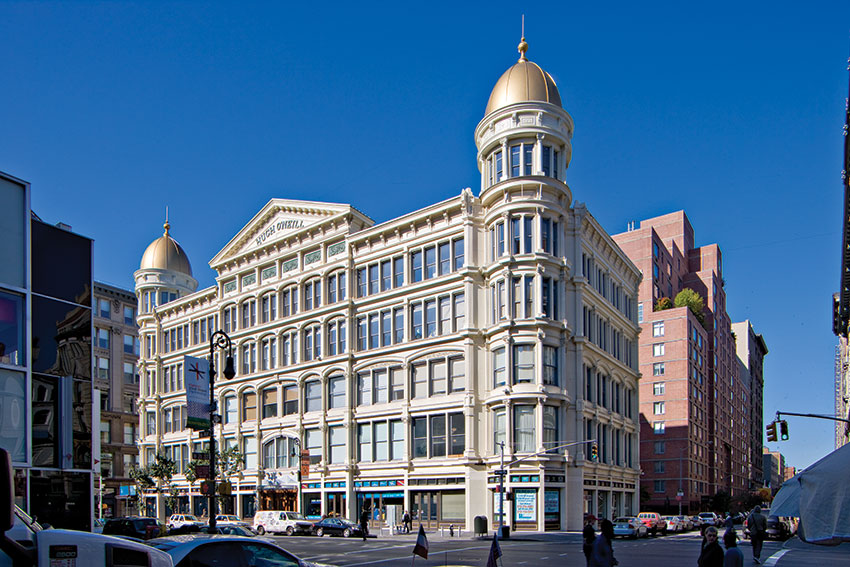
Photo courtesy of © Alan Schindler
The Hugh O'Neill Building (Mortimer C. Merritt, 1887), New York City, converted from commercial to residential use by CetraRuddy in 2005.
The first question, commentators suggest, has been answered “yes, theoretically” more often than “yes, and here's the living proof: a boom in conversion projects.” Reflection on the second question explains why such a boom may be slower to start than some have hoped, but may gain momentum in the foreseeable future, given a set of appropriate policy and economic incentives and prudently imaginative choices of prospective sites.
Commercial real estate markets softened dramatically when large numbers of office workers, unprotected by vaccines until December 2020, began working remotely. As many workers and employers have discovered the feasibility of work from home or hybrid schedules, demand for office space as the pandemic wanes has not sprung back to pre-pandemic levels. Coldwell Banker Richard Ellis (CBRE) reported a national commercial vacancy rate of 17 percent in the third quarter of 2022, continuing to rise as new supply outstrips demand, with class A space accounting for all net demand, class B/C demand actually negative, and downtown vacancy rates surpassing suburban for the past two quarters (CBRE, 2022). A Jones Lang LaSalle report on the same period calculated the national vacancy rate at a record 19.1 percent (Jones Lang LaSalle, 2022).
Business Insider recently labeled today's conditions an “office apocalypse,” with pre-pandemic occupancy rates of 95 percent now falling below 50 percent (Skandul, 2022). Collateral effects have lowered multiple variables reflecting business districts' vigor: not just office occupancy and commercial real estate values but employment, foot traffic, business spending, transit ridership, public services, and property-tax revenues for cities nationwide. Apocalyptic rhetoric is not limited to journalistic contexts; the same term appears in a detailed report by scholars at NYU and Columbia Business Schools, posted on the Social Science Research Network, calculating that remote work had caused “a $413-billion value destruction” in the U.S. commercial office sector (Gupta et al., 2022).
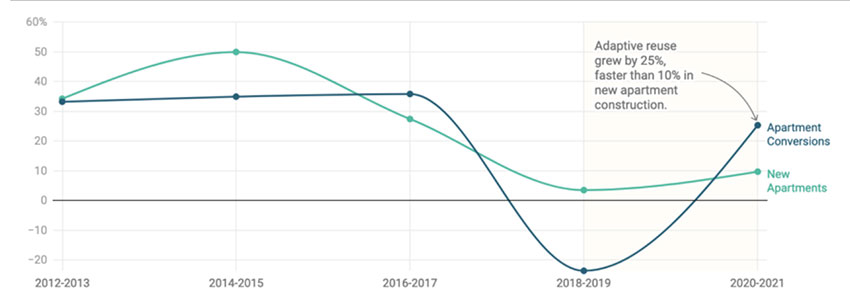
Source: RentCafe analysis of Yardi Matrix data (Neculae, 2022).
Figure 1. Percentage increases in adaptive-reuse apartments in 2020-2021 became higher than in new apartments. Source: RentCafe analysis of Yardi Matrix data (Neculae, 2022).
The idea of converting commercial real estate to residential has the intuitive appeal of solving two problems at once: helping to relieve the housing shortage in high-demand urban areas and adding new forms of value to spaces that have been neglected, abandoned, or rendered less marketable. Research suggests that residential adaptive reuse is indeed rising, with about 28,000 new rental units nationwide between January 2020 and December 2021, 11,000 of which (about 40 percent) were in the office-to-residential niche (Kolomatsky, 2022), increasing at a faster rate than new apartments (Neculae, 2022) (see Figure 1). Other building types chosen for conversion during these years included factories (15.5 percent), hotels (12.8 percent), and warehouses (9.0 percent), followed by health care, educational, and religious buildings. (These figures are from the real estate research group RentCafe, which studies Yardi Matrix data on conversions into residential buildings with at least 50 units; smaller-scale conversions, assuming these are above zero, logically imply that RentCafe's counts are conservative, possibly underestimates.)
The National Apartment Association, tracking rising numbers of conversions since 2010, has offered roughly comparable figures, noting that offices have overtaken hotels as the leading target type despite a COVID-19-related rise in hotel conversions (Miller, 2022). Office conversion is most common in “larger, more historic cities,” with 1,000 to 2,000 conversions seen in Philadelphia, Washington, D.C., Cleveland, Chicago, and Los Angeles. Curiously, the NAA's report says little about New York City's conversions, though these have become prominent through media coverage, the Skyscraper Museum's “Residential Rising” exhibition on downtown Manhattan's transformations since the 1990s, and city government's creation of an Office Adaptive Reuse Task Force in July 2022. Such conversions, one should note, still represent a relatively small phenomenon within the real estate context, contrasting with 791,081 newly constructed rental units nationwide during 2020-2021, according to RentCafe (see Figure 1 above).
Converted office buildings, particularly from before World War II, offer dwellers an array of advantages, says James McLane, AIA, director of technology at Page & Turnbull, a San Francisco-based firm focusing on renovation and preservation. Their formal lobby spaces and corridors are character-defining features; they often have ground-level commercial spaces with high ceilings, readily adapted into amenities such as fitness centers, cafés, or mobile work centers; many have balconies, tall story heights and windows, and narrow floorplates. These buildings are sometimes associated with federal tax credit opportunities or reductions in local parking requirements, McLane adds. Another benefit is that the conversion process is generally less physically disruptive to a neighborhood than new construction. “Projects of this nature,” he says, “are opportunities to fix the wrongs that we've done to our downtowns and revitalize them.”
John Cetra, founding principal of New York firm CetraRuddy, has worked on several of the city's most prominent conversion projects and sees this sector as ripe for expansion. “People are not using office space to the same degree that they had been before COVID,” he says, recounting a recent client conversation about an office building undergoing extensive renovation. “We've been working on the plans for over a year, and we have no new tenants lined up. So they're calling me and saying, 'What can we do with this building? Can we look at that quickly and see if it's a viable candidate for either mixed use or total conversion to residential use?' So, I think we're going to see more.”
In practice, some sites and building categories are well-suited to this form of adaptive reuse, while others look promising from afar but turn out to be cases of wishful thinking when analyzed in detail. Certain relevant architectural variables are obvious; some, not so obvious, until investigation of a proposed project leads to practical obstacles or deal-breaking costs. In some instances, nonarchitectural factors such as zoning or finance become deal-killers before architectural considerations even arise. (The financial and policy particulars of commercial-to-residential conversions are largely beyond the scope of this discussion, though they provide the background conditions for the architectural decisions considered here.)
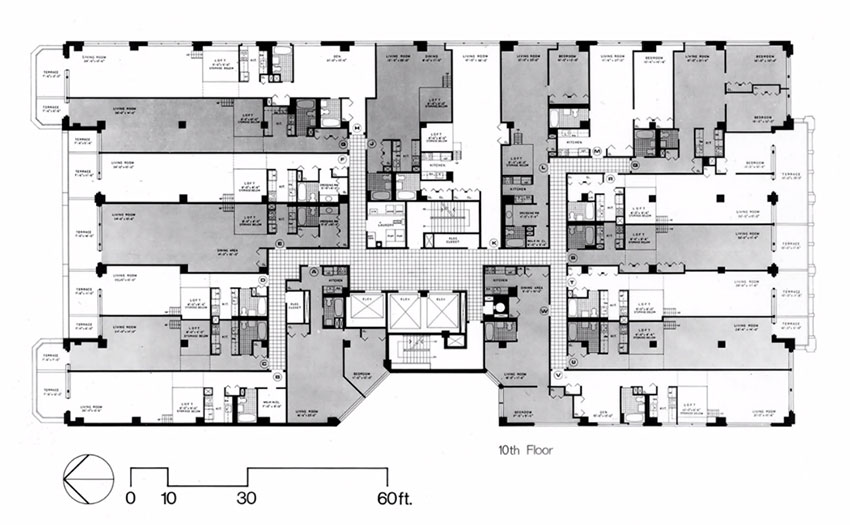
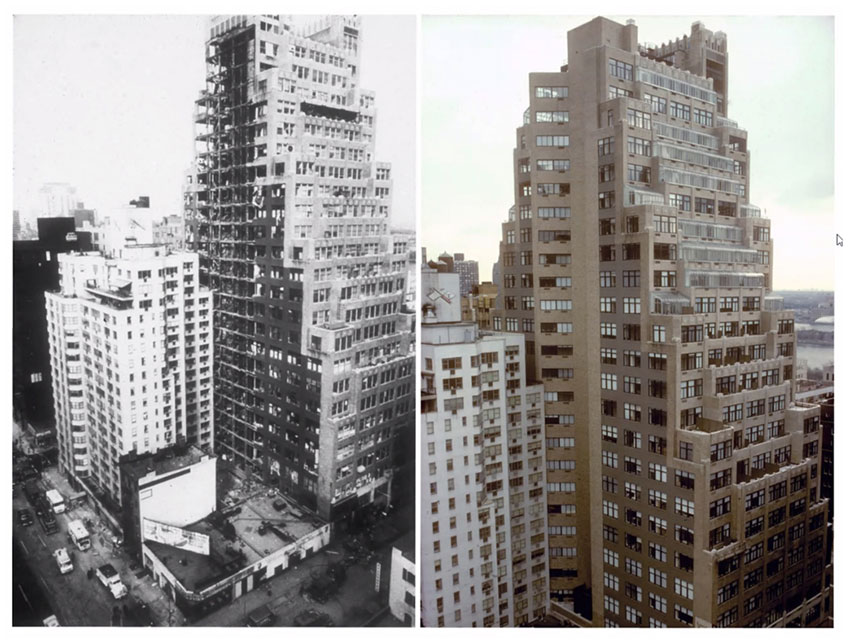
Proponents of conversions cite benefits including easier permitting, low construction costs, lighter environmental footprints, and partial leasability during conversion (Kiger, 2022; Malizia, 2022). However, Peter Bafitis, managing principal of New York firm RKTB and chair of AIA-New York's Housing Committee, comments, “The truth of the matter is, conversions are not inexpensive things; they are expensive and complicated, among the most complicated. I have always said that adapting a building, reusing it, is far more complicated than building something from scratch. You have to work with what's there, and often, you have to understand an older technology and bend it to your will, and then figure out how to get new services and utilities in it.” With those caveats in place, he remains enthusiastic about the practice: “You can make any building work, and you can adapt any building; I fully believe that there's no building where that is not possible. It's just that from a development perspective, you just have to be prepared for the unexpected” (see case studies and Figures 2 and 3).
As a guiding principle for a sustainable built environment, Bafitis cites with approval the motto of Pritzker Prize winners Anne Lacaton and Jean-Philippe Vassal: “Never demolish. Never subtract, remove, or replace. Always add, transform, and utilize, with and for the inhabitants.” Transforming the category of inhabitants themselves from office workers to residents calls for assessments on multiple levels, from the spatial and the material to the civic and the global, along with an awareness that economic considerations do not always harmonize with choices that otherwise look like win/win outcomes for most parties involved.
The COVID-19 pandemic and ensuing workplace changes have increased attention to an enduring anomaly in the national built environment: a glut of commercial space coexisting with a housing shortage. The question has naturally arisen: Can some of the former resources be repurposed to address the latter need? Architects with experience in adaptive reuse add a corollary question: Can the transformation of commercial properties to residences yield desirable homes, buildings, neighborhoods, and cities?
Photo courtesy of © Alan Schindler
The Hugh O'Neill Building (Mortimer C. Merritt, 1887), New York City, converted from commercial to residential use by CetraRuddy in 2005.
The first question, commentators suggest, has been answered “yes, theoretically” more often than “yes, and here's the living proof: a boom in conversion projects.” Reflection on the second question explains why such a boom may be slower to start than some have hoped, but may gain momentum in the foreseeable future, given a set of appropriate policy and economic incentives and prudently imaginative choices of prospective sites.
Commercial real estate markets softened dramatically when large numbers of office workers, unprotected by vaccines until December 2020, began working remotely. As many workers and employers have discovered the feasibility of work from home or hybrid schedules, demand for office space as the pandemic wanes has not sprung back to pre-pandemic levels. Coldwell Banker Richard Ellis (CBRE) reported a national commercial vacancy rate of 17 percent in the third quarter of 2022, continuing to rise as new supply outstrips demand, with class A space accounting for all net demand, class B/C demand actually negative, and downtown vacancy rates surpassing suburban for the past two quarters (CBRE, 2022). A Jones Lang LaSalle report on the same period calculated the national vacancy rate at a record 19.1 percent (Jones Lang LaSalle, 2022).
Business Insider recently labeled today's conditions an “office apocalypse,” with pre-pandemic occupancy rates of 95 percent now falling below 50 percent (Skandul, 2022). Collateral effects have lowered multiple variables reflecting business districts' vigor: not just office occupancy and commercial real estate values but employment, foot traffic, business spending, transit ridership, public services, and property-tax revenues for cities nationwide. Apocalyptic rhetoric is not limited to journalistic contexts; the same term appears in a detailed report by scholars at NYU and Columbia Business Schools, posted on the Social Science Research Network, calculating that remote work had caused “a $413-billion value destruction” in the U.S. commercial office sector (Gupta et al., 2022).
Source: RentCafe analysis of Yardi Matrix data (Neculae, 2022).
Figure 1. Percentage increases in adaptive-reuse apartments in 2020-2021 became higher than in new apartments. Source: RentCafe analysis of Yardi Matrix data (Neculae, 2022).
The idea of converting commercial real estate to residential has the intuitive appeal of solving two problems at once: helping to relieve the housing shortage in high-demand urban areas and adding new forms of value to spaces that have been neglected, abandoned, or rendered less marketable. Research suggests that residential adaptive reuse is indeed rising, with about 28,000 new rental units nationwide between January 2020 and December 2021, 11,000 of which (about 40 percent) were in the office-to-residential niche (Kolomatsky, 2022), increasing at a faster rate than new apartments (Neculae, 2022) (see Figure 1). Other building types chosen for conversion during these years included factories (15.5 percent), hotels (12.8 percent), and warehouses (9.0 percent), followed by health care, educational, and religious buildings. (These figures are from the real estate research group RentCafe, which studies Yardi Matrix data on conversions into residential buildings with at least 50 units; smaller-scale conversions, assuming these are above zero, logically imply that RentCafe's counts are conservative, possibly underestimates.)
The National Apartment Association, tracking rising numbers of conversions since 2010, has offered roughly comparable figures, noting that offices have overtaken hotels as the leading target type despite a COVID-19-related rise in hotel conversions (Miller, 2022). Office conversion is most common in “larger, more historic cities,” with 1,000 to 2,000 conversions seen in Philadelphia, Washington, D.C., Cleveland, Chicago, and Los Angeles. Curiously, the NAA's report says little about New York City's conversions, though these have become prominent through media coverage, the Skyscraper Museum's “Residential Rising” exhibition on downtown Manhattan's transformations since the 1990s, and city government's creation of an Office Adaptive Reuse Task Force in July 2022. Such conversions, one should note, still represent a relatively small phenomenon within the real estate context, contrasting with 791,081 newly constructed rental units nationwide during 2020-2021, according to RentCafe (see Figure 1 above).
Converted office buildings, particularly from before World War II, offer dwellers an array of advantages, says James McLane, AIA, director of technology at Page & Turnbull, a San Francisco-based firm focusing on renovation and preservation. Their formal lobby spaces and corridors are character-defining features; they often have ground-level commercial spaces with high ceilings, readily adapted into amenities such as fitness centers, cafés, or mobile work centers; many have balconies, tall story heights and windows, and narrow floorplates. These buildings are sometimes associated with federal tax credit opportunities or reductions in local parking requirements, McLane adds. Another benefit is that the conversion process is generally less physically disruptive to a neighborhood than new construction. “Projects of this nature,” he says, “are opportunities to fix the wrongs that we've done to our downtowns and revitalize them.”
John Cetra, founding principal of New York firm CetraRuddy, has worked on several of the city's most prominent conversion projects and sees this sector as ripe for expansion. “People are not using office space to the same degree that they had been before COVID,” he says, recounting a recent client conversation about an office building undergoing extensive renovation. “We've been working on the plans for over a year, and we have no new tenants lined up. So they're calling me and saying, 'What can we do with this building? Can we look at that quickly and see if it's a viable candidate for either mixed use or total conversion to residential use?' So, I think we're going to see more.”
In practice, some sites and building categories are well-suited to this form of adaptive reuse, while others look promising from afar but turn out to be cases of wishful thinking when analyzed in detail. Certain relevant architectural variables are obvious; some, not so obvious, until investigation of a proposed project leads to practical obstacles or deal-breaking costs. In some instances, nonarchitectural factors such as zoning or finance become deal-killers before architectural considerations even arise. (The financial and policy particulars of commercial-to-residential conversions are largely beyond the scope of this discussion, though they provide the background conditions for the architectural decisions considered here.)
Proponents of conversions cite benefits including easier permitting, low construction costs, lighter environmental footprints, and partial leasability during conversion (Kiger, 2022; Malizia, 2022). However, Peter Bafitis, managing principal of New York firm RKTB and chair of AIA-New York's Housing Committee, comments, “The truth of the matter is, conversions are not inexpensive things; they are expensive and complicated, among the most complicated. I have always said that adapting a building, reusing it, is far more complicated than building something from scratch. You have to work with what's there, and often, you have to understand an older technology and bend it to your will, and then figure out how to get new services and utilities in it.” With those caveats in place, he remains enthusiastic about the practice: “You can make any building work, and you can adapt any building; I fully believe that there's no building where that is not possible. It's just that from a development perspective, you just have to be prepared for the unexpected” (see case studies and Figures 2 and 3).
As a guiding principle for a sustainable built environment, Bafitis cites with approval the motto of Pritzker Prize winners Anne Lacaton and Jean-Philippe Vassal: “Never demolish. Never subtract, remove, or replace. Always add, transform, and utilize, with and for the inhabitants.” Transforming the category of inhabitants themselves from office workers to residents calls for assessments on multiple levels, from the spatial and the material to the civic and the global, along with an awareness that economic considerations do not always harmonize with choices that otherwise look like win/win outcomes for most parties involved.
DETAILS TO LOOK FOR, CHANGES TO PREPARE FOR
Floorplate sizes and proportions, ceiling heights, street exposures, mechanical/electrical/plumbing (MEP) infrastructure, and envelope features often vary dramatically between commercial and residential buildings. Zoning customarily separates these uses, except where municipalities have taken explicit steps to combine uses in certain districts; New York City's pattern of conversions, for example, has been shaped by successive rezonings of neighborhoods allowing adaptive reuse, largely in Manhattan below 59th Street after revisions to the Multiple Dwelling Law. Successful conversions, add architects who have worked on or analyzed these projects, have been more common at the higher end of the urban real estate market, as yet doing little to bridge the gap between the societal need for non-luxury housing and the oversupply of office space.
Several years before the pandemic began, the Gensler Research Institute developed a classification for floorplate configurations divided into five archetypes (wedge, cube, light or L-shaped, blinder, and heavy or slight slab), with different potentials for commercial-to-residential conversion based on analysis of sites in the Washington, D.C., central business district (Gilley et al., 2017). The wedge and cube models, this group found, were most conducive to conversion; slabs and L-shapes varied in suitability depending on floorplate depth; “blinders,” in mid-block, lacking openings on side walls, were deemed “logistically complex and financially unsound.” From discussions with clients about pandemic-era priorities, discovering that many developers considered Class C office buildings good candidates for conversion, this firm more recently formulated an internal “office-to-residential calculator dashboard” assigning relative weights to five groups of criteria (site context, 10 percent; building form, 30 percent; floorplate, 30 percent; envelope, 10 percent; servicing, 20 percent) (Gensler, 2022).
Different generations of office buildings offer different possibilities for convertibility, with early-20th-century buildings' fenestration often more conducive to residential adaptation than the towers of the 1960s through 1980s. The latter typically have sealed envelopes with inoperable fenestration, heavy reliance on mechanical ventilation (often dedicating substantial space to MEP systems in vertical shafts and dropped ceilings), and large floorplates. A counterbalancing advantage of nonhistoric buildings, McLane points out, is the flexibility to make exterior improvements, such as adding balconies and rooftop amenities.
“Whether it's a rental building or a condominium, the efficiency of the floorplate and the net rentable or sellable area is really critical,” Cetra comments. “If those numbers look good, that's what's going to make it viable. So you've got to get an efficiency on a typical floor of at least 85 percent, which shouldn't be too difficult to do....You want to get a lease-span dimension that's not so great that it will create a lot of interior space that's not going to be usable and enjoyable to use,” he says, noting that buildings with lease spans up to 40 feet, sometimes slightly higher, are easiest to convert.
Typical residential floorplates with a center double-loaded corridor are around 65 feet wide, allowing apartments up to a 30-foot lease span from corridor to window. With commercial floorplates in the range of 40,000 square feet, or roughly 150 feet by 300 feet, Cetra says, “You have to carve them out to make them work, and when you carve them out, you don't want to lose that floor area, so you've got to put it somewhere. Mostly you put it on top of the existing building, if the building can sustain the additional redistribution of the load. A lot of the buildings from the '60s/'70s were not designed to the same standards for lateral and seismic loading, and so adding onto the buildings can be very, very costly. It usually requires a reinforcement of the structural system.”
One downtown project Cetra's firm is working on, an office building with ample floor area (over a million square feet) and extensive water damage from Hurricane Sandy, provides an example of the degree of renovation a conversion can require. Flooding required elevation of all the electrical equipment. In addition, a code change required the team to raise the ground floor about six feet to be clearly above the flood elevation. To provide natural ventilation and daylight for the apartments being created, the restructured building will have two courtyards carved out, plus an equivalent amount of space added in the form of 10 new stories atop the existing building. “That amount of additional floor area is requiring us to laterally brace the entire structure, so a series of K bracing lines have been designed into the floorplans,” Cetra says, “and the facade needs a lot of work in order to bring it up to current energy code.”
Facades commonly require renovation to improve energy performance and often to provide natural ventilation, which New York City codes and others require for residential use. “A lot of those buildings as well, from a standpoint of energy consumption, don't have high-efficiency exterior walls, and they may not have operable windows,” Cetra notes. “So you're going in and changing the exterior. You may not be ripping it all down, but you're going to improve the energy efficiency. You're going to go from a single-pane window system to at least a double-pane glass and operable windows. So there's an expense there, but I think that's one that's clearly very valuable.” Bafitis adds that, “In almost every case, in conversions that I'm aware of, windows get replaced, so whether they're operable or not is almost irrelevant, because the entire fenestration gets replaced. Now, on a glass office building it becomes tough, but they're so dated and energy-inefficient that I don't see how you convert any of these Midtown office buildings without recladding.” (A previous Architectural Record Continuing Education article, “Adaptive Reuse of Commercial Spaces: Curtain Wall Solutions,” December 2021, addresses facade retrofits in detail.)
A related consideration, Cetra says, is whether a building's MEP systems need replacement. Many candidate buildings have “forced-air cooling systems with the ducts coming from the roofs and going down, and that antiquated system has to be totally ripped out and new high-efficiency systems...put in. And many of these buildings will become all-electric, also, in order to comply with future energy code requirements.” A common condition he has seen in lower Manhattan is for ground floors to be below the flood elevation, with mechanical systems located in the basement; moving those components higher in the building addresses that issue.
Another variable to assess in a candidate building, or to alter in the new design, is the number and position of elevator cores. Residential buildings have lighter elevator requirements than commercial, Cetra says, and in the latter, “usually, the cores are not in the best, most efficient place for conversion. Stairs were placed near the exterior walls so they provided a window into the stairwell, which is no longer required. So you want to move those inboard to take advantage of whatever perimeter you can get...potentially cutting down the number of elevators to a third, depending upon how big the floorplates are and how many units.”
Ceiling heights in older commercial buildings tend to be generous, a plus for post-conversion occupants' quality of life, though from developers' perspective it can be too much of a good thing: 13- to 15-foot ceilings do not maximize rentable space. Such large spaces are also inefficient to heat. Bafitis views 10 to 12 feet as a sweet spot between overscaled ceilings and the 8 to 8½ feet often seen in postwar construction, arguably an artifact of standardized timber lengths and widely regarded as conducive to claustrophobia.
The challenge of a suboptimally configured building can inspire imaginative solutions, not all of which prove feasible. Deep interior spaces in former offices, far from windows, can become dens or home offices. “You could take a large floorplate and you can do a perimeter,” Cetra says. “You use the perimeter for residential, but then you create a different use in the center.”
The obstacles have been effectively surmounted when architects have adequate client support and the opportunity to make strategic alterations. “The big challenge is zoning,” comments Claire Weisz, founding partner of WXY Architecture + Urban Design in New York City. Reconceiving single buildings' programs or combining uses on a civic scale to create “the vertical city,” she says, is “a zoning challenge; it's a financing challenge. But I don't think it's a huge architectural challenge, because actually, in general, commercial buildings are flexible. There's been a huge number of residential conversions, and even some larger ones have come up with clever things like carving courts out in various floors, moving facades back, or doubling the facade so you get an outdoor space.”
Adaptive reuse projects, in general, benefit from the strength-to-weight ratio, construction speed, flexibility, and recyclability of structural steel (see “Weight Watching: Adaptive Reuse with Structural Steel,” Architectural Record Continuing Education, November 2015), a clear advantage when relocating elevator cores, facades, or other components to optimize a commercial building's square footage for residential use.
Weisz’s optimism about these projects is grounded in the contextual details of sustainable urbanism: energy systems, circulation, management of light and airflow. “The world has recognized all-electric as an idea,” she says, “and because of that, I think architecture can be more flexible. You're worried less about gas lines in buildings. We've had our exiting and egress laws that are not so dissimilar between office buildings and residential,” with certain nuanced exceptions (e.g., in New York City, scissor stairs are allowed in residential buildings but not commercial buildings). The challenge, she believes, is not so much to shoehorn new uses into fixed spaces as to create projects that convince “policymakers, planners, and communities why flexible conversions, and being able to actually have even office space and residential space in the same building, might be a good way to go....Adapting buildings that already exist is the challenge of our time.”
THE COMMUNITY CONTEXT
The oft-quoted adage of past AIA President Carl Elefante is relevant here: “the greenest building is the one already built” (Elefante, 2007). Repurposing underused components of the built environment is a sound way to respect the natural environment, whether or not it pencils out financially at any particular site, since the variables determining that penciling-out are relatively malleable, responding to regulatory or market conditions, compared with the long-range mandate to conserve resources and minimize damage to the Earth. Discrepancies between the value of a green community and the different sense of green that private developers prioritize have long predated the current pandemic-related conditions. What one stakeholder sees as a desirable site will appear unpromising or counterproductive from other perspectives.
With attention to the role of residential buildings in transforming neighborhoods and creating viable communities, Weisz recommends a multifactorial analysis of candidate buildings in their local contexts, asking not only whether they have readily transformable floorplates and sufficient plumbing but whether they are located close to municipal infrastructure and food sources, whether they include open space and other neighborhood amenities, and whether they respond to local needs not limited to housing units alone.
Proximity to transit, Weisz contends, is an important precondition for converting spaces and increasing a district's residential component; urban transit deserts and smaller-town locations underserved by bus or light rail are weak candidates for conversion. “The conversion issue to me,” she says, “has more to do with our codes that require parking, and all of our services that come through the streets, and what the future will be, than actually the buildings themselves, which are easy to convert.” Zoning mandating a parking-space minimum, she adds, is among the factors driving up costs of construction (reportedly adding $50,000 per parking space to development costs in Los Angeles [Manville, 2021]); “People can't afford to do structured parking, especially below grade, unless the subsidies are there for it—and again, then we're just subsidizing car use.”
Transit access, she says, “not only should be a precondition but should be the way we advocate for the conditions for making community.” WXY often seeks out settings where “communities are struggling to be communities. The concept of community actually takes a lot of work...to have someone be able to run a retail business and have reliable customers, to have that face-to-face interaction, to live somewhere and feel like you can easily get the things you need within a couple of blocks, that you're there to help your neighbors─that actually requires support.”
One adaptive-reuse project that WXY and collaborators Body-Lawson Associates have recently completed (converting from a different use), The Peninsula at Hunts Point, addresses the rebounding South Bronx's requirements for open space, healthy food sources, and live-work facilities as well as apartments. Adapted from the notorious Spofford Juvenile Detention Center (shuttered in 2011), Weisz says, the Peninsula development rearranged the relations of the carceral buildings and their surroundings and transformed the prison into a six-building, 4.75-acre, mixed-use campus. “The social impact and the fact that these buildings were closed fundamentally programmatically to the neighborhood,” she says, “really made us rethink adaptive reuse,” exchanging existing buildings with open spaces “because they were retreating from the street, and they were blocking connections to the neighborhood.”
Recalling industrial neighborhoods where a concentration of jobs have been natural residence magnets, such as the Navy Yards of Brooklyn and Philadelphia, she says, Hunts Point's fish market, produce market, small manufacturers, and new office/arts/studio/retail center (the nearby BankNote Building, another adaptive-reuse project by Beyer Blinder Belle) likewise create logical conditions for residential conversion. Combining 740 new residences with community facilities, retail, and light-industrial space including food manufacturing and media production, the Peninsula exemplifies the contextually integrated neighborhood revitalization that Weisz considers essential in adaptive reuse regardless of original program.
WXY has designed conversions of other typologies and included commercial-to-residential conversions as part of master plans and rezoning efforts, Weisz adds, though it has yet to have a commercial-to-residential project built. This is a common experience among firms that have investigated conversions. “Mainly what the pandemic has done is generated more conversation around this topic,” comments David Hart, AIA, the San Francisco-based president and CEO of Steinberg Hart, an international firm headquartered in Los Angeles. “I don't think it's actually generated a whole lot of actual movement.” Conversions of class B and C office space, in his experience, have occurred in locations where residential is scarce, often areas with 90 to 100 percent office space, where newly created housing offers a needed alternative that can “garner a per-square-foot rent that is better than the adjacent commercial only because of it being a different product type.”
In California, Hart adds, the gap between conversation and construction involves a combination of cost-benefit analyses and local conditions. “The West Coast is way behind in housing production,” he says, because “our environmental laws here in California have slowed the production over the last 20-plus years, to the point where we have what I would call a state-of-emergency housing crisis....Talk to any developer, and they will tell you that the economics of converting most office buildings to residential is cost-prohibitive.” He sees no market mechanisms generating an “office-price reset” in response to the pandemic-related demand decline; building sales that might lead to conversions are rare, with most owners preferring to hold onto underused office buildings and wait out the slump rather than sell buildings at fire-sale discounts.
“What would change the economics? Incentives from government,” Hart continues. “Because we see this empty office as a problem for an urban area, because we don't want urban blight, we'd rather have people living there, and we know we need affordable housing. So there's a place where the government could step in with subsidies, incentives, tax credits, etc.” Two pieces of state legislation signed into law in September 2022, Senate Bill 6 and Assembly Bill 2011, aim to streamline the construction process and labor arrangements for converting office buildings, big-box stores, and strip malls into affordable housing, a sign that California's government can sometimes break interest-group logjams exacerbating its housing shortage (Wiley, 2022).
The state's Project Homekey, Hart observes—an anti-homelessness grant program that grew from the Project Roomkey emergency-housing measure during the 2020 lockdown, began with hotels, and expanded to include apartments and converted commercial properties—has made some headway in expanding housing and lowering affordability barriers. National historic tax credits are also helpful. Counteracting these influences, however, is the state requirement for seismic structural upgrades, a response to the 1994 Northridge earthquake incorporated into California's 1997 building code. Because that event exposed vulnerabilities in welded steel moment frames, with about 100 Los Angeles steel buildings sustaining joint fractures, codes changed to require buildings predating 1994 to undergo a full upgrade with any change of use. (Non-ductile concrete buildings, including many built in California before the implementation of the 1976 Uniform Building Code, must also undergo structural analysis and either retrofitting to meet lateral-force restraining standards or demolition, with timelines varying by municipality.) Hart's firm recently evaluated a tower in downtown Los Angeles for conversion; although updates for Americans with Disabilities Act (ADA) compliance and energy performance were routine and were “baked in” to the cost estimates, he says, “the seismic upgrade was going to put a $40-million price tag” on the deal, delivering a fatal blow, as often happens with projects to adapt tall buildings of pre-Northridge vintage.
McLane frames the state's seismic regulations as catalysts for opportunities. “If you're a property owner with a building that's non-ductile [concrete],” he says, “you have to upgrade it at some point, and certainly whenever you make a major rehab, examining what's needed to upgrade the structure can be the prompt that actually then expands your minds as a team.” A client with an office building that needs structural work to meet an ordinance will sometimes ask architects what it needs, beginning a conversation that “opens up the property to more optimal use.”
After producing a white paper on hotel conversions (Steinberg Hart, 2021), “what we're recommending to clients,” Hart says, “is, don't shy away from this as a concept, but just do a rapid assessment.” Instead of hiring large teams and spending months evaluating a single site, he recommends small teams exploring multiple properties. “In three weeks, you'll have enough information to do your due diligence and say, 'Yeah, we want to move forward with this or not.'...Don't look at one building and spend months looking at one building. Look at 10 buildings, and look at all of them on a comparative analysis in a two- to three-week period, and then buy two, or buy one, and then move forward.” Although some clients still conclude that the buildings are overpriced and shy away from sunk costs (either land or buildings), he says, “that's not to say we won't see it. I think we'll see an uptick in this, and we're very interested in doing more of this type of work. But I don't think it's the radical transformation of our built environment that I think some of the conversation around it has that I've heard over the last six to 12 months as a result of the hybrid-work scenario.” Developers' hesitancy can stop a good idea in its tracks, he finds: “Architects like to talk about architecture, but there's no project if there's no project.”
THE “FLIGHT TO QUALITY” AND THE NEEDS OF HISTORY
In 2021, journalist Justin Davidson (writing for New York magazine's urban-environment section Curbed) challenged Architectural Research Office (ARO) to develop a residential conversion plan for a mid-Manhattan office building, 260 Madison Avenue, testing then-governor Andrew Cuomo's proposal to create conversion incentives through zoning revisions in designated parts of the city (Davidson, 2021). The premise of ARO's thought experiment was that class B and C commercial buildings, lacking the panache of newer class A spaces and, in some cases, lacking appropriate maintenance, could find a second life as residential or mixed use, given “a few nuanced regulatory tweaks.” Though some in New York City's real estate community remained skeptical about the project's economic plausibility, a development executive signed off on the numbers, at least on a “smell test” basis. The transformations were substantial, including relocating volumes, constructing new components out of mass timber, and adding a high-performance facade; the resulting mixed-use design appeared sustainable and livable.
ARO, says Bafitis, “took this conventional mid-20th-century wedding cake building where it's really fat on the bottom and it gets skinnier on top, and they took portions from the bottom and elevated them higher, which made a lot of sense because you reduce the floorplate on the bottom, where you want to do it, and you increase it on the top, and they created a mixed-use building, energy-efficient. They gave a template of how it can be done physically and even aesthetically.”
Historical precedent for this hypothetical conversion and rising numbers of real ones exists in the form of the Lower Manhattan Conversion Program (1995–2006), a.k.a. the 421-g Tax Incentive, which offered real estate tax abatements and other motivators for conversions in the Financial District, which helped downtown Manhattan evolve from a nocturnally deserted commuter district into a true community with around-the-clock amenities. This measure, in turn, rested on precedents for manufacturing-to-residential conversions in the nearby SoHo neighborhood, where artist-activists from the 1960s onward started a movement that catalyzed two amendments of the state's Multiple Dwelling Law allowing artists to live in converted manufacturing spaces, then a 1982 Loft Law opening that model to broader populations. It is not hard to extrapolate from past changes to future policy shifts that may accelerate today's trends, particularly with the New York City's Office Adaptive Reuse Task Force releasing new recommendations for expanded regulatory flexibility and tax incentives (NYC Department of City Planning, 2023), and with more cities choosing similar approaches.
Charles F. Bloszies, an architect, structural/civil engineer, educator, and writer based in San Francisco whose firm emphasizes urban infill and historic preservation, concurs with Bafitis's caveat that assumptions about the economics can be unrealistic. “Everybody says, 'Well, it's an existing building; it's going to cost less to refurbish it than to build new.' That's actually not true,” he comments. “It costs less to build new and faster and more predictable than tearing apart an existing building and doing a major conversion.”
In conversations with contacts in California's brokerage and legal fields about potential conversions through the pandemic period, Bloszies has noticed that their position has adjusted from initially dismissing the idea as too expensive. “It doesn't make sense. We're waiting for the office market to rebound”─to a more nuanced and flexible tone: “Well, we're worried that we're not going to see a rebound.” The Bay Area is heavily reliant on tech offices and well supplied with buildings dating from shortly after the 1906 earthquake and fire, noted for high ceilings, operable windows, views, and charm: exactly the blend of features that are conducive to residential conversion. “I think if the economics can be worked out and the politics can be worked out—and that's not simple—that this is bound to happen,” he says.
With business leaders pessimistic about downtown San Francisco's economic comeback, many firms are adopting hybrid work-from-home arrangements requiring less office presence, and “what most of the big players are doing is what's being called a flight to quality," says Bloszies. "They're downsizing their real estate footprint, but they're going to class A buildings with services that would be more attractive to their workforce. And the consequence of that is the class A buildings here, the high-rise buildings like the Embarcadero Center, Salesforce Tower, all our big skyscrapers, are really not suffering the economic consequences that the smaller buildings are.” Those class B and C buildings, located in or near downtown, and often owned by families or smaller investors, are prime conversion candidates.
Considering the area's high building costs, construction costs (around $700-800 per square foot), a lengthy planning process, and affordable-housing requirements, new construction in San Francisco has become rare. One broker told Bloszies, “In real estate, it almost never makes economic sense to do a development. The real window of opportunity has been maybe a year in my 30-year career.” There is also concern that the city budget's substantial reliance on commercial property-tax revenue creates public-sector vulnerability as property values fall. “If there could be some kind of incentive to keep them alive by converting them to residential, from the economic side and the broker side, that would be wonderful,” Bloszies comments, while raising the question of whether the political will to create such incentives is present.
Bloszies and colleagues have examined properties with high potential for conversion, singling out as particularly promising a historic four-story office building in the Jackson Square nightlife district adjacent to downtown with three sides of exposure, a relatively small floorplate, light exposure, and the potential for a “density and height bonus,” a provision originally aimed at adding affordable housing. With the necessary seismic structural upgrade (probably shotcrete shear walls to strengthen the original brick) and new elevators, Bloszies envisions adding several stories to the building, creating four residential units per floor. San Francisco, he says, has hundreds of similar buildings.
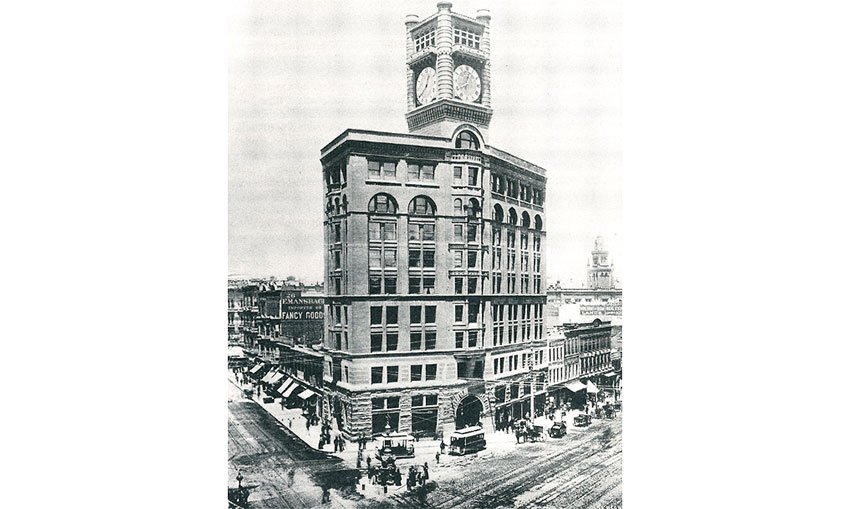
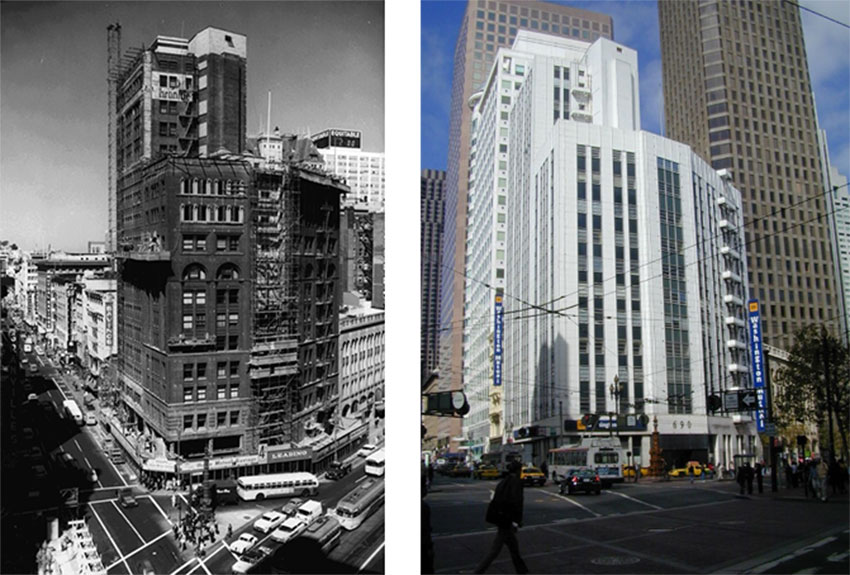
His prepandemic experience with converting the original Chronicle building by Daniel Burnham into a mixed-use building with a large residential component is a complex saga of sequential adaptations, expansions, and ultimately the recovery of a respected civic asset (see old Chronicle building case study and Figures 4-7). San Francisco's heritage of Chicago School commercial buildings also includes the Aronson Building (706 Mission), a ten-story office midrise recently expanded to a mixed-use complex combining luxury residences with the Mexican Museum (a modernist structure by TEN Arquitectos of Mexico City) and an adjoining 43-story residential tower of precast stone and glass, a joint project of Page & Turnbull and Handel Architects that provides structural reinforcement for the original Aronson. Designed by Hemenway & Miller (1903), it survived both the 1906 earthquake and the Loma Prieta earthquake of 1989 as well as several nonhistoric additions, now removed. With the rehabilitation component guided by Page & Turnbull, including repair of an elaborate facade including terracotta ornamentation, cornices of sheet metal, entries of Colusa sandstone, and cast iron pilasters, the complex offers a strong example of the reinvigorated past in dialogue with the present.
CONCLUSION
Transforming commercial spaces into residences, whether they originate as offices or as any other typology, is more than a business venture involving a single property. It is a step toward sculpting a neighborhood, ideally taken with an awareness that conversions can kindle changes with unforeseen effects, sometimes reanimating an underperforming building or aiding an underserved community, but also capable of straining local infrastructure or worsening the environmental burdens of development. Conversions represent calculated risks rather than panaceas. They are usually sui generis projects, and they have frequently depended on an economic or regulatory nudge from the public sector.
Bloszies compares such incentivization to changes in a local ecosystem that create conditions for gradual growth, “like the coral reefs that occur when a ship sinks, where it doesn't happen naturally. Something happens that's sudden, like a shipwreck, and then eventually a coral reef develops.” He is skeptical about sudden creation of dedicated districts and, instead, sees neighborhoods developing organically around “a series of small moves. I think large developments that are purporting to create instant neighborhoods almost by definition can't succeed. It has to happen organically, by accretion.”
McLane suggests a series of questions that Page & Turnbull applies to evaluate proposals: “If it's a historic building, is that one that can stand up to the changes that would be necessary, and does it meet our firm standards for appropriate treatment of a historic building? We follow historic preservation practices very closely, so if it's a building that's designated as a landmark, then it's a given that the building must be treated following professional standards. It might be a building where that isn't the case, and the developer might want to do something that is to us questionable. So then we have to decide: do we want to help this developer, or do we take a pass? We don't usually take a pass,” he continues. “We usually try to help a property owner reach their goals, and we give them our recommendations. They may not follow all of them....We are experts in historic preservation, and we not only can help owners understand how to get through the approvals process and how to design a project that will meet their market goals, but we think we can help them expand their vision, sometimes, of what you can do with a building.”
Weisz addresses the elephant in the living room: the tendency of conversions to date, despite their benefits reducing housing shortfalls and embodied carbon, to skew toward price points where cities least need them. “Once you have the right incentives, then saving buildings, whether it's for affordable housing or not, becomes a lot more feasible. If you're basically not getting any financing on the basis of saving a building, then it's going to be even harder, and therefore you really need to get paid back enough to cover your costs. It's really where we put our incentives in. In the old 80/20 program, I'm sure there are affordable apartments, even in adaptive reuse, where the financing was there for basically averting taxes for 20 or 30 years, and it's worth it. But there's no physical reason why affordable housing cannot be part of office conversion to residential.”
END NOTES
Bill Millard, is a New York-based journalist who has contributed to Architectural Record, The Architect's Newspaper, Oculus, Architect, Annals of Emergency Medicine, OMA's Content, and other publications.