This CE Center article is no longer eligible for receiving credits.
Green building, or sustainable design and construction, is a growing element of the global economy, in projected market share, and heightened public awareness. From building owners, architects, engineers, construction managers, and government agencies to the mainstream media and energy-consuming public, the business of green is now an important economic and social policy issue.
Rising energy costs impact all aspects of the building industry, from availability, transport, and processing, to demolition, recycling, and disposal of building construction materials. Buildings and their construction account for half of all greenhouse gas emissions and energy consumption in the U.S. annually. This includes energy used in the production and transportation of materials to building construction sites, and energy used to operate buildings. Globally, the percentage is even greater. Buildings are the primary source of demand for energy and materials that produce by-product greenhouse gas.
"As of 2005, buildings account for 48 percent of U.S. energy consumption and generate far more greenhouse gas emission than any other sector," says R.K. Stewart, FAIA, principal of Gensler, San Francisco, and 2006 AIA First Vice President/2007 President Elect. Transportation accounts for 27 percent, and industry for 25 percent, respectively. "Architects must accept responsibility for our role in creating the built environment, and encourage our clients and the design and construction industry to join us in developing measurable changes that will improve the quality of life." To ensure results, AIA supports the development and use of rating systems and standards that promote a more sustainable environment.

The Blakely Hall Community Center, Issaquah, Washington, is the first U.S. building to receive a sustainability certification under the Green Globesâ„¢ rating system.
Architect: Weber + Thompson.
Photo courtesy of GBI. |
|
|
Public and private sector owners and managers increasingly are reviewing the benefits and potential savings of green building and sustainable practices. The challenge of implementing sustainability into the built environment has provided new marketplace opportunities, from green building products and college programs, to sustainability rating systems.
This article will explore sustainability principles, implementing best practices, and applying sustainability ratings to create energy efficient commercial and residential construction, such as when using the Green Globesâ„¢ system.
Energy Consumption
According to the U.S. Environmental Protection Agency (EPA), in 2002, buildings accounted for 39 percent of total U.S. energy consumption. Residential structures accounted for 55 percent of that total, while commercial buildings accounted for the other 45 percent. These statistics have risen steadily since then.
The AIA, along with other building industry organizations, has endorsed sustainability and the goals of lowering energy consumption and greenhouse gas emissions, which contribute to climate change. In December 2005, the AIA adopted two policies, endorsing sustainable architectural practice, and the development and use of rating systems and standards that promote and contribute to a sustainable future.
The AIA's sustainability goals support resource conservation to achieve a minimum reduction of 50 percent of the current consumption level of fossil fuels used to construct and operate buildings by the year 2010. Just as importantly, integrating sustainability into the curriculum for architectural continuing education activities relating to professional licensure, and within architectural schools, will result in an emerging core competency within the established design criteria for current and future U.S. architects.
Changing the mindset of the building industry, facility owners, and the public towards accepting the benefits of greener future is a long-range undertaking. At least 10 to 15 years, an entire generation of graduates, may be needed to educate owners and government agencies about the benefits of sustainability principles.
To make an impact, there must be greater use of renewable energy sources and the use of innovative design principles to improve environmental performance. Since energy consumption reductions will be realized over the entire building life cycle, architects and owners must look beyond first impacts associated with construction, and consider operational and life cycle ramifications. "It's time to require specific goals for significant reductions in energy use, with enhanced performance assured through building commissioning," Stewart adds.
Sustainable Rating Systems
The marketplace has traditionally welcomed innovation and consumer choice, from automotives and soft drinks, to computer software and health care plans. Even in industries where a single product or brand tends to dominate the market, other options always emerge to meet consumer needs.
Increasingly, private nonprofit groups, companies, organizations, public agencies, and educational institutions are developing sustainability guidelines and rating systems to meet their requirements, budgets and schedules, rather than relying on a one-size-fits-all standard. When the marketplace develops different sustainability rating systems in response to consumer preferences, more design professionals and building owners are likely to implement sustainability principles.
"There are a number of standards out there, and architects must understand how they are derived, so they can better use them. Architects must learn to address the important characteristics of these standards, work with various groups to promote them, and help craft them to meet architectural concerns. Sustainability ratings should be developed as a collaborative, consensus building process, with designers, manufacturers, and contractors," says Stewart.
From a regulatory perspective, a two-pronged approach is needed, Stewart adds. Regulations at the federal, state, and local levels may require certain goals to be met, and standards to be implemented. At the same time, creating incentives for the building industry to go beyond the minimums may provide an additional push for regulations and mandated standards.
"Changing behavior is difficult, but we can offer incentives to advance sustainability, and back up good practice with legislation and regulations," Stewart adds. "In California, energy standards are only one part of public policy, relating to climate change. The building industry must deal with the entire spectrum of building life span and operations. Regulations still don't address energy concerns over a building's 50-year life cycle. It is difficult to assess the energy consumed on a project, from extracting raw materials, to transporting them, and preparing them for processing. Architects can't always judge the environmental impact of specifying materials made locally over those brought in from a distance. Life cycle analysis addresses these bigger issues."
Clients and building owners often focus on first costs over long-term costs, especially with limited multi-year public appropriations or private funds providing fixed project budgets. One solution, Stewart observes, may lie in the financial markets, and how they view sustainability over traditional construction methods. "Once we get the financial markets to recognize greater dollar values on projects with lighter environmental impact, they may be more inclined to see the inherent benefits," he adds.
Best Practices and Sustainability Rating Systems
The principles included in the AIA policy on sustainability rating systems comprise a compendium of best sustainable practices that rating systems should ideally address. Green building rating systems, standards, or regulations for the design and construction industry should encompass the following:
- Be developed and renewed regularly, through a consensus-based process, in which all interested parties can participate
- Require clearly defined design documentation to demonstrate compliance
- Require compliance to be validated by an independent third party
- Require the development of sustainable sites, while avoiding conversion of prime
agricultural lands or wetlands, regenerating brownfield sites, or those that result in
regenerative benefits to the natural environment
- Require specific goals in the efficient use of water resources, that promote use of
new wastewater technologies
- Require goals for energy use reduction, especially non-renewable energy sources,
with enhanced performance assured through commissioning of building systems
- Promote the use of renewable energy sources
- Require reduced use of non-renewable natural resources through the reuse of
existing structures and materials, reduction in construction waste, promotion of
recycled content materials, and use of materials independently certified as from
sustainable sources
- Require goals for improved indoor air quality (IAQ) through enhanced IAQ, thermal
comfort, acoustics, daylighting and pollutant source control, and use low emission
materials and building system controls
- Promote the development and application of innovative designs and collaborative
processes to improve environmental performance
- Recognize the life cycle value of a community or project in addition to construction
first costs, including assessment on climate change, acid rain, water pollution,
resource depletion, and toxicity factors
- Use life cycle assessment data as the basis for design and construction
decision making
- Acknowledge national, regional, and bio-climatic differences
- Reduce (and eventually eliminate) on-site and off-site toxic elements in the
built environment
- Require specific measurable reductions in CO2 production in the built environment
- Require documentation of actual building energy and operational performance
Educating Students, Emerging Architects and Future Business Leaders
Changing the ways of professional practice and how people perceive sustainability is part of the challenge facing the building industry, nonprofit green groups, and sustainability advocates. Academia, too, is grappling with how to integrate sustainability into architectural education. But architects are only one of many professional disciplines who ultimately will make decisions about the business of green design.
Building owners, engineers, financiers, lawyers, government administrators, elected officials, and building industry members play significant roles in promoting, paying for, and adopting sustainability principles, rating systems, guidelines, and standards, along with architects.
"Students and young architects are more aggressive about embracing sustainability principles," states Stewart. Multi-disciplinary academic programs available to those in and outside schools of architecture can effectively educate tomorrow's business leaders and future clients.
"Emerging architects understand the benefits of sustainability goals. It may be a hard sell for some clients, but in a world of scarce resources and a growing body of evidence pointing to the need for energy conservation, this is the future of the building industry," says Jeremy Edmunds, Assoc. AIA, P.E., LEED-AP, sustainability advisor, Cherokee Northeast, New York, New York, and 2006 National Associate Representative to the AIA Executive Committee.
About the Green Building Initiative
The Green Building Initiative (GBI) is a not-for-profit organization established to accelerate green building among mainstream practitioners. GBI encourages increased education that will result in sustainable design and construction practices. In early 2005, GBI introduced the Green Globesâ„¢ environmental assessment and rating system, an online tool for assessing sustainable design criteria, to support these goals.
GBI consists of a network of design and construction industry leaders committed to sustainable design. The mission includes adoption of building practices that result in energy-efficient, healthier and environmentally sustainable buildings, with a focus on residential and commercial design and construction. In addition to overseeing Green Globesâ„¢ in the U.S., GBI works with Home Builder Associations to develop green building programs for the residential market based on the National Association of Home Builders Model Green Home Building Guidelines.
GBI is governed by an independent board of directors comprised equally of producers (building material suppliers), users (architects, engineers and builders) and interested third parties (academics and non-governmental organizations). Details on the GBI board and lists of supporting and associate members are available atwww.thegbi.org.
Evolution of Green Building Rating Systems
Although relatively new to the U.S. market, Green Globesâ„¢ is the product of over nine years of research and refinement, beginning in 1996 when its forerunner, the Building Research Establishment Environmental Assessment Method (BREEAM), was adapted in Canada. Subsequently, the Canadian system underwent various iterations, becoming BREEAM Green Leaf in 1999 and Green Globesâ„¢ in 2002.
When GBI acquired the rights to distribute Green Globesâ„¢ in the U.S., it made a commitment to continued improvement, to ensure the system reflects ongoing best practices in sustainable design. Changes required for adapting Green Globesâ„¢ to the U.S. market covered units of measurement, U.S. versus Canadian references, and the incorporation of U.S. programs, such as the EPA Target Finder. After pilot testing, GBI added on-site inspection as an essential part of the verification process, to strengthen the system's effectiveness and credibility.
In 2000, the Green Globesâ„¢ developers created a streamlined, user-friendly system, and converted the paper-based assessment to an online version. Although green building was not as widely accepted or used in Canada at the time, public agencies and the building industry expressed increased interest in energy efficient design opportunities, and ways to assess them. As an online tool with an affordable cost, the Green Globesâ„¢ rating system was thus available to a wider audience seeking ways to implement environmental design.
In Canada, Green Globesâ„¢ is one of two green building rating systems, along with Leadership in Energy and Environmental Design (LEED®), from the U.S. Green Building Council (USGBC), recognized by the Canadian government. Under the trade name Go Green Plus, Green Globesâ„¢ is also the basis of the Building Owners and Managers Association (BOMA) of Canada's national energy and environmental program for existing buildings, which the Canadian federal government recently adopted for its entire real estate portfolio.
A Market Alternative
The major green building standards and rating systems have more similarities than differences. However, the Green Globesâ„¢ system has several unique characteristics that make it attractive to those seeking a flexible, practical, affordable option.
In addition to an assessment protocol and rating system, Green Globesâ„¢ serves as a design tool, suggesting improvements and guiding the integration of green principles throughout the design process. Web-based and fully interactive, the system allows users to update online information for a year, and compare multiple buildings within a portfolio. As more buildings are Green Globesâ„¢ rated, point scores will be aggregated in an anonymous database, enabling users to analyze how projects perform against the median as well as buildings that are similar in size, type, and region.
As with other ratings and standards, Green Globesâ„¢ enables projects to be recognized as environmentally superior through third-party verification. In 2006, each Green Globesâ„¢ assessment costs $500. To have a building third-party verified, there is an average additional cost of approximately $4,000 to $5,000, which includes a conditional verification at the construction documents stage and final verification following an on-site inspection.
ANSI Accreditation
GBI was the first green building organization to seek and receive accreditation as a standards developer by the American National Standards Institute (ANSI), and has begun the process to establish Green Globesâ„¢ as an official ANSI standard. This effort is expected to be completed by 2008. The ANSI process is consensus-based and will involve further development of the system through a multi-stakeholder technical review. As per ANSI rules, the first 15 members of the technical committee were selected by the GBI board of directors and asked to self-populate to 30. Details on the committee, which functions independently of the GBI board and staff, are available at www.thegbi.org.
Life Cycle Assessment (LCA)
As the ANSI process proceeds, GBI has initiated a process to further incorporate life cycle assessment (LCA) into the Green Globesâ„¢ system. The intent is to simplify sustainable practices by suggesting alternatives with scientifically based choices. The system currently incorporates LCA in the resource section. As sustainable practices become widely accepted, rating systems should evolve away from prescriptive (subjective) scoring, towards a greater reliance on quantitative and objective data, giving rise to systems that reward performance results, instead of the means to achieve them.
As a first step, GBI has commissioned an engineering firm to assess and rank building assemblies, such as complete wall or roof assemblies, using established LCA methodology. The intent is that design teams will be credited within the Green Globesâ„¢ system for using highly ranked assemblies. The UK's BREEAM system uses this approach successfully by drawing upon assembly rankings in its Green Guide to Specifications.
Another objective of the LCA incorporation is to establish a relative basis from which progress can be measured. Green Globesâ„¢ incorporates benchmarking for operating energy and water use, with a score based on how well a building performs against the benchmark. A similar capability will be established for comparing and scoring LCA results.
The Evaluation Process
In the U.S., Green Globesâ„¢ modules are available for new construction and renovation projects. The system is based on a series of questionnaires that relate to seven areas of assessment: project management, site, energy, water, resources, emissions/effluents and other impacts, and indoor environment.
Depending on the building, users work through up to eight project delivery modules that correspond to project phases, from pre-design, schematic design, construction documents, construction, and commissioning. Although evaluation can occur at any time, the system is designed to facilitate planning by providing detailed reports at two key stages, schematic design and construction documents.
At the schematic design stage, which often corresponds with planning approval, the system generates a preliminary score and suggests changes (where applicable) that will improve the building's performance and ultimate rating.
A final score is provided at the construction documents stage, which usually corresponds with building permit approval.
Both evaluation documents are written in plain language, to facilitate communications among the design team and owners or developers, contractors, future occupants, and others. These evaluations allow municipal authorities to verify that environmental claims are met as the project proceeds.
The data submitted must be substantiated by a third-party verifier, typically a licensed engineer, architect or building science expert, trained in the Green Globesâ„¢ system, before a final rating is given.
The verification process is completed in two phases. Once the construction documents questionnaire is complete, it is verified against the documentation generated throughout the design process, including construction specifications, working drawings, evidence of energy and life cycle modeling, and support materials, such as waste management plans. This phase results in a conditional assessment. Final verification occurs post-construction and includes an on-site inspection by the third-party verifier.
Once an assessment is verified by a qualified third party, projects achieving a score of 35 percent or more receive a Green Globesâ„¢ rating based on the percent of total points achieved.
| 85-100% |
 |
|
|
|
Reserved for select building designs that serve as national or world leaders in energy and environmental performance. The project introduces design practices that can be adopted and implemented by others. |
| 70-84% |
|
|
|
|
Demonstrates leadership in energy and environmental design practices and a commitment to continuous improvement and industry leadership. |
| 55-69% |
|
|
|
|
Demonstrates excellent progress in achieving eco-efficiency results through current best practices in energy and environmental design. |
| 35-54% |
|
|
|
|
Demonstrates movement beyond awareness and commitment to sound energy and environmental design practices by demonstrating good progress in reducing
environmental impacts. |
| Green Globes Ratings: Projects achieving a score of 35 percent or more receive a Green Globesâ„¢ rating based on the percent of total points achieved. |
|
|
|
 |
The mission of the Green Building Initiative is to accelerate the adoption of building practices that result in energy-efficient, healthier and environmentally sustainable buildings by promoting credible and practical green building approaches for residential and commercial construction. |
|
Three Wisconsin Commercial Buildings
The Green Globesâ„¢ rating system has been applied to a growing number of projects. Eric T. Truelove, P.E., LEED AP, Director of Sustainable Design Services at The Renschler Company in Madison, Wisconsin, managed the Green Globesâ„¢ process for three Madison projects:
- The Wisconsin Electrical Employees Benefit Fund (WEEBF) Office Building consists of
12,000 sf of new single-story construction. Completed in 2005, the project was certified
by a Green Globesâ„¢ verifier in 2006.
- The RenewAire renovation included a 34,000 sf sports facility. Completed in 2005, the
project was certified by a Green Globesâ„¢ verifier in 2006.
- Home Savings Bank, a new, single-story, 5,000 sf bank branch, was completed in 2006.
The project will be certified by a Green Globesâ„¢ verifier in 2006.
Sustainable features at these facilities include:
- Energy costs 30 percent below a similar code-built facility (qualifying for the Energy Star® rating)
- Heating efficiency 10 percent above code
- Cooling efficiency 30 percent above code
- Ventilation system that delivers seven to ten times the amount of code-required outdoor air
- Non-chlorinated (ozone-friendly) refrigerants
- Recycling of 50 to 90 percent of the construction waste
- Recycled gypsum board (made from power plant byproducts)
- Paints, sealants, and adhesives that meet the strictest VOC limits in the country (California)
- CRI-certified Green Seal carpet and adhesives

The Wisconsin Electrical Employees Benefit Fund Office Building, Madison, Wis. utilized the Green Globesâ„¢ rating system to achieve energy efficiency.
Architect and photo credit:
The Renschler Company |
|
|
Benefits of Using the Green Globesâ„¢ Process
According to Truelove, Green Globesâ„¢ is easy to use and educational: "All documentation is done online, which streamlines paperwork and makes data entry fast and reliable. The documentation procedure is carefully designed to follow the entire building process, from project initiation to commissioning. Users address only questions related to the project phase they are involved with. This is an enormous benefit in the building industry, where time is precious, and additional paperwork is burdensome," Truelove says.
"The educational component prompts users with examples and recommendations at each project phase, to ensure the building will be sustainable," he continues. "After answering questions in each phase, the database provides immediate feedback on how the building is progressing, and ideas on what could have been done to make the building more sustainable. Architects, engineers, and contractors new to the green building market can use Green Globesâ„¢ to educate themselves on best practices. This makes Green Globesâ„¢ ideal for new graduates just starting their careers."
Once data entry is complete, an email is immediately sent to the user, starting the process of verifier contact for an on-site review. "Although this review is optional, it is essential to ensure the Green Globesâ„¢ system provides maximum benefit to designers, contractors, and owners," Truelove notes.
"Our Green Globesâ„¢ verifier was knowledgeable about architectural, engineering, and contracting issues. The verification took only one day and involves interviews with the project team. Once the review is complete, the verifier provides excellent, immediate input on what went well and what might be considered for future green buildings, a welcome benefit," says Truelove. The verifier took the energy modeling documentation and is running the input through a Green Globesâ„¢ system as a check of assumptions. Upon completion he will send a final report.
Truelove found the process to be highly effective in promoting a sustainable approach to design and construction. Furthermore, he says, Green Globesâ„¢ is affordable. "The entire process can usually be done for well under $10,000, which includes the verifier fee, and is within the budgets of most building owners. We look forward to using Green Globesâ„¢ on many successful green building projects, he concludes.
Research and Institutional Facilities
Gregory Bergmiller, LEED AP, project manager at The Slam Collaborative in Glastonbury, Conn., has successfully used the Green Globesâ„¢ rating system for several projects, including a pharmaceutical research facility, and is pleased with the process and the results. "This system provides a holistic project approach and covers a wider scope. Unlike other systems, it's not just yes or no, but offers a percentage based on how many things you do, such as how well you work with a team. The project management section is very effective, as is site assessment. Green Globesâ„¢ gives credit for sites enhancements, such as berms, and addressing wind load. You don't get penalized for doing things under this system," he says.
Green Globesâ„¢ offers an instant, automated online response, withrecommendations on next steps. Bergmiller cites this fast and simple process as a clear benefit: "Feedback from other well known rating system is slow. We have waited two months or more to get a response, and there is little interaction. Our clients like immediate updates. Some clients avoid these systems because of the amount of paperwork, time-consuming activities, and high costs involved. There is often a lot of extra work and clients typically don't pay additional fees, or soft costs, to cover this. Clients resist hiring a project manager to do the extra work, and may try to shift the tasks to the contractor, who may not be inclined to follow up."
Health care facilities and laboratories are two building types that are increasingly addressing sustainability. Some organizations have established their own guidelines, to be applied on a voluntary basis, using existing rating system templates, without offering points. "Even without formal verification, these voluntary modules provide strategies to move market segments toward greater sustainable practices," Bergmiller adds.
Blakely Hall Receives First U.S. Green GlobesTM Rating
Continuing a longstanding commitment to environmental stewardship, Issaquah, Washington was the first U.S. city to have a building certified under the Green Globesâ„¢ environmental assessment and rating system.The Blakely Hall community center achieved two Globes by incorporating several green attributes, such as high energy and water efficiency, integration of daylighting, and use of locally sourced materials. The implementation of a construction waste management plan also helped divert more than 97 percent of waste from landfill.

Blakely Hall Community Center, interior view right, Issaquah, Washington, received two Green Globesâ„¢ because of several attributes, including high energy and water efficiency, use of daylighting, and locally sourced materials.
Architect: Weber + Thompson
Photo courtesy of GBI |
|
Other green features include an innovative storm water management system, which is part of a larger plan created by Port Blakely Communities to control surface flow in the 2,200-acre Issaquah Highlands Community. With the local population expected to grow substantially, the plan incorporates a comprehensive system of retention ponds, filtration devices, and water control monitors to ensure that ground water is continually replenished, and without any net increase in water flows to streams. Completed in 2005, the two-story, 7,000 square foot community center houses the Issaquah Highlands Council and public spaces.
Using the Green Globesâ„¢ Online Application
Green Globesâ„¢ is suitable for any size commercial structure, from office buildings and multi-family residences, to schools, universities, and libraries. The ease of use and affordability make this rating system viable for smaller projects with limited budgets and schedules.
Projects are awarded up to 1,000 points, based on their performance in each of the assessment areas, with those achieving a score of 35 percent or more becoming eligible for a Green Globesâ„¢ rating of one, two, three or four globes. Categories include:
1. Project Management − 50 Points
The Green Globesâ„¢ system emphasizes integrated design, an approach that
encourages multi-disciplinary collaboration from the earliest stages of a project, while
considering the interaction among sustainability elements. Most decisions that
influence a building's performance (such as siting, orientation, form, construction and
building services) are made at the start of the project.
To ensure that all relevant players are involved, the system tailors questionnaires so
that input from team members is captured in an interactive manner, even on those
issues which may at first appear to fall outside their mandate. For example, while site
design and landscaping may come under the purview of the landscape designers, the
questionnaire prompts the electrical engineer to get involved with design issues such
as outdoor lighting or security. Thus, the format promotes teamwork and
prevents a situation where, despite strong individual resources, the combined effort
falls short. Project management also includes environmental purchasing,
commissioning, and emergency response.
2. Site − 115 Points
Site evaluations are based on the development area (including site selection,
development density and site remediation), ecological impacts (on ecological integrity,
biodiversity, air and water quality, microclimate, habitat, and nocturnal fauna and
flora), watershed features (such as site grading, storm water management, pervious
cover and rainwater capture), and site ecology enhancement.
3. Energy − 360 Points
To simplify the process of energy performance review, information submitted to the
Green Globes system is routed seamlessly to the Energy Star Target Finder software,
which generates a realistic energy target. Thus, an aggressive energy performance
goal can be set and used as a benchmark for comparison with modeled energy data.
In addition to overall consumption, projects are evaluated based on the objectives of
reduced energy demand (through space optimization, microclimatic response to site,
daylighting, envelope design and metering), integration of "right sized" energy-efficient
systems, on-site renewable energy sources, and access to energy-efficient transportation.
4. Water − 100 Points
Projects receive points for overall water efficiency and water conservation features
(such as sub-metering, efficiency of cooling towers and irrigation strategies), and on-
site treatment (of grey water and waste water).
5. Resources − 100 Points
The resources section covers building materials and solid waste. It includes points for
materials with low environmental impact (based on life cycle assessment), minimal
consumption and depletion of resources (with an emphasis on materials that are re-
used, recycled, bio-based and, in the case of wood products, certified as having come
from sustainable sources), re-use of existing structures, building durability,
adaptability and disassembly, and waste reduction, re-use and recycling.
6. Emissions, Effluents and Other Impacts − 75 Points
Points in this section are awarded in six categories, including air emissions, ozone
depletion, and global warming, protection of waterways and impact on municipal waste
water treatment facilities, minimization of land and water pollution (and the associated
risk to occupants' health and the local environment), integrated pest management, and
storage of hazardous materials.
7. Indoor Environment − 200 Points
According to the EPA, indoor air can be up to
10 times more polluted than outdoor air, even
in cities where the quality of outdoor air is
poor. Along with health implications,
the consequences are also economic. A study
by Lawrence Berkeley National Laboratory
found that improving indoor air at work could save
U.S. businesses up to $58 billion in lost sick time
each year, with another $200 billion earned in
increased worker performance.
This section evaluates the quality of the indoor environment based on the effectiveness of the ventilation system, the source control of indoor pollutants, lighting design, and the integration of lighting systems, thermal comfort, and acoustic comfort.
Because Green Globesâ„¢ is Web-based and formatted so that users are guided through process, there is a minimal learning curve, even for those with limited environmental design experience. Users can participate in online or in-person training sessions. (Send such requests to info@thegbi.org.). Training session participants can access the Green Globesâ„¢ system free for 30 days.
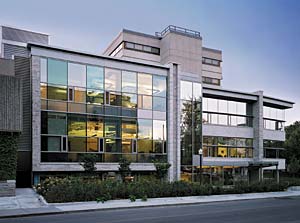
The Integrated Learning Center, Kingston, Ontario, Canada, located on the Queen's University campus, achieved four Green Globesâ„¢ for energy saving design and construction approaches.
Architect: B+H Architects
Photo courtesy of GBI |
|
|
Canadian Projects
The Green Globesâ„¢ rating system has been used successfully for several Canadian projects. Note that Green Globesâ„¢ uses a four globe scale in U.S. and five globe scale in the Canada. Canadian case studies and their key features include:
- Federal Court Building in Toronto, Ontario is a 225,000 sf building designed by Kuwabara Payne
McKenna Blumberg, and completed in 2006. Rated four Globes out of five, the building's
microclimate design includes shading and fenestration strategies to improve IAQ and lower
energy consumption. Cantilevered aluminum panels minimize daytime heat gain, while
pedestrian colonnades offer protection from the elements.
- Toronto Military Family Resource Center, is a 19,800 sf government facility designed by J. Richard Doucette, and completed in 2004. Located at Toronto's highest elevation, with extreme
wind exposure, the project was rated four Globes out of five. The roof is designed to use wind as
a natural cooling device in the summer. Operable windows near the roof create negative pressure
and a stack effect, drawing cool air into the building base. In the winter, the large, sloping roof
reduces snow accumulation.
- Allison Hall Fitness Center in Sackville, New Brunswick, is a 7,300 sf building designed by
Diamond and Schmitt Architects. The project was completed in 2006 and rated four Globes out
of five. As part of integrated design, the architects introduced sustainable systems and products
during early project phases, resulting in consideration of sustainable design practices and
construction methods that may not have otherwise been addressed.
- The Integrated Learning Center, in Kingston, Ontario, is a 72,100 sf Queen's University building
designed by B+H Architects. The project was completed in 2004 with a four out of five Globe
rating. This infill project is located between two existing buildings, whose facades are integrated
with the new building, thus minimizing new elevations and energy demand. Limestone was
salvaged from another on-campus building that was demolished.
Barbara A. Nadel, FAIA, principal of Barbara Nadel Architect, in New York City, frequently writes about design and technology. She is the author and editor-in-chief of Building Security: Handbook for Architectural Planning and Design (McGraw-Hill, 2004).