This CE Center article is no longer eligible for receiving credits.
Global water consumption has doubled in the last 20 years and will continue to rise in an increasingly populated and energy-intensive world. As a result, water will become scarcer and more expensive. In the U.S., legislation, water conservation programs, and green building rating systems are all calling for ways to save water and achieve water-efficient design. One key strategy in meeting these goals is to stop wasting water. Industry research has zeroed in on significant opportunities to do so in the built environment. Whether it's a school, office, hospital or hotel, most of the water used is in the restroom. According to the U.S. Environmental Protection Agency (EPA), a leaking toilet can waste 200 gallons of water a day, and a dripping faucet or showerhead can waste up to 1,000 gallons per week—scenarios greatly reduced or eliminated by today's high-efficiency plumbing products. From toilets and urinals to faucets and high-speed hand dryers, next-generation products are designed to reduce not only water, but energy, maintenance, and waste as well. This article examines the trends in water usage and how green building programs, particularly the U.S. Green Building Council's Leadership in Energy and Environmental Design (LEED®) v4, are recommending ways to save water. Also discussed will be the types of plumbing products that represent the cornerstone of next-generation green restroom design.
Saving Water: Why It’s Important
Water is critical to life. Humans can survive for weeks without food, but only days without water.
Americans are the biggest consumers of water—the average North American resident uses 100 gallons of water a day. In the U.S., 3 trillion gallons of water are consumed every month. Yet, in 2012 some two-thirds of the U.S. was in drought. As a result, water supply conflicts are building in the Southwest as disputes between farmers, electric utilities, and cities escalate, particularly in drier areas like Denver, Albuquerque, and Las Vegas.
Population growth is the biggest driver of water shortages, and regions such as South Asia and the Middle East will be facing competition for scarce water, which will fuel instability. All over the world, the competition for a limited supply of water is heating up. The CIA predicts that by 2015, drinking water shortages could be a major source of world conflict.
Yet the water situation is not limited to human consumption. The demand for water and energy is intertwined—water is needed to produce energy, and energy is necessary to deliver water. U.S. public water supply and treatment plants consume some 50 billion kilowatt hours per day—enough energy to power 4.5 million homes for a year. Some 13 percent of our electrical energy goes to heat, treat, and pump water. By the same token, energy plants are dependent on water. Making 1 gallon of ethanol takes about 100 gallons of water. The biggest use of electricity for most cities is supplying and treating water. If water levels in rivers, lakes, and aquifers get too low, power plants won't be able to cool down with the worst-case scenario being water shortages shutting down power plants and causing blackouts. Water and energy production are interdependent. Yet, unlike energy, water has no substitute.
 |
High-efficiency plumbing products contribute to a sustainable restroom.
Photo courtesy of Sloan Valve Company |
Not only is scarcity of water supply an issue, cost is too. More than $4 billion is spent annually in the U.S. on energy to run drinking water and wastewater utilities, and researchers say the cost of water is rising faster than any other utility. Average rates in the top 30 U.S. cities went up more than 9 percent in 2011 alone and as much as 25 percent in other areas. Yet current water rates are the lowest we will ever see; industry watchers predict that the cost of water will rise more than the rate of inflation.
The increase in water price is attributable to the increase in the cost of operational inputs such as chemicals, energy, and labor. In Phoenix, for example, over the last 10 years chemical costs per million gallons of treated water have increased 493 percent, electricity cost by 68 percent, and raw water cost by 41 percent. Drought is also a factor in higher water prices. San Diego imports 90 percent of its water, paying 66 percent more for untreated water because prolonged droughts have reduced deliveries of cheap water from the Colorado River.
High-Efficiency Plumbing and Monitoring Systems Help a Major Museum Conserve Resources |
|
| Photo courtesy of Sloan Valve Company |
| The Chicago Museum of Science and Industry used highefficiency plumbing products and monitoring systems to realize significant water savings. |
|
Chicago’s Museum of Science and Industry, which features exhibits highlighting mankind’s grandest ideas, renovated its largest public restroom and added two new restrooms with a suite of water-efficient fixtures, and a networked, software-based water control system. The museum installed low-consumption fixtures in place of older fixtures, replacing manual 3.5 gallon per flush (gpf) water closets with sensor-activated 1.6 gpf water closets, manual 1.5 gpf and waterfree urinals, and manual metering faucets operating at 0.25 gallon-per-use with sensor-activated 0.5 gpm faucets. The water closet and faucet updates alone have reduced annual water usage by approximately 800,000 gallons. Installation of waterfree urinals, along with a greywater system that supplies water to flush some of the water closets, saves the museum another 250,000 gallons of water annually, for a total water savings of almost 1.1 million gallons a year.
The monitoring system worked so well for the museum that J. Jeffery Johnson, director of facilities, is keen on bringing the systems to its other restrooms. Greywater is the only source of water for about half of the 50 toilets in restrooms with the monitoring system. Although Johnson says he would prefer to have all toilets pulling water from the greywater system, not enough water is generated by lavatory use to flush all of them. Even so, the museum is ahead of most of its peers when it comes to water efficiency, and is Illinois’ only cultural institution with a standalone greywater system for restrooms, as well as the state’s first institution to roll out dozens of waterfree urinals. Installing the greywater system and the waterfree urinals required special approval from the city and state.
Occupancy sensors at the door to each restroom count how many people enter. Counters placed at each water closet and waterfree urinal aid in restroom monitoring, issuing a warning when a urinal comes within about 100 uses of expiration to ensure that housekeeping replaces the waterfree urinal cartridges in a timely manner. Sensors are also linked to electronic faucets and soap dispensers to signal when a faucet is running non-stop or a dispenser is low on soap. An air sensor connected to the monitoring system detects air quality issues ranging from a higher than acceptable level of sewer gas to a visitor smoking in the restroom.
“The system works flawlessly,” says Johnson. The monitoring system alerts feed into a computer in the central dispatch office, which is monitored 24/7, and tie into the museum’s work order system, which may either send an e-mail to the housekeeping staff office or automatically generate work tickets. While everyday matters, such as soap dispenser refills, are handled through the monitoring system, more serious issues, such as a lavatory blockage, are dispatched to a plumber. Johnson maintains that restroom service has actually improved due to the monitoring system—consumable outages are no longer a problem, and housekeeping managers have gained workforce flexibility. “It’s been a great assistance to us,” he says. “If we get a call that a dispenser is out or there’s a clog, we can selectively pull people from other spaces to take care of that on an ad hoc basis versus dedicating personnel to restrooms 100 percent of the time.” Another benefit: Requests for restroom supplies have decreased as well, and Johnson surmises that using resources more efficiently has resulted in less waste. |
Another piece of the cost increase puzzle is aging infrastructure. In some cities, pipes that were laid over 50 years ago are reaching the end of their design life. If they are not replaced, cities face more frequent water main breaks and associated costs. For many cities, this is already a reality. Baltimore, for example, has had over 5,000 breaks in the last five years. Houston is changing out 150 miles of its 7,500-mile water distribution pipe network every year, and Chicago is raising funds to replace 900 miles of its water distribution network. Many cities are facing constrained resources and budget shortfalls that do not bode well for replacement of aging pipes.
Saving Water: What’s Being Done
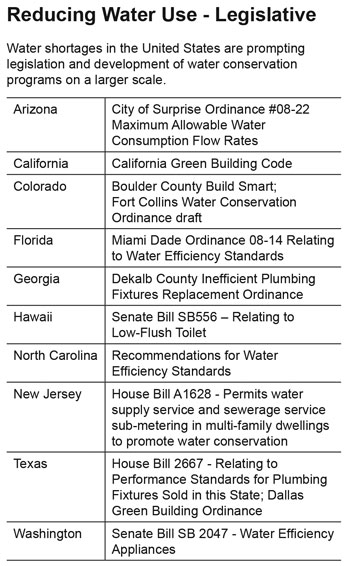
Water shortages in the U.S. are prompting legislation and development of large-scale water conservation programs. See below for a chart highlighting ongoing efforts in several states. Many states and municipalities also offer water rebate programs that involve replacing a high water-consuming product with a lower water-consuming version, with the jurisdiction reimbursing all or part of the costs. Citywide rebate programs can add up to significant savings. New York City's recent rebate program to replace 800,000 toilets, for example, is expected to save 30 million gallons of water a day. The San Antonio Water System Rebate Program is anticipated to save 1 billion gallons of water a year.
Green Building Rating Systems
The benefits of building green are well known in terms of environmental, economic, health and safety, and community impacts. Looking specifically at the water side of green buildings, using less water means reduction of impact of a limited resource. It also means pumping less water in and out of a building and the associated reduction in energy and utility bills, as well as decreasing the strain on the local water treatment facilities.
Standards in achieving reduced water usage have been established by several green building rating systems, including LEED, Green Globes Building Initiative, EPA WaterSense Program, ENERGY STAR, Green Guide for Health Care, and Collaborative for High Performance Schools.
Similar to its ENERGY STAR program, the EPA WaterSense program is a voluntary labeling program within the EPA Water Efficiency Program that helps guide consumers in choosing simple ways to use less water with water-efficient products and services. Products that have earned the WaterSense label have been certified to be at least 20 percent more efficient without sacrificing performance. The system for labeling residential high-efficiency plumbing products has been completed, and a similar system for commercial products is under development.
Perhaps the most influential rating system in the design community is LEED, the flagship tool created by the U.S. Green Building Council to guide the green building process.
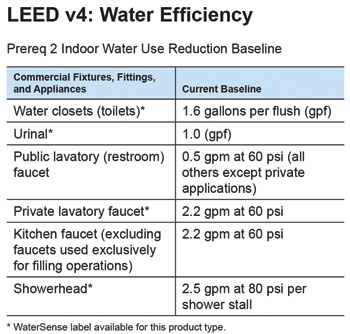
LEED 2009 was not too stringent when it came to water usage. There was one prerequisite for projects—a 20 percent reduction in water usage—and 10 possible points from landscaping, wastewater innovation, and indoor water use. In LEED v4, due out this year, the water-efficiency section incorporates dramatic changes. There are two new prerequisites, a revised title, and updated requirements for water-efficient landscaping and water use reduction credits, as well as two new credits: one for cooling water tower use and another for water metering. In addition, CR2 in LEED 2009, the credit for Sustainable Water Management, has been removed. The chart above summarizes the new water use features in LEED v4.
 |
 |
The new prerequisite, Outdoor Water Use Reduction, offers two options. To meet the requirements of the first option, No Irrigation Required, designers must show that the landscape does not require a permanent irrigation system beyond a maximum two-year establishment period. The second option, Reduced Irrigation, stipulates that the project's landscape water requirement must be reduced by at least 30 percent from the calculated baseline for the site's peak watering month. Reductions must be achieved through plant species selection and irrigation system efficiency, as calculated by the WaterSense Water Budget Tool.
Prerequisite 2, now called Indoor Water Use Reduction, requires a reduction of aggregate water consumption by 20 percent from the baseline. See the online version of this course for an accompanying figure for base calculations on volumes and flow rates. In addition, all newly installed toilets, urinals, private lavatory faucets, and showerheads that are eligible for labeling must be WaterSense labeled or carry a local equivalent for products made outside the U.S.
 |
A third prerequisite, Building Level Water Metering, is new in LEED v4 and is very specific. Permanent water meters must be installed that measure the total potable water use for the building and associated grounds. Meter data must be compiled into monthly and annual summaries; meter readings can be manual or automated. Further, the project owner must commit to sharing with USGBC the resulting whole project water data usage for a five-year period beginning on the date the project accepts LEED certification or typical occupancy, whichever occurs first. This commitment must carry forward for five years or until the building changes ownership or lessee.
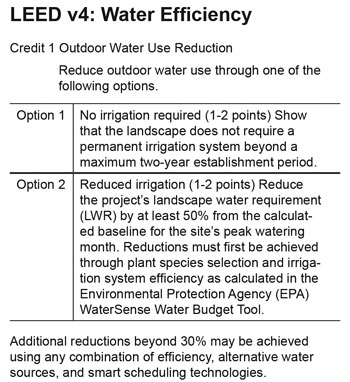
In order to earn points under Credit 1, for Outdoor Water Use Reduction, outdoor water use must be reduced by one of the following options.
Option 1
No Irrigation Required (1-2 points)
Designers must show that the landscape does not require a permanent irrigation system beyond a maximum two-year establishment period.
Option 2
Reduced Irrigation (1-2 points)
The project's landscape water requirement must be reduced by at least 50 percent from the calculated baseline for the site's peak watering month. Reductions must first be achieved through plant species selection and irrigation system efficiency as calculated in the EPA WaterSense model.
Additional reductions beyond 30 percent may be achieved using any combination of efficiency, alternate water sources, and smart scheduling technologies.
There are several strategies designers can take to meet these options and earn the credits, including the use of high-efficiency equipment and stormwater, greywater, and condensate for irrigation, as well as xeriscaping, a landscaping philosophy that uses native, drought-resistant plants to the extent possible and arranges them in efficient, water-saving ways.
Credit 2 Indoor Water Use Reduction awards points for further reduction of fixture and fitting water from the baseline. Additional potable water savings can be realized by using alternate water sources. Points are awarded based on percentage of reduction from 1 point for 25 percent reduction to 6 points for a 50 percent reduction. Strategies to earn points here include specifying high-efficiency toilets, urinals, and electronic faucets, and using rainwater, stormwater, greywater, and air conditioner condensate to flush toilets and urinals.
Credit 3 Cooling Water Tower Use is a new credit in LEED v4 in which one or two points are awarded for conserving water used for cooling tower makeup while controlling microbes, corrosion, and scale in the condenser water system.
Credit 4 Additional Water Metering is also a new credit that allows one point for installation of permanent water meters for two or more of the following water subsystems—irrigation, indoor plumbing fixtures and fittings, domestic hot water, boiler, reclaimed water, and other process water systems.
| High-efficiency Plumbing Put to the Super Test at the Nation’s Greenest Ballpark |
 |
| Photo courtesy of
Sloan Valve Company |
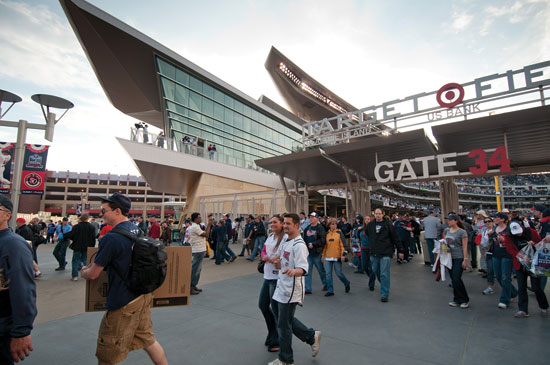
| High-efficiency plumbing products at target field were put to a worst-case scenario test to ensure they would work flawlessly for the fans. |
|
The U.S. Green Building Council, which certified Target Field with LEED Silver status, calls it the “greenest” outdoor ballpark in America. The $545-million home of the Minnesota Twins Major League Baseball team was designed to accommodate the masses of fans who pile into the stadium at game time and then load the common areas during the seventh-inning stretch. In the restrooms, vandal-proof, water-efficient products were installed to meet the stadium’s high-traffic demands and “green” building goals. Specifically 610 flushometers were installed on the toilets and 286 flushometers were installed on the urinals for a total of 896 flushometers. This dual-flush option can reduce water volume by 30 percent, which calculates to a cost savings of at least $100,000 per year. The calculation is based on average attendance plus restroom use per baseball season at Target Field with water closets flushing at the standard 1.6 gpf. Pushing the green handle down initiates a standard 1.6 gpf flush for solid waste and paper. Lifting the handle up initiates a reduced flush of 1.1 gpf for liquid and paper.
The efficiency of the system was well tested. Before the 2010 baseball season, the stadium’s main domestic water and sanitary systems were put through a worst-case scenario, known in the plumbing industry as the “super flush.” The process simulates a worst-case highest flow under tightly controlled conditions and checks the city’s mains as well, testing the water delivery to the building. Ultimately, the test answers the question: can the system deliver a specified number of gallons per minute through the main? And can the system discharge a certain number of gallons per minute of sanitary water back to the city’s system?
The system works with pumps on variable frequency drives. The pumps ramp up and ramp down based upon demand. Some 150 people participated in super flush using 20 percent of the toilets and urinals. The exercise began slowly with several seconds between flushes and then quickening the pace and adding rooms and floors until reaching the highest flow of about 2,000 gpm.
“The Super Flush is tested in many newly built stadiums to put the sanitary main system in a scenario that most likely would never occur under normal circumstances,” says Kip Olson, piping coordinator/food service project manager on the Target Field project for Metropolitan Mechanical Contractors, Eden Prairie, Minnesota, which conducted the test of the entire plumbing system. Olson noted that the test at Target Field went off successfully and without a problem. |
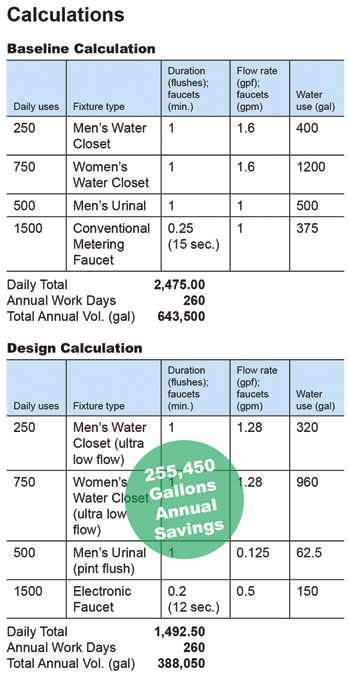
In determining eligibility for LEED credits for water-efficient products, the methodology of the following calculation is helpful. For a baseline calculation, assume a one-story building with two restrooms and 500 building occupants, equally divided between men and women. The men's restroom includes two urinals, two water closets, and two sinks with manual faucets; the women's restroom includes four closets and two sinks with manual faucets. Males use the urinals twice daily and closets once, females use closets three times daily, and all use faucets three times a day. In calculating the design case, retain the same number of occupants, workdays, and frequency. Assume 0.125 gallons per flush (gpf) urinals, 1.28 water closets, and electronic faucets with low-flow aerators (0.5 gpm with a 12-second duration) for high-efficiency products. The result is a 40 percent savings over baseline.
High-Efficiency Solutions for Green Restroom Design
In any building, restrooms are a cost center. Water, electricity, paper, maintenance, and waste removal expenses add up quickly, impacting a facility manager's bottom line. Upgrading restrooms with high-efficiency products conserve water, reduce electrical consumption, and eliminate waste. Less water also means reduced drainage, which translates to less energy for treatment and discharge.
High-Efficiency Toilets
The flush volume of toilets has improved steadily from the 1950s when it took 7 gallons per flush to the current 1.6 gpf standard. A High-Efficiency Toilet (HET) is a fixture with an average flush volume of 1.28 gpf or less that meets the performance requirements of ASME 19.2/CSA B45.1 and Maximum Performance testing, known as MaP. MaP testing simulates solid waste, and the minimum benchmark is 250 grams, based on a British medical study that identified 250 grams as the average maximum fecal size for males. The ASME minimum threshold is also 250 grams, but the EPA has adopted 350 grams as the minimum threshold for its WaterSense Program, and most water rebate programs with HETs are adopting the WaterSense specifications for performance. Dual-flush devices (1.6/1.1 gpf) are considered HETs.
By using an HET with 1.28 gpf, designers can save more than 83,000 gallons a year over the standard 1.6 gpf toilet.
Another issue to consider in specifying HETs are the pros and cons of battery operated vs. hardwired toilets. Assume a building is open 360 days a year, for three years of 4,000 cycles a month, or 133 cycles a day. The cost of the battery-operated option, which requires both batteries and a maintenance man to change them, comes out to nearly twice the cost of the hardwired option. While the hardwired option, however, is more expensive to install, it does not require the additional maintenance of changing batteries and sending used batteries to landfills.
Manual dual-flush toilets offer the option of a 1.6 gallon flush for solid waste or 30 percent less (1.1 gallon flush) for liquid waste. These options are available either as a complete valve or as a retrofit to an existing valve. Electronic dual-flush toilets, either battery powered or hardwired, carry the advantage of hands-free operation which, because it reduces contact in the restroom, promotes hygiene. Portland International Airport, for example, installed 330 manual and electronic dual-flush flushometers for a reported savings of more than 30,000 gallons of water a day.
Another option is a pressure-assisted HET in which air is compressed as the inner tank fills, which increases flush velocity. Solar-powered flushometers are available, too, both in single-flush electronic and dual-flush electronic products. Solar products use less battery power, and their power source is augmented by ambient light, extending the life of normal battery-powered products by two to three times.
High-Efficiency Urinals
A High-Efficiency Urinal (HEU) is a urinal with a maximum flush volume of 0.5 gpf, which meets the performance requirements of ASME 19.2/CSA B45.1. An HEU is 50 percent more efficient than the prevailing urinal gpf of 1.0. In addition to the 0.5 gpf, HEUs are also available in 0.25 and 0.125 gpf flush cycles and in waterless options. In waterfree urinals, a cartridge collects sediment, allowing the remaining waste to pass freely down the drain. Merritt 7 Corporate Park in Norwalk, Connecticut, for example, retrofitted 23 waterfree urinals. According to before and after water bills, water usage was reduced by 858,000 gallons. This equates to an annual saving of $7,800 with a 2.5-year payback on investment. The owner anticipates saving as much as 2 million gallons a year from all its water-efficient plumbing system upgrades—an advantage that also earned an additional LEED credit for Water Efficiency in addition to the credit already earned for installing high performance toilets.
 |
| Photo courtesy of Sloan Valve Company |
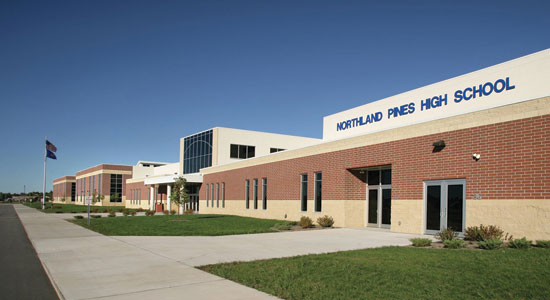
Water-Saving Plumbing Helps the Nation’s First LEE D® Gold-Certified Public High School
|
 |
| Photo courtesy of Sloan Valve Company |
| Water-saving plumbing fixtures got high marks at this Wisconsin high school. |
|
While going for gold certification wasn’t part of the plan during the early stages of building Northland Pines High School in Eagle River, Wisconsin, it became apparent that LEED Gold status was within easy reach because plans already incorporated many sustainability features. “The school district was interested in a practical design, but also in a design that was environmentally responsible,” says Mark Hanson, LEED AP and director of sustainable services for Hoffman LLC in Appleton, Wisconsin, the design-build firm for Northland Pines.
Among the sustainable building components were 22 waterfree urinals and sensor-activated faucets running at an efficient flow rate of 0.5 gallons per minute as opposed to the maximum of 2.2 gpm. In addition, designers specified more than 40 dual-flush flushometers, which flush at the standard 1.6 gallons of water with a pull down on the handle or with half a gallon less with a push up. Signage in the restroom stalls educates users about this water-saving feature.
“Our philosophy as a firm is you should be able to achieve [at least a] LEED Silver rating at a conventional cost,” says Hanson. “We had designed sustainability into the project. The decision to go for formal certification didn’t alter the building. We were already tracking there.”
The team felt that initiatives to save water are a good example.”We’re sitting in the upper Midwest in the Saudi Arabia of water resources,” Hanson says, referring broadly to the Great Lakes, which contain one-fifth of the world’s fresh surface water. Yet, planners’ watchful eye on using water wisely—from both a fiscal and a resourcefulness point of view—led them to install water-efficient plumbing products and to put in landscaping that doesn’t require outdoor watering. “In a rural Wisconsin community, that speaks to people,” he says. The monetary savings from using less water compared to a like-sized school proved to be significant. “When you actually calculate your cost to buy water from the municipality, it’s an annual appreciation of $15,000 per year. We thought we should be able to cut that by 40 percent or better and save $7,000 a year.” In so doing, Hanson adds, “We’re realizing an appreciable water savings.” With the waterfree urinals proving worthwhile, other area schools are starting to do their own share of low-consumption plumbing upgrades. |
High-Efficiency Faucets
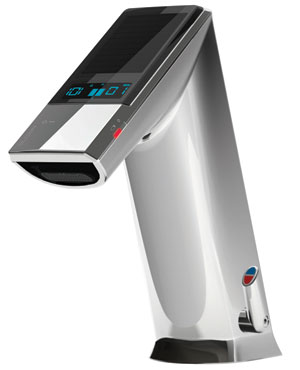
Faucets account for more than 1 trillion gallons of water a year across the U.S. The average time an electronic faucet is “on” per user is roughly 10 seconds—two to three seconds when a user wets his hands and then five to six seconds for rinsing. In addition to dispensing water only when needed by the user, high-efficiency faucets offer the advantage of increased hygiene, power harvesting and time-out settings that are significantly below baseline as can be seen in the accompanying figure.
 |
| Photo courtesy of Sloan Valve Company |
The superior performance of high-efficiency faucets was confirmed in a study conducted at a major university that measured and monitored faucet consumption in a building over a six-week period. The study was conducted in three phases—each phase was two weeks. In the tune-up phase, existing manual faucets were tested after having been regulated to 1.0 gpm flow rates to establish a baseline. In the low-consumption phase, 0.5 gpm aerators were installed on the manual faucets and lavatory flows were re-measured. In the automatic phase, sensor-operated faucets with 0.5 gpm aerators were installed and flows were remeasured. The automatic phase accounted for a 70 percent reduction over the manual tune-up phase, and a 39 percent reduction over the low-consumption phase.
High-Efficiency Showerheads
According to the EPA, we use 1.2 trillion gallons of water per year showering—an amount that can be substantially decreased either by using high-efficiency showerheads or by cutting the duration of the shower. Easy-to-install low-flow showerheads can reduce flows from around 5 gpm all the way down to 1.25 gpm, with hot water use for an average shower reduced from 50 gallons to 20 or less. A wide variety of low-flow models are available, from the popular pulsating or massage type to those with a valve or pushbutton that interrupts water flow while the user soaps up.
The EPA requires 2.5 gpm or less for showerheads. At 2.5 gpm, the average eight-minute shower uses 20 gallons of water. If the shower time is reduced by three minutes, 7.5 gallons of water are saved. Assuming an eight-minute shower, using a 1.6 gpm showerhead saves 7.2 gallons of water.
Monitoring Systems
Technologically advanced monitoring systems on high-efficiency products add up to even greater savings. California's Corcoran and High Desert State Prisons, for example, use programmable systems on their fixtures, allowing administrators to automatically control any combination of toilets, sinks or showers and to set program limits on fixture use that eliminates the possibility of inmates flushing inappropriate objects that would clog the system. By using the programmable system, the prisons decreased average daily water discharge from 42,000 gallons to 8,300 gallons for an 80 percent savings.
High-Efficiency Hand Dryers
Super high-efficiency hand dryers can save 80 percent of the energy of a standard hand dryer. Hands are dried in 10 to 15 seconds without the need for paper towels. The following figure shows that in a manufacturing plant, a Class A office building and a ballpark, high-efficiency hand dryers save up to 95 percent of the costs of paper towels.
Hands-Free Soap Dispensers
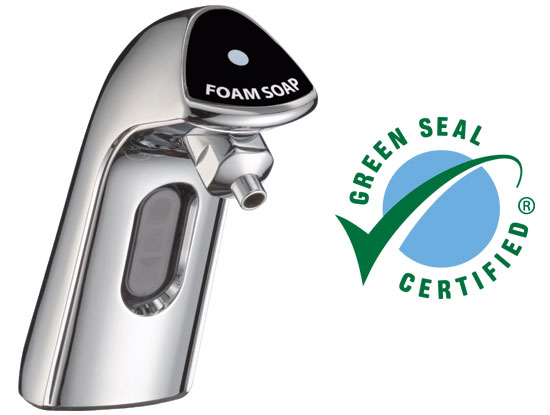
Sensor technology activates foam soap dispensers. The hands-free operation promotes hygiene and eliminates cross contamination. For best practice, Green Seal-certified soap refills are recommended.
 |
| Photo courtesy of Sloan Valve Company |
High-Efficiency Products Save Water
With water high on the list of scare resources getting scarcer, it is critical to take measures to conserve. Restrooms are a key target area for high-efficiency products that save water, using far fewer gallons than standard equipment and earning points from the stricter LEED v4 in the process.
 |
Sloan, a leader of commercial plumbing systems, is at the forefront of the green building movement. Sloan manufactures water- and energy-efficient products such as flush valves, electronic faucets, sink systems, and High- Efficiency toilets and urinals for commercial, industrial, and institutional markets worldwide. www.sloanvalve.com |