This CE Center article is no longer eligible for receiving credits.
New advances in window research and technology are enabling the imagination and creativity of architects throughout the world. Architects are connecting building occupants to the environment through ever-larger window openings with thinner window mullions. Their designs provide views and access to natural daylight. As Ximena Rojas, marketing director at Panda Windows & Doors, explains: “In the fast-paced world we live in, people don't have time to enjoy the outdoors anymore. If they have no time to spend outdoors, then the outdoors needs to be brought to their homes. Large window panel solutions do just that. They respond to the lifestyle of customers and bring the outdoors directly into their living areas. Large door or window openings create a sense of freshness and serenity that makes you feel like you are one with your natural surroundings.”
Innovations in window glass, coatings, and the framing systems that they are glazed into, have increased the energy efficiency of windows and curtain-wall systems. In addition, according to Dave Hewitt, vice president of sales and marketing for EFCO, a Pella Company, “daylighting without water intrusion, without draft, without excessive energy consumption, is important to name a few. This is why the pre-glazing of a window or curtain-wall unit is vital. Sunlight, yes, but more importantly comfort and performance in that sunlight are part of the successful use of daylight. Daylighting means nothing without performance.”
New windows, framing systems, and window coatings allow the architect to design larger glass openings, even when designing buildings that meet stringent green building certification programs. Architect Mark Maddalina, AIA, LEED AP, manager of sustainable design at SWBR Architects in Rochester, New York, sums it up when commenting on the windows used for the Rochester Institute of Technology Golisano Institute. Maddalina says, “The windows we used, with line voltage feed, essentially stops all heat transfer from windows into a room. Occupants comment that when the occupancy sensor goes on—any draft goes away. These windows are game changers. Manufacturers are on the verge of creating the 'perfect' window system—one that will provide access to daylight without sacrificing energy efficiency.”
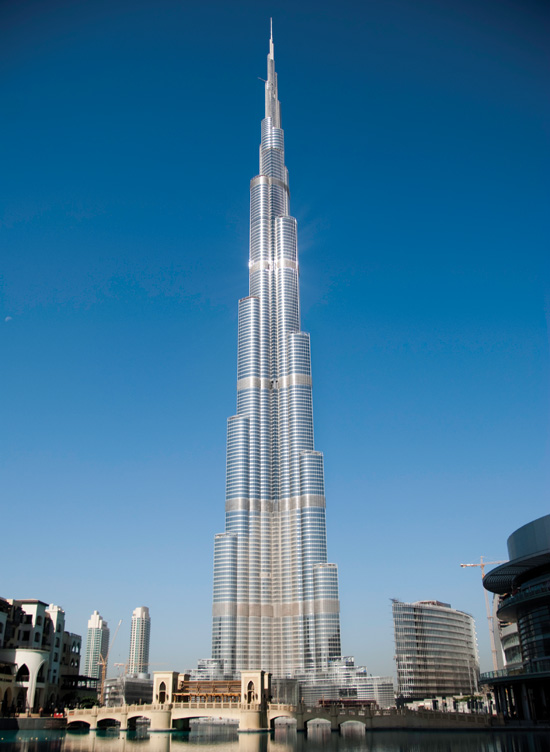 |
Skidmore Owings Merrill LLP designed the Burj Khalifa in Dubai, which at 2,650 feet is the world’s tallest building. More than 1.8 million square feet of high-performance low-E glass provides an anti-glare shield from the strong desert sun, and substantial solar protection to keep the interior from overheating.
Photo courtesy of Guardian Industries |
Along with new digital tools that allow the architect to evaluate heat loss and heat gain from all sides of a building, the architect has many choices for specifying the appropriate glass for a successful green project. According to Chris Dolan, director, Commercial Glass Marketing, Guardian Industries: “Architects may be interested in the many high-performance glazing products now available. There are new coating technologies that allow architects to help meet new energy codes, move toward net-zero requirements, and support LEED® and other stringent rating system requirements. It's important to consider climate zone, building orientation, and design intent for appearance when selecting the right glazing product.” A review of some of these new initiatives will assist designers as they design for transparency and energy efficiency. From technology to research, there are many innovations in window design.
Dynamic Glass: Sunglasses for Your Building
Electrochromic glass is another energy-efficient technology that incorporates low-voltage current into window glazing. This product allows a window to “track the sun,” changing the values of visible light transmittance (VLT) and solar heat gain coefficient (SHGC) throughout the day. The conductors can be switched on or off through sensors automatically or manually by building occupants. These windows provide built-in sunshades for buildings and allow occupants greater control of glare or too much daylighting during their workday.
 |
This custom home in a remote town along the Pacific Coast in Mendocino County, California, designed by Mork-Ulnes Design, uses large, energy-efficient windows to frame views.
Photography by Bruce Damonte |
Exploring Low-E Window Coatings and Vision Clarity
To meet the demand for a window that maximized transparency without causing increases in energy consumption and excessive heat gain, glass manufacturers introduced low-emissivity or low-E glass. Emissivity is the measure of the ability of a material to radiate energy. The lower the emissivity, the less heat is transferred through the glass. Low-E glass has a very thin coating applied to one or more surfaces of an insulated glass unit.
Not all low-E products are equal in performance and the manufacturing process—the type of coatings and the placement of coatings on the surfaces of a double or triple glass pane window can affect window performance. Two common low-E options are sputter coat, or soft coat glass, and pyrolytic, or hard coat glass. In comparisons of building performance by manufacturers between sputter- and pyrolytic-coated products, the results have shown that sputter-coated glass provides a combination of higher visible light transmission and lower solar heat gain. In addition, low-E glass prevents heat loss in cooler climates. Higher-performance windows result in better occupant comfort, a decrease in energy consumption, and a reduction of heating and cooling system loads.
 |
Performance data for sputter- and pyrolytic-coated low-E windows.
Chart courtsey of Guardian Industries |
| Demanding Performance in Tall Buildings |
|
Skidmore Owings Merrill LLP (SOM) designed the Burj Khalifa in Dubai, which at 2,650 feet is the world’s tallest building. More than 1.8 million square feet of high-performance low-E glazing reduces the amount of glare from the strong desert sun, and provides substantial solar protection to keep the interior from overheating. Gregory Smith, associate director, SOM (Chicago office), and technical coordinator on this project, worked with the cladding contractor and glass manufacturer to choose high-performance windows. Because of the change in wind pressure at different levels of the building, the windows are engineered to have many different glass thicknesses in the structure. The glazing has to withstand extreme desert temperature swings as well as strong winds.
To achieve a mirrored appearance, to protect against ultraviolet radiation, and to maximize the views from inside, the architects chose a silver reflective coating. To achieve high-performance energy efficiency the architect also specified a low-E coating. To maximize performance, the silver coating was placed on the number two surface of the insulating glass unit and the low-E coating on the third surface.
When specifying coatings, it is important to understand the correct application of each type of coating as well as the surfaces of the inboard and outboard lites of an insulating glass unit. The number one surface is the glass on the outboard lite facing the outside of the building, number two is the glass surface on the outboard lite facing the air gap. Number three is the glass surface facing the air gap on the inboard lite and number four is the glass surface on the inboard lite facing the interior of a room. (See accompanying image.) For improved performance and better appearance, low-E coatings are typically applied to the number two surface. Certain low-E coatings can be placed on the number three surface to improve performance of insulated units with coated or tinted outboard lites. It is important to work with the glass manufacturer at an early stage in the process to assure correct specifications.
Reflecting on this project, Smith comments: “There are definitely ongoing improvements in the coating technology.” As the project progressed, even higher performance glass values were achieved. Architects can achieve a window with a neutral appearance on the inside looking out because of these improvements. The visible light transmission for this project was 19 percent, shading coefficient 0.26, and solar heat gain coefficient 0.23—high-performance values for this tall building in the desert.
 |
Common numbering system for glazing
surfaces in an insulating glass unit.
Image courtesy of Guardian Industries |
|
 |
|
Chart courtesy of Guardian Industries |
The evolution of glazings and glass performance has shown dramatic improvements in visible light transmission, U-values, SHGC, and shading coefficients. See the online version of this course for a chart that demonstrates the performance enhancements to a ¼-inch monolithic lite with the addition of high-performance coatings.
Prior to low-E coatings, tinted glass was used as a means of solar control. As technology advancements continue, low-E coated clear glass offers better insulating performance and solar control than tinted glass, along with potentially truer color transmission as expressed by the color rendering index (CRI). The CRI is a measure of color accuracy ranging from 1-100, with a rating of 100 representing the truest color transmission as it relates to natural daylight.
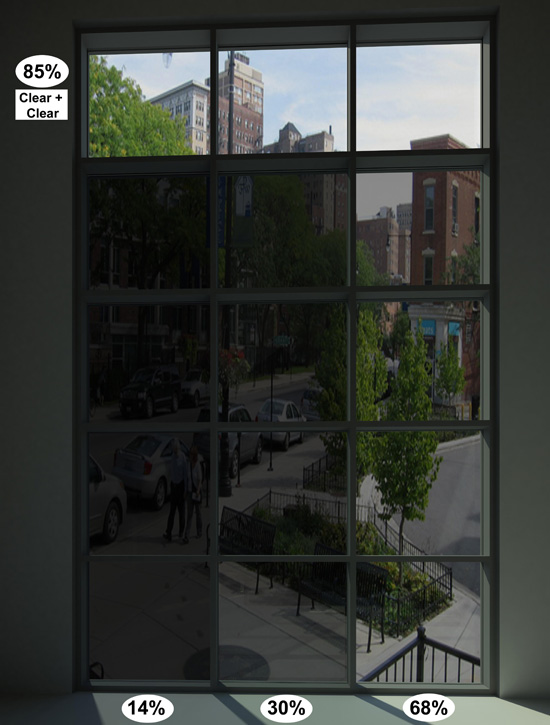 |
From the inside looking out at a simulated streetscape, the architect can compare the visible light transmission from a wide range of coated products on clear glass as they relate to an uncoated clear glass unit that has 85% visible light transmission.
Photo courtesy of Guardian Industries |
High-Tech Calculators Guide Performance Selection
New web-based IG performance and building energy calculators that are capable of producing BIM content are now available to help architects guide performance selection. These powerful tools populate BIM content with manufacturer data for thermal and optical performance values for use in project-specific integrated mockups and building models. This digital tool creates highly detailed content representing the correct thickness and color of the inboard and outboard lites. Users can control the level of detail depending on the scale of the drawing and views on the computer. The generated report compares energy cost, utility consumption, and the financial payback of different glazing options. By simulating alternatives along with the cost of those alternatives, architects can clearly demonstrate to their clients the economic and performance advantages of choosing a higher-performance window even if it has higher initial costs.
In addition, a simple box energy model also assists the architects in “tuning” windows based on climate or on building orientation. A digital building energy calculator can easily model the nuances of selecting a different type of window for the north side of a building versus south, east, or west side. Based on the project location, the architect can select different types of coatings with similar visual appearance but different energy performance criteria to optimize each elevation of a building. The cost of tuning the windows for orientation can be modeled and the payback period often will show that the extra expense (if any) to optimize each glazing scenario per elevation is a good bargain.
 |
To reduce patient exposure to airborne allergens and to provide sun control, high-performance aluminum-clad wood windows with integral blinds were used at the Vollum Institute for Advanced Biomedical Research in Portland, Oregon.
Photo courtesy of Pella Commercial |
Too much uncontrolled daylight can cause glare and provide occupant discomfort. As Terry Zeimetz, AIA, CSI, CCPR of Pella Commercial, states: “It is important to understand how to control solar energy. Where is it going to be stopped, through exterior sunshades, on different panes of glass, inside the glass system with in-between blinds or shades or inside the building with some type of window treatments. The most effective strategy is to block solar energy before it enters the building. Second best is to stop it with between-the-glass blinds or shades before it gets past the inner piece of glass. The least effective way to stop heat gain is with room-side window treatments since the heat has already passed through the glass and must be dealt with.”
Sometimes the solution to adding interior sun controls can have the unintended consequences of causing health problems. As an example, the use of room-side curtains or blinds collect allergens on the surface materials. New research by the Department of Occupational and Environmental Health at The University of Iowa demonstrates the potential for designing window treatments that can improve health for allergy sufferers.2
Researchers at the Vollum Institute for Advanced Biomedical Research, designed by Zimmer Gunsul Frasca Architects LLP, studied the collection of allergens on window blinds. They documented results that demonstrated that windows with ordinary room-side blinds accumulated 200 times more of certain airborne allergens than some high-performance windows with between-the-glass blinds.
 |
Large door or window openings create a sense of freshness and serenity that makes you feel like you are one with your natural surroundings.
Photo courtesy of Panda Windows & Doors |
Between-the-glass window options reduce long-term maintenance costs and improve energy performance. Not only do blinds and shades between panes of glass make cleaning much easier; they eliminate the need for room-side window treatments that can be damaged through accidental or deliberate actions. Between-the-glass window options are just one of many ways to control glare with the added value of reducing long-term maintenance costs and improved energy performance.
Architects continue to be drawn to the need to create transparent structures—buildings that float on the landscape as if they were a part of the natural world. However, these human structures require a balance between visible clarity and energy savings. Buildings with vast expanses of glass have been hard to heat and cool. Recent data from the Environmental Protection Agency and statistics show that in the United States buildings account for 36 percent of total energy use, 65 percent of electricity consumption, and 30 percent of greenhouse gas emissions. Technology that improves energy and light transmission includes research on the effectiveness of different low-E glass, new dynamic coatings, and structural innovations to allow for larger windows.
The criteria for the U.S. Green Building Council LEED® EQc8.1 Daylight and Views requires that designers optimize building orientation and envelope design to provide access to daylight. The next step is to identify occupant behavior and the use of building spaces. Depending on that use, the designer will need to develop a strategy to control daylight. They also need to consider room configuration and window locations to maximize access to daylight. In many cases, interior windows can be added to “harvest” daylight into corridors and deeper areas of the building. There are many ways to develop a strategy for daylighting and the architect needs to integrate such strategies throughout the building. LEED® recommends that 75 percent of all occupants are provided with access to daylight.
 |
The transition from inside to outside is seamless because of the large operable multi-slide pocket door system in this custom residential home in Irvine Terrace Community in Corona del Mar, California, designed by Spinnaker Development of Newport Beach.
Photo courtesy of Panda Windows & Doors |
| Glass That Stops Drafts: Golisano Institute for Sustainability |
 |
Modeling by architect SWBR helped the Rochester Institute of Technology Golisano Institute for Sustainability choose advanced glazing solutions.
Photo courtesy of EFCO, a Pella Company |
The mission of the Rochester Institute of Technology (RIT) Golisano Institute for Sustainability is to undertake world-class education and research programs in sustainability, focusing on sustainable production, sustainable energy, sustainable mobility, and ecologically friendly information technology systems.1 The Institute’s instructions to architect SWBR Architects who designed this project in association with Design Architect FXFOWLE, was to provide an aggressively designed thermal envelope. The Institute required that the project provide significant energy savings for a building of this type—a particular challenge for a multi-story research building located in upstate New York. Given these goals, the team approached decision-making for the building envelope system with two overriding criteria: optimize energy performance and minimize energy demand.
The envelope utilized several curtain-wall systems. Its primary facade system features a thermally broken curtain wall and an array of high-performance glass types that reduce the possibility of thermal transfer. Given the size and complexity of the system, the products were unitized, or factory assembled into larger units of seven or eight glazed components each, prior to being installed in the field. This permitted improved quality control with limited field connections and limited installation time on site.
Tracking against a baseline energy model, the architectural team sought to provide no more than 40 percent vision glass on the envelope and to improve upon the thermal performance of all components. They evaluated parallel energy and cost models specific to the envelope. The selected spandrel glazing incorporates 4.5-inch thermal insulation. Daylighting glazing primarily utilizes an advanced, 3-inch-thick glass and translucent infill. The building’s vision glazing is primarily a glass with a heat-mirror film and krypton gas infill, which provided triple-pane performance within a 1-inch product.
In addition to these high-performance products, a new and innovative glass was utilized in areas where occupants would be seated near the curtain wall. This double-paned window utilizes an electric current to charge and heat an invisible metal coating on the third surface. While it offers the appearance of standard vision glazing, it is designed to achieve a room-temperature set point, effectively eliminating the expected temperature differential and associated cold downdraft along a window, improving user comfort and eliminating the need for other perimeter heat systems in the project. Within the energy model, these were termed “perfect windows,” as they become “thermally opaque” when outdoor temperatures drop below 42 degrees. The heat provided is only within the cavity on the surface of the double-pane window, so the energy required to raise its temperature is generally low and the energy is more effectively applied than in conventional perimeter systems. Similar to the building lighting systems, these windows are also tied in to room occupancy sensors.
The incorporation of this technology represents both RIT’s commitment to innovation and the Golisano Institute’s work in bringing environmentally smart and efficient technologies to market. SWBR architect Maddalina comments, “True innovation is not for the faint-of-heart. While the product has had its challenges with a relatively high failure rate upon initial installation and a high first cost, the project team recognizes that this technology is potentially game-changing and, as it reaches the mainstream, could represent the future of glazing technology.”
Given this array of products within the curtain-wall system, the team included air and water infiltration testing as part of the installation. The system passed with no measurable infiltration found. The project is seeking LEED® Platinum certification. The electronic power glass used on this project essentially stops all heat loss from the interior to exterior while heating the interior space of the building.
|
Eliminating Barriers
Mid-century modernism is often credited for residential designs that open up buildings to the outdoors. These architects followed the inspiration of Mies Van Der Rohe who designed the glass Farnsworth House. The philosophy of Mies Van Der Rohe and his belief that exposure to the natural world, including access to daylight, is part of a higher unity has had a strong influence on American architecture.
“Nature, too, shall live its own life. We must beware not to disrupt it with the color of our houses and interior fittings. Yet, we should attempt to bring nature, houses, and human beings together into a higher unity. If you view nature through the glass walls of the Farnsworth House, it gains a more profound significance than if viewed from outside. That way more is said about nature—it becomes a part of a larger whole.”3
|
California mid-fifties cases study houses provided examples of a lifestyle that allowed a seamless transition between living indoors to living outdoors with main living spaces opening up to the outdoors. In the later part of the last century, architects became more conscious of the environmental impact of these large framed openings. To control heat loss and heat gain while still providing access to daylight, architects began to design homes and businesses with smaller windows to reduce heat gain and heat loss. Today, residential designers are finding that there are fewer design compromises with new window and door systems.
With the advent of new sliding and folding door walls, the interior becomes part of the exterior and vice-versa with new window systems that allow direct access to daylight. With thinner mullions and with engineering that has been tested to meet high performance values, these new door walls are finding a place in residential, commercial, and institutional settings. According to Ximena Rojas, marketing director for Panda Windows & Doors, “Large panel door solutions such as sliding doors and folding doors have been around for a long time, of course, but interest is growing as new technology and innovations are introduced. The result is better, bigger, and slimmer sophisticated doors with architectural bells and whistles. The trend has been popular in warmer states but now it's gaining traction in harsher climates where homeowners are highly motivated to make the most out of their short outdoor season.”
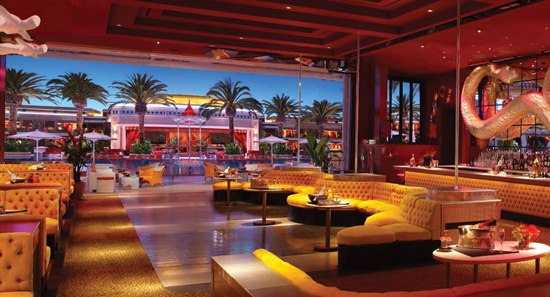 |
At the Surrender Nightclub at Wynn Hotel and Casino in Las Vegas, the bar is extended into the outdoor pool area for patrons to enjoy a sunny day or warm night. This 20-foot-wide, 15-foot-tall, four-panel lift and slide glass wall system is hidden into a wall pocket when completely opened.
Photo courtesy of Panda Windows & Doors |
As a response to New Urbanist principles of connectivity and the redevelopment of Main Street to be more active and lively places, architects are choosing window systems that open up to the street or to the market place. Because of new lift and slide technology, even larger window openings are possible as alternatives for wall facades. Captured door systems with perimeter frames provide better energy performance than that of a frameless or butt jointed panel. Framing and interlocking components control air and water infiltration better than a frameless system with glass joints and air spacers. For exterior applications, window manufacturers recommend aluminum or wood pre-framed, “captured” energy-efficient systems. However, if the window system is specified for an indoor climate-controlled opening, like at a store or restaurant in an enclosed mall, a frameless system might be the best solution.
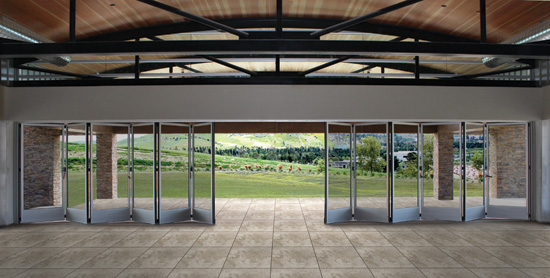 |
The large door at the University of Irvine in California has eight panels with an overall opening of approximately 20 panels—7 feet by 8 feet high. The architect specified this door to meet the maximum impact rating and allowable design pressure criteria.
Photo courtesy of Panda Windows & Doors |
Structural Performance
Structural performance is important when specifying large window openings. Larger frames with very long spans are now possible and have been incorporated in projects ranging from residential to commercial.
Architects and engineers specify window and door systems to meet the appropriate design pressure rating (DP) as well as impact ratings. Lift and slide window and door products have the ability to reach a DP rating of 100 percent. Those manufacturers that can achieve this rating in their products exceed Miami-Dade test criteria. Miami-Dade County in Florida is exposed to category four and five hurricane winds. Miami-Dade is the industry standard used in most building codes that set the baseline for DP ratings. Products that exceed the Miami-Dade standards ensure consistent product quality, assure better property and life protection, and comply with uniform codes.
| Windows: Connections and Performance in Kansas |
|
The design intent of 360 Architecture for the first building on Kansas State University’s Olathe campus was visibility, connectivity, and a strong sense of place. The architects selected high-performance glazing for the building’s exterior glass. Dave Rezac, principal at 360 Architecture, commented: “The use of glass was deliberate and strategic, as we wanted to produce a transparent envelope that created visual interest looking into the facility while providing daylight and views out of the building.” With a visible light transmission of 68 percent and solar heat gain coefficient of 0.38, these windows provided abundant daylighting along with outstanding solar energy control, which helps reduce electric lighting and HVAC loads, thus contributing to the building’s LEED® Silver certification.
 |
Designed to achieve visibility, connectivity, and a strong sense of place, the first building on Kansas State University’s Olathe campus was designed by 360 Architecture.
Photo courtesy of David Mayes, Kansas State University |
|
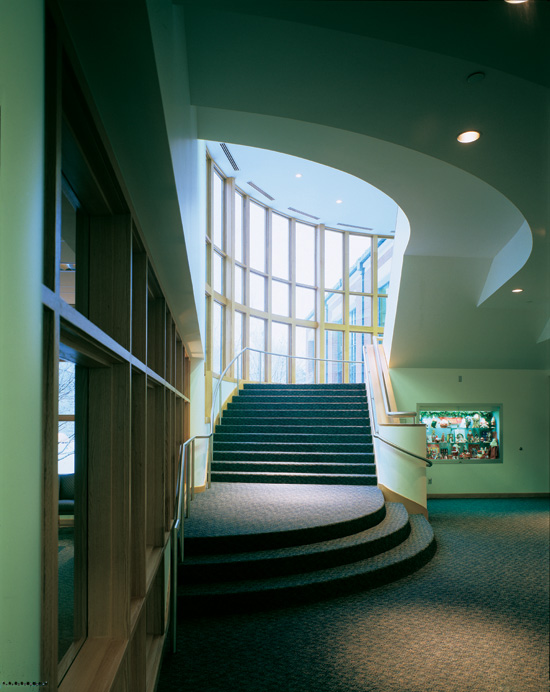 |
Rochester Hills Library, designed by Architects TMP. Energy-efficient, large window expanses encourage patrons to use the stairs and provide connectivity and harvested daylight between floors.
Photo courtesy of Pella Commercial |
New Research on the Benefits of Daylight
Numerous studies verify the significant relationship between productivity gains, cognitive responses, health benefits, and daylighting. Forward-thinking architects who design a workspace that includes sunlight, window views, privacy, and individual controls, find access to daylight can have measurable, positive results on the building occupants. A recently published survey, “The Benefits of Glass”4 documents numerous qualitative studies on the advantages of access to daylight in office, education, retail, and health-care environments. Research on the effect on employees who work in buildings that meet sustainable design criteria shows a reduction of absenteeism by those with access to daylight. In studies of retail environments, sales are shown to increase in stores with windows. The research on educational facilities confirms that access to daylight and views in schools can contribute to improvements in student test scores.5
One of these studies by Drs. Wang and Boubekri tested single-occupancy office spaces and documented occupants' preference for office areas with daylight patches. In their research, cognitive scores increased as much as 20 percent above average for those with access to views and/or daylight and 24 percent below average for those without.6 Roger Ulrich, Ph.D., a leading proponent of such evidence-based design and author of Biophilic Design, states that as of 2008, there are more than 50 rigorous studies on the topic of daylight and views. Studies on the effect of daylight to occupants, or “biophilia,” often are influenced by the writings of Erich Fromm and E.O. Wilson, who introduced the term. Writers, social psychologists, and environmentalists believe that humans have a subconscious need to relate to nature. The benefits of access to daylight on building occupants include improvements in productivity, learning, and healing.
One of Ulrich's recommendations to architects and designers working in health care is, that based on his studies, “larger windows should be provided to permit more exposure to daylight and restorative nature views in patient rooms and other spaces where depression, pain, and stress are problems.”7
Window to Wall Ratio and ASHRAE Concerns
The relationship of the area of windows to the area of walls in a building envelope can affect both human behavior as well as energy use in a building. Architects average the heat gain/loss from the building envelope to assure that the building meets strict energy standards and the more windows, the harder it is to maintain an energy-efficient envelope.
The American Society of Heating, Refrigerating and Air-Conditioning Engineers (ASHRAE) introduced a proposal in June 2013, to decrease the ratio of windows to walls by almost 25 percent, as a revision to ASHRAE 189.1, The Standard for the Design of High-Performance Buildings. Their recommendation that the glass area allowed in the prescriptive path from 40 percent wall-to-window ratio (WWR) to 30 percent WWR for buildings less than 25,000 square feet has been met with resistance by researchers, universities, architects, and glass manufacturers.
The conflicts between the size and efficiency of windows to prevent heat loss and the need to provide access to daylight as a benefit to occupants are real issues that architects balance project by project. New window systems are making it possible to argue that buildings can have larger window openings that maintain energy efficiency while providing access to daylight and views of nature.
Net Zero and Other Opportunities
Putting it all together, architects are using their knowledge of high-performance windows and glass to design very high-performance buildings with large expanses of glass. Jim Pattison Centre of Excellence at Okanagan College, in Kelowna, British Columbia, is a net-zero building with large expanses of glass. CEI Architecture selected low-E glass to offer the maximum daylight penetration into the building and to control solar heat gain. This net-zero project is an example of how architects can use large window openings without sacrificing solar performance.
Manufacturers are also incorporating building integrated photovoltaics (BIPV) into buildings that meet high levels of other sustainable design criteria. Designed by SLCE Architects in New York, the Verdesien is a 26-story residential apartment building located at the northern end of Battery Park City. The Verdesian rooftop contains 20.4 kWp of solar cells that are integrated directly into the glazing system. The energy generated by the BIPV goes into the electrical grid reducing the electric load generated by the building. The photovoltaic cells provide 5 percent of the electric load of the building, helping to reduce the demand from fossil fuels and reducing greenhouse gases.
 |
Designed by SLCE Architects, the panels at the Verdesian rooftop contain building integrated photovoltaic panels.
Photo courtesy of EFCO, a Pella Company |
Architects who learn more about the unique opportunities provided by new glass, glazing, and window solutions will have the tools that will allow them to provide even more access to daylight and healthy, sustainable buildings.
 |
Jim Pattison Centre of Excellence at Okanagan College, in Kelowna, British Columbia, is a net-zero building. CEI Architecture selected low-E glass to offer the maximum daylight penetration into the building and to control solar heat gain.
Photo courtesy of Ed White Photographics |
Celeste Allen Novak, AIA, LEED AP, specializes in sustainable design and planning in Ann Arbor,
Michigan.