This CE Center article is no longer eligible for receiving credits.
Design professionals are well aware that in the hierarchy of energy-efficient lighting, LED (light-emitting diode) systems are superior to compact fluorescent systems and are far superior to the incandescent lamp. They also know that LED technology will go a long way to help counteract our expanding carbon footprint. But they may not know that within the last year, many new linear LED luminaires have come on the market that now represent a viable alternative to the traditional linear fluorescent fixture.
According to the U.S. Department of Energy (DOE), which has adopted a comprehensive strategy to accelerate the LED market, LED lighting is expected to represent 36 percent of luminaire sales for the general illumination market by 2020, which translates into energy savings of 19 percent. The replacement of traditional fluorescent lighting with linear LED luminaires (the complete lighting unit rather than the lamp alone) will significantly contribute to those reductions.
The Fluorescent Lamp
Since it appeared on the market in the late 1930s and spread rapidly during World War II as wartime manufacturing demanded better lighting, the fluorescent lamp has been the mainstay of commercial and industrial lighting. Both T12 and T8 lamps remain common in existing buildings, but due to recent federal efficiency standards, almost all new commercial construction uses T8 or T5 linear fluorescent lamps.
The light produced by a fluorescent tube is caused by an electric current conducted through mercury and inert gases. This allows the phosphor coating on the glass tube to emit light. Fluorescent lamps require a ballast to regulate operating current and provide a high start-up voltage. Electronic ballasts outperform electromagnetic ballasts by operating at a very high frequency that eliminates flicker and noise. Electronic ballasts also are more energy-efficient. Special ballasts are needed to allow dimming of fluorescent lamps. Improvements in technology have resulted in fluorescent lamps with color temperature and color rendition that are comparable to incandescent lamps.
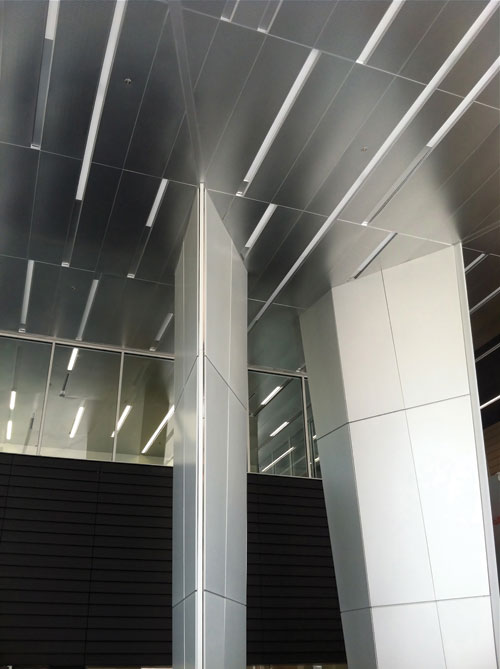 |
Linear LED luminaires light Marquez Hall, the new state-of-the-art teaching and research facility at the Colorado School of Mines, Golden, Colorado.
Photo by Kenneth Wiese, courtesy of Selux |
| Glossary and Lighting Metrics |
|
CCT (correlated color temperature): a measure of the color appearance of a white light source. CCT is measured on the Kelvin absolute temperature scale (K). White lighting products are most commonly available from 2,700K (warm white) to 5,000K (cool white). Cool light is preferred for visual tasks because it produces higher contrast than warm light. Warm light is preferred for living spaces because it is more flattering to skin tones and clothing. A color temperature of 2,700–3,600K is generally recommended for most indoor general and task lighting applications.
CRI (color rendering index): a measure of how a light source renders colors of objects, compared to a “perfect” reference light source. Color rendition is generally considered to be a more important lighting quality than color temperature. Most objects are not a single color, but a combination of many colors. Light sources that are deficient in certain colors may change the apparent color of an object. The Color Rendering Index (CRI) is a 1–100 scale that measures a light source’s ability to render colors the same way sunlight does. The top value of the CRI scale (100) is based on illumination by a 100-watt incandescent light bulb.
Electroluminescence: Light is generated directly when electrons recombine with holes, in the process of emitting photons.
LED: light-emitting diode. LEDs are small light sources that become illuminated by the movement of electrons through a semiconductor material. LEDs can be integrated into light fixtures to provide white and colored light.
LED light engine: comprises the driver (powers and regulates the power supply and other electronics), LEDs, optics, and heat sink/mounting.
Life performance curve: a curve that presents the variation of a particular characteristic of a light source (such as luminous flux, intensity, etc.) throughout the life of the source. Also called lumen maintenance curve.
Lumen: The International System of Units (SI) unit of luminous flux is a measurement of light. The total amount of light emitted by a light source, without regard to directionality, is given in lumens (lm). As reference, a 100-watt incandescent lamp emits about 1,600 lumens.
Lumen depreciation: the decrease in lumen output that occurs as a lamp is operated. LED useful life is typically based on the number of operating hours until the LED is emitting 70 percent of its initial light output (L70).
Lumen maintenance: the percentage of initial light output produced by a light source at some percentage of rated useful life.
Luminaire: the complete lighting unit (LED light engine and housing) ready to plug in.
Luminous efficacy: or efficacy of energy consumption is the total luminous flux emitted by the light source divided by the lamp wattage; expressed in lumens per watt (lm/W). DOE long-term research and development goals calls for white-light LEDs producing 160 lumens per watt in cost-effective, market-ready systems by 2025. If a luminaire efficacy value is not included in a manufacturer’s data sheet, it may be calculated by dividing the product’s total light output (lumens) by the input power (watts) from the same photometric test. The result is the product’s efficacy in lm/W.
Efficiency vs. efficacy: The term “efficacy” is normally used where the input and output units differ (lumens and watts). The term “efficiency” usually is dimensionless. For example, lighting fixture efficiency is the ratio of the total lumens exiting the fixture to the total lumens produced by the light source.
SSL: solid-state lighting; umbrella term for semiconductors used to convert electricity into light. |
Fluorescent lamps use about 25 percent of the energy used by incandescent lamps to provide the same amount of illumination (efficacy of 30–110 lumens per watt). They also last about 10 times longer (7,000–24,000 hours). Lower energy costs typically offset the higher initial cost of the lamp that requires the additional cost of a ballast. Because they contain mercury, many fluorescent lamps are classified as hazardous waste. The United States Environmental Protection Agency recommends that fluorescent lamps are segregated from general waste for recycling or safe disposal.
There are two general types of fluorescent lamps: compact fluorescent lamps (CFLs) and fluorescent tubes.
CFLs
CFLs combine the energy efficiency of fluorescent lighting with the convenience and popularity of the incandescent lamp shape. They can replace incandescent lamps that are roughly 3–4 times their wattage, saving up to 75 percent of the initial lighting energy. Although CFLs cost 3–10 times more than comparable incandescent lamps, they last about 10 times as long (10,000 hours).
Fluorescent Tubes
More energy efficient than CFLs, fluorescent tube lamps—the second most popular type of lamp—are usually identified as T12 or T8 (12/8 or 8/8 of an inch tube diameter, respectively). They are installed in a dedicated fixture with a built-in ballast. The two most common types are 40-watt, 4-foot lamps, and 75-watt, 8-foot lamps. Tubular fluorescent fixtures and lamps are preferred for ambient lighting in large indoor areas because their low brightness creates less direct glare than incandescent lamps.
Fluorescent tube construction. A fluorescent lamp tube is filled with a gas containing low-pressure mercury vapor and argon, xenon, neon, or krypton. The inner surface of the lamp is coated with a fluorescent (and often slightly phosphorescent) coating made of varying blends of metallic and rare-earth phosphor salts. The lamp's electrodes are typically made of coiled tungsten and usually referred to as cathodes because of their prime function of emitting electrons. For this, they are coated with a mixture of barium, strontium and calcium oxides chosen to have a low thermionic emission temperature.
 |
Linear LED luminaires provide soft lighting for Boston University Rich Hall residence in Boston, Massachusetts.
Photo courtesy of Hyexposure Photography |
LED Technology
Unlike incandescent and fluorescent lamps, LEDs are not inherently white light sources. Instead, LED is a semiconductor light source. When a light-emitting diode is switched on, electrons are able to recombine with electron holes within the device, releasing energy in the form of photons. This effect is called electroluminescence and the color of the light (corresponding to the energy of the photon) is determined by the energy gap of the semiconductor. An LED is often small in area (less than 1 square millimeter), and integrated optical components may be used to shape its radiation pattern.
LEDs emit nearly monochromatic light, making them highly efficient for colored light applications such as traffic lights and signage. However, to be used as a general light source, white light is needed.
White light can be achieved with LEDs in two main ways: phosphor conversion, in which a phosphor is used on or near the LED to emit white light; and RGB (red, green, and blue) systems, in which light from multiple monochromatic LEDs (red, green, and blue) are mixed, resulting in white light.
Directional Light
One of the defining features of LEDs is that they emit light in a specific direction. Since directional lighting reduces the need for reflectors and diffusers that can trap light, well-designed LED fixtures can deliver light efficiently to the intended location. In contrast, fluorescent and “bulb”-shaped incandescent lamps emit light in all directions where much of the light produced is lost within the fixture, reabsorbed by the lamp, or escapes from the fixture in a direction that is not useful. For many fixture types, including recessed downlights, troffers, and undercabinet fixtures, it is not uncommon for 40 to 50 percent of the total light output of fluorescent and incandescent lamps to be lost before it exits the fixture.
Extended Lifetime
The rated lifetime of LED products is at least comparable to other high-efficacy lighting products, if not better, and for many specific product types, LEDs have the highest rated lifetime. This attribute can be especially important where access is difficult or where maintenance costs are high. In fact, several U.S. Department of Energy GATEWAY demonstrations have revealed that maintenance savings, as opposed to energy savings, are the primary factor in determining the payback period for an LED product.
LED Market
A perfect storm of state and federal government attention to energy-saving LEDs plus industry investment in LED technology is delivering an abundance of products that enter the market about every four to six months. ANSI/ASHRAE 90.1-2010, Title 24 2010 California Building Standards & Codes, LEED® requirements and the DOE are all shaping the LED market. ANSI/ASHRAE 90.1-2010 is pushing increasingly strict energy code models with goals to have market-viable net-zero buildings by 2030.
Lighting programs such as ENERGY STAR, a joint program of the U.S. Environmental Protection Agency and the DOE, and DesignLights™ Consortium, a collaboration of utility companies and regional energy efficiency organizations, are offering rebate programs. Also related is the DOE's LED Lighting Facts® program which showcases LED products performance by reviewing third-party testing and supplying an approved label indicating performance. Commercially available LED Product Evaluation and Reporting (CALiPER) program, provided by the DOE, is a useful resource that shares case studies and extensive testing results.
But the quality and energy efficiency of LED products still varies widely as LED technology continues to evolve and luminaire manufacturers negotiate the learning curve of integrating LEDs into their products. To keep up to date with LED technology developments, design professionals are urged to track the many organizations supporting LED technology.
Successful LED Applications
Some LED products have performed well. These include a wide range of replacement lamps, as well as integrated light fixtures, such as portable desk/task lights, under-cabinet lights, recessed can downlights, track heads, and outdoor fixtures for street and area lighting.
Recessed LED downlights. One of the earliest applications of solid-state lighting for general illumination, LED recessed can downlights are now widely available in a range of sizes and lumen packages, offering a viable alternative to incandescent and compact fluorescent (CFL) products. As the technology has advanced, LED downlights have in many cases become superior to conventional downlights in terms of energy efficiency. This has led to the increasing choice of LED lamps and LED downlight retrofit units as replacements for omnidirectional lamps.
As of May 2012, more than 350 recessed LED downlight products were ENERGY STAR qualified, and more than 590 LED downlights were listed by LED LightingFacts, the majority of which exceeded the minimum 42 lm/W luminous efficacy required for ENERGY STAR qualification.
Under-cabinet lighting. Increasingly specified by design professionals, low-profile, energy-efficient, long-lasting, under-cabinet LED fixtures offer new possibilities for creating specific lighting effects and providing pure light to kitchen work areas.
Solar landscape/marker lights. With long-lasting LED lamps (up to 10 times longer than MR16 lamps) and zero running expenses, solar landscape/marker lights are becoming the choice of convenience for supporters of green technology.
RGB color-changing applications. With the growing availability of digital controllers, RGB color-changing and dimming LED technology is used in a wide range of applications from ballrooms and luxury apartments to bridges and restaurants.
LED Luminaire Construction
An LED luminaire, or integrated LED package, starts with a tiny chip (most commonly about one square millimeter) comprised of layers of semi-conducting material. LED packages may contain just one chip or multiple chips. The package is mounted on heat-conducting material called a “heat sink” and is usually enclosed in a lens. LED luminaires require a heat sink because LEDs do not emit heat as infrared radiation; the heat must be removed from the device by conduction or convection or “heat sinking.” Without adequate heat sinking or ventilation, the device temperature will rise, resulting in lower light output. Because LEDs are sensitive to thermal and electrical conditions, they must be carefully integrated into lighting products. In fact, thermal management is arguably the most important aspect of successful LED system design.
 |
 |
Components of a typical light-emitting diode (LED)
Source: www.otherworldlight.com/resources.asp
|
Example of uniform lens brightness from edge to edge in an LED luminaire
Photo by Hyexposure Photography |
The resulting device, typically around 7 to 9 mm on a side, can be used separately or in arrays. LED devices are mounted on a circuit board, which can be programmed to include lighting controls such as dimming, light sensing, and pre-set timing. The circuit board is mounted on another heat sink to manage the heat from all the LEDs in the array. The system is then encased in a lighting fixture or architectural structure and is termed a “luminaire.”
 |
Components of a typical light-emitting diode (LED)
Source: www.otherworldlight.com/resources.asp |
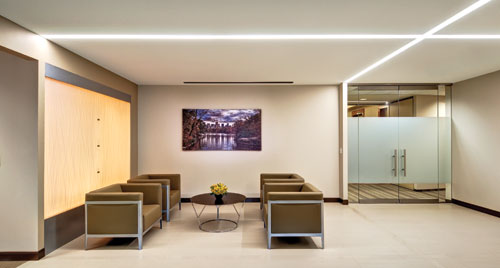 |
Continuous-run linear LED luminaires were specified in custom lengths for the Chapwood Capital Investments office in Dallas, Texas.
Photo by Steven Vaughan Photography, Dallas |
New developments. Without new components, materials and design updates, new performance levels of LEDs could not be realized.
The use of low-copper aluminum extrusions, castings with stainless steel hardware, and quality powder coat finishes are allowing luminaires to maintain their appearance at L70 (70 percent of its initial light output) and beyond. Captive screws, replaceable LED light engines, age-resistant gasket systems, and tool-less access are critical, while potential issues such as galvanic corrosion, lens yellowing, and expansion/contraction are being addressed during product design. LED drivers should have life-hour values similar to the LEDs they power.
Leading luminaire manufacturers use only reliable LEDs with LM-80 test data (see sidebar “Test Method Quick Reference”) and pay special attention to maintaining the proper junction temperature of the LED. One manufacturer designs for a balance of power, heat sinking, and possible ambient temperatures by using a heat chamber for testing luminaires at elevated temperatures of 50°C or more.
Optics is an area where manufacturers can vary greatly. Some manufacturers invest in optics with maximum efficiency while others trade off some efficiency for increased visual comfort. One manufacturer has each of its LED luminaires undergo an extensive visual performance critique process arguing that visual comfort can improve your ability to see well.
The end result of minimal glare is achieved through critical viewing angles and, in some cases, an LED source that is completely unseen. LEDs have allowed manufacturers to achieve uniform lens luminance and color for linear luminaires never possible with similar fluorescent systems.
Manufacturers have updated their light engines so that new generations are providing a confident 36,000- to 60,000-hour life with minimal lumen depreciation based on TM-21 calculation results. (See sidebar "Test Method Quick Reference.") Good LED light engine designs can be easily interchanged via plug-in terminal connectors. They are also delivering CRIs of 80+ and standard color temperatures of 3,000K, 3,500K, and 4,000K. One winner of The Next Generation Luminaires™ (NGL) Solid-State Lighting (SSL) Design Indoor Competition was commended on its product's “continuous lines of light, which provide superior performance, excellent luminance uniformity, and flexibility,” and on the integral driver “available in different housings, with multiple mounting and dimming options.”
LED Life-Cycle Assessment
Studies by the DOE updated in August 2012, found that the negative environmental impacts of LED lamps at present are less than those for incandescent lighting products, but by 2017 they will be significantly less than for all other lighting products.
Part 2 Life-Cycle Assessment of Energy and Environmental Impacts of LED Lighting1 examined five life-cycle stages: raw materials, manufacturing, transportation to point of sale, energy-in-use of the product, and end-of-life/disposal/recycling. It also examined the manufacturing process for a white-light LED product to understand the impacts of the manufacturing process. It then compared the manufacturing process with that of other lighting products.
The study found that energy-in-use is the dominant negative environmental impact, and that LEDs and CFLs are similar in energy consumption. But by 2017, the prospective negative environmental impacts of the improved LED lamp will be significantly less than incandescent, about 70 percent lower than CFLs, and approximately 50 percent lower than current 2012 LED solutions. The spider web charts spell out 15 environmental impacts in four sectors.
 |
Life-cycle assessment impacts of the lamps analyzed relative to incandescent |
 |
Life-cycle assessment impacts of the lamps analyzed relative to CFLS
Source: U.S. Department of Energy |
Testing Standards
The use of LEDs as a general light source has forced changes in test procedures used to measure lighting performance.
 |
Goniophotometer performing an LM-79 photometric distribution test
Photo by IAEI |
Traditional photometry methods use a “relative photometry method,” where lighting energy efficiency was developed separately for lamp ratings and for fixture efficiency. A lamp rating indicates how much light (in lumens) the lamp will produce. A fixture efficiency, which is an appropriate measure for fixtures that have interchangeable lamps, indicates the proportion of rated lamp lumens actually emitted by the fixture.
In contrast, LEDs have a complex relationship between the LED light sources and the luminaire components, where manufacturers design LEDs as a unit. The performance of each unit is unique and is a function of the design and the manner in which the LEDs are integrated into the package or luminaire. LED luminaires, therefore, cannot be compared to other lighting systems, which separate lamp performance and fixture performance.
The efficiency of an omnidirectional fluorescent luminaire, for example, is measured according to relative photometry methods, i.e., lumens emitted by the lamp plus the performance of the fixture in directing “usable” light. Its efficiency is greatly limited by the fixture components (e.g., lenses, reflectors, or louvers), orientation of the lamp, and size of the fixture. But in the case of directional LED linear luminaires, where all the light is emitted in the intended direction, performance is improved because of less wasted light.
In order to evaluate LED products, the Illuminating Engineering Society of North America (IES) published LM-79-08, Approved Method for the Electrical and Photometric Measurements of Solid-State Lighting Products. LM-79 is a product testing method based on absolute photometry, which characterizes a luminaire as a whole and acknowledges its unique thermal, optical, and electrical properties (see sidebar “Test Method Quick Reference”). Its performance data provides a means for design professionals to evaluate different LED luminaires.
Of more interest to manufacturers, IES LM-80-08: IES, Approved Method for Measuring Lumen Maintenance of LED Light Sources, describes the measurement of lumen maintenance—the amount of light output maintained over time—for LED packages used in luminaries.
| Test Method Quick Reference |
IES LM-79-08: IES “Approved Method for the Electrical and Photometric Measurements of Solid-State Lighting Products.” Describes the method of absolute photometry for LED luminaires and integral replacement lamps, and associated electrical measurements. Provides performance data (i.e., light output and efficacy, light distribution, and color characteristics) for the entire, integrated product—versus separate results for the light source (“lamp”) and luminaire provided by traditional relative photometry.
IES LM-80-08: IES “Approved Method for Measuring Lumen Maintenance of LED Light Sources.” Describes the measurement of lumen maintenance—the amount of light output maintained over time—for LED devices (i.e., single or multiple die chips). LED devices are operated for at least 6,000 hours at representative operating temperatures, with photometric data collected at a minimum of every 1,000 hours. Using modeling guidance from a proposed companion test method, IES TM-21 (see below), this “device-level” data can be applied to the integrated LED product to predict useful operating life and light output over time.
IES TM-21: “Lumen Depreciation Lifetime Estimation Method for LED Light Sources” provides a method for determining an LED luminaire or integral replacement lamp’s expected operating life, based on initial LED performance data collected per IES LM-80 guidelines. IES TM-21was completed and released in 2012. Its testing/calculation method addresses the potential degradation paths seen with different LEDs and luminaire integration. Since TM-21 provides two values relating to L70 lifetime—reported hours and calculated hours—it is important for specifiers to understand how the two values are generated and the difference between them.
ENERGY STAR provides an online TM-21 calculator for luminaire manufacturers to enter LM-80 data that consists of temperature measurements collected during in-situ heat testing and drive current used. Because of the time involved for LED manufacturers to create LM-80 data—most LEDs have only tested for 6,000 hours or 10,000 hours—TM-21 extrapolates the data from LM-80 (submitted by LED manufacturers) and provides a “reported” value and a “calculated” value for lumen depreciation and lifetime. For instance, a 6,000-hour LM-80 report can only result in a maximum “reported” 36,000-hour lumen depreciation estimate, while a 10,000-hour LM-80 report could only result in a maximum “reported” 60,000 hours lumen depreciation estimate. These reported values are very conservative and may be reporting lumen depreciation of 10 percent or less. The “calculated” values, on the other hand, are typically much higher, usually over 100,000 hours and are often cited in luminaire manufacturer data sheets. While LED luminaire products may very well perform to their calculated L70 lifetime, these calculated values should not be confused with reported values.
IES LM-79 performance testing is typically conducted by independent testing labs on behalf of manufacturers or testing programs like DOE CALiPER.* Given its duration and space requirements, long-term testing under IES LM-80 is generally performed by LED device manufacturers.
* More information on DOE’s Commercially Available LED Product Evaluation and Reporting (CALiPER) Program can be found at: www.ssl.energy.gov/caliper.html. |
Theoretical Limits of LED Technology
In regard to luminous efficacy (lumens produced per watts consumed), current proven performance in labs has delivered over 280 lm/W. Researchers have indicated a theoretical limit for white LEDs to be somewhere around 300 lm/W at the device level. LED devices with an efficacy of 300 lm/W will result in luminaires with the potential to deliver 240 lm/W or more, by far the most efficacious practical light source available for general lighting. This potential is certainly exciting and has developers of LEDs racing to reach this limit with major advances about every year.
Linear LED Luminaires Versus Linear Fluorescent Luminaires
While there has been considerable DOE-driven literature on LED replacement lamps for CFL and linear fluorescent fixtures, there has been relatively little addressing linear LED luminaires as replacements for linear fluorescent lighting. However, the IES LM-79-08 photometric reports and manufacturer data sheets of the many newly introduced LED luminaires should provide design professionals with a helpful basis for evaluating products.
Length of Life
Unlike other light sources, LEDs usually don't “burn out”—instead, they get progressively dimmer over time (a process called lumen depreciation primarily caused by heat generated at the LED junction). LED useful life is typically based on the number of operating hours until the LED is emitting 70 percent of its initial light output (L70). Good-quality white LEDs in well-designed fixtures are expected to have a useful life of over 60,000 hours. High-quality linear fluorescent tubes (T8 and T5) using rare earth phosphors will lose only about 5 percent of initial lumens at 20,000 hours of operation. The life of a typical linear fluorescent tube ranges from 7,000 to 24,000 hours while the best linear fluorescent lamps can last more than 30,000 hours depending on the type of ballast used and amount of on/off cycles.
Color/CRI
Design professionals used to rely upon standard fluorescent lamp colors to create the appropriate mood for a space. The reality today with LED is that virtually any color temperature is possible by adjusting the amount of phosphor used. In terms of color rendering fluorescent tubes provide impressive performance with CRI values up to 98 while LED values are commonly better than 80 but are also available around 90. When looking at the color spectrum of these sources as compared to full color spectrum sunlight, LEDs provide a more similar spectral distribution curve than fluorescent tubes, which tend to show spikes in the red, green and blue areas of the curve.
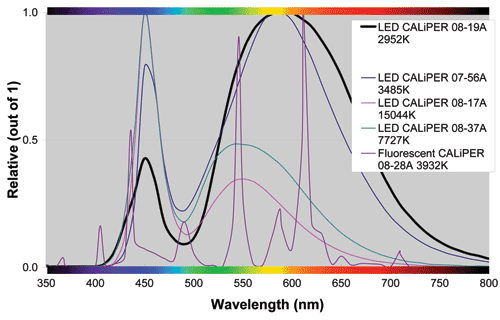 |
Spectral power distribution curves for LED and fluorescent
Source: Department of Energy |
Efficacy
Until recently linear LED luminaires were no rival for linear fluorescent luminaires whose typical efficacy (lumens per watt) for narrow aperture linear luminaires with diffuse lens is 70 – 80 lm/W including lamp and ballast. Similar linear LED products are now delivering between 2,000 - 3,000 lumens per 4-foot-section and have efficacy ratings from 75 lm/W - 85 lm/W. As of 2012 linear LED luminaires have become a viable and more environmentally friendly alternative to fluorescent systems.
Infrared or Ultraviolet Emission
Ultraviolet and infrared radiation bookend the spectrum of visible light, but do not contribute to humans' ability to see. Ultraviolet radiation can damage artwork, artifacts, and fabrics. Excessive infrared radiation from lighting presents a burn hazard to people and materials. LED luminaires lack infrared or ultraviolet emissions, while fluorescent lamps emit a small amount of ultraviolet (UV) light. LED lighting is, therefore, an appropriate choice for museums and illuminating artworks.
LEDs can, however, be manufactured to emit light in the ultraviolet wavelength range below 365 nanometers (nm) and are beginning to be used for special purposes such as UV curing and digital print applications.
Breakage Resistance
LED luminaires are largely impervious to vibration because they do not have filaments or glass enclosures. The inherent vibration resistance of LEDs may be beneficial in applications such as transportation lighting (planes, trains, or automobiles), lighting on and near industrial equipment, or exterior area and roadway lighting.
LEDs offer increased resistance to breaking during transport, storage, handling, and installation. However, LED devices mounted on a circuit board are connected with soldered leads that may be vulnerable to direct impact. Because they do not contain any glass, like fluorescent units, LEDs may be especially appropriate in applications with a high likelihood of lamp breakage, such as sports facilities or vandalism-prone areas.
Size
A single LED is a small point source and produces a relatively small amount of light alone. The small source allows luminaire manufacturers to make custom LED arrays with shapes and sizes best suited for a particular luminaire housing. Small light sources are easier to control optically than larger ones and allow LED designs to direct light with greater precision than possible with traditional light sources. For direct lighting applications the low profile form factor of the LED luminaire lends itself to meet ADA requirements and provides solutions for reduced ceiling height applications.
Controllability
Linear fluorescent lights do not provide full brightness immediately after being turned on. LED luminaires turn on at full brightness almost instantly. This advantage can be simply aesthetic or a user preference, but can also be beneficial for emergency egress or high-security situations.
Rapid Cycling
LEDs are impervious to the deleterious effects of on-off cycling. In fact, one method for dimming LEDs is to switch them on and off at a frequency that is undetectable by the human eye. For fluorescent lamps, the high starting voltage erodes the emitter material coating the electrodes. Thus, lifetime is reduced when the rate of on-off cycles is increased. Because of their operating characteristics, LEDs have an advantage when used in conjunction with occupancy sensors or daylight sensors that rely on on-off operation. Whereas the lifetime of fluorescent sources would diminish, there is no negative effect on LED lifetime.
Cold Temperature Operation
Cold temperatures present a challenge for fluorescent lamps. In contrast, LED light output (and efficacy) increases as operating temperatures drop. This makes LEDs a natural fit for refrigerated and freezer cases, cold storage facilities, and many outdoor applications. In fact, CALiPER testing of an LED refrigerated case light measured 5 percent higher efficacy at -5 °C compared to operation at 25 °C. Conversely, operation of LEDs in hot environments or use of products with poor thermal management characteristics can lead to undesirable performance attributes ranging from reduced lumen output to premature failure.
Dimming Performance
Dimming is often a desirable operating characteristic, but most energy-efficient technologies have challenges that must be overcome or mitigated. Some manufacturers of new linear LEDs have addressed problems by ensuring compatibility between the different hardware devices (e.g., the driver and dimmer). The best performing LEDs, when matched with a compatible dimmer, have better dimming performance than CFLs (limited range) or linear fluorescent luminaires.
Servicing Requirements
Good quality linear LED luminaires typically come with some type of manufacturer warranty, usually 5 years. In addition to the warranty most LED applications would benefit from avoiding at least one lamp and ballast replacement required for a traditional system, and could, in some cases, avoid two to three rounds of replacements. A 60,000-hr life means replacing the LED light engine or replacing the luminaire half way through year 13 from the installation date based on 12 hours of operation per day. Even at this point the luminaire should be providing 70 percent of its original light output. Caution should always be taken when handling LEDs directly as damage from ESD (electro-static discharge) can compromise the LED and cause premature failure.
 |
Service requirements should be considered when choosing between fluorescent and LED.
Photo courtesy of Selux |
Acceptable Operating Conditions
Lighting class LEDs offer advantages in cold weather starting and low temperature applications where fluorescent/high-intensity discharge (HID) sources have typically struggled. A T5 fluorescent lamp produces a maximum efficiency of around 35°C and a T8 of around 25°C. LED luminaire acceptable operating temperatures range from product to product but are available with maximum ratings of 35°C or better but require some de-rating to light output above 25°C. Design professionals should contact the manufacturer for a lumen depreciation curve of the product as it is not always published.
Flexibility
A narrow aperture, continuous-run luminaire made up of overlapping 3-foot and 4-foot fluorescent lamps creates some limitations when specifying custom lengths. Similar LED luminaires have the ability to be specified within a ¼ inch for custom lengths. This is a major freedom for the design professional wanting to have light from wall to wall.
 |
Reflective materials used on inside of luminaire maximize efficiency.
Photo by Hyexposure Photography |
Appearance
Appearance of the lens is one of the most obvious elements to be criticized because it is the first thing to be seen. Continuous run luminaires using fluorescent lamps typically overlap tubes for unbroken lines of light. Due to the physical character of a fluorescent lamp, bases/sockets and imperfect reflectors create socket shadows and other visually degrading elements tolerated for many years because the fluorescent lamp was the best thing out there. The lens luminance (brightness of the lens) for a linear LED luminaire can be nearly flawless from edge to edge—a welcomed advantage for high-end architectural applications.
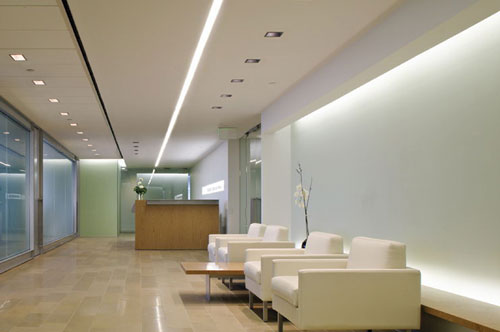 |
Linear fluorescent is often used in a continuous run.
Photo courtesy of Selux |
Specifying Linear LED Luminaires
Challenges persist as LED technology develops, which acknowledges the unique properties of each product. This, in turn, requires informed specification on the part of design professionals.
Binning
One challenge for the luminaire manufacturer—and the end user—is binning, where LED producers separate their production into lumen, color and sometimes voltage bins. By ordering a wide range of binned LEDs, a luminaire manufacturer receives a better price and improved lead time. On the downside, the variability of luminaire performance is substantially increased, creating high probability for negative impact to end-use customers.
For ENERGY STAR certification, luminaires are required to meet the ANSI C78 377A bin standard (seven-step bin). Even so, luminaires may still have some degree of perceivable color variation. This is acceptable for most commercial lighting applications. But for museum or retail lighting, say, specifiers need to ensure that luminaires meet rigorous color requirements.
Top luminaire manufacturers likely use LEDs from a two-step or four-step bin to maintain color uniformity throughout a product. It may be easier for the end user to understand what they are getting if expressed as a CCT tolerance (e.g., 3,000K LEDs from a two-step bin may be +/-125K from specified CCT meaning LED CCT range could be 2875K - 3125K).
Some luminaire manufacturers may record LED bin information for every job sold to allow future orders to match when installed. It may be necessary for future additions/project add-ons to have new generation LED luminaires preset at the factory to a dimmed level for matching the light output of an older generation installation.
Determining End of Useful Life
A challenge not yet addressed wholly by the industry is determining an LED luminaire's end of useful life. Certain applications may be more sensitive to this than others (e.g., a custodian closet versus a higher security high traffic area of a building). End-of-life indicators in the form of a visual signal are in the works; some examples may be a red indicator light or a luminaire blinking periodically to indicate 70 percent lumen output.
Ambient/Environmental Conditions
When considering applications requiring certain listings design professionals should be sure to verify that the product is adequately listed. This is quite important for LED luminaires when it comes situations like dry-damp or wet locations. IC rated means a luminaire can be installed in direct contact with insulation. Without an IC rating, a 3-inch space must be maintained around the luminaire when installed. The ambient temperature of on installation should be coordinated with the published maximum operating temperature for the LED luminaire selected. Wall mounted luminaires less than 80 inches from the finished floor require ADA compliance. An ADA-compliant luminaire will not protrude more than 4 inches from the wall.
Judging Light Output
An experienced design professional could predict approximately how much light output to expect if he or she knew quantity and type of lamps used. With LED luminaires it is necessary to take a deeper look into the product data sheet/photometry files to determine light output. Simply going by wattage could produce a result that is far different from that expected from a particular product. Similar linear LED luminaire products can actually vary greatly when it comes to light output.
Conclusion
Multiple commercial and governmental forces are driving the development of LED technology which is expected to represent 36 percent of luminaire sales for the general illumination market by 2020 which translates into energy savings of 19 percent. New LED components, materials, and design updates are delivering energy efficacy performance levels unseen until recently. Already, linear LED luminaires are providing a viable alternative to the traditional fluorescent tube with such features as increased length of life, efficacy, energy efficiency, and design flexibility and appearance. But the quality and performance of LED products varies among manufacturers. Design professionals are therefore urged to become familiar with the organizations supporting LED technology and discuss particular specification questions with manufacturers.
| ENDNOTES |
| 1 |
Life-Cycle Assessment of Energy and Environmental Impacts of LED Lighting Products |
| |
Part 1: Review of the Life-Cycle Energy Consumption of Incandescent, Compact Fluorescent, and LED Lamps
Part 2: LED Manufacturing and Performance |
| |
February 2012 Updated August 2012, Prepared for: Solid-State Lighting Program, Building Technologies Program, Office of Energy Efficiency and Renewable Energy, U.S. Department of Energy
Part 1 prepared by Navigant Consulting, Inc. Part 2 prepared by Pacific Northwest National Laboratory N14 Energy Limited |
 |
Selux offers a comprehensive range of high-quality interior and exterior architectural luminaires with advanced LED and optical design. Selux innovative luminaires are designed to help lighting professionals and architects create exceptional interior and exterior spaces in which to live and work. www.selux.us |