This CE Center article is no longer eligible for receiving credits.
Interiors are rarely considered as challenging or complex as base building elements, such as enclosures or circulation cores. Yet with its myriad uses, loads, penetrations, and performance expectations, the ceiling plane is unusually intricate. If it is carefully considered from a building project's earliest phases, ceiling design and integration can be accomplished successfully. Yet too often, this is not the case; too frequently the many key decisions about ceilings are postponed or left for the trades to work out. The result is a ceiling that may not work as expected—and that doesn't look as good as it could have.
An improved focus on the ceiling plane has begun to take hold in the architectural profession. The new approach benefits from more cohesive project coordination, on one hand, as well as the use of next-generation ceiling systems and components on the other. From the use of integrated project delivery (IPD) and building information modeling (BIM) to the application of new grids, supports, and frame-and-panel ceiling systems, these coordination methods treat the ceiling plane in a holistic way.
As with any building system requiring significant coordination, the project team must address the ceiling plane early in the project cycle. “Because ceilings serve so many purposes in modern construction in addition to acoustical control, there are many elements that must be coordinated with the selection and detailing of ceiling systems,” according to David Kent Ballast, FAIA, NCIDQ, author of Interior Construction and Detailing for Designers and Architects.1
It should also be considered as a complex system, requiring an integrated design approach. There are four elements of an integrated design process, according to Mir M. Ali and Paul J. Armstrong of the University of Illinois at Urbana-Champaign's School of Architecture.2 Paraphrasing an approach espoused by the Rocky Mountain Institute, Ali and Armstrong offer advice that should apply to the ceiling plane as to any other complex assembly:
1. Whole-systems thinking, to exploit the interactions between elements and systems
2. Front-loaded design, where the team thinks through the design early to avoid losing opportunities for “low-cost, high-value changes” later in the process
3. End-use, least-cost planning, which means focusing on occupant needs rather than the equipment that meets those needs
4. Teamwork—pure and simple, collaborating on what's needed and how to do it well.
 |
Ceiling systems must allow for a complex coordinated plane that addresses aesthetics, noise control, light reflectance, and building services delivery.
Photo by Bob Perzel |
“For the ceiling, which is a complex building plane, project teams are realizing that early coordination and integration of ceilings with various subsystems that penetrate it is a path toward reducing costs, shortening construction schedules, and eliminating errors,” says Ko Kuperus, a general manager at Hunter Douglas Contract, a manufacturer of ceiling systems. “Awareness is half of the battle, and team coordination and use of high-value ceiling technologies take care of the rest.”
Historical View of the Ceiling
According to Kuperus, the basic concept of the modern suspended ceiling—a continuous aesthetic plane with the key function of hiding building services routed through the interior—has changed little over the better part of a century. “Acoustic tiles were dropped into a metal grid, and the same is true today,” he explains. “Yet over time we have added significant burdens to that tile-and-grid assembly, with more system types, more penetrations for security and audiovisual technologies, and a much broader range of HVAC and lighting systems.”
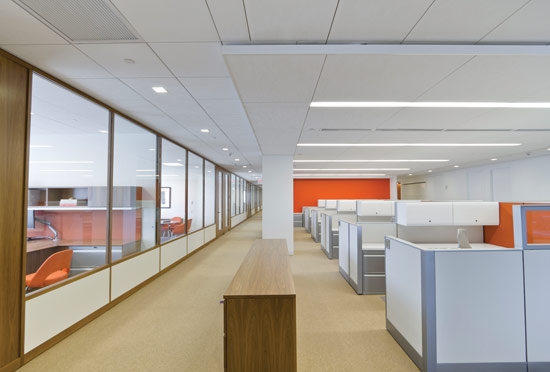 |
To accommodate light fixtures, air diffusers, and fire sprinklers at the Hunter Douglas offices in New York, the design by Gensler employs a frame-and-panel suspended ceiling.
Photo courtesy of Hunter Douglas Contract |
A few of the advances have been particularly challenging. The use of the volume above the dropped ceiling as a plenum for ventilation return air, for example, demanded carefully engineered return openings across the ceiling plane. It also changed safety needs, as a fire reaching the plenum could potentially feed toxic smoke into the ventilation system, harming occupants throughout the building. Cables and wiring above the ceiling, for example, now require fire-resistive, low-smoke zero-halogen insulation.
Other specific prohibitions have been included in building codes to prevent fire and smoke development within the unseen plenum space. High-voltage electrical equipment has to be enclosed within metal conduit, raceways, and containers, for example, and electrical outlets can only be installed on ceiling tiles inside electrical boxes, with the sockets exposed to the interior below. With live voltage and lighting systems, performance during earthquakes is also a concern, and diagonal wire stays, compression posts, and seismic clips are now required in certain jurisdictions.
Yet there have been other developments increasing the complexity of the ceiling plane. “During the 1950s and 1960s, suspended ceilings and molded floor slabs of concrete and steel were developed as a 'multipurpose power-membrane' in which technical rationality and economy emerge as new architectural objectives consistent with the mechanized environment,” according to Ali and Armstrong. Some of these looked like today's suspended ceilings, while others—such as Louis Kahn's Yale University Art Gallery—incorporated MEP ducts and conduits into the concrete structural slab.
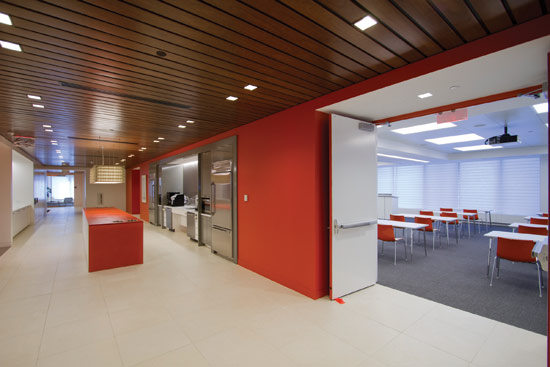 |
Gensler specified a real wood veneer on linear metal panels for this New York office project, selecting a system that effectively coordinates with light fixtures, linear diffusers, sprinklers, and signage.
Photo courtesy of Hunter Douglas Contract |
This level of integration—ceiling-routed services with building structure—has been rare. Instead, by the late 1960s, “the suspended ceiling, which supplied consistent uniform energy, became the primary modular planning element for the layout of the office,” says Ali, as well as other occupancies. Manufacturers responded with ceiling systems designed specifically for system integration. Many boasted of systems that could bring light, air, audio, life-safety and security elements through the ceiling plane, all with one grid system.
| Integrated Elements at the Ceiling Plane |
Technical Services to Address
• Lighting
• Climate control (heating, cooling, ventilation)
• Fire protection
• Data
• Security
• Speakers
Other Penetrations & Interactions
• Columns
• Walls
• Signage
Other Ceiling Functions
• Acoustical performance (NRC/CAC)
• Light reflectance
• Aesthetics
|
By 1961, the lighting researcher Murray L. Quin stated, “The ceiling plane of present-day buildings presents one of the most difficult product coordination areas in the building industry.”3
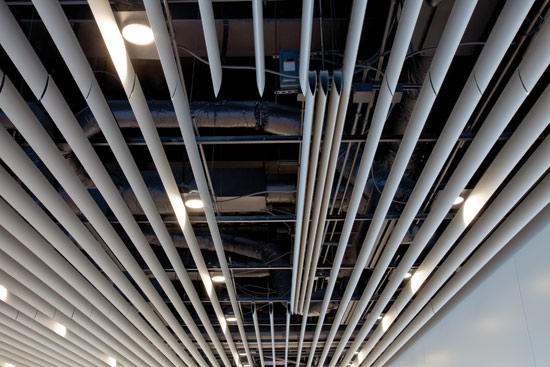 |
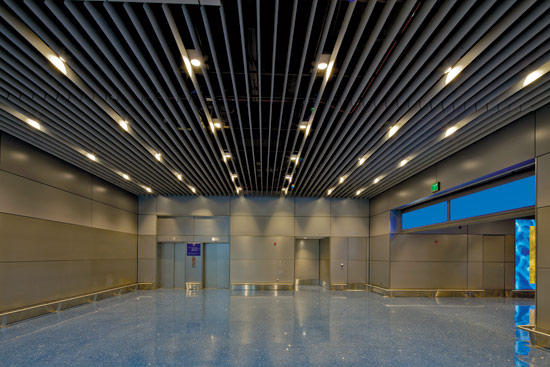
HOK designed this robust baffle ceiling system for Phoenix Sky Harbor International Airport's PHX Sky Train™. The baffle ceiling system provides
openings for service maintenance.
Photos by Bob Perzel |
On top of that, by the 1970s, the ceiling plane came to be viewed as a critical component in building performance: In terms of light propagation, its surface reflectance could enhance both daylight and electrical lighting efficacy. With this, as well as its effectiveness as a membrane to contain conditioned air, the suspended ceiling became essential to energy efficiency. In addition, its acoustical properties were of tremendous value—it offered lots of surface area and could be porous and absorbent in nature, unlike the resilient floors and walls.
Yet the exposed ceiling face was hardly continuous or uniform. More services than ever before seemed to be poking out or otherwise interrupting the design surface. There were multiple grid designs, and even when grid openings were uniform, the profiles and bearing capacity of cross-members might vary. To some degree, that is still the case today, and the range of ceiling materials is vast, from wood and perforated metals to stretched fabric and translucent plastics. The systems offer varied techniques for integrating services into the exposed ceiling plane; demountable tiles have long been a feature, though some have been limited in size due to the sagging of soft materials such as cellulose or mineral board.
Simplified ceiling systems have also been introduced in recent years, and these have led to some abdication of responsibility and incomplete detailing. “Yet, whether mineral board and grid, specialized materials or metal ceilings, each ceiling type needs to be understood with respect to plenum uses, load bearings, and penetrations through the ceiling plane,” says Kuperus. This goes for both new construction and interior retrofit projects—left as an afterthought, issues of service coordination arise that also impact aesthetics and long-term system maintenance. The project design team needs to be vigilant and organized to avoid PM issues, he says. Many can also use new ceiling technologies that help integrate various building services and penetrations.
Getting a Handle on the Complex Plane
In fact, one would be hard-pressed to argue with Quin's prescient assertion in 1961: “The ceiling plane is the most complex surface. So for construction project teams, the main challenge is to develop a method for successful integration of systems and components needed for the suspended ceiling.”
| Seven-Step Ceiling Design Methodology |
Ceilings are too often treated as an afterthought in a large-scale building project. Yet without proper front-end planning, they can turn out to be a source of unneeded cost increases and schedule delays.
Good early-stage planning and pre-coordination of all services is key to a well-coordinated, functional, and aesthetically pleasing ceiling assembly. Proper design and specification steps include the following:
1. Determine customer required services and ceiling functions.
2. Calculate required space for each service, and allocate plenum space to assure all elements fit above the ceiling.
3. Select ceiling material type (metal, mineral, wood) and functions, which include acoustical properties, light reflectivity characteristics, fire/smoke performance, cleanability, durability, and LEED inputs.
4. Complete ceiling aesthetic choices, such as finishes, colors, prints, patterns, and modules.
5. Narrow down ceiling system options, such as accessibility, weight, spanning capability, and dimensional tolerances.
6. Specify suitable components to be integrated and verify coordination with chosen ceiling system.
7. Link technical component specifications to the chosen ceiling system—often the key step in ensuring proper coordination.
|
Function
The first question is ceiling function, which comprises a number of key variables that should be catalogued and reviewed. First, consider how the plenum will be used: Will ventilation return air be unducted, and how much cabling will be accommodated? How frequently will the plenum space be accessed? Second, list the anticipated loads on the ceiling plane, including elements that are independently suspended or braced. Note critical loads, such as fire sprinklers, and whether the ceiling must meet seismic requirements. Third, list and indicate on schematic or DD drawings all anticipated penetrations of the ceiling plane.
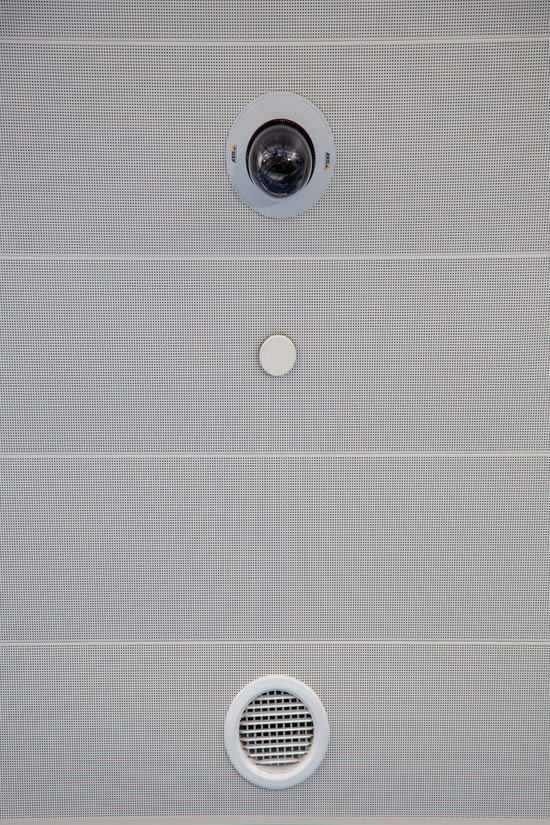 |
This floating metal ceiling designed by HOK offers a plane for independently supported service devices. Specific elements are delivered through the ceiling panels.
Photos by Bob Perzel |
Type
A second influence on the project approach is suspended ceiling system type. Will the team use a standard system—typically exposed tee grid members of 15/16 inch in flange width, with most openings of 2 feet square or 2 feet by 4 feet in shape—or will the choice be one of the many standard alternative systems available on the market? Will the design include metal, wood, or other specialty panels? Often the process begins as a simple material selection in the schematic design or design-development (DD) phase; in other cases, client requirements for the occupied spaces precede the choice of materials, which flow from those needs.
Coordination
Ceiling coordination ideally begins with early-phase design reviews that include all of the key team members—architect, interior designer, MEP engineer, contractors, and key trades and suppliers. (Sounds like a big meeting? It should be; again, this is one of the most complex planes in the project.) Before or upon commencing the ceiling design review, the project manager or designer in charge should assign responsibility for various aspects of properly implementing the ceiling system and all associated services and penetrations.
Too often, coordination of the ceiling work begins in earnest somewhere around the shop drawing phase. By then, it's too late to make those low-cost, high-value changes—errors have a large impact, and revisions become costly.
Documentation
The ceiling design review should also set the stage for creating proper and explicit construction documentation (CDs) that match the scope of ceiling coordination. Specifications, reflected ceiling plans, and key details will define not only how the assemblies and components are physically integrated; they should also call out (a) who supplies what, (b) who installs what, and (c) who pays for what.
Communication
Consultants, vendors, and key trades whose work impacts the ceiling plane should be aware of their critical involvement in a team-wide effort to achieve successful ceiling integration. Architects and IPD team leaders are best positioned to create this team atmosphere, although in practice it is often the ceiling supplier who does so by raising the issue of service delivery first—the tail wagging the proverbial dog. Yet neither the ceiling supplier nor the installer bear responsibility for all integration of the ceiling services. Many of the system supports, penetration assemblies, and trim components are “by others,” to use the parlance. Even when some design teams have cleverly assigned away all ceiling responsibility to a single party in the contract documents, the clauses rarely hold up under the pressures of the project.
The benefits of the steps described briefly above are manifold. There are potential schedule and budget reductions through the early planning and coordination of ceiling plane functions. Project team awareness also ensures that the selected ceiling design solution will be thorough and operationally effective. It also helps ensure that CD contents match the project scope.
Yet in many cases, these benefits will remain unexploited. The integration of services in the ceiling plane “is a little minor detail to these folks in their big schemes,” says one system vendor, “but it's one that matters big time later in the game.”
Common Issues for Ceiling Services
For those project teams who see the benefits—or have experienced the misery of poor ceiling coordination and delivery—there are a number of recurring challenges and problems that can be avoided through awareness and early-phase coordination. Projects requiring the integration of varied subsystems into the ceiling often require factory-cut holes for certain types of panels, for example. For standard 2-foot-by-2-foot (2x2) grids, a wide selection of 2x2 light fixtures are available that simply lay into the ceiling grid; yet for 4-foot-by-4-foot metal panels, coordination for similar light fixtures is handled very differently. In addition, successful projects have often utilized coordination documents at the shop-drawing phase to ease and expedite integration.
When beginning the ceiling plane coordination process, experienced architects will not assume that all services are best located at the ceiling plane. Rather, they will look for opportunities to serve interior spaces through walls, raceway, raised floors, soffits, and other architectural elements, in addition to ceilings. The savvy design team should be aware of the following recurring issues regarding ceiling-based services:
1. Independent supports for ceiling plane elements. Many ceiling grid systems are designed “to support 'lay-in' luminaires,” exit lights, diffuser grilles, and some electrical components up to a certain weight, according to codes experts Noel Williams and Jeffrey Sargent in NEC Q & A. However, “Other equipment and heavier luminaires must be supported independently of the suspended ceiling system, although they may be directly or indirectly attached to the ceiling system.” Many subsystems that appear to be integral to the ceiling must, in fact, be independently supported. Luminaires and boxes may be attached to ceiling framing members or support wires, but raceways and cables may not be, according to the National Electrical Code (NEC).
| For Suspended Ceilings: Key Standards and Associations |
ASTM Standards:
ASTM C635 – Manufacture, Performance and Testing
ASTM C636 – Installation
ASTM E580 – Seismic Installation
ASTM E1264 – Standard Classification for Acoustical Ceilings – Includes the following key standards:
ASTM E84 - Surface Burning - Class A
ASTM E1477 - Light Reflectance
ASTM C423 - Acoustics
ASTM E1110 - Acoustics
ASTM E1111 - Acoustics
ASTM E1414 - Acoustics
Industry Associations:
CISCA – Ceilings & Interior Systems Construction Association
AWCI – Association of the Wall & Ceiling Industry
|
These requirements become more restrictive in areas subject to serious seismic activity, according to CISCA, which makes recommendations for ceiling installation practices. In International Building Code (IBC) seismic area categories D, E, and F, cable trays and electrical conduits must be independently supported and braced, even though the ceilings typically use a heavy-duty grid with wall attachments and restraint wires. Where partitions and columns penetrate ceiling areas larger than 2,500 square feet, they must have seismic separation joints or the partitions must be full height, reaching through to the structural deck above. If the ceilings do not have rigid bracing, the design must include oversized trim rings for sprinklers and other penetrations.
Sprinklers and life-safety equipment are a special case. The National Fire Protection Association guideline NFPA 13, Standard for the Installation of Sprinkler Systems provides two solution paths for fire sprinkler support systems. One way is to use the prescriptive guidelines and tables in Chapter 9, “Hanging, Bracing, and Restraint of System Piping,” which can be accomplished without an engineering analysis. As an alternative, the design team can use the key principles of fire-safety engineering outlined in the chapter along with tabular data given on hanger spacing; for example, all hanger elements must be ferrous, and at each point of support they must be sized to carry at least five times the weight of the pipes (when full) plus a 250-pound margin. If the authorities having jurisdiction (AHJs) require it, the team must also prepare calculations showing stresses and safety factors assumed for all pipe lengths, hangers, and fittings.
2. Access and maintenance in the plenum space. The need to access the plenum space for maintenance has increased dramatically in recent years. Growing use of wireless local-area networks (WLANS) is one of the pressures, according to network design engineers at Cisco. “Due to the rapid proliferation of new network devices and applications,” they say, “the number of devices and connections per user is steadily increasing.” Most users have a primary computer and at least one other smart device, “driving a dramatic increase in user densities.”
WLAN devices and cabling, like other information technology and telecommunications (IT&T) components, require frequent upgrades, programming, maintenance, and replacement. Along with other routine maintenance of lighting, MEP, and fire-safety systems, a higher frequency of access is required, demanding more use of heavy-duty grid systems, ceiling tiles with increased durability, and operable, hinged panel systems. In all cases, many building owners and tenants choose to stock replacement tiles and panels for rapid changeout of damaged ceiling areas.
3. Movement and vibrations in the plenum. Vibrations from mechanical equipment, audiovisual products such as projectors, and other system use can propagate from the plenum along structure, ceiling grid supports, and through collars and fixtures. The main result of the vibration is background noise, often exacerbated by the plenum air cavity, which is naturally resonant similar to the inside of a drum. Engineered substrates and isolation decoupling assemblies, such as neoprene gaskets, can be used with ceiling hangers, wall braces, or floor supports to reduce unwanted vibrations and noise.
4. Lighting system integration. The main challenge for lighting systems is the increasing desire to use combined direct/indirect illumination to cut glare and match daylight distribution, according to the Lawrence Berkeley National Laboratory (LBL) Windows & Daylighting group. “These systems require a clean, high-reflectance ceiling and adequate ceiling height,” according to LBL, advising that ceiling heights should be more than 9 feet with pendants hung at least 1.5 feet from the ceiling. In addition, the ceiling system must allow proper fixture layouts to match daylighting distribution, with lighting circuits arranged in zones that reflect window locations.
Further, LBL admonishes project teams, “Flag potential conflicts early,” including poor lighting “location, access, and crowded ceiling plenums.” As another example, lighting fixtures and supply/return registers must be coordinated and located so as not to disrupt HVAC system airflow, says LBL. The group recommends including calibration and maintenance plans in the construction documents, in a clear and easy-to-use package.
5. Low-voltage systems (security systems, audio). In addition, there are a number of low-voltage systems that are integrated into the building that require access through or behind the suspended ceiling. Halogen and xenon lighting with 12- or 24-volt operation are increasingly used in shops, museums, restaurants, and hotels, often on tracks penetrating the suspended ceiling grid. These systems have transformers that produce noise and heat, as well as thick wires that conduct a lot of electricity.
 |
Some ceiling systems provide a built-in utility zone for service coordination that maintains aesthetic continuity across the ceiling plane.
Photo courtesy of Hunter Douglas Contract |
Yet there are many other low-voltage systems, including amplified ceiling speakers installed by low-voltage and AV system contractors, as well as closed-circuit TV security cameras and other security devices that may be installed by the same contractors or a separate security design-build contractor. Smoke detectors are typically mounted on the ceiling, of course. System integrators, which in some cases are integral to the MEP design team, will specify and select equipment for these low-voltage installations, as well as related equipment such as monitors, signage, and motion detectors, which may also be ceiling mounted.
According to David Kent Ballast, FAIA, NCIDQ, author of Interior Construction and Detailing for Designers and Architects, the designer “is often the person who must coordinate the efforts of the team members so that their work fits within the overall design and construction of the project,” including the ceiling design and electrical and signal systems that impact it. Says Ballast, “In most cases, this involves making sure necessary information is transmitted between the members of the team and that all required data and details are shown on the final set of drawings.”
6. Special ceiling assemblies. There are a number of special construction types and specialties that will affect ceiling coordination, says Ballast. These may include wayfinding and signage, plenum sound barriers, seismic restraints, drapery pockets, and other recessed items. In a laboratory or healthcare facility, the ceiling may be transected by pipes, conduit, and structured cabling, among other systems.
An important question to raise at early project meetings is: Who will be in charge of coordinating all this stuff?
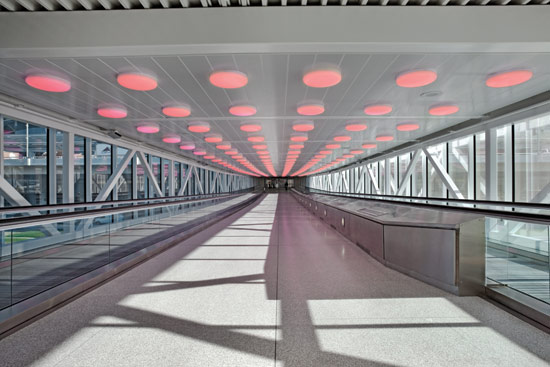 |
A walkway at Indianapolis Airport shows a ceiling that is used to coordinate lighting and audio.
Photo courtesy of Hunter Douglas Contract |
Multipurpose Building Plane
There are more potential challenges at the multipurpose ceiling plane. Penetrations can be made for a variety of reasons with a variety of materials. Plumbing, electrical, communication, HVAC systems as well as sprinkler and detection and alarms systems each result in penetrations of these assemblies. The penetrations can be for pipe, conduit, wiring or ducts; the materials of those items can be either metal, glass or plastic, depending on other construction requirements.4
In fact, ceilings serve so many purposes, says Ballast, that there is a severe onus on design consultants to coordinate every element. More than anything else, the architect wants to make sure the ceiling still looks attractive after all this multidisciplinary desecration is done. It also has to maintain criteria for light reflectance and acoustics as per the design intent. The use of BIM may help, but BIM is only as good as the design team when it comes to accurately foreseeing all the needed penetrations and preventing “clashes” of various kinds.
 |
|
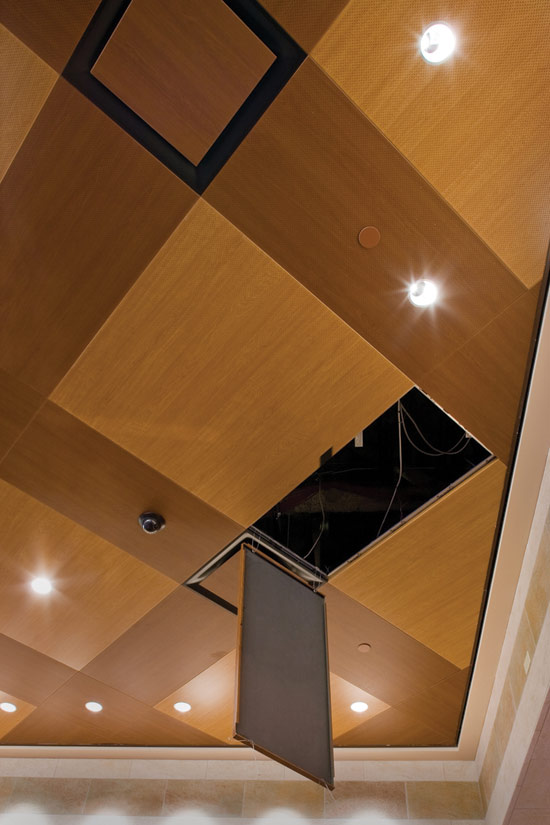 |
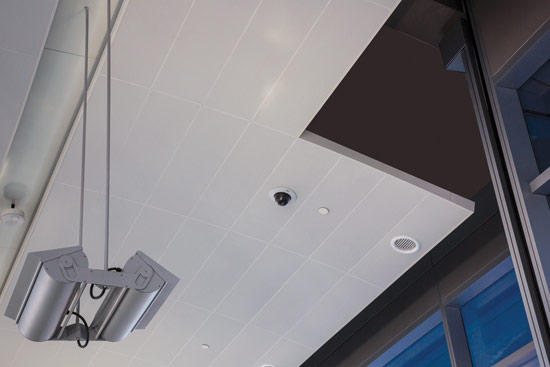
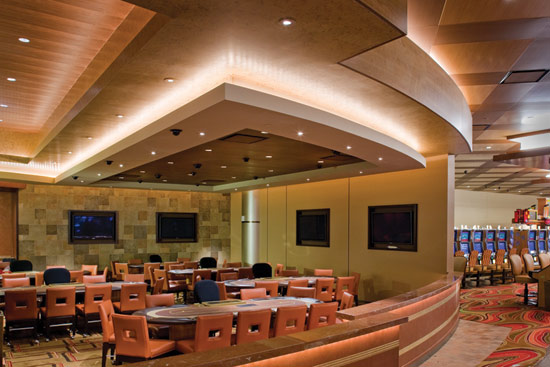
Ceiling plenum access through the ceiling plane is critical for the ongoing operations at Lumiere Casino in St. Louis. The plenum access allows maintenance staff to maintain and add services, or correct problems after the initial construction. Designed by Marnell, the ceiling accommodates a number of coordinated service devices, including light fixtures, air diffusers, security cameras, life safety systems, and audio speakers.
Photos by Mark Bealer |
Moreover, in some situations the penetrations of wall and floor/ceiling assemblies need to be protected at each penetration with a firestop that is listed and approved for the particular characteristics of each penetration. So if the finished ceiling also serves as a fire or smoke barrier, the assemblies need to be protected at each penetration with a firestopping material that meets a given T rating, which describes the time period that the penetration firestop assembly—including the penetrating item—limits the maximum temperature rise to 325 degrees F above its initial temperature (on the nonfire side) as per IBC standards.
Multi-Party Solution for a Multidisciplinary Challenge
Solutions for the complex integration of technical components in the ceiling plane include a mix of project management, design resolution, and appropriate ceiling technology. The core challenge is what happens at the interface between disparate systems, whether it has firestopping or acoustical fill or just a decorative trim—or zero transition at all. Determining which services are needed is the first step, says Ron Rice, an executive specializing in ceiling systems with Hunter Douglas Contract. Second, the design team typically selects a suitable ceiling type.
“In this transition from the service delivery mindset to the ceiling material or system choice, one vital step tends to be overlooked: confirming that there is a method for service interfaces and integration between the ceiling assembly and the service component,” says Rice. “There tends to be a missing link that connects them, which is especially problematic with standard and client-specific ceiling types, like many metal, wood, and specialty material ceilings that do not conform to the 15/16-inch standard grid.”
In fact, project team research shows that this “linking stage” that compiles services and matches them with ceiling system solutions is often not fully integrated into the design stage. Many of the service/ceiling solutions are “pushed downstream,” says Rice, and left to the varied providers of the services, such as electrical trades, plumbing contractors, the HVAC installers, and security integrators, among others. So the linking stage is left to the service element and ceiling manufacturers and their respective trade subcontractors during late-in-the-game phases, such as the shop-drawing stages.
“While this coordination is expected, we see too many instances where the service elements and ceiling integration do not allow for coordination and changes must be made,” says Rice, leading to potential change orders that relates solely to the ceiling plane. With the change orders come unanticipated costs and time loss.”
As an example, Rice describes a recent project in which a designer spent months creating a specific aesthetic concept for a large entertainment facility. This included nine months of work with a ceiling manufacturer selecting and approving a client-specific color match and an innovative “open-cell” layout. The color designation and layout design were incorporated into the bid documents.
After the project bid, the general contractor realized the security, lighting, mechanical, sprinkler and audio trades did not have methods to coordinate their services in and through the proposed ceiling plane. In fact, the designer did not initiate plans to coordinate service delivery with the unaffiliated architect and general contractor. At this post-bid point, the GC took responsibility and determined that a unistrut substructure would be required to accommodate the weight of several audio elements, along with a series of open-cell fixture frames to accommodate the lights, diffusers, and cameras.
None of the associated costs were factored into the project. So to avoid the budget changes, the GC shopped out the ceiling portion to a supplier of a system with a matching color and a similar aesthetic. It would also accommodate all ceiling-located services at no added cost. This was fortunate —in many cases, those many months of design work could be completely lost in the hunt for a suitable replacement system. Yet the entire issue—which consumed valuable time for the design-and-construction team—could have been avoided by beginning with a coordinated approach to ceiling services delivery.
Solutions for Better Service/Ceiling “Linking”
To better link the ceiling system resolution and service penetrations and related needs, such as plenum access, leading project teams recommend several project management (PM) approaches. Best practices in integrated project delivery (IPD), for example, include heightened awareness among project team members, as well as more effective communication approaches.
Early-phase coordination for the ceiling system and a full raft of related building services may seem likely to take a back seat to meetings on topics that have a major operations impact, such as energy use modeling. Yet project architects who have pushed for “ceiling team meetings” in the schematic and early DD phases report significant success and reduced change orders.
Ceiling scheduling. The project team may also elect to create a special track for the ceiling system in scheduling documents. If there is a consultant focused on scheduling and estimating services, he or she should be involved in this effort. Concept development estimates are made to check against project funding, and for best accuracy the concept estimates provide both building costs and time-related costs in one overall number, according to Summit Consulting Services. “The accuracy of that number helps to ensure project progress, while meeting the owner's needs and providing a little flair in the process.”
IPD and design-build. According to the American Institute of Architects (AIA), the use of IPD “leverages early contributions of knowledge and expertise through the utilization of new technologies, allowing all team members to better realize their highest potentials while expanding the value they provide throughout the project life cycle.” A number of practitioners are now using IPD for interiors work, even thought it was originally created for very large building projects.
For both new construction and retrofit projects, IPD can help bring together all the participants involved in the ceiling-related systems. And IPD will help ensure that the participants have a reason to work together effectively. Because of IPD's contractual structure, says Joan Blumenfeld, FAIA, LEED AP, global interior design leader with Perkins + Will New York, innovations are driven by financial incentives. “These structures assign reward and risk based on outcomes, provisions that can motivate big changes in attitude and behavior,” she says.
BIM and ceilings. According to the consulting engineer Lawrence Perry Associates, “BIM enables design teams a unique opportunity—a futuristic perspective of proposed building systems and their interoperability with architectural and structural elements. What does this mean? Unprecedented design coordination across trades and fewer conflicts in the field.” In the firm's projects, they have used BIM as part of the IPD process to take a “virtual tour” of mechanical systems and the spaces above suspended ceilings, “for views previously unavailable prior to project completion.”
There are other techniques for successful integration of services into ceiling plane, including methods that streamline and coordinate the complex integration of systems. A number of them borrow from larger projects, such as nuclear plants and manufacturing facilities. In Engineering News-Record, Ted Lynch, Ph.D., chief executive of the national mechanical engineering firm Southland Industries, has argued for a “smart compromise” hybrid approach that “incorporates design-build specialty subcontractors within the framework of a traditional project delivery approach.”5
In this method, says Lynch, the project team opts for selective use of key design-build trades for systems that can benefit from performance-based specs while maintaining more centralized control of the project. This could include the entire MEP subcontract, but it could also serve as a “ceiling-plane services” subcontract. The challenge is that there should be a “single source of accountability for scope and performance,” Lynch believes. As in any design-build situation, there is an assumed high level of trust and improved communication and coordination between the designers and contractors—which is clearly a benefit for the tricky case of the ceiling.
In any case, Kuperus offers seven steps to ensure proper delivery of the ceiling and related services and penetrations: First, determine all the required functions impacting the ceiling plane; second, allocate enough space to accommodate all of those systems and conditions. Third is the ceiling material selection, followed by a careful review of suitable system options: grid design, plenum accessibility, the weight of each element, anticipated major elements, such as lighting and HVAC, and the like.
The next step is to specify suitable components for the structure, operable panels, and other features. Then specifications are written to link technical services and components to the chosen ceiling systems. Last, the design team delivers the full scope and coordination drawings to the general contractor or construction manager. The CAD or BIM files ideally include layers showing all the through-ceiling or above-ceiling services separately and clearly, including mechanical, electrical, life safety, and so on.
Ceiling Services Technology Solutions
In addition to the project management solutions described above, architects and manufacturers have discussed the range of ceiling technology solutions—products, systems, materials, and detailing options—that can aid in better ceiling-plane service integration. Among the recent developments in this regard are ceiling concepts designed specifically for system integration, as well as a variety of frame-and-panel systems that are designed more presciently to accommodate a greater range of services.
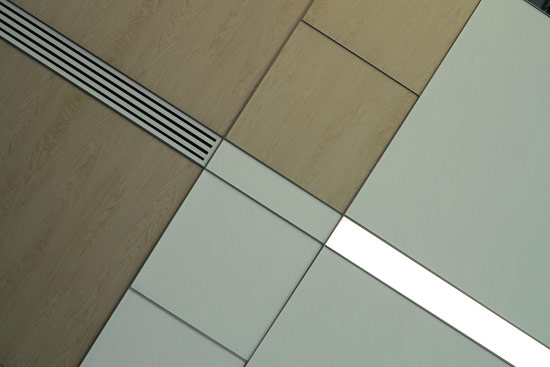 |
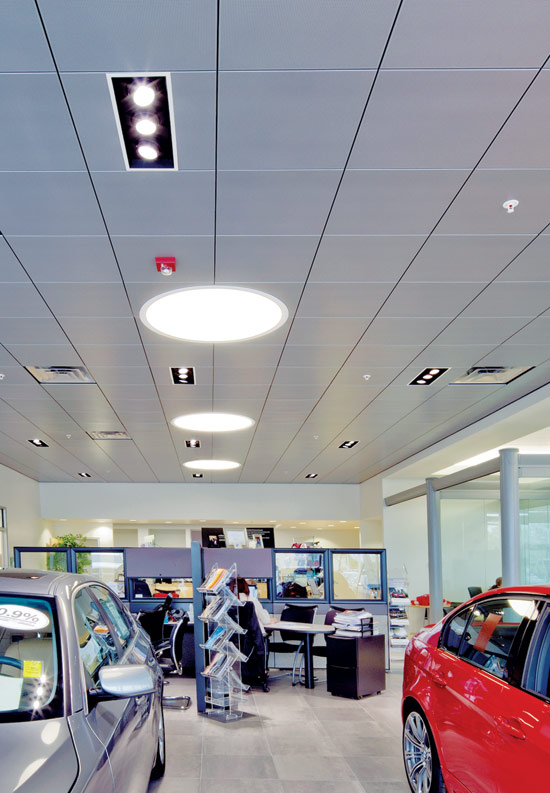
Frame-and-panel ceiling systems can offer coordinated zones for building service delivery.
Photo courtesy of Hunter Douglas Contract |
The design-and-construction team should consider these products and systems carefully, examining both the features visible to building occupants as well as the less glamorous but much more technically challenging plenum side. The ceiling must provide some support capacity for certain lay-in items, but more important it must allow for independent structural support for many ceiling services. The ceilings must allow for:
• Access for maintenance.
• Load-bearing penetrations.
• Structural transition details, including hanger hardware, cable, and connections, as well as collars and other ceiling-plane hardware.
• Accessories and hardware to accommodate related specialties.
• Ability to integrate MEP and IT systems, such as utility troughs and cable trays.
• HVAC components to protect the ceiling plane and interiors below, such as moisture mitigation components for IAQ maintenance.
Ceiling products for system integration include these features in an overall configuration meant to ease and visually organize penetrations to create a clean look. For example, the ceiling design may have section groupings or panel bands that accommodate all the services. Part aesthetics and part structured organization, the systems offer a range of panel sizes and shapes that work together to accommodates a variety of fixture spacings in those prearranged geometries.
Some of the system integration ceilings have an exposed grid, but a concealed grid tends to be more common, in some cases with nominal reveals between panels and from panels to fixtures. The benefit is largely architectural, articulating the clean lines and flatness of the ceiling. In terms of plenum access, these products may have pop-out panels, but because they allow for a highly engineered suspension, many offer convenient swing-down panels so the users can enter or reach above. As with many modern ceiling types, the system integration products are designed for lights and diffusers that mount flush with the ceiling plane.
Another development in recent years is the growth in use of large-format acoustical ceiling panels with a narrow frame profile. This is the second type of ceiling focused on service integration: the frame-and-panel type with thinner aesthetically pleasing grids. Arguably this class of ceiling system is favored for its very narrow visible grid as much as its capacity to support a large range of service integrations, whether surface-mounted, recessed or penetrating through the ceiling plane. In addition, some of the panel makers offer “mass-customized textures, prints and colors” beyond the standard white and other colors.
Yet it is the visually clean framing of ceiling penetrations with the narrow profiles that has made the solution attractive. With a minimal amount of materials, these frame-and-panel type ceilings with their thin metal grids allow for a robust backup structure while keeping a clean, precise look that is harder to achieve with more common products such as soft metal grids and cellulose lay-in panels. The frame-and-panel products install easily, yet they are self-squaring, and support versatile grid spacings with large panel sizes up to 4 feet.
Starting in the Early Phases
Yet these advantages are only possible if the project starts with early consideration of ceiling integration. If not, the outcome can be costly. As another project example, Rice describes a designer who spent months creating the specific aesthetics for a large interior public space, including about half a year working with a ceiling manufacturer selecting and approving a client-specific wood finish match and an innovative “cell-beam” design and layout. The wood finish designation and layout design were incorporated into the CDs and bid documents.
Again, a post-bid analysis by the GC showed that the trades for security, lighting, mechanical, sprinkler, and audio specialties were unable to coordinate their services in and through the designed ceiling plane. The designer had not initiated any coordination of their services. Nor did the ceiling subcontractor include any associated fixture frames in his bid—as none were called out on the drawings or included in the specifications.
As a workaround, the GC worked with the ceiling subcontractor, the trades, and the ceiling manufacturer to utilize contingency funds for about $50,000 of cell-beam ceiling fixture frames to accommodate lights, diffusers, cameras, and speakers. This allowed for the same original ceiling aesthetics and layout envisaged, as well as a basis for proper delivery of through-ceiling building services. So while the designer did not engage and coordinate the ceiling services, the manufacturer was able to assist the team—though at a substantial cost.
This scenario also raises a number of larger issues for the project team. One is that system-integration ceilings and the frame-and-panel systems often must be specified for the highest levels of performance as required for green building projects or high-efficiency interiors, say experts. This needs to start early in the project cycle—not late in the game.
With an early start, a number of options are available for high-performance interiors. The associated acoustical panels on the market offer NRC values up to 0.85, and many are made with materials that are recycled or GREENGUARD certified, or both. Some of the panel designs use much less material than traditional sound-absorbing materials, weighing up to 50 percent less for the panels only. Like any ceiling, they should be durable enough for daily use and maintenance, and some of the newer systems are known to survive moves and reuse. Light reflectance values should also meet or exceed industry norms.
Considerations for any product or system selected should include a clear idea of “the view from the plenum side,” as Rice explains. “There should also be an early focus on independent structural support for all services, although some lay-in lighting fixtures and HVAC registers can be integral to a modern ceiling system. Many related specialties services will need to have their structural support and attachment methods well documented.”
Conclusion: View from the Plenum Side, Too
Regardless of the materials and ceiling systems selected, the integration of services is a significant challenge to address, from aesthetics to interior performance to effective operations and maintenance.
According to ceiling system manufacturers, the number one call received from building project teams are inquiries about trades that need to install air handlers, sprinklers, security cameras, and other services through the ceiling plane. In a large number of those calls, says Kuperus, the ceiling manufacturer and vendor are actually not responsible for the integration issue.
“To some degree, the service in question must be independent from the ceiling system, and its weight must be supported separately by something other than the ceiling grid,” Kuperus explains. “Yet the ceiling system must also be capable of allowing coordination of the tangible products and trades.”
The major disconnect is often poor bid documentation: Where do the ceiling-located services fall in the documents? Who pays for it? Just the coordination alone may cost tens of thousands of dollars. For these reasons, awareness is critical from the earliest phases of the project. Then the design team needs ideas for ceiling solutions that meet their objectives. With this in mind, guidance on what choices and decisions should be made must come early in the design process, to make sure chosen details, specs, and products can take care of these ceiling integration issues.
Chris Sullivan is principal of C.C. Sullivan, an integrated marketing communications agency focused on the architectural and construction markets. www.ccsullivan.com
 |
For more than 60 years, the architecture and design community has specified contract products from Hunter Douglas, the world leader in window coverings and a major manufacturer of architectural products. A tradition of bringing breakthrough products to market makes Hunter Douglas the choice for an array of innovative contract solutions. www.hunterdouglascontract.com |