This CE Center article is no longer eligible for receiving credits.
As sustainability continues to be a goal of the building industry, designers are constantly looking for new ways to add energy efficiency and environmental integrity to their projects, particularly when it comes to heating, ventilating, and air-conditioning. While these activities are key to maintaining comfortable, healthy, and productive spaces, collectively they account for approximately 40 percent of the electricity used in commercial buildings, according to statistics published by the U.S. Small Business Administration.
One key way to improve energy performance and boost energy savings is through radiant heating and cooling, a technology that has been used in commercial spaces in Europe for more than three decades. Radiant systems have also been used throughout the U.S. and Canada, but in a limited manner, primarily for perimeter heating. Radiant panels used for heating and cooling meet metrics of high-performance building operation from the standpoint of energy use and cost effectiveness, and they provide design flexibility, easily being incorporated into the architectural finish in a manner that provides both function and architectural appeal.
Of particular interest is the use of chilled ceilings and chilled sails due to the potential for efficient design and increased occupant thermal comfort. This article will explore the environmental and operational characteristics of both chilled ceilings and chilled sails, with special attention to architectural applications in a variety of commercial spaces, including large spaces and specialized boutique projects.
The Principles of Radiant Heating and Cooling
Radiant systems provide heating or cooling directly to occupants and the occupied space. The systems depend on the principle of radiant heat transfer—the delivery or removal of thermal energy directly from one surface to another including the people and objects in the room. Because thermal conditioning is delivered directly to occupants, rather than via forced air movement, radiant systems offer improved comfort and greater energy efficiency than forced air systems. This higher efficiency results in significant energy savings. When used as the primary means of cooling and heating, a chilled ceiling system occupies a significant percentage of the overall ceiling. Because of this, it is typical for the chilled ceiling system design to be informed as much by the architectural team as the MEP consultant, in some cases more. It it not unusual for a ceiling to be integrated with the lighting and other services to offer a tailored solution on a project-by-project basis.
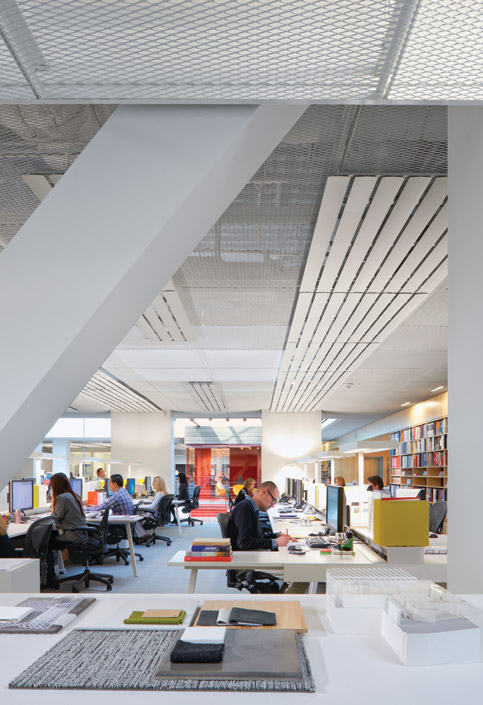 |
Radiant technology is a sustainable, aesthetically pleasing method of heating and cooling a space. Gensler, one of the world’s leading architecture firms, utilizes chilled sails in the firm’s Los Angeles office.
Photo © Ryan Gobuty / Gensler |
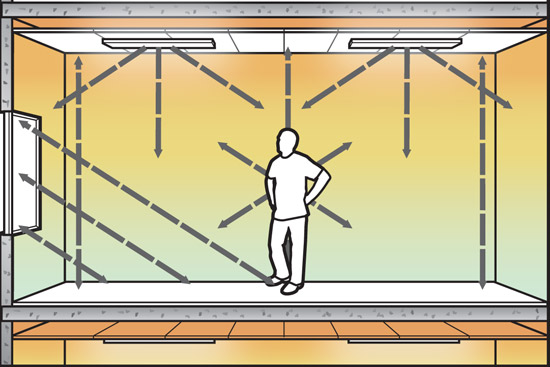
Functionally, the chilled ceiling system can be split into two general types: the cooling only panels for the majority of the building core, and cooling and heating panels to help condition the building envelope. In winter, the radiant ceiling, or sails, along the building perimeter transfer heat to the outer walls, raising the surface temperatures, which reduce the radiant heat loss from the occupants to these surfaces and avoiding discomfort. During summer months, these same panels will absorb sensible heat from these surfaces and the occupants, dissipating heat directly to the radiant ceiling in the same manner as the cooling panels in the core manage the load year-round. This can lead to greatly reduced volumes of heated or cooled supply air over convective systems, leading to fewer thermal comfort complaints.
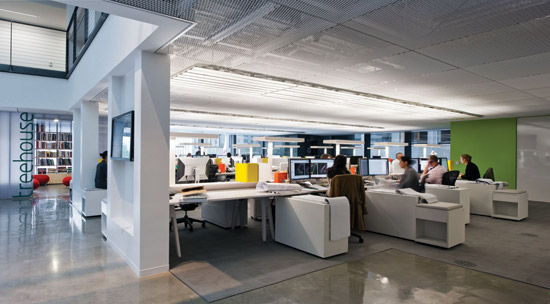 |
Chilled sails couple the radiant cooling effects of standard radiant panels with a convective component for increased performance.
Photo © Ryan Gobuty / Gensler |
Historically, exterior heat by hot water systems used standalone radiators, while modern commercial systems are typically incorporated into floors or ceilings. There are three primary types of radiant heating systems. Electric heating panels are ceiling or wall mounted. Often, occupant sensors or timers are used to turn on the electric heating panels. These panels come with a range of radiant heat output. Low-intensity panels are lightweight and often placed into T-Bar ceilings, or attached to surfaces, such as under an occupant's desk. Higher intensity panels may require more extensive installation steps due to the weight and dimensional aspects of the panels.
 |
|
Image courtesy of Price Industries |
The second type, electrically resistance cables, are generally used by being attached to the underside of wood floors, embedded in a material such as gypcrete or tile substructures, or in wall cavities. These typically offer good thermal capacity and consistent room surface temperatures, though this system can be slow to respond to temperature changes due to the thermal mass of the material they are attached or embedded into.
The third type is hydronic or water-based systems. Hydronic radiant heating systems pump heated water from a boiler through tubing embedded into floors or ceiling materials, or through baseboard fin tube heaters. Wall- and ceiling-mounted radiant panels are usually made of aluminum and have water tubing attached to the back of the panel.
Ways to Heat and Cool a Building: Radiant Technology vs. All-Air
Management of heat loads can be classified into two different types: all-air HVAC systems and hybrid systems. All-air systems have been the most prominent in North America during the 20th century and have been in use since the advent of forced air conditioning. The majority of commercial spaces are still heated and cooled by conventional HVAC, which typically has a central air handling unit, or rooftop unit, that delivers cool or warm air to satisfy the building load and maintain the desired thermal conditions in the occupied zone. These conventional systems use high-volume air flows, bring them to the supply air temperature required to maintain the zone set point, and distribute the conditioned air throughout the building via ducts. Air diffusers are mounted in the zone to distribute the supply air. In most cases, the volume of supply air required to cool or warm the space is higher than the ventilation requirements in order to properly mix the occupied space to obtain the uniform temperature in the occupied zone. Draft is not uncommon and is often the primary complaint from occupants. Draft complaints are common when the supply air volume is the minimum due to low thermal loads in the occupied space.
Hybrid systems often have two components: an air-side ventilation system and a water-side heating/cooling system. The air side is typically designed to meet the ventilation requirements for the occupied space, as well as satisfy all latent loads. Ideally, it is a 100 percent outside air system and simply provides the volume of air required for ventilation and dehumidification. The water side is designed to meet the balance of the sensible cooling and heating loads. These loads may be handled by water-based products, such as radiant panels, which transfer heat mainly by thermal radiation, and chilled sails, which transfer heat using a combination of thermal radiation and natural convection. Because these radiant systems use water to condition a space's sensible load, and rely on a separate ventilation system to provide ventilation and satisfy latent loads, there is a greatly reduced supply air volume requirement and a significant reduction in break horse power due to the energy density of water compared to air. Using water takes less energy to move the same amount of thermal energy into and out of the occupied space when compared to an all-air system.
Radiant Ceilings
Chilled ceilings are a radiant technology that can be used to provide both cooling and heating. Generally, chilled ceilings are configured as a flat metal panel with a water pipe attached to one side in a serpentine pattern. Chilled or hot water is circulated through the water pipe. The thermally conditioned water transfers energy (heating or cooling) to the panel, which in turn transfers this thermal energy to the occupied space. The pipes heat or cool the metal panel, which then radiates that energy toward the building occupants.
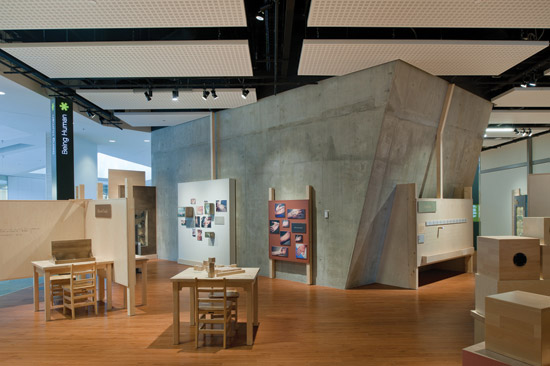 |
Radiant heating and cooling systems at TELUS Spark: the New Science Center feature an “architectural cut in,” a panel cut to integrate into the structural elements.
Photo courtesy of Price Industries |
The thermal comfort and high efficiency achieved with radiant heating and cooling, as well as the flexibility and customization of the product, make it suitable for use in almost any application. Radiant panels are designed with a low profile to integrate into a variety of installations, from standard suspended ceiling systems to free hanging applications and surface-mounted applications on walls or ceilings. The panels are typically installed along perimeters, corridors, hallways, and aisle ways, or in interior spaces, with exposed linear panels provided when the ceiling space is not available, when a radiant panel installed or recessed into the ceiling is not feasible, or when the radiant panel is to be placed in an area with high ceilings.
Chilled Sails
Originally developed in Europe in the late 1990s, chilled sails are a relatively new technology in North America. Sails couple the radiant cooling effects of standard radiant panels with a convective component in cooling for increased thermal performance. The sails' unique shape gives them more surface area than a traditional radiant panel, increasing their radiant capacity and still achieving the high comfort of radiant systems. They allow air that has been cooled by contact with the sails to pass through openings between the blades, thus increasing the capacity of the unit and providing an effective means of dealing with the sensible cooling load.
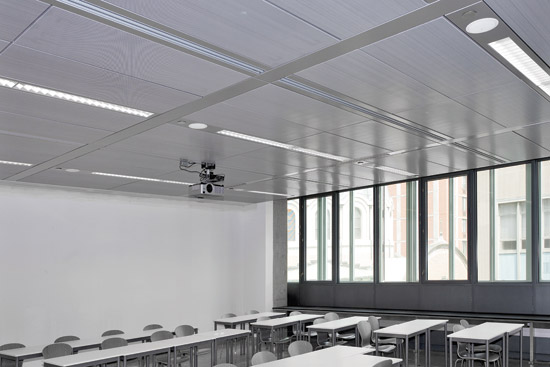 |
41 Cooper Square, the newest addition to The Cooper Union for the Advancement of Science and Art, features an integrated spring clip chilled ceiling system.
Photo courtesy of Nelson Industrial Inc. |
The heat transfer between the sail to the room has two components: natural convection with the room air and thermal radiation with the room surfaces.
In cooling mode, a significant amount of the heat transfer occurs via natural convection as warm air rising due to natural buoyancy forces, passes over the chilled sails, cools and then sinks down into the occupied zone. As the air falls into the occupied zone, the convective cooling capacity of the sail is coupled with the radiant capacity of the cool sail surface, resulting in a cooling capacity greater than that of standard . In cooling, the approximate breakdown of heat mode transfer of chilled sails is 30 percent by thermal radiation and 70 percent by natural convection.
 |
Chilled sails are a relatively new technology in North America.
Photo courtesy of Price Industries |
Like , sails can only handle the sensible portion of a building load and must be paired with a fresh air system for ventilation and latent load removal.
Characteristics
Chilled ceilings and chilled sails share several beneficial characteristics.
Architectural appeal. Chilled ceilings and chilled sails can add design elements into a space to provide both a practical function and aesthetic appeal. Available in a variety of surface finishes, profiles, and services, and chilled sails offer a sleek, streamlined profile that complements today's modernistic architectural designs while dovetailing with current green building goals. Chilled panels also offer architects sound-dampening qualities as they can integrate acoustic damping, or they can be silk screened to match acoustical tiles. In some instances, the chilled ceiling can even become a primary architectural feature in the building, essentially being a functional sculpture.
Energy efficiency. Radiant systems require less parasitic energy (pump and fan energy) to deliver heat. Using panels or sails to satisfy sensible room loads instead of all-air systems, greatly reduces the supply air volume required by as much as 60 to 80 percent, with the result of decreased fan power requirements and associated energy savings.
Indoor air quality. Depending on the application, under maximum load, only 15 to 40 percent of the typical overhead mixing system supply air volume in a typical space is outdoor air and is required to satisfy the ventilation requirements. The balance of the supply air flow is re-circulated air which can transport pollutants through the building from one space to another. Radiant systems transfer heat directly to/from the zone and are often used with a 100 percent outdoor air system which exhausts polluted air directly to the outside, reducing the opportunity for VOCs and biologically active airborne material such as flu to travel between air distribution zones. This characteristic makes radiant systems an ideal choice in buildings or rooms where air quality is critical.
Thermal comfort. Radiant heat transfer has been shown to condition a space more comfortably than convection. Since radiant heating/cooling uses minimum primary air quantities, air velocities are lower in the occupied space, minimizing draft risk.
Quiet operation. Because radiant panels and chilled sails have no moving parts, the only noise they produce comes from water moving through the copper piping. At typical water velocities, the noise produced by the system is nearly imperceptible. This allows radiant ceilings to operate more quietly than traditional all-air systems. Radiant panels and sails are also commonly integrated with acoustical panels, which can further reduce noise levels in a space.
Smaller services footprint. The reduced supply air volume of a hydronic system reduces ductwork requirements, resulting in the ability to reduce plenum heights. This allows radiant systems to be installed in tight spaces, and creates the potential for lower construction costs, higher ceilings, and more usable floor space. In addition, the air handling equipment is often downsized—saving cost and providing more flexibility in locating the equipment.
Reduced maintenance. Due to the reduction in moving parts and mechanical equipment associated with radiant panels, these systems have lower maintenance costs than all-air systems.
Radiant Systems in Boston’s Building Technology Showcase |
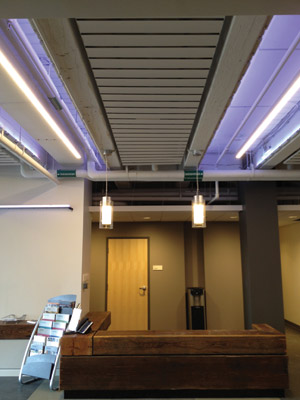 |
The chilled sails were built with a service border to accommodate installed lighting. The displacement ventilation is installed along the outer wall of the room. The controls in this space run displacement ventilation as the first stage of cooling, and chilled sails as the second.
Photo courtesy of Price Industries |
Fraunhofer’s Building Technology Showcase (BTS) represents the future of sustainable design. Completed in 2013 in Boston’s fast-growing innovation district, the BTS is a deep energy retrofit of a 100-year-old building that serves as a living laboratory for R&D of advanced sustainable energy technologies. Radiant technology figures significantly in the building’s energy-saving strategy. In the lobby reception area and gallery, chilled sails are installed in the ceiling between the support struts. Displacement ventilation is installed along the wall. The controls setup runs displacement as the first stage of cooling, and uses chilled sails as a second stage of cooling under normal operating conditions. The chilled sails rely on the displacement system to provide ventilation and satisfy latent loads, which results in a greatly reduced supply air volume requirement, making this hybrid solution extremely energy efficient when compared to a traditional all-air system.
The entire central section of the sixth floor is dedicated to the BEEG Workshop, where radiant panels complement the natural ventilation system. When appropriate exterior and interior temperature and humidity conditions exist, the system will satisfy occupied space conditions using the natural ventilation system. The system also provides supplemental cooling when necessary using the radiant panels. When the occupied space conditions cannot be maintained using natural ventilation and radiant panels, the mode of operation changes to mechanical cooling using fan coils.
|
Design Considerations
A number of functional and aesthetic issues should be considered to properly specify radiant heating and cooling systems.
Applications
Chilled ceilings and sails can be an asset to a wide range of building types, including, but not limited to:
• Office spaces
• Schools
• Post-secondary educational facilities
• Healthcare
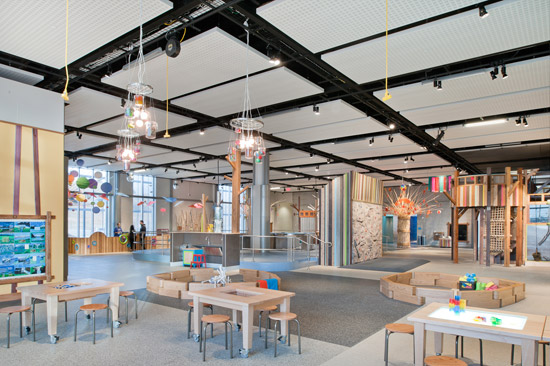 |
Radiant panels and chilled sails improve thermal comfort while providing energy efficiency and contributing to LEED designation. Here, they enhance the architectural design at TELUS Spark: the New Science Centre.
Photo courtesy of Price Industries |
In addition to energy savings, radiant heating and cooling systems offer a customized aesthetic and potential reduction in the amount of plenum and shaft space required for the mechanical service, translating into shorter floor-to-floor construction or higher ceilings. In most cases, owners will trend towards an integrated, unique approach to the chilled ceiling that can differentiate the building from others, as well as potentially reduce construction time and cost by integrating services and reducing the amount of time spent installing each disparate system. In the extreme cases, significant economy has been seen by installing pre-fabricated integrated ceilings on site, where the lighting, acoustical treatment, mechanical cooling and ventilation, as well as the ceiling itself are all installed at once.
It is worth noting that there are several areas in a building where humidity can be difficult to control, such as lobby areas and locations of egress. These areas may see a significant short-term humidity load if the entrances are not isolated in some way (revolving doors or vestibules). In these areas, a choice of a complementary technology such as fan coil units or displacement ventilation is ideal. Other applications may have high airflow/ventilation requirements, such as an exhaust driven lab. Most of the benefit provided by the hydronic system is linked to the reduction in supply air flow. As such, these applications may not see sufficient benefit to justify the addition of the hydronic circulation system, making them unlikely to be good candidates in these situations.
Architectural applications. The cooling capacity and unique design of chilled ceilings make them an excellent alternative to panel systems, particularly in applications that have an architectural focus. Typical applications of chilled sails and customized radiant panels include offices, meeting/conference rooms, theaters, studios, lobbies/foyers, waiting areas, or any areas where radiant panel use is appropriate. Chilled sails can either be concealed or exposed. Concealed chilled sails with a standard black finish remain undetected from the room side when mounted above perforated ceiling tiles. Exposed chilled sails designed for architectural appeal are typically installed in interior spaces as a cloud ceiling, in a suspended ceiling or in a T-bar application with a standard white finish. They can also be installed along a wall in a surface-mounted application, or placed around utilities such as lights, sprinklers, air outlets, and the like.
Hybrid HVAC at Upper Iowa University Helps Achieve LEED Silver |
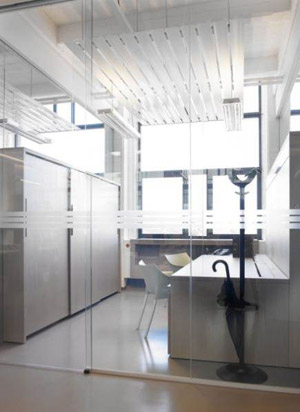 |
Exposed chilled sails for an architectual application.
Photo courtesy of Price Industries |
A USGBC LEED Silver designation for the building was targeted from the outset of the design process, with the design team specifying a cutting-edge hybrid HVAC system that incorporates both underfloor air distribution and chilled sails—the first of its kind in a U.S. college. Close collaboration between the design team, mechanical contractors, and the manufacturer was key to achieving core objectives of an HVAC system that would reduce operating costs, provide maximum comfort for students, and afford future flexibility as the utilization of the space evolved—all within a new building that fit with the historic feel of the 153-year-old campus.
A hybrid underfloor air distribution and chilled sail solution was specified. Architectural firm Meyer, Scherer & Rockcastle, Ltd, (MS&R) and mechanical engineering firm Karges-Faulconbridge, Inc. (KFI) had successful experiences with underfloor air distribution systems in the past, and were intrigued by the additional benefits of incorporating chilled sails into a hybrid solution.
The underfloor component of the hybrid system ventilates the building with fresh air, while the chilled sail component delivers radiant heating and cooling to classrooms, offices, and the auditorium. Underfloor air distribution is renowned for the flexibility it brings to evolving spaces, as it uses an easily reconfigured raised floor tile system and underfloor air plenum. The underfloor displacement diffusers deliver high indoor air quality, as air in the space is thermally stratified and contaminants move up and out of the breathing zone, rather than being recirculated. Chilled sails, which provide both a radiant and convective component, use water to efficiently condition the space. Convection currents are created when warm air is cooled as it passes over the surface of the sail. This cooled air then naturally falls into the occupied zone, forcing warm air to rise.
 |
The underfloor component of the hybrid system ventilates the building with fresh air, while the chilled sail component delivers radiant heating and cooling to the Liberal Arts Building at Upper Iowa University.
Photo courtesy of Price Industries |
Chilled sails rely on the underfloor air distribution system to provide fresh air for ventilation, which greatly reduces the supply air volume requirement and makes the system extremely energy efficient. Due to their aesthetically pleasing appearance, chilled sails also fit extremely well into the architect’s design vision for the building, making them both an architectural element and an HVAC system component.
The raised-floor plenum used in the underfloor air distribution system is substantially smaller than the suspended ceiling necessary for an overhead system. This reduced construction costs and ensured a floor-to-floor height that was in line with other facilities on campus.
Executive Director of Facilities, Bryan Jolley, states that the building has already played an important role in illustrating design concepts and demonstrating to prospective students the ways in which sustainable design goals on the campus are being met.
|
Profiles and Finish Options
Modular panels can be easily installed in an exposed grid acoustical ceiling system and can be laid into traditional T-Bar systems. When used across an entire floorplate, it is common to use spring clips to suspend the radiant panels from a concealed structure. This tends to improve the look as well as functionality in that the panels offer easy access to the space above, hinging when connected with flexible hosing to access any areas above the ceiling. For these applications, perforated panels are typically used in order to offer acoustical attenuation, as well as cooling and/or heating to the zone below.
Radiant panels can be freely suspended when an open ceiling effect is desired, as is common with converted warehouses, schools, etc., or in spaces where the ceilings would be otherwise too high for radiation to be an effective method of heating and cooling. These panels feature integral structure, trim on the edges, as well as concealed fastening.
A range of surface finishes are available including anodized aluminum, silk screening, to match an acoustical tile, for example, as well as perforated or formed metal pieces. While manufacturers offer an extensive range of profiles and finishes, many architects gravitate toward custom solutions rather than cataloged options as there is a lot of flexibility in the construction of the chilled ceiling.
Condensation
A common concern with hydronic radiant cooling systems is the potential for condensation. Proper planning and control can make this a non-issue. To avoid condensation and its effects, radiant ceilings must be maintained several degrees warmer than the dewpoint. This requires that ventilation air be used to control the space latent loads. This ventilation air is often dehumidified via a parallel system to decouple the space sensible and latent loads. The use of an additional system, such as a dehumidifier or dedicated outdoor air system (DOAS), can both control space humidity and allow for increased cooling capacity by the ventilation air. It is important that the dewpoint temperature be determined with some precision and circulating water temperature controlled to achieve effective cooling while avoiding condensation. Today's advanced sensors and controls enable fast, accurate tracking and adjusting to optimize the cooling function while avoiding condensation problems.
When properly ventilated, radiant cooling systems show distinct energy savings. Corina Stetiu of Lawrence Berkeley National Laboratory developed detailed simulations of a prototypical office building in nine U.S. cities to compare the performance of radiant cooling systems with ventilation and conventional all-air systems.1 Stetiu found that, on average, radiant cooling systems save 30 percent on overall energy for cooling and 27 percent on demand vs. their all-air counterparts.
Energy savings ranged from 17 percent in cold, moist areas to 42 percent in warmer, dry areas, with the humid areas showing lower savings because of the costs associated with required dehumidification.
Significant Energy Savings from Innovative Mechanical System at TELUS Spark: The New Science Centre |
In the new Calgary Science Centre, which doubles the capacity of the existing facility, and hosts up to 500,000 visitors each year, Calgary design firm DIALOG specified an innovative mechanical system that has achieved an energy savings of 44 percent lower than the ASHRAE 90.1-1999 baseline.
In addition to a high-performance building envelope designed to reduce mechanical ventilation system operating cost, space cooling and heating requirements were decoupled from the ventilation system, yielding enhanced energy performance, thermal comfort, and indoor air quality.
Generally all areas are ventilated, and partially cooled, by a displacement ventilation system, which introduces supply air at or near the floor level, at a low velocity, and at a temperature only slightly below the desired room temperature. The cooler supply air “displaces” the warmer room air, creating a zone of fresh cool air at the occupied level. Heat, moisture, and contaminants produced by activities in the space rise with the air to the ceiling level and are exhausted from the space.
Perimeter radiant heating panels were used to manage glazing loads and envelope losses throughout the perimeter spaces. Radiant cooling panels were incorporated into the majority of occupied spaces to augment cooling from the demand controlled displacement ventilation system. In the various galleries, floating clouds of perforated radiant cooling panels create a well-integrated, finished acoustic ceiling plane. Office areas utilize perforated acoustic panels in a lay-in acoustic ceiling. Finally, the central atrium uses radiant chilled/heated slabs and displacement ventilation, creating a mechanical system which is inconspicuous but highly effective.
In operation, the hybrid mechanical system has proven its energy-saving ability, its draft-free thermal comfort, greater ventilation effectiveness, and superior acoustics. The building received the Alberta Construction Magazine Top Award, Institutional Category and the Canadian Institute of Steel Construction 2013 Alberta Steel Design, Architecture Award of Excellence.
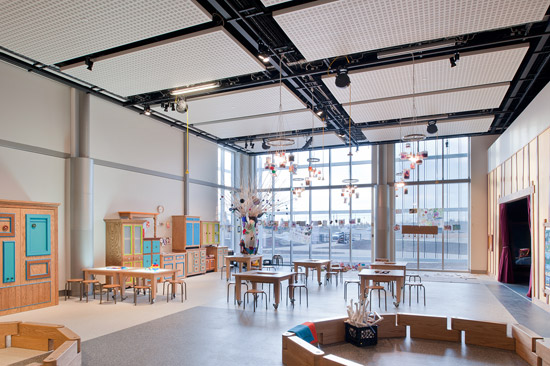 |
At TELUS Spark, there are radiant panels on the ceilings, and the silver floor-to-ceiling columns have architecturally integrated displacement diffusers embedded into the base. Fire protection is integrated into the panels, with sprinkler heads that pop out when required.
Photo courtesy of Price Industries |
|
Ventilation
Radiant systems provide sensible cooling or heating only. Therefore, the ventilation requirement and latent load must still be met by an air delivery system. The traditional method of supplying air to ventilated spaces is known as mixed flow ventilation. This is a system in which cool air is blown in through the ceiling or wall and dilutes the room air in an attempt to provide an even temperature and contaminant level through the space. The flow is driven by the inertia of the supply air. The volume of the air supplied for mixed flow ventilation is calculated proportionally to the supply air and room air temperature.
An alternative solution is displacement ventilation, which coupled with radiant technology, represents a promising integrated approach that combines the energy efficiency of both sub-systems with the opportunity for strong ventilation performance. Displacement ventilation is an air distribution technology that introduces cool air into a zone at low velocity, usually also at a low level. Buoyancy forces ensure that this supply air pools near the floor level, allowing it to be carried up into the thermal plumes that are formed by heat sources. Research indicates that displacement ventilation is effective at delivering fresh air to occupants and removing many of the contaminants associated with heat sources, while creating a comfortable environment that is less subject to drafts. In addition to higher indoor air quality, displacement ventilation offers the benefit of flexibility. As load distribution changes within the space, a displacement system will be able to compensate. For example, if the space was designed to have a fairly even load distribution and now has the loads concentrated to one side, the system is able to compensate as the buoyant forces drive the supply system and will draw the supply air towards the loads.
Displacement systems present many potential opportunities for energy savings. The lower pressure drop associated with displacement ventilation outlets and the corresponding selection of smaller fan components may allow for a reduction in fan energy. The supply air temperature is typically higher for displacement systems than for overhead mixing systems, and can lead to free cooling from increased economizer hours. Combined with a higher return temperature than overhead systems, the warmer supply temperature of displacement ventilation systems can cause an increase in chiller efficiency. Due to high ventilation effectiveness, the amount of outdoor air that must be conditioned can also be decreased when compared with a mixing system. This is especially significant in humid climates, where dehumidification of outdoor air is a significant cost. It is also worth noting that green building rating systems, such as LEED and Green Globes have credits that are applicable to displacement ventilation systems.
As sustainable construction increasingly focuses on curtailing rising energy costs and improving life-cycle cost, natural ventilation systems are increasingly employed to leverage freely available resources such as wind and outdoor air to satisfy cooling loads and provide occupant comfort. In its most basic form, natural ventilation provides openings in the building façade to allow fresh outdoor air in one area of the building and out another. As the fresh outdoor air passes through, heat is removed and ventilation is provided. Designers should note, however, that this technology is only appropriate where climatic conditions allow. In the right situations, the use of mechanical heating and cooling in combination with natural ventilation, as a hybrid or mixed mode system, can extend the acceptable climate conditions where natural ventilation can be effectively applied to utilize free cooling for a large portion of the year.
Computational Fluid Dynamics (CFD) Modeling—Validating Design Before Construction |
CFD modeling is a valuable analysis tool that allows designers to evaluate the performance of a system before construction begins. It is particularly helpful in solving variables associated with chilled sails such as the temperature profile and air velocity along with other various thermal comfort indices. In addition to saving time and money, design options can be evaluated quickly in terms of air quality, thermal comfort, and other parameters. CFD can also help earn LEED credits (Credit 7.1). Typically, results are presented in easily comprehensible formats, using either 2D contour plots, 3D iso-volumes or flow streamlines. A contour plot, for example, can show the variation of a variable such as velocity or temperature on a 2D plane in the space. Variable values are assigned different colors within a given range, facilitating visualization of results. An iso-volume highlights a volume inside the space where a specific variable is above or below a certain value—a visual that is valuable in understanding draft discomfort in the indoor environment.
 |
|
Image courtesy of Price Industries |
|
Involving the Manufacturer Early On
Architects are increasingly finding that a supplier's involvement with integrated design can offer real value. In today's construction market, designers are continually pushing the boundaries of building performance, integration, and differentiation. When evaluating design options against these goals, the supplier can provide guidance as to how a design will rate in terms of performance (aesthetic, lighting, thermal, acoustic, etc.), cost, and development time. Additionally, it is likely that a supplier has industry partners that can simplify coordination efforts or, at minimum, suggest types of integration or coordination that have worked well in the past.
Ultimately, the successful realization of the project will rest on the management, contracting, and supply teams. The role of the supplier in the design phase is to offer guidance on performance, finishes, coordination, and manufacturability. This often includes the facilitation of testing, aesthetic and performance mockups, and prototype development. In more complex cases, this information is invaluable to designers trying to identify options that will meet the design intent, while not jeopardizing schedule or comfort. Close collaboration with the manufacturer can facilitate interesting, innovative options that the team may have discounted as overly complex or impractical. Conversely, the manufacturer can quickly analyze designs that may pose serious challenges and provide feasible alternatives.
Radiant Heating and Cooling: A Smart, Stylish Solution
Coupled with the right ventilation solution, radiant heating and cooling can lead to a very efficient mechanical system. The technology has been used in Europe for many years, and designers in North America are increasingly recognizing radiant systems as a way to save on energy costs, increase occupant comfort, and enhance the architectural appeal of interior spaces.
| ENDNOTES |
| 1 |
Corina Stetiu, “Energy and Peak Power Savings Potential of Radiant Cooling Systems in U.S. Commercial Buildings,” Energy and Buildings, v. 30, no. 2 (1999). |
 |
Price Industries is the leading manufacturer of air distribution products in the North American market, and works to bring about the vision of the design community by collaborating on high-quality, high-performing, and customizable air distribution solutions. www.price-hvac.com |