This CE Center article is no longer eligible for receiving credits.
Architects currently have an increasing number of choices when it comes to specifying insulation in buildings. Among the criteria for selecting the most appropriate choice for a particular project are thermal performance over time, water and moisture resistance, and the impact on the rest of the building design. Included in this latter criterion are things like fire resistance properties, depth of insulation required, dimensional stability and overall cost. In light of all of these desired attributes and design criteria, one insulation type is emerging as a preferred material selection for many building types for both new and retrofit applications – stone wool insulation.
Properties of Stone Wool Insulation
Stone wool was discovered at the beginning of the 20th century on the islands of Hawaii where it occurs naturally as a byproduct of volcanic activity. The primary rock involved is basalt which is an igneous rock and very common in volcanic areas and the ocean floor. In addition, slag, recycled from a variety of industrial sources, is used to add to the overall properties of the finished product.
Manufacturing Process
Zero Waste to Landfill
In its manufactured state, stone wool combines the traits of rock with the characteristics of typical wool insulation. It is in fact manufactured from natural, inorganic stone to create natural fibers with no blowing agent used. The typical production process for stone wool begins with the fusion of volcanic rock at a temperature of 1500° C (2732°F). Volcanic rock, slag and coke are automatically fed from the top of a cupola furnace. The melt runs out of the bottom of the furnace and onto a machine, where wool is literally spun. Minor amounts of organic binder and oil are then added, and the wool is collected on a belt conveyor in a collection chamber. The structure and density of the wool are adjusted on a forming table which helps determine its final use as either a batt or board product. In either case, the wool fibers are typically non-directional which is important for achieving the multiple performance characteristics of the final product. It then moves to a curing oven where these final properties are maintained after the organic binder has been cured.
 |
Stone wool is manufactured from natural inorganic materials, and no blowing agents.
Image courtesy of Roxul Inc. |
Once cured, the wool emerges with non-directional fibers that contribute to its specific properties and capabilities. This finished product will proceed to cutting saws and packing equipment or is led to off-line equipment for special treatment. The off-gases from the production process coming from the furnace, spinning chamber, and curing oven are typically cleaned in filters and after-burners before entering the chimney. The waste inevitably created during the production is fully recyclable.
Dimensional stability
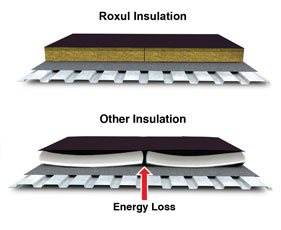
Stone wool retains its manufactured characteristics unaltered over time. The term dimensional stability is generally defined as the materials ability to retain its original shape when subjected to external forces such as varying degrees of temperatures, atmospheric pressures, moisture content and/or other external stresses. Dimensional stability in relation to thermal insulation is a physical characteristic that is sometimes overlooked when a designer or specifier is determining which type of insulation to use for a project, particularly on roofing applications. Neglecting the dimensional stability characteristics can potentially result in the reduction of the effective R values, increased energy costs, increased environmental impacts (CO2) and the unexpected replacement of building materials due to stress and fatigue.
 |
Stone wool is manufactured from natural volcanic basalt rock and recycled slag.
Image courtesy of Roxul Inc. |
The dimensional stability of an insulation material is necessary for the faultless function of an insulation system. Dimensional changes in materials vary according to their physical properties. Thermal expansion co-efficients express the rate at which materials shrink or expand when cooled or heated. Stone wool insulation has a much smaller thermal expansion coefficient than organic insulation materials such as foam plastics. Poor dimensional stability can cause shrinking, expansion, and buckling of a system's insulation. These actions can lead to thermal bridging, waterproofing breaches, and unpredictable insulation performance.
The most common dimensional change in building materials is created by temperature variation. In thermal insulation, the rate of this dimensional change due to temperature variation is based on 3 factors: the difference in temperature (∆T), the coefficient of linear expansion (α), and the specimen length (l). Using these variables, the table in Figure 2 illustrates the dramatically reduced movement of stone wool insulation at a temperature difference of 50 degrees for a 10 meter board compared to the same sized common organic plastic insulation boards. Stone wool is also much closer to the coefficient of expansion of steel and concrete than the plastics meaning that it will move more closely in line with those materials.
 |
A comparison of expansion rates of different building and insulation materials
Image courtesy of Roxul Inc. |
The other common dimensional change in many insulation products occurs due to aging. The molecular structure of foam insulation is initially unstable for a period of time after manufacturing and so there is high potential for shrinkage to occur. As this shrinkage is deemed to be an "acceptable practice" within the roofing industry, ASTM D2126 Test Method for Response of Rigid Cellular Plastics to Thermal and Humid Aging allows for a maximum shrinkage of 2% (length and width). In theory, this will reduce the insulation footprint covering a roof deck for example by 2%, thus allowing for increased heat loss and leaving the roofing membrane unsupported along insulation joints thus increasing the potential for damage. By contrast, studies have proven that stone wool insulation maintains its dimensions and its physical characteristics throughout a building's life cycle. By maintaining the material's original dimensions, full thermal insulation coverage is maintained and the roofing membrane service life is extended due to a lack of unnecessary stress and or fatigue.
Fire Resistance
Fire resistance describes how well a building component can - for a stated period of time - hold back fire and prevent it from penetrating from one room to another. The basic criteria used to characterize the fire resistance of a product are flame spread, smoke development and non-combustibility. Because of its stone and slag makeup, stone wool excels in all three of these criteria. Stone wool insulation is typically classified as "non-combustible" as determined by ASTM E136 and CAN4-S114. It will not develop toxic smoke or promote flame spread, even when directly exposed to fire, as most other insulation materials do. When tested in accordance with ASTM E 84 results typically show a flame spread of 0 and a smoke development of 0 to 5. By comparison, spray polyurethane foam [SPUF] tested to ASTM E 84, typically achieves a flame spread of 25 and smoke developed in the 350 to 500 range.
Beyond these basic fire resistance properties, stone wool insulation has an impressive ability to withstand temperatures up to its melting point of approximately 2150° F (1177° C). As such, it can act as a fire barrier,when used in conjunction with appropriate fire sealant materials,thus protecting against the spread of fire and providing valuable extra minutes to save people and property. This is quite a contrast to most other insulation materials and even many other building materials. This has been illustrated recently in 2010 fire in Shanghai, China which raised new concerns about fire safety during construction. In the case of the Shanghai fire, foam insulation was ignited accidentally during construction and quickly spread through the building exterior. Because of these safety concerns, architects should take into account the added value that the passive fire resistance that stone wool provides for buildings.
 |
A comparison of different fire resistance properties of insulation products.
Image courtesy of Roxul Inc. |
Since stone wool insulation does not contribute to fire it can provide additional minutes of protection for occupants to reach safety. It can also provide fire services personnel valuable time to both clear occupants, and control the spread of fire while delaying the collapse of various structural members of the building. Again by contrast, foam plastic insulation is regulated by chapter 26 of the International Building Code (2009) stating that it must meet ASTM E84 ratings of a flame spread of 75 and smoke development of 450. Even at those levels, it must also be separated from the building interior by an approved thermal barrier (which does not apply to stone wool.) However, this protection barrier shielding the plastic foam from the interior does not take away the "stored" fuel of the foam plastic that could supply energy to a fire contributing to the heat of combustion. Finally, medical journals have shown that smoke inhalation accounts for an estimated 50 to 80 percent of deaths in a fire. Smoke inhalation occurs when an occupant inhales chemicals of combustion during a fire. Smoke is generated by a product's combustion and is a mixture of heated gases and particles. To reduce the potential for smoke inhalation in buildings, specifying non-combustible products, such as stone wool, is highly recommended.
Thermal Properties
Stone wool has been tested and shown to be an excellent insulator and a vital component of an energy efficient building. Further, its R-value does not change over time because stone wool is not produced with blowing agents, which off-gas and result in lower thermal performance. Not only is the thermal performance of stone wool insulation maintained over its lifetime, but a building's thermal performance can be maintained because of the dimensionally stability of the material. It will not slump in stud spacing causing gaps, will not expand or contract due to temperature variances in a rainscreen or roofing system, all of which contribute to the optimal thermal performance of a building envelope.
In terms of heat transfer as expressed in U or R-value, stone wool insulation performs better than many others, particularly when looked at over time. The Long-Term Thermal Resistance (LTTR) method has generally been followed as the scientific method to describe aged thermal performance of foam insulation products using blowing agents other than air, including polyisocyanurate, polyurethane and extruded polystyrene. This method is based on accelerated aging by conditioning thin slices of foam insulation at a particular temperature for a specified number of days. The method is based on consensus standards in both the United States and Canada and provides a 15-year time-weighted average LTTR value. However, the National Roofing Contractors Association (NRCA) sponsored a ten year study on aged R-values and reported the results at the International Roofing Expo in February 2010. Their data shows that tested R-values for polyisocyanurate insulations over time are actually lower than the R-6 or R-7 per inch as had been commonly believed based on LTTR laboratory testing, and other industry standards including ASTM C 1289. As a result, the NRCA Roofing Manual: Membrane Roof Systems 2011 now recommends that designers use an aged R value for polyisocyanurate insulation of R-5.0 per inch of thickness in locations where heating degree days (HDD) dominate, and R-5.6 in locations where cooling degree days (CDD) dominate.
ASTM C 1289 requires the R-Value to be measured at four temperatures. (See graph) For polyisocyanurate, a peak R-value of 5.7 is obtained at 75°F (24°C) and drops to 4.74 at 25°F (-4°C) and 5.05 at 110°F (43°C). By comparison stone wool tested at these same temperatures indicates that its R-value is remarkably consistent over extended temperature ranges. Stone wool actually increases from the established value of R-3.87 at 75°F (24°C) to R-4.27 at the much colder 25°F (-4°C) while at 110°F (43°C) it decreases only slightly from R-3.87 to R-3.67. Hence, stone wool performs almost the same as polyisocyanurate at lower temperatures and maintains a good R-value as the temperature increases. The stability of stone wool's R-value means that under real life building conditions, it will maintain its thermal performance and yield the intended energy savings in the building. Note that there are many manufacturers of insulation, each making their own claims in their guarantees. In some cases the R-value may not be guaranteed for the period of time assumed by the designer or owner and may only be guaranteed for a very short period of time. Nonetheless, any energy savings calculations or life cycle analysis should take the manufacturers guarantees into consideration since they often reflect the real world experience of the manufacturer.
 |
Third party test results for stone wool insulation compared to polyisocyanurate insulation based on 1" thickness. Data published by the NRCA
Image courtesy of Roxul Inc. |
 |
Stone wool insulation repels water
Image courtesy of Roxul Inc. |
Water Repellency
Stone wool is a hydrophobic material making it water repellent yet vapor permeable. Water contacting the outer surface will not be absorbed and retained within the insulation, so the R-value is not negatively affected as with other insulation materials such fiberglass. The permeability means that the material is breathable so no double vapor barrier or trapped moisture issues arise. Further, being water-repellent also means that stone wool insulation does not promote rot, corrosion, fungi, mold, or bacterial growth.
An important benefit of stone wool insulation is its “breathability” or ability to allow trapped vapors in a roof or wall assembly to disperse throughout the insulation layer and dry out, effectively maintaining moisture control . The Water Vapor Permeability of stone wool is approximately 30 Perm, as measured in accordance with ASTM E 96-05 'Standard Test Method for Water Vapor Transmission of Materials'. Hence, in roofing applications, water exposure from leaks in a membrane or from condensation within the assembly can be removed by allowing the insulation to vent this moisture. Stone wool will quickly dry out to become fully restored and retain its original characteristics.
When tested in accordance with ASTM C 1511-04 'Standard Test Method for Determining the Water Retention (Repellency) Characteristics of Fibrous Glass Insulation' stone wool demonstrates its superior water management properties. The test procedure consists of fully submerging insulation 127 mm (5") of water for 15 minutes and then measuring the water retained after allowing the product to drain for 60 seconds. The initial water retention of stone wool insulation has been measured at a very low 2.3%. When allowed to dry naturally, the water content drops even lower to below 0.5% within 8 hours of total immersion, over 75% of the initial surface water is dissipated and it returns to complete dryness within a 24 hour period under standard laboratory conditions.
 |
Image courtesy of Roxul Inc. |
Sound Absorbency
The higher density of stone wool insulation contributes to achieving higher acoustical performance than most other insulating materials. Further, the non-directional fiber orientation of the stone wool helps with the absorption of acoustic waves and can reduce the intensity and propagation of noise. Stone wool compositions also have higher densities to effectively reduce airflow and essentially, sound transmissions. These denser structures, coupled with tight, seamless joints create effective barriers to noise and contribute to much quieter and safer work environments.
 |
Acoustical design is based on people's response to sound and noise.
Image courtesy of Roxul Inc. |
Application for Acoustical Quality
In general acoustic design, noise should be dampened to such an extent that it no longer interferes with the intended activity of the space. Just 30 decibels is disturbing to sleep. Noise with sound levels of 35 decibels or more interferes with the intelligibility of speech in smaller rooms. Even lower background levels are needed for adequate speech intelligibility for vulnerable groups - such as the hearing impaired, the elderly, children in the process of language and reading development, and individuals who are not familiar with the spoken language Rooms with many hard surfaces may result in disturbing 'echo' which must be avoided. A reverberation time below 0.6 seconds is desirable, even in a quiet environment. A 10 dB difference is perceived by the human ear as a doubling (or halving) of the audible sound.
The unique non-directional structure of stone wool insulation is denser than traditional insulations. This effectively reduces airflow and essentially, sound transmissions. Higher air flow resistivity means better sound attenuation. The excellent overall sound control achieved with stone wool batt insulation is also achieved with higher density products rigid and semi-rigid board products.
Green Building Contributions
Stone wool insulation has a number of inherent characteristics that make it intrinsically eligible for US Green Building Council LEED® credits. These include:
- Energy & Atmosphere:
Energy saving performance through consistently high R-values over time
-
Materials & Resources – MRc4 Credit Recycled Content:
Natural, inorganic materials with a minimum of 75% and up to 93% recycled content available from some stone wool manufacturers.
- Materials & Resources – MRc2 Credit Construction Waste Management:
When removed undamaged, stone wool products may be reused and recycled for other projects.
- Indoor Environmental Air Quality:
Naturally non-combustible without adding undesirable chemicals
Chemically inert with no outgassing or emissions
Resistance to growth of mold, fungi, and bacteria
Will not sustain vermin
CFC and HCFC free product and process
 |
Stone wool manufacturing is heavily dependent on recycling.
Image courtesy of Roxul Inc. |
Application in Buildings
In well-designed buildings, insulation is integrated fully within the envelope design. Generally these systems fall into several typical categories with different stone wool insulation products being well suited to each.
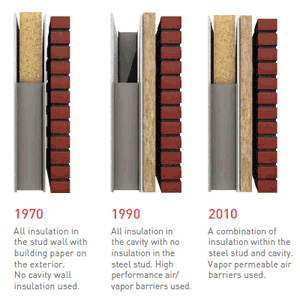 |
The progression of thought on cavity wall insulation over the past forty years.
Image courtesy of Roxul Inc. |
Cavity Walls
The primary functions of a cavity wall system have not changed fundamentally over the past 40 years, namely to protect against unwanted heat transfer, air infiltration, rain penetration, movement of moisture, and fire. Further the desirable aspects of durability, noise and light control, strength, and aesthetics all have remained fairly constant needs. The same cannot be said for the components and design of cavity wall systems, which have undergone a significant transformation in North America. This change in design requirements is a result of the increased focus on ASHRAE standards and the need for continuous insulation to meet the R-value and U-value requirements of ASHRAE 90.1. The traditional approach has been for batt type insulation to be placed between the framing members. This had the benefit of economizing on wall thickness, but did not provide continuous insulation across the wall due to the recurring thermal bridging of the studs. The insulation would also be routinely compromised by mechanical, plumbing, or electrical components embedded within the same stud cavity. A second approach of using only continuous board type insulation outside of the studs overcame the continuous insulation issue, but the thicknesses were sometimes compromised due to increasing costs related to increasing wall thicknesses. A current approach is to combine the two, using continuous board type insulation outside of the stud and batt type between the studs with attention to detail in all cases to avoid compromise and thermal bridging.
There are stone wool insulation products that are designed specifically for exterior wall steel and wood stud applications. The properties of this insulation include batts that compress or expand between frame studs or joists to completely fill the cavities. R-values are available in batts rated at R10, R14 (Canada), R15 (USA), R22.5 and R24 depending on thickness. The water and moisture resistant properties of the material means that it repels water to protect walls and studs. It will not rot, promote mildew, fungi, or bacteria, or sustain vermin. Finally, it is easy to handle on the jobsite since it is easy to cut with a serrated knife similar to other batt type insulation.
 |
Rigid stone wool insulation conforms to curves and wall irregularities.
Image courtesy of Roxul Inc. |
Not to be overlooked is the sag resistant capability and higher density of stone wool which allows for tighter fits that don't lose their shape inside cavities. These attractive properties impede natural convection currents in the stud cavities which can greatly reduce the thermal insulation's effectiveness and in some instances completely negate the thermal value. It is important to detail the insulation as filling the cavity space completely in this regard. Using stone wool that is flexible and can conform to curves and wall irregularities reduces convection. Rigid thermal insulations cannot conform to such wall irregularities and architectural curves, therefore increasing the potential for natural convection behind the thermal barrier. It should also be noted that stone wool is up to four times denser than fiberglass insulation which does not have the same ability to impede convection currents and air flow in cavities. Hence to eliminate the potential for natural convection behind thermal insulation the use of full depth, flexible and conforming, dense stone wool insulation is highly recommended.
 |
Stone wool batt insulation in the steel stud & stone wool continuous insulation in the exterior cavity
Image courtesy of Roxul Inc. |
Continuous Insulation and Rainscreen Walls
Stone wool insulation board is quite suitable as a non-combustible, water repellent sheathing when engineered for both cavity wall and rainscreen applications. As a continuous insulation, it provides excellent thermal performance and minimizes thermal bridging otherwise caused by stud assemblies. Typical products are manufactured in a mono density format that deliver an R-value/inch of 4.2 and is generally available in thicknesses of up to 2 inches. For assemblies requiring higher R-values, dual density products deliver an R-value of 4.3/inch in thicknesses of 2.5 to 5 inches. This mixed density insulation combines a high density outer layer and a more compliant, low density inner layer that are created simultaneously during the manufacturing process.
Properties to look for in this application include the non-combustibility of the stone wool insulation, water and moisture resistance to avoid moisture absorption, long term insulating value, and freedom from rot, mold, mildew, fungi, bacteria, or vermin. Further, since this product is field installed, stone wool is simple to cut with a serrated knife for clean straight edges and fits properly at the point of installation. Quick and easy cutting means less waste and faster installation, which saves money on labor and lost production time.
When used in a rainscreen application, it is worth noting that proper attention to detail and construction are important for creating an effective envelope solution to external moisture penetration. In general, the purpose of the "rainscreen" is to limit the amount of water entering the building's exterior envelope. The rainscreen principle can be divided into 3 basic components, the rainscreen, the air space and the drainage layer. The rainscreen's function is to screen the driving rain and limit the potential for moisture entering the wall system. The air space including weep holes/opened joints will allow for the equal pressurization of the rainscreen. By introducing equal pressurization within the wall system the air pressure differential will theoretically be equal, essentially eliminating the suction of water into the open cavity. The drainage plane's function is to direct the minimal amount of water that enters the cavity to the exterior by the use of flashings. The impact of penetrating moisture on thermal insulation installed in a cavity wall is minimal due to the location of the insulation, presence of airspace, types of opening and types of cladding. Stone wool insulation will support and contribute to all of these criteria.
Curtain Walls
In curtain walls, a lightweight semi-rigid stone wool insulation board is most appropriate particularly when it is specifically designed for backpan or mechanical fastening applications. Generally such products are available in 24" x 48" and 24" x 60" panels while some also come in larger 36" x 48", and 48" x 72" panels. The properties to specify in this case include a low moisture absorption rate which effectively drains water away from exterior walls, higher R-values for lasting thermal protection, and non-combustibility product for safety including approval for use as a component of UL-approved systems. To help with general human health and comfort issues, the insulation board should also be sound absorbent, chemically inert, non-corrosive, and not rot, promote the growth of mildew, fungi, or bacteria. Finally, fabrication with reinforced foil facings is often desirable for installation and maintenance reasons.
 |
Stone wool rigid insulation boards for roofing typically carry UL and FM, and local fire ratings.
Image courtesy of Roxul Inc. |
Roofing Applications
Insulating a commercial, institutional, or industrial roof has often relied on foam plastic insulation which carries some concerns and limitations, some of which have been previously noted. Stone wool board insulation products have emerged as a real alternative to foam plastics with very attractive performance, cost, and green building characteristics. This is generally true whether flat or tapered insulation boards are used and whether addressing new construction or re-roofing of an existing building. Attention should be paid to variations in manufactured products for these different types of installations, and these conditions can be addressed. For example, some products are available with an impregnated bitumen layer which is compatible with torch or mop applied membrane. Other stone wool board products are intended for use with mechanically fastened or ballasted traditional and single ply membranes. In certain cases, the designer may opt for a hybrid system which combines both stone wool and plastic insulation.
Among the considerations for specifying and detailing stone wool roof insulation, the following should be considered:
-
 |
LEED® EBOM Gold certification re-roof project on the Empire State Building 2011/2012 using stone wool insulation.
Image courtesy of Roxul Inc. |
Stable R-value – as demonstrated by NRCA testing, the R-value of many plastic foam insulations degrades over time, while the R-value of stone wool insulation remains stable. This is important for the long term performance and durability of the roof system and the building.
- Dimensionally stability – avoiding movement of the insulation board, even at the industry standard level of 2% for foam plastics, means avoiding gaps in the insulation. That translates into ongoing full coverage of the roof deck with insulation and no undue strain on the roofing membrane that needs to bridge gaps. Similarly, the shape stability of stone wool boards means that they are not prone to warping or cupping.
- Low moisture absorption – even in the best roofing assembly, the concern arises on how to deal with any moisture that may enter through condensation or penetration. In many systems, such penetration renders the insulation ineffective and requires replacement. Stone wool roof insulation boards repel water and dissipate moisture vapor away from the surface, alleviating stress on the membrane.
- Impact resistance – stone wool has tested stronger and more forgiving than foam plastics making it more resistant to hail and other impacts on the roof, including those caused by people during construction and maintenance.
- Fire resistance – UL classifications for roofing assemblies are critically important for safety and meeting code requirements. Using non-combustible insulation such as stone wool can be shown to exceed those minimum requirements and standards.
Conclusion
The unique combination of properties in stone wool insulation makes it a very versatile and attractive solution for insulating buildings. The natural stone material that it is made out of makes it more durable, sustainable, fire resistant, denser, and water resistant than other insulation materials. The variety of products available makes it an appropriate, long-term energy efficient solution for many exterior and interior applications.
Peter J. Arsenault, FAIA, NCARB, LEED-AP is a practicing architect, sustainability consultant, and free-lance writer based in New York State focused on work related to design, sustainability, and technology solutions nationwide. He can be reached at www.linkedin.com/in/pjaarch
 |
Roxul Inc. is part of Rockwool International, the largest producer of stone wool insulation in the world. Roxul has achieved ICC-ES SAVE third-party certification for recycled content, with a minimum 75%, and certified up to 93%, on all products produced in the Milton facility. www.roxul.com |