This CE Center article is no longer eligible for receiving credits.
The reduction of fossil fuel-based energy continues to be encouraged by national and local organizations that ultimately seek designers to create net-zero energy buildings. While this remains a top priority, aesthetics still play a vital role in design decisions. Dovetailing these two concerns can become a design balancing act, but in recent years building materials and systems have evolved, offering the architectural community an ever-broadening array of options in creating visually appealing, eco-friendly structures.
Aluminum exterior wall systems are a prime example of that evolution. Originally seen as a new and innovative breakthrough, aluminum quickly became a commonplace building material that has experienced a new surge in popularity due to its composition of recycled content and recyclable attributes. It is routinely used in many interior and exterior building applications due to its light weight, high strength, durability, and easy fabrication. It has even become possible to finish it so it looks like anything but metal. Today, aluminum products can be specified that are finished to look like wood-grained materials, creating striking visual effects in both commercial and residential buildings in the United States and Canada.
In addition to the visual appearance changes, aluminum can be used as part of an innovative cladding support system. Such a system can also allow for the installation of continuous insulation to meet the requirements of energy codes and standards. Altogether, a fully coordinated aluminum wall system directly impacts energy use in buildings, contributes to green and sustainable design, and provides great aesthetic value as well. This article will discuss how all of these aspects can come together successfully.

Photo courtesy of Longboard – a division of Mayne Coatings Corp.
Aluminum cladding systems provide a range of metallic and wood-grained appearances, the ability to use high-performance continuous insulation, and fully coordinated soffits and fascia.
The Drive Towards Energy Reduction
Energy use in a building is directly related to the design of the building envelope, and often to the design of the exterior walls in particular. Common wall construction systems suffer from the classic problem of thermal imperfections where insulation material is interrupted by wall framing, floor slabs, corner conditions, or any number of other construction items. These interruptions create “thermal bridges” between the inside and outside which effectively reduce the overall thermal performance of the wall. For example, a conventional stud framed wall that uses insulation between the studs may carry a manufacturer's “nominal” R-value rating of R-19. However, the other materials in the assembly can have a much lower or negligible R-value and account for as much as 20 percent of the total wall surface. The result is an “effective” R-value for the total wall that is closer to R-10 or even less, meaning the wall is less effective thermally and the building will likely need more energy to operate.
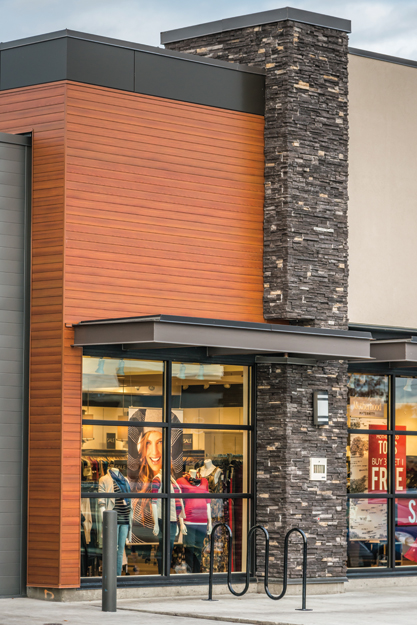
Photo by Dale Klippenstein
Aluminum cladding with wood grain appearance can be used effectively on commercial buildings.
The International Energy Conservation Code (IECC) and ASHRAE 90.1 have become the most recognized standards in North America for identifying minimum conditions for energy use reductions in buildings. Both standards recognize the negative impact of thermal bridging on a building's energy performance. Therefore, these standards encourage and sometimes require that these negative effects be mitigated through the use of continuous insulation (ci) to demonstrate code compliance. Specifically, ASHRAE 90.1 defines continuous insulation as “insulation that is continuous across all structural members without thermal bridges other than fasteners and service openings. It is installed on the interior, exterior, or is integral to any opaque surface of the building envelope.” As a practical matter, continuous insulation is commonly installed between the exterior wall sheathing (or comparable surface) and the final exterior cladding or finish material. In so doing, the ci avoids most other construction items and supplies the needed unbroken layer of insulation across the entire wall assembly. Of course, it is up to local jurisdictions to adopt specific versions of energy codes, so details and requirements can and do vary somewhat depending on the location of any particular building. Nonetheless, green building rating systems and other initiatives that seek to achieve energy performance beyond code-required minimums, also recognize and actively promote the effective use of continuous insulation to the fullest extent.
Incorporating continuous insulation on the outside of conventionally framed wall systems has a dramatic effect on the thermal performance of that wall assembly. But the effectiveness of continuous insulation becomes even more pronounced on multistory buildings where a stud wall assembly is used on multiple floors. The studs commonly rest on and get anchored to a floor structure that, for example, could be made from 4 to 6 inches of concrete in a metal deck or from a 10-inch to 12-inch wood framed structure. In this type of construction, the insulation in the wall studs stops above and below the floor structure meaning the floor edge is exposed along the full length and width of the building. The floor becomes a very significant thermal bridge since there is often nothing to prevent heat from being transferred between the inside and the outside of the building along the entire perimeter of the floor construction. The obvious means to overcome this deficiency is to insulate this edge as part of the overall continuous insulation scheme of the building envelope.
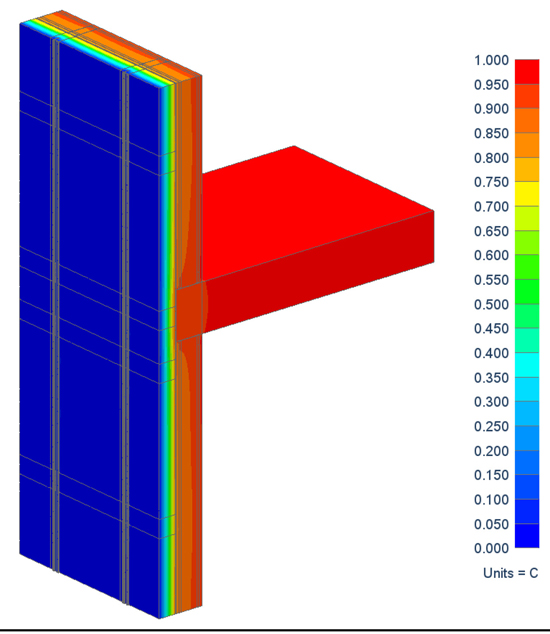
Image courtesy of Longboard – a division of Mayne Coatings Corp.
Thermal imaging shows that continuous insulation across an exterior wall and the edge of a floor slab can be extremely effective.
The same type of thermal bridging phenomenon occurs elsewhere in the building envelope as well. Structural elements such as columns or beams made of steel or concrete can create very significant thermal breaks if they are not fully insulated. This applies not only to walls but to roof elements too, such as roof parapets which can act in the vertical plane the same way exposed floor slabs act in a horizontal plane. The ideal solution is to make sure that continuous insulation connects at all of the critical junctures between building assemblies such as the wall and roof junction, parapets, soffits, and fascia.
The Role of Aluminum
Aluminum has been produced commercially for about a century, offering a number of advantages as a building material. Malleable and ductile, it machines and casts easily, offers superior resistance to corrosion, and is about one third the weight of steel and copper. Aluminum is also a low-maintenance, highly durable material. Aluminum's structural strength and stability is consistently high, even under extreme conditions and temperature changes. Where plastics may become brittle at low temperatures, aluminum actually becomes even stronger at extremely cold temperatures, which is why NASA chooses it for many aerospace applications. According to the Aluminum Association, aluminum is 34 times stronger than vinyl, 43 times stronger than wood, and when appropriately alloyed and treated, can be stronger than some steels.
Aluminum is also valued for its recyclability. According to the Aluminum Association, a 2008 survey of producers found an 85 percent recycled content rate for U.S. flat rolled products for the building industry, with some 60 percent from post-consumer sources. Individual producers may be able to provide aluminum with higher percentages. At the end of its service life, many aluminum construction elements can be recycled into like products without a loss in quality. From an energy standpoint, the recycling process only requires 5 percent of the energy used to produce the metal from its origin as bauxite ore. Recycling 1 ton of aluminum, in fact, saves 4 tons of bauxite with associated reductions in air pollution of 95 percent and water pollution by 97 percent.
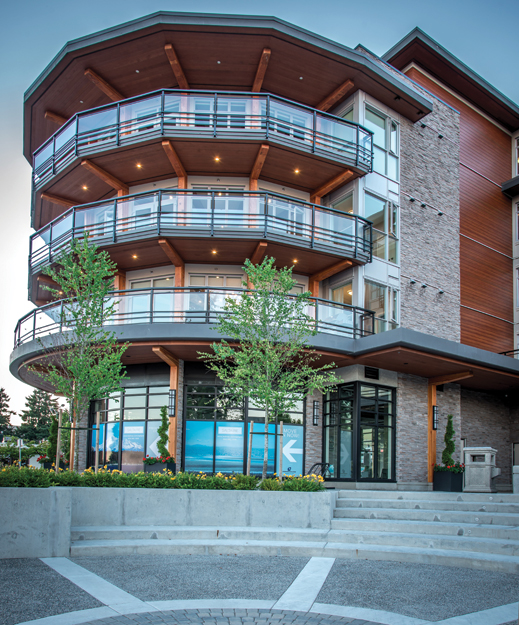
Photo by Dale Klippenstein
Aluminum cladding and siding products provide a durable and sustainable solution for building façades of all types.
Aluminum extrusions in particular offer a number of advantages. Because of its lighter weight, extruded aluminum is less costly to ship and easier to handle. Its malleability enables aluminum to be extruded not only in standard profiles but in a myriad of custom profiles geared to the aesthetic or functional objectives of the architect and owner. The extrusion process enables the inherent strength to be intensified where needed, by adjusting the thickness of the extrusion or reinforcing certain parts of the profile. The tooling for the extrusion process is inexpensive relative to that of other materials and can be quickly accomplished. Designed effectively, aluminum extrusions can greatly simplify subsequent fabrication and assembly. As such there is a wide variety of fabrication processes that are routinely employed in the production of extrusion-based components and assemblies.
Most aluminum products, like most metals, are actually alloys that add other minerals to achieve different physical properties. National standards developed in conjunction with the Aluminum Association identify different alloys by numeric designations. Extruded architectural aluminum falls within the 6000 series designation, with 6063 being the most popular for building materials like aluminum siding, cladding, and soffit materials. The characteristics of the 6000 series include good finish, surface strength, and corrosion resistance.
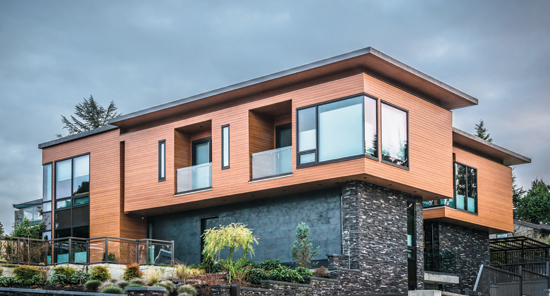
Photo by Dale Klippenstein
Aluminum wall cladding can take many forms including horizontal siding used on residential and commercial buildings.
Aluminum is also non-combustible and non-toxic even at high temperatures. Independent testing reports confirm the non-combustibility of certain coated aluminum extrusions and their compliance with ASTM E2768-11, Standard Test Method for Extended Duration Surface Burning Characteristics for Building Materials (30-Minute Tunnel Test). The examination includes three tests: the flame spread index; Smoke Developed; and Extended 20-Minute Burn. Test results are reported via indices that compare the sample to graded red oak flooring and inorganic-cement board. In the first test, the rate of progression of a natural gas flame applied to the start of a sample product is measured in a 25-foot tunnel. Secondly, a photocell measures the amount of light obscured by the smoke in the tunnel. When the smoke from a burning sample blocks out the light, the photocell output dips, and is recorded against the red oak results. Lastly, consistent with ASTM E2768, the test continues for another 20 minutes and the flame front is measured. Because aluminum does not typically burn in these test conditions, it is considered a non-combustible material for construction. However, aluminum alloy will melt at 1,200°F but without emitting hazardous gases. The aluminum cladding being increasingly used on industrial roofs and walls is actually intended to take advantage of this and to melt during a fire, so that heat and smoke can escape to reduce damage to the building.
Aluminum Back-Framing Systems
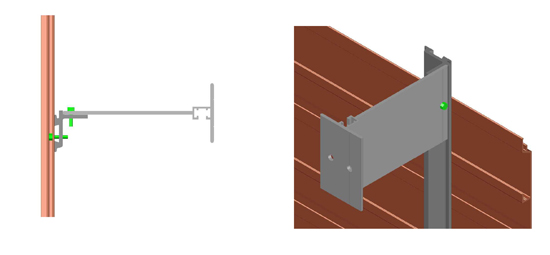
Image courtesy of Longboard – a division of Mayne Coatings Corp.
An aluminum back-framing system secures aluminum cladding to the primary wall while providing a space for continuous insulation to be inserted.
Combining the need for energy efficiency and the benefits of aluminum has led to an interest in finding ways to use aluminum exterior cladding or ventilated rainscreens over continuous insulation. The challenge of course is how to secure the exterior cladding without compromising the continuous insulation with fasteners and supports. An innovative solution can be found in aluminum “back-framing” systems that can secure the metal cladding to the primary wall with minimal disruption to standard insulation products. Such a system also needs to contain its own thermal break to avoid adding thermal bridges through the fasteners to the wall assembly. Back-framing systems that incorporate thermally broken aluminum clips for attaching aluminum cladding to the primary wall assembly and integrate continuous insulation offer the best potential to boost building energy performance and occupant comfort. Offering the most flexibility are framing systems designed for non-combustible mid- and high-rise building envelopes whether the primary walls are steel framing, stud walls, block, or concrete. Similarly, systems that can accommodate different continuous insulation thicknesses, generally 3, 4, 5, and 6 inches, offer more options to optimize energy performance.
In order to evaluate the thermal performance and wind load resistance of such a back-framed system, the independent testing laboratory Morrison Hershfield has tested such a system on various types of backup or primary walls. Performance of this system was validated through modeling and the finite element analysis (FEA). The tested system consists of a thermally broken aluminum T-clip and an extruded aluminum sub-girt for attaching rainscreen cladding systems to the primary walls. The aluminum T-clips are fastened directly to the primary wall at a spacing that can match wall framing or to accommodate standard widths of continuous insulation products (i.e. 2-feet-0-inch on center). The T-clips project out horizontally from the wall and include a thermal break in the base to thwart thermal bridging between the wall and the clip. The depth of the T-clip is equal to the depth of the continuous insulation used. Along the outside end of the T-clip, thin sub-girts are fastened to run vertically so they are parallel to the wall. These sub-girts in turn support aluminum cladding or rainscreen panels.
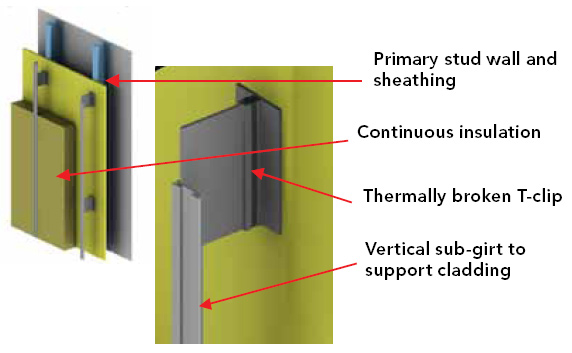
Photo courtesy of Longboard – a division of Mayne Coatings Corp.
Morrison Hershfield tested an aluminum back-frame system that allowed for different thicknesses of continuous insulation and was suitable for a variety of different primary wall types.
The Morrison Hershfield engineer's report included structural analysis for dead loads and wind loads on the entire system, including fasteners, clips, sub-girts, and the cladding. Clip spacing was examined with clip attachment assumed to connect to an 18-gauge stud (minimum) using two screws attaching the clip to the stud plus one screw attaching the sub-girt to each clip. The clip analysis was based on using cladding with a dead load of 1.5 pounds per square foot. The system was further analyzed using different types and thicknesses of continuous insulation.
Some of the key findings of the Morrison Hershfield report included the following:
• The back-framing system meets the prescriptive requirements in ASHRAE 90.1 – 2007/2010 for all climate zones for non-residential steel stud walls through the effective use of continuous insulation.
• The system is appropriately designed for mid and high-rise (non-combustible) building envelopes.
• Wind load resistance up to 70 psf is possible.
• A comprehensive rainscreen solution is provided in the system.
• The back-framing system is suitable for use with all types of primary wall systems including steel stud, wood stud, masonry, and concrete.
Overall, the Morrison Hershfield study suggests that this type of back-frame system performs very well in the context of meeting code requirements for structure, fire, and energy performance.
Wall and Soffit Cladding Materials
Wall cladding is typically referred to as a decorative covering intended to achieve an overall aesthetic appearance that an architect, designer, or owner has in mind. Some of the most common examples are on the outside of buildings, but cladding can also be an artistic element on interior locations. It's usually non-structural, which means that it doesn't impact the stability or integrity of a building's structural system. It is intended to be the permanent weathering and wearing surface of a wall. A variation is rainscreen cladding which anticipates and is designed for some air flow behind the cladding in order to allow any moisture or rain water to freely drain away. Either way, cladding can be made out of almost any material including various metals, stone, composite materials, and others.
One type of cladding is simply referred to as siding, particularly on residential buildings. Siding is the exterior material on building walls that protects them from the elements, usually by shedding or deflecting rain and weather away. Before World War II, wood siding was the most commonly used type in residential construction. While the beauty and warmth of natural wood has been and still is highly regarded, wood can have drawbacks. According to the International Association of Certified Home Inspectors, wood requires higher maintenance than many other building materials and is subject to regular repainting or resealing as often as every two to three years. If wood is not well maintained, deterioration may occur which, in turn, can compromise the integrity of a building. Further, wood is a hygroscopic material in that it takes in and gives off water to balance with its environment. If exposed to a high-moisture environment, wood can become subject to decay over time. Pests such as termites are another factor that may be damaging to wood, though that potential can be reduced by the selection of the wood species itself, by preservatives, or by other treatments. Cost is another consideration, with wood among the most expensive cladding materials on the market.
In the post WWII era, as metal was more available, aluminum siding was increasingly used successfully on many homes as a more durable, lower maintenance choice compared to wood. Other materials have since entered the residential market including vinyl and composite siding materials, each with their own particular attributes, strengths, and weaknesses. Meanwhile, aluminum use for cladding has expanded notably into the commercial sector bringing all of the attributes and characteristics of the material to virtually all building types.
In addition to wall cladding, most buildings require some related materials to cover surfaces adjacent to the walls such as soffits and fascia. The word soffit originated with the Latin suffigere, meaning “to fix underneath.” Technically speaking a soffit is the underside of any element of a building. So there are soffits on ceilings, stairs, arches, and even cornices. The most commonly referred to type is found in the area under the eaves on the exterior of a building. This type of soffit extends horizontally from the side of an exterior wall to the edge of the eave and closes the space beneath the eave. Although relatively well protected due its limited exposure, soffits can be vulnerable to weather damage and impacts from other nearby construction failures. Roofing failures of torn or missing roofing, damaged flashing, ice dams, or unintended water infiltration can all add stress to the soffit support or the soffit material itself. Deteriorated or misaligned soffits can create openings that lead to further weather infiltration or small animals entering and causing damage. Since this type of incursion is one of the biggest threats to a building's stability and the health and well-being of its occupants, an integrated cladding and soffit system with a rainscreen design to manage moisture is well worth considering.

Photo by Dale Klippenstein
Any “underneath” area can constitute a building soffit including this extended area forming an outdoor seating area.
Fabricating Aluminum Materials with a Wood Appearance
One of the advancements of aluminum cladding, siding, and soffit materials is the development of finishing processes that create a very realistic finished wood appearance. Wood-grained aluminum cladding, siding, and soffit materials, used in conjunction with a back-framing system, can provide architects with an aesthetic, energy-saving option for exterior facades in both commercial and residential construction. One misconception about wood grained aluminum materials is that this kind of product is merely a vinyl laminate put on to an aluminum sheet, which is not at all the case. To fully understand these innovative aluminum products, an examination of the multi-step production and fabrication process is in order. Along the way, we will note the ways that aluminum processing has become more environmentally responsible of late as well.
Aluminum Extrusions
Generally speaking, aluminum cladding, siding, and soffits are extruded, meaning the aluminum alloy is changed into objects with a cross-sectional profile. As previously mentioned, extrusion allows aluminum's key physical characteristics to be optimized. In the extrusion process, aluminum is either forced through or drawn through a die that conforms to a particular profile. Extrusion offers several advantages, notably the capability of producing intricate cross sections with superior surface characteristics.
Aluminum Pretreatment
Once the aluminum is extruded and ready for finishing, a pre-treatment process is necessary. The quality of finished metal begins with a proven method to clean it. Traditionally, chrome and phosphate were used to accomplish this task. However, due to potential health hazards, the United States Environmental Protection Agency (EPA), the Occupational Safety and Health Administration (OSHA), and local jurisdictions have severely restricted the use of chrome-based pretreatment processes. In recognition that the future will bring ever more stringent controls, costs, and potentially hazardous effects, some aluminum material manufacturers have opted for pretreatment processes that do not utilize chromium, cyanide, phosphate or other chemicals that have been identified by the EPA or OSHA as potentially harmful. Further, green goals have been achieved by totally eliminating sludge from the pre-treatment process, obviating both the need for hauling, containment and disposal of hazardous materials and the associated costs. Other features that can add to the sustainability of a product are pretreatment processes that involve special formulations to control corrosion.
Powder Coating
A dry finishing process with a four-decade history in North America, powder coating is used on many products for an environmentally sound, durable, and high-end finish that is available in a wide array of colors and textures. Sophisticated technological processes have enabled superior performance.
The powder coating process eliminates or minimizes several issues innate to liquid paints, with the presence of solvents being the key factor. Solvents are inherent to liquid finishes, and they contain volatile organic compounds (VOC), which are emitted as gases from certain solids or liquids, and include chemicals that may potentially result in short- and long-term adverse health effects. VOCs are not present in powder coatings, so they do not release VOCs into the environment, eliminating the need for expensive pollution control equipment and enabling straightforward compliance with EPA regulations. Generally speaking, powder waste is negligible since overspray or unused powder can be easily and economically returned to a feed hopper for future use. Also, less exhaust is incurred in the process—the coating booth emits exhaust air that can be recirculated into the plant, with less hot oven air reaching the outside area. Heating and cooling costs are eliminated for make-up air and the cost for maintaining oven temperatures is minimized.
When specifying powder coatings, the American Architectural Manufacturers Association (AAMA) can be cited for established performance standards. Specifying the performance of powder coatings is typically tied to AAMA 2603, 2604, or 2605, which express increasingly more stringent requirements as evidenced by South Florida simulated outdoor exposure and laboratory accelerated testing procedures. AAMA 2603 is a lower performing specification used for interior applications. AAMA 2604 certified powder coatings demonstrates a 500 percent improvement over AAMA 2603 in the critical areas of color and gloss retention. Finishes so certified will provide hardness and resistance to abrasion, making them suitable for high-traffic areas such as storefronts and doors. The exterior specification for high performance, AAMA 2605 certifies finishes with superior resistance to weathering, humidity, and salt spray testing. Further, some proprietary finishes can give aluminum superior UV resistance, high gloss, and color retention when compared to vinyl, wood, fiber cement, and other powder coated materials.
Sublimation
The process of embedding ink into the base powder coat is known as sublimation and is used to create a realistic wood grain appearance. To achieve the effect, the pre-treated, base-coated aluminum extrusion is bagged in a film that has the desired wood grain pattern inked onto it. The film is then vacuum sealed to the extrusion, covering all of its critical surface areas. Next, the prepared extrusions are placed into an oven where the ink turns to a gas and penetrates through the full thickness of the base powder. It essentially “tattoos the ink” onto the powder coated aluminum. The result is a permanent wood grain pattern with the full benefit of the UV resistance and durability of the base powder coat. It is also possible to add an anti-graffiti coating which allows acetone cleaners to be used without compromising color and gloss retention.
Design Considerations
When choosing to use wood grain appearing aluminum materials, there are several design considerations to take into account in order to achieve the desired aesthetic effect within the context of an energy efficient building.
Aesthetics
For centuries, the look of wood has been valued in the built environment. The natural characteristics of the various wood species add interest and variety to a space and serve as accents or feature elements that effectively contrast or complement other components of a façade or interior. By its very nature, wood has irregular features that are pleasing to the eye. The way in which real wood grows, and the way in which the board is sawed both influence its grain appearance. Wood grain does not always appear uniform, and in many instances the unusual patterns of sawn wood are considered highly desirable from an aesthetic standpoint. In optimizing the selection process, it is important to specify a product in which the faux wood grain has the color, tonal variations and characteristics of the actual wood itself.
Some simulated species naturally lend themselves to specific applications. Popular choices in wood grain aluminum siding include light and dark cherry, which are quite similar to cedar and have good variation in tone and depth. Fir and Ash have a uniform wood grain appearance suitable for contemporary applications. The range of walnut wood grains also work well as accent pieces in modern designs. Dark knotty pine is a popular choice for rustic and large-scale soffit applications.
Profiles
Profile dimensions of the finished extruded products are important to consider as well. Some companies offer several variations, with industry examples ranging from 4-inch to 6-inch channel and V-groove options. The gauge of aluminum used for siding and soffit panels can vary but are available up to 1/16 of an inch. Standard panel lengths are 12 or 24 feet, which enables significant clear spans that can lead to dramatic design possibilities. Long spans also mean fewer seams and faster installations. Products that offer vertical and horizontal profiles, that is, that can be installed vertically or horizontally using the same profile, offer the greatest design flexibility. Some manufacturers offer a range of component profiles to assure a clean, consistent application. These include starter, finishing and expansion strips; J tracks for door and window surrounds; inside and outside corner pieces; and venting profiles. Also available are profiles that act with installation systems, such as back framing, without exposed fasteners to touch up or hide resulting in a clean, sleek look.
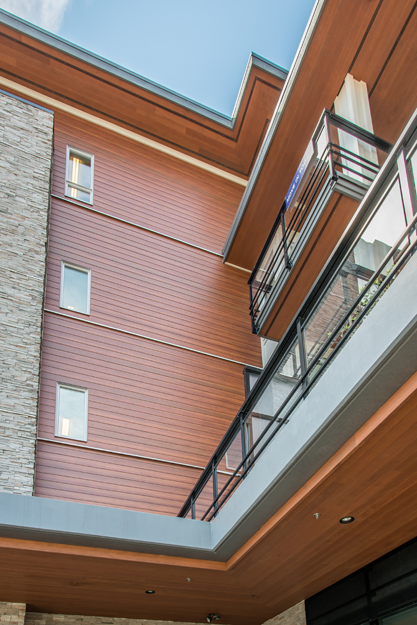
Photo by Dale Klippenstein
The manufacturing process for wood-grained aluminum siding allows for a range of color schemes that can complement other materials. Project: Sotaire (multifamily residential)
Maintenance
Some exterior claddings can require routine and often costly maintenance. With aluminum products, maintenance has been shown to be minimal, drastically reducing and in some cases eliminating obviating the need for staining, repairing, painting, or replacement. Manufacturers recommend a periodic washing with mild soap and water.
LEED Contributions from Aluminum Wall Products
The U.S. Green Building Council's Leadership in Energy and Environmental Design (LEED®) rating system has become the most recognized program for certifying a building for green and sustainable designs. Wood grained aluminum cladding, siding, and soffit used in combination with an aluminum back-framing system and continuous insulation, can collectively contribute to this certification under LEED 2009 in several areas.
Energy and Atmosphere
Optimized Energy Performance EA Credit 1.
The intent is to demonstrate a reduction of energy usage in buildings. The back-framing system with exterior continuous insulation has been shown to improve the thermal performance of exterior walls and contribute to reduced energy needs accordingly. Less energy need ripples over to HVAC equipment sizing which can also be optimized to use as little energy as possible.
Materials and Resources
Construction Waste Management, MR Credit 2.1, 2.2.
The intent in these credits is to divert construction and demolition debris from disposal in landfills and incineration facilities through recycling or salvaging. Using products sized to suit a building project, scrap and waste can be minimized. Any scrap aluminum is 100 percent recyclable and can be collected and sent to an appropriate recycling facility.
Regional Materials MR Credit 5.1, 5.
Credit is given for using at least 10 percent of building materials and products extracted and manufactured within the region for 1 point; using 20 percent of regionally collected materials earns an additional point. Consequently, working with manufacturers that source a good portion of their aluminum locally or regionally can earn credits in this category.
Durable Building MR Credit 8.
LEED seeks to reward projects that minimize materials use and construction waste over a building's life resulting from premature failure of the building and its constituent components and assemblies. Aluminum products have a long service life and can last up to 40 years or more if properly maintained.
Indoor Air Quality
Low-Emitting Materials: Paints and Coatings IEQ Credit 4.
Consistent with the goal of reducing indoor air contaminants, aluminum siding that is powder coated without VOCs can earn credits in this category.
Thermal Comfort: Compliance IEQ Credit 7.
Supporting the productivity and well-being of occupants, an aluminum back-framing system enables external insulation, keeping the interior more comfortable than other conventional solutions.
Innovation in Design
ID Credit 1.
Points are available for sustainable strategies not specifically addressed in other LEED credits. Wood grained aluminum siding in combination with the back frame/continuous insulation system, all providing the durability needed on exterior products, are potential candidates for credits in this category.
Conclusion—Increasing Building Performance Beautifully
Manufacturers of building products and architects concerned with green design are all doing their part to create energy-efficient buildings that have aesthetic appeal. Wood-grained aluminum cladding and thermally broken back framed systems represent a superior response to these goals. The long life of aluminum combined with the rich visual character of wood graining and the added insulation capabilities of thermally broken insulation systems are a valuable addition to the architect's design toolbox. Suitable for a full range of both residential and commercial structures, these aluminum wall systems can decrease energy bills, increase user satisfaction, install easily, and be readily maintained over time. Successful use of these systems in projects of every type are raising the profile of this next generation of code-compliant and AAMA-certified aluminum products that make an important contribution to the sustainable built environment.
 |
Longboard – a division of Mayne Coatings Corp. Mayne Coatings Corp. is best known as the manufacturer of
Longboard Products. The company focuses on continually exceeding environmental standards and providing
premium architectural products for sustainable design. www.longboardproducts.com
|