This CE Center article is no longer eligible for receiving credits.
Windows are more than a view between
worlds. They offer protection and comfort, and with the right
combination of materials windows can increase energy efficiency,
enhance daylighting, improve occupant comfort, and provide
low maintenance for the building owner. The right window selection
also can offer a balance between design, performance and budget
when first and long-term costs are considered.
This continuing education program examines factors that influence
window selection. It focuses on six key criteria: aesthetics,
price, energy efficiency, durability, maintenance and environmental
impact. Through comparisons of available materials and selected
case studies this unit is intended to help architects and
specifiers improve their ability to advise clients on the
best window solution for their projects. It will show the
options available for window styles and materials for commercial
and institutional buildings.
Glass Options
Window assemblies consist of framing, glazing systems, hardware,
finishes, sealants, and weather stripping. The first consideration
is glass and glazing options. This is a key in calculating
long-term cost because of its affect on energy efficiency
and building operating expense.
Design requirements, the size of the window openings, thermal
performance, cost, sound transmission, maintenance, durability,
shading options, weather conditions and local requirements
all have a bearing on selection of the glazing system.
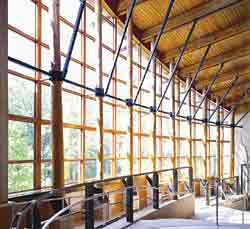
Wood-framed glazing
complements the beautiful view of the woodlands
at Lakeside Nature Center, Kansas City, MO,
by International Architects Atelier.
|
|
|
In commercial structures, the two most commonly chosen systems
are sealed insulating glass and dual glazed systems.
Sealed insulating glass consists of two glass panes separated
by a perimeter spacer typically made of metal. The sealed
space between the panes may be filled with an inert gas like
argon to improve the U-value of the insulating glass unit
(IGU). In a single-seal system the primary sealant is applied
behind the spacer. In a double-seal system, the primary sealant
seals the spacer to the glass on both sides, and the secondary
sealant, which is applied behind the spacer, provides the
structural characteristics needed to hold the unit together.
In both cases the sealant minimizes the potential for moisture
intrusion and gas loss. However, when the seal in insulating
glass fails, moisture appears on the internal surfaces, impairing
vision through the glass and permanently damaging the insulating
glass, which then must be replaced at a significant cost to
the owner. Single-seal sealant systems often carry a five-year
warranty against seal failure whereas double-seal systems
typically come with a ten- to twenty-year warranty.
Dual glazing comprises two single glass panes set individually
into a window frame of aluminum or wood. (Vinyl and fiberglass
frames do not typically offer a dual glazing option.) Dual
glazing relies on a gasket and vent system design to keep
moisture out of the air space and from forming on internal
glass surfaces. The space between panes of glass can vary
in size to hold blinds or other shading devices and to buffer
outside sound, temperature changes and wind. In most cases
dual glazing systems offer a life cycle cost advantage over
windows with sealed insulating glass since they are not subject
to the seal failure commonly associated with insulating glass
systems.
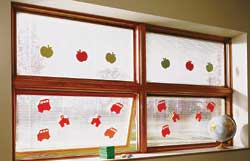
Wayland Union Middle
School, Wayland, MI, by Design Plus, Inc.,
shows how dual glazing with between-the-glass
window treatments reduces maintenance.
|
|
|
The table below shows a comparison of sealed insulating glass
and dual glazing-at a quick glance, both offer similar
advantages in terms of aesthetics, cost, and thermal performance.
However, the IGU accommodates a wider range of fenestration
types and larger glass sizes, while dual glazing offers a
longer life, easier re-glazing, between-glass options, less
sound transmission, and better thermal performance when between-glass
blinds are included.
|
Comparison of Dual
Glazing and
Insulating Glass based on Selection Criteria
|
Glazing
System
Selection Criteria
|
Dual
Glazing
|
Insulating
Glass
|
|
Fenestration
Type
|
|
+
|
|
Glass Size
|
|
+
|
|
Longevity
|
+
|
|
|
Re-glazing
|
+
|
|
|
Between-glass options
|
+
|
|
|
Thermal Performance
|
=
|
=
|
|
Thermal Performance with blinds
|
+
|
|
|
Cost
|
=
|
=
|
|
Aesthetics
|
=
|
=
|
|
Sound Transmission
|
+
|
|
|
Both dual glazing and insulating glass units can accommodate between-glass options such as blinds and muntins. In a dual glazing system the interior glass panel is typically designed as an access panel, allowing blinds/shades to be serviced for maintenance/repair. However, when the blinds in an insulating glass unit break, the entire piece of insulating glass requires replacement.
When blinds are excluded, the difference in cost between a window with insulating glass and one with dual glazing is negligible. The initial price of a between-glass blind is slightly higher than a room-side blind of similar quality. However, between-glass blinds do not have the future life-cycle costs associated with room-side blinds (i.e. cleaning and replacement due to damage).
When comparing insulating glass to dual glazing, the only differing acoustic factor is the air space between the panes of glass. The larger air space associated with dual glazing results in less sound transmission through the window and a sound transmission class (STC) rating at least 15% better, with additional improvements in STC as the air space increases.
When sealed insulating glass is broken, the entire unit must be replaced. However, with the large air space between the panes in a dual-glazed window, it is uncommon for both to be broken simultaneously. When the exterior pane is broken, the interior pane remains intact and provides protection or vice versa.
|
Thermal Performance
of Insulating Glass and Dual Glazing
|
Glass Type
|
Visible
light transmission
|
Ultraviolet light transmission
|
Solar heat
gain coefficient
|
U-value of total unit
|
|
Clear insulating
glass
|
81%
|
56%
|
0.76
|
0.54
|
|
Clear dual
glazing
|
81%
|
56%
|
0.76
|
0.50
|
|
The above table shows clear dual glazing offers a better total window U-value than clear insulating glass while all other values are the same. When closed blinds are added to the window, dual glazing with between-the-glass blinds offers an 18% improvement in total window U-value and a 43% improvement in solar heat gain coefficient (SHGC) over a window with room-side blinds.
In addition to using layers of glazing and controlling the properties of the spaces between them, the Web site www.efficientwindows.org suggests improving the energy performance of glazing products by changing the chemical composition or physical characteristics of the glazing material by adding a tint or by applying a low-emittance (Low-E) coating to the glazing material surface to reduce heat gain and glare.
Framing Materials
The next consideration is window frame material. The window
frame must do several things. It should provide strength to
withstand wind and other loads, drainage for water and accommodate
weather stripping, glazing channels and rabbets, weep holes,
internal gutters, screw bosses, concealed fasteners, flashings,
drips, corner keys, thermal breaks, hardware, and frame accessories.
Properties of the framing material affect the thickness and
weight of each window. A suitable material can be chosen from
four available options: wood, aluminum, vinyl and fiberglass.
Each one has properties that make it more appropriate for
certain applications.

Wayland Union Middle
School, Wayland, MI, by Design Plus, Inc.,
shows how dual glazing with between-the-glass
window treatments reduces maintenance.
|
|
|
Wood is one of the oldest building materials and has been
the traditional frame material in all types of buildings primarily
because it has been consistently and readily available and
can be milled into many shapes to fit simple or complex designs.
Wood-framed windows also can have an exterior cladding of
vinyl or aluminum to increase weather-resistance while retaining
an attractive wood finish on the interior.
Aluminum is a popular window frame material appreciated for
its light weight and durability, but it has the disadvantage
of high thermal conductance. This nonferrous metal is made
from bauxite and cryolite and can be extruded into simple
or complex frames. It is available in a variety of anodized
and painted finishes. Aluminum is considered mostly for commercial
and institutional use and when manufactured with a high percentage
of recycled content adds value in green building.
Vinyl (also known as polyvinyl chloride or PVC) is newer
than wood or aluminum as a window frame material and is derived
from fossil fuels. It offers good insulating values and has
good moisture resistance. Some recent advances have improved
dimensional stability and resistance to degradation from sunlight
and temperature extremes. Vinyl is considered a residential
material and because PVC formulations for windows are not
consistent throughout the industry, quality and performance
can vary.
As window framing material, fiberglass (glass-fiber-reinforced
polyester) is an emerging product. Fiberglass framing products
were developed in the 1990s and currently are used in less
than 2% of today's market. Fiberglass is a composite
that can be pultruded into lineal forms. Because the material
is stronger than vinyl, it can have smaller cross-sectional
shapes and thus less area. It provides exceptional thermal
stability, strength, and durability.
The Selection Process
Four window types are commonly used in commercial structures:
double-hung, casement, fixed and awning. A double-hung window
consists of two sashes operating in a rectangular frame with
upper and lower halves able to slide up and down. A casement
window swings open on side hinges. A fixed window has no operating
sashes, and an awning window is similar to casement, but the
sash is hinged at the top and always swings out.
 |
 |
 |
 |
| Aluminum-clad
wood |
Aluminum
with thermal break |
Vinyl |
Fiberglass |
|
|
|
|
|
How Window Materials
Meet Selection Criteria
|
|
Wood
|
Aluminum
|
Vinyl
|
Fiberglass
|
|
Aesthetics
|
Warm, natural beauty; many finish
options
|
Many finish options
|
Limited color options
|
Many color options
|
|
Energy Efficiency
|
Natural insulator
|
Natural conductor
|
Good insulator
|
Good insulator
|
|
Environmental Impact
|
Very low embodied energy; can
be recycled
|
High embodied energy; can be
recycled
|
Medium embodied energy; not
recyclable
|
Low embodied energy; limited
recyclability
|
|
Price
|
Medium to high first cost; low
long-term cost
|
Medium to high first cost; low
long-term cost
|
Low first cost; higher long-term
cost
|
Low first cost; low long-term
cost
|
|
Durability
|
High
|
High; but potential for thermal
break failure
|
Low; cracks easily
|
High
|
|
Maintenance
|
Interior wood surfaces may need
refinishing; scratches can be repaired
|
Low; not scratch resistant
|
Low; may require early window
replacement
|
Low; high scratch and dent resistance
|
|
Aesthetics
The choice of materials is influenced by the architect's
perspective and the project design intent. Several things
must be considered: scale and proportion, sightlines, relationship
to other interior finishes, frame profiles, and glass types.
Hardware and location of window treatments (room side or between-glass
blinds) also influence the choice of frame material.
Of the four framing materials, wood is unique because it
allows different finishes for the interior and exterior and
provides a warmth and natural beauty not offered by the other
materials.
Aluminum offers a broad selection of anodized and painted
finishes that typically are the same on both sides. Aluminum
can be combined with wood in an aluminum clad wood frame that
offers the warmth and natural beauty of wood on the interior
and the durability of aluminum on the exterior.
Vinyl framing offers few color choices and has the same finish
on both sides. Medium to dark colors are especially limited.
Some manufacturers offer surface treatments such as laminates
or other coating options to increase color selection and surface
appearance.
Fiberglass has high design flexibility with many color options.
The material is typically painted the same color on both sides
but offers the potential for different colors on the exterior
and interior.
Energy Efficiency
The energy efficiency of the windows has a significant impact
on the overall annual operating costs of a building. To obtain
the best energy efficiency from a window three factors must
be evaluated: thermal performance, condensation resistance
and occupant comfort. Additionally, because installation can
affect window performance, the manufacturer's installation
instructions should be evaluated and followed for optimum
performance.

Wood windows optimize
design performance and budget flexibility
at the F.M. Kirby Shakespeare Theatre, Drew
University, Madison, NJ, by Ford Farewell
Mills and Gatsch, Architects. |
|
|
To compare thermal performance look at the R-values and U-values.
The R-value measures resistance of glazing material or fenestration
assembly to heat flow. Materials with higher R-values have
higher resistance to heat flow and are better insulators.
The U-value measures the rate of non-solar heat loss or gain
through a material and may be expressed for the glass alone
or the entire window including frame and spacer material.
The lower the U-factor, the greater a window's resistance
to heat flow and the better its insulating value.
Choice of materials has a bearing on both these factors.
For example, in Chapter 30 of the 2001 ASHRAE Fundamentals
Handbook, the addition of a thermal break in an aluminum frame
improves the U-value from 1.92 to 1.13. An aluminum-clad wood
frame further improves the frame U-value from 1.13 to 0.51.
The handbook also indicates that total Unit U-values for
the entire window include both the frame and glass. The range
for aluminum windows with thermal breaks is from 0.35 (triple
glazing with low-E coatings) to 0.64 (double glazing with
clear glass).
For aluminum-clad wood windows the range is from 0.25 (triple
glazing with low-E coatings) to 0.53 (double glazing with
clear glass). The glass is the same so the difference in U-values
is a result of changing frame material.
The National Fenestration Rating Council (NFRC) is a reliable
source for determining window energy properties and comparing
products. NFRC rates window units for U-factor, SHGC, visible
light transmittance (VT), and air leakage (AL).
Another factor that affects window thermal performance is
air infiltration. Air leakage heat loss and gain occur by
infiltration through cracks in the window assembly. This is
indicated by an AL rating expressed as the equivalent cubic
feet of air passing through a square foot of window area.
The lower the AL, the less air will pass through cracks in
the window assembly. Select windows with an AL rating of 0.30
cfm/sq ft or less.
Resistance to condensation also is important. Condensation
on window frames can damage interior windowsills, finishes
and eventually walls and floors. Specifying products and design
conditions that regulate surface temperatures and moisture
in the air will minimize potential for condensation.
Materials with greater resistance to condensation also provide
greater comfort to occupants seated near windows, and occupant
comfort has a direct impact on worker productivity.
Wood is considered the best performer from a thermal point
of view. It is a natural insulator with excellent resistance
to condensation and a high degree of thermal comfort.
Aluminum is a natural conductor and therefore has poor energy
efficiency and low resistance to condensation. Aluminum's
R-value is minimal and raises the overall U-factor of a window
unit. In cold climates, an aluminum frame can become cold
enough to condense moisture or frost on the inside surfaces.
A desirable combination for thermal performance and comfort
is an aluminum-clad wood window. This alleviates differences
in exterior and interior frame temperatures, offering resistance
to condensation, greater thermal comfort and lower annual
energy costs than thermally-broken aluminum windows.
The average annual savings from the use of aluminum-clad
wood windows is fairly consistent across the United States:
27% to 31% compared to single-glazed aluminum windows without
thermal breaks; 6% to 9% compared to thermally-broken aluminum
windows.
Vinyl has the same thermal efficiency as wood and in terms
of thermal performance vinyl frames are comparable with wood.
However, vinyl's expansion and contraction encourages
air and water infiltration which increases maintenance and
damage issues.
Fiberglass offers thermal efficiency similar to wood and
the lowest expansion and contraction rates of all four materials.
Less expansion ensures a consistent bond between sash and
glass and reduced energy costs as well as less stress on joints
for greater durability.
Environmental Impact of Materials
The choice of windows can add value to a structure and the
environment. The most commonly used evaluator of a structure's
environmental impact is the U.S. Green Building Council's
LEED® (Leadership in Energy and Environmental Design)
Green Building Rating System. This guide for designing, constructing,
operating, and certifying buildings is based on accepted energy
and environmental principles.
LEED's measurement standard follows a point system.
The four levels of LEED certification and required points
for each are:
| Certified |
26 - 32 points |
| Silver |
33 - 38 points |
| Gold |
39 - 51 points |
| Platinum |
52+ points (69 possible) |
The points are earned within six categories. The five environmental
categories (not including Innovation and Design Process) are
divided into credits. One or more points are available within
each credit, and points are achieved by meeting specified
requirements.
- Sustainable Sites: 8 credits, 14 points
- Water Efficiency: 3 credits, 5 points
- Energy and Atmosphere: 6 credits, 17 points
- Materials and Resources: 7 credits, 13 points
- Indoor Environmental Quality: 8 credits, 15 points
- Innovation: 4 points
|
About Pella
|
|
Pella
Corporation is a world leader in the manufacturing of
premium windows and doors. Long-recognized in the window
industry for its technology and innovation, the company
holds more than 100 U.S. product and design patents.
Registered
with the American Institute of Architects as a Continuing
Education System provider since 1995, Pella is committed
to developing quality learning activities in accordance
with AIA/CES and Health/Safety/Welfare (HSW) criteria.
Pella offers several continuing education programs through
www.pellacommercial.com
in addition to this partnership withArchitectural
Record.
Pella
also awards scholarships to top students at leading
universities and schools of architecture. Please contact
your local Pella architectural consultant for more information
about these programs.
|
Involving a LEED Accredited Professional in the process adds
another point.
LEED uses performance-based requirements, so most building
products will only contribute to achieving LEED points, not
credits. To meet these, products with desired attributes should
be specified.

Vinyl window frames
offer the same thermal efficiency as wood.
Courtesy of Pella Corporation |
|
|
Currently, LEED-NC (New Construction and Major Renovations/Additions)
Version 2.1 involves window selection for commercial properties.
USGBC expects to release Version 2.2 by Fall 2005.
Windows and doors can contribute to one prerequisite and
up to 26 points in LEED-NC. Windows may contribute one point
in the Sustainable Sites category under Light Pollution Reduction,
dealing with light trespass from buildings. Although most
of the credit revolves around outdoor lights, it includes
interior light trespass through windows at night. Proper use
of window treatments can contribute to this credit if they
reduce glare or direct light shining onto neighboring property,
streets, or night sky.
In the Energy and Atmosphere category, windows can contribute
to 1 prerequisite and up to 13 points. Prerequisite 2-Minimum
Energy Performance requires the building comply with ASHRAE/IESNA
90.1-1999 or the local code, whichever is more stringent.
Windows can contribute to meeting the standard's building
envelope requirements based on their energy efficiency, including
low U-values, low air infiltration rates and low SHGC.
Windows can earn points in Credit 1-Optimizing Energy
Performance. Up to 10 points are available with this credit
and increase as energy costs decline so the window's
energy efficiency is critical in maximizing this point category.
Points also can be earned in Credit 1-Technologies and
Strategies for strategic placement of windows for natural
ventilation, minimal undesirable air infiltration, maximum
day lighting and minimum heat gain. Appropriate glazing to
optimize natural lighting, heating and cooling also is point-worthy.
The LEED Reference Guide notes only permanent interior shading
devices such as between-glass blinds qualify for points.
Window material's content can earn points in Credit
4-Recycled Content. Aluminum, glass and wood can contribute
to two points because they are recyclable materials and have
recycled content. Additional points can be earned in Credit
5-Local/Regional Materials if the windows are made within
500 miles of the project site and another point can be added
if a minimum of 50% of the building materials and products
are extracted, harvested or recovered within the 500-mile
guideline.
In the major category of Indoor Environmental Quality, windows
can contribute up to 6 points. In Credit 2-Increase Ventilation
Effectiveness, consider using operable windows to provide
natural ventilation. Operable windows also can earn points
in Credit 6-Controllability of Systems if an average
of one operable window and one lighting control zone per 200
square feet are specified for all regularly occupied areas
within 15 feet of the perimeter wall.
Windows can contribute to Credit 4.2-Low-Emitting Materials
(Paints), if windows with low VOC paints and coatings for
field-finishing of interior wood surfaces are chosen. In Credit
4.4- Low-Emitting Materials (Wood), eliminating urea-formaldehyde
in composite wood products will contribute to this credit.
In Credit 8-Daylight and Views, windows earn credits
for day lighting building interiors and views. Building orientation,
window size and spacing, window placement for direct line
of sight to exterior, glass selection, shading devices, light
shelves, courtyards, atrium and window glazing should all
be considered to earn points in this credit.
If the project is not going to be submitted for LEED certification,
the program's requirements can be used as guidelines
in evaluating window frame material for environmental impact.
The Green Guide to Specification also provides evaluation
methods for various window options.
|
Environmental Impact
of Window Materials
|
Window Material
|
Rating
|
|
Softwood
preserved
|
A
|
|
Hardwood framed
|
A
|
|
Aluminum clad-wood
|
B
|
|
Aluminum
|
B
|
|
Vinyl
|
C
|
|
|
Source:
The Green Guide to Specification, 3rd Edition
|
| A= low environmental
impact; B = middle range; C = high environmental impact.
The rating is a summary of the overall impact of 12 environmental
factors as well as cost, recycled content, recyclability,
current recycling effort and typical replacement time. |
Of all four materials, wood has the lowest embodied energy.
It takes only 3,770 BTUs of energy to produce a pound (BTU/lb)
of wood. Wood frames also are recyclable if and when they
are no longer in use and are biodegradable if the products
are disposed of into the environment. Additionally, the softwood
used for window frames is obtained from rapidly renewable
resources; the net volume of wood in U.S. forests is increasing
because of sustainable harvest techniques.
Aluminum contains bauxite a non-renewable resource and takes
the most energy (103,500 BTU/lb.) to produce from raw materials.
But aluminum extruded from recycled materials uses only 20,700
BTU/lb. Aluminum frames also are recyclable when their use
has ended.
Vinyl depends on oil resources so it is not as environmentally
acceptable. Vinyl window frame material also does not have
recycled content and takes 36,500 BTU/lb to produce. It is
unclear whether vinyl is recycled or recyclable. The Vinyl
Institute indicates vinyl window frames are recyclable, but
the U.S. EPA states only a small percentage of vinyl-0.6%
in the United States and 3% in Europe-is recycled.
Also, the USGBC is re-evaluating its position on vinyl. During
early LEED development a credit was proposed for the avoidance
of vinyl in building products. Questions have been raised
that available science shows no grounds to support this exclusion
of vinyl. The USGBC Technical and Scientific Advisory Committee
has begun a comprehensive study on the matter and intends
to publish its final report in late 2005.
Fiberglass has very low embodied energy. It is a natural
insulator with low expansion/contraction rates and thus maintains
dimensional stability year round. Fiberglass also has self-extinguishing
capabilities in case of fire and does not emit toxic fumes.
Price
Determining the cost of window options can be a difficult
task at best. Prices vary by manufacturer and specific needs.
But the most important comparison is long-term cost. Total
initial cost per square foot is based on many factors including
performance, size, glass specifications (e.g. low-E or clear
glass), and interior and exterior frame colors (standard or
custom).
But maintenance/repair needs and energy/operating costs must
be added to first costs to calculate the long-term cost of
the building. Window style, accessibility for maintenance
and upkeepof framing material must be part of this calculation.
For example, between-the-glass options for blinds and shades
can offer long-term savings on maintenance and energy usage.
|
Average Price Comparisons
|
|
Based on a
quantity of 300 windows, not installed,
with clear insulating glass, standard hardware without
screens.
|
Frame &
Sash Material
|
Exterior Finish
|
Interior Finish
|
Cost per Window
|
|
Double Hung -
3 feet wide by 5 feet high
|
|
Aluminum with thermal break
|
Clear anodized
|
Clear anodized
|
$276
|
|
Fiberglass
|
Fiberglass
|
Fiberglass
|
$198
|
|
Aluminum-clad wood
|
Standard color
|
Prime and 2 top coats of paint
|
$270
|
|
Vinyl
|
Vinyl
|
Vinyl
|
$174
|
|
Fixed Casement
- 2 feet wide by 5 feet high
|
|
Aluminum with thermal break
|
Clear anodized
|
Clear anodized
|
$197
|
|
Fiberglass
|
Fiberglass
|
Fiberglass
|
$188
|
|
Aluminum-clad wood
|
Standard color
|
Prime and 2 top coats of paint
|
$216
|
|
Vinyl
|
Vinyl
|
Vinyl
|
$194
|
|
|
Sources: R.S. Means Building Construction
Cost Data and Pella Corporation
|
In comparing life cycle cost, aluminum window frames can
be lower in repair and maintenance costs. In most cases dual
glazing systems, whether in wood or aluminum windows, offer
a life cycle cost advantage over windows with sealed insulating
glass. Choice of color and coating on an aluminum frame also
can affect cost.

At The Lansburgh,
Washington, D.C., by Graham Gund Architects
aluminum-clad wood windows offer high durability
and design flexibility. |
|
|
In first cost, wood and aluminum are comparable. Generally
initial costs for operable aluminum-clad wood windows offer
a lower price point than aluminum windows. For storefront
applications, costs are comparable. In curtain walls and window
walls aluminum systems typically cost less than wood.
Vinyl offers short-term savings because of its initial low
cost, but the long-term cost of vinyl is higher because vinyl's
expansion and contraction can cause more repairs and potential
earlier replacement of windows due to frame failure.
Fiberglass is priced lower than aluminum and is competitive
with vinyl. Fiberglass' superior durability should be
factored into long-term costs.
Durability
When determining a structure's windows, consider the
building owner's or developer's intent for the project.
How long do they expect the building to last? How well will
the owner maintain the structure? How will weather conditions
affect the structure?
The durability of any material can be proven by how it reacts
over time to weather extremes, impact and damage caused by
nature or human acts. The thermal break of a window also is
a key consideration in durability.
With wood windows, a thermal break is natural because of
wood's inherent properties, making it a more stable option.
But the durability of wood is sometimes misunderstood because
in certain climates it can be more susceptible to rot. According
to the Window and Door Manufacturers Association (WDMA): "Wood
stands the test of time. It doesn't naturally decay as
many people believe and indeed has been found nicely preserved
in 2,000-year-old structures."
Wood-frame windows on historic buildings have lasted for
centuries-a testimony to wood's incredible durability.
Prior to the 1920s, wood was virtually the only window frame
material available. Today, the most common reasons to replace
wood-frame windows are not because of structural or material
failure, but rather to:
- Replace single glazing with more efficient dual glazing;
- Improve weatherstripping to reduce air infiltration; or
- Provide exterior aluminum cladding to eliminate exterior
repainting.
Aluminum windows are perceived as highly durable. The only
weakness is in the construction of the thermal break, which
is commonly engineered using a polyurethane material that
is susceptible to shrinking and cracking over time. This can
eventually cause glazing failure, increased air and water
leakage, and a general degradation of the window unit's
structural integrity.
Architects concerned about thermal break performance can
reference the test method and performance requirements outlined
in The American Architectural Manufacturers Association (AAMA)
publication 505-98, "Dry Shrinkage and Composite Performance
Thermal Cycling Test Procedure".
Vinyl resists abrasion and moisture and withstands rust and
corrosion, but generally is less durable than other window
frame materials. According to the WDMA, however, efforts have
been made to make vinyl a more long-lasting material. The
WDMA Hallmark Certification program focuses on stabilizing
manufacturers' formulation compounds by requiring long-term
weathering tests for color retention and certain mechanical
properties. This has helped upgrade the quality of vinyl and
reduce the number of manufacturers making less-than-quality
vinyl material.

Aluminum-clad wood
windows offer low-maintenance exterior and
warm, rich interior at Vollum Institute for
Advanced Biomedical Research, Portland, OR,
by Zimmer Gunsul Frasca Partnership.
|
|
|
Fiberglass is a strong and durable window frame material.
It is nine times stronger than vinyl and twice as strong as
aluminum in tensile strength. It also offers high impact and
scratch resistance and low thermal expansion.
Maintenance
For most buildings maintenance costs represent the highest
percentage of long-term costs at 67% of the life cycle cost;
energy costs are 16% and initial costs are 17%. Therefore,
all possible window maintenance activities must be evaluated
in choosing window materials. These are: washing the glass,
cleaning the window coverings, replacing broken parts, re-finishing
and repairing interior surfaces, replacing broken glass or
failed insulating glass.
Specifying between-the-glass blinds and shades in wood or
aluminum windows can reduce maintenance on window treatments
because they are located between the panes of glass where
they are protected from dust and damage. Windows with interior
access for washing the exterior provide easier, faster cleaning,
which also can reduce maintenance costs.
The cost of replacing broken parts is comparable for wood,
aluminum, vinyl, and fiberglass windows unless the manufacturer
that supplied the original windows is no longer in business.
Then replacement parts such as double-hung balances and casement
hinges and cranks are not available and the only option is
to replace the entire window.
Choice of framing materials also affects maintenance. Wood
does not need frequent refinishing if the initial finish is
high quality.
When the interiors of wood windows are finished properly
(three coats) the finish can last up to 25 years or more.
Typically, stain and two coats of varnish last longer than
paint. Additionally, the finish on a wood frame can easily
be repaired to keep a neat, clean appearance or changed to
match new interior needs.
As an exterior material, aluminum offers very low maintenance,
however, any scratches or damage to the interior finish cannot
be easily repaired. Because aluminum frames are not typically
re-finished during the life of the windows, aluminum may offer
a cost advantage.
Vinyl offers a low maintenance finish, but the material has
low durability because of its sensitivity to temperature changes.
Over the long-term, this can cause other maintenance problems
related to air and water leakage and operation issues.
Fiberglass offers low maintenance and its scratch resistance
is six times better than vinyl. A powder-coat paint finish
on fiberglass is quite durable and easily withstands scratching
and denting.
Outlook
The variety of available options for windows continues to
grow and enhance possibilities for more durable, efficient
systems to meet many design needs. The growth of the green
building movement has increased awareness of using natural
resources wisely and influenced product development. The commercial
market is leading this trend and windows can play a significant
role in saving energy during the life of the building. Decisions
made now in the choice of window materials will affect not
only the daily comfort of building occupants but also the
resources used to operate and maintain the building.
Case Studies
Blending aesthetics and energy
efficiency
Visitors enter the Lakeside Nature Center in Kansas City,
MO, through a single-story cast-in-place concrete wall that
offers little clue to what lies beyond. Once inside, they
are greeted with a view of lush woodlands, framed by floor-to-ceiling
glazing rising up to 28 feet. Daylight from clerestory windows
reinforces the illusion of being in the woods by simulating
diffused light penetrating through a forest canopy. Transferring
loads from the extensively overhung roof to the cedar columns
without deflecting and breaking glazing was a major design
challenge for International Architects Atelier as were the
large spans of glazing and multiplicity of shapes and sizes.
Creating beauty with low maintenance
At the Vollum Institute for Advanced Biomedical Research
in Portland, OR, architects Zimmer Gunsul Frasca (Portland,
OR) chose to make wood a major interior design element. Chairs,
paneling, trim, and window frames are all made of wood. For
the windows, aluminum-clad wood was chosen for a low maintenance
aluminum exterior and a warm, rich wood interior with durability
and color flexibility. The wood blends with interior furnishings
and trim and offers a warm, less institutional look. Plus,
between-the-glass blinds reduce maintenance costs associated
with cleaning and replacement of window treatments.

Zimmer Gunsul Frasca
Partnership chose aluminum-clad wood windows
with between-the-glass blinds for beauty and
low maintenance at the Vollum Institute for
Advanced Biomedial Research, Portland, OR.
|
|
|
High design flexibility at
low cost
High cost is not necessary to achieve great design. Phillips
Place in Charlotte, NC, offers an example. Designed by LS3P
Associates Ltd., it consists of one hotel, four restaurants,
and 24 retail shops including Waverly Home, Smith & Hawken,
Restoration Hardware, and Dean & Deluca. Pricing for wood
windows for the center was competitive with aluminum windows
so the developer chose aluminum-clad wood windows and doors
with a burgundy exterior and low-E glass. The architect and
developer most appreciated the wood windows for the flexibility
that allowed tenants to finish the interior of the windows
to match the design of their stores.
For example, Restoration Hardware and Cradle & All painted
the windows different shades of white; Dean & Deluca painted
the windows light gray; Smith & Hawken painted the windows
a darker bluish gray and stained the doors.

Competitively priced
aluminum-clad wood windows allowed tenants
to match store interiors at Phillips Place,
Charlotte, NC, by LS3P Associates Ltd.
|
|
|
Achieving environmental goals-beautifully
IslandWood, an interactive learning environment on Bainbridge
Island, WA, helps children and communities understand how
their actions affect the environment.
Windows in the complex are positioned to permit maximum air
circulation and natural daylighting. Operable skylights provide
additional natural airflow and light. The high performance
wood windows are clad in aluminum to protect the exterior
from the elements, reduce maintenance and provide a beautiful
interior; the frames and glass have recycled content. These
and other techniques helped IslandWood earn a LEED Gold Certification
from the USGBC while being chosen one of the Top Green Projects
for 2002 by AIA's Committee on the Environment.

Aluminum-clad wood
windows at Island Wood, Bainbridge Island,
WA, by Mithun, are positioned for maximum
airflow and light. |
|
|
Sources:
AIA Masterspec, a publication of ARCOM
American Architectural Manufacturers Association
2001 ASHRAE Fundamentals Handbook
U.S. Green Building Council
www.efficientwindows.org
www.vinylinfo.org
Window and Door Manufacturers Association
|