This CE Center article is no longer eligible for receiving credits.
The green building trend affects virtually all buildings, whether new or renovated. The performance of the building envelope, including fenestration, continues to be paramount to the successful control of energy use plus the quality of the indoor environment experienced by building users. In design situations where large operable window or glazed door areas are desirable for both green building and occupant reasons, the performance of these systems is clearly critical. Among the design choices to meet these demanding criteria, the latest generation of operable glazed wall systems warrants full consideration since they provide notable benefits in both their open and closed positions. Operable glass walls are now available that, when closed, provide the needed high levels of energy performance, weather resistance, and security in addition to welcome daylight and regulated solar gains. In the open position, they provide natural ventilation and flexibility of living areas by creating seamless flows between indoor and outdoor spaces. This combination of large format operable glazing coupled with high performance construction offers architects a design alternative that is not available through other fenestration options.
Performance Characteristics of Operable Glass Walls
In essence, an operable glass wall is technically defined as a system that uses door sized glass panels that can be readily opened or closed on demand. Like any other type of building fenestration, this system does not carry any structural load from the building, but is reliant on being appropriately attached to the building and operates within a structurally supported opening. In most settings, the intent is to allow a large, uninterrupted opening between two interior spaces or between an indoor and outdoor space. Commonly, operable glass walls are full height or match standard door heights, although they can also be used in shorter heights for large continuous window applications as well. The range in width is from as little as 9 feet wide to unlimited widths so long as there is structure to support. They typically comprise of custom door sized panels with a top and bottom track along which the doors either fold or slide.
 |
|
Photo courtesy of NanaWall, Inc. |
Because of the large opening sizes, the corresponding large perimeter area, and multiple joints between panel sections, the manufacture and production of these systems requires considerable diligence and attention to detail in order achieve performance levels that are required for green buildings. Hence, it is incumbent on manufacturers to provide independent testing on their products to determine the results for thermal performance, penetration of wind or water, security, and acoustical characteristics. This stringent and thorough third party testing ensures optimum performance for specific site conditions. Each of these tested performance categories are reviewed briefly as follows:
Thermal Performance
Identifying the true thermal performance of fenestration systems and products has been the focus of a not-for-profit trade association known as The National Fenestration Rating Council (NFRC). Since 1989 they have championed the process of fairly and comprehensively rating windows, doors, skylights, and also operable glass walls. Prior to the formation of NFRC, window manufacturers used different tools to measure and report the energy efficiency of their products. In 1993, NFRC developed the first consensus method for evaluating the thermal transmission of windows. NFRC 100 “Procedures for Determining Fenestration Product U-factors” is now the accepted standard for rating windows, doors, and skylights for U-factor. This standard establishes standardized environmental conditions, product sizes, and testing requirements, so that architects and others can make informed choices by comparing the performance of different products fairly and accurately. One of the most important improvements NFRC 100 offered the industry was that the determination of heat loss of the entire window unit, not just the glazing. An operable glass wall that is tested and subsequently rated in accordance with NFRC 100 gets credit for all of the energy efficient features including low-e glass, thermally improved frames, and even the spacer used between layers of insulated glass. However, if a manufacturer is deficient in any of these areas, the testing will reveal that as well. Therefore, when comparing performance between different manufactured systems it is advisable to always look for products that have U-factors determined in accordance with NFRC 100.
Beyond direct thermal transfer through materials, codes and standards, along with the NFRC, have increasingly recognized air leakage (AL) as a very significant factor in fenestration performance. Therefore, it is becoming required for fenestration products to meet minimum standards for this leakage or air infiltration and be tested, certified and labeled as such, which the NFRC does. The total system must be able to withstand wind pressures associated with their location and air leakage must be controlled not only for energy performance but for occupant comfort and long term durability of the fenestration system.
NFRC testing also looks at other overall performance characteristics including the well-established solar heat gain coefficient (SHGC) which measures how much solar energy passes through a particular glazing (versus being reflected away) creating heat gains inside a building. This performance factor is usually adjusted through coatings applied to the glass to allow more light (and resulting solar heat) where it may be desired in cold climates, or to allow less where it is not wanted in hot climates. NFRC testing also responds to green building standards by assigning a value to the visible light transmittance (VT) that comes through a tested product. This VT determines the effective light available for daylighting so finding the right balance between how much light and resulting solar heat is transmitted versus how much to exclude needs to be assessed on a project by project basis.
At the end of all of this testing, a comprehensive view of thermal performance of tested products is determined providing a more accurate, credible, and uniform energy rating for fenestration products. The test results are documented through the NFRC Product Certification Program (NFRC 700, PCP) which sets forth the specific requirements for rating, certification, and labeling of a manufactured fenestration product. Manufacturers who participate in the NFRC Certification Program have their products listed in the NFRC Certified Products Directory which contains thousands of certified products and is available on-line at www.nfrc.org. In addition, each tested unit is then shipped with a standard label that identifies the key elements of performance, much the way mileage rating stickers are applied to cars or nutrition labels are applied to food.
The ultimate balancing activity in any design is how much fenestration to use as a percentage of the overall wall area of a building. The energy codes tend to use 40% as the benchmark. Building designs that use operable glass walls with higher percentages are possible but offsetting measures elsewhere in the building envelope are required. The rationale for this benchmark seems to rely on the fact that a well-insulated wall will inherently perform better thermally than any type of fenestration. Nonetheless they also recognize that only fenestration allows the natural daylight and potentially beneficial solar heat gain into buildings. Simple energy modeling of different scenarios during the earliest stages of design will help to determine the most appropriate balance of opaque wall to fenestration. This is particularly important when different façade orientations (i.e. north, south, east, west) are taken into account since the best performing buildings usually do not treat all facades equally. The talent, experience and skill of the architect used in finding this appropriate balance will determine not only design quality and code compliance, but in a very real way the overall energy performance and utility costs experienced by the owner and users of the building.
All Season Operation
Beyond thermal and energy performance, operable glass walls need to address other environmental concerns as well. During pleasant weather, they can be opened to allow fresh air and connection to the outdoors. The performance of these systems when the panels are closed, however, needs to allow for a secure, weather-resistant barrier that protects against rain, snow, humidity, noise, and extreme temperatures. Even the largest glass panels need to quickly and easily glide securely closed, creating a refuge and comfort against extreme weather. Among the performance concerns to be addressed when the panels are closed are the following:
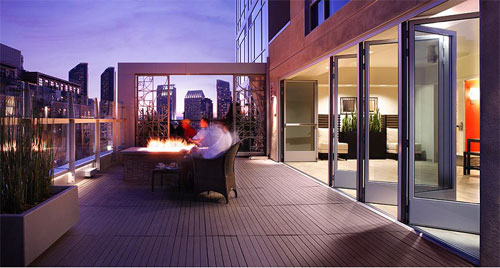 |
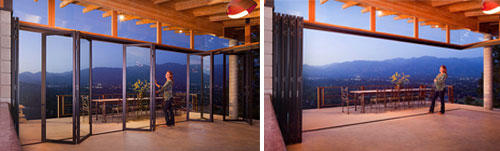
Operable glazed walls provide flexible space that open between indoor and outdoor spaces.
Photo courtesy of NanaWall, Inc. |
- Water Penetration: Clearly water entering through a closed glass wall would be disconcerting at least and damaging to the building at worst. Gentle rainwater cascading down a vertical plane to the ground is one thing, but more typically, fenestration needs to resist wind-driven rain. Since water penetration must not occur, water must either be sealed out completely or managed so that if it does penetrate any part of the system, it will drain away harmlessly. Manufacturers routinely test operable glass wall systems for resistance to water penetration by placing them under pressure to determine the performance in extreme weather. The results state at what pressure the operable glass wall fail. Some inswing and outswing folding operable glass walls with a raised sill have results indicating no water leakage at 12 psf or the equivalent of wind driven rain at 68 miles per hour. Air infiltration in these units is also well below the allowable limit.
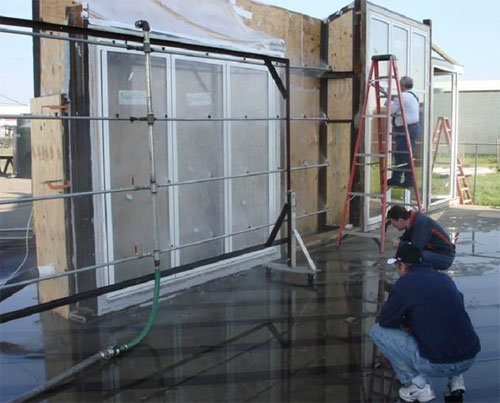 |
Testing of operable glass panels for water and air infiltration to verify performance.
Photo courtesy of NanaWall, Inc. |
- Security: Any operable building opening raises a question of how it is locked and secured when closed. Operable glass walls typically employ multi-point locking hardware as well as extra-long, tamper-resistant dual point locking rods between panels. This ensures that they meet or exceed all forced entry testing for commercial grade door panels. In enclosed malls, operable glass wall storefront openings also can provide a secure and protective dust-control measure for after-hours. For example, a bakery inside a mall had to remove the bread at closing then bring it back out in the morning as directed by the health inspector. By using weather-stripped operable glass walls they could keep the bread out all night and save valuable labor time.
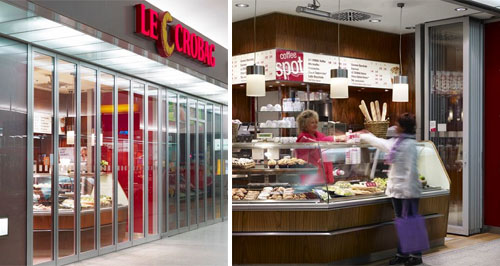 |
Operable glass walls used for interior applications provide security and flexibility of defining enclosed and open space.
Photo courtesy of NanaWall, Inc. |
- Durability: Opening and closing the glass wall over time will create normal wear and tear on the system so proper attention to a products ability to withstand that over time defines its overall durability. Commercial swing panels are routinely tested for 500,000 cycles and meet industry operational standards (AAMA920). Built-in adjustment and compensation points are typical to ensure continued ease of operation if building settling occurs. Reinforced structural posts provide internal strength and integrity. All of this plays to the longevity of the system and contributes to the useful life and sustainability of the operable glass wall.
- Acoustic performance: The measurement for the effective control of sound being transmitted through a material or assembly is a Sound Transmission Class (STC) rating. A higher STC rating means that more airborne sound is blocked by the component or assembly. Lower STC ratings mean that more sound passes through the components or assemblies adding to the background noise level in the space, degrading the ability to hear and understand speech. Operable glass wall systems significantly reduce noise between interior spaces while still allowing viewing or supervision and access to the divided area. Tested STC results represent complete systems including frames, header, jambs and sill. Operable glass walls can achieve sound transmission ratings between STC 32 – 45 depending on the type of glass being used. For exterior applications Outdoor-Indoor Transmission Class (OITC) is a standard used for indicating the rate of transmission of sound between outdoor and indoor spaces in a structure. It considers frequencies down to 80 Hz (Aircraft /Rail /Truck traffic) and is weighted more to lower frequencies. Operable glass walls can achieve OITC values 26 – 35 to block interference from outdoor noise.
Design Considerations
Operable glass walls create flexible spaces and can have a significant role in creating a successful building design with green and sustainable attributes. For example an operable glass wall has been used in a recreation complex to open up the areas between a warm up pool and a competition pool for large meets. When the wall is closed, it allows the facility to have a small swim meet on one side and swim lessons on the other. In this case operable glass walls that were fully weather stripped were specified to address both security and sound requirements.
Regardless of the design setting, there are two general types of large opening glass walls; folding and sliding. Discussed below are the different details and attributes of each of these types.
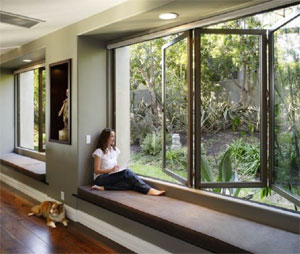 |
Folding glass walls can be full height from the floor or in large size continuous window openings
Photo courtesy of NanaWall, Inc. |
Folding Glass Panels
Folding panels can enclose a variety of shapes such as straight walls, open corners, window and door combinations, and even segmented curves. The folding glass wall consists of a number of hinged panels that fold together and slide out of the way. These panels may be hinged together in pairs or in a large number of connected panels like a train. The image below shows a few samples of how the doors could operate. Many opening configurations are possible with inward, outward or center-pivot opening options along with segmented curves and open corners. The swing door is a locking swing panel for easy entry egress within the wall. It is also possible to use this type with a corner-less folding system with paired panels. A special astragal is used to provide a weather tight seal at the corner. More common features of this operable glass wall type are below.
- Mounting: Folding doors can be top hung or floor mounted. The standard system is top hung, where the main weight is carried by the head track and the bottom track is a guide. The floor mounted system is recommended for applications where the load bearing capability of the header is a concern and in this case the main weight is carried by the floor track.
 |
Folding glass panels can be configured to stack in different patterns between left and right side stacking patterns.
Image courtesy of NanaWall, Inc. |
- Panel sizes: Generally, panel heights of up to 9’-0” and panel widths of up to 3’-3” can be framed in solid wood, aluminum clad over wood, or all aluminum, thermally broken or not. The frame material will affect the maximum width and maximum height, so verify heights and widths with the manufacturer. In height, aluminum folding panels are typically available up to 12’-0”. The openings can range from as few as two panels to as many as twelve panels, and with additional paired panels, virtually unlimited widths are possible.
 |
Folding panels can be configured to suit a corner free installation with a specially designed astragal to maintain performance.
Photo courtesy of NanaWall, Inc. |
- Frame materials: Aluminum frames are available in a large number of finishes and colors. Standard wood choices generally include douglas fir, pine, and some hardwoods but many other wood choices are available, including FSC certified wood and bamboo laminates.
- Glazing: Glazing options include clear insulated, insulated low-E, triple insulated low-E, bird protection glass, turtle glass, heat mirror, impact and other specialty glass.
It is important to note that folding doors are always stacked perpendicular to the opening. The amount of space that the folding doors will take away from the opening is dependent on the number of panels, panel width, height and thickness. There are a multitude of configuration options, paired panels allow for the best flexibility in configuration. We have already mentioned that folding panels can be thermally insulated with possible U values as low as .17 and water penetration test results of 12 psf. Also a non- conducting thermal break in aluminum systems eliminates condensation.
Sliding Glass Panels
A sliding glass wall is comprised of a number of individual, top hung sliding panels that ride on a single head track over a single floor track and stack in one or more parking bays outside the plane of the opening. The end to end closure of a single track sliding system creates a streamlined look and a tight weather seal. The sliding glass wall offers more flexibility in configurations than the folding glass wall. Other notable features of sliding systems include the following:
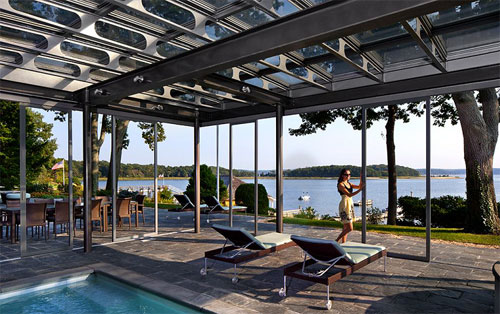 |
Sliding panels can be readily moved and stacked out of the way to create a seamless flow between enclosed space and outdoor spaces.
Photo courtesy of NanaWall, Inc. |
- Typical sizes and configurations: This type of large opening glass wall is used most often when the opening is greater than 40 feet or to achieve open corners on a 3 sided structure (like a patio). Again many room shapes can be enclosed with sliding operable glass wall panels, from curved walls to right angle corners.
- Sliding details: The single track design allows unattached panels to navigate multiple angle changes up to 90 degrees and stacking bays to be located virtually anywhere. Swing panels may be attached to side jambs or incorporated into the line of panels. Sliding panels are generally top mounted and for certain applications, sills can be eliminated completely - providing seamless transition between two spaces.
- Panel stacking options: Panels can be stored wherever convenient and accommodate segmented curves, open corners, and multiple angle changes. Single track sliding systems are often used when remote stacking is required for the stored panels. With individual sliding panel systems the sill track is only needed within the opening. In the parking bay only a head track is required, this allows freedom to locate the parking bay as far away from the opening as desired and completely out of sight. Some suspension systems permit the use of a track with right-angle turns and curves, allowing multiple options for space set-up and remote storage.
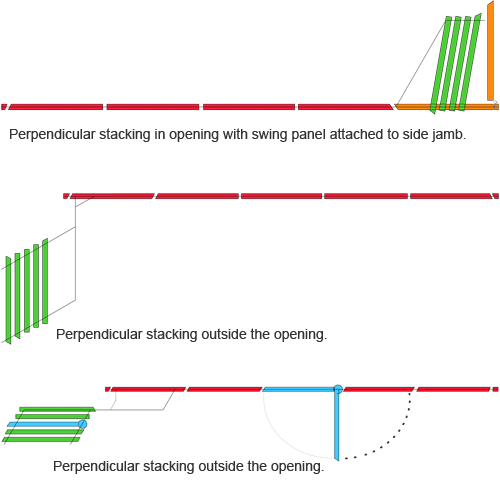 |
Some standard stacking options for sliding glazed panels.
Image courtesy of NanaWall, Inc. |
- Frame material options: Sliding panel systems are available in thermally-broken aluminum, solid-wood, and all-glass frameless options. All glass panels have aluminum top and bottom rails but no vertical stiles. All-glass systems provide weather protection for patios, decks and balconies as well as creating an insulating airspace for the building interior. Similar to the single track sliding system, the all glass system is a number of unattached panels sliding one at a time to the end of the opening. Unlike the sliding system the all glass panels must stack perpendicular to the opening.
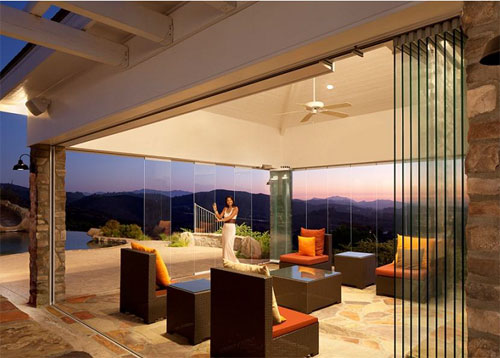 |
All glass, frameless panels provide clear vision in both closed and open positions.
Photo courtesy of NanaWall, Inc. |
- Glazing options: Sliding panels can accommodate single, double, or triple glazing and achieve U values as low as .34.
Green Building Contributions of Operable Glazed Walls
The green building movement in this country has given rise to quantifiable rating systems that seek to establish specific levels of achievement in the creation and performance of green buildings. The best known of these green building rating systems has been developed by the US Green Building Council and known as the LEED® rating system. This is actually a family of ratings that apply to different building situations (e.g. new or existing buildings, core and shell, interiors) and in some cases building types (schools, healthcare, retail, homes, etc.). All of the LEED rating systems have been subject to ongoing changes and updates since their inception, but the basic categories of defining green buildings have remained the same across the different versions over time. With that in mind, the contributions that operable glass walls can fall into several green building categories.
- Optimize Energy Performance: As part of an overall building envelope design, operable glazed walls can have a big impact on the energy performance due to their high performance when closed. They can also contribute to desirable passive solar heat gain that is controlled through the type of glazing specified and a large overhang. Well-controlled daylight can reduce the amount of artificial lighting needed and reduce the associated cooling load imposed by excess electric lighting. By incorporating controlled daylighting and passive solar strategies, solar gain can be used to an advantage in the heating season, and reduced in the cooling season. For example, the Passive House design is a rigorous voluntary standard for energy efficient buildings. This comprehensive system works with natural resources, capturing and applying free solar energy instead of relying on active systems. High performance triple-glazed windows, super-insulation, an airtight building shell, limitation of thermal bridging and balanced energy recovery ventilation make possible extraordinary reductions in energy use and carbon emission. Operable glass walls can meet this exacting standard using triple glazed argon filled glass and thermally broken frames.
- Materials and Resources: In some cases operable glass walls are available with some recycled content, particularly in the case of aluminum components. Panels can be salvaged and re-used in other buildings at end of service. Single component limits or reduces scrap and construction site waste. Manufactured in the USA means regional material contribution is possible.
- Indoor Environmental Quality: Large format operable glass walls provide the notable and desirable addition of daylight and views. While operable glass walls are able to maximize natural daylighting and provide flexible space, there are many options to mitigate excessive heat gain or loss with the large glazed area. In the open position, operable glass walls provide ample natural ventilation. Finally, since minimum paints, coatings, adhesives, or harmful sealants are needed they do not contribute to VOC content in the indoor air.
- Innovation in design: With green design, size matters. Building size is a significant contributing factor to resource efficiency and in the end will affect energy use also. The move to smaller and more efficiently planned spaces makes flexibility, functionality, and expansion capabilities all the more important. Operable glass walls do just this, whether in an exterior wall providing a variable connection to the outdoors or in an interior space allowing for different room configurations with the operable glass wall opened or closed.
A number of homes designed for the Solar Decathlon have used large operable glass walls, citing the ability to nearly double the size of the home when the folding glass doors were open. Any amount of exterior space can be appended to an interior space using a large opening glass wall. The 2009 Cornell University team used these walls with low-emissivity glass to open the interior of the house into the exterior courtyard, allowing for cross-ventilation, interior-exterior spatial fluidity along with control of the solar heat gain from the large glass surface. This connection to the outdoors also brings all the health benefits of the outdoors to an interior space: fresh air and unlimited views, all controlled by the user. Fresh air, natural lighting and a connection to the outside have been shown to improve the overall well-being of building occupants.
Specifying Operable Glazed Walls
When it comes to specifying the most appropriate operable glass wall for a particular building, especially a green building, the first place to look at is performance criteria. Make sure to compare similar testing methods between manufacturers and in particular look for NFRC certified and labeled systems. Water penetration should be tested by ASTM E-547 noting that the sill configuration will have an influence on the results. Air infiltration testing under ASTM E-283 will indicate cubic feet per minute per linear feet of crack. Structural Load Deflection testing is carried out under ASTM E-330 and will be dependent on the size of the panels for results. Finally, Forced Entry Resistance is commonly tested through AAMA 1304 and CAWM 300-96 requirements.
The choice of frame materials is important to specify appropriately. A wood clad folding system is an exterior facing of extruded aluminum attached to laminated wood. The extruded aluminum cladding is typically held away from the wood creating a ventilated rain screen, accomplishing no build up of moisture furthermore protecting and isolating the exterior wood. The wood clad folding door frame is the most energy efficient and weather resistant of all the operable glass walls. This is the door type that water leakage has been tested to 12 psf and has U Values as low as .17. Both folding and sliding operable glass walls are also available in a solid wood frame. Although wood frame units can’t meet the impressive U values of the clad walls, with triple glazing and argon fill, the folding operable glass walls have a U Value of .19 and no uncontrolled water entry at 12 psf. For sliding wood frame operable glass walls low U Values are in the range of .21. Large opening glass walls are available with Forest Stewardship Council Certified wood frames and in a number of different wood types with many different finishes. In addition, look for eco-friendly water-based pre-treatment on wood.
A thermally broken, aluminum folding panel system is designed to provide an opening glass wall for openings up to 39 feet wide. It is available as both a folding and a sliding door. It is appropriate for most residential applications where higher levels of resistance to air and water infiltration are desired. A non-conducting thermal break in aluminum systems eliminates condensation and heat/cold transfer. These are recyclable aluminum frames with 25% recycled content and eco friendly powder coated finishes. Some aluminum framed folding wall systems meet the requirements of Miami/Dade and AAMA Hurricane certification. These systems are suitable for low and mid-rises.
With the frame selected, the glazing infill options need to be finalized. Typically, most applications use insulated low-E glass but specialties are available with different numbers of glass lites and coatings. Obscure, acoustic laminate, impact resistant, art glass, or even solid material can be inserted in wood or aluminum frames. In some cases frames can shipped unglazed and specialty material can be inserted locally.
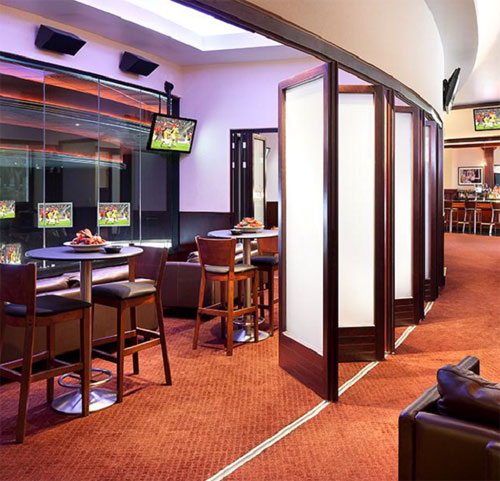 |
Glazing options include clear and frosted glass or opaque panels in some cases.
Photo courtesy of NanaWall, Inc. |
Sill choice depends on the environment of the operable glass walls. If water penetration is a concern a raised sill can be used. Flush and low profile sills are used where water infiltration is not a concern and if ADA requirements must be met. Surface mounted flush sills are available for interior applications. In some situations the sill may be eliminated entirely creating a seamless transition between two spaces. Sills are typically thermally broken.
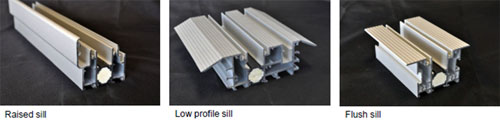 |
When specifying details of operable glass walls, the choice of sill profiles will affect the overall performance and weather resistance of the system.
Photo courtesy of NanaWall, Inc. |
Hardware in operable glass walls includes a number of choices. Locking options exist for the main entry panels of the operable glass wall. Generally, the door can be prepped for hardware during production and hardware is supplied by others. Different handle finishes are also available. Door panels can be specified meet ADA recommendations even in closed position. Such a system opens by opening the two end swing doors and folding the folding panels up against the swing panels for a clear opening.
In areas where insects are a problem collapsible screens are an option. Typically, pleated polyester mesh screens collapse and move out of the opening for maximum space and are is designed to be out of view when not in use. Screens can be used as main door while the door system is open.
Conclusion
Operable glass walls offer designers the ability to create flexible spaces that are able to seamlessly bring the outdoors in, provide daylighting and natural ventilation, and capitalize on beautiful views. Large opening glass walls with thermally broken frames and low U Value glazing eliminate the high solar heat gain or heat loss that may come with increased opening size. Some large opening glass walls are able to meet the stringent requirements of the Passive House requirements. Large opening glass walls can be used in applications as varied as single detached residential to interior office space to large scale openings 300’ openings for sports venues.
Case Studies
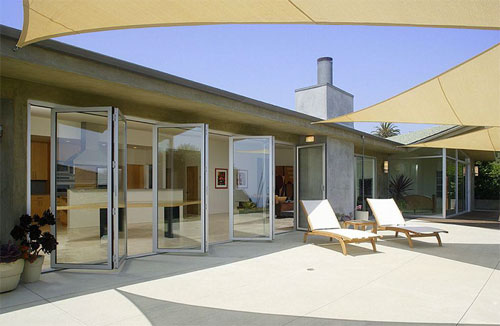
| St Francis High School, Watsonville CA |
|
Fresh air, natural lighting and a connection to the outside have been shown to improve the overall well-being of all occupants of a building. This California High School Art and Science Center wanted to expand their useable teaching space and connect with the outdoors. Therefore they selected folding operable glass panels to meet these objectives and create an inspiring design environment for students. |
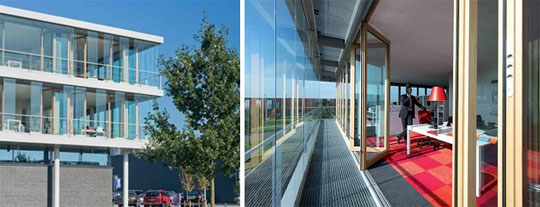
| Comfort Office Nijverdal, The Netherlands |
|
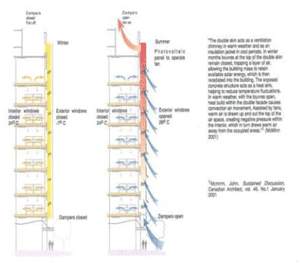 Architect Wolfgang Herich compares the design of his new office building in the Dutch town of Nijverdal to a sailing ship. Powered by the elements, this 27,000 sf three-story office, gallery and showroom can be actively controlled by its users. Completed in 2010, the designers and engineers targeted a goal of a climate-neutral sustainable building that uses less technology and more physics. By using an all-glass operable wall system, they created an intelligent, user-controlled building envelope that reduced energy consumption while increasing human comfort. A double wall façade creates an accessible façade corridor allowing for independent operation, protection from the elements, and a thermal barrier between the indoors and outdoors. Architect Wolfgang Herich compares the design of his new office building in the Dutch town of Nijverdal to a sailing ship. Powered by the elements, this 27,000 sf three-story office, gallery and showroom can be actively controlled by its users. Completed in 2010, the designers and engineers targeted a goal of a climate-neutral sustainable building that uses less technology and more physics. By using an all-glass operable wall system, they created an intelligent, user-controlled building envelope that reduced energy consumption while increasing human comfort. A double wall façade creates an accessible façade corridor allowing for independent operation, protection from the elements, and a thermal barrier between the indoors and outdoors.
Most double-skin systems are designed to separate the inside climate from the outside. Few have the flexibility to allow for a seamless transition between the inside to the outside. Here users may decide to open the windows or not thus regulating their own balance of heat and fresh air supply without the use of a mechanical system. Studies have shown that rather than distracting occupants, views of the changing face of nature increases concentration and focus.
The use of operable glass wall systems in this application provides natural ventilation, natural lighting, and enhanced well being and productivity all while reducing energy and CO2 emissions and lowering long term fuel costs. |
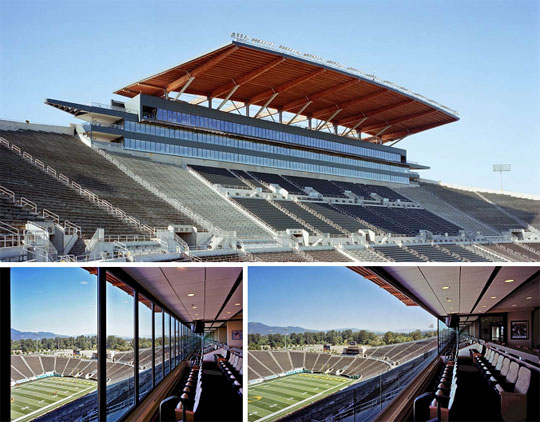
| University of Oregon, Autzen Stadium |
|
At the University of Oregon, Autzen Stadium, the window walls open the press level and suites to the field. There are 40 panels that open to the left and 40 panels that open to the right side at the upper press level and the entire wall takes 20 minutes to open. The second and third levels are suites that can be independently opened. An operable glass wall was chosen for this application because it provided a clear view of the field when open and yet in inclement weather the thermally broken system protects the occupants from the cold and still provides a large window for viewing.
Installed at over 100 stadiums throughout North America, operable glass walls have been part of the sports fan experience for national winning sports teams. Innovative operable glass walls bring the fan base together and provide unique event experiences. The key is proper design to determine the right configuration based on clearly defined design objectives to accommodate specialized design challenges. Innovative operable glass walls create exclusive and unique suite facades, suite space divisions, restaurant entrances, and attractive fan areas while expanding the usability of these areas far beyond game day. Further, they are typically easy to use, allowing the occupants the choice to have the suite open or closed to the arena. When open, the fan experiences the action and crowd but when closed, the system provides an oasis of calm even during the loudest of events. In the off-season, the weather resistant systems protect interior spaces and furnishings from exposure and/or unauthorized entry. |
Peter J. Arsenault, FAIA, NCARB, LEED AP practices, consults, and writes about sustainable design and practice solutions nationwide. www.linkedin.com/in/pjaarch

 |
NanaWall Systems provides operable glass wall systems for large architectural openings. With over 25 years of experience, NanaWall is the recognized industry leader trusted to provide opening glass wall systems with countless style options, unsurpassed durability and superior performance—all based on a foundation of testing, research and innovation. www.nanawall.com |