This CE Center article is no longer eligible for receiving credits.
Modern Bathroom Fixture Technologies
Let's assume, for a moment, the best of all possible worlds. Your client is deeply committed to sustainability and is building a massive project with a loose schedule and an unlimited budget. You now have every
possible advantage in designing and building a fully green monster. As you arrive at the task of selecting and specifying products and systems for the bathrooms, what must you consider to secure your place in the pantheon of modern sustainable design?
High-efficiency toilets. Begin with the basics. Many products will
be labeled "High Efficiency," but what does that mean? As it happens,
the EPA has created a set of specifications and requirements for
high-efficiency toilets (HETs), which conform to the following
performance specifications:
- Water Consumption of 1.28Gpf/4.8Lpf or less at original
factory setting.
- Water Consumption of 1.68Gpf/6.8Lpf or less with tank
trim adjustment.
a) Fill valve set to highest setting (1/2 inch below overflow tube)
b) Pilot-style fill valve or ballcock with minimum fluctuation in
water level
c) Extra buoyant after-market flapper
- 350g "uncased" waste removal with trap seal restoration
- Meets all ASME performance requirements
The EPA also has standards for a number of products, but reserves the use of the term "high efficiency" for toilets only. The California Urban Water Conservation Council in Sacramento has created standards for other high-efficiency products, and is encouraging the use of these
products by offering rebates. These include toilets, urinals of less than 0.5 gpf, clothes washers, and even a pressurized water broom, which is meant to replace high-pressure spraying for the cleaning of sidewalks and similar surfaces.
Sensor-operated fixtures represent another category of product that offers new solutions and challenges. Each of us is likely to have
encountered this technology, as it is commonly used in public restrooms to operate faucets, toilets and urinals, as well as non-water bearing devices such as hand dryers and soap dispensers. The sensors use infrared emissions which, when reflected back to the sensor by the
proximity of the user, signal the device to begin to operate.
Sensor-operated fixtures. Sensor technology offers a number of advantages and flexibilities to designers of public washrooms, and not all of them relate to water efficiency. Because the user needn't touch the fixtures to operate them, sensor-operated devices tend to be cleaner and more sanitary. Also, because the user does not mechanically
operate them, they are less likely to break from abuse, misuse or
overuse, thus reducing maintenance costs. Most sensor devices have a very positive life-cycle assessment.
Water conservation is a major reason for the employment of sensors, however, and a 30 percent reduction in water consumption is generally the result. Flexibility of use is a major contributor to their success. Faucet sensors, for instance, can be set to start either as a direct result of user proximity; based on user proximity and then stop after a set time; or by detecting the user and starting momentarily afterwards, among the options. In the case of toilets and urinals, the operation begins when the sensor no longer detects the user, and some sensor-operated toilets feature a button for optional manual use in the event of sensor failure. Still others disable the manual switch for a period of time after a flush, in order to discourage unnecessary extra flushes.
Cost-effective and sustainable, sensor-operated fixtures are
effective in operations and are a good retrofit option.
 |
Both sensor technology and wall-mount toilet bowls typically require more up-front cost for installation, but both produce significant long-run benefits and savings: better water efficiency, reduced maintenance and repair costs, and even saved space.
Photo courtesy of TOTO |
|
Comparing and Specifying Toilets
Sensor-operated or otherwise, flush toilets represent a significant
challenge to the conservation-minded. As mentioned earlier, toilets can consume up to one-third of the total water used in most buildings. When creating specifications for green washrooms, the type of toilet implemented will make a significant difference. The table shows the basic types of toilet fixtures.
Commercial toilets are procured as two separate parts: the bowl and the flush valve. (Residential toilet fixtures will generally, but not as a rule, be marketed and sold as a unit.) As such, it is crucial to understand not only what flush valves are available, but how they perform when paired with particular bowl-types.
 |
Sources: TOTO and Zurn Engineered Water Solutions |
|
Flush valves have been the preferred flushing device for commercial, institutional and industrial applications for more than 80 years. The metal finish is generally sanitary and vandal-resistant, while the technology provides a short post-flush recovery time and adaptability to new technologies such as sensor operation. There are two main categories of flush valves: piston-operated and diaphragm operated.
As the technology improves, both types of flush valves are becoming more and more sustainable. Ultra-smooth bowl glazings improve water flow, while chemical and corrosive-resistant materials, as well as filter systems, are incorporated into the designs of piston and diaphragm internal components in order to extend the device life and reduce the likelihood of unnecessary valve run-on.
An important consideration in terms of performance and conservation is pairing: which bowls work best with which valves? In general, it may be advantageous to match bowls and valves from the same manufacturer, assuming that those making both components understand best how one benefits, or improves the performance of, the other. Using this rationale, some sustainability advocates contend that "paired performance" of bowls and valves is likely to be an increasingly common measure of performance in overall indoor water efficiency. As water efficiency becomes a more highly sought-after aspect of high-performance sustainable buildings, one can expect paired performance to become the norm, and may perhaps be included as a baseline in some standards for commercial washrooms.
Building designers and owners deserve a pat on the back for pushing the industry as far forward into green territory as possible, given the constraints within which they design,
budget and manage projects. With sustainable energy use and a reduced global footprint in mind, we've created and implemented any number of innovations calculated to keep energy use, as well as embedded energy, low. Yet in the area of water conservation, there is room to expand.
The concept of "water efficiency" has recently taken on new urgency in the building design profession. Experts on global warming theory point to water as a rapidly dwindling resource-the result of rising
temperatures and sea levels. Only 0.5 percent of the earth's water is potable and available for use, and of that amount up to half could
ultimately become contaminated by seawater, according to a recent study from Ohio State University. With such challenges in mind,
architects, engineers, contractors and facility managers are now
implementing inventive retention, recycling and reuse strategies for water, as well as basic conservation strategies.
So then what's missing? In a word, "comprehensiveness." Too often, our approach to water systems has lacked holism and system-wide analysis. "Water is often subjugated in status to energy, but water is
energy," says Gunnar I. Baldwin, LEED AP, Water Efficiency Specialist with TOTO USA, Inc. "Yet there's so much embedded energy, and that has not been well broadcast, although the EPA and some green-building
professionals have recently been emphasizing this."
So what of the energy inextricably embedded in water? How much electricity, how much carbon output, goes into the treatment and delivery of usable water? A broad strategy for water conservation can't factor in energy and water separately.
The Energy in Water
About 8 percent of all electricity used in the United States is expended in the delivery and treatment of potable water, according to Benjamin Grumbles, Assistant Administrator for Water at the EPA. In California, the most populous state in the nation, 19 percent of the electricity is used for delivering water, and a staggering 32 percent of the state's natural gas consumption powers the treatment of water and wastewater.
In rough numbers, the American public water supply and its
treatment facilities consume 50 billion kilowatt-hours annually-about as much electricity as is needed to power 4.5 million private homes each year. And this number is conservative; it only includes the energy used to bring potable water into the public consumer supply. Still more energy is used to deliver sewage and wastewater to treatment plants, and more still by rural homes using electric pumps for well water.
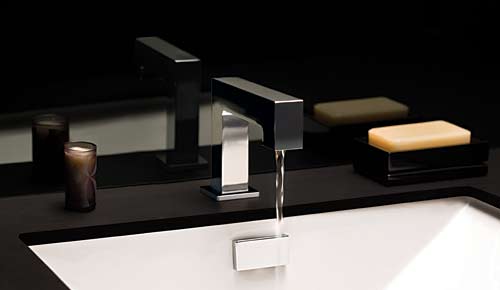 |
The fixture industry is competing heavily to produce sleek, efficient designs that will satisfy both specifiers and end-user. Some faucets, such as the model pictured, serve the need for an inexpensive, sensor-operated fixture with efficiency well beyond the 1992 EPAct baseline.
Photo courtesy of TOTO |
|
On the macro level the dilemma is obvious. Let's translate it for a moment to the micro level. How long do you run the hot water when you shower? Or wash dishes? Run a hot water faucet for just five minutes, and the user has consumed power equivalent to that used by a 60-watt light bulb after burning for 14 hours. The energy embedded in water, apparently, is massive; saving a little water saves a lot of energy.
Water efficiency, then, is a challenge for our nation as a whole, and as individuals. Where end-user behavior cannot be predicted or
controlled, building design and operations professionals are uniquely placed to create and implement water-saving strategies and solutions. Vital to the effort is basic knowledge of sustainability issues and
guidelines, cost-effectiveness strategies, building occupant and tenant desires, construction costs and limitations, as well as building codes, regulations and standards.
Water Use, Indoors and Out
By juggling these variables successfully, green building professionals will have any number of opportunities to create sustainable structures, transitively turning their occupants into eco-warriors. In the design or analysis of new construction, it is first useful to look at system-wide water conservation approaches.
Technique |
Indoor/Outdoor
Application |
Description |
|
Indoor |
Makes use of rainwater,
gray water, and recycled or any otherwise non-potable water (for toilet-flushing, or site irrigation) |
| Recirculating systems |
Indoor |
For centralized hot water
distribution |
| Point-of-use water heating systems |
Indoor |
For locations more distant from the central hot water (eliminating the high level of embedded energy in delivery of pre-heated water) |
| Water Budget approach |
Outdoor |
Makes use of regional
guidelines and data (such
as California's Irrigation Management Information System) to schedule irrigation |
| Micro-irrigation |
Outdoor |
For non-turf areas.
Eliminates wasteful sprinklers and sprayers. |
|
Outdoors: These techniques can be combined with other outdoor
conservation and recapture strategies, such as rainwater harvesting. Other strategies for reducing water use outside the building include
separate water meters for the building and the landscaping, and use of state-of-the-art irrigation controllers as well as simple strategies like self-closing nozzles for hoses.
The benefit of such approaches, notes Marty Eberhardt, executive director of the Water Conservation Garden in El Cajon, CA, is that they address the main challenge of system-wide retrofitting. "The greatest
challenge to landscaping conservation is landscape retrofits," says Eberhardt. "Because it costs up-front money that people don't want to pay, there can be resistance to swapping out old existing irrigation systems for up-to-date sustainable ones. New construction is easier because
landscaping costs are already being discussed." Eberhardt notes that some regions offer rebates for the installation of weather-based irrigation controls, known as WBICs, which can offset system upgrades.
Another challenge is simply the attitudes of building operators. Irrigation strategies are crucial, regardless of whether the buildings are located in areas of severe drought, as was recently the case in the American Southeast.
"Those designing and building current irrigation systems have thus far not embraced sustainable strategies, especially in areas like New England which are mistakenly seen as ‘water-rich,'" says Raymond Jack, Director of Public Works in Falmouth, MA, and president of the Massachusetts Water Works Association. According to Jack, numerous municipalities faced with water shortages are planning outright bans on irrigation of any kind: "A smart long-term strategy for irrigation and
landscaping contractors would be to introduce sustainable elements as soon as possible," adds Jack. "Short-term profit shortfalls are a very small price to pay in the face of having one's entire industry banned."
The best way to assess the conservation value of a particular
product or system approach is the cost per acre-foot, contends Chris Robbins, Water Conservation Supervisor for San Diego's Water Department. "We want to implement programs that are typically less expensive than the purchase price of raw water," he explains, adding that regional offices such as his offer guidelines for water conservation.
Indoors: Water conservation strategies inside the building should also focus on system-wide challenges. For example, while gray-water
systems can reuse supply water for toilet flushing or other non-potable uses, building designs need to ensure the minimum water quality required for all downstream systems. In addition, specific technologies needed for effective solids composting and urine separation are not yet commercially available.
 |
Toilet flushing accounts for the most water consumption in commercial buildings today-as much as 1.2 billion gallons every day. Instead of 1.6-gallon-per-flush valves, water
closets are now available with highly effective, 1.28-gpf
versions with hands free sensor-operated flush valve and bowl combinations. A large water spot, siphon jet flushing and a fully glazed trapway help ensure adequate carry.
Photo courtesy of
Zurn Engineered Water Solutions |
|
|
Still, bathroom strategies, the primary focus of this continuing
education unit, provide one of the best methods for conserving water. In most buildings, toilets consume the most water-usually between 25 percent and 33 percent of the total amount. With a U.S. population of 300 million, one can conservatively estimate that 500 million gallons of water are used each day, just to flush toilets. Now factor in showers, baths, shaving, and hand and face washing: The United States easily uses more than a billion gallons of water daily in its bathrooms. That's the reason toilets were mandated to go from 3 or more gallons per flush to 1.6 gallons per flush (gpf) in the Energy Policy Act of 1992. Even an overall strategy that conserves only an extra one percent of
bathroom usage would save more than 10 million gallons of water a day.
The key is to focus on the prudent application of these strategies with appropriate fixtures and fittings that are compatible with the overall
system engineering in commercial structures, multi-family residential buildings and high-use facilities, such as airports and arenas. The reason is that poorly employed sustainability strategies can wind up wasting more water than they save, notes Jack: "Many varieties of low-flow toilets have wasted water rather than saving it, because one flush is not enough." Education and awareness of end-user needs and the meanings and long-term effects of fixture specifications help solve such dilemmas.
The History of the Low-Flow Standard
The movement to reduce unnecessary water use, particularly in flush toilets, emerged in 1972 when Sweden passed its 6-liter code for toilets. Four years later the Swedish technology was introduced to the rural United States, in hopes of helping homes without access to a public water supply. Low-consumption (LC) toilets were already in use aboard trains and yachts as early as 1968. By 1978, a Penn State study showed that LC toilets were a simple solution to septic system failure; leading to the 1982 inclusion of low-flow toilets in ANSI standard 112.19.2, a voluntary national standard still on the books today.
In fact, the national water-conservation movement has been an
outgrowth of problems with sewage treatment, more so than with drought. In Boston, for instance, strict water codes were passed in 1987 because of concern for the cleanliness of Boston Harbor.
The strategy was to reduce the burden on an overworked sewage treatment infrastructure, which would hopefully reduce the amount of polluted storm water runoff entering the waterways.
Amazingly, most U.S. toilet manufacturers failed to provide the technology, which was more frequently being adopted as required code. So in 1992, the Energy Policy Act (EPAct) actually required manufacturers to apply a 1.6-gpf standard to all new toilets. Many states and municipalities then provided additional momentum in the form of new codes and rebates. Since then, low-flow fixtures have generated debate on the true effectiveness of the water savings, as many users flush more than once.
The key for specifiers has been to focus on "paired performance," explains Sean Martin, VP Marketing and Sales with Zurn Commercial Brass and Fixtures Operations. "Design engineers have focused on the paired performance of water closets, urinals, and lavatories to deliver maximum top loading capability, anti-clogging fixture evacuation, line carry, and lower overall life cycle cost," explains Martin.
Another possibility, says TOTO's Baldwin, is that there may be fewer commercial-type toilets in public and commercial buildings, and instead more tank-type models, which can be quite effective. Issues of
maintenance and vandalism will still influence choice, however. "The noisy blow-out bowls used in airports and bus stations are exempted from EPAct, but they are there to deal with human mischief, not to save water."
1992 Energy Policy Act: maximum flow rates
Fixture |
Max. Flow Rate |
|
1.6 gpf |
| Urinals |
1.0 gpf |
| Faucets |
2.2 gpm (2.5 before 1998) |
| Faucets - commercial |
0.25 gal/cycle, or .5 gpm |
| Metering Faucets |
0.25 gal/cycle @ 80 psi |
| Showerheads |
2.5 gpm |
| Spray Rinse Valves |
1.6 gpm (as of 2005) |
Source: U.S. Environmental Protection Agency |
|
Realistic Tests for Low-Flow
As Jack expressed, concern over the effectiveness of low-flow toilets has contributed to their slow adoption. As seen in customer opinion
surveys, the performance of LC toilets is required by the user to be
virtually 100 percent effective, meaning that the user does not want to see any apparent residual waste after flushing. In recent years, the introduction of "realistic media testing" for low-flow toilets has provided design professionals, contractors and building managers with a more genuine appraisal of likely per-fixture water use by building occupants.
In the realistic media tests, solids are flushed to assess the
performance of the toilet bowl and of the drain line carry. As early as 2000, ANSI conducted such testing concurrently with similar studies being
undertaken in Canada, which were criticized for using such materials as sawdust, paper balls, sponges and dye, and the like, which did not adequately simulate clogging. Similar tests were performed again in 2003, resulting in similarly poor assessments of performance. Then, in Japan, tests employing both commercial and residential types of toilet paper were shown to much more accurately predict clogging issues; the inclusion of a soybean paste about the same consistency and density of human waste, improved the results significantly. These were "realistic" experiments because they combined both sinking and floating media (in this case, polystyrene balls).
Canadian testing groups borrowed aspects of the Japanese testing methods-even including an imported soy-paste medium-in 2002. Led by the consulting group Veritec, the Maximum Performance (MaP) Testing Program was launched, and it soon confirmed that "some
certified and commercially available models do not meet customer expectation," said Bill Gauley who co-authored Veritec's study with John Koeller. Furthermore, MaP showed that low-flow toilets do work, when the prevailing opinion had been that low-flow toilets were ineffective.
The success of MaP testing in determining toilet performance, and of requirement programs such as the Los Angeles Supplementary Purchase Specification in demonstrating significant water conservation, eventually led to the development of UNAR, the Uniform North American Requirements. The UNAR specifications can be adopted by any municipality on a voluntary basis, and have been shown to contribute significantly to U.S. and Canadian conservation goals.
Still, LC toilet testing is not without its flaws, and the MaP test scores are often marketed heavily as proof of a robust fixture design. Architects, engineers and plumbing contractors should take care not to rely simply on a single rating number conspicuously advertised on a model that tested well. For instance, a model tested in 2004 may have a similar score to a model tested in 2005, but in 2005 MaP testing started encasing the solid media in latex sleeves. This had a dramatic effect on bowl water density, and thus on test results. For this reason some test scores cannot be compared directly.
The EPA's WaterSense program
While low-flow designs are well established, the drive to encourage their use is still new. In 2006, the U.S. Environmental Protection Agency (EPA) launched its WaterSense partnership program. Similar to its sister program EnergyStar, the voluntary program aims to educate private and commercial end-users about existing water-saving technology. Furthermore, as with EnergyStar, the EPA will begin to provide a labeling system for water-using products. The products to be labeled will include, but not be limited to:
- Bathroom faucets
- Weather-based irrigation controllers
- Soil moisture sensors
- Drip irrigation
- Commercial toilets, faucets, laundries, and the like
- Autoclave water valves
 |
For high-end but
sustainable homes, clients tend to prefer
one-piece toilets, which are easier to keep clean.
Many high-end toilets, like the one pictured,
feature efficiencies and savings, which
will pay for the added cost of the unit within
the first few years after installation.
Photo courtesy of TOTO |
|
It is important to note, as with MaP testing and voluntary
conservation standards like UNAR, EPA's WaterSense program creates no requirements for manufacturers, their products or the consumers who use them. In fact, some green-building advocates have criticized the EnergyStar program for misleading consumers about the energy used and saved by the products wearing its label; once again, a single rating or score is not enough information on which to judge the performance of a product as it relates to conservation and sustainability. The design professional should be fully aware of the weaknesses and pitfalls of such programs.
Conversely, programs like WaterSense and EnergyStar have the benefit of educating the broad consumer population about efficiency and conservation. According to Treehugger.com, "the WaterSense site has numerous practical tips available for anyone looking to reduce their water consumption (and, perhaps, their water bill). As water
conservation is becoming a critical issue for many U.S. communities, it's good to see the EPA adding this resource." So WaterSense, it is hoped, will help educate clients to be more responsive about water efficiency-an elevated consciousness that will only increase as the WaterSense label is applied to more products.
"Architects who want to specify for water conservation should
definitely familiarize themselves with WaterSense," says Al Dietemann, a board member at the Alliance for Water Efficiency. "The WaterSense label is already appearing on high-efficiency toilets and high-efficiency
urinals, and will soon appear on some faucets and aerators.
Typical Water Conservation − Industrial/Commercial
The following tables represent the example of an office setting with 100
occupants, 50 male and 50 female. The EPAct of 1992 provides
the baseline figures for consumption.
(Figures for frequency of use come fromWater Use and Conservation by Amy Vickers.)
|
|
|
|
Modern Bathroom Fixture Technologies
Let's assume, for a moment, the best of all possible worlds. Your client is deeply committed to sustainability and is building a massive project with a loose schedule and an unlimited budget. You now have every
possible advantage in designing and building a fully green monster. As you arrive at the task of selecting and specifying products and systems for the bathrooms, what must you consider to secure your place in the pantheon of modern sustainable design?
High-efficiency toilets. Begin with the basics. Many products will
be labeled "High Efficiency," but what does that mean? As it happens,
the EPA has created a set of specifications and requirements for
high-efficiency toilets (HETs), which conform to the following
performance specifications:
- Water Consumption of 1.28Gpf/4.8Lpf or less at original
factory setting.
- Water Consumption of 1.68Gpf/6.8Lpf or less with tank
trim adjustment.
a) Fill valve set to highest setting (1/2 inch below overflow tube)
b) Pilot-style fill valve or ballcock with minimum fluctuation in
water level
c) Extra buoyant after-market flapper
- 350g "uncased" waste removal with trap seal restoration
- Meets all ASME performance requirements
The EPA also has standards for a number of products, but reserves the use of the term "high efficiency" for toilets only. The California Urban Water Conservation Council in Sacramento has created standards for other high-efficiency products, and is encouraging the use of these
products by offering rebates. These include toilets, urinals of less than 0.5 gpf, clothes washers, and even a pressurized water broom, which is meant to replace high-pressure spraying for the cleaning of sidewalks and similar surfaces.
Sensor-operated fixtures represent another category of product that offers new solutions and challenges. Each of us is likely to have
encountered this technology, as it is commonly used in public restrooms to operate faucets, toilets and urinals, as well as non-water bearing devices such as hand dryers and soap dispensers. The sensors use infrared emissions which, when reflected back to the sensor by the
proximity of the user, signal the device to begin to operate.
Sensor-operated fixtures. Sensor technology offers a number of advantages and flexibilities to designers of public washrooms, and not all of them relate to water efficiency. Because the user needn't touch the fixtures to operate them, sensor-operated devices tend to be cleaner and more sanitary. Also, because the user does not mechanically
operate them, they are less likely to break from abuse, misuse or
overuse, thus reducing maintenance costs. Most sensor devices have a very positive life-cycle assessment.
Water conservation is a major reason for the employment of sensors, however, and a 30 percent reduction in water consumption is generally the result. Flexibility of use is a major contributor to their success. Faucet sensors, for instance, can be set to start either as a direct result of user proximity; based on user proximity and then stop after a set time; or by detecting the user and starting momentarily afterwards, among the options. In the case of toilets and urinals, the operation begins when the sensor no longer detects the user, and some sensor-operated toilets feature a button for optional manual use in the event of sensor failure. Still others disable the manual switch for a period of time after a flush, in order to discourage unnecessary extra flushes.
Cost-effective and sustainable, sensor-operated fixtures are
effective in operations and are a good retrofit option.
|
Both sensor technology and wall-mount toilet bowls typically require more up-front cost for installation, but both produce significant long-run benefits and savings: better water efficiency, reduced maintenance and repair costs, and even saved space.
Photo courtesy of TOTO |
|
Comparing and Specifying Toilets
Sensor-operated or otherwise, flush toilets represent a significant
challenge to the conservation-minded. As mentioned earlier, toilets can consume up to one-third of the total water used in most buildings. When creating specifications for green washrooms, the type of toilet implemented will make a significant difference. The table shows the basic types of toilet fixtures.
Commercial toilets are procured as two separate parts: the bowl and the flush valve. (Residential toilet fixtures will generally, but not as a rule, be marketed and sold as a unit.) As such, it is crucial to understand not only what flush valves are available, but how they perform when paired with particular bowl-types.
|
Sources: TOTO and Zurn Engineered Water Solutions |
|
Flush valves have been the preferred flushing device for commercial, institutional and industrial applications for more than 80 years. The metal finish is generally sanitary and vandal-resistant, while the technology provides a short post-flush recovery time and adaptability to new technologies such as sensor operation. There are two main categories of flush valves: piston-operated and diaphragm operated.
As the technology improves, both types of flush valves are becoming more and more sustainable. Ultra-smooth bowl glazings improve water flow, while chemical and corrosive-resistant materials, as well as filter systems, are incorporated into the designs of piston and diaphragm internal components in order to extend the device life and reduce the likelihood of unnecessary valve run-on.
An important consideration in terms of performance and conservation is pairing: which bowls work best with which valves? In general, it may be advantageous to match bowls and valves from the same manufacturer, assuming that those making both components understand best how one benefits, or improves the performance of, the other. Using this rationale, some sustainability advocates contend that "paired performance" of bowls and valves is likely to be an increasingly common measure of performance in overall indoor water efficiency. As water efficiency becomes a more highly sought-after aspect of high-performance sustainable buildings, one can expect paired performance to become the norm, and may perhaps be included as a baseline in some standards for commercial washrooms.
"High-Performance" Green Fixtures
In fact, water efficiency is already gaining importance in standards of sustainability commonly utilized by architects, such as the U.S. Green Building Council (USGBC) LEED® Green Building Rating System. (Water-conservation credits offered in LEED are explored in depth later in this education module). One could build a project with a host of futuristic power-saving and carbon-reducing elements, like photovoltaic windows or a geothermal heat-source capture, and still sacrifice a higher LEED rating by ignoring water use considerations.
So what constitutes a "high-performance fixture?" HETs make the grade as high-performance fixtures. In the main, the UNAR standard of 1.28 gpf (1.68 gpf for models with a field adjustment to the tank trim) satisfy the criteria needed to earn a superior performance rating.
The USGBC has also set a standard for what it calls a "green toilet"-an important element of the LEED for New Construction (LEED-NC)
rating-which should:
- Flush well with 1.28 gpf or less.
- Require minimal cleaning with environmentally unfriendly
detergents.
- Be user friendly and comfortable to all possible occupants and
visitors-in other words, meet universal design criteria and
flush quietly.
- Be the major tool in reducing indoor potable water consumption.
Let's look at a couple of high-performance models, to see what
features contribute to water conservation. For high-end residential
applications, there are one-piece standard gravity fixtures with a 1.28 gpf flush and a 3-inch wide valve-more than twice as large as the
conventional valves. A wide, glazed trapway will enhance its performance further. For commercial settings, 1.28 gpf flush is preferred over the EPAct baseline 1.6 gpf EPAct baseline, earning the fixture an HET designation. Pairing with a carefully matched flush valve is crucial, but the performance can be further enhanced by including an infrared sensor to operate the valve and a 2-inch-wide, fully glazed trapway.
In general, there are a few specifications that should also guide the choice of toilet fixture, some of which may relate only tangentially to the issue of conservation but are nonetheless important:
Finish. Finish, for instance, has been shown to contribute to performance in many studies. For the two examples above, the glaze on the porcelain or china used in the bowl and trapway was mentioned as a performance factor. Newer, smoother "nano-glazing" technologies are now available that appear smooth even under an atomic microscope, and feature an ionic barrier. The result is increased resistance to staining, bacteria and mold, as well as reduced maintenance needs. A damp cloth is sufficient to wipe the bowl sparkling clean. (Come to think of it, that will conserve water.)
 |
Because obesity has become a national health concern, many
building designers and owners are taking that into consideration by adding extra structural support for bathroom fixtures, such as wall-mounted toilets.
Photo courtesy of Zurn Engineered Water Solutions |
|
Flapper.Regarding durability, sensor technology can eliminate some concerns over the durability of the valves. Still, toilet flapper specifications are still critical. Chemical cleaners, tank additives and chlorine tablets entered the market place some time ago and began to cause many flappers to deteriorate faster than normal. The industry has made several attempts to create flapper standards which would be durable even under extreme exposure to chemicals, says John Koeller of the California Urban Water Conservation Council (CUWCC), based largely upon the earlier work of the Metropolitan Water District of Southern California and the Los Angeles Department of Water and Power for their procurement specifications.
Weight loading. Some testing has also been done to determine
toilet bowl adequacy in handling higher weights. This is not a delicate topic, but most health authorities agree that our country faces an obesity crisis, if not an epidemic. Today's fixtures have to be equipped to
handle higher loads, particularly in geographic regions with particularly high rates of obesity, and especially for wall-mounted models. Many of these tests are current or recently finished, and results should be available. Manufacturers should be able to direct a query to the proper test lab or published study.
High-Efficiency Urinals
Urinals represent an excellent opportunity to conserve water, because the technology has progressed significantly. Since the waste is
liquid-only, engineers developing "green urinals" have been aggressive in reducing the water required for an adequately clean and sanitary fixture after use.
As there are HETs, so are there HEUs, or high-efficiency urinals. According to the EPA, HEUs operate at 0.5 gpf or less-an enormous improvement over traditional 1-gallon urinals. What's more, new urinals are not necessarily needed to achieve these results. Retrofitting valves can suffice in many cases, and offers an opportunity to consider
replacing traditional valves with sensor-operated ones. (If cost is an issue, some valves can be retrofitted without being replaced.)
"High-efficiency urinals offer up to 87 percent savings over
traditional 1-gallon urinals," says Sean Martin, with Zurn Commercial Brass and Fixtures Operations. "The life-cycle cost per unit is only about $30-$40 per year, depending on what part of the country. And they can elevate the level of hygiene if they have hands-free operation."
Also, new urinal technology continues to improve. Some models combine computer-modeled shapes with ultra low flushing (ULF), as low as a pint per flush--0.125 gpf. Flushless, waterless urinals have also been introduced, and while they may have drawbacks in operations, many building managers have field-tested the products with considerable
success. The concessionaire at the Statue of Liberty since 1931, Evelyn Hill, recently installed waterless urinals in its men's room. The company believes, based on attendance at the national monument, that they may save as many as 385,000 gallons of water per year.
The challenges of waterless and ULF options, however, should be carefully considered. Flush-free urinals require cartridges to absorb liquid waste; the problem then is disposal of the cartridges-another sustainability quandary-as well as the cost of replacement cartridges. ULF valves may effectively clean the porcelain fixture, but may not use enough water to keep salts and minerals from collecting in the drainline. These deposits could ultimately lead to damaged plumbing.
A solution to both of these problems might be to create a fixture,
perhaps run with a special sensor valve, that operates at the ULF specs but occasionally flushes more water than normal. This would keep the bowls and pipes clean, and could still save up to 87 percent over the old 1-gallon flush standard.
Faucet Efficiency
EPAct included requirements for faucet flow rates. Residential lavatory faucets must be regulated by an aerator to 2.2 gallons per minute (gpm) or less, kitchen faucets to 2.5 gpm or less. Commercial faucet requirements vary by fixture type: handle-operated models are regulated by aerator to 0.5 gpm, while self-closing and sensor-operated ones are limited to less than .25 gallons per cycle.
As usual, however, the technology available is far greener than EPAct. While kitchen faucets need about a 2.5 gpm flow rate in order to fill a pot in a timely fashion, residential lavatory faucets can be satisfactory for the user when reduced to even a 0.5 gpm flow rate, and conservation-minded specifiers have begun to recommend aerators which deliver that flow rate. In commercial washrooms, metered faucets are common. These are generally mechanically operated fixtures that deliver water (at no more than .25 gal/cycle), then self-close. Many of these devices are built to allow the user to adjust the temperature before operation.
In most commercial washrooms, however, sensors are becoming the standard. But engineers have reached the limit of water-efficiency for sensor models: 0.08 gallons per cycle. Ironically, it is not user demand or engineering limitations which make this the limit. Rather it is the fact that other environmental considerations come into play. At less than 0.08 gal/cycle, battery disposal (or power use) takes a greater toll on the environment than is represented by the water that might have been saved.
The Massachusetts Water Works Association's Raymond Jack reminds project leaders that end-user considerations must come first, especially for specialized institutional projects. Take a senior center, for example: Such a residence will have aspects of multi-unit residential and healthcare facilities built into the configuration, but must also feel to its occupants like a home. No one has sensor-faucets at home, and furthermore they won't allow users to adjust the water temperature-a feature anyone would expect at home. In addition and interestingly, when one arrives at the most ergonomic model for seniors, one has probably arrived at the most water-efficient model. "An older person will likely have some difficulty with their hands," says Jack. "If that person has to fumble with two possibly stiff and difficult-to-manage handles to start the water and adjust the temperature, a great deal of water will have been wasted before the user begins to wash." Jack suggests single-lever faucet fixtures for these situations, which will save water-enough to pay for the more expensive fixture in a relatively short time.
Shower Efficiency
As illustrated in an old Seinfeld television program, poor showerhead performance drives otherwise sane people to pester friends and family for a place to get "a good shower"-even to the "black market." (Kramer buys a model intended for "hosing down elephants in the circus.") Is there a point at which user acceptance must trump any advance in conservation technology?
The answer is yes: 2.5 gallons per minute. This flow rate is both the EPAct requirement and the LEED baseline. Attempts to reduce the flow rate still further are mostly met with very unhappy users. Some users even remove the flow restrictors from their fixtures, producing rates of 4 gpm to 6 gpm, which is clearly not green by any standard. Also, flow rates below 2.5 gpm risk failure of certain types of thermostatic mixing valves, leading to scalding of the user. When specifying valves and showerheads, it is wise to consult the manufacturer of the valve; the information may help avoid this problem altogether, and no one gets burned.
Water Conservation for Better O&M
Among the key issues related to indoor water conservation and the
operation and maintenance of commercial buildings are:
Public health and hygiene
Attractive, healthy environments
- Unflushed fixtures
- Unpleasant odors
- Excessive water consumption
- Undue moisture on surfaces
- Increased housekeeping hours
- Increased maintenance costs
- Excessive use of paper and towels
- ADA compliance
- Needed modernization of fixture systems
- Security /vandalism issues
- Life-cycle analysis and costs
- Long-term operating costs
Expected occupancies and types of use
- minimal water use (office buildings)
- high and variable loads (hospital / healthcare,
hotels and lodging)
- specialized user needs (laboratories, assisted living facilities)
- heavy use (foodservice)
|
|
|
The Sewerless City of the Future?
Water conservation laws were originally developed not as a response
to drought, but as an outgrowth of problems with sewage treatment, more so than with drought. For that reason, one promising technology for future water conservation is a "sewerless" municipal water system.
In this scenario:
All buildings or building clusters will have independent waste
treatment systems having no off-site discharge.
Human waste will be recycled safely and become a marketable
resource.
Gray water will be used for irrigation.
Storm water will be filtered, used and returned to the underlying
aquifer.
Potable water will be purchased at the grocery store or supplied
by small diameter tubing on separate meters.
Most significantly, in this concept, all large central sewer systems
would disappear. |
|
|
LEED® and Indoor Water Conservation
Architects, engineers and other building construction and operations professionals will no doubt already be familiar with the Leadership in Energy and Environmental Design (LEED) Green Building Rating Systemâ„¢. Most may not be aware, however, that LEED ratings are based on a number of green standards, including a number for water conservation.
LEED-NC, the system for New Construction projects, is based on a scoring system of 69 total possible points, 5 of which are for water efficiency techniques. Up to two points are awarded for reducing by 50 percent--or for eliminating--potable water used in irrigation of landscaping. Another is awarded for achieving a significant reduction in wastewater, either by recycling it or treating it onsite. Relevant to our article are the LEED NC credit points for water-efficient indoor fixtures. Reduce use by 20 percent as compared to a calculated baseline, and the project gets the first point; the second point is awarded when the project achieves a 30 percent use reduction.
As seen in various available technologies, these two points are certainly achievable, and a reasonable client will understand the long-term benefits and savings. Then all a designer or engineer has to do is specify plumbing products that save water without compromising performance.
The same two points are available in a number of LEED rating categories, such as for Commercial Interiors (LEED-CI) and LEED for Retail (now in its pilot program). In LEED-EB, which is for retrofits of Existing Buildings, the points are awarded for 10 percent and 20 percent reductions from the baseline. LEED's new program for Schools is more ambitious, offering a third point for a 40 percent reduction in potable water use. LEED for Schools also offers a point for reduction of process water use; the idea is to maximize the efficient use of water within the school buildings so as to decrease the burden on the municipal water supply and on the wastewater system.
C.C. Sullivan is an author and communications consultant
specializing in architecture and green building.