This CE Center article is no longer eligible for receiving credits.
Designing for Circulation
Walking toward, into, and through an arena or stadium on the way to a seat, suite, or lounge, is part of the overall experience of the facility. However, it needs to be a safe one that allows people to keep moving, particularly when exiting whether because it is time to go or because of an emergency. It also should be a pleasant one that doesn’t impose unwarranted exertion on people by walking long distances or excessively climbing stairs. Recognizing that the pedestrian traffic in arenas or stadiums is extremely heavy, particularly at specific times, is the first step to designing adequate and appropriate circulation into the facility. Directly related, having the right equipment to move people such as escalators and moving walkways can improve and enhance the experience for all visitors. Fortunately, there is a full range of such equipment readily available that is designed to help owners move thousands of fans through the space and safely to or from their seats.
Coordinating the flow of people at entrances with their movement onto escalators can be the focus of such a circulation design study. For example entrances can be coordinated to act as “injectors” that will lead spectators to a series of escalators and elevators, transporting them to different concourse levels as may be appropriate. This can all be possible because of the use of multiple entry points and properly located escalators.
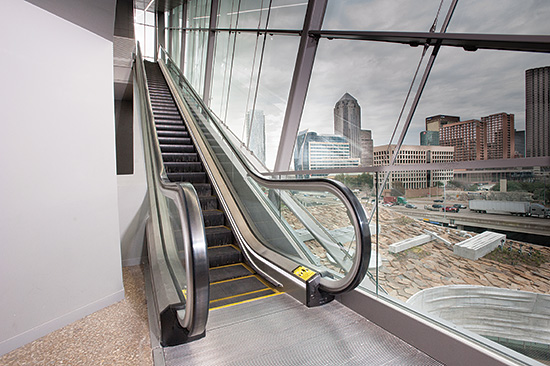
The process of moving along an escalator can also be an enhanced experience and a highlighted part of the design. AIA Gold Medalist Thom Mayne and his firm Morphosis Architects are known for developing architecture that shuns traditional form and creates bold, enlightening buildings. In their design of the Perot Museum of Nature and Science, a 54-foot escalator has been enclosed in a glass atrium that is smacked onto the south facade of the building. The escalator is one of the first in the world to protrude outside the main structure of a building allowing the enclosure to be visually cracked open on the southeast corner of the building bringing daylight inside. Unexpected details like the protruding escalator define the architect’s style but the unique building design required the manufacturer to work closely with the general contractor to develop an unusual installation path for the escalators. Timing and coordination were critical because the escalators had to be positioned before the building exterior was complete. In order to accomplish aligning and securing the pieces into place in a safe manner, many hours of planning and preparation were required. In the end, the building was described as “the boldest piece of modern architecture to hit Dallas” by The Dallas Morning News.
Floor Surfaces
Selecting a flooring material for many commercial and industrial installations is often heavily dependent on performance but that doesn't mean that appearance and design have to suffer as a result. Quite the contrary, the flooring industry has developed many dynamic and attractive products that can be used quite creatively and innovatively with performance characteristics to suit a variety of light-, medium-, and heavy-duty installations. This is probably most evident in the use of the variety of commercial resilient flooring products that are available, from high design luxury vinyl tile (LVT) to technically focused resilient sheet products that can be made with 100 percent bio-based plasticizers. From a design standpoint, resilient flooring products are available with homogeneous makeup using non-directional designs and colors which can make more of a bold design statement than some common directional patterns. Manufacturers offer literally dozens of tone-on-tone non-directional colors to choose from.
Photos courtesy of ThyssenKrupp Elevator Americas
This glass enclosed escalator in Dallas, Texas quickly and efficiently moves people through the building but also provides daylight and a positive experience for the people using it.
Safe Stair Design
While automated pedestrian circulation may be part of a facility design, fixed stairs will always be required and desirable. Such stairs can be incorporated into the overall design and circulatory flow of a stadium or arena and be a real design statement or be kept simple and understated as the situation may warrant. They also serve as a means of egress in the event of fire or other emergencies and are regulated in great detail by building codes and standards as a result. From a safety standpoint, they are one of the most common locations for people to trip, fall, and be injured. The importance of designing safe and code compliant stairs cannot be understated particularly since architects are sometimes held liable for damages to people injured on those stairs. Among the most significant safety details to be addressed are the proper design and specifications for treads and nosings installed on stairs. The challenge is often how to meet safety requirements in a manner that is appropriately consistent with the design of the rest of the building.
Stair nosings are a distinct part of a step that building codes define as “the leading edge of stair treads”. Nosings also apply to the leading edge of landings at the top of stairway flights. The codes address the size and depth of the nosing for different stair profiles and call for them to provide a degree of slip resistance along their surface. Generally a tread is differentiated from a nosing based on the stair industry standard - a nosing is defined as 4” or less in depth and a tread is defined as greater than 4” in depth (commonly the full depth of the stair tread.) In light of the above, it is common current practice to design and specify stair treads and nosings as distinct elements of the overall stair design. As such, they can be added to the supporting material of concrete or steel that stadium and arena stairs are usually made from. Further, they can be specified for both new and retrofit / renovation installations.
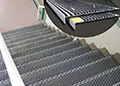
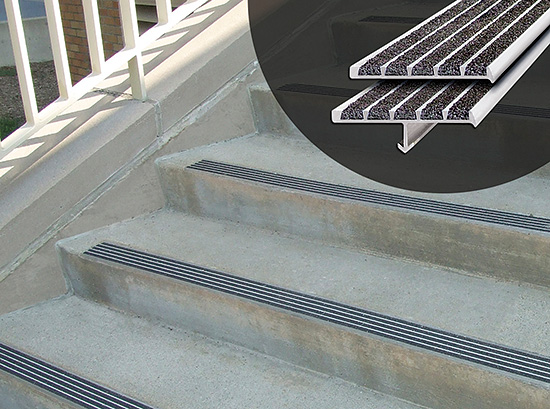
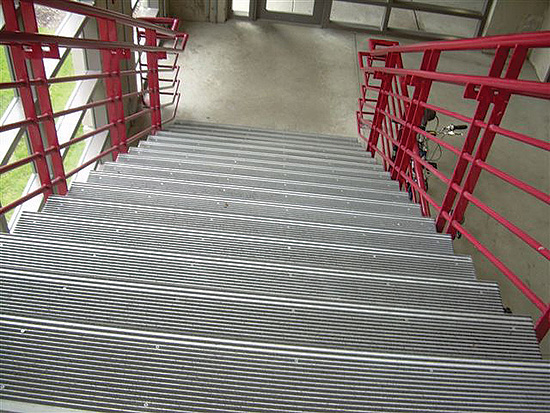
For facilities with moderate to high levels of foot traffic, extruded aluminum nosings and treads are often selected for both interior and exterior locations. The aluminum extrusions are typically filled with abrasive material running from side to side along the width of the tread or nosing. When using this approach, the abrasive material is installed in channels in the extrusion thus forming alternating strips of exposed aluminum and abrasive running across the stair tread providing slip resistance. It is also possible to use “full abrasive” treads and nosings which have the abrasive material covering over the top of the extrusions so that only the abrasive material is seen. It is worth noting that numerous colors of abrasive material are available either to work with an overall design scheme or pick up on favorite team colors.
Photos courtesy of Wooster Products, Inc.
Stairs can be significant design elements in stadiums and arenas but also need to be designed for safety. Nosings are commonly added for increased slip resistance and are available in many different colors.
America and the world seem to love stadiums and arenas. Whether it is due to loyalty to an alma mater or feeling part of a community championed by a professional sports team, these unique building types draw people, and lots of them. They also seek to be used for a wider variety of events than just sports, including entertainment, education, and special gatherings. Over the years, newly designed facilities have become larger and more sophisticated than in the past. No longer limited to outdoor seating areas using bleachers, users and owners demand more amenities and features that offer comfort and choices. The attending experience has become more important than the event or game itself as the ticket holders expect more from their surroundings—a level of experience more akin to deluxe hotels, clubs, and restaurants. Architects and other design professionals involved in projects for new or renovated stadiums and arenas are responding to these needs with well-designed and creatively executed spaces. But truly successful designs also need to respond to the practical needs of high performance required by the intense activity of large crowds on a regular basis.
Growth and Evolution
Part of the reason behind the growth in stadiums and arenas is certainly linked to the growing populations in urban areas where most of these facilities are located. A recently released report indicates that urbanization will see a 2.8 billion increase in city populations by the year 2050. Cities across the country are already seeing some of that growth and have been able to build stadiums in recent years in the downtown areas of cities such as Indianapolis, Dallas and New York. Plus stadiums and arenas are becoming supported with nearby mixed-use projects and expanded entertainment properties. This means that they are moving beyond the typical open seating areas and public spaces. Rather, they are becoming part of a vibrant, urban neighborhood that provides people with a unique social experience with options to suit their tastes and preferences. In essence, the spaces in and around the stadium or arena have become as competitive for attracting people as the events that it focuses on.

Photo courtesy of NanaWall
Stadiums and arenas, such as the Autzen Stadium at the University of Oregon shown here, are becoming larger, more sophisticated, and more attuned to the current demands of people who experience these facilities.
Part of the experience at events is interacting with others. But there is a difference between interacting with the whole crowd in an outdoor venue and joining with a specific group in a separated area such as a suite, box, or other enclosed area. The ability to carve out such spaces and to make them flexible is certainly a growing trend at stadiums and arenas. The experience becomes more focused socially on being part of a select group rather than part of a large throng. These separated areas may include enhanced or catered food and drink, more comfortable amenities, and glazing that separates the space from the main open area. In many of these situations, particularly in outdoor stadiums, there is also a growing trend to provide flexibility in the enclosure such that the glass is in place when needed for weather or comfort control, but able to be opened or removed in favorable conditions.
Efficient circulation routes and mobility of people is important in any building but in a high-density space like an arena or stadium, it is critical to keep the flow of people moving. It is also necessary to prevent congestion which could become unsafe in emergency situations or where it induces panic and harm. Accordingly, both horizontal and vertical pedestrian circulation has been receiving more attention in these venues. The accommodation of people of all ages and all levels of ambulatory abilities or disabilities requires both good master planning and attention to detail. It also requires an awareness of the various options available for both static and moving pedestrian routes such as stairs, corridors, escalators, elevators, and moving walks.
Directly related to the accommodation and movement of people, the choice of materials used for flooring, stairs, and other surfaces has evolved for these large assembly spaces. A variety of durable, colorful floor surfaces has emerged that can not only withstand the rigors of high traffic areas, but they can also incorporate custom colors and designs. This plays directly into the spirit of such places where logos, mascot images, and other elements of pride can become part of the building and the experience of attending.

Photo courtesy of Stonhard
The experiences of people in the seats within the larger facility, such as Madison Square Garden in New York, are driving the trends and evolution of stadiums and arenas of all types.
Design Considerations
In light of the evolving nature of stadiums and arenas, and the continued need for protecting the health, safety and welfare of the people who use them, we will look at four areas that can enhance the overall design and user experience of such facilities.
Operable Glass Walls
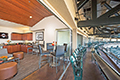
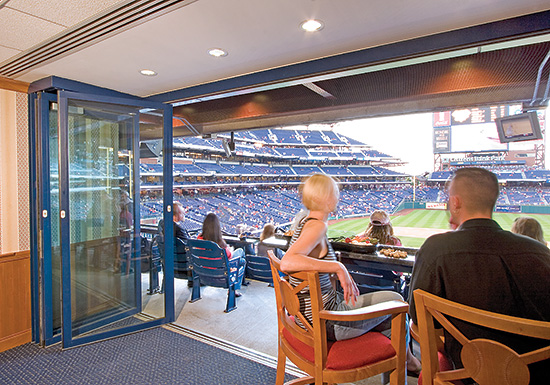
In response to the desire to have flexibility in viewing conditions and the ability to open up or isolate areas, operable glass walls have become a part of stadium and arena design. In essence, an operable glass wall is defined as a system that uses door sized glass panels that can be readily opened or closed on demand. Like any other type of building fenestration, this system does not carry any structural load from the building, but is reliant on being appropriately attached to the building and operates within a structurally supported opening. In most settings, the intent is to allow a large, uninterrupted opening between two interior spaces or between an indoor and outdoor space. Operable glass walls can be full wall height, match standard door heights, or be used in shorter heights for continuous window style applications as well. The openings can range in width from as little as 9 feet wide up to as much as 300 feet or more. They are typically comprised of uniformly sized panels with a top and bottom track along which the doors either fold or slide.
Operable glass wall systems provide an innovative and unique design solution that brings wide-open connections, flexible space management, and natural daylight to all types and sizes of spaces. When the panels are closed, they offer the comfort and security of a fixed wall. When open, with the movable panels stored out of the way, adjacent spaces are freely connected to each other. Those seeking innovative design solutions in stadiums or arenas can use operable glass walls to bring spectators together and to provide unique event experiences. They can create exclusive and unique suite facades, suite space divisions, restaurant entrances, press booths, and attractive fan areas for sports and entertainment events. They can also expand the usability of these areas far beyond the days when main events are held by catering to smaller events. The multiple uses and configurations can create a continuous source of facility revenue by providing various types and sizes of events.
Sports facility owners in particular have recognized the advantages of operable glass walls in terms of their operations most notably by being able to charge more for use of these defined areas. They do that by commanding higher ticket prices or season ticket rates with suites that offer a unique experience for the fan, allowing the occupant the choice to open or close the wall panels with ease. When open, the fan experiences the crowd but when closed, the glass wall provides a transparent barrier with unobstructed viewing. For outdoor stadiums, they also provide greater fan comfort with protection from wind, cold air and noise. In the off-season, weather resistant opening glass walls protect interior spaces and furnishings from exposure and/or unauthorized entry.
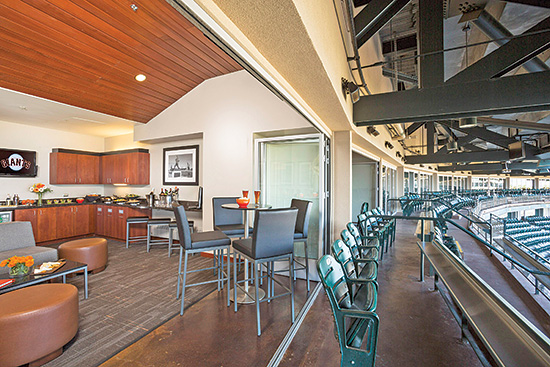
Tyson Godfrey, principal with Hubbard Godfrey Architects worked on the design of a separated area called the Legends Club at the San Francisco Giants Stadium, AT&T Park. He points out “The Legends Club defines a new standard of luxury at AT&T Park. While sightlines to game day action were a priority, the suite was also conceived as a social and event space with maximum flexibility for one large group or two smaller ones in a variety of seating configurations.” The use of operable glass walls allowed the design to be executed successfully.
Photos courtesy of NanaWall
The ability to separate off smaller spaces or open them up to the larger complex at will has become a sought after design feature in many sports venues such as Citizens Bank Park on the left and, the San Francisco Giants Stadium (A&T Park) on the right.
Flooring Systems
Among the many flooring finishes available on the market, not all are suitable for use in stadiums and arenas. From a design standpoint, flooring is one of the most visible and space defining characteristics of many spaces in terms of enhancing a color scheme, helping with way-finding, and contributing to the overall experience of the facility. For these reasons, plus the need to provide a durable, easy to clean surface, a popular choice is resinous flooring which is a seamless, poured in place system. Typically, these systems are high performance epoxy and urethane floor covering products. They have been proven to be long-wearing and easy to clean and are typically engineered to perform in both industrial and commercial environments without sacrificing design and innovative vision.
Seamless, poured in place flooring systems offer multiple design options. They are available in a range of product types that give owners, planners and designers options for both public areas and behind the scene spaces. In public areas such as stadium seating, enclosed suites, corridors, walkways, lobbies, eating areas, and entries they can provide colors to suit the location or differentiate one space from another. In addition there are both smooth and textured versions available that provide choices in their decorative appearance. It is even readily possible to include custom logos and sports designs in the flooring. As such they can provide flooring that can trigger an emotional response to those entering these facilities that is durable enough to last the life of stadium or arena where they are located. Colors, designs and branding also help enhance the overall experience of someone walking into smaller areas such as a private suite.
Certain heavy duty poured in place flooring systems are well suited for non-public areas such as kitchens, locker rooms and mechanical rooms. These epoxy and urethane based flooring systems can also be provided in different colors and with different final appearances including a flake finish, high gloss, or low gloss. While it is not common to find one product that works as well as resinous flooring in so many diverse settings, the nature of this type of product is to be durable, attractive, customizable, and easy to maintain allowing for fewer flooring products to be used throughout a single facility. Further, they help that facility deliver on expectations to meet the demands of high-level users while maintaining the appearance, function, and durability required in arenas and stadiums.
Photos courtesy of Stonhard
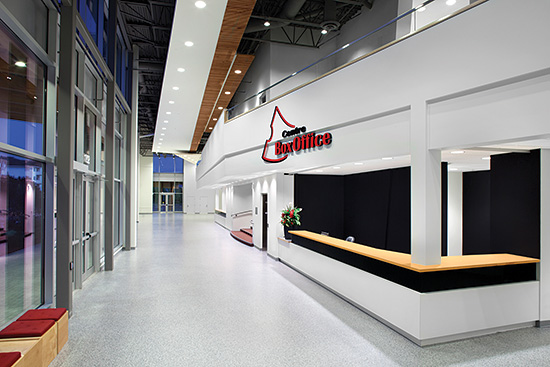
The seamless resinous flooring used in this lobby and ticket area meets the design needs of the space by providing a clean, crisp, continuous appearance.
Designing for Circulation
Walking toward, into, and through an arena or stadium on the way to a seat, suite, or lounge, is part of the overall experience of the facility. However, it needs to be a safe one that allows people to keep moving, particularly when exiting whether because it is time to go or because of an emergency. It also should be a pleasant one that doesn’t impose unwarranted exertion on people by walking long distances or excessively climbing stairs. Recognizing that the pedestrian traffic in arenas or stadiums is extremely heavy, particularly at specific times, is the first step to designing adequate and appropriate circulation into the facility. Directly related, having the right equipment to move people such as escalators and moving walkways can improve and enhance the experience for all visitors. Fortunately, there is a full range of such equipment readily available that is designed to help owners move thousands of fans through the space and safely to or from their seats.
Coordinating the flow of people at entrances with their movement onto escalators can be the focus of such a circulation design study. For example entrances can be coordinated to act as “injectors” that will lead spectators to a series of escalators and elevators, transporting them to different concourse levels as may be appropriate. This can all be possible because of the use of multiple entry points and properly located escalators.
The process of moving along an escalator can also be an enhanced experience and a highlighted part of the design. AIA Gold Medalist Thom Mayne and his firm Morphosis Architects are known for developing architecture that shuns traditional form and creates bold, enlightening buildings. In their design of the Perot Museum of Nature and Science, a 54-foot escalator has been enclosed in a glass atrium that is smacked onto the south facade of the building. The escalator is one of the first in the world to protrude outside the main structure of a building allowing the enclosure to be visually cracked open on the southeast corner of the building bringing daylight inside. Unexpected details like the protruding escalator define the architect’s style but the unique building design required the manufacturer to work closely with the general contractor to develop an unusual installation path for the escalators. Timing and coordination were critical because the escalators had to be positioned before the building exterior was complete. In order to accomplish aligning and securing the pieces into place in a safe manner, many hours of planning and preparation were required. In the end, the building was described as “the boldest piece of modern architecture to hit Dallas” by The Dallas Morning News.
Floor Surfaces
Selecting a flooring material for many commercial and industrial installations is often heavily dependent on performance but that doesn't mean that appearance and design have to suffer as a result. Quite the contrary, the flooring industry has developed many dynamic and attractive products that can be used quite creatively and innovatively with performance characteristics to suit a variety of light-, medium-, and heavy-duty installations. This is probably most evident in the use of the variety of commercial resilient flooring products that are available, from high design luxury vinyl tile (LVT) to technically focused resilient sheet products that can be made with 100 percent bio-based plasticizers. From a design standpoint, resilient flooring products are available with homogeneous makeup using non-directional designs and colors which can make more of a bold design statement than some common directional patterns. Manufacturers offer literally dozens of tone-on-tone non-directional colors to choose from.
Photos courtesy of ThyssenKrupp Elevator Americas
This glass enclosed escalator in Dallas, Texas quickly and efficiently moves people through the building but also provides daylight and a positive experience for the people using it.
Safe Stair Design
While automated pedestrian circulation may be part of a facility design, fixed stairs will always be required and desirable. Such stairs can be incorporated into the overall design and circulatory flow of a stadium or arena and be a real design statement or be kept simple and understated as the situation may warrant. They also serve as a means of egress in the event of fire or other emergencies and are regulated in great detail by building codes and standards as a result. From a safety standpoint, they are one of the most common locations for people to trip, fall, and be injured. The importance of designing safe and code compliant stairs cannot be understated particularly since architects are sometimes held liable for damages to people injured on those stairs. Among the most significant safety details to be addressed are the proper design and specifications for treads and nosings installed on stairs. The challenge is often how to meet safety requirements in a manner that is appropriately consistent with the design of the rest of the building.
Stair nosings are a distinct part of a step that building codes define as “the leading edge of stair treads”. Nosings also apply to the leading edge of landings at the top of stairway flights. The codes address the size and depth of the nosing for different stair profiles and call for them to provide a degree of slip resistance along their surface. Generally a tread is differentiated from a nosing based on the stair industry standard - a nosing is defined as 4” or less in depth and a tread is defined as greater than 4” in depth (commonly the full depth of the stair tread.) In light of the above, it is common current practice to design and specify stair treads and nosings as distinct elements of the overall stair design. As such, they can be added to the supporting material of concrete or steel that stadium and arena stairs are usually made from. Further, they can be specified for both new and retrofit / renovation installations.
For facilities with moderate to high levels of foot traffic, extruded aluminum nosings and treads are often selected for both interior and exterior locations. The aluminum extrusions are typically filled with abrasive material running from side to side along the width of the tread or nosing. When using this approach, the abrasive material is installed in channels in the extrusion thus forming alternating strips of exposed aluminum and abrasive running across the stair tread providing slip resistance. It is also possible to use “full abrasive” treads and nosings which have the abrasive material covering over the top of the extrusions so that only the abrasive material is seen. It is worth noting that numerous colors of abrasive material are available either to work with an overall design scheme or pick up on favorite team colors.
Photos courtesy of Wooster Products, Inc.
Stairs can be significant design elements in stadiums and arenas but also need to be designed for safety. Nosings are commonly added for increased slip resistance and are available in many different colors.
Performance Considerations
Beyond design considerations, everything in a stadium or arena environment has to meet demanding performance requirements. This includes the ability to handle large crowds, withstand repeated usage, hold up against weather and thermal forces, and provide the safety needed for large assembly spaces. We will look next at the same four design areas discussed above in terms of their performance.
Operable Wall Performance
Operable glass walls need to cover a number of key functions and do so with an eye not just for today but toward long term durability. Thermal and energy performance are important where they separate conditioned and unconditioned spaces as already mentioned. But operable glass walls need to address other environmental concerns as well. During pleasant weather, they can be opened to allow fresh air and connection to the outdoors. When the panels are closed, however, they need to allow for a secure, weather-resistant barrier that protects against rain, snow, humidity, noise, and extreme temperatures. Because of the typically large opening sizes, the corresponding large perimeter area, and multiple joints between panel sections, the ability to seal tightly along all of these locations when closed is important. From an operational standpoint, the glass panels need to quickly and easily glide or fold into the open or securely closed positions meaning the mounting and tracking mechanisms must be proven and reliable.
The manufacture and production of these systems can certainly vary between suppliers since they require considerable diligence and attention to detail in order achieve high performance levels. Hence, it is incumbent on specifiers to request independent testing reports on the selected products to determine the results for thermal performance, penetration of wind or water, security, and acoustical characteristics. This stringent and thorough third party testing ensures optimum performance for specific site conditions.
John Poston, an architect and principal with Ellerbe Becket worked on the design of the Autzen Stadium at the University of Oregon in Eugene. For that project, they successfully specified and incorporated operable glass walls as a key component of the design. He commented that “The operable glass wall uniquely balanced operability and thermal performance in delivering unobstructed panoramic views of both Autzen Stadium and the stunning Oregon landscape beyond. It has performed perfectly since day one.” He elaborated on the particulars of the design too, pointing out “The design is unique in terms of its operability, especially on the press level. There, the sliding glass sections pocket back into each suite individually, and the whole section opens with no intermediate mullions.”
Steven Ziegler is an architect with Ewing Cole Cherry Brott who designed Citizens Bank Park for the Philadelphia Phillies. His experience reinforces the need to look carefully at different products in terms of performance. “The selected product was one of the only operable glass wall companies that could achieve the weather seals we required, especially for the doors between the outside seating and insides of the suites. Also, during the off-season the window units needed to maintain the interior spaces without wasting energy or damaging finishes, keeping water and humidity and extreme temperatures out. We went searching for this answer, and the one we specified was one of few that could do it.”

Photo courtesy of Nanawall
Using opening glass walls helped the Arizona Diamondbacks and Colorado Rockies Salt River Fields spring training facility achieve LEED Gold status. The glass walls provide excellent thermal control when closed with energy savings calculated at 23.5% over baseline. When open, they provide fresh air ventilation for the training facility.
Flooring Performance
The decision to use resinous, seamless, poured in place flooring systems can often be driven as much by performance as by design attributes. Durability and clean-ability is a key factor when choosing flooring for high-performance stadiums and arenas and these products have been shown to rise to the occasion. Safety with regards to people walking on flooring that is reasonably slip resistant is also a concern which can be adequately addressed and met with these seamless systems.
Products that are most suitable for best performance in stadiums and entertainment venues include decorative epoxy or urethane based product lines. Within the design variations available, these are typically formulated to withstand throngs of daily foot and wheeled traffic and harsh cleaning procedures. For heavy duty locations, products can be specified that provide a dense, stain resistant, epoxy and urethane based flooring system with minimal installation time and maximum durability. These are available in an extensive range of flake finishes and color options depending on the manufacturer. These heavy duty systems are also designed to withstand heavy traffic areas and provide excellent impact resistance.
When it comes to sustainability and green building design, there are a growing number of products available that contribute to that effort. For example at least one manufacturer offers epoxy mortar systems that blend recycled glass chips into the surface for a stylized look and a sustainable solution. Similarly a four-component, polyurethane mortar system is available that incorporates post-industrial recycled glass and rapidly-renewable materials into its composition. There are also general service epoxy mortar systems that use recycled material. Perhaps more importantly, though, it is reported that over 90% of new product development and reformulation efforts for the past several years have been geared to water based urethanes or 100% solid epoxy based chemistry. This effort not only provides safer floor and coating products to both industrial and commercial markets, it also reduces hazardous waste.


Photos courtesy of Stonhard
Seamless, poured in place flooring used in general use areas like seating or heavy duty locations such as kitchens can be specified in a variety of product types, colors, textures, and recycled content.
Escalator Optimization
Just like other aspects of circulation design, there are choices in escalator technology. Most manufacturers offer several classes of escalators such as commercial duty, heavy duty, or transit duty. Depending on the particular stadium or arena usage and requirements the heavy duty escalators may be the best choice. Typically this class of escalators feature larger motors, chains and reinforced handrail drives to move lots of people. The balustrade can be reinforced or made of tempered safety glass so it is resistant to bumps from carried items. The look can also be customized with colored glass and lighting under the handrail in some cases. This class of escalator is commonly suited for indoor and outdoor installations and designed for higher floor to floor applications up to 65 feet.
In selecting the best set of attributes for an escalator in a particular venue, it is important to be aware of a number of performance related factors. First and foremost, keep in mind that escalators and moving walks can continuously move passengers. Consequently, their transport capacity is much greater than that of elevators. It is possible to calculate the anticipated flow of people by assuming 1 or 2 people across the width of a specific walkway or escalator. The travel speed of escalators is regulated by code to a maximum of 100 feet per minute while moving walks with 0–8° inclination can be increased up to 180 feet per minute. Based on the number of people that need to be moved and the capacity and speed of the equipment, it is then possible to determine how long it will take for everyone to pass through. If the amount of time is considered too long, then additional equipment may be required.
When looking at the vertical travel distance, it is worth noting that a rise of only 6’-0” can benefit from considerably improved access to a building via an escalator. At the other end of the spectrum, manufacturers have designed escalators to reach a rise of 164’-0” (50 meters). Building Codes limit the inclination angle to 30° in the US and Canada for escalators, so the horizontal space requirement can be determined accordingly. Inclined moving walks are possible and desirable in some applications and are permitted by Code with a maximum angle of 12°. The width of the equipment also needs to be accounted for which in North America is fairly standard at 62 inches (1575mm) wide. In addition, a clearance of 1-1/4” (30 mm) for installation must be added to the overall pit width on either side of an escalator or moving walk. For extended travel distances, horizontal moving walks which enable the use of wider units are the most efficient option.
When specifying people moving systems, the specific needs of the location and project need to be accounted for. If outdoor application escalators are incorporated, then at a minimum, the specification should include a galvanized truss structure, protective chain covers, automatic lubrication, handrails with nylon sliders, stainless steel handrail guides, oil/water separator in the lower pit floor, and stainless steel fasteners for all exposed surfaces. In order to meet energy requirements, outdoor or indoor equipment can be selected that runs efficiently, keeping users safe while using minimal energy. Some manufacturers offer dual CPU controllers and optional Variable Voltage Variable Frequency (VVVF) drive technology as a way to save energy and help keep operational costs low.


Photos courtesy of ThyssenKrupp Elevator Americas
Optimizing the use of escalators and moving walkways is facilitated by understanding the space requirements, the capacity, and the choices for components to best suit specific locational needs.
Safety Stair Performance
Indoor and outdoor conditions at stadiums and arenas make safety enhancements on stairs necessary. Adding non-slip nosings or treads is very inexpensive relative to the overall cost of a project. However, all it takes is one person to fall down and sue the facility to realize what a bargain such enhancements really are – they can easily pay for themselves many times over in avoided legal fees and claimant damages.
Anti-slip safety stair treads and nosings can be specified and installed based on a variety of manufacturer options. Recent innovations include two stage products designed to streamline construction and protect the finished result from construction activity. In this case, the nosing base and anchor are installed first with a wood insert on top serving as a temporary nosing during construction. As the project nears completion, the wood is removed and the final nosings are installed. This allows for a beautiful presentation at the conclusion of the project with the nosings fully intact and ready for service.
Another important innovation is the use of self-glowing photo luminescent nosings that serve as a safety feature should electricity fail or if the artificial lighting is dimmed. This can be the case when the lights are turned off for the dramatic effect of introducing sports athletes or entertainers. The glowing products will allow people who may be walking to still identify the stair edges during these times to safely continue their way.
When specifying safety treads and nosings, it is common to call for an extruded aluminum base with a high content of aluminum oxide abrasive grit for long life and a lasting appearance. Lengths are generally available up to 10 feet long in a single piece. Where possible or desired, it is also a good idea to call for the anti-slip abrasive to extend over the radius of the nose.

Photos courtesy of Wooster Products, Inc.
Stair safety nosings can be selected and specified using an extruded aluminum base filled with aluminum oxide abrasive that may also be treated with photoluminescence properties to glow when the lights are out.
Conclusion
Stadiums and arenas demand considerable design attention to accommodate the many and varied needs and desires of the increasingly sophisticated, urban population that they serve. Understanding the options and best use of materials and systems that are being used around the country gives architects and other design professionals the opportunity to create timely, successful, safe, and long-lasting facilities.
Peter J. Arsenault, FAIA, NCARB, LEED AP, is an architect and green building consultant who has authored over 100 continuing education and technical publications as part of a nationwide practice. www.linkedin.com/in/pjaarch