This CE Center article is no longer eligible for receiving credits.
Is the multifamily market ready for true innovation? The answer lately has been a resounding yes. In the face of a burgeoning market for downtown rentals, luxury condominiums, and assisted living, architects around the country are experimenting with a variety of new apartment layouts and building technologies that help differentiate today's new and renovated properties. From indoor-outdoor spaces and panelized structures to geothermal systems and weather-resistant assemblies, the very fabric of today's residential construction systems would be unrecognizable to an architect working just a decade ago.
The reinvention of today's multifamily offerings may be the most important macro trend. The underlying market dynamic is driven by retrenching, according to Freddie Mac, including the increased demand for apartment rentals “related to economic stress and high foreclosures in single-family housing.”
New multifamily designs reflect that: Starting in San Francisco over the last two years—and now upending the local markets as far away as Charlotte, Boston, and New York—are new ideas in micro-housing, for example, with some apartments as small as 450 square feet. In addition to offering less expensive homes for emerging professionals and seniors alike, micro-units create a need for varied building products that offer the illusion of greater volume—wall-to-wall mirrors, anyone?—as well as shared amenities in common areas and more access to the outdoors.
“In many urban markets, developers and architects are working to maximize outdoor living spaces,” says Lisa von Gunten, general manager of Bison Innovative Products, Denver, which makes pedestal-mounted deck systems that are used on rooftops, as well as other zones in multifamily housing. “Recently this has included access to green roofs, pool areas, walkways to decks, outdoor movie theaters, and even a dog park on an upper floor of one Denver apartment mid-rise.”
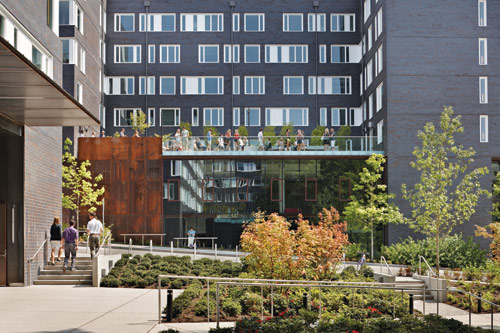 |
The University of Washington's new West Campus Student Housing by Mahlum Architects comprises five upper floors of Type V-A wood construction over a podium of Type I-A concrete, clad with manganese flashed brick.
Photo by Benjamin Benschneider/Mahlum, courtesy of WoodWorks |
Indoor-outdoor design statements are another way to mitigate the enclosed and sometimes claustrophobic feel of more efficient housing layouts, leading to more use of terrace doors, balconies, and sliding glass doors. Architects are also working with larger window openings with fewer mullions and cross members to boost that open feel. In many cases, renters also expect that unit doors or windows will open to exterior zones including balconies and rooftops. “Even for entire façades or selective renovations of existing residences, project teams are using large openings as not just a selling point but also as a lifestyle feature,” notes Matt Thomas, marketing director with NanaWall Systems, which makes operable glass walls.
 |
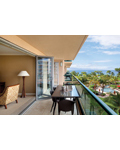
Many new multifamily projects include larger window openings, including operable walls, for access to balconies and rooftops.
Photo courtesy of NanaWall Systems |
These trends are shaking up enclosure design for the entire multifamily market, a bellwether business for many architects, contractors, and suppliers. “Fenestration in multifamily typologies is evolving to include more walls with operable windows and sliders or terraces doors. Utilizing insulated slab covers, window wall systems provide versatility and aesthetic options when compared to a conventional all-glass curtain wall,” says Dave Hewitt, vice president of sales and marketing with the window producer EFCO, a Pella Company. “The market is robust in several key metropolitan areas, including for tall buildings. Right now, for example, we're supplying three new high-rise projects in Minneapolis with high-performance window walls and terrace doors.”
| Multifamily Housing Trends, Shaped by Feeble Single-Family Picture |
According to mortgage aggregator Freddie Mac, recent declines in single-family homeownership have helped propel growth in multifamily housing. The slow economic recovery is still pushing down homeownership rates, so the prospects for certain offerings—especially rental homes and apartments will continue to blossom.
“Multifamily market demand is expected to be strong through 2015 primarily due to demographic trends and shift in homeownership preference,” Freddie Mac announced in a recent national forecast.
Given current economic assumptions, the group anticipates about 1.7 million new renter households between late 2012 and 2015. This would include home rentals: Freddie Mac also observed that single-family rentals have expanded 16 percent, or about 3 million units, since 2007.
www.freddiemac.com/multifamily/pdf/market_demand_forecast_2012-2015.pdf |
Across the country, growth tends to be concentrated in mid-rise multi-housing projects, from college campuses to retirement locations. Wood-framed projects dominate construction in projects up to five or six stories, for condominiums, townhouses, and supportive housing types, such as assisted-living facilities (ALFs). Yet traditional building approaches are rapidly giving way to prefabricated, panelized timber assemblies and meticulously detailed enclosures with air barriers, continuous insulation (CI), and techniques for draining and blocking moisture.
“Investors are more interested in life-cycle cost and overall profitability, and many buyers say they value durability and sustainability, so that makes multifamily a target for better protection against moisture and air infiltration,” says Peter Barrett, product manager for Cosella-Dörken, which makes building enclosure materials including water-resistive barriers (WRBs) and drainage sheets. “Air tightness is critical to energy management, and moisture is acknowledged as the leading cause of building degradation.”
Improvements to the enclosure extend to fenestration as well, with novel windows that have triple glazing and gas fill or blinds or shades between the glass lites. High-performance vinyl windows are increasingly specified for multifamily projects, too. “These newer products also improve energy efficiency by controlling heat while helping to bring more daylight into the apartment interiors,” says Terry Zeimetz, AIA, CSI, CCPR, commercial marketing manager with manufacturer Pella Commercial Solutions. “The between-glass blinds also mitigate the issue of allergens that can get trapped in room-side blinds.”
 |
Recent projects use windows with triple glazing or gas fill, or both, as well as blinds or shades between the glass lites.
Photo courtesy of Pella Commercial Solutions |
For structural systems, modular and prefabricated timber systems are adding new options alongside traditional, stick-built framing that dominates one- to three-family, detached dwellings. “Modular, prefabricated walls and floor systems are the most important innovation in the wood multifamily and residential market in years,” says Lisa Podesto, MS, P.E., a structural engineer and senior technical director in Building Systems for WoodWorks, an education and technical resource provider. “Assembled offsite, these systems are efficient and fast to build, with components like studs, plates, and openings already included. For large repetitive structure, these help work out lots of issues in the field and save money.”
On the operational side of the multifamily business are a number of techniques to reduce energy costs, maintenance needs, and also simplify building systems. Among the most rapidly growing are proven renewable energy systems such as geothermal heating and cooling.
“The energy extracted from the earth provides an immediate and free efficiency boost, and water-source geothermal systems can serve diverse needs, such as moving heat from the south-facing units and moving it to other units that need heat,” says Tony Landers, director of marketing with ClimateMaster, a geothermal system provider. “Other than energy needed to pump the loop, that is free conditioning by moving heat from one point to the next.”.
Micro-Housing Gets Bigger
Efficiency is important—but it's not just energy efficiency in today's market. “Space efficiency is the name of the game for growing segments of the multifamily market, including very small apartments that range from 250 to 450 square feet,” says Andrew Franz, AIA, principal of Andrew Franz Architect, New York City. “These new typologies are meant to accommodate a growing urban demographic: one- and two-person households, often of young professionals, who need to live more economically in the city.”
In fact, in New York, longstanding zoning regulations were recently waived to allow a city-owned property with 55 micro-units as part of a local pilot. Designed by the architecture firms Monadnock and nARCHITECTS, the project uses prefabricated, modular construction techniques and will rent at $950 to $1,900 per apartment.
In Boston, market-rate developments of similar sizes are planned for the fast-growing Seaport District, including the $100-million Boston Wharf Tower, designed by ADD Inc. (The city allows floor plans as small as a tidy 300 square feet.) Others, such as the luxury high-rise The Kensington, designed by The Architectural Team, include efficient “open one-bedrooms” of about 550 square feet. In San Francisco, the smallest pads ever include 220-square-foot units starting at about $975 per month.1
In fact, micro-units are a new riff on an old and much-maligned idea: single-room occupancy or SRO buildings, many with shared kitchens or bathrooms, which were opposed by building departments in these same cities just a few years ago. Today, leaders including Boston Mayor Thomas M. Menino and San Francisco's Edwin M. Lee are eager to entice young professionals with more affordable downtown housing options to stabilize neighborhoods.
Unlike SROs, today's market-rate micro-pads are hardly cheap: A 450-square-foot unit might go for $2,200 per month. With pull-out sofas or Murphy beds, small bathrooms, and open or galley-style kitchens, the apartments often come with shared amenities in common zones to allow residents to escape from their confines and socialize with likeminded tenants.
“In these ways, micro-units are starting to resemble assisted-living facilities, an ironic parallel between young professionals and seniors with a certain degree of acuity,” says Michael E. Liu, AIA, NCARB, vice president with The Architectural Team in Chelsea, Mass. “Some developers see an opportunity to convert their micro-unit projects to housing for older, more frail populations as demographics shift.” While the net-to-gross ratio, which compares living unit area against common space, tends to be higher for ALFs, so too are the rents—typically about three times what the apartments command.
Low-Cost Mid-Rise, High-Value Amenities
With these economic realities in mind, multifamily developers and their architects are focused on efficient layouts, maximizing unit density, and low-cost building solutions. “Many of these new urban infill, mid-rise developments are gravitating to wood mid-rise solutions, including wood frame over a one- or two-story concrete podium, which help maximize how many units you can fit on the site,” says WoodWorks' Podesto. “There are also major cost savings, period. Savings of 30 percent would not be out of the question, though of course it depends on the project design and the system it's being costed against.”
Examples include the first phase of the University of Washington's West Campus housing in Seattle, which added 1,700 new beds in three residential halls and two apartment buildings designed by Mahlum Architects. The 668,800-square-foot complex uses five stories of light-frame wood over two stories of concrete structure, which cost about $177 per square foot to build in 2012. “Currently we're seeing a majority of our projects leveraging this 'five over one' typology, mainly due to budget constraints,” says Anne Schopf, FAIA, design partner with Mahlum. “This is a common construction type here in Seattle.”
For the West Campus, each building has upper floors of Type V-A construction over two lower floors of a Type I-A concrete, clad with manganese flashed brick and topped with roofs of engineered wood trusses and plywood sheathing. The podium and upper floors are separated by a three-hour-rated floor assembly, and the wood-frame floors use 2x4 and 2x6 wood studs and plywood sheathing in both exterior and interior load-bearing walls and partitions. Schopf specified engineered wood I-joists and plywood sheathing for the floors and stair treads, with landings of glued laminated beams and engineered laminated strand lumber (LSL) for the rim board stringers. Heavy timber blocking throughout affords fire protection, though all floors are fully sprinklered.
Similar techniques are validated at Morgan Park Place in Nashville, a 72-unit, mixed-use residential and retail development located parkside in the historic Germantown neighborhood and designed by Dryden Abernathy Architecture Design. After winning a competition for this project, the architects put into action their eco-friendly, “urban village” concept for a live-work-play hub of townhouses, carriage houses, single-family houses, and upstairs flats in mixed-use buildings. The units, in compact sizes ranging from 750 to 2,200 square feet, were priced at $150,000 to $550,000.
The hybrid structures combine precast insulated concrete form (ICF) walls and light-frame wood using advanced framing techniques, such as ladder corners, which allow for better insulation. Various cladding materials “ensure a timeless, modern landscape,” say the architects. The tightly sealed enclosures are heavily insulated with open-cell spray foam for larger surface areas and closed-cell foam for enclosure joints. Between the studs, blown-in cellulose from recycled blue jeans provides ample R-value. Interior materials include sustainable bamboo flooring, Energy Star-rated appliances, on-demand water heaters, recycled rubber, and highly efficient heating and cooling equipment.
The enclosures also benefit from windows and doors with low-emissivity (low-E) triple-pane glazing, according to Pella's Zeimetz. Between-the-glass window treatments increase each opening's energy efficiency, helping to substantially reduce heating and cooling costs. Convenient for users and flexible in terms of design, the integral window treatments snap in and out, so homeowners can change them as desired, choosing from blinds, shades, grilles, or decorative panels.
Earning an EarthCraft House certification, the new complex offers living spaces that are 50 percent more energy-efficient overall than conventionally built homes—and with less square footage. “When you have a premium product on the marketplace, you have to offer advantages—especially when it is a small space,” says Darrell Crawford, director of New Urban Construction LLC, one of the developers. “Our customers want personalization, and the windows help meet that need.”
In other situations, especially where energy efficiency is critical, so-called “premium vinyl” windows are useful in not only meeting aesthetic needs but also providing high levels of insulation. Some of these units, which can look like traditional double-hung and picture windows, are specified for admitting plenty of sunlight while helping to ensure good thermal performance.
At the Prestwick Chase mid-rise senior development in Saratoga Springs, New York, for example, architect Ethan Hall of Rucinski Hall Architecture specified about 1,500 high-end vinyl windows with low-E glass and an argon gas fill. The thermal control helps reduce unwanted heating in the building's sunlit atriums and window-wrapped common areas.
Sophisticated High-Rise Homes
While mid-rise projects account for the lion's share of U.S. multifamily market activity, an increase in high-rise buildings is animating many central business districts, from Houston to Chicago. Behind the growth are low debt financing rates, and annual rent increases of 7 to 8 percent for Class A units, according to real estate services company CBRE.2 The towers “resemble resorts” in terms of amenities and aesthetics, and typical renters are young professionals, typically 25- to 45-year-old singles or couples, and some empty-nesters of retirement age.
| Multifamily Window Ratings: Low-Rise to High-Rise |
For multifamily residential dwellings, window performance classes given by the American Architectural Manufacturers Association (AAMA, which rhymes with llama) offer a quick way to size up the suitability of a product for a particular project.
The AAMA rating AW class is commonly used in high-rise applications to meet more rigorous loading requirements and limits on deflection. These windows resist wind-design pressures of 40 psf and higher.
This contrasts with CW class products, which meet high loading needs, deflection limits and heavy use in low- and mid-rise buildings. These assemblies should withstand pressures of at least 30 psf. (The CW class replaces the C and HC classifications used before 2008.)
For low- and mid-rise multifamily dwellings, AAMA’s LC class is a typical specification. These windows are larger and tolerate higher structural loads than those used for single-family dwellings. Pressures of at least 25 psf can be sustained.
Two-family dwellings can use R class products, which withstand pressures of at least 15 psf. |
Concrete and steel structures vie for dominance in the urban skyscraper markets, as exemplified by Chicago's 82-story Aqua, designed by the local firm Studio Gang for Magellan Development Group. The 1.9-million-square-foot structure near Millennium Park is instantly recognizable, with its curving concrete floor slabs extending beyond the rectangular footprint to offer solar shading and thermal mass. Its three-story podium is planted with a large garden, further cooling the site. High-performance glazing allows ample views—a major driver for the high-rise market—while cutting solar load with low-E coatings and reflective glass on portions of the south- and east-facing façades.
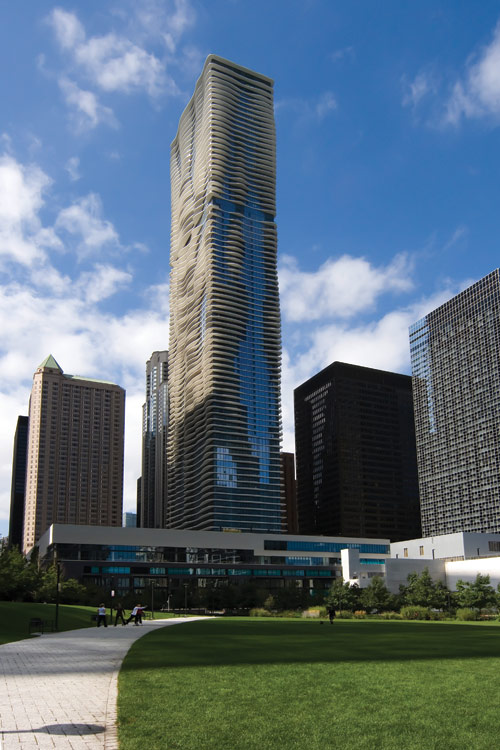 |
This project has high-performance aluminum projected windows with sliding glass doors, providing energy efficiency and comfort for occupants with balcony access.
Photo courtesy of EFCO, a Pella Company |
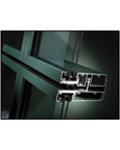
The project used a variety of projected, casement, and fixed thermal aluminum windows and curtain wall, as well as matched sliding glass doors for the balconies. The unique design of the extended balconies required a window system that could easily accommodate the unusual deflection with custom head receptors. Another key feature of the window system was the ability to easily change mullion spacing to match the desired aesthetics for the award-winning design.
Whether in the Windy City or elsewhere, high-rise buildings need “the added strength, durability, and design flexibility of aluminum windows,” says EFCO's Hewitt, who explains that American Architectural Manufacturers Association (AAMA) guidelines3 classify window product performance. The AAMA rating AW class is commonly used in high-rise applications to meet increased loading requirements and limits on deflection, including where pressures of at least 40 psf are expected. (By contrast, LC-class products for low- to mid-rise multifamily dwellings resist pressures up to 25 psf.)
The challenge of floor-to-ceiling, operable glazing systems is well worth the effort, say developers like Magellan's James Loewenberg —also an architect—noting that the resulting designs bring more tenants and higher rents. This dynamic is true for both high-rise and mid-rise developments, adds NanaWall's Thomas, though he sees fully opening glass walls as a way to differentiate offerings in many markets, including detached condominiums and townhouses, among others.
Examples include the live-work-play Justison Landing in Wilmington, Delaware, a 150,000-square-foot building set on a former brownfield adjacent to the Christina River. Designed by the firm Burt Hill, the project fills out six new city blocks with housing, retail, offices, and a hotel, with an overall goal of “maintaining continuity along the streets, and drawing people in from other areas to visit the shops and access the riverfront walk,” according to the architects. Residential options include four seven-story blocks of two-story townhomes topped by luxury loft condominiums. To enhance the loft feel, the firm added fully opening glass walls with a series of collapsible screen panels that stack onto each other using a single track.
Depending on the climate and the proposed height of the operable glass walls, the key to specification is determining needs for weather resistance, impact resistance, and other durability considerations. In general, thermally broken aluminum folding-type glass walls tend to be favored for multifamily projects over single-track, sliding systems.
Shared Outdoor Spaces
With these large openings available for even mid-rise and high-rise apartments, the indoor-outdoor craze that swept the custom home industry over the last decade has had a pronounced effect on multifamily environments. Many of the outdoor settings are private, but the increased expectations for shared amenities and common spaces—especially for so-called lifestyle residences where community and socializing are part of the sell—have led to more programming of communal zones. Rooftop clubrooms, open terraces, and pools as well as shared balconies and courtyards are now common features highlighted by realtors.
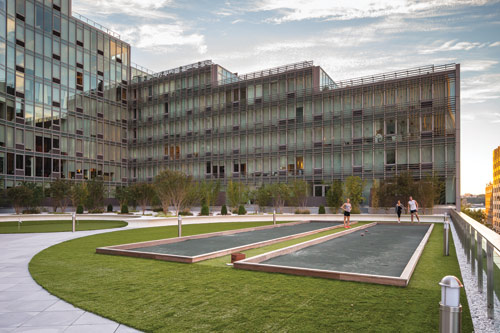 |
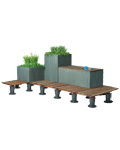
Gravity-based, modular pedestal deck systems are used on flat rooftop terraces as pool surrounds, green roofs, water features, and even lawn bowling courts.
Photo courtesy of Bison Innovative Products |
Whether for new buildings or renovations, the key challenges include activating roof areas and beautifying the surroundings while also protecting the roof membrane and drainage elements, such as soft metal flashings. Pedestal decking, which are gravity-based modular systems, have in recent years been applied to flat rooftop terraces as pool surrounds, green roofs, water features, and even as upper-floor dog parks and bocce lawn bowling courts. The systems use deck point supports topped by varied flat surfaces such as wood and stone tiles and concrete pavers.
“The pedestal systems do not penetrate or attach through waterproofing or roofing membranes, and they also eliminate the need to connect to parapet walls or use joists,” says Bison Innovative Products' von Gunten. Building systems are accommodated below the pedestals, such as roof drains, piping, irrigation for roof gardens, and even low-voltage lighting. The modular elements are fitted to a 2-foot grid, and they are lightweight and relatively small enough to ease transport to upper floors, she adds. Typical materials include Ipé and other weather-resistant deck tiles. Used with water features, the pedestals sit within pools and fountains.
Keeping these outdoor, shared spaces safe is critical to project owners, and some pedestal systems have been developed to meet seismic criteria and ASTM standards for fire resistance. One of the challenges for high-rise developments and locations with potential for severe weather has been wind uplift, says von Gunten, and the air-permeable pedestal decks help equalize uplift forces, restraining the decks and tiles from movement. Although there is no specific standard for testing the decks, engineers have applied the Florida Building Code's Testing Application Standard (TAS) 108, Test Procedure for Wind Tunnel Testing of Air Permeable, Rigid, Discontinuous Roof Systems.
The rooftop systems also have a positive effect on enclosure performance, both protecting the underlying roof membrane and helping to reduce solar heat gain on large, flat roof expanses. This performance benefit dovetails neatly with the overall trajectory of today's designs for multifamily building enclosures, where better thermal control, air barriers, and moisture management are driving new construction techniques.
Opaque Walls and Punched Windows
In spite of the allure of the glass-box look and large windows expanses, many developers are using punched-out windows and more opaque wall surfaces in order to reduce operating costs and—where submetering is used—to reduce utility bills for tenants. “Many of these techniques are geared toward wood construction, which is very common for multifamily developments,” says Cosella-Dörken's Barrett. “They also address cladding materials that can cause moisture issues, such as manufactured stone and conventional stucco.”
According to Barrett, the issue of solar-driven moisture and inward vapor drive has been poorly understood, presenting a common cause of wetting and rot in sheathing behind masonry veneer. Essentially, the sun heating the outside of a wet stucco or manufactured-stone wall forms high vapor pressure that impels moisture further into the wall assembly and prevents it from drying to the outside. “It tends to move from high pressure to areas of low pressure, so the moisture is moving deeper into the wall,” he says.
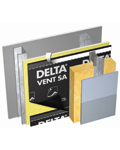
One solution to the issue has been applying a dimensional, two-sided drainage sheet behind the cladding but exterior to the weather-resistive barrier (WRB). The drainage layer installs easily with standard roofing nails and helps drain more than the requisite 80 percent of moisture entering the wall.
Other enclosure systems are designed to provide drying and drainage, and have been adopted by many architects and their multifamily clients. Ventilated rainscreens, for example, have open-joint claddings designed for drainage and natural ventilation, helping to keep wall assemblies dry. Behind the rainscreen, the insulation and air barriers are protected from weather and solar degradation.
Novel technologies are improving air tightness and moisture control, including self-adhering, vapor-permeable air barrier and WRB materials used over exterior-grade drywall sheathing or concrete masonry. Eliminating leaks at staples, nails, and other fasteners, the self-adhered barriers exceed the relevant requirements of the Air Barrier Association of America (ABAA) and building codes referencing ASTM E2357, Standard Test Method for Determining Air Leakage of Air Barrier Assemblies. Yet the vapor permeable construction also allows moisture within the building enclosure to escape through the membrane via diffusion.
An example of the application of a simple ventilated rainscreen to multifamily developments is seen in projects like the new Bellingrath Town Residences in Atlanta, a grouping of eight unique, luxury town residences on Peachtree in the trendy Buckhead district. Designed by Harrison Design Associates, the linear townhome block is “true to classical forms, [to] make a statement that creates a timeless and lasting impression,” as the architects have stated. Yet the enclosure system uses high-end, modern technologies. About 25,000 square feet of ventilated rainscreen was installed over a polymeric, water-resistive barrier and OSB sheathing behind the limestone and brick façade. The result manages moisture flow in the wall assembly.
 |
A ventilated rainscreen over a polymeric, water-resistive barrier protects the enclosure for Bellingrath Town Residences in Atlanta's Buckhead.
Photos courtesy of Cosella-Dörken Products Inc. |
“Air tightness is critical to energy management,” says Barrett, noting that air leakage is responsible for up to one-third of lost heating and cooling energy in some older residential structures. “And moisture is the leading cause of building degradation, so these simple details are shown to make multifamily projects into much better investments.”
The focus on energy costs is reshaping how buildings are designed, leading to more use of high-efficiency design approaches that often exceed the U.S. Green Building Council's LEED requirements. For Museum Tower in the downtown Dallas arts district, for example, the developer's vision was of a classic, modern glass box with a feeling of immediacy and sweeping views of the city. Yet the 42-story, 115-unit luxury high-rise designed by architect Scott Johnson of Johnson Fain Partners, is designed to LEED Gold and uses surprisingly little energy considering its transparent envelope.
Improved HVAC Systems
One of the reasons is the use of a geothermal cooling and heating system, which comprises 335 water-source heat pump systems in individual packaged units for each condominium, which transfer heat via a single- or two-pipe water loops. Each unit can be used in either heating or cooling mode year-round, and loop temperature is maintained via the building's boilers and cooling towers. “Each zone within the tower has complete control of its heating or cooling mode and each unit is independent from the others,” says ClimateMaster's Landers. “High-rise applications in downtown areas have been among the largest markets for these systems, and they are coming back, thanks in part to aggressive energy plans like the one for Museum Tower.”
For the multifamily building operator, using a renewable energy technology like geothermal affords several benefits. “The main goal was two-fold—to be able to submeter the electrical usage of each condo unit, and also to achieve an ultra-high level of efficiency with the HVAC system's operation,” says Jake Musick, P.E., project manager at Blum Consulting Engineers. “A heat pump-driven system helped us to achieve both aims, while also providing the quiet operation expected in a residence of such luxury caliber.”
 |
For the 234-unit Millennium
Tower in New York City's Battery Park, unitized water-to-air heat pumps are used for geothermal heating and cooling.
Photo courtesy of ClimateMaster |
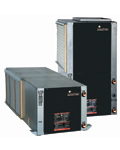
Recent applications of geothermal for multifamily projects like Museum Tower and the 234-unit Millennium Tower in New York City's Battery Park rely on the unitized, small-footprint units that can fit inside individual living areas.
Similar to new unitized and ductless air-conditioning systems, these water-to-air heat pumps come in compact, vertical-stack units that can be located in coat-closet-sized mechanical rooms, typically off of a living room or bedroom. The package units are tightly insulated, especially for the geothermal systems, which transport water that is colder than cooling tower feed.
“Just as important is the ability to submeter each unit, so you can tell how much each unit is using for heating or cooling,” says Landers. “Using geothermal loops, a multifamily building can sell BTUs for heating or cooling, and submetering gives the building owner or property manager control over that.”
The use of submeters for multifamily buildings has a long history, but recently use of the systems have taken off for both energy tracking—for electric and gas—and, increasingly, water monitoring. The most common scheme employs individual meters installed in each condominium or apartment and networked together using wireless radio-frequency (RF) communication systems, allowing for remote meter reading. Simple software programs collect the usage data and generate bills ready to mail or email to residents; for their part, the building owners simply pay the utility one bill as clocked by the master meter.
Beyond the benefits of passing along the costs fairly to tenants, some multifamily owners have adopted submeter products because of local utilities and municipalities offering incentives to use them. As an example, the East Bay Municipal Utility District in Oakland, California, offers apartment building owners a rebate up to $250 per dwelling unit for installing submeters. The utility also offers up to $150 per unit for condominiums and townhouse homeowner associations, or HOAs.
Leaner Operations for Lean Times
Submeters are just one tool for a market that is at once growing but at the same time proceeding cautiously. More than ever, today's multifamily developers and property managers are focused closely on operational costs, life-cycle performance and the durability and resilience of every building system and material.
Similar to the focus on micro-units, many developers are retooling to be leaner and more cost-effective. A recent study by MIT study, for example, shows that methods for reducing initial construction costs should be weighed against long-term costs and environmental impacts such as global-warming potential (GWP).
For example, for concrete structures in multifamily buildings, reducing core thickness from 6 inches to 4 inches is both cost effective and reduces emissions. Using increased percentage of supplementary cementitious materials, or SCMs, in ICF buildings can reduce GWP by as much as 14 percent. For some developers, this and other benefits, such as may reduced heating and cooling costs over the life of the building, may offset concerns about the higher initial cost of ICF as compared to light-frame wood construction.
In spite of the wariness and vigilance that multifamily investors and builders show in today's market, they are solidly bullish for certain markets. Multifamily rents increased by about 4.9 percent in 2011 while vacancy rates dropped to below 5.0 percent late last year from a high of 7.3 percent in 2009, according to CBRE Econometric Advisors. On top of that, based on U.S. Census data the supply of rentals is still relatively low, says Freddie Mac: Only 167,000 units started construction in 2011, as compared to the preceding decade's annual average of 260,000 units.
In 2012 and into early 2013, the pace of supply is accelerating yet still below the level of need, due in part to weak credit markets and a slow overall economic recovery (see “Multifamily Housing Trends” sidebar on page 2).
“Based on permit issuance to date and expected construction time, it is unlikely that the number of new units delivered nationwide will exceed long-run averages over the next two years,” according to a Freddie Mac report. Slowly but surely, however, new supply is coming on the market, with building conversions and renovations slightly outpacing new construction projects. A few local markets even have murmurs about potential overbuilding, especially in student housing.
In a few years, this new wave of multifamily will be easy to distinguish from apartment buildings and condominiums built in past years. It won't just be the re-emergence of old ideas, like the micro-units that resemble SROs, but also the new amenities drawing buyers and tenants—and the new technologies behind the walls. Whether it's prefabricated wood systems, moisture control and air barriers, or the new roof decks and fenestration systems, innovation is as rapid as the pace of development for today's multifamily structures.
Sunlight and Energy Efficiency Live in Perfect Harmony
|
 |
A beautiful wall of windows allows sunlight inside while providing excellent energy efficiency.
Photo courtesy of Simonton Windows® |
The multifamily housing market serves more than 15 million people—one in seven American households. Multifamily structures span workforce, senior, and student housing while providing market-rate and affordable rental properties. Planning for multifamily housing comes with unique challenges. Take Prestwick Chase, a sprawling senior living community in Saratoga Springs, New York.
1,500 Windows and Doors Were Used for This Project
Abundant natural sunlight in both residential and common areas of the community was a primary objective. But energy efficiency was just as important, especially because most utilities are included in the price of the apartments. A total of 1,500 double-hung, single-hung, and picture windows and 167 patio doors were specified to deliver the desired sunlight along with impressive thermal performance.
The windows specified for this project included:
- 12 half-rounds
- 12 quarter-rounds
- 526 single hungs
- 600 sliders
- 200 pictures
- 167 patio doors
In addition to requiring virtually no maintenance, premium vinyl is an excellent insulator. Low-E glass combined with an Argon gas fill allows sunlight to stream through the expansive windows, yet it also helps reduce heating and cooling costs. Now the residents of Prestwick Chase enjoy sunlit atriums, bright common areas, and inviting residences while staying comfortable year round. |
Chris Sullivan is principal of C.C. Sullivan, a communications consulting and marketing agency
focused on architecture and building products.