This CE Center article is no longer eligible for receiving credits.
According to the Green Outlook 2011 report, building owners cited three business benefits as the main drivers for building green: reduction in operating costs of 13.6 percent on average for new buildings and 8.5 percent for retrofits; increase in building values of 10.9 precent for new buildings and 6.8 percent for retrofits; and increase in return on investment (ROI) of 9.9 percent for new buildings and 19.2 percent for retrofits.1
By 2012, forecasters predict as much as a 17 percent increase in commercial green renovations.2 Green construction currently represents approximately one third of all nonresidential construction and by 2015, from $14 to 18 billion will be spent on major retrofits and renovations to make buildings more sustainable. Designers are finding that as credit is tightening for new projects, opportunities to evaluate and improve on the design potential of existing buildings are creating new markets for sustainable development. This article will review opportunities to use a variety of materials that have green components to meet renovation goals for both energy efficiency and modernization.
GREEN OPPORTUNITIES
The following descriptions of new windows and window treatments, waterproofing, manufactured stone and sliding glass doors demonstrate just some opportunities to use innovative products in sustainable renovations.
Energy-Saving Window Options
Maximum energy savings can be achieved by renovating an existing building through the replacement of older windows. As Terry Zeimetz, AIA, CSI, CCPR, commercial marketing manager at Pella Commercial, comments, “The sustainable renovation of an existing building often includes improving energy efficiency so heating and cooling costs are reduced. Replacing the existing windows with new aluminum-clad wood, fiberglass or vinyl windows with a broad variety of glass options can help architects fine tune the energy efficiency of the building envelope by greatly reducing air infiltration, improving insulating value, and managing solar heat gain.”
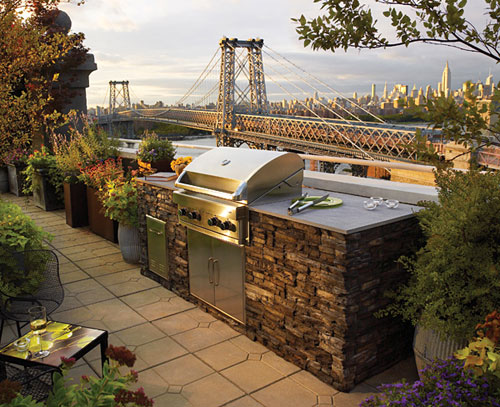 |
New lightweight stone veneer clad GFRC (glass fiber reinforced concrete) cabinets make this 12-story-high balcony retrofit possible.
Photo courtesy of Eldorado Stone |
A case study discussed later in the article will show how new fiberglass windows with high-performance insulating glass have replaced steel frames and single-pane glass at the University of New Mexico. Another will demonstrate how the use of aluminum-clad wood windows with blinds in-between the glass can increase daylight and air quality while minimizing cleaning and maintenance in a New Jersey school.
These examples and others will demonstrate the versatility of new products that can be used to replace even historic windows as part of projects going for high green rating certifications as well as historic tax credits.
 |
Window replacement for the William C. McGinnis Middle School in Perth Amboy, New Jersey, used operable aluminum clad wood double-hung windows with high-performance low-E glass. These windows also included a between-the-glass window blind treatment as a method to enhance daylight and reduce allergens in classrooms.
Photo courtesy of Pella Commercial |
 |
This thermoplastic roofing membrane was chosen as the best solution for cost and time saving for the roof renovation of the City of LA Police Department.
Photo courtesy of CETCO |
Self-Sealing Waterproofing
A new waterproofing product that has met even the most stringent review of the City of Los Angeles allows the contractor to retain large portions of adhered roof surfaces as part of a roofing replacement system that reduces waste removal. This welded thermal-plastic membrane is lightweight, easy to apply and can reduce the construction schedule by as much as 30 percent. According to Stacy Byrd, national products manager for the Building Materials Group of CETCO, “It has become a common trend for many building departments to encourage or require adherence to new green practices and principles using ASHRAE standards as a guideline for energy efficiency and performance. Manufacturers are increasing the performance values of new products to meet these guidelines.” This product with its hydrophilic, water-activated self-sealing membrane is engineered as a high-performance waterproofing system.
Lightweight Manufactured Stone
 |
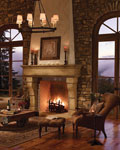
An authentic limestone appearance is achieved through a multi-step hand-finished process as shown in this close-up of a fireplace surround.
Photo courtesy of Eldorado Stone |
Manufactured stone products are being used in interior and exterior applications in many new and highly creative ways. The designer can take advantages of products that are lightweight, environmentally friendly and combine luxury with affordability to increase design opportunities in both residential and commercial settings. These products include a unique engineered limestone fireplace surround and the use of manufactured stone in outdoor cabinetry.
Fireplaces create a sense of home and place, but often are removed from a project budget because of additional costs for structure and installation. An innovative, engineered limestone fireplace surround allows the designer to re-insert the hearth into homes, multifamily housing, restaurants and hotel lobbies. An authentic limestone appearance is developed through a multi-step hand-finished process and the completed fireplace surround is lightweight and easily installed.
A new product line made of glass fiber reinforced concrete (GFRC) cabinets featuring manufactured stone veneer provides opportunities to design outdoor rooms. Design professionals who want to use the natural look of stone but are limited by structural weight and budget restraints can create new outdoor living spaces in both residential and commercial settings with a combination of GFRC cabinets and lightweight manufactured stone. These products make it possible to transform backyard gardens or high-rise balconies with seating walls, barbecue islands, fireplaces, fire pits and kitchens with products that look and feel like stone. A lighter product requires less energy to ship, as well as allows installation even on high-rise apartment balconies. They are light enough so that the contractor can even bring them up to the site on an ordinary elevator.
Flexibility and Sliding Doors
 |
Flexible partitions promote shared daylight, different working styles, easy renovations and re-configurations in offices.
Photo courtesy of THE SLIDING DOOR COMPANY® |
Modernization, rebranding and creating a new business image can drive major renovations. In fact, the refresh rate for new images for hotels, restaurants and offices is often part of a 5- to 10-year facility plan. New research in work styles has driven new configurations for old office floor plans. To maintain and recruit new staff, business owners and management are requesting interiors that provide healthier air quality, increased access to daylight, use less toxic finishes and allow for flexible work spaces that can be configured to a variety of work options.
Workspaces created from sliding glass doors can provide flexibility for shared workplaces, satellite offices, as well as group conference nodes. Glass sliding doors create a larger sense of space and can be used in daylight harvesting strategies for greater access to views of nature. These modular components replace traditional drywall partitions and promote change.
As Todd Schwarz, sales manager, Commercial Division of The Sliding Door Company notes, “Sustainability is not just a checklist of materials, healthy finishes or certified products. It is problem solving that affects design in a cost-effective manner. For an office setting, modularity allows for flexible configurations for growing businesses as well as businesses looking to downsize.”
 |
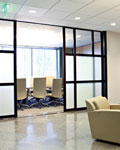
A private conference room created with a frosted sliding glass door wall with upper transparent window glazing shares daylight with the hallway.
Photo courtesy of THE SLIDING DOOR COMPANY® |
REUSE, REDUCE, RECYCLE: CONSERVING RESOURCES
Building reuse is a strategy for the conservation of resources. Renovating an existing building rather than building new can reduce the environmental impact on the environment of materials transport and manufacturing and reduce waste.
Brent Spann, vice president of marketing of Eldorado Stone, comments: “Whenever possible, specified building products should have sustainable attributes. Some products that are lighter weight are better in a life-cycle analysis because they can be transported over longer distances for less fuel and less impact on infrastructure. Products designed to reduce labor and waste during installation can also be considered sustainable.”
Renovations using products, processes and materials that have green attributes can add substantial value to projects. The following is a continued discussion of windows, waterproofing, engineered and manufactured stone, as well as the use of glass sliding doors for maximizing the benefits of green renovations:
WINDOWS
New fixed fiberglass exterior window glazing systems offer the design flexibility of fixed aluminum glazing systems while providing greater energy efficiency at a lower cost. The result is lower energy bills, better U-factors, greater resistance to condensation and superior thermal comfort. Fiberglass frames provide thermal expansion at the same rate as the window glazing, assuring a weather-tight seal between the frame and the glass. Glazing gaskets required with aluminum systems are not needed, thus reducing maintenance. Fiberglass is inherently a good insulator, and unlike aluminum, a fixed fiberglass frame will not need to have a thermal break. The frames can also be filled with foam insulation to provide some of the highest frame insulation values possible.
Improving Indoor Air Quality
Poor air quality and high levels of indoor and outdoor air pollutants have been linked to the increase in asthma cases in school-age children over the past 30 years.3 To reduce indoor air pollution, the EPA recommends controlling the sources of pollution, providing adequate ventilation and clean indoor air. Windows with ordinary room side blinds accumulate 200 times more of certain airborne allergens. Windows with integral between-the-glass blinds control the source of pollution by reducing the exposed surfaces for dust collection. They are easier to maintain and also provide sun controls to prevent glare and increase usable daylight in the classroom.
Speedy Construction and Preservation Tax Credits |
|
In order to reduce energy loss, a major part of the Hotel Andaluz renovation in Albuquerque, New Mexico included replacement of the building’s 192 historic wood windows with low-maintenance aluminum-clad wood double-hung windows—with a finely detailed sash profile, simulated divided lights and authentic spoon hardware. To save installation time as well as to allow for historic tax credits, the manufacturer devised an installation procedure using a T-subframe and brickmould that allowed for the installation of the new windows without removing the existing wood frame. Although the existing sash was removed, the existing frames were left in place and covered by the new subframe with brickmould.

|
 |
This detail shows how the T-subframe and brickmould were used to cover the existing wood frame.
Images courtesy of Pella Commercial |
Historic Hotel Andaluz replaced 192 historic windows with aluminum-clad wood double-hung windows. The architect is pursuing preservation and sustainable building tax credits for this project as well as LEED® certification. |
WATERPROOFING
 |
A unique waterproofing membrane composite with a 60-ml-thick thermoplastic membrane reinforced with a weft polyester knit fabric and a hydrophilic polymer layer that will activate and swell at any breach in the thermoplastic membrane to stop water ingress.
Image courtesy of CETCO |
The advantages of a new thermoplastic waterproofing membrane are that they reduce substrate preparation work and disposal, can be installed over damp concrete and that they provide superior moisture proofing. This unique thermoplastic waterproofing membrane incorporates a hydrophilic composite layer engineered to swell when exposed to water ingress through a breach in the thick thermoplastic membrane. This waterproofing membrane is installed with heat-welded seams and is reinforced with 5.0-ounce weft polyester knit fabric. This dual-composite membrane is puncture resistant, dimensionally stable and has tested for both good tensile and tear strengths. This product is engineered to resist ground water contaminants typical of below-grade conditions and is chemically resistant to oils, chemicals, salt and other contaminants. The membrane has an extremely low water vapor transmission that qualifies it as a Class “A” Vapor Retarder per ASTM E1745 and can be used as a methane barrier.
This waterproofing system provides both active and passive moisture protection. Each membrane overlap seam utilizes both a conventional weld and an overlap assembly of the membrane system with hydrophilic properties to assure water-tightness eliminating reliance on seam integrity based on adhesives or installation labor.
Roof Replacements and Waste Reduction
This high-performance waterproofing can be used both for new building construction and remedial work such as plaza and podium deck renovations, as well as roof replacements. In the online portion of this article, you will find a case study describing a roof replacement for the City of Los Angeles Police Department Heliport that met stringent code requirements. New construction applications include property line construction, backfilled walls, under slabs, tunnels and greenroofs. For remedial projects, an advantage of this system is that it can be applied directly on top of the existing membrane. This can greatly reduce the time and money spent removing the existing waterproofing membrane to the structural deck as preparation for a new membrane. Specifications for remedial projects should include proper removal of old, loose waterproofing, and any flashing materials around penetrations, drains and perimeters. For this application, the waterproofing consultant should provide a field assessment of the remaining membrane and upon review and verification.
 |
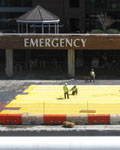
Workers installing thermoplastic membrane waterproofing system over the existing failed rubberized asphalt membrane on the split-slab deck of this hospital.
Photo courtesy of CETCO |
MANUFACTURED STONE PRODUCTS
Engineered Fireplace Surrounds
The fireplace is often the most coveted space in the home with a lot of attention put on its look and feel. It can add to the sales value of any home or condominium project as a premium. Historically, people had to ship stone mantels from Europe to achieve the look of hand-carved limestone but some manufacturers now engineer this product to provide it locally. Partnered with modern environmentally friendly fireplaces like these, designers can expand their offerings for new green construction and renovation.
Engineered limestone fireplace surrounds are lightweight, more affordable and still hand-carved. To create this handcrafted look, a blend of natural limestone and other minerals and materials are used.
An authentic limestone appearance is developed through a multi-step hand-finished process. After being placed in the mold, the cementitious product containing a stone aggregate is hand-packed allowing undulations to be exposed on the surface of the fireplace surround. In the factory, the surround is sanded and ground to expose the aggregate. Each surround is unique and typically come in various color options and finishes. Bonded with glass fiber reinforced concrete (GFRC), these fireplace surrounds provide a lighter alternative to the traditional stone fireplace surround.
Installation of the surround around a fireplace requires the use of standard hand tools, not special equipment. They can be installed on top of standard wood framing. The items included in an installation kit are a mantel and legs, trim kit, ledger board, screws, color-matched caulk, shims and polyurethane adhesive. The installer will carefully measure the area, cut hearthstones and riser blocks with wet tile saws, attach the surround to a ledger board, drill and caulk. The weight of the surround will vary depending upon the profile chosen and the mortar, grout technique, lath and lath accessories used.
 |
Engineered fireplace surrounds, along with manufactured stone veneer chimneys and accent walls, can be used in either a modern or traditional interior.
Photos courtesy of T.C. Studios |
Outdoor Cabinets
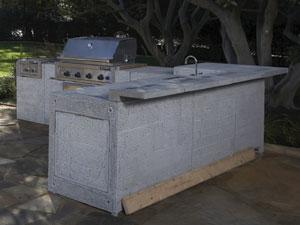 |
GFRC cabinet before the manufactured stone veneer is adhered to the surface
Photo courtesy of Eldorado Stone |
Manufactured stone veneer clad cabinets can be specified to transform and create new outdoor living spaces. A GFRC cabinet is specified from the manufacturer and shipped complete with factory scratch coat, floated smooth top and pre-drilled bolt holes. Cabinets and outdoor seating can have rounded edges, cantilevers and be selected in multiple configurations and sizes. Cabinets are delivered to the site and put in place with loose bolts. They are also conveniently open to the flooring surfaces for easy gas, electrical and water connections.
Cabinets are then leveled and openings for sinks, vents, barbecue grills can be made with diamond blade grinders. When the cabinets are set in place, the manufactured stone veneer is applied with low-VOC construction adhesive. These finished cabinets do not require footings and can be placed on top of any 4-inch slab or paver. Some manufacturers provide website design tools that allow the architect and/or client to design their patio spaces online and to view the final product in alternative colors and finishes. The following chart shows the comparisons between materials, labor and time for concrete vs. stone veneer GFRC cabinets.
CMU Concrete Block: |
Stone Veneer with GFRC Cabinets |
| 160 Qty. Concrete Blocks |
6 Outdoor Cabinets |
| 200 Ft. Rebar |
4 Raised Backsplashes |
| 45 Qty. Bags of Cement |
2 End Caps |
| Heavy Equipment |
Hand Tools |
| 4 People |
2 People |
| 7 Days |
1 Day |
A comparison between building a 12-ft x 9-ft L-shaped island kitchen with CMU vs. stone veneer GFRC cabinets illustrates labor and schedule savings.
Data provided by Eldorado Stone |
Additional Environmental Benefits
Manufactured stone veneer outdoor furniture has many environmental advantages over the alternative use of concrete masonry units (CMUs). Manufacturers can provide testing results for stone veneers to show that they are low-emitting and help with good indoor air quality. These products should meet or exceed GREENGUARD's Test Method P066 and ASTM D 5116, ASTM D 6670, and the EPA's Environmental Technology Verification protocol. Installation is a quarter of the time and half the cost. It is a greener option than quarrying natural stone, shipped across half the world. A lighter product, locally produced, uses less energy to transport. Because of the manufacturing and assembly process, this product also has far less waste than that produced by traditional stone or CMU construction.
Manufactured stone products including engineered fireplace surrounds reduce the amount of natural stone excavated around the United States and the world. Moreover, at half the weight, it considerably reduces installation time and costs, as well as shipping weights. Installed, manufactured stone is approximately one-third to one-half the cost of natural stone. Its lightweight properties eliminate the need for wall ties or footings. Manufactured stone has a 2 percent (approximately) waste factor versus 10 percent or more for natural stone.
Many manufactured stone veneer companies add fly ash, a byproduct of coal burning, to their mixes. Some also use reclaimed water as part of the manufacturing process. Professionals can also specify custom mixes using aggregates made of recycled materials to meet green building credits for use of recycled content.
Another advantage of manufactured stone veneer products is that they require little to no maintenance for the life of the product—saving time, energy and expense when compared to painted drywall, wallpaper, wood, stucco and other less durable finish materials.
SLIDING DOORS
Open Planning
Studies of 20th century open-plan office planning have shown that there are both positive and negative effects for workers. According to an extensive Australian study, 84 percent of workers would prefer to work in closed rather than open-plan offices. “High levels of stress and conflict, elevated blood pressure, and rapid staff turnover were associated with open-plan environments, according to review author Vinesh Oommen. “Employees face a multitude of problems such as the loss of privacy, loss of identity, low work productivity, various health issues, overstimulation and low job satisfaction when working in an open plan work environment,” Oommen wrote in a recent Asia-Pacific Journal of Health Management.”4
The advantages of open plans include the ability to re-configure work areas for different employee clusters, shared communications, more open management styles, shared daylight, and the reduction of constructed floor area per user making construction cheaper. Examining both the requests for enclosure as well as an interest in flexible configurations by employers, the design professional can choose from a number of office systems, conference room dividers, privacy walls and drywall enclosures. Sliding glass doors designed as office partitions can be the answer to both questions of privacy as well as flexibility and daylight sharing.
Just as there are different learning styles, there are also different individual work styles. In addition, different types of work require different spaces. Research, client meetings, focused deskwork may well require a space with greater acoustic privacy. By using a sliding glass door, the employer can promote different configurations in the same space. The employee can slide open the door partitions to share in the office brainstorming or close them for greater privacy.
A glass and aluminum sliding door or partition system can be installed either from the ceiling or on the floor. The system can be chosen with a variety of finishes. These demountable, recyclable panels come in many standard sizes and patterns or can be custom designed and built. Depending on the amount of privacy required, the glass can be frosted or clear and can be specified with 5mm-thick tempered glass for extra safety. They can also be specified with 7mm-thick laminated glass. These doors or partitions are constructed with a sturdy aluminum frame and gliding mechanisms that assure that they do not leave the tracks. If the door is used as a half or full wall and mounted on the floor, this track can either be flush with the floor system or to make removals and re-installations simple, provide a low 3/8-in. ramp that prevents tripping. Moving partitions and doors also have a push pressure of only three lb. Both the threshold and the calibrated push pressure meet Americans with Disabilities Act.
In a drywall installation, installation is slow, requires many trades and can be extremely disruptive and messy. Often an office is closed for an extended schedule period. There are multiple materials and on-site finishing. In addition, when the office requires a wall change, the stick-built drywall system creates waste and additional disposal costs on top of the labor expense. According to most codes, the drywall partition will require the installation of an electrical outlet adding to the expense of the renovation. Drywall partitions are non-reusable and as a fixed asset with their apparent permanence discourage change. They block daylight unless fitted with a window adding additional costs.
In comparison, glass room dividers and sliding partitions promote change. These systems are factory assembled, pre-finished and can be quickly installed in place without creating dust. Construction and the disruption to the staff and office are kept to a minimum. The schedule for change is kept to a minimum. There is no waste associated with construction and installation costs are low. The installer is provided with a complete package that includes walls, doors, hardware and glass. Because these partitions are considered semi-permanent by code, electrical outlets are not required. Because they are categorized as furniture, sliding glass doors can be written-off for additional tax advantages.
Sliding glass doors are 100 percent reusable. They are modular, versatile and can be removed and reused in the same space or in other offices. These systems encourage change as employees can slide or rotate partitions open or close them as needed. Divider strips can separate glass so that the upper portions of the wall may have greater transparency to share daylight throughout the office.
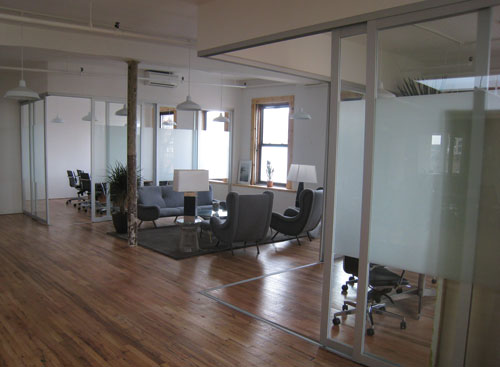 |
Flexible partitions promote shared daylight, different working styles, easy renovations and re-configurations in offices.
Photo courtesy of THE SLIDING DOOR COMPANY® |
Daylighting
Daylight sharing is important for several reasons. Studies show that access to daylight and views to the outdoors can promote well-being in employees, reducing absenteeism and increasing productivity. In addition, shared daylight also reduces the amount of electricity used in an office as natural light can substitute for large portions of the open office plan. The architect can design these movable partitions to maximize the amount of daylight throughout the office by manipulating the transparency of the room dividers.
Sliding partitions have other environmental advantages. Besides being portable, demountable, reducing waste and promoting different working styles, these systems are composed of primarily aluminum and glass, materials that are easily recyclable. They do not need to be painted and are factory finished to meet high indoor air standards. They do not require harsh chemicals for cleaning or maintenance.
CASE STUDIES
Restoring a 100-Year-Old School |
 |
Windows at the William C. McGinnis Middle School in Perth Amboy, New Jersey, are designed with integral between-the-glass blinds for sun control.
Photo courtesy of Pella Commercial |
Program needs demanded the total area of McGinnis School in Perth Amboy, New Jersey, to increase by 33 percent. Set in a densely populated urban area, the 104,000-sq-ft middle school had limited choices for expansion. No other building sites were available for a new facility—and two of the existing school’s walls sat on its property lines, making an addition out of the question.
Architect Steve Carlidge of Vitetta Group found an additional 28,000 sq ft of a space within the 100-year-old structure by enclosing an interior courtyard, adding a mezzanine level, turning the auditorium balcony into library space, and converting the basement into a cafeteria by relocating the mechanical systems to the attic—while also restoring its original turn-of-the-century character. Now the updated building fits the needs of the school district and is a source of pride for the entire community.
The design team chose custom aluminum-clad, wood, double-hung windows with fixed transoms to replace existing aluminum windows that were in disrepair. Original circle head windows—which had been boarded up in the 1950s—were also replaced and fixed frame windows were incorporated into the octagonal staircase area to help bring abundant natural light into the space.
To help the architect meet the challenges of the window retrofit, the window manufacturer designed a custom sub-frame installation based on their on-site measurement of the window openings. They provided all of the technical resources needed to plan, design and detail the window portion of the project—including turnkey fabrication and installation. Because of maintenance and safety concerns, as well as control of dust allergens, the architect chose products with blinds between-the-glass. These custom windows provide light and ventilation to the classrooms while also protecting window treatments from dust and damage. The glazing system incorporates custom muntins in order to create the appearance of historically accurate divided lights, yet still accommodate blinds between-the-glass. According to research, the original wood windows had tan exteriors. The aluminum cladding provided a perfect match to the original color with its standard tan finish, and it’s virtually maintenance-free. On the interior, the windows’ wood-stained frames add the warmth and beauty of the original wood design to the classrooms. |
City of Los Angeles Adopts New Green Code |
Although the City of Los Angeles Department of Building and Safety has its own building code based on the state and international codes, as of January 11, 2011, it also adopted a new green code. The city had already been requiring specific testing of building materials prior to their acceptance on city projects. This stringent third-party testing program can often cost a manufacturer thousands, if not hundreds of thousands of dollars for registration as an approved product by the city. Additional testing can gain approval for the material to be certified as a methane gas barrier (for use in underground installations).
In 2009, the City of Los Angeles needed to replace the waterproofing membrane in the split-slab deck at the police department’s heliport located on the top deck of the four-story Piper Tech Center building. The contractor had only a 90-day schedule to complete the 130,000-sq-ft installation. The contractor selected a thermoplastic membrane with an intergral hydrophilic barrier layer approved by the City’s strict material testing program. He was able to install the system on top of the existing deck without extensive preparation work to remove all residual coal tar pitch waterproofing of the existing system. This reduced substrate preparation work facilitated the installation to be completed 25 days early. |
 |
The new fiberglass windows for Mitchell Hall successfully match the existing window profiles.
Photo courtesy of Pella Commercial |
Mitchell Hall Gets Energy-Efficient Window Overhaul |
| Replacing windows, particularly in a historic building can be a challenge to designers who want to provide high-performance, energy-efficient windows without sacrificing appearance. The Hartman + Majewski Design Group’s mission was to reintroduce Mitchell Hall as a 21st century education facility that emphasizes student and faculty collaboration through improved technology, amenities, comfort and infrastructure operations. At the core of this mission was the desire for greater environmental sustainability, while preserving the historic integrity of the building. Mitchell Hall is one of the oldest classroom buildings on the University of New Mexico’s campus. Constructed in 1950, the two-story, Spanish-style concrete structure hadn’t received a major remodel since it was built. As a result, Mitchell Hall was one of the most energy-inefficient buildings on campus—with 60-year-old single-pane steel-framed windows contributing to its high-energy usage and uncomfortable interior environment.
The project was designed to achieve a LEED® Silver rating; LEED Gold is currently expected. Along with a more efficient mechanical system and enhanced lighting controls with sensors, fixed-frame fiberglass composite windows helped contribute to specific LEED points on the project. Because Mitchell Hall was under consideration for historic registry, careful attention needed to be made with the replacement window choice. The original steel windows had narrow sightlines—they were stacked vertically with 1-in widths in-between the glazing.
The project team’s original plan was to replace them with aluminum windows. However, they were able to replicate the appearance of the windows with ENERGY STAR® fiberglass windows with low-e insulating glass that provided better thermal efficiency, durability as well as substantial cost savings over the aluminum windows originally specified. To preserve the historic character of the building, the manufacturer provided fixed windows with applied muntins and sightlines that created an acceptable match to the original windows. |
 |
Application of an innovative waterproofing system reduced waste and decreased construction time at the City of LA Police Department Heliport.
Photo courtesy of CETCO |
CONCLUSION
As shown, a variety of innovative products are available to designers. Evaluating a product goes beyond its environmental make-up and should include the life-cycle analysis of a product. As seen in this article—from high-performance exterior windows with integral between-the glass blinds, to self-sealing waterproofing, and from lightweight manufactured stone veneer products to flexible sliding partitions—there are numerous ways to take advantage of the innovations provided by these products. They are modular, factory built, or engineered for high performance and responsive to client's environmental requirements.
For the next few years, design professionals will find numerous opportunities to market green renovations by using innovative products that promote change and the renewal of existing properties. Sustainable, green renovations are a segment that is expected to continue to expand the design and construction market.
Architect Celeste Allen Novak, AIA, LEED AP, specializes in sustainable design and planning in Ann Arbor, Michigan.