This CE Center article is no longer eligible for receiving credits.
View course on architecturalrecord.com »
Big City Dreams
On an island in New York, Cornell Tech opens a high-tech campus that marries education and entrepreneurship.
By Joann Gonchar, AIA
The concept for what would become Cornell Tech—the new tech-focused graduate school on New York’s Roosevelt Island—was born during the last recession. Former mayor Michael Bloomberg was behind the push to accelerate growth of the city’s tech sector and make the economy less dependent on Wall Street and the financial-services industry. At the inauguration of the first phase of the campus in mid-September, Bloomberg summed up his sweeping vision. “The companies and innovations spawned by Cornell Tech graduates will . . . help our city compete with tech centers around the world, from Silicon Valley to Seoul.”
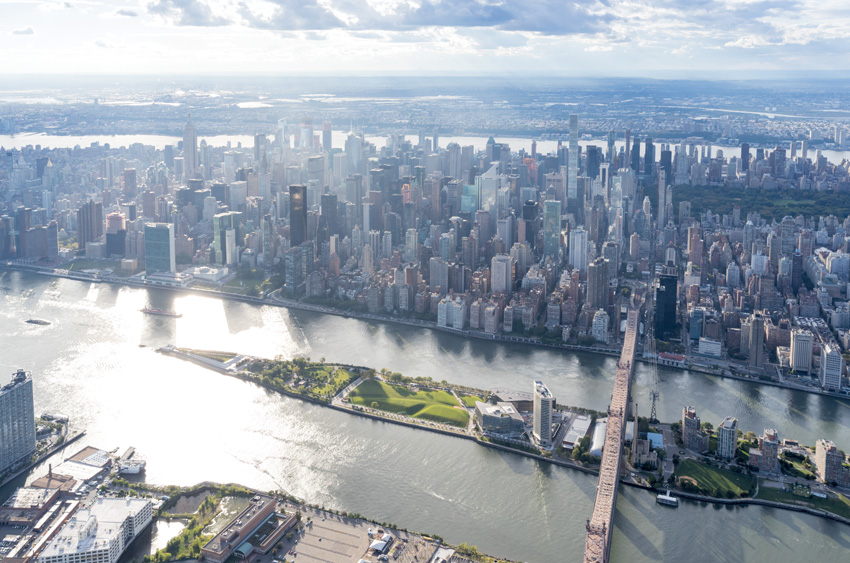
PHOTO BY IWAN BAAN
Bloomberg Center by Morphosis
The Bridge by Weiss/Manfredi
The House by Handel Architects
This new institution, which offers graduate-level degrees in disciplines such as information science, electrical engineering, and connective media, and combines cutting-edge research and education with entrepreneurship, had, since 2012, been housed in Google’s building in Manhattan. But now its 300 students and 30 faculty members have a home of their own, with three completed structures: an academic building by Morphosis Architects; a “co-location” facility by Weiss/Manfredi Architects that provides space for collaboration between academia and industry; and a residential tower by Handel Architects. More students, faculty, and buildings are coming, including a Snøhetta-designed hotel and executive-education center set for completion in 2019, and the possibility of a total of 2.1 million square feet of facilities on the 12-acre site by 2037. Ultimately, there could be more than 2,000 students enrolled.
The Bloomberg administration started this ambitious applied-¬sciences initiative in late 2010 by soliciting ideas and expressions of interest from leading universities, offering them the prospect of developing one of several city-owned sites, a 99-year lease on the land, and $100 million in seed funding. Ultimately, the New York Economic Development Corporation awarded the project to Cornell University and its partner, Technion-Israel Institute of Technology, and their proposal for Roosevelt Island. (Bloomberg’s charitable foundation would later donate $100 million for the main academic building. The schools also raised more than $770 million from other private sources.)
Of course, having won the competition, they then faced the real challenge. The Cornell-Technion team had to tackle the hard work of developing a group of structures and a campus for a forward-looking curriculum that was not yet well defined, and one that would probably continue to evolve long after the first facilities were complete. The partners would need to grapple with other tough questions, such as what it means to build an urban campus on a two-mile-long narrow spit of land in the East River in an area that had once been home to a variety of institutions, including a penitentiary, an asylum, and a smallpox hospital. To make way for the campus, Goldwater Memorial Hospital, a late 1930s Modernist complex where chronic diseases were treated for more than 70 years, was razed.
To shape the campus layout, Cornell Tech turned to Skidmore, Owings & Merrill (SOM). The firm’s master plan, which eschews the usual collegiate trappings of campus walls and gates, places a series of schematic volumes so that the buildings-to-come would define oblique view corridors of the Manhattan skyline and the Queens waterfront. A pedestrian route called Tech Walk threads through the site, helping to link the mostly residential neighborhood to the north of the site with Four Freedoms Park, the memorial to Franklin D. Roosevelt at the island’s southern tip, designed by Louis Kahn (RECORD, October 2012, page 125).
The master plan also delineates open areas that permeate inward from the island’s perimeter to form what Karen Tamir, a principal with the project’s landscape architect, James Cor¬ner Field Operations, refers to as “scoops” of public space. These outdoor rooms keep a sizable chunk of the site open and accessible to nearby residents, the Cornell Tech community, and visitors. Together with the circula¬tion route, the amount of public space provided is considerably more than the 20 percent stipulated in Cornell Tech’s agreement with the city, according to Colin Koop, a design director for SOM.
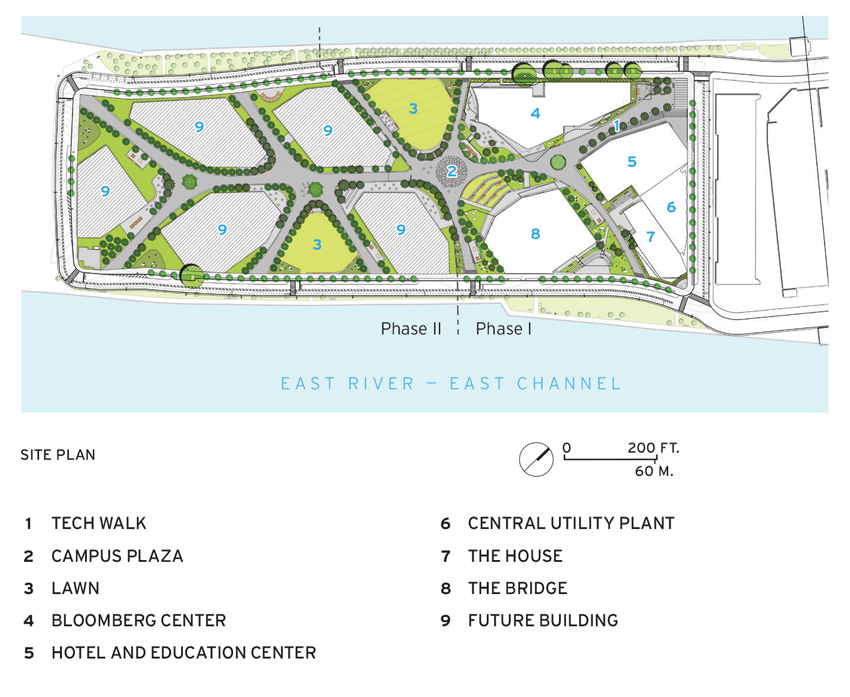
IMAGES: © ALBERT VECERKA (TOP RIGHT); FIELD CONDITION (TOP LEFT); COURTESY JAMES CORNER FIELD OPERATIONS (BOTTOM)
ISLAND LIFE
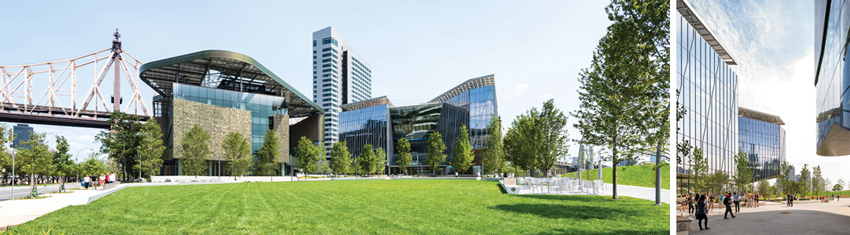
The campus plaza and Tech Walk (top right), between The Bridge (top right, shown at left) and Bloomberg Center (top right, shown at right), stem from a master plan by SOM for Cornell Tech’s Roosevelt Island complex. So far, only three buildings (top left and bottom) are complete.
Relying on a project-delivery model that is emblematic of the new institution’s blend of entrepreneurship and academia, the school selected developer-architect teams for the co-location building and the residential tower: Weiss/Manfredi was paired with Forest City Ratner, and Handel with the Hudson Companies and Related. As for the academic building, which Cornell Tech owns and operates, Morphosis was selected, according to former senior director for capital projects Andrew Winters, in part because the institution well knew the firm’s ability to seamlessly integrate digital technology into its design process. (Morphosis designed the Bill & Melinda Gates Hall for the Faculty of Com¬puting and Information Science for Cornell University’s Ithaca, New York, campus in 2014 [RECORD, November 2014, page 100].)
As further expression of Cornell Tech’s forward-looking values, it has incorporated crucial resilience and sustainability measures into its overall plan. Even before Hurricane Sandy hit New York in October 2012, the school decided to elevate all of the structures above the 500-year flood plane. To meet the building’s front doors, the Tech Walk slopes up significantly, but almost imperceptibly, from the island’s perimeter roadway. The individual buildings all have their own ambitious green goals, with the Bloomberg Center aiming for net zero energy, the co-location building on track for LEED Gold, and the residential tower slated to become the largest Passive House project in the world.
It is too soon to know if these performance and certification targets will be met. But Cornell Tech’s success will also be measured by the answers to larger, and more philosophical, questions about the effectiveness of this unusual experiment in education, economic transformation, architecture, and urbanism. But with only a small portion of what is planned for the campus complete, it could take years or even decades to assess the full impact. At this point, the ensemble looks a bit like a potluck supper with a variety of dishes—some distinct, with exotic ingredients, some not. And they are clustered at the far end of the buffet table awaiting the rest of the meal.
View course on architecturalrecord.com »
Big City Dreams
On an island in New York, Cornell Tech opens a high-tech campus that marries education and entrepreneurship.
By Joann Gonchar, AIA
The concept for what would become Cornell Tech—the new tech-focused graduate school on New York’s Roosevelt Island—was born during the last recession. Former mayor Michael Bloomberg was behind the push to accelerate growth of the city’s tech sector and make the economy less dependent on Wall Street and the financial-services industry. At the inauguration of the first phase of the campus in mid-September, Bloomberg summed up his sweeping vision. “The companies and innovations spawned by Cornell Tech graduates will . . . help our city compete with tech centers around the world, from Silicon Valley to Seoul.”
PHOTO BY IWAN BAAN
Bloomberg Center by Morphosis
The Bridge by Weiss/Manfredi
The House by Handel Architects
This new institution, which offers graduate-level degrees in disciplines such as information science, electrical engineering, and connective media, and combines cutting-edge research and education with entrepreneurship, had, since 2012, been housed in Google’s building in Manhattan. But now its 300 students and 30 faculty members have a home of their own, with three completed structures: an academic building by Morphosis Architects; a “co-location” facility by Weiss/Manfredi Architects that provides space for collaboration between academia and industry; and a residential tower by Handel Architects. More students, faculty, and buildings are coming, including a Snøhetta-designed hotel and executive-education center set for completion in 2019, and the possibility of a total of 2.1 million square feet of facilities on the 12-acre site by 2037. Ultimately, there could be more than 2,000 students enrolled.
The Bloomberg administration started this ambitious applied-¬sciences initiative in late 2010 by soliciting ideas and expressions of interest from leading universities, offering them the prospect of developing one of several city-owned sites, a 99-year lease on the land, and $100 million in seed funding. Ultimately, the New York Economic Development Corporation awarded the project to Cornell University and its partner, Technion-Israel Institute of Technology, and their proposal for Roosevelt Island. (Bloomberg’s charitable foundation would later donate $100 million for the main academic building. The schools also raised more than $770 million from other private sources.)
Of course, having won the competition, they then faced the real challenge. The Cornell-Technion team had to tackle the hard work of developing a group of structures and a campus for a forward-looking curriculum that was not yet well defined, and one that would probably continue to evolve long after the first facilities were complete. The partners would need to grapple with other tough questions, such as what it means to build an urban campus on a two-mile-long narrow spit of land in the East River in an area that had once been home to a variety of institutions, including a penitentiary, an asylum, and a smallpox hospital. To make way for the campus, Goldwater Memorial Hospital, a late 1930s Modernist complex where chronic diseases were treated for more than 70 years, was razed.
To shape the campus layout, Cornell Tech turned to Skidmore, Owings & Merrill (SOM). The firm’s master plan, which eschews the usual collegiate trappings of campus walls and gates, places a series of schematic volumes so that the buildings-to-come would define oblique view corridors of the Manhattan skyline and the Queens waterfront. A pedestrian route called Tech Walk threads through the site, helping to link the mostly residential neighborhood to the north of the site with Four Freedoms Park, the memorial to Franklin D. Roosevelt at the island’s southern tip, designed by Louis Kahn (RECORD, October 2012, page 125).
The master plan also delineates open areas that permeate inward from the island’s perimeter to form what Karen Tamir, a principal with the project’s landscape architect, James Cor¬ner Field Operations, refers to as “scoops” of public space. These outdoor rooms keep a sizable chunk of the site open and accessible to nearby residents, the Cornell Tech community, and visitors. Together with the circula¬tion route, the amount of public space provided is considerably more than the 20 percent stipulated in Cornell Tech’s agreement with the city, according to Colin Koop, a design director for SOM.
IMAGES: © ALBERT VECERKA (TOP RIGHT); FIELD CONDITION (TOP LEFT); COURTESY JAMES CORNER FIELD OPERATIONS (BOTTOM)
ISLAND LIFE
The campus plaza and Tech Walk (top right), between The Bridge (top right, shown at left) and Bloomberg Center (top right, shown at right), stem from a master plan by SOM for Cornell Tech’s Roosevelt Island complex. So far, only three buildings (top left and bottom) are complete.
Relying on a project-delivery model that is emblematic of the new institution’s blend of entrepreneurship and academia, the school selected developer-architect teams for the co-location building and the residential tower: Weiss/Manfredi was paired with Forest City Ratner, and Handel with the Hudson Companies and Related. As for the academic building, which Cornell Tech owns and operates, Morphosis was selected, according to former senior director for capital projects Andrew Winters, in part because the institution well knew the firm’s ability to seamlessly integrate digital technology into its design process. (Morphosis designed the Bill & Melinda Gates Hall for the Faculty of Com¬puting and Information Science for Cornell University’s Ithaca, New York, campus in 2014 [RECORD, November 2014, page 100].)
As further expression of Cornell Tech’s forward-looking values, it has incorporated crucial resilience and sustainability measures into its overall plan. Even before Hurricane Sandy hit New York in October 2012, the school decided to elevate all of the structures above the 500-year flood plane. To meet the building’s front doors, the Tech Walk slopes up significantly, but almost imperceptibly, from the island’s perimeter roadway. The individual buildings all have their own ambitious green goals, with the Bloomberg Center aiming for net zero energy, the co-location building on track for LEED Gold, and the residential tower slated to become the largest Passive House project in the world.
It is too soon to know if these performance and certification targets will be met. But Cornell Tech’s success will also be measured by the answers to larger, and more philosophical, questions about the effectiveness of this unusual experiment in education, economic transformation, architecture, and urbanism. But with only a small portion of what is planned for the campus complete, it could take years or even decades to assess the full impact. At this point, the ensemble looks a bit like a potluck supper with a variety of dishes—some distinct, with exotic ingredients, some not. And they are clustered at the far end of the buffet table awaiting the rest of the meal.
View course on architecturalrecord.com »
Bloomberg Center
Cornell Tech
Morphosis Architects
By Suzanne Stephanes
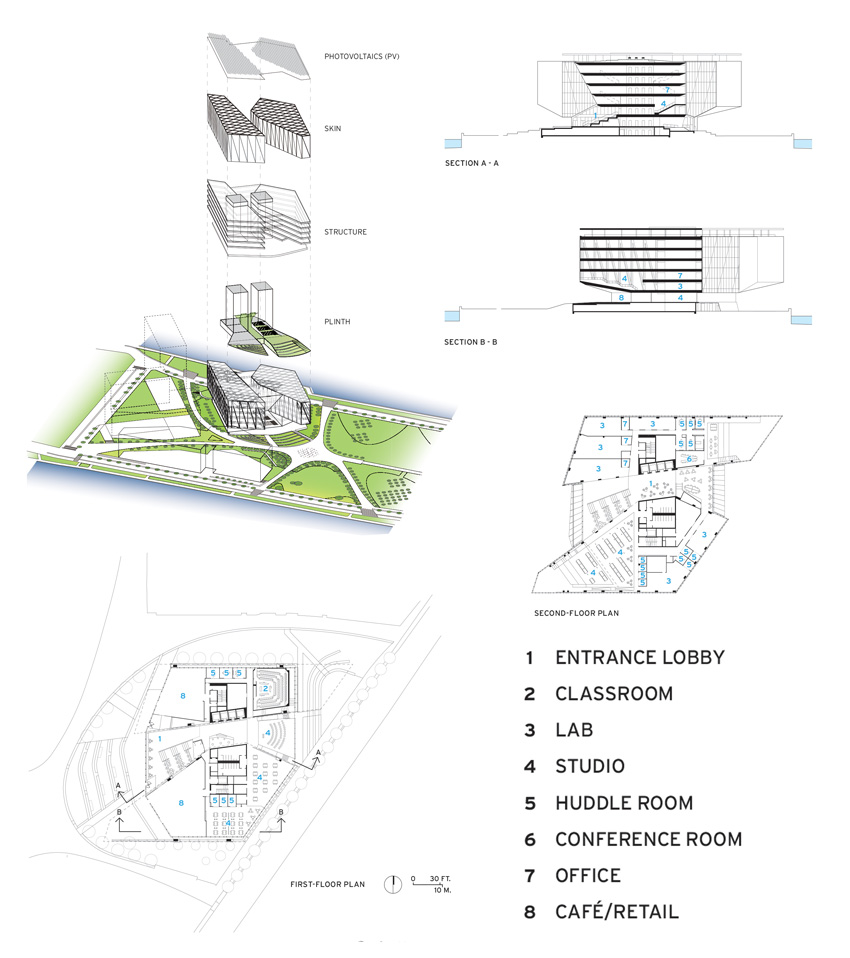
The first academic building at Cornell Tech, the Emma and Georgina Bloomberg Center, is a gleaming, bold statement on the new island campus for Cornell Tech, a partnership of Cornell University and Technion-Israel Institute of Technology. Its muscular, athletic stance, where a solar roof of 1,464 photovoltaic (PV) panels is boosted above four stories of teaching spaces, exultantly declares we have arrived about this adventurous step in bringing digital education and entrepreneurship together. Yet Thom Mayne, the design director and founder of Morphosis Architects, a Los Angeles– and New York–based firm, brushes off the implication that an arresting expression was intentional for this graduate computer-science and engineering facility. “I don’t design icons,” he says without irony—even though academic buildings by Morphosis such as Gates Hall at Cornell’s Ithaca, New York, campus (RECORD, November 2014, page 100), or Emerson College in L.A. (RECORD, May 2014 page 100) do stand out forcefully from the crowd.

PHOTOGRAPHY: © MATTHEW CARBONE
FULL METAL JACKET
The lily pad–shaped solar canopy, carrying photovoltaic panels, juts like a visor over the southern end of the Bloomberg Center (right). Morphosis has designed an aluminum rainscreen wall system (left), which maximizes insulation values and minimizes thermal bridging for the building. The hope is to achieve net zero status.
Mayne invokes sustainability—particularly the Bloomberg’s lily pad canopy of PVs—as the foremost generator of his scheme. It is only the tip of the hat to an array of green features such as geothermal wells, and a rainwater-collection system for the all-electricity (no combustion) building. The overall desire is to attain net zero energy, with the building producing, over the course of a year, at least as much energy from renewable sources as it consumes. Morphosis originally envisioned a roof of PVs that would float across the pedestrian plaza and central circulation spine to The Bridge building by Weiss/Manfredi on the eastern side of the site (page 134) to provide enough energy to meet the goal. Ultimately the idea was scaled back so that each structure has its own solar canopy: the Bloomberg Center’s is 40,000 square feet. Taken with The Bridge’s, the two arrays create the equivalent of a 900-kilowatt system. Whether the center proves to be “zero” or only “lite” will be answered by future monitoring.
To cut energy consumption, however, Morphosis clad the Bloomberg Center in a rainscreen wall system that maximizes insulation values and minimizes thermal bridging. In addition, the outermost layer is punched with 2-inch circular tabs and coated in an iridescent polymer film. “We wanted a dynamic facade,” says Ung-Joo Scott Lee, Morphosis principal. To get the full optical effect, the architects worked with Zahner, the architectural-metal fabricator, and received digital input from Cornell and MIT students.
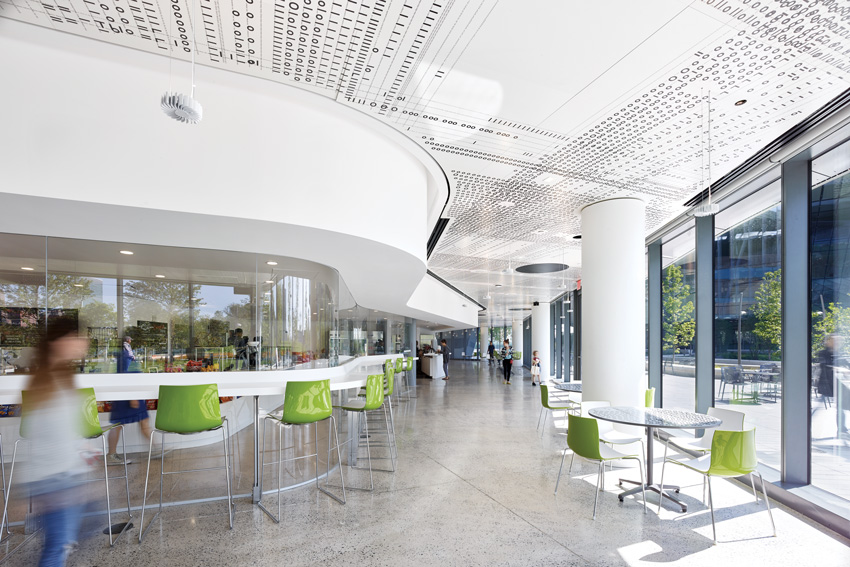
PHOTOGRAPHY: © MATTHEW CARBONE
WELCOME TO OUR WORLD
The café at the entrance to the Center is open to the general public. Highlighting the swerving counter and soffit is an expansive artwork by Michael Riedel. Titled Cornell Tech Mag, the piece is a black-and-white inkjet print on acoustical ceiling panels and is also silkscreened on the café’s tabletops.
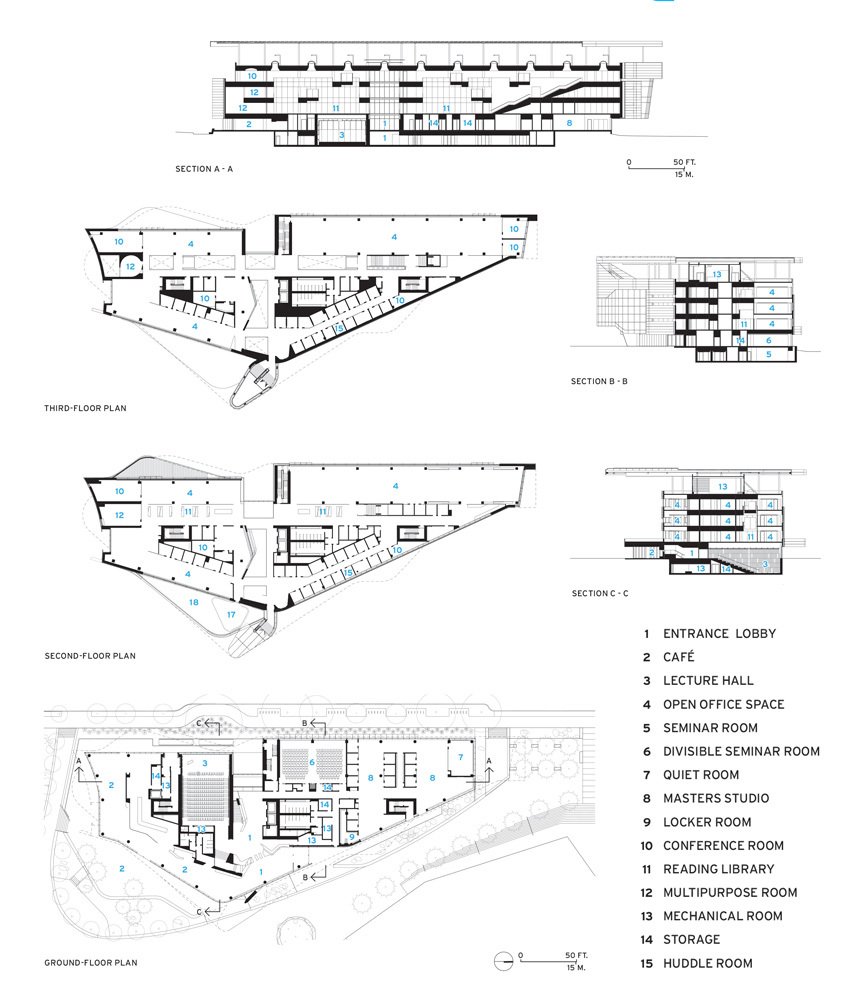
The iridescent, sparkling exterior skin is cut away so that bands of glazing do admit light to an array of educational spaces but maintain the recommended 60:40 ratio of wall surface to glass. Open classrooms are located on the western side of the building, facing Manhattan, and 76 small “huddle” rooms, where three or four people can meet, are on the east, oriented toward Queens. The huddle rooms evolved out of the desire by Daniel Huttenlocher, Cornell Tech dean and vice provost, to encourage an improvisatory exchange of ideas among the students and faculty. Whether these remain unassigned spaces or are appropriated by faculty members is unclear.
To ensure a fluidity of space that might spark spontaneous interaction, Morphosis placed a four-story atrium (five-story along the west) at the center of the building, anchored by an expansive stairway. At the second level, ancillary stairs take over the circulation. One veers into a curved appendage that protrudes outside the main volume of the building; its steel structure helps prop up the solar-canopy roof, which other¬wise depends on the extension of the Center’s steel columnar grid for support.
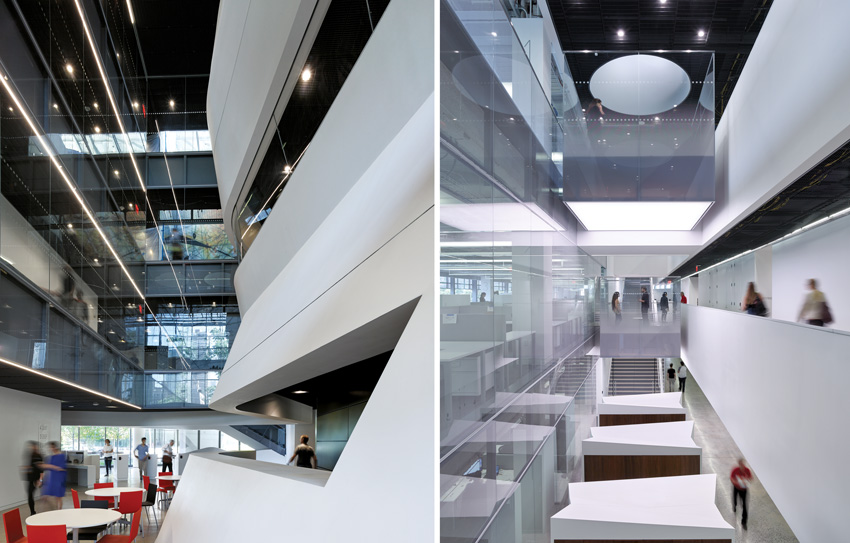
PHOTOGRAPHY: © MATTHEW CARBONE
INTO THE VOID
A long, three-story-high galleria (right) extends along the western portion of the Center. Here glass boxes on the third and fourth levels seem to float in the space, overlooking the locker pavilions adjoining reading tables below. At the entrance, a four-story part of the atrium (left) is given drama by the curving balustrades and bowed walls.
The atrium’s curvilinear walls, plus a stair’s glass enclosure, along with artist Matthew Ritchie’s resin, glass, and ink, 80-foot-high mural create an active core for the Center. In addition, a long galleria cut north–south through three stories of the western portion of the building offers another opportunity for casual encounter. Here five glass boxes for collaboration appear to float high in the void. (They are actually cantilevered from the steel frame.) Although the interior is more crepuscular than The Bridge across the plaza, skylights introduce illumination, while the white solid surfaces of the lockers on the second floor and polished concrete floors help bounce light.
The café, at the main entrance facing the plaza and Tech Walk, is open to the public. Its swooping, white, serpentine counter and the lowered ceiling soffit are handsomely offset by an inkjet artwork by Michael Riedel printed on the acoustical panels of the ceiling and silkscreened on the café tabletops. Adding an unusual note, a series of “discovery rooms” contain art installations by Alison Elizabeth Taylor and Matthew Day Jackson. But the most surprising one has a striking 50-foot-long mural by Ilya Bolotowski from 1941 that was painted for the WPA program and salvaged from the Goldwater Memorial Hospital formerly on the site. (Another mural from Goldwater by Albert Swinden has found a home in The Bridge.)
If art seems unusual for a high-tech school, so are the grassy terraces, the variegated plantings, and the contoured lawns by James Corner Field Operations. They unite the exterior spaces around the Center with its neighbors, creating numerous places for socializing in good weather. With its glinting skin that turns different colors in the sunlight, the Bloomberg Center is a strong and welcome presence for the approximately 300 master’s and Ph.D. students and 30 faculty members now using it. In deference to the architect, let’s not call it an icon. But it helps that a by-product of functional and environmental concerns is a magnetic work of architecture.
Credits
Architect: Morphosis Architects — Thom Mayne, design director; Ung-Joo Scott Lee, principal; Edmund Ming-Yip Kwong, Jerry Figurski, Debbie Chen, Stuart Franks, Farah Harake, Cory Brugger, team
Engineer: Arup (structural, m/e/p)
Consultants: Arup (facade, lighting, acoustic, fire, audiovisual, BMS controls, sustainability); Mueser Rutledge Consulting (geotechnical); Pentagram (graphic)
Client and Owner: Cornell University
Size: 160,000 square feet
Cost: withheld
Completion date: July 2017
Sources
Structural Steel: Beauce Atlas
PV Steel support: Koenig
Metal cladding: Zahner
Miscellaneous metal: Crystal Metal Works
Unitized facade/rainscreen: Island Exterior Fabricators
Exterior Glazing: W&W Glass
Curtain Wall/Metal Windows: YKK
Flat and Curved IGU: Cristacurva
Built-up Roofing: Sarnafil/Sikesland
Tile: Sarnatherm Heavyguard
Interior Glazing: Infinite Glass and Metal
Skylights: LineEl
Dome Skylights: Wasco
Acoustical Ceilings: Lindner, Baswaphon, Armstrong
Paints and Stains: Benjamin Moore, Idea Paint
Solid Surfacing: Dupont Corian
Special Finishes: 3Form Varia Eco Resin Wall Paneling
Interior Shades: Mechoshade
Gypsum Prefabricated Products: Plasterform
Office Furniture: Teknion, Herman Miller, Vitra, Wilkhahn, Andreu World, Allermuir
Interior Ambient Lighting: Lucifer Lighting, HE Williams, Linear Lighting
Photovoltaic Panels: Solaria
Photovoltaic System: Entresolar
View course on architecturalrecord.com »
The Bridge
Cornell Tech
Weiss/Manfredi
By Suzanne Stephens
In designing The Bridge for the new Cornell Tech campus in New York, Weiss/Manfredi faced several architectural challenges. As part of the first phase of creating this engineering and computer-science complex for Cornell University and Technion-Israel Institute of Technology, the project was one of three new buildings on Roosevelt Island in the East River. Accordingly, it needed to strongly express its identity. At the same time, it had to acknowledge its neighbors: Morphosis’s prominently placed four-story Bloomberg Center across the way (page 2) and Handel Architect’s The House, a 26-story academic residence just to the north (page 4).
PHOTOGRAPHY: © ALBERT VECERKA/ESTO, EXCEPT AS NOTED; IWAN BAAN (LEFT)
LIGHT LIFT
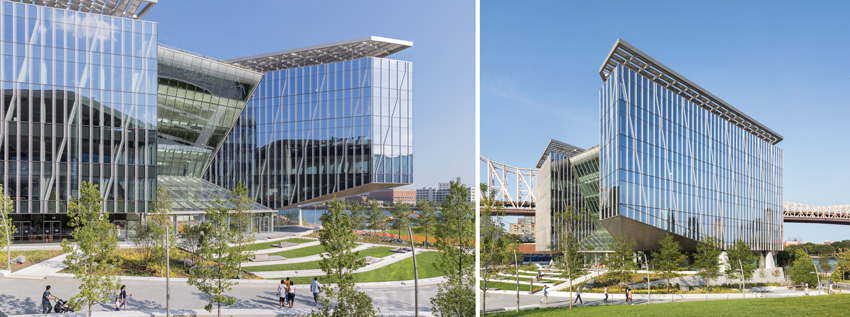
The cantilevered wings of The Bridge frame views for those passing by on the main promenade; landscaping by James Corner Field Operations softens the building’s base. Fritted-glass strips activate the facades, while solar canopies and terraces do the same for the roof.
But perhaps the most challenging was the relatively untried program—a co-location space. Here in a 235,000-square-foot building, graduate students would be encouraged to mingle with entrepreneurs to generate start-ups. One-third of the space would be filled with students, while two-thirds would accommodate workplaces for tech businesses. The developer, Forest City Ratner Companies (FCR), actually owns the facility, leasing space both to the school and to tech-related companies.
Yet there was no “co-location” building typology on which the architects could model a design: “The new program was both liberating and terrifying,” says principal Michael Manfredi. FCR had invited Weiss/Manfredi to submit an RFQ based on the firm’s past institutional work, particularly the nanotechnology center at the University of Pennsylvania (RECORD, November 2013, page 140) and the architecture and arts building for Barnard College (2010).
To create an open, flexible environment where students and entrepreneurs could spontaneously interact, Weiss/Manfredi split a rhomboid-like block into two prisms divided by an atrium and generous circulation space. The fissure “is our biggest single move,” says principal Marion Weiss about the parti: “We cut through the middle of the block on an east–west axis that takes in river-to-river views.” Loft spaces and an “inefficient core,” as Weiss refers to this expansive atrium, could foster unexpected encounters. Cornell Tech occupies the first and second floors and part of the third, while the rest of the six levels are leased to business groups such as Two Sigma, an investment firm involved in tech activities, as well as Citicorp’s securities division, and Microsoft.
PHOTOGRAPHY: © ALBERT VECERKA/ESTO
WALK RIGHT IN
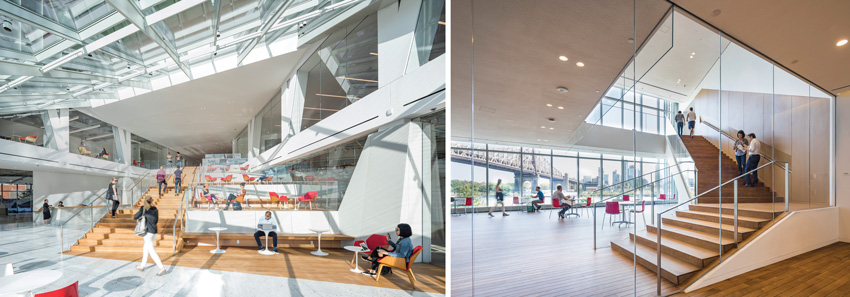
An expansive stadium stair (left) fills the lobby, interrupted with interior landings that complement the landscaped terraces outdoors. Another stair (right) links the second and third levels of floors on the east side of the building, where views of the Queensboro Bridge dominate.
The mostly steel structure rests on a poured concrete base (clad in precast concrete panels where exposed), which is raised 7 feet above the elevation recommended for severe flooding. The Bridge’s entrance opens onto an expansive pedestrian plaza with cascading grassy terraces designed by James Corner Field Operations. Two wings, which dramatically cantilever in northeast and southwest directions, lift off the ground to shelter outdoor spaces for classes and sitting areas. More important, the space under the cantilevers allows unobstructed views—of the East River on both sides, and cityscapes of Manhattan and Queens.
The entrance to The Bridge draws passersby into the almost column-free lobby. Here café tables and a broad stadium stair, interspersed with three expansive interior terraces, offer ample opportunities for impromptu schmoozing, studying, or discussion. Sectional cuts through the atrium provide glimpses of both upper and lower levels, and glazed perimeter walls of each polyhedral wing amplify the opportunity for different kinds of light and glimpses of the water and urban shoreline.
PHOTOGRAPHY: © ALBERT VECERKA/ESTO
IN THE PROW
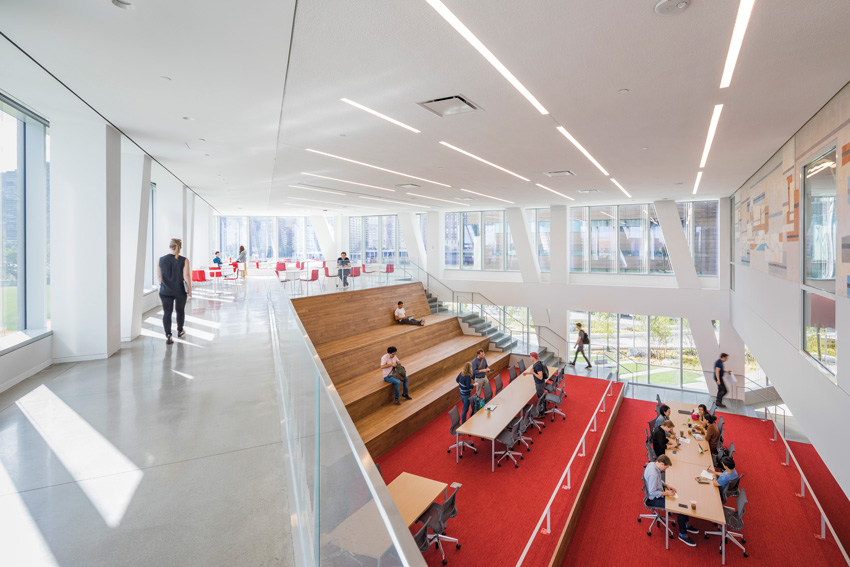
In the second-level studio space (above, at left), which follows the lift of the cantilevered wing, tenants can work or confer in a variety of settings. A 1942 WPA mural by Albert Swinden from the razed Goldwater Memorial Hospital is installed on the inner wall (above, at right).
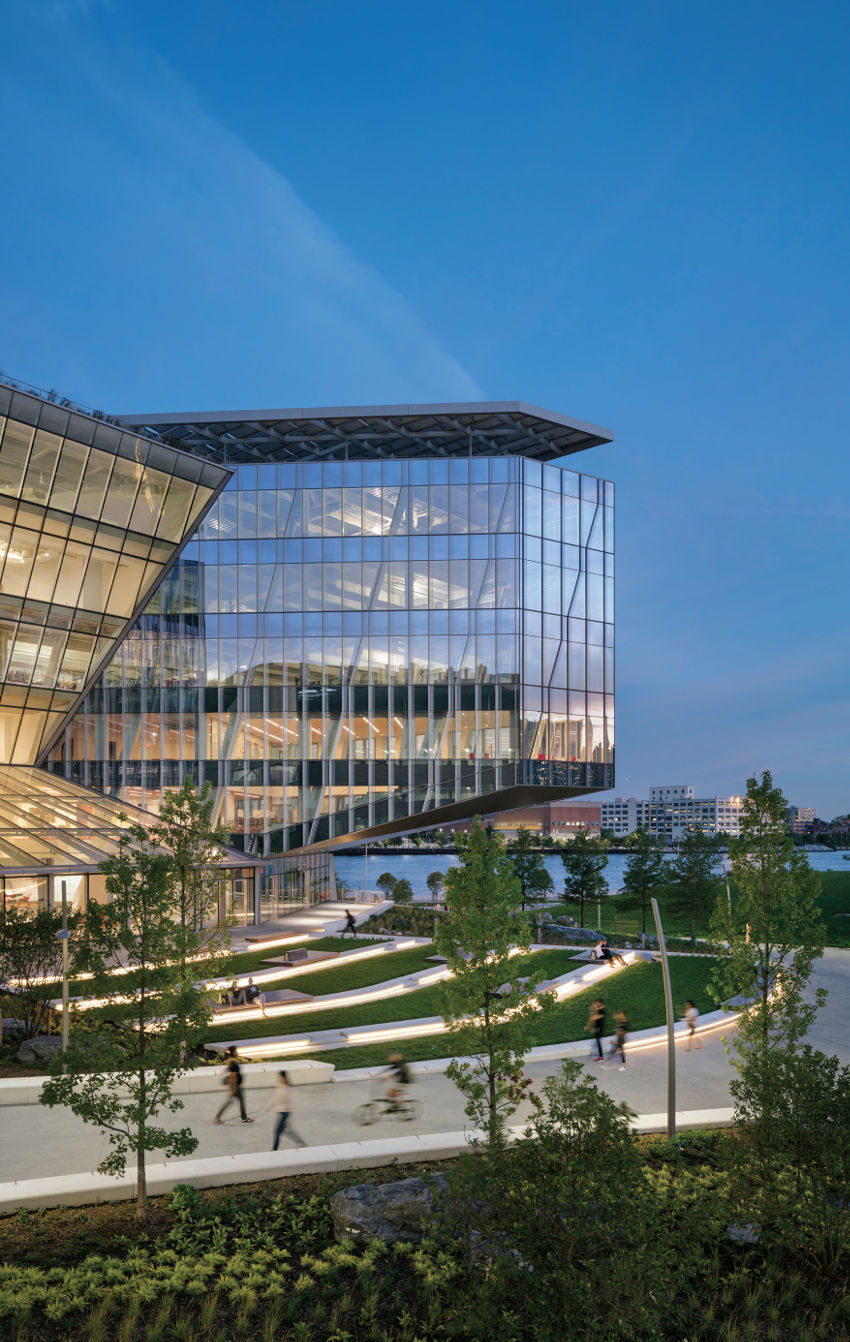
Since the energy-code requirements called for a 60:40 ratio of wall to window, the glass-skinned Bridge might seem to not comply. However, Weiss/Manfredi combined thermally efficient, transparent insulated glass with 5-foot-tall “shadow box” units, where double-glazing is placed 3 inches in front of insulated gray metal panels. Reflective coatings give the impression of a continuous surface of glass and reduce heat gain and glare, while diagonal fritted-glass strips, zigzagging across the facades, further mitigate the solar load and add an active pattern to the vitreous surfaces.
The architects planned the spaces so that 75 percent of the learning, working, and socializing areas are within 30 feet of the windows, keeping the need for electric light lower than normal. Another energy savings comes from the 761 photovoltaic (pv) panels in the 24,000-¬ square-foot array on the rooftop canopy. Although the electricity generated by those pvs goes toward the neighboring Bloomberg Center’s net zero goal, the canopy itself shades outdoor terraces overlooking mesmerizing, panoramic views of the East River and the New York skyline.
The gigantic full-height elevated trusses that support the cantilevers hardly look economical. But the architects argue that they make the structure 40 percent lighter than a typical steel frame and cut down the need for more interior columns. The lavish use of gypsum board to cover the trusses does diminish the drama a bit, even if its white color keeps the light level high.
Gauging the success in how The Bridge does (or doesn’t) meet its goals—in terms of encouraging interaction and creativity between students and businesspeople, not to mention energy efficiency—should be instructive and fascinating to follow as it reaches its full occupancy in the coming months. Already, the building is on track for achieving LEED Gold status and is a remarkable addition to the ensemble: its geodic features, gleaming glass, and dramatic cantilevers exhibit a frank optimism about Cornell Tech’s educational significance and its own contribution to the ensemble. Its crystalline surfaces stand out from the metal-paneled The House hovering behind it. And, while The Bridge is lighter, if sharper-edged, than the brawnier Bloomberg Center by Morphosis, it complements the dynamism of its neighbor with its own shimmering, bravura statement.
PHOTOGRAPHY: © ALBERT VECERKA/ESTO
GLASS EXPRESSIONISM
The polyhedral volumes of The Bridge amplify light and views within the building. Transparent insulated glass is combined with 5-foot-tall “shadow box” units where double glazing is placed in front of insulated metal panels.
Credits
Architect: Weiss/Manfredi Architecture/Landscape/Urbanism — Marion Weiss, Michael Manfredi, design partners; Mike Harshman, project manager; Joe Vessell, Pierre Hoppenot, project architects
Engineers: Thornton Tomasetti (structural); Jaros, Baum & Bolles (m/e/p/fp)
Consultants: Heintges (glazing); Renfro Design Group (lighting); Arup (acoustics); Arup, Jaros, Baum & Bolles (AVIT and security)
Owner: Forest City Ratner
Client: Forest City Ratner and Cornell Tech
Size: 235,000 square feet
Cost: withheld
Completion date: September 2017
Sources
Metal/Glass Curtain Wall: W&W Glass; Erie Architectural Products
Metal Panels: Jobin Organization; Sobotec
Glass: Interpane, Viracon
Acoustical Plaster Ceiling: Baswa Acoustic, Sonakrete
Classroom/Studio Furniture: Herman Miller
View course on architecturalrecord.com »
The House
Cornell Tech
Handel Architects
By Joann Gonchar
Not every structure should shout for attention: there’s nothing wrong with a well-designed background building. Handel Architects’ latest project, The House at Cornell Tech, a $115 million residential tower on the new computer, information, and engineering-sciences campus on New York’s Roosevelt Island, could have been a fine example of this notion. Heralded for its pioneering energy-conserving strategies, its form—a shaft extruded from a roughly rectangular footprint—is straightforward, if plain. Its windows are slightly inset, giving the facade’s alternating bands of light and dark gray metal some depth. And this skin has other subtle refinements, including its expression as a wrapper, with a louvered vertical “reveal” that extends from the entrance almost to the roof.


PHOTOGRAPHY: © FIELD CONDITION, EXCEPT AS NOTED; PAVEL BENDOV (TOP)
STANDING TALL
The House (top), a 26-story residential tower, is slated to become the tallest and largest
Passive House building in the world. Its superinsulated metal skin is expressed as a wrapper, with a vertical
louvered reveal (bottom) that encloses mechanical equipment and extends from the entrance almost to the roof.
There’s one problem, however: The House is too tall and too prominent for such a simple response. It sits at the northern end of the 12-acre campus, which could eventually include up to 2.1 million square feet of facilities, and it rises next to the picturesque trusswork of the Queensboro Bridge. The 26-story-tall, 273,000-square-foot building is highly visible from the Manhattan and Queens riverfronts, part of an ensemble with the far more sculptural—and low-rise—Cornell Tech facilities built so far: Morphosis’s four-story academic building (page 2) and Weiss/Manfredi’s six-story “co-location” building (page 3). It is also significantly taller than the 17-story SnØhetta-designed hotel and executive education center under construction just to the west. Because of its height and placement it dominates its neighbors, but looks flat-footed in their company.
If The House is a missed opportunity for formal invention, it still represents a milestone for green multifamily development. As Handel partner Blake Middleton points out, the 352-unit apartment building for graduate students and faculty is expected to save 882 tons of CO2 per year, the equivalent of planting 5,300 trees. It is designed according to the principles of Passive House—an ultra-low-energy certification system for all building types, not just residential construction.
As part of its aspiration to create a state-of-the-art campus, Cornell included the Passive House goal in its request for proposals issued in 2012. But the developers—the Hudson Companies and Related—were under no contractual obligation to pursue it. Nevertheless, the team embraced this vision and expects official notice of certification shortly. This would make it the tallest and largest Passive House to date anywhere in the world. That is no small achievement.
The main tenets of the program, known as “Passivhaus” in Germany, where it originated, include proper solar orientation; an extra-insulated, airtight building envelope that avoids thermal bridging; high-performance windows; and mechanical ventilation with heat recovery. Handel and its consultants designed to an energy budget that allowed no more than 4.75 kBtu/ft2 be expended for heating and 5.39 kBtu/ft2 for cooling each year and permitted a total energy use intensity (EUI) of no more than 38.1 per year. This figure represents a 73 percent reduction over the median EUI for New York buildings of similar type and size.
The qualities that contribute to these sustainable targets are mostly invisible. The interior looks more like a sleek extended-stay business hotel than an ubergreen dorm. Amenities include a gym and a rooftop lounge with a terrace and grilling area. A ground-floor lounge and coffee bar, which contrasts the exposed concrete structure and terrazzo floors with warmer wood accents, is light-filled and looks out onto the East River and the landscaped campus. The apartments, which range in size from micro studios to three bedrooms, have features like full kitchens with engineered-stone counters. Although glass makes up less than 25 percent of the facade area (a key conservation strategy), the units feel bright, and many offer stunning views of the Manhattan skyline.

Surprisingly, those involved with the project say that designing a very large Passive House is not necessarily more difficult than one at a smaller scale, such as a single-family residence. From a building-envelope perspective, a larger structure can be easier due to its low surface-¬to-volume ratio, says Lois Arena, the director of Passive House services at Steven Winter Associates. The density of occupancy means there are more internal heat gains, allowing for a reduced amount of insulation than might otherwise be needed to meet the standard’s stringent energy requirements.
But despite these advantages, the exterior envelope still needed a unique approach. “There is just a tremendous amount of area to cover with high-performance materials and details,” says Deborah Moelis, a Handel senior associate. These materials and details included a custom exterior-wall system prefabricated in a Penn¬sylvania factory in 9-foot-tall by 36-foot-long sections. The panels arrived at the site complete with air and vapor barriers, mineral wool insulation, and the triple-glazed, operable windows already installed. The strategy helped speed construction but also improved quality by minimizing the number of joints that had to be sealed in the field. This in turn contributed to the building’s airtight properties, which were confirmed with a post-construction blower door test required for certification. According to Arena, the building passed with flying colors, with infiltration 75 percent below the Passive House limit of 0.6 air changes per hour at 50 pascals of pressure. “We smashed it,” she says.


PHOTOGRAPHY: © FIELD CONDITION
CREATURE COMFORTS
The building’s amenities include a lounge and coffee bar (left) in the lobby. The space offers views of the East River and the campus and combines exposed concrete structure and warmer wood accents. The apartments, such as a studio (right), have ample daylight, even though the skin is only 23 percent glass.
The design of the mechanical system was also tricky, since equipment appropriate for Passive House buildings of this size was difficult to find. The team devised a customized central ventilation system, with two energy-recovery ventilators (ERVs) on the roof supplying tempered fresh air to the apartments. For heating and cooling, they opted for a low-energy variable refrigerant flow (VRF) system with individual evaporators in each living room and bedroom. These wall units are tied to condensers located on small balconies on each floor, hidden behind the vertical louvered reveal. But the evaporators have about twice the capacity that consultants from BuroHappold Engineering determined was necessary, simply because smaller units were not available.

PHOTOGRAPHY: © FIELD CONDITION
ZIPPED UP
To speed construction and reduce the number of joints that would need to be sealed on-site, the facade panels (left and right) were fabricated in-factory and delivered to the site in 9-foot-tall, 36-foot-long sections with insulation, air, and vapor barriers, and triple-glazed windows already installed.
Hudson and Related paid a premium for Passive House construction and are said to be crunching the numbers to figure out exactly how much. “It depends on what you select as your baseline,” Arena explains. “For a developer that usually builds to LEED Gold, the premium isn’t that big.” Sources expect that the cost will come down as demand grows and more suitable products and equipment become available.

DIAGRAMS: COURTESY HANDEL ARCHITECTS
And demand does seem to be growing: Handel and Steven Winter Associates are working on several Passive House projects, including one that will be even larger than The House—a mixed-use complex for New York’s East Harlem neighborhood, with 655 affordable rental apartments. The two firms are also collaborating on an 18-story office building in Boston that will be designed according to Passive House principles. These projects will be a good thing for those cities and the planet—and even better if designers can demonstrate that “Passive House” need not be synonymous with plain vanilla.
Credits
Architect: Handel Architects — Gary Handel, Blake Middleton, Deborah Moelis, Ryan Lobello, project team
Consultants: BuroHappold Engineering (structural, m/e/p/fp, lighting); Steven Winter Associates (Passive
House, accessibility); Vidaris (exterior wall); Future Green Studio (landscape)
General Contractor: Monadnock Construction
Client: Hudson Companies and Related
Size: 273,000 square feet
Cost: $115 million
Completion Date: September 2017
Sources
Metal Wall Panels: Eastern Exterior Wall Systems
Curtain Wall: Oldcastle BuildingEnvelope
Moisture Barrier: Intesana
Insulation: Roxul
Windows: Shüco
VRF System: Mitsubishi
ERV System: Daikin