This CE Center article is no longer eligible for receiving credits.
The news on multifamily housing remains good. The largest lenders in housing, Fannie Mae and Freddie Mac, expect to break more records in 2016 in their lending on multifamily properties. They both had a very busy 2015, and according to John Cannon, senior vice president of multifamily production, sales and marketing for Freddie Mac, “I think our activity is going to be higher in 2016 than last year.” That is impressive since Freddie Mac lent $47 billion to apartment properties in 2015, which was up more than 66 percent compared to 2014. Fannie Mae wasn’t far behind, lending $42 billion in 2015.
All of these numbers and trends are interesting because their federal regulator, the Federal Housing Finance Administration (FHFA), has set limits on how much they can lend to multifamily housing at $30 billion. Those limits came from the government seizure of these two lending agencies during the recent financial crisis. However, in 2015, those limits loosened such that lending to affordable housing properties and “workforce” housing properties no longer counts toward their $30 billion limits. Strong demand for loans for this type of housing as well as others was the main reason that Fannie Mae and Freddie Mac lent so much in 2015. With the ability to lend to a wide portfolio of properties beyond their otherwise imposed limits, they are poised to continue to meet that demand in 2016.
Driving that demand are developers who are in turn responding to a very robust market. Instead of just catering to luxury high-rise projects, it seems that a mix of settings, building types, sizes, and amenities are all responding to different market needs, as people of all ages seek multifamily living environments suited to their lifestyles. As architects and designers of these new and renovated buildings, it behooves us to stay abreast of available options, systems, building components, and features that we can bring to multifamily projects. Accordingly, we can satisfy both the developer clients and the end users who will live with and in the vibrant spaces we create as part of a larger community.
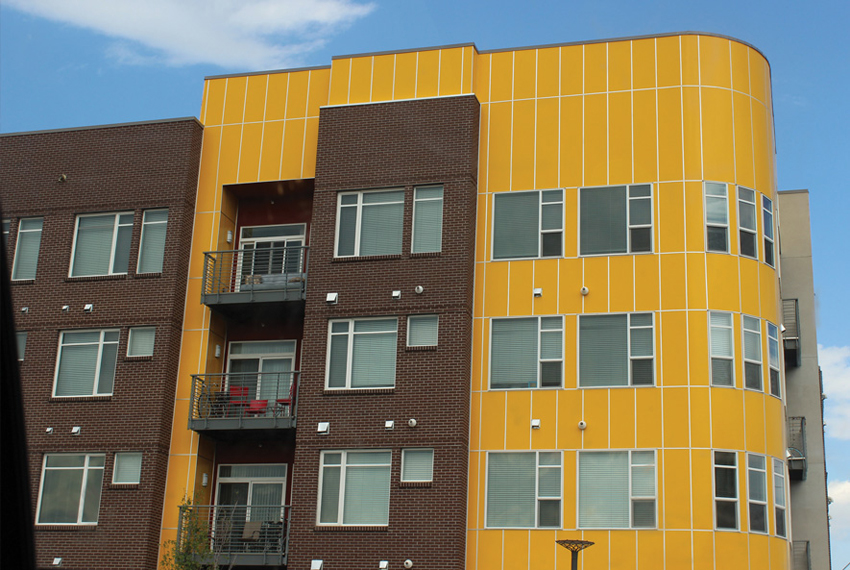
Photo courtesy of TAMLYN
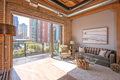
Multifamily housing that offers up-to-date features and amenities remains a significant part of the construction market, both new and renovation, because demand is high all across the United States.
ENHANCED EXTERIOR BUILDING DESIGN
Let’s start by looking at the exterior of multifamily buildings. This is an area where aesthetics and curb appeal loom large in the interest of marketing a project and providing some satisfaction to those who live there. Additionally, the exterior systems make up the building envelope, which needs to provide the requisite barriers for air, vapor, weather, and thermal control. Successfully bringing the aesthetics and the performance together requires attention to both the overall design and the details. Some examples of systems that do just that follow.
Photos courtesy of TAMLYN
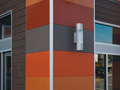
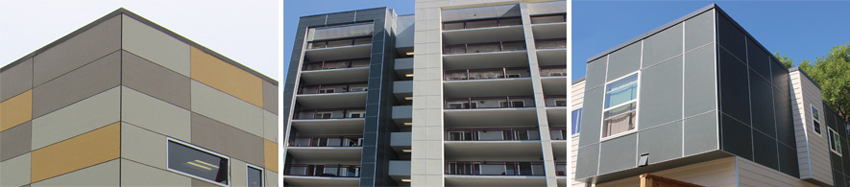
Exterior cladding with various types of aluminum trim contribute to a wide variety of exterior design approaches for multifamily housing projects.
Exterior Cladding Treatments
In the interest of satisfying aesthetic solutions that support human scale as well as cost effectiveness using lightweight materials, many new types of exterior cladding materials have entered the market. Some are thin composite panels, some are ceramic, and some are metal. They all offer different visual choices and evoke different design strategies depending on how they are used, but they all need to be mounted and held in place appropriately. Further, they need to have the panel edges addressed to create trimmed or trim-less appearances, or if siding is used then some trim is needed to contain the edges.
Recognizing the varying design needs, there are panel and siding trim systems available that cover a wide range of appearances. These include different systems of profiles that can work together to create a total design solution without changing manufacturers. Such trim products are designed to work with most siding, panel, and product offerings so compatibility should be fairly straightforward. Different finishes are readily available, including anodized, painted, powder coated, and primed, allowing for a scheme of matching or contrasting appearance. This means architects have the ability to detail the exterior with different options, from wide horizontal breaks, verticals that are accented or fade into a monolithic form, and corners that offer open reveals or closed sharp angles.
Val Glitch, FAIA, is an architect who has looked at a number of options and says, “The alternative to premanufactured trim? Wood trim gives a very different aesthetic. It is bulkier and, for water infiltration concerns, can only be used for vertical joints. We could have had a metal shop make up the trim pieces, but that’s not always a good way to get a quality, consistent, cost-effective product. And the heavier-weight manufactured trim that we use makes it easier to install the product properly.” Russell A. Hruska, AIA, goes on to observe that, “Using trim over panel joints becomes an architectural element and is a way of expressing the joints and defining their deliberate placement. It adds a level of architectural refinement.”
Manufactured Stone Veneer
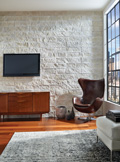
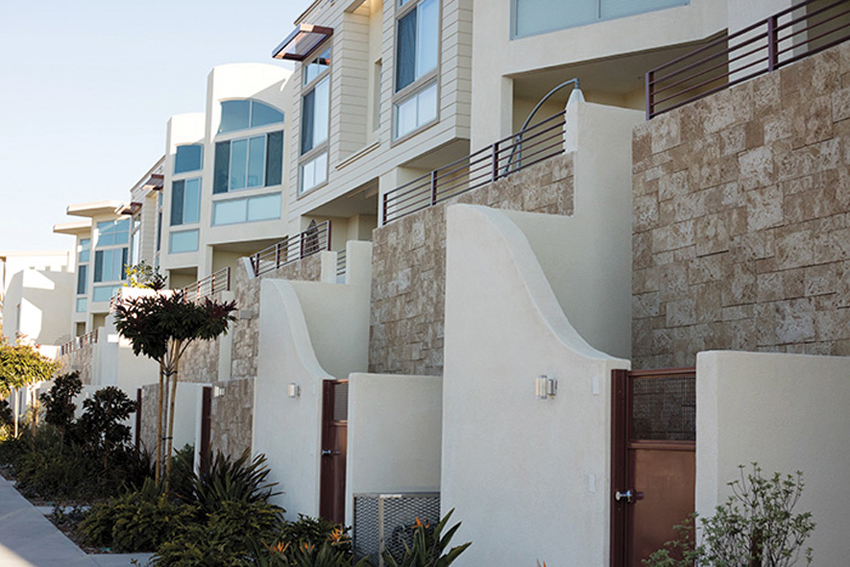
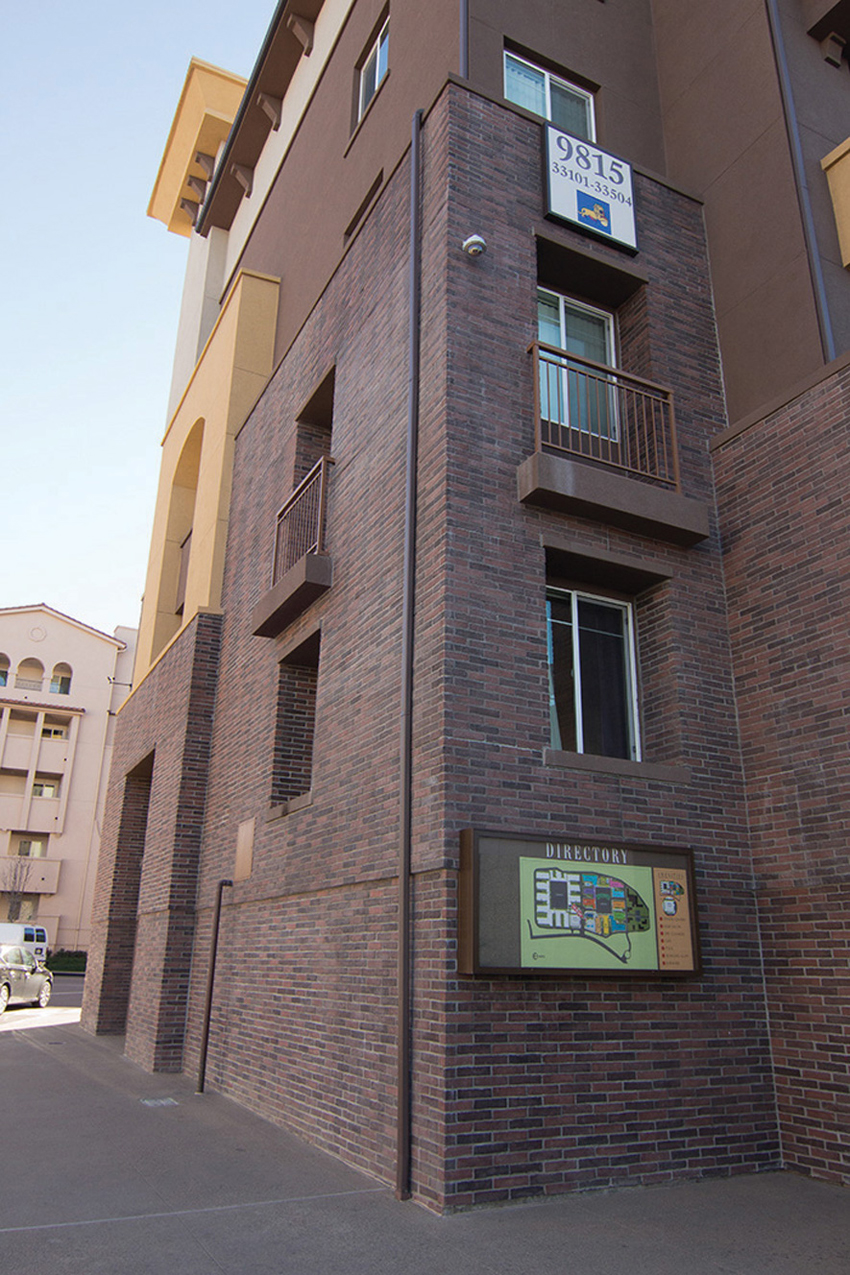
An alternative to smooth-surfaced cladding panels, manufactured stone veneer can add texture to multifamily building facades. As a lighter-weight product than full thickness stone or masonry, it can be incorporated into projects of all types and sizes with about half the weight and cost of natural stone veneer. Further, manufactured stone provides greater quality control on color consistency throughout a large project.Manufactured stone veneer has become popular for part or all of a building facade in multifamily projects for a variety of reasons. First, it is indeed a stone product, making it very durable and able to stand up to the rigors of a heavily used building. Second, it is easy to detail, with a full line of manufactured accessories available to allow realistic transitions across corners and other building conditions. Third, it is easy to install, including the option to panelize to make installation quick for large projects. Quicker installations mean shorter building construction times, which usually translates to cost savings. Compared to natural stone, architectural stone veneer provides the advantages of lower weight, easier installation, less waste, controllable color palettes, and lower price.
Natural materials like stone not only speak to environmental awareness, they evoke a sense of connectivity to nature. Stone’s inherent characteristics of texture and warmth have been used on buildings to help define and highlight the design of both interior and exterior wall surfaces. As such, architects and designers have been able to incorporate products that transform ordinary environments into unique and memorable spaces. There is an abundance of choice and variety available with dozens of stone profiles and more than 150 different colors on the market, offering a full range of palettes, shapes, and textures.
Architectural stone veneer can be applied to interior or exterior locations in multifamily buildings. Selecting the right stone and color can make the difference between an ordinary project and a true showcase. Stone textures, styles, and color palettes range from contemporary clean lines with monochromatic colors to rustic irregular shapes with rich, bold color variation. Manufacturers stay innovative by working closely with designers and architects to develop new stone profiles and colors, which drive the trends in the industry.
Photos courtesy of Eldorado Stone
Architectural manufactured stone veneer can be used creatively in a variety of ways to enhance the texture and color of a multifamily building facade with quicker installation and less cost than conventional stone.
Moisture Management System
Beyond the appearance of a building facade, a critically important performance aspect is the way that moisture is controlled behind the exterior cladding. Designing a wall assembly with a gap between the finished surface and the substrate has been recognized as a key performance enhancer. This is true because it helps to reduce the hydrostatic pressure on the substrate and allows water to drain out of the wall cavity. Through testing per ASTM E2273, it has been shown that a gap of 1 millimeter or greater provides 96 percent drainage efficiency. The Building Science Corporation of Canada has noted that, “The measured drainage rate of a 1-millimeter gap is greater than extreme driving rain intensity for the worst climate in Canada.”
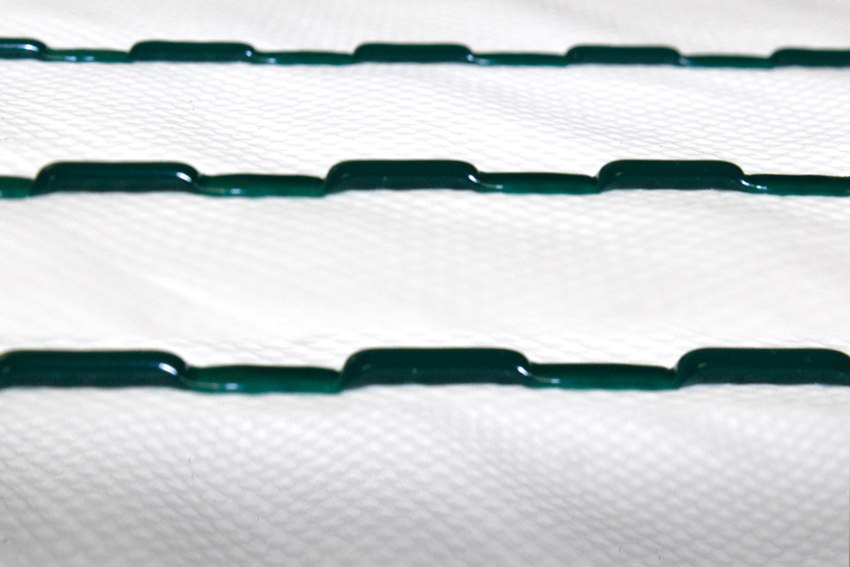
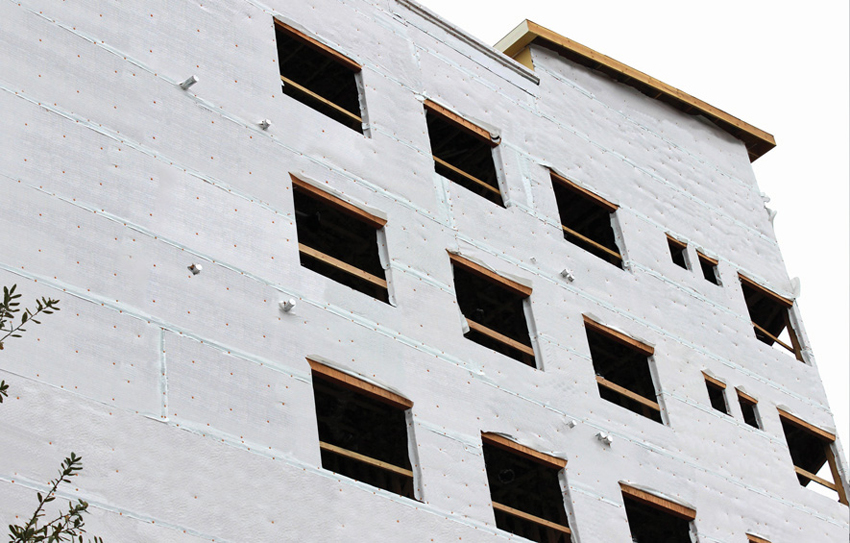
With this understanding in mind, there is a new segment in building wrap materials that creates such a gap by using an applied surface treatment to the wrap. This produces a micro rainscreen and a fully functioning drainage plane behind the cladding and in front of the substrate. Properly detailed and installed, this type of drainable building wrap helps to handle the moisture that is inherent in exterior wall assemblies. Combined with a compatible tape for the seams of the building wrap, it helps maintain a continuous, overlapping, secured installation. This is the preferred approach for effective moisture management by many members of the building science community. Jon Standley, the project manager for a multifamily project known as Texan 26, notes, “This approach was chosen for the effectiveness as a drainage plane under multiple siding products and for maintaining its gap once installed.” It is expected to help keep the facade performing properly and looking good not just at first installation, but for many years to come.
Images courtesy of TAMLYN
Strategically located spacers provide an intended drainage gap on a synthetic, non-woven, breathable building wrap product.
The news on multifamily housing remains good. The largest lenders in housing, Fannie Mae and Freddie Mac, expect to break more records in 2016 in their lending on multifamily properties. They both had a very busy 2015, and according to John Cannon, senior vice president of multifamily production, sales and marketing for Freddie Mac, “I think our activity is going to be higher in 2016 than last year.” That is impressive since Freddie Mac lent $47 billion to apartment properties in 2015, which was up more than 66 percent compared to 2014. Fannie Mae wasn’t far behind, lending $42 billion in 2015.
All of these numbers and trends are interesting because their federal regulator, the Federal Housing Finance Administration (FHFA), has set limits on how much they can lend to multifamily housing at $30 billion. Those limits came from the government seizure of these two lending agencies during the recent financial crisis. However, in 2015, those limits loosened such that lending to affordable housing properties and “workforce” housing properties no longer counts toward their $30 billion limits. Strong demand for loans for this type of housing as well as others was the main reason that Fannie Mae and Freddie Mac lent so much in 2015. With the ability to lend to a wide portfolio of properties beyond their otherwise imposed limits, they are poised to continue to meet that demand in 2016.
Driving that demand are developers who are in turn responding to a very robust market. Instead of just catering to luxury high-rise projects, it seems that a mix of settings, building types, sizes, and amenities are all responding to different market needs, as people of all ages seek multifamily living environments suited to their lifestyles. As architects and designers of these new and renovated buildings, it behooves us to stay abreast of available options, systems, building components, and features that we can bring to multifamily projects. Accordingly, we can satisfy both the developer clients and the end users who will live with and in the vibrant spaces we create as part of a larger community.
Photo courtesy of TAMLYN
Multifamily housing that offers up-to-date features and amenities remains a significant part of the construction market, both new and renovation, because demand is high all across the United States.
ENHANCED EXTERIOR BUILDING DESIGN
Let’s start by looking at the exterior of multifamily buildings. This is an area where aesthetics and curb appeal loom large in the interest of marketing a project and providing some satisfaction to those who live there. Additionally, the exterior systems make up the building envelope, which needs to provide the requisite barriers for air, vapor, weather, and thermal control. Successfully bringing the aesthetics and the performance together requires attention to both the overall design and the details. Some examples of systems that do just that follow.
Photos courtesy of TAMLYN
Exterior cladding with various types of aluminum trim contribute to a wide variety of exterior design approaches for multifamily housing projects.
Exterior Cladding Treatments
In the interest of satisfying aesthetic solutions that support human scale as well as cost effectiveness using lightweight materials, many new types of exterior cladding materials have entered the market. Some are thin composite panels, some are ceramic, and some are metal. They all offer different visual choices and evoke different design strategies depending on how they are used, but they all need to be mounted and held in place appropriately. Further, they need to have the panel edges addressed to create trimmed or trim-less appearances, or if siding is used then some trim is needed to contain the edges.
Recognizing the varying design needs, there are panel and siding trim systems available that cover a wide range of appearances. These include different systems of profiles that can work together to create a total design solution without changing manufacturers. Such trim products are designed to work with most siding, panel, and product offerings so compatibility should be fairly straightforward. Different finishes are readily available, including anodized, painted, powder coated, and primed, allowing for a scheme of matching or contrasting appearance. This means architects have the ability to detail the exterior with different options, from wide horizontal breaks, verticals that are accented or fade into a monolithic form, and corners that offer open reveals or closed sharp angles.
Val Glitch, FAIA, is an architect who has looked at a number of options and says, “The alternative to premanufactured trim? Wood trim gives a very different aesthetic. It is bulkier and, for water infiltration concerns, can only be used for vertical joints. We could have had a metal shop make up the trim pieces, but that’s not always a good way to get a quality, consistent, cost-effective product. And the heavier-weight manufactured trim that we use makes it easier to install the product properly.” Russell A. Hruska, AIA, goes on to observe that, “Using trim over panel joints becomes an architectural element and is a way of expressing the joints and defining their deliberate placement. It adds a level of architectural refinement.”
Manufactured Stone Veneer
An alternative to smooth-surfaced cladding panels, manufactured stone veneer can add texture to multifamily building facades. As a lighter-weight product than full thickness stone or masonry, it can be incorporated into projects of all types and sizes with about half the weight and cost of natural stone veneer. Further, manufactured stone provides greater quality control on color consistency throughout a large project.Manufactured stone veneer has become popular for part or all of a building facade in multifamily projects for a variety of reasons. First, it is indeed a stone product, making it very durable and able to stand up to the rigors of a heavily used building. Second, it is easy to detail, with a full line of manufactured accessories available to allow realistic transitions across corners and other building conditions. Third, it is easy to install, including the option to panelize to make installation quick for large projects. Quicker installations mean shorter building construction times, which usually translates to cost savings. Compared to natural stone, architectural stone veneer provides the advantages of lower weight, easier installation, less waste, controllable color palettes, and lower price.
Natural materials like stone not only speak to environmental awareness, they evoke a sense of connectivity to nature. Stone’s inherent characteristics of texture and warmth have been used on buildings to help define and highlight the design of both interior and exterior wall surfaces. As such, architects and designers have been able to incorporate products that transform ordinary environments into unique and memorable spaces. There is an abundance of choice and variety available with dozens of stone profiles and more than 150 different colors on the market, offering a full range of palettes, shapes, and textures.
Architectural stone veneer can be applied to interior or exterior locations in multifamily buildings. Selecting the right stone and color can make the difference between an ordinary project and a true showcase. Stone textures, styles, and color palettes range from contemporary clean lines with monochromatic colors to rustic irregular shapes with rich, bold color variation. Manufacturers stay innovative by working closely with designers and architects to develop new stone profiles and colors, which drive the trends in the industry.
Photos courtesy of Eldorado Stone
Architectural manufactured stone veneer can be used creatively in a variety of ways to enhance the texture and color of a multifamily building facade with quicker installation and less cost than conventional stone.
Moisture Management System
Beyond the appearance of a building facade, a critically important performance aspect is the way that moisture is controlled behind the exterior cladding. Designing a wall assembly with a gap between the finished surface and the substrate has been recognized as a key performance enhancer. This is true because it helps to reduce the hydrostatic pressure on the substrate and allows water to drain out of the wall cavity. Through testing per ASTM E2273, it has been shown that a gap of 1 millimeter or greater provides 96 percent drainage efficiency. The Building Science Corporation of Canada has noted that, “The measured drainage rate of a 1-millimeter gap is greater than extreme driving rain intensity for the worst climate in Canada.”
With this understanding in mind, there is a new segment in building wrap materials that creates such a gap by using an applied surface treatment to the wrap. This produces a micro rainscreen and a fully functioning drainage plane behind the cladding and in front of the substrate. Properly detailed and installed, this type of drainable building wrap helps to handle the moisture that is inherent in exterior wall assemblies. Combined with a compatible tape for the seams of the building wrap, it helps maintain a continuous, overlapping, secured installation. This is the preferred approach for effective moisture management by many members of the building science community. Jon Standley, the project manager for a multifamily project known as Texan 26, notes, “This approach was chosen for the effectiveness as a drainage plane under multiple siding products and for maintaining its gap once installed.” It is expected to help keep the facade performing properly and looking good not just at first installation, but for many years to come.
Images courtesy of TAMLYN
Strategically located spacers provide an intended drainage gap on a synthetic, non-woven, breathable building wrap product.
CONNECTING INDOORS AND OUTDOORS
The exterior of a building is usually thought of in terms of keeping things outside that belong outside, but there are plenty of times when people want to connect with the outdoors, too. That connection could be in terms of windows or doors that allow visual or direct access to patios or other private spaces. It could also be through the creation of outdoor spaces specifically designed to be used and enjoyed by residents and visitors to multifamily buildings.
Opening Glass Walls
Many multifamily housing projects of all types include an outdoor balcony, porch, deck, or similar space as part of a living unit. This is often a very sought-after trait by the people living in the units, which means they also add value to the property for the building owner. Commonly, the access to such a balcony or porch is through a swinging or sliding glass door. However, there is an alternative that is proving to be very effective at adding a “wow factor” to living units in the form of opening glass walls. These are made up of multiple glass panels in either wood or aluminum frames that fold or slide to create a continuous opening between the indoor living space and the outdoor balcony or porch.
Opening glass walls respond to consumer demand for connecting to the outdoors and can differentiate a multifamily property from others on the market that only use a single door. Opening glass walls provide building owners, architects, property managers, homeowner associations, and contractors with a solution for increasing usable space by allowing the balcony to feel like a direct extension of the living space. It also helps the living unit connect directly with the outdoors in a more natural and appealing manner to take advantage of days or nights with favorable weather. This sense of creating more living space has been used on balconies, porches, and even shallow Juliet balconies. In all cases, they have been shown to enhance the living unit’s value and the marketability of the entire development.
When it comes to the thermal performance and comfort of operable glass walls, it should be noted that all manufacturers are not alike. It is important to compare the performance characteristics of different products to be sure that they can meet the specified performance requirements. This will be true for the thermal performance of the products in terms of R-value or U-factor for energy efficiency and for occupant comfort. It will also be relevant for resistance to wind load and air-and-water infiltration performance requirements, particularly for mid-rise and high-rise buildings. When specified and used appropriately, opening glass walls can provide year-round benefit with an indoor/outdoor atmosphere, fresh air ventilation, and natural light in condos and apartments, particularly those with otherwise limited natural light sources.
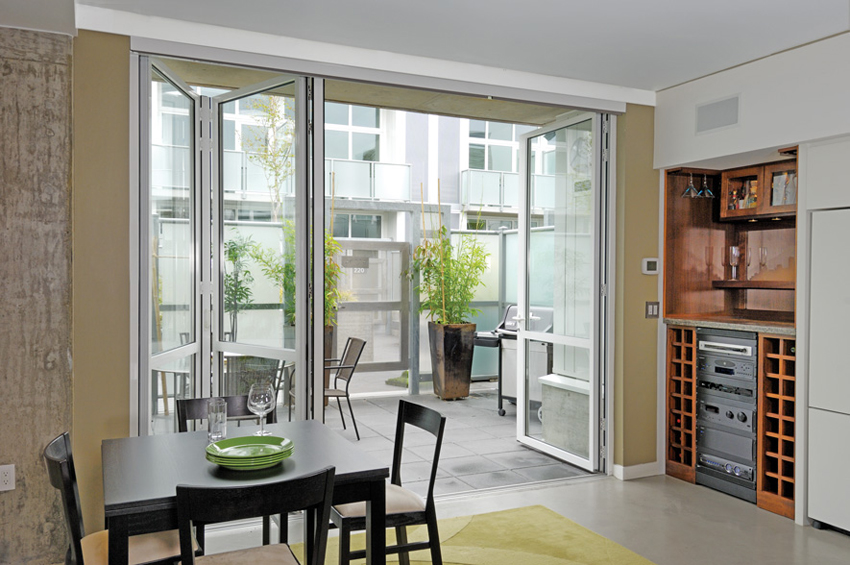
Photo courtesy of NanaWall Systems
Opening glass walls used in apartments and condo units can extend the usable living space to outdoor balconies and porches, while sealing tightly when closed.
Common Outdoor Areas
Beyond private outdoor spaces, most multifamily facilities contain common outdoor areas. These can be intentional spaces for recreation, gardens, or gathering, or they can be part of an outdoor circulation system, such as walkways, paths, etc. Either way, on-site outdoor spaces are viewed as an amenity area, and they continue to be one of the most desirable features in multifamily construction. This means that such spaces need to be identified for location within the facility, and then they need to be designed.
There are two ways that outdoor spaces are enhanced by design—one on the horizontal plane with vegetation, plantings, furnishings, or other features, and one on the vertical plane with vegetated or green walls. The horizontal design starts with a determination of the use and type of surface needed. In open courtyards, that could be grass, pavers, decking, or other similar materials. On rooftop settings, it could be similar, but could also be a green roof design intended for plantings of one type or another. The underlying structure of any of these locations needs to be taken into account, particularly if it is not level or intended to be made level. In those cases, the surface will need some form of adjustable supports that will allow for a level horizontal surface. There are many such systems available, and they are designed for ease of use, long-term durability, and proper drainage.
Once the surface is finalized, then other appropriate features can be added, such as seating, tables, planters, water features, garden features, recreational items, or whatever else suits the intended use of the outdoor space. If plantings are part of it, then attention needs to be given to how they are watered and maintained, as well as how they are installed. If the surface is not directly on the ground, thus allowing for direct plantings in the earth, then some form of pot or planter will be needed to provide a growing medium and water irrigation system. Some manufacturers do offer a self-irrigation system based on using an insert in a large pot that holds a reservoir of water and allows it to be wicked up on demand by the plants. Then the reservoir is simply topped off as needed.
“Green walls” is an all-encompassing term that is used to refer to all forms of vegetated wall surfaces. However, there are two major system categories that fall under this term’s rubric: green facades and living walls. Green facades are systems in which climbing plants or cascading groundcovers are trained to grow onto and over specially designed supporting structures, such as a trellis. A living wall, by comparison, is an integral part of an exterior building envelope system or an interior wall. In either location, a living wall is comprised of distinct panels that are either pre-vegetated or planted on-site and include growing medium or liquid nutrient.
When architects are considering any of these natural outdoor amenities, they are often seeking to work with a manufacturer to maximize the design opportunity or to help assure successful growing. This can be especially true on green roofs or green wall designs. Fortunately, that assistance is available from one or more manufacturers who have built up their design and project management teams to support the architectural and construction functions. They offer a wide range of products that make an architect’s job easier for amenity space design but may also offer to modify their existing products or create solutions from scratch. This ability to customize the outdoor amenities designs can truly help take a project to the next level.
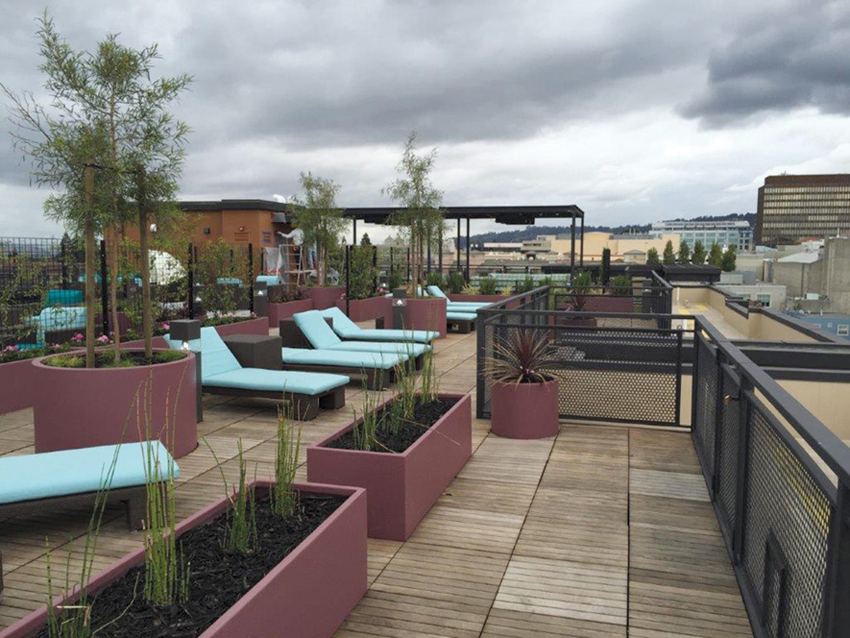
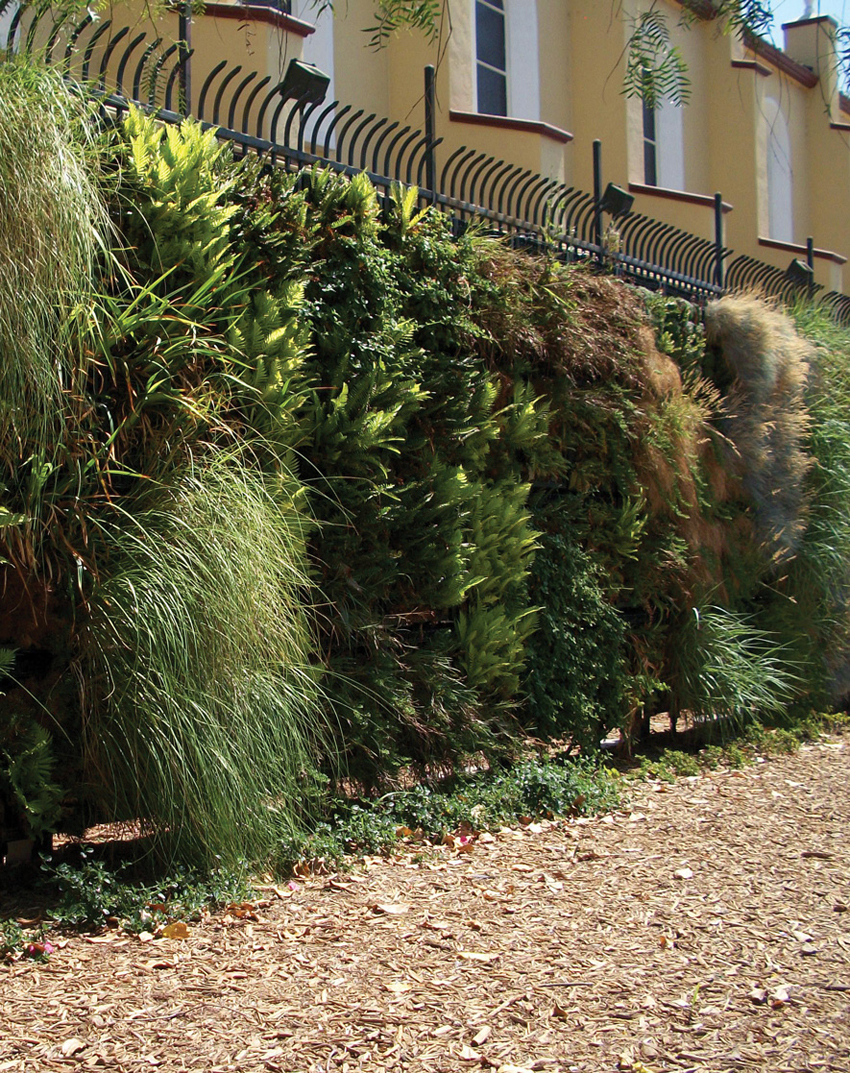
Photos courtesy of Tournesol Siteworks
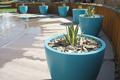
Outdoor spaces become amenities when both the horizontal surfaces and the vertical surfaces are designed using decks, planters, furnishings, green walls, or green roofs.
TOTAL FLOOR SOLUTIONS
Floor construction in multifamily housing of all types is a significant factor in the way people perceive the quality and comfort of a living unit. It also impacts fire resistance, acoustics, longevity, appearance, and the budget. Let’s turn our attention to some of the important decisions that can impact this critical aspect of construction of multifamily buildings.
Composite Floor Structures
When designing multi-story multifamily buildings, there are a number of ways to provide the floor structure. One that has been gaining in popularity is the use of composite steel deck and concrete floor systems, which combine features beneficial to any multifamily housing design. Architects have been particularly interested in this system when they recognize that floor type selection encompasses more than structural design. Floors influence space design and convertibility, sound transmission, room temperature, and fire resistance. Composite steel and concrete systems address all of these factors favorably. Further, they install quickly to help keep schedules in line, integrate with any type of support frame, and are completely adaptable to MEP pass-through needs. From a ceiling finish standpoint, composite steel and concrete systems can be exposed and direct finished or covered with a ceiling material of choice.
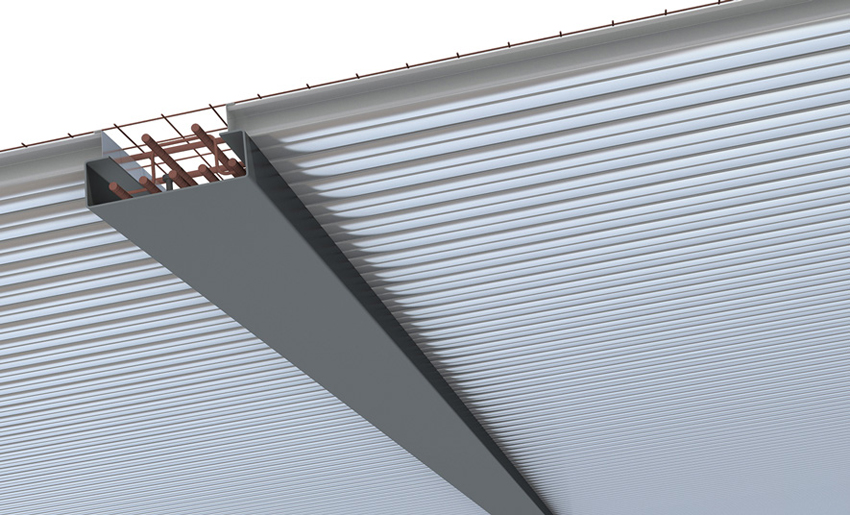
The key to the composite system is the metal deck that connects to the structural steel frame and receives reinforced concrete above it. The size and height of the metal deck profile directly influence its structural strength and maximum span capabilities. A fairly shallow system with a metal deck on the order of 2½ to 3½ inches in height and a total height of 4½ to 7 inches with the concrete in place can typically span 12 to 25 feet. Taller composite deck systems on the order of 8 to 11½ inches are capable of spanning 25 to 36 feet. These are dramatically thinner floor systems than other conventional floor framing systems of wood or steel, which can require two or three times these thicknesses for similar structural span capabilities. It should be pointed out that other systems may also require additional thickness to match the two-hour fire rating of the concrete and steel composite system. Also, in taller systems, the composite system can be applied to the bottom flange of structural steel beams, thus creating an “upset” beam condition, eliminating the beam from being exposed down into the living space. Alternatively, a composite beam that incorporates specifically fabricated steel profiles with structural concrete fill can be incorporated with similar low-profile capabilities.
The implications for using this type of system in multifamily buildings are numerous. We have already noted the very favorable span-to-depth ratio compared to joist systems, which can translate into fewer supporting columns or walls. The shallower floor system depth provides designers with greater control of the floor-to-floor heights and the overall building height, allowing either higher ceilings or a potential increase in the number of building stories where zoning ordinances limit overall building height. From a usability standpoint, acoustics can be enhanced such that the sound transmission class (STC) and impact insulation class (IIC) results can be a very favorable rating of 60 or more. Fire-resistance of the non-combustible system can achieve two- or four-hour ratings (unprotected), which makes it ideal for many multi-story settings. Placement of mechanical, electrical, and plumbing features are simplified using cast-in-place sleeves or reinforced slab beams at larger openings such that no concrete sawing or hole-cutting is required. Further, in some deck systems, the profile forms a series of plenums that are available for conduit, small light fixtures, plumbing lines, sprinklers, and other items.
Since this type of composite floor system can be customized and installed by steel and iron workers, some manufacturers offer specialty support services for both design and construction. This can include determination of shoring needs (if required) and specification of deck, concrete, and slab reinforcement requirements based on construction and in-service loading and floor penetration requirements. On-site training can also be provided for quality control covering the use of specialized tools and installation procedures. Overall, this integrated approach helps coordinate efforts between the design team and deck manufacturer so that job-site deliveries and installation can meet the project schedule.
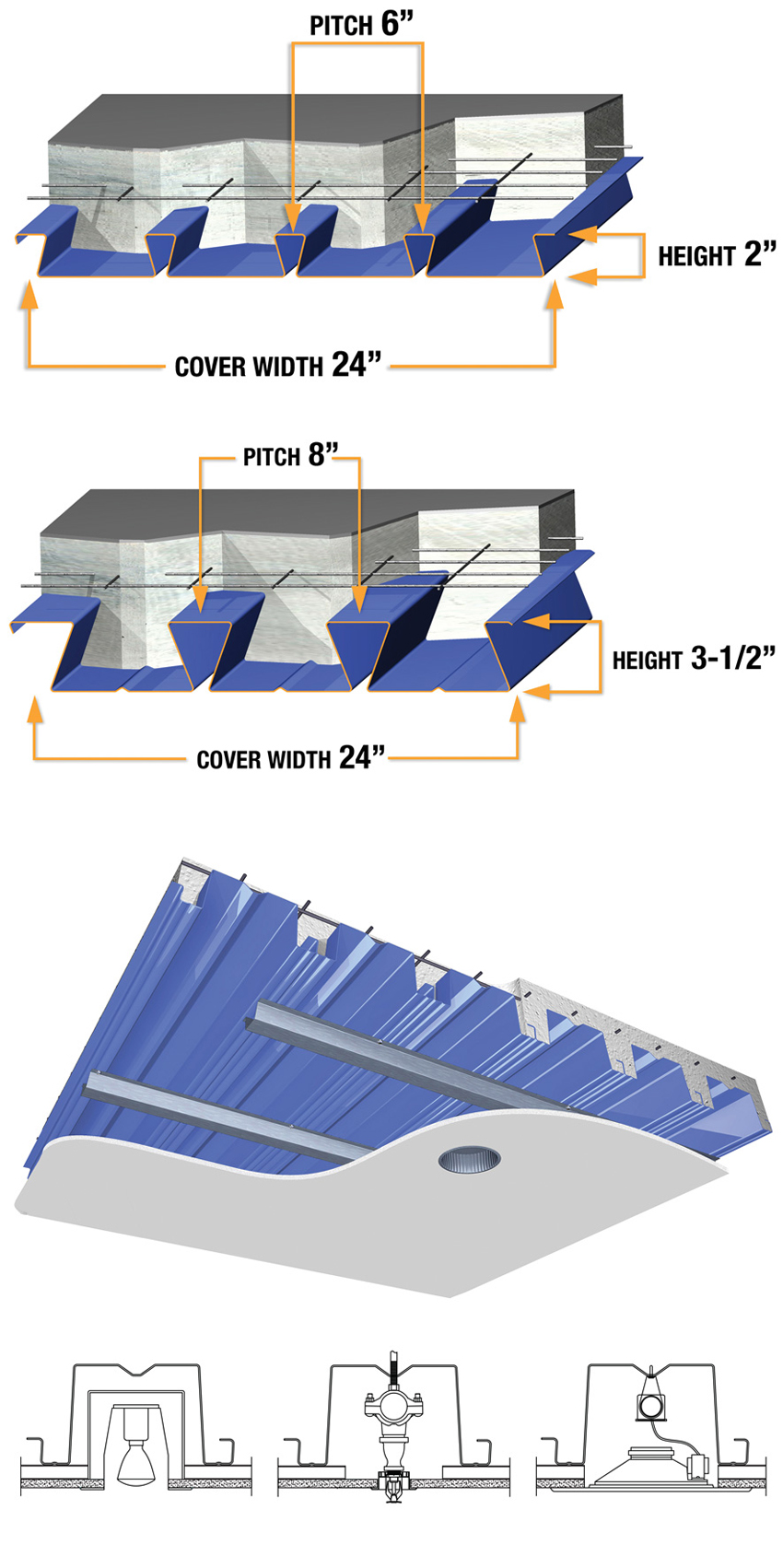
Images courtesy of New Millennium Building Systems
Composite concrete and steel floor systems gain their strength from the shape and height of the metal deck that receives the concrete. In some profiles, the underside spaces are large enough for small utilities to be run, such as lighting, sprinklers, or sound components.
Flooring Underlayment
Once the floor structure is in place, it is important to consider selection of an underlayment that, installed between the structural surface and the finish flooring, can add real value to the overall floor assembly. Underlayment improves resilient floors, such as vinyl or linoleum, but also works particularly well under hardwood, engineered wood, laminate, luxury vinyl, and tile floors. Flooring underlayment, typically sold in rolls or sheets, can be specifically engineered to achieve particular goals. These may include improving acoustics by deadening sound in a room and to rooms below, helping manage unwanted moisture, and helping ensure a smooth and warrantable surface for the installation of the finish flooring. In addition, some underlayment products are designed with sustainability in mind and are carefully manufactured to meet the most rigorous standards for indoor air quality (IAQ).
Careful selection of a particular underlayment can be an important factor in multi-family housing when aiming to minimize sound transmission between floors, whether from people walking on the floor, from items that bounce or drop, or from loud music or TV—all sounds that can annoy downstairs neighbors and, possibly, lead to complaints from tenant to landlord. This is true for any type of flooring but particularly for hard surface flooring. When looking to install a floor assembly that can achieve “less noise” between floors, look for acoustical underlayment that has been tested for and carries good STC and IIC ratings that exceed the minimum requirements.
The ability of an underlayment to address moisture management helps protect the finish flooring from moisture that may be released from the subfloor. That moisture might come from wood or concrete that is not 100 percent dried when the flooring is laid down. Some underlayments are engineered to prevent moisture from pushing up and causing damage, separation, or mold growth under the flooring. An underlayment that is designed to address moisture management may also have the ability to wick moisture to the edges where it can evaporate over time, as long as the source of the moisture is addressed.
In cases where a fire-rated assembly is important, specifying an underlayment with attributes that enhance the performance of the floor can benefit the new floor, from installation all the way through the life of the floor. Common practice, particularly where a fire-rated assembly is required in a wood framed building, is to embed a sound control mat on top of the subfloor before gypsum concrete is poured. There are also acoustical underlayments that do not need to be embedded in the gypsum concrete but rather placed on top beneath the finished flooring, which provide the needed sound control and potentially reduce project costs. Certain fiber underlayments will not only help dampen sound but also add a variety of performance-enhancing benefits to the base of the flooring material, without impacting the fire rating.
For projects designed to meet green building standards, there are underlayments available that combine many of the aforementioned attributes and are made from materials that address environmental concerns. In fact, some resource-friendly underlayments are third-party certified to be made entirely or substantially from recycled materials, which can be used to contribute to earning LEED credits in the Material and Resources category. Some of these products may also be certified as manufactured from low-emitting materials, satisfying criteria for contributing to earning credits in the LEED category of Indoor Air Quality.
Underlayment products are available in a variety of materials, including rubber and textiles that can meet all of the above needs for multifamily projects. For multifamily housing projects where multiple types of hard surface floors will be used, it can be a very good choice to select a single universal underlayment that can be laid under all of them. Universal rubber underlayment made from 100 percent virgin latex rubber, for example, can have a well-formulated mix of physical properties that make it suitable for use under a variety of flooring choices. If the project has flooring that needs to be installed in a variety of ways, universal underlayment is available that can also be installed in numerous ways. It can be floated, nailed, stapled, single-glued or double-glued, thus further enabling use of one product across a project. Some of the properties to look for in such universal underlayments include thickness, density, and thermal resistance (measured as an R-value). If luxury vinyl is being used, then it is also a good idea to specify an underlayment with a compression set of at least 15 or 16 percent, which helps minimize impressions and indentations. As for acoustical performance, the IIC and STC ratings are generally excellent with this type of universal underlayment. For example, one product, when tested in an assembly made up of a 6-inch concrete subfloor, no ceiling assembly, and luxury vinyl planks covering over the acoustic underlayment, resulted in an IIC-52, a rating that exceeds the standard for many high-rise installations. That underlayment also carried a Green Label Plus Certification for Low-Emitting Materials and is recyclable at the end of the underlayment’s useful life.
A second excellent choice of material for high-performing acoustic underlayment is one made from recycled textile fibers. This type of product is designed specifically for use under glue-down or nail-down hardwood and engineered wood floors. In addition to dampening impact noise and decreasing airborne sounds from traveling to the room below, it also protects flooring from potential plank gapping. A premium upgrade is found in an acoustic and insulating pad designed especially for floating wood and laminate floors. This type of underlayment has superior acoustic capabilities, is available VOC-free, and can contain 94 percent post-industrial/pre-consumer fibers. This premium textile-based product has filaments that are randomly air-laid, creating a capillary effect to cushion the floor, absorb sound, and help make laminate floors sound more like real wood. The underlayment can also use the capillary effect to absorb and wick moisture away to the edges of the flooring where it can be released to the air.
Regardless of the type of product specified, acoustic underlayment enhances the performance of the overall floor assembly in multifamily housing units. The choices available address the varying needs of specific types of floors or buildings. In multifamily housing projects where sound control between floors is important, acoustic underlayment can make a very noticeable and positive difference.
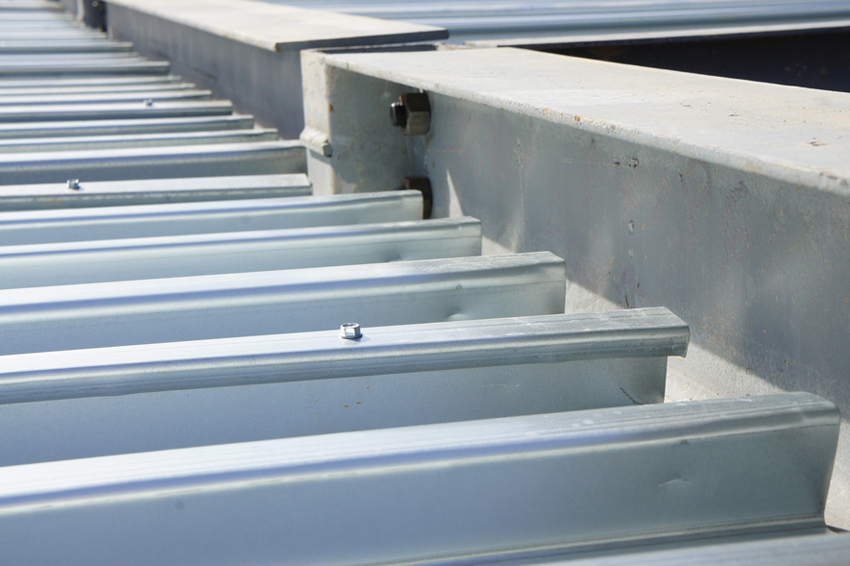
Images courtesy of New Millennium Building Systems
Composite floor metal deck systems can be designed with “upset” structural steel beams or with specially fabricated composite steel and concrete beams.
Healthier Flooring
Most flooring products (i.e. those that constitute finish flooring) have been on the market long enough to be proven for different applications and are available in a wide range of colors, patterns, and textures. One characteristic that has emerged to differentiate products and manufacturers from each other is related to the health impact of flooring products on people. Different types of flooring go through different manufacturing processes and may rely on the use of volatile organic compounds (VOCs). VOCs, both man-made and naturally occurring, are an expansive and ubiquitous class of chemicals that are transmitted through air. Some types of flooring have commonly contained high levels of the VOC formaldehyde, a carcinogen linked to cancer and respiratory problems.
A growing consumer awareness of indoor-related health issues in general, along with green building standards in particular, have brought a spotlight onto the effect that VOCs and other chemicals in flooring can have on the indoor air quality inside a building. According to the Environmental Protection Agency (EPA), indoor air quality is one of the its top environmental risks to public health. Residents of multifamily housing units are among the people who are both concerned and affected by this environmental health issue, particularly when those residents spend considerable portions of their days indoors. With an increased concern about the health effects that chemical leaching from building products may have on IAQ, the motivation exists for manufacturers to reduce or eliminate any emissions from the flooring products that they make. It is also the motivation to seek out those products that are successfully doing so.
When looking at products with VOC content, it is important to understand both the VOC (individual chemicals emitting) and the TVOC (total volatile organic compound) levels attached to the product. Certain individual chemicals may exist at acceptable levels in a product, but the combination of all of them expressed in the TVOC may be problematic. The latest version of the USGBC LEED rating system recognizes the importance of TVOCs by requiring a total disclosure of potentially harmful chemicals. It also looks at the TVOC in a space such that not only flooring, but walls, ceilings, and furniture VOCs should be added together to identify the total exposure a person has in a space. The USGBC identifies the very low level of 500 micrograms per cubic meter or less as the goal.
Separate from VOCs, vinyl flooring manufacturers have commonly added phthalates, specifically ortho-phthalates, to increase the flexibility, transparency, durability, and longevity of the flooring. Some recent studies have revealed that phthalates migrate out of flooring products and mix with dust, which may create asthma and allergy issues for inhabitants. Specifically, ortho-phthalates have been identified as endocrine disruptors that may cause asthma/allergies, change in baby boys. The good news is that at least some flooring manufacturers are now reducing or eliminating these potentially harmful chemicals from their products. Those are becoming the sought after products to specify.
One of the ways to know whether or not a flooring product is safe and appropriate for use in multifamily housing is to specify products that carry an independent certification for health-related concerns. One such certification focused on IAQ is the Asthma & Allergy Friendly™ Certification. This program independently tests and identifies products for likely exposure to allergenic and irritant materials and then determines whether they are compatible with people living with asthma and related allergies. Certification categories include paint, cleaning products, flooring systems, filters for HVAC systems, and others.
Another program that has been widely used specifically for flooring is the FloorScore® Certification Program for Indoor Air Quality. This industry standard was developed together with Scientific Certification Systems (SCS) to test and certify flooring and adhesive products for compliance with indoor air quality emission requirements. A FloorScore® IAQ Certification means that a flooring product is independently certified by SCS to comply with identified volatile organic compound emissions criteria. Under this program, SCS 1) reviews all VOC emissions test reports for particular products generated by independent testing laboratories; 2) determines whether those test results meet the California Section 01350 requirements for listed VOCs; and 3) conducts periodic manufacturing plant inspections to review product formulas, processing, and quality control to ensure the continuing integrity of the FloorScore® seal. To date, hundreds of different resilient flooring materials and their adhesives bear the FloorScore® seal. Any such product that bears this seal is represented to have met the stringent IAQ standards and contribute to good indoor air quality.


Photos courtesy of MP Global Products
Flooring underlayment is available in a variety of material and product types that can improve acoustical performance of floors, help control moisture, and assure the long-term performance of finish flooring.
The U.S. Green Building Council (USGBC) has cited FloorScore® certified flooring products as eligible for credits under LEED 2009 and LEED v4. Reflecting the inclusion of FloorScore, the LEED IEQ Credit 4.3 for Low-Emitting Materials has been expanded from “Carpet Systems” to “Flooring Systems” to include hard surface flooring. Several LEED systems specifically cite FloorScore as an indicator of indoor air quality, including New Construction (NC), Commercial Interiors (CI), Core and Shell (CS), Healthcare (HC), and LEED for Homes. FloorScore® is also included in other important environmental rating systems, such as the Green Building Initiative’s Green Globes, Collaborative for High Performance Schools (CHPS), Green Guide for Health Care, and EPA’s Tools for Schools.
When selecting flooring to round out the design and performance needs of a multifamily housing facility, it is possible to use a single-source manufacturer with multiple flooring options to help coordinate from room to room and throughout the entire property. At least one has a coordinated program that allows architects and designers to choose flooring to suit specific multifamily needs. Whether flooring is needed for dwelling spaces, common areas, support spaces, or others, it is possible to specify quality flooring that is also certified to be healthy and safe. Whether selecting for laundry rooms, fitness centers, bathrooms, hallways, or spaces in between, the choices include laminate, luxury vinyl tile, wall base, carpet tile, and others. This means that it is now entirely achievable to select coordinated flooring designs that help achieve a safe and healthy environment throughout a multifamily housing project. That is good for everyone—designers, owners and residents.


Photos courtesy of Tarkett
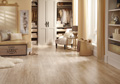
Flooring manufacturers who put people first create finish flooring products that reduce or eliminate chemicals and compounds that can impact indoor air quality and resident health.
CONCLUSION
Multifamily housing projects can be quite varied in type, size, and resident profiles. Nonetheless, understanding the options available for some key parts of the buildings can make dramatic impacts on the overall design of a new construction or renovation project. Further, paying attention to the details of manufactured systems and products can improve the performance of the building and allow the residents to be more comfortable, safer, and healthier.
Peter J. Arsenault, FAIA, NCARB, LEED AP is an architect and green building consultant who has authored more than 120 continuing education and technical publications as part of a nationwide practice. www.linkedin.com/in/pjaarch