This CE Center article is no longer eligible for receiving credits.
Times are relatively good for global healthcare. Life expectancy is at its highest level in history, and new treatments and lifesaving techniques arrive on the scene every day. In the United States, recent legislation-though swirling in controversy-aims to make care more available and affordable. Along with these advances, architects are working to make hospitals and other healthcare buildings a true ally in improving public health and patient treatment.
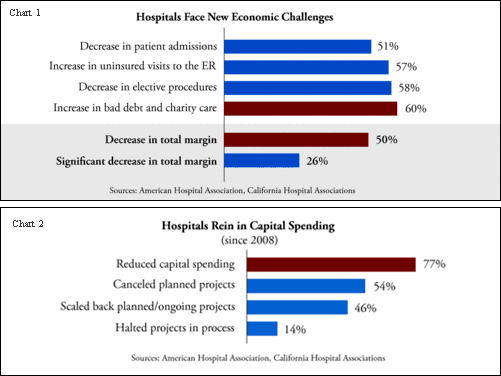
Yet economics are clouding this rosy picture. The healthcare system absorbs $2.5 trillion annually or close to 17 percent of U.S. gross domestic product (GDP). Treatment costs tend to increase rapidly, and total spending is expected to grow to 19.5 percent of GDP by 2017, according to the U.S. Department of Health and Human Services. Hospitals and healthcare providers regularly report a shortfall in payments, which the American Hospital Association (AHA) calculates in the tens of billions of dollars (see Chart 1).
"American hospitals are financially challenged and the trends in revenues and expenses will put and even greater burden on the viability of many hospitals and their ability to fund capital projects," says Anne McLeod, vice president of finance policy for the Sacramento-based California Hospital Association. While the portion of patients with Medicaid has risen over the last decade from 11 percent to about 14 percent of the total economy, McLeod adds, rates of employer-sponsored insurance have dropped precipitously-from almost 64 percent in 2000 to about 8 percent just two years ago. States, now struggling to fill budget gaps, spend on average 14 percent of their budgets on Medicaid, according to the National Association of State Budget Officers.
The need for cost control by hospitals and healthcare providers is driving architects to innovate. Based on demographics alone, the growing need for new and refurbished healthcare facilities will continue its upward trend for years. Yet healthcare facility operators will see a softening of demand due to the recent economic downturn, resulting in fewer patient admissions and fewer elective procedures. Based on those numbers-and a resulting lack of capital-providers are revising their projections for construction spending (see Chart 2). About 40 percent of hospitals have halted projects to increase patient capacity or renovate facilities, although the slowdown has more dramatically affected purchases of new clinical technologies and IT systems.
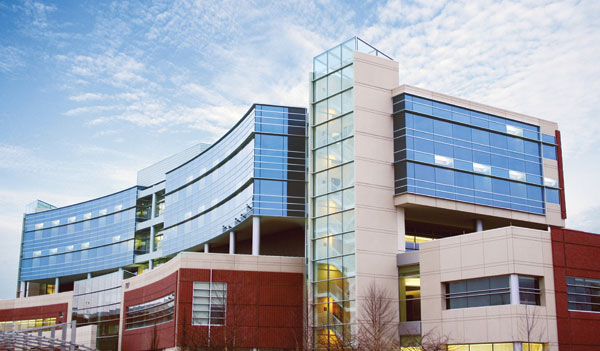 |
At the Omaha Women's Methodist Hospital in Omaha, Nebraska, the architect HDR Architecture employed low-E glazings with low-reflectivity coatings on interior surfaces.
Photo courtesy of Guardian Industries |
Demographics Drive Growth
Still, the healthcare sector will remain one of the brightest stars in the construction universe. "Over the next decade, the 65-plus population will nearly double as a result of the aging Baby Boomers," says Frank D. Kittredge, Jr., director of Clinical Solutions & Research at HKS Inc., the Dallas-based architecture firm. "In fact, by 2040, the 65-plus market will be approximately 20 percent of the U.S. population and a high percentage of them will have multiple chronic illnesses, thereby requiring more demanding patient care."
Estimates confirm this driver: Baby Boomer hospital admissions will double by 2030, accounting for 56 percent of total admissions. Several public health challenges will drive this patient flow, including chronic diseases, obesity and geriatric care. Currently, healthcare providers handle about 90 million outpatient visits and 35 million inpatient stays annually, averaging about five days each, according to the Centers for Disease Control and Prevention (CDC), and the outpatient side is growing quickly. Add to this about 120 million emergency room visits-increasingly the only resort for America's uninsured-and one can assume where the growth will be.
In addition, the aging boomer population means more healthcare-integrated living options, from assisted-living facilities and nursing homes to continuing-care options and such specialized buildings are memory-care clinics.
Bridging Cost and Care
With these issues in mind, the challenge for architects is no longer building faster to keep up with demand, but rather how to bridge healthcare costs and new approaches and concepts in giving care. Creativity in design-fused with intimate knowledge of how healthcare providers work and what challenges they face-add up to winning architectural solutions. According to architects active in healthcare, the following big-picture issues are common themes in recent healthcare building projects:
- Rightsizing facilities. Benchmarks of square footage, typical amenities, and standard-of-care equipment are common in the healthcare field. What's changing recently is the focus on reducing total floor area and cost per unit area, as well as accommodating new patient needs without expanding the building footprint. Bariatric facilities, for example, which serve morbidly obese patients, have recently focused on equipment, safety and facility guidelines for this growing treatment area, says Susana D. Andrade, Assoc. AIA, a designer with Hammel, Green, & Abrahamson in Minneapolis, who has written extensively on the subject. "We need to address these issues with a sustainable and lean approach that considers the differences in ergonomics and proportions of the bariatric patient," she explains. "This can be accomplished by letting ourselves rethink the built environment with an awareness of the direct relationship between environment and behavior and its consequences."
- Using integrated project delivery and BIM. Building information modeling, or BIM, delivers a range of benefits to healthcare facility operators, according to experts like John Cooper, AIA, ACHA, principal with Morris Architects. "BIM not only helps in design and construction, it becomes a living repository of all building information," says Cooper, adding that the U.S. General Services Administration has mandated the use of BIM in part because it "gives facility managers easy access to critical building information for operations and maintenance, renovation, and expansion."
 |
The use of running water features has affected both the façades and interior layouts of healthcare facilities.
Photo courtesy of Bluworld of Water |
- Incorporating evidence-based design solutions. Some design leaders see evidence-based design (EBD)-the use of credible clinical data to influence the design process-as more than an ancillary benefit to conceiving healthcare places. Instead, it is seen as a core design competency for delivering facilities that improve patient and staff well-being, hasten patient healing, reduce stress and boost safety. EBD is "a process for the conscientious, explicit, and judicious use of current best evidence from research and practice in making critical decisions, together with an informed client, about the design of each individual project," writes David Watkins, FAIA, founding principal of Houston-based WHR Architects, and co-author of Evidence-Based Design for Multiple Building Types.
- Employing sustainability and energy efficiency. Green building has been shown to work in healthcare. Through its success, sustainable design now promises to reduce the cost of facility operations and improve care success, healthcare experts contend. "Today's hospitals are informed by a new set of questions and challenges," wrote Perkins+Will's sustainable healthcare specialist Robin Guenther, FAIA, in her 2008 book, Sustainable Healthcare Architecture. "Healthcare leaders are intentionally connecting buildings to mission and community benefit," by considering such issues as life cycle and healthy materials. Green building approaches, including the LEED program and GGHC, also reduce energy use, improve durability, and positively impact patient and caregiver health.
- Enhancing care-delivery performance. In a related arena, quantitative and qualitative assessments of utilization and caregiver performance can be linked directly to architectural decisions. For example, chronically ill patients in Bend, Ore., spent only 10.6 days per year in the hospital, while those in Manhattan spent 34.9 days annually, according to the Dartmouth Atlas of Health Care. To impact those practice patterns, hospital operations and floor plans may be based on cellular care concepts rather than traditional departmental models. Cellular plans increase the number of care activities available in a given station while reducing the amount of patient movement, reducing average patient stays.
These five themes are behind many of the architectural challenges faced in healthcare projects across the country. Leading architects are responding with novel design approaches that are shown to reduce energy use, boost staff productivity, support best-practice operations, and even improve patient response to care.
In many ways, building products and materials are adapting to these changes. A variety of examples show how EBD, sustainability and the workaday pressures of hospital operations and caregiver challenges are influencing healthcare architectural systems. Following are a few areas that have shown the greatest changes or improvement; taken together, they constitute new, global benchmarks for leading healthcare architecture.
Daylight Usage and Benefits
One of the most successful healthcare architecture techniques in recent years has been the increased use of daylighting and outdoor views in patient settings. More glass area, however, means that better glazing is required. For improved energy efficiency of the building envelope, architects are specifying new low-emissivity (low-E) and spectrally selective glass with a range of visible light transmission, between 40 percent and 70 percent, while also offering lower reflectivity than was possible in the past.
While energy efficiency is a growing concern, the issue of reflectivity has emerged as a patient issue. "The low interior reflectance lets patients see outside better, which is shown to improve mood and recovery," says Chris Dolan, director of commercial glass marketing with Guardian Industries Corp. "When it's dark out, reflected interior lighting makes it difficult to see outside, and instead patients see their own reflections, which defeats the purpose of the windows. Low-reflectance glazings reduce the indoor mirror effect, and that's typically more comfortable for patients," and can reduce stress.
Another issue affecting the use of enclosure and interior glazing has been fire safety. Novel fire-resistant and fire-protective glass products allow the use of glass in situations that otherwise limit its use. Fire-protective performance is defined by Fire-Protection Rating-"the period of time that an opening protective assembly" can confine a fire, according to the Glass Association of North America (GANA). Fire-resistance describes how materials and assemblies prevent or retard "the passage of excessive heat, hot gases or flames," says GANA.
"How the glass performs, which is how the 2012 International Building Code defines them, is even more important," says Diana San Diego, director of marketing for SAFTIFIRST. Fire-protective glass blocks the passage of flames and smoke, based on testing to NFPA 252 and 257; it is typically used for 20- to 45-minute door and window applications, limited to 25 percent of the wall area. Fire-resistive glass blocks flames, smoke and dangerous radiant heat, based on testing to ASTM E-119; it can be used for wall and door applications rated at 60 minutes and greater. Because it blocks radiant heat, there are no size limits for fire-resistive glass applications.
The bottom line: Hospitals are now able to use glass partitions for rated interior walls, on property line or party walls, or in stairwells to improve visual security, while meeting the requirements of the code. "We're seeing more and more opportunities for fire-resistant glass to create a greater sense of openness in design or a more relaxed, less institutional feel," says Jeff Griffiths, director of business development with SAFTIFIRST.
 |
Fire-protective performance for glass is defined as the period of time an opening can confine a fire. Fire-resistant glass prevents movement excessive heat, hot gases or flames.
Courtesy of SAFTIFIRST |
Operational Effectiveness
Glazing has become a valuable building element indoors also, with increased application for partitions and interior windows. Improved transparency and interior visibility in healthcare settings is also linked to higher productivity and improved care, says Valerie Bevens, technical services manager with TIMELY Industries, a producer of prefinished door frames. "We have seen an increase in the use of sidelights, borrowed lights and transom frames, many requiring fire ratings," she explains. "Design professionals can easily manipulate door frames by adding larger glass areas or by including glazed openings to increase the transfer of light and radiant energy throughout interior spaces."
 |
Greater need for accessibility and transparency within healthcare environments has led to new, barrier-free openings with doorframes that have built-in glass sidelites and transoms. Specialized hardware needs have also called for pneumatic controls and electronic access systems.
Photo courtesy of TIMELY Industries |
Bevens adds that door designs are changing to allow for barrier-free travel paths with fewer encumbrances. Pneumatic controls and electronic access hardware are commonly integrated into hospital doors.
Interior assemblies of all kinds have evolved to meet the special operational and economic challenges associated with healthcare interiors. "Healthcare organizations demand easy-maintenance facilities, in part to reduce infections and in part to reduce overhead costs," says Lee Hedberg, director of engineering with Engineered Lighting Products, "There are new cove lighting fixtures, for example, that are integral to the wall surface so there are no edges to clean, no debris getting caught in the fixtures."
These fixture types also work well in corridors, where engineers tend to gang HVAC ducts and lines for water, vacuum, air and gas lines, which can't be routed through patient zones. To allow access and clearances, architects face significant restrictions on lighting, wall rails and other wall- or ceiling-mounted accessories, says Hedberg.
Interior Hygiene and Abuse-Resistance
Another public health consideration in hospitals areas with high levels of visitor and public traffic is reducing opportunities for bacterial growth and other sources of nosocomial infections, those that patients are exposed to in healthcare environments. According to CDC, nosocomial infection rates have remained stable over the past 25 years, at about five to six hospital-acquired infections per 100 admissions. However, because of shorter inpatient stays, the rate has actually increased 36 percent over the last 20 years, at a total cost of $4.5 billion and at least 88,000 deaths.
 |
For the Beaman Neonatal Intensive Care Unit at Baptist Hospital, Nashville, cove lighting fixtures shield patients from glare while also easing maintenance needs, because they are built into the walls leaving no slit openings to clean.
Photo courtesy of ELP |
 |
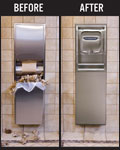
More hospitals are using electric hand dryers in public washrooms and preoperative zones due to hygiene and maintenance concerns.
Photo courtesy of Excel Dryer, Inc. |
Awareness among providers and the general public has also increased, bringing attention on indoor maintenance practices and clinical protocols to reduce the spread of viruses and bacteria. While architects play a limited role in this effort, attention to public washrooms has helped, says William Gagnon, vice president of marketing and key accounts with Excel Dryer, Inc. "Architects and facility managers are looking to remove areas where bacteria and viruses can live and grow. For example, used bacteria laden paper towel waste in trash cans or on floors creates a cool, moist environment which can be a breeding ground for bacteria. Many hospitals have opted for the newer fast efficient hand dryers that are hot and dry rather than paper products to create a more hygienic restroom environment," he explains. "This eliminates at least one of the environments where MRSAs-the so-called super-bugs-can survive and multiply."
Gagnon adds that the new age of high speed hand dryers utilize a high-velocity, heated air stream that removes the residual moisture layer on the skin more completely than paper or cloth towels due to evaporation from the heat. Other best-practice washroom specs include hands-free, high efficiency fixtures such as soap dispensers, low-flow faucets, urinal and toilets.
Biophilic Features: Evidence-Based and Sustainable
In other cases, water is being brought into the healthcare environment deliberately-though in limited and strategic ways, says Rob Morton, director of sales and marketing with Bluworld of Water. "Studies of biophilia and evidence-based design show that bringing various natural elements indoors, such as running water, can lower patient blood pressure and produce negative ions, which are known to enhance the immune system and boost alertness," he says.
Seminal review articles by the California-based Center for Health Design support the overall notion. Among the most-cited experts is Roger Ulrich, director of the Center for Health Systems and Design at Texas A&M University, whose 2003 study suggested that natural elements and nature art promote "restoration from stress" when the features contain "calm or slowly moving water, verdant foliage, flowers, foreground spatial openness, park-like or Savannah-like properties (scattered trees, grassy undershot), and birds or other unthreatening wildlife." These natural therapy environments have been shown in clinical studies to affect patients dramatically: "blood pressure drops, respiration slows, muscles relax, and moods brighten," wrote Ulrich.
Properly designed and maintained, Bluworld's Morton reports, water walls and "bubble walls" improve ambience in patient areas and recovery rates. In a few cases, he cautions, poorly designed or maintained water features have caused outbreaks including Legionnaires' disease, as in 2010 at the Milwaukee Hospital Aurora St. Luke's South Shore. Such issues are rare and preventable: "Filtration technology is very important, everything from ultraviolet light to ozone to ionizers that help combat living organisms within the systems," says Morton. "A modern water system should be able to combat both living organisms and nonliving contaminants."
In fact, a variety of new approaches to water features have been used by architects in healthcare settings, including antibacterial recirculating "encapsulated designs" with access panels for maintenance, as well as "bubble panels" in which a chamber of distilled water between acrylic panels is fitted with an air pump to produce a soothing, contained effervescence that may be highlighted with color-changing LED light sources.
Technology Drives Change
While these improvements to inpatient and outpatient environments contribute positively to care delivery and cost reduction, new and radical departures from traditional hospital organization will challenge architects anew. "Telemedicine will continue expanding physicians' geographic reach as well as treating patients who live in rural or remote areas-and those that have shortages in select clinical specialties," HKS's Kittredge explains. "Virtual ICUs and other virtual strategies will be more commonplace in order to deal with staffing shortages and provide a higher quality of care."
 |
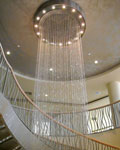
Studies of biophilia and evidence-based design show that bringing natural elements indoors, such as the running water on these glass partition panels, can lower patient blood pressure and produce negative ions, which are known to enhance the immune system and boost alertness.
Photo courtesy of Bluworld of Water |
In spite of these novel remote technologies, healthcare delivery is also more collaborative, leading many hospitals to add new videoconferencing facilities, says ELP's Hedberg. These rooms demand studio-quality lighting in an architectural environment, which can be accomplished with asymmetric-distribution lighting fixtures that provide vertical illumination on the doctor's face without creating discomfort.
Hospitals are planning other technology upgrades, too, according to recent industry surveys. Among the top five most common are asset-tracking products including RFID, bar-coding and instrument management systems, says Kittredge. New smart-phone applications are used to direct patient intake or deliver vital information. This year, for example, the Henry Ford Health System and Detroit Medical Center, have launched no-cost apps to help the public find the nearest urgent care center, complete with estimated wait times. Both medical centers say they are considering launching other smart-phone apps, according to the Detroit News.
"The integration of architecture and technology is critical to creating best-of-class facilities," says WHR's Watkins, who partnered several years ago with Genesis Healthcare International, Inc., a specialist in medical technology planning and strategy, to benefit a number of its clients. In addition to architecture and planning, WHR has been able to consult on technology adoption, long-range planning, capital management and operations.
 |
The $9.6 million expansion of the Neonatal Intensive Care Unit at Nashville�s Baptist Hospital added 25 beds as well as pinwheel-shaped pods for privacy in soft, elegant colors. The architect is Thomas Miller & Partners.
Photo courtesy of ELP |
Case Studies
Evidence of these trends and new product applications can be gleaned from recent building projects, ranging from entire replacement hospitals to relatively minor refurbishment work-the latter being increasingly common due to the scarcity of capital funds, notes CHA's McLeod.
In Chicago, for example, Northwestern Memorial Hospital (NMH) is building and opening new facilities-its entire Lake Forest campus, for example, and most recently its Northwestern Organ Transplant Clinic in Joliet, IL-but in downtown Chicago the hospital is hunkering down on basic facility upgrades to streamline operations, cut costs, and improve the patient experience, says David Stout, NMH director of Facilities and Engineering. "We're upgrading our carpeting and refurbishing with materials that are much easier to maintain and have a longer lifespan, such as wall protection, automatic doors, and wall paint that's longer-lasting," he says.
A primary focus has been reducing maintenance needs while improving sanitation in the hospital's hundreds of staff and public washrooms, says Stout. "The hospital started a refurbishment program, and as washrooms are renovated, we're installing equipment and materials that are much easier to maintain and have longer life spans," he says. "In many cases, our low-flow plumbing lines were clogged with paper towel waste, so we've put in fast, hot air electric hand dryers, and it has made all the difference in the world." Says Stout, "we have basically eliminated our plumbing issues and reduced labor hours on maintenance; the cost savings have been significant."
Hygiene and safety are the number one priority in healthcare so the facilities team coordinated with the NMH infection control department for consultation on what electric dryer models would be the most hygienic. Trough-style hand dryers, which collect water at the base of the drying area, were ruled out, as the team felt that dryers with high velocity heated air streams afforded them the most hygienic option.
Lighting is another area of focus for NMH and other healthcare organizations, in part due to recent research findings that draw a causal connection between quality of illumination and quality of care. A recent study at a Boston-area hospital, for example, found that operating room lighting can exacerbate surgeon fatigue due to the contrast between high luminance levels on patients and work surfaces as compared to darker vertical surfaces, such as walls. For that reason, the study concluded that wall washers would be an effective strategy in surgical suites.
The same benefits accrue in other patient care areas including examination rooms, a fact that has led to new lighting approaches throughout the healthcare industry. One realization is that, "Whether lying in a recovery unit, inpatient room, or being transported, the patient spends a great deal of time looking at the ceiling plane," says Jill Cody, a designer with HGA Architects and Engineers. For that reason, more dimmable and shielded, indirect light sources are being used in circulation areas where gurney-bound patients are located.
At the new Beaman Neonatal Intensive Care Unit (NICU) at Baptist Hospital in Nashville, the architect, Thomas Miller & Partners, specified cove lighting and "hole in the wall" fixtures to shield patients from glare and associated stress. The $9.6 million expansion, which added 25 beds in about 20,000 square feet of space, features "pinwheel-shaped pods for privacy in an inviting design with soft, elegant colors and curved, flowing lines throughout that help soothe, comfort and nurture," according to the hospital.
The shielded, muted lighting fixtures are made with glass-fiber-reinforced gypsum to easily recess into the gypsum-board walls. Lighting controls are integrated with remote-controlled large windows to ensure a high level of daylighting in the NICU areas for infants, caregivers and families. "We took a hands-on approach and visited other hospitals around the country to ensure we implemented the best practices in NICU design," says Damian Skelton, facilities director for Baptist Hospital.
Evidence-Based Upgrades
Like Baptist Hospital, other healthcare providers are focusing on evidence-based design in their refurbishment and new construction planning, although recent market data shows a recession-induced erosion of EBD practices among facility managers. In a Health Facilities Management 2010 survey conducted with the American Society for Healthcare Engineering (ASHE) and the American Society for Healthcare Environmental Services (ASHES), 51 percent of the survey's respondents reported "always" or "mostly" using evidence-based design, while qualifying that EBD is "not playing a large role" in their projects.
 |
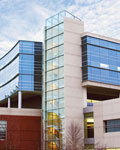
The University of Michigan's Cardiovascular Center, designed by Boston's Shepley Bulfinch Richardson & Abbott, of Boston, employed evidence-based design principles in using glazing to add daylighting through the $215 million, 48-bed facility.
Photo courtesy of Guardian Industries |
For new buildings, however, the commitment to EBD has remained strong. The design of the University of Michigan Cardiovascular Center in Ann Arbor, designed by Boston's Shepley Bulfinch Richardson & Abbott is an instructive example. The five-story, $215 million center, which contains 48 inpatient beds, eight operating rooms, 11 procedure rooms, dozens of rooms for outpatient visits and diagnostic tests, and offices for hundreds of doctors and staff, was carefully designed to employ EBD principles to create a healing environment for patients and families.
To that end, the architects incorporated soothing colors, soft music, an atrium garden and copious natural light, in addition to therapeutic amenities chosen by the client such as quiet/meditation rooms. Its most visible and dramatic evidence-based design gesture is a cylindrical, low-E glass-enclosed atrium. According to the center, the glazing allows for 68 percent visible light transmission with winter nighttime U-Value of 0.29 and a solar heat-gain coefficient of 0.38. In this way, the volume brings in daylight both as a healing element and as an energy-saving feature, yet its coated glass enclosure significantly reduces energy costs associated with heating and cooling the building.
In another example of evidence-based architectural amenities, a recent project designed by Perkins+Will at MidState Medical Center in Meriden, CT, employs a vertical water feature in its main lobby. Built as part of a $45 million, 100,000-square-foot expansion that opened last October, the lobby welcomes visitors and patients to a new emergency department with 53 private treatment rooms, an additional 28-bed inpatient unit and new medical office space. To make the most of MidState's new "front door," the serene, minimalist lobby was planned with comfortable seating and a "soothing and peaceful water wall," according to the hospital, to offer "an atmosphere for relaxing… that greets visitors as they enter or exit the elevators."
A frameless assembly made of stainless steel and tempered glass, the water feature measures more than 20 feet tall and about 25 feet wide. Rather than trickling down the face of the glass, the water runs down the back of the glass panels, to eliminate exposure of the water and to avoid splashing or human contact, which would contaminate the water. An integrated rolling ladder, attached to ceiling brackets and concealed in a 24-inch opening to the side, was included in the design to ease maintenance.
Integrated Solutions
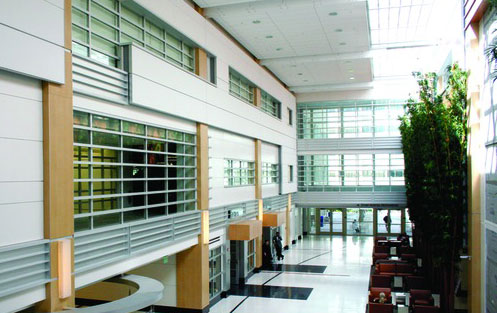 |
The atrium of the expanded UC Davis Medical Center in Sacramento was designed with seismic-rated structures and fire-protective and fire-resistant glazing to comply with Senate Bill 1953, which requires life-safety upgrades for hospitals.
Photo courtesy of SAFTIFIRST |
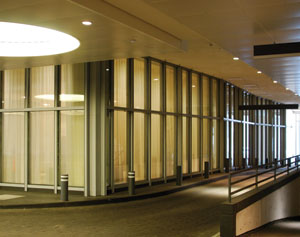 |
At Weill Cornell Medical Center, for example, fire-rated glazing was incorporated into a 2-hour-rated exterior wall leading from the lobby to a parking garage in order to increase transparency and visibility.
Photo courtesy of SAFTIFIRST |
Often, hospital upgrade projects add amenities in this way while also making changes as needed to meet new state or federal regulations and related evaluations by The Joint Commission (TJC), formerly the Joint Commission on Accreditation of Healthcare Organizations, or JCAHO, which reviews hospitals for compliance. This was the case for the UC Davis Medical Center in Sacramento, which recently undertook an expansion that would also assure compliance with Senate Bill 1953, which requires seismic upgrades for Structural Performance Category 1 buildings, such as hospitals, which could sustain significant casualties in an earthquake.
Central to the project's design by Stantec Architecture in San Francisco was a large skylight over an atrium area and other light wells throughout the building. To bring daylight into more interior spaces, the design team specified glass partitions, which had to meet a 2-hour fire rating in atria and other building openings per the standard ASTM E-119. A fire-resistive glass wall was employed in the light wells and on atrium perimeter walls. In addition, architects used fire-rated glass in the facility's patient waiting areas for a relaxed, open feel-and even for a decorative art-glass wall in a prayer-and-reflection area.
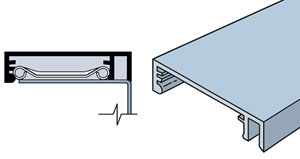 |
New door frames used for healthcare door openings have factory-installed gaskets and other features for controlling infiltration of smoke, air and water, in compliance with such codes as NFPA 80.
Rendering by TIMELY Industries |
In other healthcare projects, simpler challenges are resolved using fire-rated glazing. At Weill Cornell Medical Center, for example, the architect required fire-rated glazing in order to build a transparent 2-hour exterior wall leading from the lobby to a parking garage.
Another solution that is increasingly employed is the use of prefabricated and pre-engineered building assemblies that speed construction and improve life-cycle performance. As an example, several hospital facilities directors report using high-strength, light-gauge-steel door frames, which are anchored around the full doorway perimeter. As compared to common hollow-metal products, the steel frames offer a very high load-bearing capability, which is ideal for the rigors of hospital operations. For example, while a 16-gauge hollow metal door with wood studs can handle a load of about 254 lbs. plus the door weight, a 20-gauge steel frame with steel studs can carry almost double the load-about 500 pounds and the door's weight.
Cost, Energy-and Sometimes Green
While there are many motivations for hospitals and other healthcare facilities to undertake upgrades, energy efficiency is a growing concern. Recent surveys show that cost savings-not sustainability − has been the main impetus for healthcare providers to choose green building options. In fact, cost was the No. 1 factor in another survey of 960 ASHE and ASHES members by Health Facilities Management survey (see Charts 3 and 4).
"This is an important trend in healthcare architecture," says SAFTI FIRST's Griffiths. "The emphasis on energy performance and conservation has encouraged more use of daylight in many facilities." Energy codes are another motivation, adds ELP's Hedberg, with the energy standard ASHRAE 90.1 and the International Energy Conservation Code (IECC) being mandated in many jurisdictions. "But in too many cases, energy issues are overpowering the quality of design, which should be the designer's primary motivation," he says, pointing out that indirect lighting fixtures, as seen at the Nashville hospital, are less efficient than unshielded troffers but more conducive to patient comfort and recovery.

The answer is to balance performance and cost-to meet energy codes, but without losing sight of EBD and environment of care. "The federal stimulus funding of the last two years helped encourage public healthcare facilities to become high-performance green buildings, meaning that they are not just built green, but they're also built to live green," says Excel's Gagnon. As an example, he points to the Executive Order 13514, a new federal guidance that will requires all federal facilities to focus on sustainability with several specific goals such as reducing carbon emissions, energy usage and diverting at least 50 percent of non-hazardous solid waste by 2015.
Code-driven and federal initiatives like these will be buttressed by growing market need, adds TIMELY's Bevens. "We have seen an increase in elderly care facilities including assisted living and nursing homes. As to how quickly this will change, we don't know until we see how the federal government is going to help take care of the elderly," she wonders. The sentiment is echoed by Bluworld's Morton: "If you consider assisted living facilities and other senior care options, that healthcare segment is growing very rapidly, especially on the public side."
| Cost Per 1,000 Hand Dries |
| Description |
Mj/kg |
towels/kg |
kW draw |
time (sec) |
kJ/use |
Cost per 1,000 uses |
| Virgin Towel |
131 |
352 |
- |
- |
743 |
$23.00 |
| Recycled Towel |
81 |
352 |
- |
- |
460 |
$23.00 |
| Standard Dryer |
- |
- |
2.2 |
30 |
222 |
$1.47 |
| High-Speed Dryer |
- |
- |
1.5 |
15 |
76 |
$0.50 |
A life-cycle study of washroom hand-drying options compares various options and shows their total cost for each 1,000 uses. Analyses like these are being used by hospitals in facility decision-making.
Source: Excel Dryer, Inc. |
"Healthcare has sustained a lot of architects and others in the building and construction industry over the past few years," Morton adds. "There are no signs of healthcare overall slowing down."
C.C. Sullivan is a marketing consultant specializing in the architecture, design, and construction segments. He is former editor-in-chief of the magazines Architecture and Building Design + Construction.