This CE Center article is no longer eligible for receiving credits.
In May of 2017, the last large coal-fired power plant in New England closed, and by the end of 2020, the last of New York’s coal plants are set to close. State and local governments are implementing carbon-reduction policies with support from the building industry and nonprofit organizations. For example, Northeast Energy Efficiency Partnerships (NEEP), a nonprofit organization dedicated to accelerating energy efficiency in the Northeast and Mid-Atlantic states, says its “long-term shared goal is to assist the region to reduce carbon emissions 80 percent by 2050.” NEEP notes four key strategies for achieving its carbon reduction goal: “dramatically improve the efficiency of energy use; decarbonize the electric grid through the use of distributed and large-scale renewable energy sources; move as many end uses as possible to renewable electricity; and use lower-carbon fuels for remaining needs.”1
All images are courtesy of Mitsubishi Electric Trane HVAC US
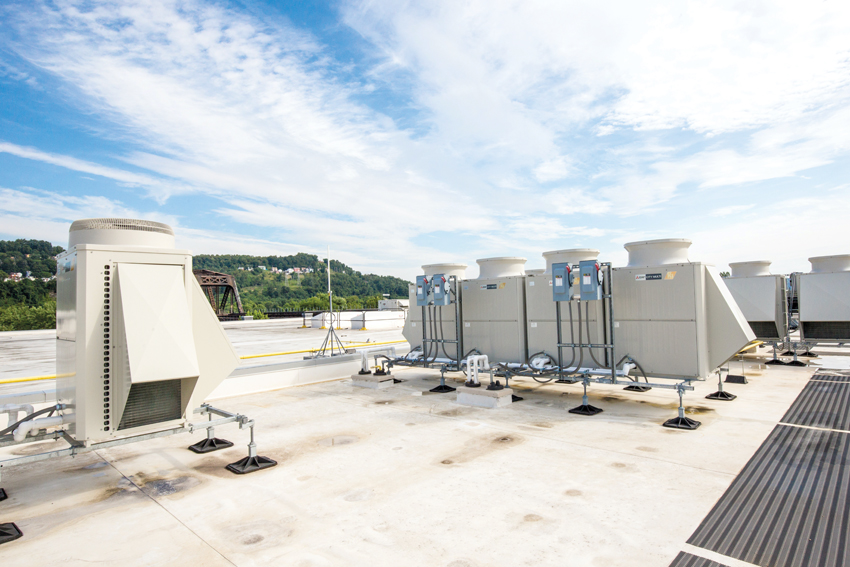
Variable refrigerant flow (VRF) outdoor units are compact, quiet and lightweight.
NEEP maintains that the key drivers behind these strategies, in addition to carbon emissions and reducing dependence on fossil fuels, are health, comfort, safety and costs. In an effort to benefit consumers, businesses, and the environment, NEEP believes that advanced electric technologies, such as space/water heating, deep energy efficiency like thermal improvements, and grid integration, including the flexible use of energy, are all crucial components of reducing carbon emissions through strategic electrification.2
Defining Strategic Electrification
NEEP defines strategic electrification as “powering end uses with electricity instead of fossil fuels in a way that increases energy efficiency and reduces pollution, while lowering costs to customers and society, as part of an integrated approach to deep decarbonization.”3
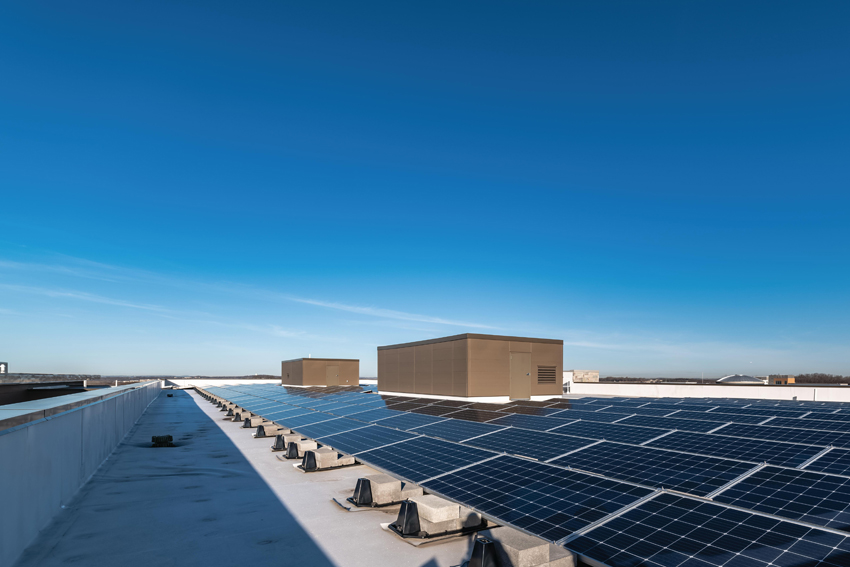
This building uses water-source VRF and therefore does not have rooftop outdoor units.
Strategic electrification is also sometimes known as beneficial electrification and offers many opportunities within both the commercial and residential sectors to reduce emissions and energy costs. For instance, strategic electrification can include switching to an electric car or heating system. Strategic electrification occurs when both the end-user and the environment benefit and efficiency policies strive to assess the life-cycle energy savings of a product.4
The Current State of Strategic Electrification
At the moment, the majority of vehicles and homes still rely on the on-demand, on-site burning of fossil fuels for power and heat, and many view using electricity as inefficient; however, the Environmental and Energy Study Institute (EESI) notes several factors that make electrification more viable, both financially and environmentally:
- Rapid growth in low-cost, zero-emissions power
- Volatility in fossil fuel prices and availability (especially propane and heating oil)
- Increasing efficiency and performance of electric-powered appliances and vehicles
- Growing need for electricity load management
- Emission reduction goals5
Adopting electrification would necessitate a shift in the viewpoints and business models set forth by utility companies, policymakers, and other invested parties. For example, the EESI recommends that rather than considering the power, heating, and transportation sectors as distinct, energy consumption should be analyzed as a whole across the U.S. economy to incentivize electrification, enabling both financial growth and environmental benefits. The EESI further claims that the electrification of the transportation and commercial and residential building sectors would “double electricity use by 2050” while reducing greenhouse gas emissions by 70 percent.
New technologies are also making strategic electrification more viable by reducing power demand. For instance, energy efficiency, demand-response technologies, inexpensive renewable power, and the closing of coal plants are “reducing the carbon intensity of the electric grid,” causing electricity to become more environmentally beneficial. Overall, strategic electrification would simultaneously green the grid, increase the sale of electricity, and “link the electric utility model to a clean energy future.”6
Strategic Electrification and Decarbonization
The major goal of strategic electrification is to identify opportunities provided by new technologies to switch from fossil fuel use to electricity—where it is practical from financial and environmental perspectives. Another goal is “to accelerate long-term market transformation for strategic electrification to displace the use of carbon-intensive fuels.”7
Displacing the use of carbon-intensive fuels, or decarbonization, is “the process by which the average amount of carbon in primary energy reduces over a period of time.”
Green Coast, a non-profit organization whose goal is to connect energy professionals, notes the measures needed to be taken for decarbonization to occur:
- Reducing the reliance of producing electricity through fossil fuels and adopting clean energy that will decarbonize electricity production
- Ensuring that there is high energy efficiency, which in turn helps in reducing the high demand for energy
- Increasing the use of clean energy
- Ensuring that the natural ways of absorbing carbon are active; for example, increasing the forest cover8
As these steps are taken, energy production costs and air, water, and soil pollution will all reduce.
According to Carolyn Fortuna, Ph.D., writer and author of "Home is Where Climate Action Begins – Strategies for Building Decarbonization" on Clean Technica, the adoption of a decarbonization strategy that specifically relies on building electrification will ultimately save consumers billions of dollars compared to other carbon reduction strategies.9 In her article, Fortuna summarizes three recent white papers written on strategies for building decarbonization. She discusses the rate design for building electrification, noting the complexity but achievability of the process. She claims that by changing long-term building end uses, such as the reliance of heating systems on fossil fuels to clean electricity, decarbonization can occur. Four major design levers that should be taken into account to accomplish this include the following:
- Adjustable baseline allowances for electrified water heating and other essential home energy uses
- Volumetric rates with meaningful peak to off-peak differentials
- Time differentiated solar export prices
- Seamless compensation for GHG reductions and grid services10
On the whole, building electrification shifts the focus away from conservation and energy-use reduction to reducing greenhouse gas emissions. This strategy further promotes the adoption of less carbon-intensive fuels, such as electricity, over oil and propane.
NEEP maintains that to achieve long-term decarbonization goals, intensive change must occur in the short term. For instance, local and state policy changes are needed to assist market development so that barriers to electrification and new technologies related to electrification can be broken down. Business and economic impacts would also need to be analyzed, and public education would need to occur.11
Potential Setbacks
NEEP identifies several potential market barriers to the goals of strategic electrification: awareness, supply chain, economic, technical and infrastructure, and policy and regulatory. Other issues include a lack of consumer awareness and contractor education, insufficient contractor base, high upfront costs, little performance data, fuel-switching policies, and fossil fuel subsidies.
To offset these potential barriers, NEEP suggests several strategies, including marketing, outreach, and education; mandates and targets; pricing-based options; and emerging financing and business models. In their white paper, “Rate Design for Beneficial Electrification,” authors Cunningham, Ralston, and Wu note that simply providing short-term incentives to encourage electrification will not be enough to sustain long-term change. Instead, they argue that “more dynamic, granular rates and load management will be needed. Advanced grid harmonization rates with active load management can be key to achieving […] long-term GHG reduction goals with the lowest costs possible.”12
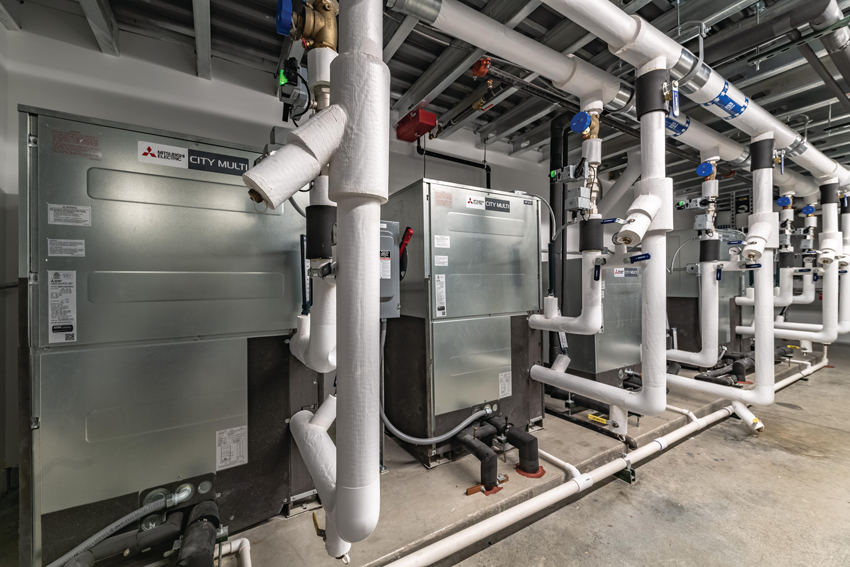
A geothermal water-source VRF system would save Fairway Independent Mortgage, headquartered in Madison, Wisconsin, $0.50–$0.75 per square foot in annual utility costs compared to a traditional hot water VAV rooftop system.
Using Heat Pumps to Help Achieve Decarbonization Through Strategic Electrification
One opportunity to achieve decarbonization through strategic or beneficial electrification in both the commercial and residential buildings sectors is heating. The U.S. Energy Information Administration (EIA) maintains that space heating accounted for 46 percent of the total consumption of energy in single-family detached homes in 2015, and space and water heating collectively accounted for 62 percent of household energy consumption in 2015.13
The EESI states that in 2015, 36 percent of households in the United States already used electricity as a primary heating fuel versus 10 percent that used oil or propane. Through the years, the costs of oil and propane have increased, and oil and propane systems also have higher carbon emissions than natural gas. Importantly, “improvements in electric heat pump technology” means that new electric-powered appliances “can heat space and water at efficiencies between 200 and 300 percent, compared with 67 percent for a typical Energy Star gas water heater.” The EESI further states that these new appliances are better at operating in colder temperatures, whereas older gas heat pumps are not as effective below 40 degrees Fahrenheit.14
NEEP also notes that the largest residential energy user is space heating, followed by water heating, and believes that the newest generation of heat pump water heaters (HPWHs) present an opportunity to implement strategic electrification, including through energy and cost savings. NEEP demonstrates that market analysis of the technology shows “that a complete conversion of units 50 gallons and larger from standard electric resistance to energy efficient technology would secure nearly 340 million kWh in annual electricity savings across the region [Northeast and Mid-Atlantic states], the equivalent of over 41,000 households’ annual electricity use. Summer peak demand would be reduced by 30 MW. The 240,000 metric tons of CO2 prevented is equivalent to taking over 50,000 cars off the road for a year.”15
Heat Pump Technologies
There are multiple heat pump technologies including ground-source heat pumps (GSHPs), air-source heat pumps (ASHPs), and commercial ASHP applications with variable refrigerant flow (VRF) technology that can help achieve decarbonization through strategic electrification.

Fairway Independent Mortgage selected water-source VRF for its ability to provide an efficient building that maximizes mechanical system performance without compromising architectural design intent.
Marcia Karr, an engineer writing for Washington State University, notes that GSHPs “tap a large reservoir of nearly constant-temperature heat (the ground) and use water as the heat exchange fluid.” She further maintains, however, that new VRF technology, “even with air-to-air heat exchangers, can meet or exceed the efficiencies of GSHPs by using multi-speed fans and variable speed compressors,” and permits heating and cooling recovery from one zone to another in a building. Amongst numerous other benefits, Karr also states that VRF technology offers “energy savings due to better part-load efficiencies and reducing or eliminating duct losses when compared to standard air-to-air heat pumps.” Overall, Karr concludes that VRF heat pump systems can reduce energy consumption for heating and cooling by as much as 32–40 percent in a variety of applications and locations.16 VRF technology will be discussed in greater detail in an upcoming section.
Air-source heat pumps (ASHPs) is another category of heating and cooling systems that is growing in availability. The U.S. Department of Energy states that an ASHP is capable of delivering “one-and-a-half to three times more heat energy to a home than the electrical energy it consumes.” ASHPs operate by moving heat rather than converting it from fuel, which is what a traditional heating system does. Different types of ASHPs include ductless, ducted, or short-run ducted, split or packaged, and multi-zone or single-zone. These systems were, at one time, not intended for use in areas that experienced long periods of subfreezing temperatures; however, newer generations of the technology have enabled its use in a variety of harsh climates.17
Heat Pump Market
NEEP notes the downturn in the market for heating and cooling systems in general that occurred in 2005, close to the onset of the housing crash. In 2011, sales, primarily in cooling systems, began to once again increase. In terms of ASHP installation, NEEP identifies opportunities to transform the residential market by taking advantage of replacement, displacement, and new construction. It defines “replacement” simply as the replacement of old, broken, or existing systems; “displacement” as the addition of a system without removing the old one; and “new construction” as the opportunity to install systems that conform to strategic electrification whether it is because a home does not have access to natural gas, the home is low load, the owners or specifiers are aiming to build a net-zero all-electric home with solar electric systems, or they are avoiding meter fees and gas infrastructure costs.18
When assessing the market in the Northeast and Mid-Atlantic, NEEP states that in the Northeast, gas is used for space heating in less than half of the homes, and 31 percent of homes use oil. By contrast, in the Mid-Atlantic region, 58 percent use gas, and only 6 percent use oil. An additional 12.5 percent of homes in the Northeast and 25.8 percent of homes in the Mid-Atlantic use electricity for heating; however, these are primarily electric resistance systems. Heat pumps are only used in 2.3 percent of Northeast homes and 11.1 percent of Mid-Atlantic homes.19 NEEP identifies heat pump candidates as older homes getting an energy retrofit or more energy-efficient heating system. Other candidates include homes that currently use electric resistance or oil systems, as a heat pump system would offer increased energy cost savings. The addition of a heat pump could also offer homes without air-conditioning increased comfort in the summer. Comparatively, there is more opportunity to introduce these systems in the Northeast than in the Mid-Atlantic based on existing systems and costs.20
ENERGY STAR estimates that heat pump water heater systems can save a household of four around $350 per year on electric bills and up to $3,750 over the course of the water heater’s lifetime. It further claims, “If all residential electric water heaters less than 55 gallons sold in the United States were ENERGY STAR certified HPWHs, the energy cost savings would grow to almost $12 billion each year, and 140 billion pounds of annual greenhouse gas emissions would be prevented, equivalent to the emissions from more than 13 million vehicles.”21
Despite the technological advancements and potential for cost and energy savings, the market for heat pump systems is still immature. The Building Decarbonization Coalition believes that while electric appliances have lower lifetime costs than fossil fuel appliances, such technologies “will not reach mass adoption until market interests [are realigned] so that everyone benefits from decarbonization.”22 Ensuring that everyone benefits entails everything from customer education to implementing rate design for building electrification to ensure financial and environmental benefits.
State and Local Building Codes
State and local building codes may also present opportunities to implement and promote heat pump technology. A major issue, however, is that state and local codes are not permitted to require minimum efficiencies below the minimum federal standard, which is also capable of overriding the International Energy Conservation Code (IECC). According to the Vermont Energy Investment Corporation (VEIC), a non-profit dedicated to reducing the economic and environmental costs of energy use, studies show that up to 80 percent of residential energy consumption can be attributed to products that only have to meet minimum federal standards. These products, which are outside the purview of local building energy codes, include HVAC and water-heating equipment. VEIC concludes that, “the inability for building energy codes to prescribe high-efficiency mechanical equipment makes it difficult to encourage high-efficiency or zero energy building practices through the prescriptive compliance path of the IECC, as well as inclusion of high-efficiency electric heating and hot water systems such as ASHPs.”
VEIC offers alternative solutions, such as creating local amendments to the IECC, which include the following: “limiting compliance options to a performance-based path, granting builders more control; developing prescriptive paths, including options for higher mechanical efficiencies; and adding a high-efficiencies ‘options’ package from which builders must choose a minimum number of additional efficiency requirements.”23
The Energy Efficiency of VRF Advance Heating Technology
Greener grids and the wider use of renewable energy sources make electrification key to achieving decarbonization goals. Both residential and commercial architects can contribute to the electrification of the built environment by incorporating highly efficient, variable capacity HVAC systems into their designs.

On the interior of this building, VRF was ideal because the ventilation shafts are minimal, the small horizontal duct work maximizes the available ceiling height, and the VRF equip-ment is easily hidden above ceilings.
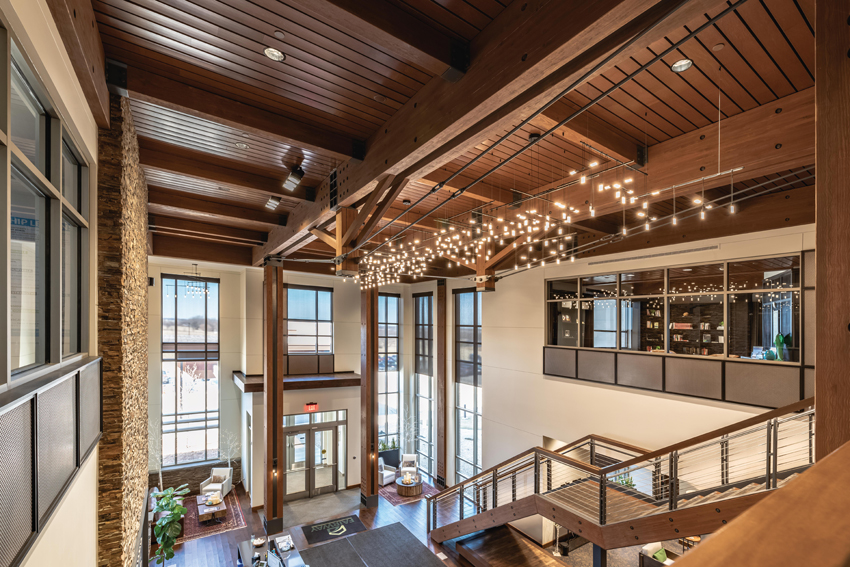
Fairway Independent Mortgage wanted an energy-efficient HVAC system to provide distributed comfort and zoning to a large office building.
Variable refrigerant flow (VRF) zoning technology has been used since the 1980s. Architects have favored VRF systems for many reasons, among them longer line lengths for more flexible design and more affordable cold-climate heating. VRF for commercial applications was introduced to the U.S. market in 2003. Since then, there have been major improvements in heating capabilities, space savings, and ease of retrofitting into buildings that were not originally designed to have air-conditioning. Advances have also been made in the performance of the inverter-driven compressor, including improved energy efficiencies and reduced operational noise.
VRF systems are engineered to use only the precise amount of energy needed to heat or cool a commercial building. As manufacturers innovate, the amperage required by VRF systems continues to fall making VRF ideal for office buildings, hotels, and educational facilities, among other applications, that utilize renewable energy.
Benefits of VRF Zoning Technology
VRF achieves comfort success by dividing a building’s interior into zones, each of which can be conditioned separately. The system’s total capacity, in this case, would be distributed to each indoor unit via a branch circuit controller, resulting in greater comfort control for the occupant. For VRF systems with heat recovery, one zone can be cooled while another is simultaneously heated using the rejected heat energy.
As opposed to VRF, traditional HVAC systems are large with outdoor units requiring ample square footage on rooftops or grounds, and indoor units and ductwork consuming space in ceilings and plenums. The other main challenge in designing an HVAC system for comfort is acoustics. Traditional systems tend to have loud outdoor units, noisy indoor units, and a vibrating structure that are all problematic. VRF systems, on the other hand, optimizes square footage, acoustics, and budget while offering energy-efficient technology that provides comfort.
The use of VRF technology provides a building’s occupants with personalized comfort control, permits energy and operational savings to a building owner, and delivers a flexible solution to the architect, engineer, and contractor during the design and installation process. VRF allows for a more spacious, modern feel, lower construction costs due to the possibility of designing shorter buildings, more natural light, and better indoor environment due to bigger windows and the option to add an additional floor for more leasable space.
By incorporating modern sensing technologies for temperature, humidity, occupancy, and more, energy efficiency is further increased. In general, and depending on the baseline comparative system, VRF systems consistently perform at 25 percent higher efficiency than conventional HVAC systems.
VRF Heat Pumps with Advanced Heating Technology (Hyper Heating)
Until recently, some specifiers in northern regions felt obligated to select a gas-powered furnace or electric resistance for their heating system due to air-source heat pump derating at sub-freezing temperatures. Today, air-source VRF systems use advanced hyper-heating technology in the compressor to offer unprecedented levels of capacity and efficiency at low outdoor ambient temperatures.

At UBER Advanced Technologies Group in Pittsburgh, VRF technology provided an energy-efficient, comfortable office building with ventilation and HVAC tied in to one con-trols interface.
This creates opportunities to replace fossil-fuel burning equipment and implement strategic electrification in more regions than before.
As outdoor temperatures drop below freezing, traditional heat pumps struggle to extract heat from ambient air as the flow of refrigerant circulating through the system drops. Advanced hyper-heating technology solves this problem with the addition of a flash-injection circuit. The system injects a portion of the refrigerant into the compressor at a lower temperature than normal, reducing the temperature inside the compression chamber. With the compressor running at higher speeds than normal, the system can maintain its heating capacity despite colder outdoor temperatures.
As a result, VRF heat pumps can function at 100 percent capacity at 0 degrees Fahrenheit and 85 percent capacity at minus 13 degrees Fahrenheit. In the case of VRF systems with heat-recovery and flash-injection technology, simultaneous cooling and heating is generally available down to minus 4 degrees Fahrenheit (instead of the 14 degrees Fahrenheit associated with most manufacturers’ standard version of VRF).
Benefits of VRF Heat Pumps
VRF systems are up to 40 percent more energy-efficient than conventional HVAC equipment. Most of these savings occur during partial load conditions as VRF systems continually adjust capacity and energy consumption to precisely match each zone’s load. By contrast, conventional, fixed-capacity HVAC systems run at full power or are off. Writing for The Construction Specifier, Cain White, director of commercial product management at Mitsubishi Electric Trane HVAC US, notes, “In the United States, a zone exhibits partial-load conditions more than 90 percent of the time.”25

VRF technology keeps tenants comfortable and free from distraction with noninvasive installation options and whisper-quiet operating sound levels.
VRF systems have the full-range variable capacity to deliver only the amount of conditioning required to match a zone’s cooling or heating demand. Integrated controls and sensors measure loads for each zone, and the compressor seamlessly adjusts speeds to maintain the desired zone temperature. Low-profile ducted or ductless designs typically increases energy efficiency about 25 percent over conventional ducted systems, partly due to the energy lost by forcing air through ductwork.
Efficiency Ratings
VRF technology can also help facilities meet sustainability certifications and accolades such as Green Globes and LEED requirements, as well as achieve the highest Integrated Energy Efficiency Ratio (IEER) ratings. IEER ratings allow for different systems to be compared to one another, regardless of the season, as long as the environmental conditions are the same.26 A typical VRF system with advanced heating technology will perform with an IEER rating of up to 16.8; VRF systems with heat recovery and advanced heating technology will see even higher IEER ratings—up to 18.4. The higher the IEER rating, the more energy-efficient the system.
Overall, as electrification becomes increasingly more common in buildings across the United States, end use technologies have the ability to utilize electricity—and the grid—more efficiently.
Implementing Strategic Electrification: A Detailed Look At New York
New York, California, and New England and many other areas around the United States are all making strides toward strategic electrification. New York Governor Andrew M. Cuomo’s Green New Deal, for example, calls for 100 percent clean power by 2040, which would ultimately lead to carbon neutrality across all sectors. Governor Cuomo’s Green New Deal is, in part, a response to the Intergovernmental Panel on Climate Change and the U.S. Global Change Research Project’s Fourth National Climate Assessment. The panel determined that over the past 115 years (1901–2016), global temperatures have risen by approximately 1.8 degrees Fahrenheit on average. The rise in temperatures, which is expected to continue to increase, has been attributed primarily to “human activities, especially emissions of greenhouse gases.”27
New York’s response to this report is one of the most aggressive clean energy agendas in the nation. To achieve the 2040 goal, the Green New Deal stipulates the following:
- 6,000 MW of solar by 2025
- 70 percent renewable electricity by 2030
- 9,000 MW of offshore wind by 2035
- Carbon-free electricity by 204028
The end result will be the reduction of greenhouse gas emissions, the use of renewable energy, increased energy efficiency, a clean-energy economy, and a resilient and distributed energy system. Strategic electrification, in addition to energy efficiency and carbon-free electricity are crucial to meeting goals by 2040.
To reach these end targets, the New York State Research and Development Authority (NYSERDA) has assessed the use of several heat pump technologies, including ground-source heat pumps (GSHP), air-source heat pumps (ASHP), and commercial ASHP applications with variable refrigerant flow (VRF) technology.29 VEIC maintains that New York could reach the following milestones by 2025 and 2030:
- ASHPs installed in two-thirds of New York households by 2030.
- 31 TBTU of energy savings from heat pump installations by 2025, contributing 17 percent of the savings needed to achieve New York’s 185 TBTU 2025 efficiency target.
- 3.5 percent of New York’s GHG emissions reductions coming from heat pump installations by 2030, contributing to the goal of 40 percent GHG reduction compared to baseline emissions in 1990. Focusing on the residential sector, for which better data was available, the emissions savings from this level of adoption would be nearly 20 percent30
NYSERDA suggests a variety of approaches for encouraging the adoption of technologies that complement strategic electrification, including a variety of incentives geared toward different sectors. For instance, incentive designs range from “downstream rebates paid to customers, to midstream incentives paid to contractors, to upstream incentives paid to wholesale distributors.” Each of these rebate strategies targets a different actor in the value chain, each addressing different challenges.
NYSERDA is also leading market development initiatives with various programs designed to reduce costs, accelerate market demand, and increase private investment in energy-efficiency and clean-energy technologies. Some programs include the Air Source Heat Pump Program and the Ground Source Heat Pump Program, both of which offer monetary incentives to contractors.31
Currently, NYSERDA does not offer incentive programs for VRF zoning technology. However, VEIC recommends the following to VRF stakeholders, including NYSERDA: aggressively promote VRF systems for commercial and residential new construction and in building codes; support the accelerated transition of heat pumps to lower global warming potential (GWP) refrigerants; explore distributor incentives for VRF technology; develop regional standards for VRF systems in the Northeast; review building code barriers to VRF technology; consider creating a VRF “Clean Energy Challenge;” accelerate NYSERDA’s soft cost reduction strategy for GSHPs; and develop and fund demonstration projects.32
The combination of strategies mentioned above can all help transition toward the ultimate goal of the Green New Deal: implementing an energy system that is clean, reliable, and affordable.
Conclusion
Overall, the adoption of heat pump technologies can help reduce the carbon footprint of buildings, enabling the country to move more progressively toward adopting clean energy. Economically, strategic electrification and heat pump technologies have the potential to reduce operating and maintenance costs. Focusing on strategic electrification, or beneficial electrification, also reduces dependence on fossil fuels and has a positive impact on the environment as well as human health, comfort, and safety.
END NOTES
1Lis, David. “Action Plan to Accelerate Strategic Electrification in the Northeast.” Northeast Energy Efficiency Partnerships (NEEP). 2018. Web. 30 June 2020.
2Lis, David. “Action Plan to Accelerate Strategic Electrification in the Northeast.” Northeast Energy Efficiency Partnerships (NEEP). 2018. Web. 30 June 2020.
3Strategic Electrification. Northeast Energy Efficiency Partnerships (NEEP). Web. 30 June 2020.
4“Beneficial Electrification: An Access Clean Energy Savings Program.” Environmental and Energy Study Institute (EESI). Web. 30 June 2020.
5“Beneficial Electrification: An Access Clean Energy Savings Program.” Environmental and Energy Study Institute (EESI). Web. 30 June 2020.
6“Beneficial Electrification: An Access Clean Energy Savings Program.” Environmental and Energy Study Institute (EESI). Web. 30 June 2020.
7“Beneficial Electrification: An Access Clean Energy Savings Program.” Environmental and Energy Study Institute (EESI). Web. 30 June 2020.
8Harris, Nancy; Waite, Richard; and Lyons, Katie. “The Roadmap to Decarbonization Won't Go Far without Land.” World Resources Institute. 4 April 2017. Web. 6 July 2020.
9Fortuna, Carolyn. “Home is Where Climate Action Begins – Strategies for Building Decarbonization.” Clean Technica. 4 March 2019. Web. 30 June 2020.
10Fortuna, Carolyn. “Home is Where Climate Action Begins – Strategies for Building Decarbonization.” Clean Technica. 4 March 2019. Web. 30 June 2020.
11Lis, David. “Action Plan to Accelerate Strategic Electrification in the Northeast.” Northeast Energy Efficiency Partnerships (NEEP). 2018. Web. 30 June 2020.
12Cunningham, A.M.; Ralston, M.V.; and Wu, K. “Rate Design for Beneficial Electrification.” Building Carbonization Coalition. Web. 30 June 2002.
13Berry, Chip. “Space heating and water heating account for nearly two thirds of U.S. home energy use.” U.S. Energy Information Administration (EIA). 7 November 2018. Web. 30 June 2020.
14“Beneficial Electrification: An Access Clean Energy Savings Program.” Environmental and Energy Study Institute (EESI). Web. 30 June 2020.
15Heat Pump Water Heater. Northeast Energy Efficiency Partnerships (NEEP). Web. 30 June 2020.
16Karr, Marcia. “Ground-Source Variable Refrigerant Flow Heat Pumps.” Washington State University. Web. 30 June 2020.
17Air-Source Heat Pumps. U.S. Department of Energy. Web. 30 June 2002.
18“Northeast/Mid-Atlantic Air-Source Heat Pump Market Strategies Report.” Northeast Energy Efficiency Partnerships (NEEP). January 2014. Web. 30 June 2020.
19“Northeast/Mid-Atlantic Air-Source Heat Pump Market Strategies Report.” Northeast Energy Efficiency Partnerships (NEEP). January 2014. Web. 30 June 2020.
20“Northeast/Mid-Atlantic Air-Source Heat Pump Market Strategies Report.” Northeast Energy Efficiency Partnerships (NEEP). January 2014. Web. 30 June 2020.
21Save Money and More with Energy Star Certified Heat Pump Water Heaters. ENERGY STAR. Web. 30 June 2020.
22“White Papers: Building decarbonization is critical low-cost strategy to reduce GHG emissions, but significant barriers remain.” Building Decarbonization Coalition. 19 January 2019. Web. 30 June 2020.
23“Ramping Up Heat Pump Adoption in New York State: Targets and Programs to Accelerate Savings.” VEIC. 25 September 2018. Web. 30 June 2020.
24White, Cain. “Advanced heating technologies for VRF.” The Construction Specifier. 27 September 2016. Web. 30 June 2020.
25White, Cain. “Advanced heating technologies for VRF.” The Construction Specifier. 27 September 2016. Web. 30 June 2020.
26Nguyen, Oanh. “Understanding Energy Efficiency Ratings in HVAC/R.” The Refrigeration School. 3 November 2015. Web. 30 June 2020.
27“Fourth National Climate Assessment (NCA4), Volume I.” Climate Science Special Report. U.S. Global Change Research Program. 2017. Web. 30 June 2020.
28“Toward a Clean Energy Future: A Strategic Outlook 2019–2022.” New York State Energy Research and Development Authority (NYSERDA). Web. 30 June 2020.
29“Ramping Up Heat Pump Adoption in New York State: Targets and Programs to Accelerate Savings.” VEIC. 25 September 2018. Web. 30 June 2020.
30“Ramping Up Heat Pump Adoption in New York State: Targets and Programs to Accelerate Savings.” VEIC. 25 September 2018. Web. 30 June 2020.
31“Ramping Up Heat Pump Adoption in New York State: Targets and Programs to Accelerate Savings.” VEIC. 25 September 2018. Web. 30 June 2020.
32“Ramping Up Heat Pump Adoption in New York State: Targets and Programs to Accelerate Savings.” VEIC. 25 September 2018. Web. 30 June 2020.
Eric Dubin is the senior director of utilities and performance construction at Mitsubishi Electric Trane HVAC US (METUS). He is active across the United States in education and policy development, and currently serves on the Board of Directors for the Northeast Energy Efficiency Partnership (NEEP).