This CE Center article is no longer eligible for receiving credits.
Windows often define a building's style and connect it with the outside world. Technology improvements in materials, coatings, and processes allow unprecedented flexibility in window design, resulting in the availability of larger window sizes and dramatic shapes that are also low maintenance and energy efficient.
Even as the window industry offers many new choices, fenestration products must meet exacting design and functional standards. Understanding the advantages and disadvantages of various window products will assist architects in specifying the most appropriate windows on projects.
Aluminum clad window frames that meet the strict criteria of American Architectural Manufacturers Association (AAMA) 2605-05 standards offer significant advantages in several areas, including durability, color and gloss retention, and corrosion resistance. This article will cover the properties of aluminum as a fenestration material and compare
the advantages and disadvantages of various window frame materials. The AAMA
2605-05 specification, the highest standard available, will be analyzed to provide architects with a benchmark for quality in selecting the right windows for new construction and renovation projects.
Aluminum Properties
Derived from bauxite, aluminum is one of the most abundant minerals in the earth's crust. About one-third the weight of iron, steel, copper, or brass, aluminum is easy to handle and relatively inexpensive to transport. Aluminum has a high strength-to-weight ratio that is equal to or stronger than steel. Protected by a naturally occurring oxide film, aluminum offers some corrosion resistance and by nature does not rust. With high elasticity, aluminum offers design flexibility and is conducive to innovative applications.
 |
|
 The Motherhouse of the Dominican Sisters of St. Cecilia in Nashville
underwent a massive renovation and expansion, including installation
of approximately 750 new and replacement clad windows.Photo courtesy of Marvin Windows and Doors.
The Motherhouse of the Dominican Sisters of St. Cecilia in Nashville
underwent a massive renovation and expansion, including installation
of approximately 750 new and replacement clad windows.Photo courtesy of Marvin Windows and Doors. |
|
Aluminum is a sustainable material. Though not specifically addressed by the U.S. Green Building Council's Leadership in Energy and Environmental Design (LEED®) rating system, a positive environmental characteristic of aluminum involves the end of its life cycle. Aluminum is 100 percent recyclable. Virtually anything made of aluminum can be recycled repeatedly due to its economic value. Cans, foil, plates, molds, window frames, garden furniture, and automotive components are typically melted down for recycling.
The re-melting of aluminum requires little energy. Only about five percent of the energy required to produce the primary metal initially is needed in the recycling process, and there is no off-gassing of harmful chemicals. Nearly one third of aluminum is manufactured from recycled materials.
Durability is a significant factor when assessing a material's long-term environmental impact. Aluminum framed structures are not subject to rot or rust, and are known for their extreme longevity. Although the electricity in producing aluminum is significant, this embodied energy is used over many years.
Extruded Aluminum Cladding in Historic Renovations |
Extruded aluminum clad frames have a significant place in restoration work. Built in the 1880s, LaFortune Student Center and Washington Hall at Notre Dame University, South Bend, Indiana, are both on the National Register of Historic Places. This renovation, designed by Architecture Design Group, South Bend, Indiana, called for energy-efficient, low-maintenance windows that preserved the profiles and unique colors of the original. Including a large circular window assembly in Washington Hall, all the windows duplicated the original Irish Tan color in low-maintenance aluminum cladding. At LaFortune Student Center, double-hung windows with extruded aluminum cladding and simulated divided lites were used. Casings for the clad window were factory applied-a solution that can save significant job site time and labor while resulting in consistent, high-quality casing and a good match for the building character and materials.
Extruded aluminum cladding is also specified for projects that have unique historical features. For example, at the University of Minnesota, Nolte Hall features windows with architectural nuances. The windows built for
this restoration project, designed by Miller Dunwiddie Architecture, Minneapolis, Minnesota, incorporated custom extruded aluminum clad casing and sill profiles, simulated divide lites, and a recessed transom on a number of large round top windows. One of the design details replicated was
the ogee lug, a curved ornamental part that hangs down from the lower corners of upper sash in double-hung windows. This historic feature was recreated in low-maintenance clad aluminum. A new insulating glass sash was designed to save energy, while preserving the original art glass and
wood millwork.
|
 |
 |
| Fenestration that preserved the profiles and unique colors of the existing 300-plus windows were critical in the renovation of Washington Hall at Notre Dame University. |
Energy efficient clad windows duplicated
the intricacies of the original profiles on
the renovation project at the University
of Minnesota's Nolte Hall. |
Photography: courtesy of
Marvin Windows and Doors. |
|
|
Designers look to aluminum cladding for windows that precisely reproduce the aesthetic intricacies of the original windows, and contemporary materials and features that provide a durable, energy-efficient, low-maintenance solution. This is illustrated in the restoration undertaken by
the Motherhouse of the Dominican Sisters of St. Cecilia congregation in Nashville, Tennessee, which embarked on a major renovation and expansion to save the building and
gain more space. One of
the major components
of the project involved building and installing approximately 750 new and replacement windows. The new construction involved over 300 windows; the renovation called for approximately 440 custom-built windows in a variety of shapes and sizes, many of them of massive dimensions and requiring unique design solutions, including custom panning systems and replication details.

"Angel Wing" windows replicated the authentic divided
lite and beading on the original windows.
Photography: courtesy of
Marvin Windows and Doors. |
|
The window specifications for the renovation included clad double-hung and single-hung windows, many with round tops. Round top windows were of an uncommon design with a round-topped sash and frame on the exterior and a round-topped sash and rectangular frame on the interior. Also included were 22 distinctive "angel wing" windows. These were clad single-hung, round top windows almost 12 feet high and featuring interior authentic divided lites in the upper sash; a three-and one-half-inch beaded wood bar on the interior with one-and three-quarter-inch beading around the circular lite; and a decorative exterior one-piece milled upper sash. Existing peeling and rotting sills and jambs of varying widths were covered with a maintenance-free aluminum surface.
"A historic renovation project of this type can be very exacting in terms of fenestration," says Jim Thompson, AIA, partner, Fowlkes and Associates, Nashville, Tennessee. "We were looking for windows that require minimum maintenance, have a long life, provide the complex profiles that would be similar to the originals, and meet the requirements of the local historic review board. The durability and flexibility of extruded aluminum frames helped us achieve these goals." |
|
The Basics of Window Framing
Wood. Wood windows generally have a classic appearance. Wood is a versatile material, can be painted in any color, and delivers exceptional thermal performance and energy efficiency. Softwoods have an average R-value of approximately 1.25/inch. The biggest drawback of wood is maintenance. Wood frames can have a long life span, but they are more susceptible to the elements than metal or vinyl, and consequently require ongoing repainting or refinishing. Wood must be protected from moisture because it is prone to warping, cracking, ultraviolet radiation, and rot.
Wood Composite. The wood window industry has created a new generation of wood and polymer composites that are extruded into a series of lineal shapes for window frame and sash members. These composites can compare either structurally or thermally with wood. Both, however, cannot be enhanced simultaneously. Increased density for structural performance results in lower thermal performance.
Testing indicates that composite materials may have excellent long-term durability. However, composites that are made from wood mixed with vinyl can share characteristics of vinyl, such as distortion and discoloration in hot climates. Their use for window applications is relatively new; installation in housing started in the mid-1990s.
Fiberglass. Fiberglass frames offer superior energy efficiency. Fiberglass is twice as strong as steel. While its strength and durability make it suitable for large expanses of glass, it's also virtually maintenance free. Fiberglass expands and contracts at the exact same rate as glass, reducing stress cracks and other temperature-related fractures. Fiberglass frames achieve strength without the bulk, and thus may be built with a lower frame profile like traditional aluminum frames, but with better thermal performance. However, the rigid composition of fiberglass may limit design flexibility.
Vinyl. Polyvinyl chloride (PVC) or vinyl is a versatile material with a good insulating value and available in a wide range of shapes and styles. Vinyl is not as rigid as aluminum, and is not as strong as either aluminum or fiberglass. Internal hollow chambers are often added to provide strength. These chambers also trap air, increasing the energy performance and improving the sound deadening qualities of the frame. The more internal chambers, the stronger and more energy efficient the vinyl frame will be. As with aluminum, the design of the extrusion is critical to the energy performance, structural strength, and economics of the product. Vinyl frames are generally the least expensive option.
However, vinyl expands and contracts due to heat and cold. Additionally, the damaging effects of ultraviolet (UV) light cause vinyl to eventually chalk and fade. The pigment in darker vinyl breaks down after exposure to UV light, which causes fading. Due to the likely fading problem with darker hues of vinyl, manufacturers often opt to offer lighter shades. With constant exposure to the weather, vinyl windows can become brittle with age and may not last as long as some other materials.
Aluminum. Aluminum frames are light, strong, durable, and low maintenance. The drawback of aluminum is that it causes conductive heat loss, which affects the U-factor and decreases energy efficiency. It also allows for condensation buildup, which may cause problems in the building interior. Because aluminum is about 1,000 times more heat conductive than materials like wood and vinyl, aluminum window frames are often designed using a lower profile cross-section than their wood and vinyl counterparts.
A standard aluminum frame window will allow heat to travel freely from the warm inner side of the frame to the cold exterior side. This heat loss path can be short-circuited by separating the aluminum in a section of the frame and replacing it with a non-conductive material. A thermal break separation of only one-quarter inch can substantially improve window performance. It is important that all frame parts which extend metal from inside to outside be broken and that the breaks are placed correctly to avoid thermal bridges or short circuits for heat loss. This type of frame requires additional manufacturing steps and typically costs more than standard aluminum windows. It is advisable to check the National Fenestration Rating Council (NFRC) window U-factor rating since not all thermal break windows perform better than well-designed standard aluminum products.
Aluminum Clad Wood Frames. Window frames that are wood on the inside but have a protective coating outside are known as clad. When wood frames are clad with vinyl, aluminum, fiberglass, or composites, they combine wood's insulation with the durability of man-made materials. Clad-wood products feature a wood interior that improves thermal efficiency. Thermal energy performance of properly designed wood clad products can approach the efficiency of wood windows.
While typically more costly than vinyl, aluminum cladding is stronger and more flexible. Aluminum cladding can be painted, with manufacturers offering many different colors. As another benefit, aluminum cladding is only applied to the window exterior, enabling the rich traditional appearance of wood to be visible on building interiors.
Although aluminum is a conductor of heat and cold, because the cladding does not extend to the interior, the wood minimizes the transfer of heat and cold, making the windows energy efficient. Many aluminum window manufacturers offer a higher nickel content to the aluminum, thereby dramatically reducing the risk of corrosiveness.
The aluminum cladding can be thin or thick, based on how it is manufactured. Roll-form aluminum is a thin sheet that is bent to cover and protect the exterior of the window. Roll-form aluminum isn't much thicker than a beverage can, and is easily bent and damaged. Most standard windows using roll-form aluminum use a less expensive paint coating that can easily fade, chalk, and scratch.
The aluminum used on clad windows can also be extruded. Extrusion, or forcing solid metal through an opening under compressive forces, is somewhat like forcing toothpaste through a tube. Extruded aluminum is made from heated ingots forced through a shaped opening with the aid of a powerful hydraulic press to produce a wide variety of useful products in almost any shape. Extruders maintain standard shaped dies-angles, channels, bars, tubes, pipes, among them-but custom dies can be made to any design specification.
Extruded aluminum is heavier in weight than roll-formed aluminum. About as thick as a quarter, extruded aluminum is a strong and durable cladding material. Extruded aluminum is generally more wear-resistant than roll-formed aluminum and because it is a thicker substrate, offers a more conducive surface for a thicker, more durable paint coating. Before it is painted, extruded aluminum is profiled, or contoured to fit the outline of the molding or other architectural element. This adds to extruded aluminum's ability to support a thicker, more even coating.
Complex shapes are more efficiently produced by extrusion than by other methods, such as stamped, formed, rolled, cast, welded or machined processes. That is because with extrusions, rather than joining different elements, a custom extrusion design can combine all elements into a single component in a single economical die. Extrusions also yield a stronger product that offers tighter dimensional stability. In addition, aluminum extrusions can offer architects the flexibility to design a complex profile.
Window manufacturers offer a wide variety of extruded products to meet the rising demand for unique fenestration products. Round tops, or circular windows, as well as octagons, hexagons, trapezoids, pentoids, triangles, or virtually any geometrically shaped window can add dimension and drama to a building exterior. In some cases, manufacturers offer a combination of roll-form and extruded aluminum techniques according to the function of each frame component. For example, aluminum-clad windows can be made with extruded frames and roll-form sashes. This can result in the finish on the two different substrates exhibiting different performance over time.
Case Studies
Because of its chief attributes-wood interior, ease of maintenance, energy efficiency-extruded aluminum cladding is often preferred over other systems in residential and commercial projects. Rock Island Lofts, in downtown Minneapolis, was originally designed by Oertel Architects, St. Paul, Minnesota, with an all-aluminum window system characteristic of this type of structure. However, developer Shamrock Construction sought windows with a wood interior to achieve a more upscale look, and opted instead for a commercial grade, extruded aluminum that offered a richer interior look and a low-maintenance exterior. On the seventh floor of the building, the window units had to function properly, and meet wind load requirements. The twelve-foot-eight inch by eleven-foot-four-inch window assemblies were installed around a steel substructure from the building interior. The assemblies were designed to be sealed from the exterior and covered with extruded aluminum mull covers.
|
 |
 |
| Abundant windows create a high-style residence at Rock
Island Lofts designed by Oertel Architects in Minneapolis. |
Extruded aluminum clad windows complement the contemporary
design of the Madison County Highway Department. |
Images: Courtesy of
Petersen Aluminium Corporation |
|
|
For the Madison County Highway Department facility in Alton, Illinois, designed by AAIC Inc., Collinsville, Illinois, many energy-efficient windows allow ample natural light into the interior. Extruded aluminum clad windows were finished in Cape Cod Blue in a commercial-grade finish that met AAMA 2605-05 specifications. "We used aluminum clad wood windows because we were looking for energy efficiency and durability in an operable window and a wood look on the interior," says Barry Moyer, AIA, design director at AAIC Inc. "Typically, all-aluminum window systems are used because they're less expensive, but they may not have the energy efficiency or aesthetic appeal of aluminum clad wood frames and sash. We have experienced some surface deterioration, fading, and cracking with vinyl and vinyl clad wood windows specified on projects that are now 10 to 20 years old. I have seen factory-applied paint coatings on aluminum clad wood windows that are 30 years old which exhibit only minimal color change and fading."
Boosting Energy Efficiency
In addition to exterior cladding, the window and door industry offers insulating glass to significantly reduce heat transfer through windows. Two layers of glass protect an inner layer of argon, an inert gas placed between glass panes to improve the insulating value of the sealed glass unit. Many window companies also offer a low-e coating on the glass which can further reduce thermal transmission as well as block out harmful UV rays. In addition to obvious benefits, this coating can also reduce or slow the fading of carpets and furniture. Insulating glass increases energy efficiency while decreasing building heating and cooling costs. In residential construction, insulating glass also reduces the need for storm windows.
Paint and Coatings on Aluminum Extrusions
In understanding extruded aluminum cladding, it is helpful to have a working knowledge of applied coatings and paints. Liquid paint applied to an aluminum substrate consists of 60 percent solvent, 10 percent pigment and 30 percent binder/resin.
Solvents are the liquids that dissolve or disperse other substances; they are the liquid portion of the paint. Pigments are the finely ground, solid particles that provide color and are dispersed in liquid to make paint. When the elements of the environment attack the pigment portion of the paint and cause the color to change, fading occurs.
Binders are the non-volatile resins that bind pigment particles together. Paint binder, or resin, is solid, and represents the bulk of the dry paint. Typically, it is a strong material, and essentially gives the paint its thermal and weathering properties. Because its adhesive quality causes the pigment particles to stick to a substrate, the higher quality the resin, the more durable the paint will be. When high-performance resistance to corrosive environments is called for, resins will be more costly. Polyvinlidene fluoride (PVDF) resin, a thermoplastic fluoropolymer that relies on the superior strength of the carbon-fluoride bond, is one of the strongest chemical bonds in existence. It is used in fluoropolymer resin coatings and paints. PVDF resins should be considered for all projects calling for the highest purity, strength, and resistance to solvents, acids, bases, and heat.
|
|
|
Chalking |
Fading |
Coatings with 70 percent PVFD on aluminum substrate show minimal chalking and fading at 5, 10 and even 20 years of exposure. |
|
|
When formulated into a coating composition containing a minimum of 70 percent PVDF resin, the resultant coatings exhibit superior color and gloss retention, chalk and corrosion resistance, flexibility, stain resistance, overall durability, and can stand up to direct sun, extreme temperature variations and acidic pollutants without fading. Coatings with 70 percent PVDF meet or exceed the AAMA 2605-05 specifications.
During manufacturing, a chemical bond is created between the extruded aluminum and the paint to resist chalking and fading. For best results, before the finish is applied, aluminum cladding goes through a five-step pre-treatment process to ensure the finish adheres smoothly. Unlike roll-form aluminum, clad extrusions are formed first and then painted. This results in superior adhesion and a consistently thick finish so that clad products retain color and gloss qualities.
Industry Standards
Environmental conditions can cause coatings to fail. Precipitation, ultraviolet rays, heat, and temperature extremes are all capable of breaking down exposed surfaces. Standards were developed to assure
the building community that coatings on extruded aluminum retain their integrity. Adherence to these standards enables architects to make reliable projections about
product performance.
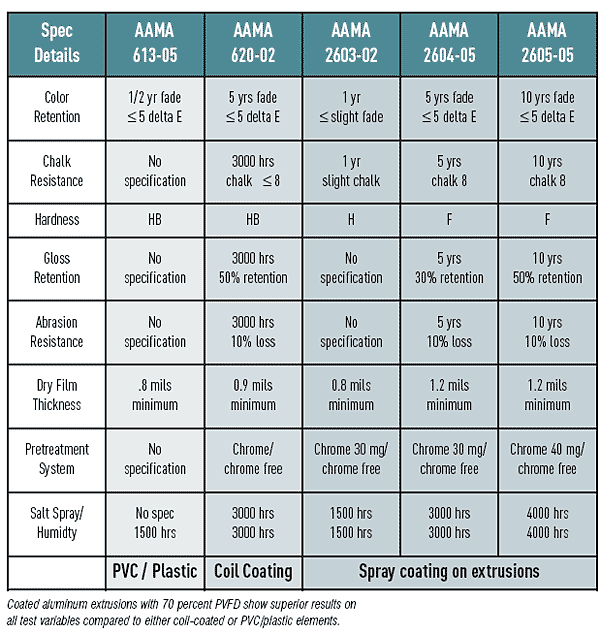
The American Architectural Manufacturers Association (AAMA) is a source of finish performance standards, product certification and educational programs for the window, door, and skylight industry. AAMA maintains specifications for all fenestration materials. For years, architects recognized 603 and 605 as standards for organic coatings on architectural aluminum and panels. These have been superseded by new specifications that will enhance architects' ability to specify the right level of performance for factory spray-applied organic coatings for project requirements. The AAMA Document Management Committee (DMC), in conjunction with AAMA's technical staff, reviews all documents that have not been revised in the last five years to determine if new information is available or necessary. If needed, the DMC asks the appropriate committee to review and refine the document. In the case of 2605, the AAMA Finishes Committee last refined the document in 2005 to support the latest industry knowledge. AAMA 2605-05 is the highest industry standard available, ensuring ten-year color retention and chalk resistance. Adherence to AAMA 2604-05 (five-year color retention and chalk resistance) and AAMA 2603-02 (one-year color retention and chalk resistance) offer less, though better and good performance levels, respectively.
The most recent AAMA standards reflect good, better, and best performance for extruded aluminum clad windows:
Best: 2605-05, 10 years color retention and chalk resistance
Better: 2604-05, 5 years color retention and chalk resistance
Good: 2603-02, 1 year color retention and chalk resistance
The purpose of these standards is to help architects, contractors, and building owners specify factory-applied organic coatings that will provide and maintain a superior level of performance in terms of coating integrity, exterior weatherability, and general appearance over many years. The standards also give buyers an added measure of quality assurance and serve as a reference point for regulators.
AAMA 2603 applies to polyester and acrylic coating and is intended primarily for interior, light commercial and residential-grade coatings of at least 20 microns (0.8 mil) thickness. A one-year South Florida weathering test is optional.
AAMA 2604 and 2605 apply to coatings of at least 30 microns (1.2 mils) thickness that are intended primarily for commercial and architectural-grade applications. AAMA 2604 applies to silicon polyester coatings; AAMA 2605 applies to coatings that contain 70 percent PVFD. The same ASTM test methods and performance criteria are used to evaluate color uniformity and specular gloss, which is a measure of the light reflected by the surface of a material. Specular gloss can be inherent in the material, or the result of the molding process or surface texture. Gloss is always referenced against a standard. Gloss can also be affected by environmental factors such as weathering or surface abrasion. In addition, the same impact resistance and chemical resistance are used in both standards. Both involve test methods and criteria not required under 2603-02. While AAMA 2604 addresses complete coatings systems based on 30mg of chrome pretreatment; AAMA 2605 applies to high-performance coatings based on 40mg of chrome pretreatment Both coating specifications may use a non-chrome pretreatment process. In places where there are environmental concerns, chrome pretreatment may not be allowed.
AAMA 2605-05: The Highest Standard in the Industry
In accordance with standards, aluminum extrusions or panels must undergo a surface preparation for a PVDF coating application that involves the following steps:
- Acid or alkaline wash to remove impurities
- A fresh water rinse
- Chemical conversion-a chromium or non-chromium pretreatment. This is a process
that treats the metal surface chemically when the metal is immersed in or sprayed
with various solutions. The finish provides good protection and adhesion; it is
typically used as a base for another, final finish.
- Ambient fresh water rinse
To adhere to the AAMA 2605-05 standards, properly prepared test panels are subjected to the following rigorous tests:
Color uniformity. Random samples are checked usually under a uniform light source from various angles and by instrumental methods.
Requirement:Color uniformity must be consistent with color range or numerical value established between the approval source and the applicator.
Specular gloss. Gloss consistency is tested from one unit to another. A 60-degree gloss meter measures newly finished aluminum for a gloss value.
Requirement:Gloss values must be within five units of the manufacturer's specification.
Dry film hardness. (The term film is used interchangeably with coating.) This is a test for susceptibility to damage that might be sustained during shipping or installation. A tester pushes a pencil with F (medium) hardness held at a 45-degree angle into the film and tries to rupture it.
Requirement: Film does not rupture.
Film Adhesion. This is a test for a coating lifting off the substrate. This test is conducted in three categories:
Dry Film Adhesion: Tape is scored in a prescribed cross hatch pattern and adhered to a sample, and then sharply pulled off at a right angle to the plane being tested.
Wet Film Adhesion: The panel with tape over the cross hatch patterns should be immersed in distilled or de-ionized water at 100 degrees F for 24 hours. The sample panel should then be removed and wiped dry, after which the film adhesion test is repeated.
Boiling Water Film Adhesion: The sample panel is immersed in boiling water for 20 minutes. The water remains boiling for the full 20-minute test period. The sample is removed and wiped dry and the adhesion test is repeated.
Requirement: For all tests, there should be no removal of coating under the tape either within or outside the cross hatched area, nor blistering anywhere on the test specimen. Paint that lifts off is measured as a percentage failure rate.
Impact resistance.This tests whether the coating will rupture after impact. A tester drop dart impacts the surface in order to deform a small piece of the sample. Tape is applied over the deformed area and sharply removed at a right angle to the panel.
Requirement: No removal of the coating from the substrate.
Abrasion resistance. This tests the number of years a product is likely to resist wearing off. Sand is filtered through a funnel until it wears through the top coat.
Requirement: The amount of sand falling onto the test sample without wearing through the surface must be within calculated parameters.

Test samples are exposed to the elements in South Florida.
Photos courtesy of Marvin Windows and Doors. |
|
Chemical resistance. Color retention and adhesion are tested following chemical contact with five different substances. The following values are used:
Muriatic Acid: A 10 percent solution at a 15-minute exposure
Requirement: There should be no blistering or noticeable change in appearance to the naked eye. There should be no removal of the coating.
Mortar: A 24 pat test in 100 percent humidity. Wet pats of mortar two inches in area and one-half inch thick should be applied to the coated aluminum panel and immediately exposed to 100 percent humidity at 100 degrees F.
Requirement: The mortar should be able to be easily removed and the residue wiped clean with a damp cloth. There should be no loss of coating and no change in visual appearance of the sample panel.
Nitric Acid: A 30-minute test exposure to a 70 percent nitric acid solution
Requirement: No more than a prescribed amount of color change when compared to the portion of the panel unexposed to acid.
Detergent: A 30 percent detergent solution at 100 degrees F for 72 hours
Requirement: No blistering, loss of coating adhesion or change in visual appearance.
Window Cleaner: 10 drops of window cleaner applied for 24 hours
Requirement: No blistering or change in visual appearance, no removal of film under tape.
Corrosion Resistance. Blistering and seepage resulting from humidity are tested at an exposure of 4,000 hours in a controlled heat and humidity cabinet.
Requirement: No formation of more than a few blisters of a prescribed size.
Salt Spray Resistance. The coating is scored deeply enough to expose the base metal using a sharp knife or other blade instrument. The test panel is exposed for 4,000 hours using a five percent salt solution. The solution is removed, and the panel dried. Tape is applied over the scored area and sharply pulled off.
Requirement:A minimum rating of seven on cut edges and minimum blister rating of eight within the test field.
Weathering. Tests for fading, chalking, gloss, and erosion are conducted over an extended period of time. Samples are placed on a fence facing the sun and left exposed to the elements for a prescribed period of time.
South Florida Test. Sites for on-fence testing are to be a South Florida exposure south of latitude 27 degrees N and at a 45 degree angle facing south for a minimum of 10 years.
Requirement: The coating must maintain its integrity and at the least meet prescribed levels for color retention, chalk resistance, gloss retention, and erosion resistance.
Chalking: Refers to a failure of the resin which results in paint coming off the surface of a product. This is evidenced by the white power that comes off the surface, indicating
the paint system is breaking down. Chalking is measured on an exposed, unwashed
painted surface.
Requirement: No more than what is represented as a No. 8 rating for colors and a No. 6 for whites after exposure for 10 years. Chalking is measured on a 10 point scale. The higher the number, the better the performance.
In a comparative analysis of the test results for 70 percent PVDF application, silicone polyester, and polyester and acrylic coatings on aluminum extrusions, 70 percent PVFD offers the best choice.
|
Marvin Windows and Doors is a premier manufacturer of made-to-order wood and clad wood windows and doors. The company's Built around you® approach means that each window and door is crafted to precise specifications and accompanied by expert service. This results in stunning, top-of-the-line units that fit perfectly, perform exceptionally, and delight your customers.
www.marvin.com |
|