This CE Center article is no longer eligible for receiving credits.
Benefits for incorporating daylighting
principles into schools grades K-12 are twofold: reduction
of energy consumption and costs by greater reliance on natural
light, and improved human performance.
Schools typically relied on daylighting as the primary source
of illumination before fluorescent lighting became common.
The California Department of Education required daylighting
standards in school construction, so that all California classrooms
built to handle the postwar baby boom in the 1950s and early
1960s were examples of daylit schools. The "Finger Plan"
schools with rows of single classrooms with exterior corridors
on both sides became a standard for grades K-12. However,
in the late 1960s, air conditioning became common and school
design changed. Classrooms were designed with less glass and
lower ceilings, and rooms were grouped together in tighter
configurations, without solar orientation in mind. The finger
plan school design was largely abandoned, and many of the
classrooms built since then do not have daylighting, and some
rooms have no windows at all.
School districts across the country are experiencing K-12
construction starts in the first half of 2005 averaging four
percent higher than the same period in 2004. $15.6 billion
in constructions starts have begun to address overcrowding
and inadequate facilities by constructing or renovating school
buildings. The need for new facilities will continue to increase,
according to Engineering News-Record and McGraw-Hill Construction
Research & Analysis, especially in southern regions of
the United States experiencing increases in school age populations
due to relocation and immigration.
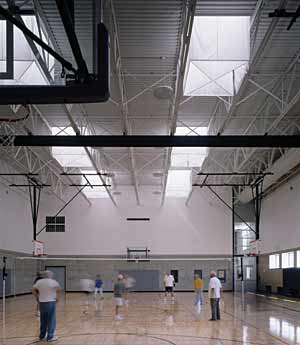
Southwest Community
Center Gymnasium, Seattle, WA
This gymnasium uses fabric skylight baffles
to diffuse glare and make electric lighting
unnecessary during daylight hours. Architect:
Weinstein A|U .
Photographer: Jamie Myers Forsythe |
|
|
Initial costs are traditionally the most important in school
construction budgets, but districts are increasingly focusing
on sustainability, as case studies prove incorporating sustainable
features into new K-12 schools can be realized within construction
budgets, thus providing a more effective learning environment
and saving resources. A sustainability measure increasingly
integrated into building design is the use of daylight as
a primary lighting element in classrooms, common areas, and
even gymnasiums. Design features such as light shelves filter
and reflect light to control glare and maximize diffuse natural
light during K-12 operating hours, which coincide with daylight
hours. Lighting controls, such as dimming ballasts, improve
the light distribution when daylight is insufficient, and
manage energy by turning off lighting by means of occupancy
sensors. Clients from K-12 schools are learning the advantages
of lighting controls such as energy savings and energy code
compliance, while seeking simple, low-cost solutions.
Benefits for incorporating daylighting
principles into schools grades K-12 are twofold: reduction
of energy consumption and costs by greater reliance on natural
light, and improved human performance.
Schools typically relied on daylighting as the primary source
of illumination before fluorescent lighting became common.
The California Department of Education required daylighting
standards in school construction, so that all California classrooms
built to handle the postwar baby boom in the 1950s and early
1960s were examples of daylit schools. The "Finger Plan"
schools with rows of single classrooms with exterior corridors
on both sides became a standard for grades K-12. However,
in the late 1960s, air conditioning became common and school
design changed. Classrooms were designed with less glass and
lower ceilings, and rooms were grouped together in tighter
configurations, without solar orientation in mind. The finger
plan school design was largely abandoned, and many of the
classrooms built since then do not have daylighting, and some
rooms have no windows at all.
School districts across the country are experiencing K-12
construction starts in the first half of 2005 averaging four
percent higher than the same period in 2004. $15.6 billion
in constructions starts have begun to address overcrowding
and inadequate facilities by constructing or renovating school
buildings. The need for new facilities will continue to increase,
according to Engineering News-Record and McGraw-Hill Construction
Research & Analysis, especially in southern regions of
the United States experiencing increases in school age populations
due to relocation and immigration.
Southwest Community
Center Gymnasium, Seattle, WA
This gymnasium uses fabric skylight baffles
to diffuse glare and make electric lighting
unnecessary during daylight hours. Architect:
Weinstein A|U .
Photographer: Jamie Myers Forsythe |
|
|
Initial costs are traditionally the most important in school
construction budgets, but districts are increasingly focusing
on sustainability, as case studies prove incorporating sustainable
features into new K-12 schools can be realized within construction
budgets, thus providing a more effective learning environment
and saving resources. A sustainability measure increasingly
integrated into building design is the use of daylight as
a primary lighting element in classrooms, common areas, and
even gymnasiums. Design features such as light shelves filter
and reflect light to control glare and maximize diffuse natural
light during K-12 operating hours, which coincide with daylight
hours. Lighting controls, such as dimming ballasts, improve
the light distribution when daylight is insufficient, and
manage energy by turning off lighting by means of occupancy
sensors. Clients from K-12 schools are learning the advantages
of lighting controls such as energy savings and energy code
compliance, while seeking simple, low-cost solutions.
Increased Student Performance
A 1999 study funded by the Pacific Gas & Electric Company
and completed by Heschong-Mahone Group found that students
get higher test scores when they learn in classrooms illuminated
by daylight. This study of the correlation between daylight
availability and test scores showed that natural daylighting
in schools resulted in documented increases in student performance
regardless of school design and climate. Three elementary
school districts (Orange County, California; Seattle, Washington;
and Fort Collins, Colorado) were studied. In Orange County,
controlling for all other factors, students with the most
daylighting in their classrooms progressed 20 percent faster
on math tests and 26 percent faster on reading tests in one
year than those students in classrooms with the least daylight;
students in classrooms with the largest window area progressed
15 percent faster in math and 23 faster in reading than those
with the least window area. In Seattle and Fort Collins, students
in classrooms with the most daylighting had tests scores seven
to eighteen percent higher than students in classrooms with
the least daylighting. The authors conclude that there is
a valid and predictable effect of daylighting on student performance.
Reduction of Energy Consumption
A white paper by Vivian Loftness, FAIA, titled Improving
Building Energy Efficiency in the U.S.: Technologies and Policies
for 2010 to 2050 (2005) lists the combination of daylighting
and natural ventilation as one of the five most important
directions for energy conservation in the following half century.
"More than ten percent of all U.S. energy is used for
lighting buildings, much of this during the day when daylight
is abundant…. Effective daylighting can yield 30-60 percent
reductions in annual lighting energy consumption, with average
energy savings for introducing daylight dimming technologies
in existing buildings at more than 30 percent…. Research
using an advanced electric lighting control system has found
that daylight-linked control systems can bring about sustainable
reductions of 30−41 percent in electrical energy for
an outermost row of lights in a perimeter zone, and 16−22
percent for the second row of lights."
Code Compliance
Energy efficiency is rapidly becoming the design requirement
of the new millennium. Many states and cities have already
adopted specific energy-saving guidelines. The following are
examples of codes and standards that are being instituted
in the United States:
- American Society of Heating, Refrigerating and Air-Conditioning
Engineers/Illuminating Engineering Society of North America
(ASHRAE/IESNA): This standard encourages the use of energy
efficient-lighting controls in design practice for both
interior and exterior lighting. Most states have or will
adopt energy codes based on the standard.
- Leadership in Energy and Environmental Design (LEED):
Efficient lighting controls may contribute to obtaining
up to 22 points in five of six LEED credit categories. A
minimum of 26 points is required for Leadership in Energy
and Environmental Design certification. LEED is a rating
system sanctioned by the United States Green Building Council
(USGBC) that provides a national standard for what constitutes
a green building.
- Title 24: California's building efficiency code (along
with those for energy-efficient appliances) has saved more
than $36 billion in electricity and natural gas costs since
1978.
Architectural Features
Daylighting control principles have two major requirements:
directing diffuse daylight delivery into interior spaces and
the control of electric lighting output in response to the
available daylight. An integrated approach must be conceived
from the beginning of the project including building siting
and orientation, window and/or skylight design, and lighting
and shading control systems design, as well as ongoing maintenance.
Daylight, electric lighting, and shading systems cannot be
considered separately because daylighting affects electric
lighting use and has the potential of introducing direct sunlight
and glare that may be uncomfortable for building occupants.
This requires cooperation between architects and lighting
engineers. Daylight, electric lighting, controls and building
design features must be seen as an integral part of the overall
energy optimization program.
Building form and orientation can be designed to capture
more daylight opportunities. The floor plan configuration
should maximize the perimeter daylight zone. This may result
in a building with a higher skin-to-volume ratio than a typical
compact building design. Other examples of design elements
used in effective daylighting include light shelves, glazing
modulation, and light monitors. A standard window can produce
useful illumination to a depth of about one and one-half times
the height of the window. As a general rule-of-thumb, the
higher the window is placed on the wall, the deeper the daylight
penetration. With lightshelves or other reflector systems
this can be increased to two times or more. A light shelf
is a horizontal light-reflecting overhang placed above eye-level
with a transom window placed above it. This design, which
is most effective on southern orientations, improves daylight
penetration, creates shading near the window, and helps reduce
window glare. Exterior shelves are more effective shading
devices than interior shelves. A combination of exterior and
interior shading devices will work best in providing an even
illumination gradient. Carefully select and detail glazing
and location and design of window openings. Glazing specification
depends on the exposure; Low E glazing with light transmission
of 50 percent should be used on the vision panels with 68
percent or greater transmission on glazing above the light
shelf. No light shelves or shading devices, and all 68 percent
or greater light transmission glazing should be used on the
north side.
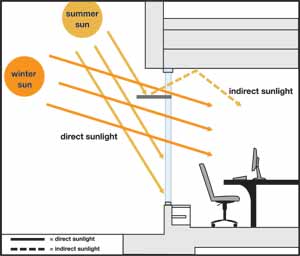
Section through
exterior wall showing light shelf, Clackamas
High School, Portland, OR: This section indicates
daylight bouncing off light shelf onto ceiling,
diffusing light throughout the space. |
|
|
Light monitors can follow an east-west axis to maximize exposure
to the southern sun. Top-lighting provides interior light
that is significantly different from that provided by windows:
it can provide relatively uniform light distribution throughout
a space, and it is often easy to integrate with electric lighting
because light originates from the ceiling in both cases. Roof
monitors can be designed to admit daylight and sunlight, although
sunlight is difficult to control and best avoided; a roof
aperture should be between four to eight percent of the floor
area. Shape the roof monitor to admit only daylight from the
north. Splaying walls and using matte white reflecting surfaces
around the monitor improves light distribution and reduces
glare. Using diffusing glass gives better distribution of
light if a view of the sky is not critical. Horizontal skylights
may result in excessive solar gains in summer. Brighter sky
visible through skylights can also cause glare problems. In
addition to maximizing the penetration of diffuse light, the
building features must diffuse or block direct rays of the
sun. Glare and overheating from the sun's direct rays
inhibits the performance of visual tasks in classrooms, offices
and other similar spaces. In order for spaces to be considered
daylit, The USGBC LEED Standard requires that no direct sunlight
be admitted to critical task areas.
Control of Electric Lighting Output
Control of electric lighting output saves energy and improves
the overall distribution of light when daylight is insufficient.
A building designed for daylighting but without an integrated
electric lighting system may even be a net energy loser because
of the increased thermal loads. Only when the electric lighting
load is reduced will there be more than offsetting savings
in electrical and cooling loads. The benefits from daylighting
are maximized when both lighting and occupancy sensors are
used to control the electric lighting system. Combining lighting
control strategies enhances building performance: Using occupancy
sensors, daylight sensors, and time clocks with fluorescent
dimming can help manage the lighting in an entire building
and further reduce electric demand. Energy savings result
when sensor and control technologies are employed in each
classroom; maintenance is reduced because of less wear and
tear on fixtures from using dimmers rather than on/off switches;
and student productivity is increased through use of daylight
and exact light levels for task needs.
| Common
School Lighting Control Functions |
Benefits |
|
Daylight Sensors and Dimming
Ballasts
|
Reduced
energy use
Even
light level throughout classroom
Non-distracting
light level changes
Increased
productivity
|
|
Occupant sensing
|
No wasted energy when classrooms
are empty
|
| Dimming
wall controls |
Saved scenes
for various presentation and computer/ classwork needs |
|
Table 1
|
Options for common school lighting control functions in classrooms,
common areas, and other types of school areas can provide
significant benefits. (Table 1.)

Mt. Angel high
performance prototype classroom, Mt. Angel,
OR: A rectangular suspended device dubbed
"the halo" is made of translucent
material that reflects part of the light onto
the ceiling and walls, while letting part
of the light into the room. Design team: BOORA,
SOLARC, Prof. Charlie Brown of the Seattle
Daylighting Lab, and SRG Partnership |
|
|
New installations and retrofits require different approaches.
With a new installation, performance targets can be set and
a light source and shading device can be chosen based on economic,
ergonomic, and technical considerations, e.g., an acceptable
payback period. With existing installations, choices will
be limited by the building constraints, the availability of
daylight, and the lighting controls used.
Modeling Daylight in Interior Spaces
Joel Loveland, director of the Seattle Daylighting Lab, oversees
his group's consultations with architects and lighting
designers to shape school designs for maximum daylighting
capability. The consultants prioritize daylighting as a building
design goal, while working with the budget and programmatic
requirements. Some of the design principles of the Daylighting
Lab are:
- Treat the building as a luminaire.
- Separate the vision and daylight glazings.
- Position the daylighting apertures to create mood and
visual focus.
- Address the requirements of the visual task.
- Integrate the daylighting system with the architecture.
- Integrate the daylighting system with the other building
systems.
The Daylighting Lab uses modeling to predict exact natural
lighting levels so that electric lighting and controls can
be specified to work with and complement the daylight.

Cafeteria, Clackamas
High School, Portland, OR: The cafeteria uses
virtually no electric light.
Architect: BOORA |
|
|
Prototype Classroom
A high performance prototype classroom in Mt. Angel, Oregon,
created through the combined efforts of many experts and design
firms, including BOORA, SOLARC, Prof. Charlie Brown of the
Seattle Daylighting Lab, and SRG Partnership seeks to light
a classroom during daylight hours without any electric light,
with minimum cost. Electric light was added for the infrequent
occasions when the classroom was used at night, but the large
skylight opening on the ceiling distributes light to the entire
classroom. A rectangular suspended device dubbed "the
halo" is made of translucent material that reflects part
of the light onto the ceiling and walls, while letting part
of the light into the room. The edges of the room receive
two sources of light, from the reflection and the direct light.
This prototype is designed for single story ground floor buildings
in moderate climates but the model could be adapted into two
story buildings with light shafts, and other region and climate
types.
Clackamas High School, Portland, OR
BOORA, Portland, OR, has developed successive daylit schools
grades K-12 including Ash Creek Intermediate School, Monmouth,
OR and Clackamas High School, Portland, OR. Most buildings
spend more on cooling than on heating, so daylighting principles
in schools typically focus on bringing in light rather than
heat. In the case of Clackamas High School (completed in 2002
for $127.71 /s.f.) control of daylight was accomplished using
light shelves and shading devices. Light bounces off the top
of the light shelf into the ceiling of the first floor spaces.
The overhang shades the window below it. This allows a higher
visible transmittance glazing in the daylight aperture if
it is out of normal sight lines. Since the ceiling is the
most important light-reflecting surface, using this surface
to bounce daylight deep into the room can be highly effective.
Both of these strategies are utilized in light shelf designs.
Rooms in this facility use occupancy sensors, timers and daylight
sensors to control output of electric light. Two rows of suspended
T-5 fixtures running parallel to exterior windows are used
for supplemental lighting, with the inner row on dimming ballasts.
Ceilings are shaped to reflect light more evenly throughout
rooms. The cafeteria uses virtually no electric light yet
offers a variety of light and dark options for students through
means of mechanized window shades. (Figure 4.) Heinz Rudolph,
FAIA, principal of BOORA, states, "When everything is
said and done a building needs a mixture of daylight and electic
light, and good control devices."
|
About Lutron
|
| Lutron Electronics Co., Inc., (www.lutron.com)
headquartered in Coopersburg, Pennsylvania, is the
world's leading designer and manufacturer of lighting
controls, lighting control systems, and shading
solutions for residential and commercial applications. |
|
|
|
Dimming Ballasts
Dimming fluorescent lighting instead of repeated switching
helps to maintain lamp life. Dimming also saves electricity
and reduces the demand on HVAC systems. Lighting output is
adjusted to predetermined levels set during the commissioning
process. A dimming unit smoothly varies the light output of
electric lights by altering the amount of power flowing to
the lamps. If daylight is less than the target illuminance,
the control increases the lighting to provide the right amount
on the work plane. Dimming controls in some situations save
more energy than switching if they are linked to daylight
and if lamps are dimmed at the start of their lifetimes to
compensate for their increased output. Dimming controls are
less obtrusive to occupants than switching, but a manual override
is recommended in areas where occupants expect to have control.
Switches can also used instead of dimmers, but this is not
recommended except for limited applications because they are
more obtrusive and may use more energy than dimming switches.
High frequency dimming produces the greatest savings in all
but the most well daylit rooms. A problem with photoelectric
switches is rapid switching on and off when daylight fluctuates
around the switching illuminance. This can annoy occupants
and reduce life. Various techniques have been developed to
reduce the amount of switching. Multi-level switching control
uses two switching illuminances, one at which the lights are
switched off and another, lower illuminance level at which
the lights are switched on. Photoelectric switching with a
time delay can also introduce a delay in the switching process.

Dimming ballasts
replace non-dim ballasts in fluorescent fixtures,
improving the energy performance and flexibility
of any space. |
|
|
Dimming is important because the human eye responds to low
light levels by enlarging the pupil, allowing more light to
enter the eye. This response results in a difference between
measured and perceived light levels. A lamp that is dimmed
to ten percent of its maximum measured light output is perceived
as being dimmed to only 32 percent. Likewise, a lamp dimmed
to one percent is perceived to be at ten percent. Descriptions
of different levels of dimming follow:
- One percent architectural dimming provides very fine light
level control to users for aesthetic effect or for very
stringent lighting or audiovisual design criteria. Architectural
spaces often have a strong focus on aesthetics and comfort,
creating an environment that portrays class and distinction.
Architects and designers create these spaces for maximum
versatility and require subtle control of the lighting.
Room types: theater, auditorium, lobby
- Five percent high performance dimming offers energy savings,
aesthetic appeal, and space flexibility, allowing users
to operate their lights at 100%, 5%, and anywhere in-between.
Room types: meeting rooms, classrooms.
- Ten percent lighting management dimming works well for
a classroom, cafeteria, or office lighting application.
To maximize the benefits of a lighting management system,
use dimming ballasts. Ten percent dimming is ideal for use
in any space where saving energy is a primary goal. Room
types: most spaces including classroom, library, cafeteria,
meeting room, graphic art workstation, office, corridor/stairwell,
utility room, restroom
Manual dimmers are available for incandescent, fluorescent,
and certain high-intensity discharge (HID) sources. Both step
and continuous dimming are available for incandescent fixtures.
Multiple dimming methods are available for both fluorescents
and HIDs, though HID dimming is limited by color rendition
and flicker problems. Experience has shown that manual controls
are not used effectively. Many occupants leave electric lighting
on once it is switched on even if the illumination from daylight
is at a level that would be considered adequate if the occupant
were entering the space. Today, there are a number of light
control systems that can cap the maximum light level provided
by a manual dimmer, reducing the electricity used when lights
are left on. Energy savings cannot be realized in daylit buildings
unless the electric lights are dimmed or switched in response
to the amount of available daylight. The energy savings achieved
with daylight-responsive lighting controls will depend on
the daylight climate, the sophistication of the controls,
and the size of the control zones. An evaluation of currently
available responsive control systems is presented in the International
Energy Agency Solar Heating and Cooling (IEA SHC) Application
Guide. This evaluation has shown that daylight-responsive
systems used up to 40 percent less than non-controlled systems.
Cooling load reductions have also been noted, which can save
an additional two to three percent of electrical energy consumption.
Savings can be larger than 40 percent especially in toplit
spaces. In hot climates, the cooling savings can also be larger.
Photoelectric Light Sensors
A key element of all types of photoelectric control is the
sensor, which detects the presence or absence of daylight
and sends a signal to a controller that will adjust the lighting
accordingly. Threshold on and off values can be set to respond
to specific lighting conditions. These sensors can operate
on/off switching of various luminaires or lamps within luminaires
and they can also operate a continuous dimming system. Continuous
dimming system may cost more than switching systems but they
have greater user satisfaction because the change in lighting
levels is not as noticeable. Added labor costs for additional
wiring and circuits necessary for switching may increase the
initial cost of a switching system.

Photosensors, also
known as daylight sensors, monitor the amount
of daylight present in a space. Daylight sensor
shown above in actual size. |
|
|
The location of the sensor is important because it influences
the type of control algorithm used. The photoelectric cell
or sensor is often located on the ceiling and is calibrated
on site to maintain a constant illuminance level. A single
sensor that dims large areas can cause problems if buildings
or trees overshadow some parts of the interior space. It has
been found that with innovative daylighting systems such as
light shelves, a partially shielded sensor (shielded from
the window only) is not susceptible to sky conditions and
direct light from the window. A controller is located at the
beginning of a circuit (normally the distribution board or
the ceiling space) and incorporates an algorithm to process
the signal from the photosensor and convert it into a command
signal that is received by the dimming or switching unit.
Photosensor-activated dimmers may be the most important dimming
technique. It matches the available natural daylight and lighting
system output to produce consistent illuminance. Electronic
or other dimming ballasts allow for control of the light level.
These systems require careful integration of control systems
and sensors.

Occupancy sensors
turn lights off when rooms are empty. Dual
technology ceiling mount occupancy sensor
shown. |
|
|
Occupancy Sensors
Occupancy sensors detect when a space is occupied by using
passive infrared, ultrasonic, or a combination of the two
technologies. Once the heat or movement of the occupant is
no longer detected, and after a preset delay time, the sensor
will emit a signal to extinguish the lights. Occupancy sensors
used alone are good for low or intermittent use areas such
as storage rooms, restrooms, private offices, and corridors.
Sensors can be installed at a wall switch, wall mounted, ceiling
mounted, or recessed in a pendant fixture depending upon preference
and room layout.
Integrated Systems Software
Integrated systems software integrates environment sensors,
such as daylight and occupant sensors, with personal controls,
such as wall controls and infrared remotes. With 60 percent
of energy use in schools going to lighting, the combined effect
of multiple environment sensors and personal controls operating
together brings energy savings to spaces that previously had
none. Ballasts can be flexibly programmed, instead of wired,
to work individually or as a group. This eliminates the need
for an area to be rewired when changes take place, creating
flexibility in a space that adjusts to shifting needs. Control
software reduces lighting system maintenance. All of the environment
sensors and personal controls connect directly to a ballast,
removing interfaces, power packs, and control devices that
on other systems require more parts, programming and maintenance.
Researchers have found that physical and perceived performance
of a daylight control system can differ. If the user finds
the environment created by the system to be uncomfortable
or disturbing in any way (abrupt on-off switching), the system
is likely to be rejected or an attempt will be made to compromise
it. Energy savings are therefore directly related to a system's
acceptance and proper operation by the user. Hard-to-operate
systems are likely to be compromised. In addition, inappropriate
ambience can result in rejection of the system. View aesthetics
are also an important consideration. Users often do not accept
daylight without view. In addition, the quality of light is
important as is the avoidance of high contrasts and absolutely
uniform lighting.

Typical layout
of control devices in a classroom. |
|
|
An important but often overlooked aspect of control installations
is the training of maintenance personnel and building occupants
in the operation and purpose of a daylight responsive control
system. Although most manufacturers provide technical support
during and for a period following installation of their systems,
it is easier and more economical if those managing and occupying
the building can address most problems. Building and facility
managers need to be aware of how to operate the system and
adjust it. They need to understand the system's performance.
Building occupants should receive information about the purpose
of the system.
Fluorescent lighting systems are the most common daylight
control lamp source because of the availability of step switching
and dimming systems. HID sources are typically not a good
choice for daylight switching or occupancy sensors because
of the extended strike and re-strike times. There are now
two-step HID sources available that may be useful in some
step switching applications where the "off" mode
is not desired during a typical day. A daylighting design
will use both occupancy and light sensors. With these two
control strategies the lights will come on only when the room
is occupied and only if there is insufficient daylight. In
most designs, a manual override is provided for user convenience.
Modeling Daylighting
Physical models are a very effective way to analyze daylighting
performance. Even simple models can begin to inform the designer
of how daylight will behave in the building. It is important
that the daylight apertures be accurately modeled and that
the materials used to construct the model have the designed
reflectance values. The model can then be tested on the actual
site or under artificial sky conditions in a daylighting laboratory.
A sundial with the appropriate latitude attached to the model
base allows the designer to simulate various dates and times
of the year. Computer analysis is another method of testing
a daylighting solution. Typically a three-dimensional digital
model is constructed using computer-aided design software
that is then imported into the lighting software. The programs
then require the operator to define all surface characteristics,
sky conditions, location, and date and time. Many of these
programs can produce photorealistic renderings of the proposed
design.
To make informed decisions about the technology most appropriate
for a space, designers must understand the daylight characteristics
of that space. The physical daylight model is one of the most
fundamental and useful tools for assessing and predicting
daylight levels and qualities. One method of measuring and
reporting a design's performance is in terms of daylight factors.
A daylight factor is the amount daylight inside a space expressed
as a percent of available exterior daylight. Photocells (light
sensors) and a data acquisition system are used to measure
daylight factors. Up to seven photocells are placed at strategic
locations within the model measure interior light levels while
a reference photocell placed on the model's roof measures
available daylight. The value measured at each interior photocell
is divided by that at the exterior reference value to determine
daylight factors. The same equipment can also be used to measure
absolute illuminance levels in lux and footcandles. Daylight
distribution and absolute illuminance are not solely dependent
upon building properties such as geometry, glazing selection,
and the finish of interior surfaces. Exterior conditions including
ground reflectance and horizon obstructions such as buildings
and vegetation also influence interior lighting characteristics.