This CE Center article is no longer eligible for receiving credits.
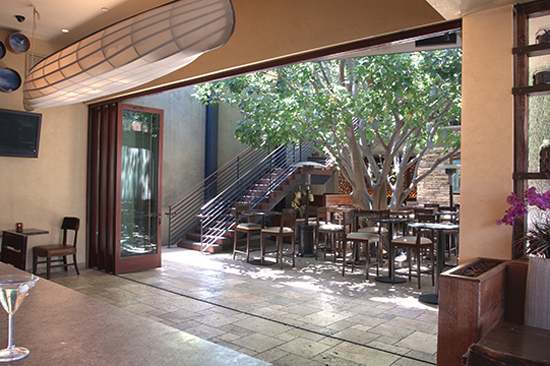
Photo courtesy of LaCantina Doors
At the Rockwell VT in California a clad glass folding door system provides the flexibility to have all seven panels open, or closed, with just the daily door providing access.
Hotel/Resort
With destination properties competing for return guests, those with upscale features, memorable views, and expansive spaces have an advantage. For resort and hospitality properties, folding door systems can create large indoor/outdoor areas that enable users to enjoy the surroundings. With unobstructed views. Guest rooms, suites and villas, outdoor cabanas, and high-rise balconies can all be outfitted with folding doors.

Photo courtesy of LaCantina Doors
At the Palms Place Hotel and Spa, a folding door system connects the Simon Restaurant and Lounge to the pool and spa areas.
At one of Las Vegas' hippest and most popular resorts, the Palms Place Hotel and Spa, a folding door system was used in the Simon Restaurant and Lounge. The concept was to connect the outdoor pool and spa area to the restaurant, with a clad folding door system chosen to reflect the elegant and open feel of the lounge and restaurant.
Showrooms
Glass is an ideal backdrop to showcase products, and has been incorporated in a number of showrooms as owners seek the flexibility and upscale visual aesthetic of glass door systems to reflect their corporate culture. The Lexus dealership located in Macon, Georgia, for example, wanted to encompass its mission statement—“relentless pursuit of perfection”—in the design of its showroom. The Lexus Covenant directs and guides the dealership to “treat each customer as we would a guest in our home.” David Gibson of Butler Lexus wanted his customers to feel at home from the minute they walked in the front doors to the second they drove off the lot. An all-aluminum folding door system helped achieve the goal. “The doors gave our vehicle delivery room a great feel of being in an atmosphere of a high-end home as opposed to a traditional dealership with roll up doors,” says Gibson. “The vehicle delivery home represents the end of a journey for our customers as they complete their luxury car buying experience. The end of the journey should leave a lasting impression. When the customer walks in, sees their new luxury automobile, and drives out through the opened doors, the world of driving and experiencing their new automobile opens up before them.”

Photo courtesy of LaCantina Doors
An all-aluminum folding glass door system gives Lexus dealership customers a feeling of being in a high-end home.
Educational
Traditional classrooms were designed with desks facing a blackboard in front of the room, but that paradigm has changed. Today's schools value and require flexibility, and spaces must frequently be modified to accommodate changes in enrollment, curriculum, or teaching style. Transforming one large open room to multiple class rooms offers a flexible multi-purpose interior solution. Folding glass doors can make better use of interior spaces or can create large open spaces for not only for schools, but for libraries, and museums as well.
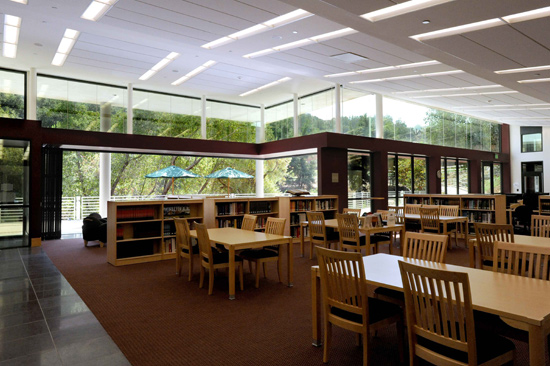
Photo courtesy of Kalban Architects
At the Viewpoint School in Calabasas, California, Kalban Architects used a folding glass system to admit maximum natural light.
Interior Dividers
As interior dividers in commercial spaces, folding door systems have extensive applicability. Flush guide tracks allow for a smooth transition between rooms, offices, conference rooms and meeting rooms. In San Francisco, flexibility was key to the design of the Dutch Consulate public spaces, and the functional requirement for multiple uses within the public suite was a basic planning principle for the space. In looking at a movable wall solution for the main multi-purpose room, it was important that a high level of finish and refinement in detail be integral to the selected product, and that it continue the design vocabulary through its incorporation into the main conference meeting space. “The clean, minimal detailing of the door frame, glazing, and hardware, combined with the unobtrusive floor and ceiling tracks, reinforces the minimal, international design vocabulary, while providing the ability to quickly modify the space through concealing the door in a relatively small enclosure at one side of the room,” says Charles Uehrke, Project Director, Huntsman Architectural Group, who notes that the scenario has held up in practice. “The frequency of modifying the space use, through the opening and closing of the doors, required a high level of quality in fabrication and materials of the doors. The doors have proven themselves, over and over again, to hold up to the demands of the client's changing meeting needs and perform effortlessly in their ease of reconfiguration,” he adds.

Photo courtesy of LaCantina Doors
Aluminum glass folding doors provided flexibility that was key to the design of the public spaces at the Dutch Consulate in San Francisco.
With some 90 percent of Americans spending most of their days indoors, one of the most salutary things an architect can do for a building is to open it up to the outdoors and natural light. Whether interior or exterior, folding glass doors represent an advantage to commercial properties in several respects: They bring richness and light to a room; they maximize space by opening a room up to the outdoors, or by reconfiguring interior areas; and they increase a building's energy performance and green building quotient. Today's profiles feature maximum glass and minimal frames, enhancing these benefits while creating a clean, crisp modern look. This article will discuss available options in glass folding doors for commercial projects, and address their performance characteristics in terms of energy efficiency, impact resistance, and sustainability. Also discussed will be ways in which glass folding doors can contribute to the health, safety, and welfare of building occupants, and new options in meeting requirements of the Americans with Disabilities Act (ADA).
Commercial Applications
The purpose of folding glass doors is to connect the indoors and out by eliminating walls, to admit natural daylight into a building, and to reconfigure interior space for greater efficiency and flexibility. Both interior and exterior glass folding doors have long been used for these purposes to enhance a variety of commercial spaces.
Restaurant/Retail
For many restaurants and retail establishments, a folding glass door system provides a unique opportunity to maximize valuable and costly commercial space in a dramatic design element. The California-style, Rockwell VT restaurant, located just outside Hollywood, needed to open its first-level bar to a courtyard that is home to a huge oak tree. A clad glass folding door system provided the necessary flexibility. With seven panels, all doors can be shut with just the daily door providing access. Alternatively, all panels can be open, giving the bar a seamless transition from inside to out and allowing bar goers room to move around. “In California we have a wonderful climate all year round, and these doors provided our customer the ability to make an indoor space immediately expand by including a patio, deck, or just the outdoors in that space through the opening of a door,” says Claire Taylor, of Taylor Brothers Architectural Products. “The product configuration choices, by having single operating doors as well as the ability to open up the full wall, make this a very exciting product for us and extremely popular as well.”
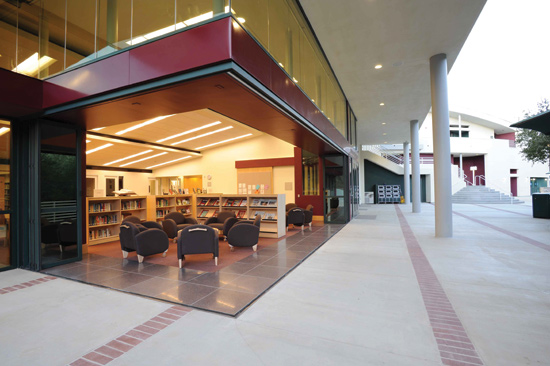
Photo courtesy of Kalban Architects
Folding glass doors connect interior spaces with the outdoors. At the Viewpoint School in Calabasas, California, Kalban Architects used a zero post corner system to completely open up the Fletcher Family Library to the courtyard when desired.
Photo courtesy of LaCantina Doors
At the Rockwell VT in California a clad glass folding door system provides the flexibility to have all seven panels open, or closed, with just the daily door providing access.
Hotel/Resort
With destination properties competing for return guests, those with upscale features, memorable views, and expansive spaces have an advantage. For resort and hospitality properties, folding door systems can create large indoor/outdoor areas that enable users to enjoy the surroundings. With unobstructed views. Guest rooms, suites and villas, outdoor cabanas, and high-rise balconies can all be outfitted with folding doors.
Photo courtesy of LaCantina Doors
At the Palms Place Hotel and Spa, a folding door system connects the Simon Restaurant and Lounge to the pool and spa areas.
At one of Las Vegas' hippest and most popular resorts, the Palms Place Hotel and Spa, a folding door system was used in the Simon Restaurant and Lounge. The concept was to connect the outdoor pool and spa area to the restaurant, with a clad folding door system chosen to reflect the elegant and open feel of the lounge and restaurant.
Showrooms
Glass is an ideal backdrop to showcase products, and has been incorporated in a number of showrooms as owners seek the flexibility and upscale visual aesthetic of glass door systems to reflect their corporate culture. The Lexus dealership located in Macon, Georgia, for example, wanted to encompass its mission statement—“relentless pursuit of perfection”—in the design of its showroom. The Lexus Covenant directs and guides the dealership to “treat each customer as we would a guest in our home.” David Gibson of Butler Lexus wanted his customers to feel at home from the minute they walked in the front doors to the second they drove off the lot. An all-aluminum folding door system helped achieve the goal. “The doors gave our vehicle delivery room a great feel of being in an atmosphere of a high-end home as opposed to a traditional dealership with roll up doors,” says Gibson. “The vehicle delivery home represents the end of a journey for our customers as they complete their luxury car buying experience. The end of the journey should leave a lasting impression. When the customer walks in, sees their new luxury automobile, and drives out through the opened doors, the world of driving and experiencing their new automobile opens up before them.”
Photo courtesy of LaCantina Doors
An all-aluminum folding glass door system gives Lexus dealership customers a feeling of being in a high-end home.
Educational
Traditional classrooms were designed with desks facing a blackboard in front of the room, but that paradigm has changed. Today's schools value and require flexibility, and spaces must frequently be modified to accommodate changes in enrollment, curriculum, or teaching style. Transforming one large open room to multiple class rooms offers a flexible multi-purpose interior solution. Folding glass doors can make better use of interior spaces or can create large open spaces for not only for schools, but for libraries, and museums as well.
Photo courtesy of Kalban Architects
At the Viewpoint School in Calabasas, California, Kalban Architects used a folding glass system to admit maximum natural light.
Interior Dividers
As interior dividers in commercial spaces, folding door systems have extensive applicability. Flush guide tracks allow for a smooth transition between rooms, offices, conference rooms and meeting rooms. In San Francisco, flexibility was key to the design of the Dutch Consulate public spaces, and the functional requirement for multiple uses within the public suite was a basic planning principle for the space. In looking at a movable wall solution for the main multi-purpose room, it was important that a high level of finish and refinement in detail be integral to the selected product, and that it continue the design vocabulary through its incorporation into the main conference meeting space. “The clean, minimal detailing of the door frame, glazing, and hardware, combined with the unobtrusive floor and ceiling tracks, reinforces the minimal, international design vocabulary, while providing the ability to quickly modify the space through concealing the door in a relatively small enclosure at one side of the room,” says Charles Uehrke, Project Director, Huntsman Architectural Group, who notes that the scenario has held up in practice. “The frequency of modifying the space use, through the opening and closing of the doors, required a high level of quality in fabrication and materials of the doors. The doors have proven themselves, over and over again, to hold up to the demands of the client's changing meeting needs and perform effortlessly in their ease of reconfiguration,” he adds.
Photo courtesy of LaCantina Doors
Aluminum glass folding doors provided flexibility that was key to the design of the public spaces at the Dutch Consulate in San Francisco.
Performance Considerations
Though glass is a strong building material with the capability to stand up to extreme climatic conditions, architects should become familiar with the types of labels, certification, and third partying testing that verify quality and performance.
Testing and Certification
To judge the plethora of competing products, certifications have taken on added significance, particularly those from two key organizations. The National Accreditation and Management Institute, Inc. (NAMI) has established product testing and quality assurance validation programs, with the organization's certification and inspection process providing the buyer with quality assurance that the product that they are purchasing is the same product that was tested by an independent laboratory and will perform to the level which the test report reflects. NAMI specializes in fenestration and building envelope products which includes are but not limited to windows, doors and glazing wall systems. Preferred products should also be validated by the National Fenestration Rating Council (NFRC), which administers the only uniform, independent rating and labeling system for the energy performance of windows, doors, skylights, and attachment products.
Approved Impact System
Another consideration is whether the intended door system has been tested for hurricane impacts. This is critical particularly in areas subjected to high winds and major storms as impact rated systems provide superior extreme weather performance, protection, and safety. Stringent guidelines are placed upon products seeking approval under Florida codes, which have the strictest regulations in the United States. For use in these storm-prone areas, architects will want to assure that doors have been certified to meet the 2007 Florida Building Code requirements for all areas outside of the HVHZ, otherwise known as Miami-Dade and Broward Counties. A “DP” or “design pressure” rating is a numerical value that represents a building component's ability to withstand a given amount of wind load, with the higher the DP, the greater the resistance. DP ratings of 50 are necessary for use outside the HVHZ, and DP ratings of 70 must be achieved for glass folding systems to be used within that area.
It is also advisable to consider whether doors have met and exceeded the requirements of Miami Dade County approval using the designated test methods for the critical testing protocols to comply with requirements of the Florida Building Code including HVHZ and other wind-borne debris areas. These include:
-- Large Missile Impact
-- Uniform Static Air Pressure Loading
-- Cyclic Wind Pressure Loading
-- Water Infiltration and Resistance
-- Forced Entry
Other pertinent tests include the ASTM E 547 for water penetration; ASTM E-283 for air infiltration, and ASTM E-330 for structural performance.
Specification Considerations
In specifying a door system that is appropriate for a given project, several points must be considered, including size, threshold, frame material, and type of glass. For best results, architects should consider installation-ready systems, complete with frame, threshold, weather-stripping, doors, glass, hinges, rollers and multi-point lock and lever handle for the daily passage door. A wide range of products, materials, finishes, size and configuration exists to meet the needs of commercial spaces.
Door panels can be up to 39 inches wide; standard heights are seven to eight feet tall or can be “made to measure” up to 10 feet tall, without the need for horizontal mullions that detract from views. Narrow stile and rail profiles—as thin as 2-¾ inches—maximize the amount of glass in the door. Panels can be configured in a myriad of ways, with eight doors opening in each direction, and creating openings of up to 65 feet; wider applications can be customized to specific project requirements.
In general, folding glass doors can either be floor-mounted or top hung, the latter being the predominant method, with the top track carrying the weight and the floor track serving as guide. The frame must be secured to an adequate header that does not deflect down when the doors are installed or if there is any settling in the structure. The structural support required and header size depends on both the weight of the doors and also surrounding structural conditions. The maximum deflection of the header with the live load should not exceed the lesser of L/720 of the span and ¼ inch. Structural support for lateral loads (both wind load and when the panels are stacked open) must be provided. For example, with door panels 36 inches wide and 96 inches tall typically weighing approximately 110lbs each, engineered or steel beams are used as headers.
Standard threshold options incorporate a bottom guide, and weather-stop and weep systems designed to weather seal the assembly against air and water. The threshold height for this option is 115/16. Threshold options specifically designed to weather seal against extreme weather conditions may incorporate a bottom guide, weep system, and weather-stop that is 35/16 inches on the inside. To minimize the height of the weather-stop, the threshold and/or build up on the finished interior flooring can be recessed. As with the standard threshold option, it is important that the exterior surface level is lower than the weep-holes to enable proper drainage. Flush floor threshold options with a bottom guide only are common for commercial applications, and are recommended for interior applications or openings without weather exposure.
Frame styles are available to suit diverse space and climate requirements.
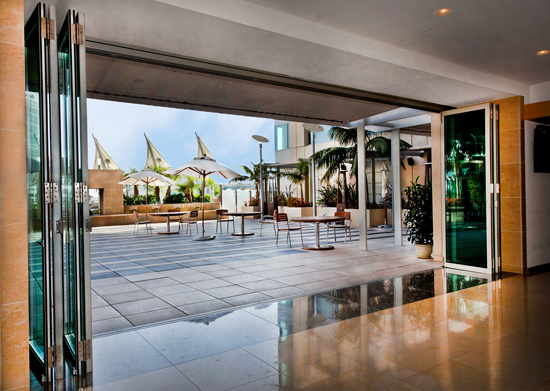
Photo courtesy of LaCantina Doors
At the Omni Hotel, sleek aluminum framed folding glass doors bring the outside in, and create a feeling of luxurious spaciousness.
Aluminum Systems
Aluminum systems have a clean design with some featuring a narrow 2¾ inch stile and rail profile, allowing for maximum glass and light. Suitable also for interior space dividers, the aluminum folding system can also offer strength and security through a concealed multi-point locking system. The basic configuration is an extruded aluminum panel wall thickness of up to ¼ inch, and single panels up to 10 feet tall. A 10-inch-tall bottom rail and low rise sill are suitable for commercial ADA requirements. Anodized white, clear and dark bronze aluminum rails and stiles match most aluminum windows, eliminate the need for finishing, and offer low maintenance.
Aluminum Thermally Controlled Systems
This system offers improved thermal performance suitable for climates where it is desirable to keep either the cold or heat out and the ideal temperature in, and where higher resistance to water and air infiltration is required. Featuring non-conducting thermal breaks throughout and narrow stile and rail profiles, aluminum thermally controlled systems are designed for optimal energy efficiency and structural performance that minimizes condensation build up and heat-cold transfer. European thermal struts create a non-conductive bridge between the outside and the inside of the door. Thicker panels (2-¼ inches) are suitable for high wind environments, and can include impact-rated features. A proprietary panel design by a leading manufacturer allows for split finish color options for the interior and exterior providing maximum design flexibility.
Impact Rated Systems
These systems are structurally sound for minimal panel deflection under high winds in HVHZ and other wind-borne debris areas. Typically offered with aluminum thermally controlled systems, the enhanced weather and safety features for air, wind, water and impact comply with stringent Florida building codes and for use in other wind-borne debris areas including Miami-Dade, the Carolinas, the Northeast and east coast, Texas, the Gulf of Mexico, and the Caribbean and Hawaiian islands. Impact rated systems generally incorporate additional hardware for maximum structural performance, laminated impact resistant glass, and optimal weather seals for water resistance.
Aluminum Wood Systems
Better suited to exterior environments than a solid wood door, an aluminum wood system features a low maintenance aluminum exterior with a natural wood interior. The hybrid panel construction typically consists of a 1¾-inch-thick extruded aluminum and ½-inch solid wood interior. Wood options are many and include vertical grain Douglas fir and mahogany, and others. Exterior surfaces can be powder coated to a range of colors, or finished for an all-wood look. An engineered aluminum panel construction creates strength and rigidity for panels over 8 feet tall.
Contemporary Clad Systems
A heavy-gauge extruded aluminum clad exterior combined with a solid laminated wood core construction and a natural wood interior facing, contemporary clad systems offer greater durability, energy efficiency, and the ability to withstand the elements, making this material an ideal solution for colder climates. These systems feature consistent-width narrower stile and rails, square or sculpted profile designs, and standard anodized and painted finishes combined with the warmth of a wood interior. Contemporary Clad systems complement a wider diversity of architectural styles and window packages compared to traditional clad systems and have better overall U-factors.
Wood Systems
Best for interior space dividers, wood systems lend a distinctive architectural style to a commercial space. Available in a range of wood species that are ready to seal, stain or paint, standard wood systems incorporate a 3⅝-inch stile and rail profile, with 7½-inch and 10-inch bottom rail options, and can accommodate custom panels from 1¾ inches to 2¼ inches thick. A solid laminated veneer lumber (LVL) wood core construction with simple flush bolt locking creates a traditional look.
Vinyl Systems
Designed to appeal to the needs of a broader market, vinyl systems perform well in all environments, match popular vinyl window packages, and are an ideal solution for home renovations and new construction. Door panels are extruded vinyl with an aluminum interior for structural integrity. Vinyl systems require no finishing, are low maintenance, and are energy efficient. Featuring high-quality contemporary styling and a narrow 215/16 stile and rail profile, a leading manufacturer’s vinyl system is setting a new standard in the vinyl door market.
Postless Corner System
A combination of two systems for a post-less or “zero post” corner application make for a distinctive addition to an office or commercial interior. Larger sizes and custom options including a window/door combination create a unique interior architectural feature.
Servery Window System
This is an ideal solution to maximize commercial spaces that require indoor/outdoor serving areas such as bars, restaurants and hotels. This innovative application requires no bottom track or sill to allow for a continuous countertop, providing the largest pass through opening. This unique servery window system eliminates the need for impractical window solutions such as casements and other window combinations that limit use and close off space.
Glass Types
A wide range of glazing options for improved thermal performance , safety protection, and privacy are available. Generally, low emissivity (low-e), insulated, tempered glass is used. Tempered glass is a strong glass that is heat treated and rapidly cooled to create a high compressive stresses which give the glass its added strength. The heat treatment process does not change the light transmission and solar radiant heat properties of the glass. Up to five times stronger than normal glass of equivalent thickness, tempered glass also provides greater thermal strength, and is more resistant to sudden temperature changes. It is difficult to break, though should breakage occur, tempered glass will break into small fragments without jagged edges, which reduces the likelihood of injury.
Most manufacturers provide a range of glass options, including tinted, obscure, frosted or colored opaque glass. Also available are laminated and triple glazed options with U values of 0 .30 or lower for hybrid aluminum/wood and aluminum thermally controlled, and wood systems that achieve high energy performance that meets the necessary and demanding energy codes found in the industry today in all geographic areas.
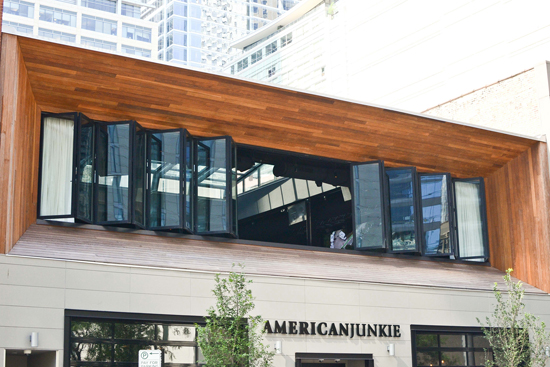
Photo courtesy of LaCantina Doors
An expanse of folding glass windows admits natural light that adds to the appeal and energy efficiency at American Junkie restaurant.
Glass and Green Building
Glass has long been a material of choice in the architectural community for its sustainability quotient, and can help achieve green building goals in the following areas.
Natural Daylighting and Views
Exterior glass doors admit natural light, which looks and feels better than artificial light, while lowering costs as well as representing a greener alternative. But even in cases of interior doors, glass will enable light to flow from one room to the other, minimizing shadows and darker areas. That natural light has a positive effect on building occupants has been borne out in extensive studies. The National Renewable Energy Lab's A Literature Review of the Effects of Natural Light on Building Occupants is a compendium of research that that indicates the salutary effects of natural light. The report states that daylight is preferable to cool white or energy-efficient fluorescent electrical light sources because “daylight…most closely matches the visual response that, through evolution, humans have come to compare with all other light” (Franta and Anstead 1994). The majority of humans prefer a daylit environment because sunlight consists of a balanced spectrum of color, with its energy peaking slightly in the blue-green area of the visible spectrum (Liberman 1991). According to Hathaway, et al. (1992), natural light also has the highest levels of light needed for biological functions.” The report goes on to site numerous studies confirming that natural light helps building occupants maintain good health, decrease stress, and increase productivity. Students achieve better test scores, better health, and better growth rates. In retail situations, day lighting allows better color rendering, which in turn, keeps customers in stores longer. In health care facilities, natural light has been associated with improved patient recovery rates and enhanced staff morale.
In addition to admitting natural light, glass permits views to nature, again creating a salutary effect borne out in research. Consistent with the concept of biophilia, which implies that humans have an instinctive bond between human beings and other living systems, experts assert that humans are “hard wired” to respond to nature, and architectural spaces that honor that connection evoke a visceral response. In its white paper, The Economics of Biophilia, Terrapin Bright Green posits an economic argument for biophilic design in the built environment. Among many studies that confirm the human response to nature, the white paper describes a research effort that documents peoples' reactions to natural scenes versus sterile office environments. Some 90 people were tested for heart rate recovery from low-level stress: 1/3 were shown a glass window with a view to nature, 1/3 a plasma screen with a view of the same setting, and 1/3 a curtained wall. Not surprisingly, the group with the view of nature had significantly higher restorative experience than the other two groups.
Perhaps more than many building components, fenestration products can lead the way in creating a space with maximum day lighting and the instinctive connection to nature and the world outside. Architects, in fact, have long known the positive impacts of a room with a view—whether it's a seascape or a cityscape. Figure: Caption: At the Villa Aquamare luxury beachfront 5 Star resort in Virgin Gorda BVI, each living room of the 8,000-square-foot villas feature a wood bifolding door system that opens up, creating unobstructed and breathtaking ocean views. At the appropriately named Linger Restaurant, located in Denver's Lower Highlands neighborhood, Boss Architecture specified an aluminum bifold system that provides striking views into downtown Denver, that diners can't help but savor. “This system is one of a select handful of products that we've found has the ability to completely transform space, and significantly impact projects for the better, ... all within a very reasonable price point,” says Kevin Stephenson, BOSS Architecture.
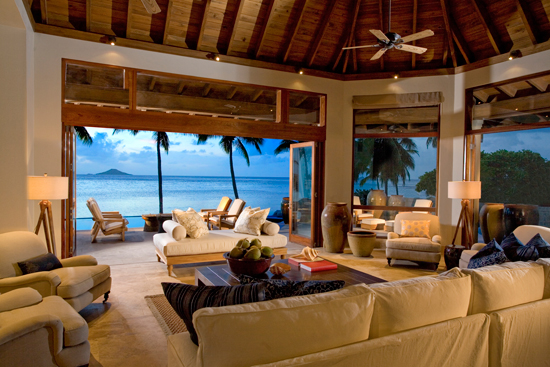
Photo courtesy of LaCantina Doors
At the Villa Aquamare luxury beachfront villas, the five-panel mahogany wood system nearly over 16 feet wide and featuring a 3L/2R configuration, enabled breathtaking views.
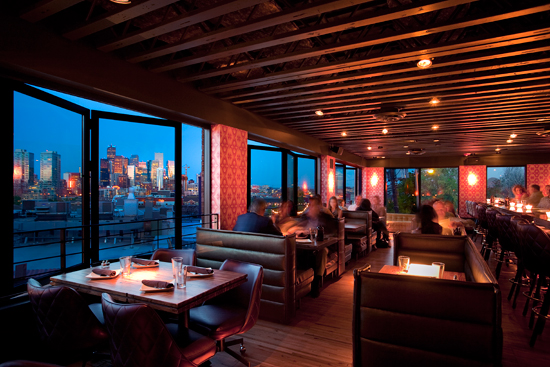
Photo courtesy of LaCantina Doors
At Denver’s Linger Restaurant, a folding fenestration system enables diners to enjoy compelling views along with farm to table cuisine.
Maximum Use
Building size is a key determinant of energy use and resource efficiency. With today's focus on efficient buildings with smaller footprints, flexibility to improve functionality is a significant design criteria. Properly placed fenestration can work to “do more with less,” in terms of both enhanced space considerations and achieving design and marketing objectives, as evidenced at the Redwood Restaurant, located in the heart of downtown Bethesda, Maryland's shopping district. In recognition of its traditional American cuisine and European-style views, the restaurant's owner and architect incorporated a bifold clad-wood fenestration system into the complete wall that faces the retail node, opening up the restaurant to the European cobble stone street and attracting prospective customers all while maintaining the traditional American modern ambiance for diners to enjoy. “Redwood's enormous front windows, cracked open in good weather, capture a lounge that looks like a cocktail party you want in on and a dining room that has California written all over it,” says Architect Griz Dwight of GrizForm. The restaurant won the 2008 AIA Merit Award for Interior Architect, Washington, DC chapter.
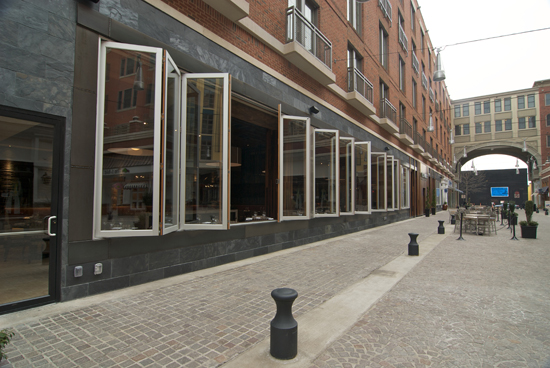
Photo courtesy of LaCantina Doors
A bifold fenestration system opens up Bethesda’s Redwood Restaurant to prospective customers while enhancing the dining ambience.
Local Manufacturing
With numerous glass manufacturers located across the United States, architects are able to source products in close proximity to project sites. Regional sourcing is well known as a key contributor to green design, as it minimizes fuel and transportation costs normally associated with importing products from distant locations or areas outside of the United States
Recycled Packaging and Materials
Some glass folding doors are available with a certain percentage of recycled material and, at the end of their service life, easily dismantled and re-used elsewhere. All-aluminum systems in particular feature a highly renewable material that can eliminate the use of all-wood components when appropriate. Packing and shipping with recycled materials reduces scrap and construction site waste.
Fresh-Air Ventilation
A critical aspect of green design involves indoor air quality that creates healthy living environments. According to the Whole Building Design Guide, a program of the National Institute of Building Sciences, “natural ventilation has become an increasingly attractive method for reducing energy use and cost and for providing acceptable indoor environmental quality and maintaining a healthy, comfortable, and productive indoor climate rather than the more prevailing approach of using mechanical ventilation.” The guide maintains that as an alternative to air-conditioning plants, natural ventilation can save up to 30 percent of total energy consumption in favorable climates and buildings types. Folding glass doors promote natural ventilation, opening up areas typically blocked for walls. In the full, or even the partial open position, they provide natural ventilation that can aid in whole building air circulation, bringing clean and fresh air into any structure, with associated decreased demand for mechanical methods.
Minimal Maintenance
Another benefit of glass doors and partitions is durability and minimal maintenance. Glass does not rust, corrode, or rot, nor does it collect dust. A minimal maintenance program keeps costs down for owners of commercial properties, and eliminates the use of harsh chemicals often used in routine cleaning programs.
Contribution to LEED Projects
Folding glass doors contribute to achieving points in the U.S. Green Building Council's Leadership in Energy and the Environment (LEED) program, the pre-eminent green building rating system in the United States today. Points can be earned in the following categories: Energy and Atmosphere, Materials and Resources, and Indoor Environmental Quality, and Innovation in Design with possible points varying by frame material and by LEED designation. For example, folding glass doors containing wood in LEED 3.0 for Retail, can potentially contribute 25 points, and as many as 27 points in LEED 3.0 for Schools, and up to 18 in LEED 3.0 Existing Building: Operations and Maintenance.
FSC Wood
For architects looking to specify wood or wood/aluminum systems, the option exists for Forest Stewardship Council (FSC) certified wood, as a further measure of green design. The FSC sets forth principles, criteria, and standards for guiding forest management practices toward sustainable forestry worldwide. It also verifies that companies claiming to sell FSC certified products have tracked their supply back to FSC certified sources, a chain of custody certification that assures that consumers can trust the FSC label. FSC-certified wood is the most specified green-building product today, surpassing even ENERGY STAR-rated items.
Complying with ADA Requirements
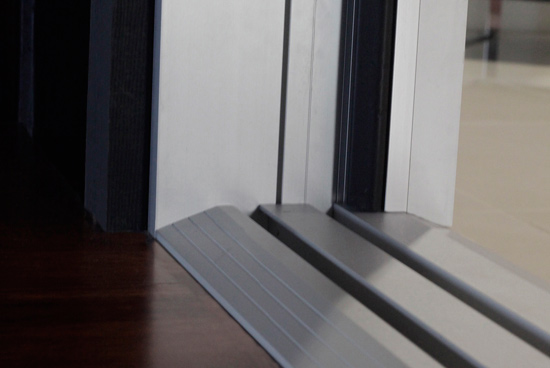
Doors in commercial settings must conform to ADA standards in several areas. For examples under ADA guidelines, a door may swing out of a room as long as there is a 48-inch clear area in front of the door to allow those in a wheelchair to safely maneuver. For the door to swing in, there must be a full 60 inches of maneuvering space in front of the door, as well as 18 inches of clearance along the side of the door. Doorway thresholds may not be more than ½ inch, or ¾ inch for exterior sliding doors. A sloped threshold may not be more than 1:2--one unit of rise to two units of run. The aforementioned newly introduced ramp that complies with the ADA Code #1124B that requires gaps in walking surfaces to be no greater than ½ inch is an important solution in commercial projects.
Schematic of Outswing Sheet
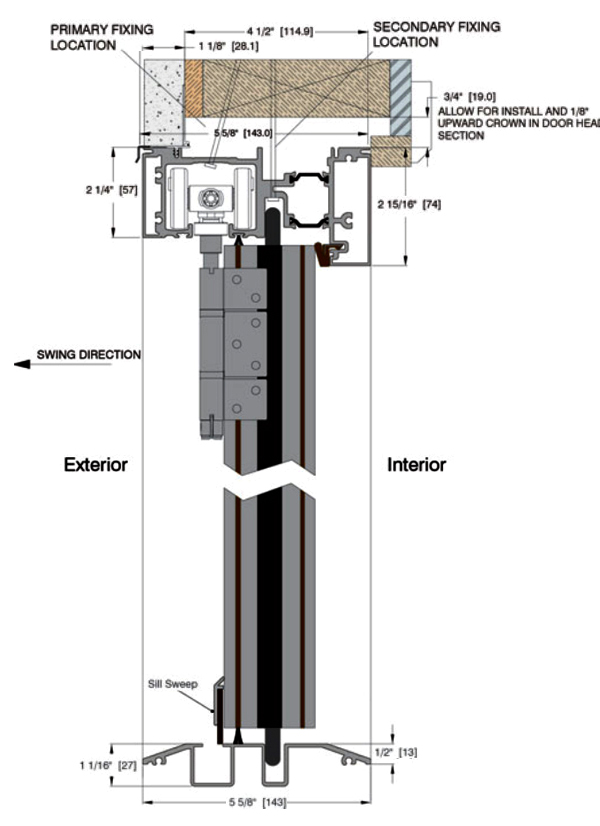
Image courtesy of LaCantina Doors
An outswing system with the commercial ramp sill is an option for when interior and exterior floor levels are the same and a maximum sill height from finish floor of ½” is required. Surface mounted sweeps applied to the face of the bottom of the panel are provided. Adequate overhangs are recommended to reduce the risk of water infiltration.
Architects should also make sure that door options for commercial projects include ADA-compliant bottom rails, panic hardware, self-closing devices and more. In terms of door hardware, rather than knobs that must be grasped and twisted to activate, ADA compliant options include pull handles or push bars designed to allow fast and unencumbered exit from a doorway”a rod or bar or lever is pushed, retracting the latch mechanism and the door is opened. Pull handles or levers are available in a number of themes, but it is important to note the features of a common type of hardware, the clutch lever, a freewheeling, vandal-resistant lever standard. Although mandated to meet ADA requirements, lever handles are especially subject to vandalism and damage. The clutch option for lever trim includes an internal slip clutch mechanism which allows the lever handle to break away without damage or violating security when excessive force is applied. The lever can be lifted back to horizontal to reset it. An internal dead stop limits the break away to 55° of lever handle rotation.
Many building codes require doors to be latched to help control fires, but not locked on the stair side unless they can be remotely unlocked without unlatching. Electrified trim allows doors to be locked tight for increased security, but enables the doors to be remotely unlocked in the event of a fire or other emergency.
In addition interior hinged doors, sliding doors and folding doors must be designed so that no more than five pounds of force is required to open or close the door. Automatic doors must take at least three seconds to open and not more than 15 pounds of force to stop.
Folding Glass Doors: A Plus for Commercial Applications
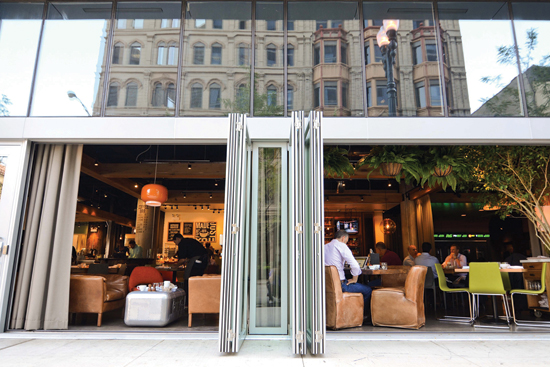
Photo courtesy of LaCantina Doors
Folding glass doors opening to the outside add to the ambience at the trendy Beatrix Restaurant at Chicago’s aLoft Hotel.
There are many reasons folding glass doors can be an ideal solution for commercial applications from restaurant and retail to offices and showrooms to educational and institutional spaces. Connecting indoors and outdoors and reconfiguring interior spaces, folding glass systems increase spatial flexibility while enhancing lifestyle options. They also contribute to green building goals in a number of areas, while enhancing the salutary effect on building occupants. Today's systems are engineered for greater strength and the level of performance necessary to withstand the most extreme weather events. For sustainability, flexibility, and durability with dramatic appeal, glass doors systems represent a clear asset in commercial construction.
 |
LaCantina Doors is the leader in designing and manufacturing products that create large open spaces. Offering the most innovative and comprehensive range of folding, sliding and swing systems available, LaCantina Doors utilizes the same signature narrow stile and rail profile across its product line for a complete and perfectly matching door package.
Designed and made in California, LaCantina Doors have contributed to award winning projects ranging from residential, retail, commercial, educational facilities, resorts and is the preferred choice when it comes to products that open spaces. Backed by an industry leading warranty, LaCantina Doors are available across the U.S. and Internationally. www.lacantinadoors.com |