This CE Center article is no longer eligible for receiving credits.
The choice of flooring in workplaces, particularly in industrial or high-traffic settings, has a significant impact on the safety of workers in those spaces. As a result, flooring that is safe for people to walk on can directly influence the operation and profitability of the businesses or organizations. Since there is a range of choices, it is important to select and specify the best flooring that is not only safe, but will hold up and be durable over time, provide the needed design characteristics for the work environment, and address sustainability.
Safety Flooring Overview
All flooring materials are clearly intended to be walked on. However, it is usually the walking surface characteristics of those different materials that constitute the difference between them being inherently safe or notably unsafe in common work environments.
The Problem—Unsafe Flooring
Unsafe flooring and walkway conditions are defined as those that are prone to cause people to slip, trip, or fall and become injured, sometimes quite seriously so. In fact, the Occupational Safety and Health Administration (OSHA) points out that walkway related injuries constitute the majority of general industry accidents. Further, OSHA and others that have looked at this issue have identified the following facts:
- Slips and falls are the leading cause of workers' compensation claims and occupational injury for people aged 15-24 years.
- 85% of workers' compensation claims are attributed to employees slipping on slick floors.
- Compensation and medical costs associated with employee slip/fall accidents is approximately $70 billion annually.
- 22% of slip/fall accidents result in more than 31 days away from work.
- According to the National Safety Council over 9 million slip/fall accidents happen per year resulting in expenses of $3.5 million per hour every day of the year.
- Slips and falls cause 15% of all accidental deaths, making them second only to motor vehicles as a cause of fatalities.
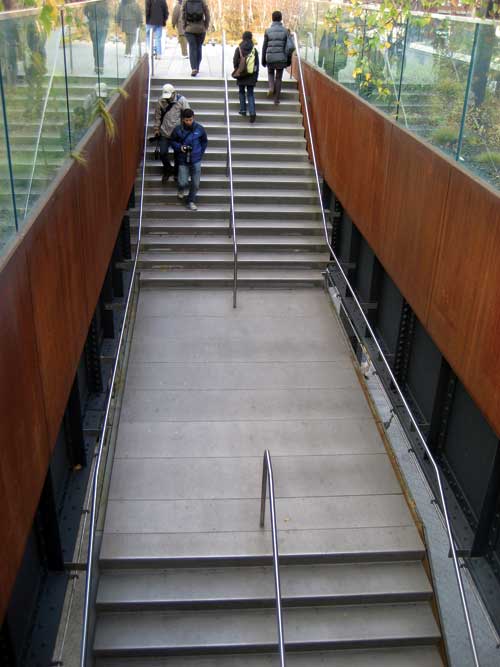 |
The safety of walkways and stair treads can be enhanced with the use of slip-resistant metal in appropriate design locations.
Photo courtesy of SlipNOT® |
This widespread common occurrence means that it is incumbent upon anyone designing or specifying flooring to appropriately address safety in order to avoid potential accidents from occurring in the first place. That implies elimination of hazards such as slippery substances on the floor but it also means using materials that help minimize these hazards should they be present. The goal is of course not to achieve perfection, but to create a real and meaningful reduction in incident rates of any such accidents occurring. Lower-than-average incident rates mean fewer people are hurt, associated costs from those accidents are less, and productivity in the workplace remains high. It also means that liability and risk are better managed not only for the owner of the workplace, but also for those designing and installing the flooring who could be found professionally liable.
The Solution—Slip-Resistant Flooring
As a means to identify what can be regarded as safe flooring, the American Society of Testing Materials (ASTM) has published Standard F 1637-10 titled “Standard Practice for Safe Walking Surfaces” which has been accepted as an international standard for the creation and maintenance of walking surfaces that can be considered safe. In very clear language, the standard states in its opening paragraph: “This practice covers design and construction guidelines and minimum maintenance criteria for new and existing buildings and structures. This practice is intended to provide reasonably safe walking surfaces for pedestrians wearing ordinary footwear.” It later goes on to state that, “This practice addresses elements along and in walkways including floors, and walkway surfaces, sidewalks, short flight stairs, gratings, wheel stops, and speed bumps.” Hence, it clearly applies to all walking areas inside and outside of buildings both during the initial design and construction as well as the operation of a facility.
A key safety characteristic defined for flooring and walkways is the presence of surfaces that are slip resistant. The cited ASTM Standard makes it clear by stating: “Walkway surfaces shall be slip resistant under expected environmental conditions and use.” It goes on to state, “Interior walkways that are not slip resistant when wet shall be maintained dry during periods of pedestrian use.” Hence the distinction is made that the surrounding environment must be factored in when considering slip resistance, specifically recognizing the ability of water on flooring to reduce resistance. Therefore, under the ASTM Standard, either slip resistance must be sustained when a floor is wet or the floor must be maintained as dry so that its slip-resistant properties continue to be effective.
OSHA has also published standards for walking/working surfaces that apply to all permanent places of employment (except where only domestic, mining, or agricultural work is performed). Specific standards have been written for walking/working surfaces for general industry, shipyard employment, marine terminals, longshoring, and the construction industry. These OSHA standards cover all walkways and areas where people are standing to work plus all stairs and ladders. Standard 1910.24 (f) for example specifically addresses stair treads and states, “All treads shall be reasonably slip resistant and the nosings shall be of nonslip finish. Welded bar grating treads without nosings are acceptable providing the leading edge can be readily identified by personnel descending the stairway and provided the tread is serrated or is of definite nonslip design.”
Other organizations and standards quite familiar to architects also address the issue of slip resistance. The Americans with Disabilities Act (ADA) points out the need to address slipping and tripping hazards and has accompanying guidelines with specific requirements for slip-resistant surfaces. The American National Standards Institute (ANSI) has initiated Standard A1264.2 with the intent of reducing falls due to slippery conditions which are preventable in the workplace. The three basic areas of this standard include 1) provisions for reducing hazards, 2) test equipment, and 3) slip-resistance criteria. Even the National Fire Protection Association (NFPA) has developed standard 1901 entitled Standard for Automotive Fire Apparatus which includes a specification in section 13-7.3 for slip resistance.
Clearly, then, there is widespread acceptance of addressing slip resistance. Therefore, it falls on the design and construction team to be sure that these safety criteria for slip resistance are met, installed, and function as intended.
Measuring Slip Resistance
All of the preceding discussion begs the obvious question—how is slip resistance determined? The intent is obviously to determine at what point people might lose their footing and become injured, but what is the acceptable means to determine when that might happen?
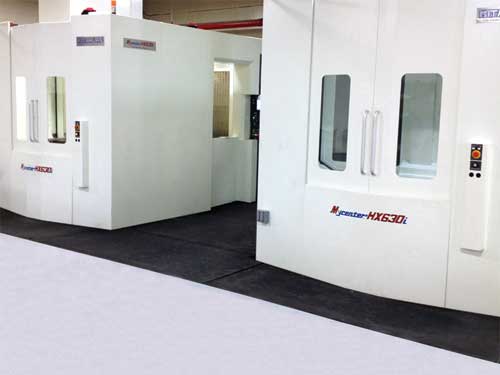 |
Bremen Castings, Inc. installed slip-resistant steel plates around their CNC machines where oil and coolant collect on the foundation pit. This
provides a safer work surface for their personnel.
Photo courtesy of SlipNOT® |
The answer is that slip resistance on walkway surfaces is based on measuring the frictional force necessary to keep a shoe heel (or a crutch tip in the case of ADA) from slipping on the walking surface under conditions likely to be found on the surface. Contrary to popular belief, some slippage is necessary to walking, especially for persons with restricted gaits; a truly “non-slip” surface could not be negotiated.
The standard measurement used for slip resistance is the Coefficient of Friction (COF) which is defined simply as a measure of the amount of resistance that a surface exerts on a substance or object that sits on or moves over it. The COF is expressed as a decimal from zero to 1 in most cases, with a few exceptional conditions warranting a number higher than 1. This number represents the ratio between the maximal frictional force that a surface exerts (such as a walkway) and the force pushing an object toward that surface (such as a person walking in shoes). The COF can be measured both for objects that are static (motionless) and for objects that are dynamic (in motion). As might be expected, static objects typically experience more friction (i.e. higher COF values) than moving ones. While the dynamic coefficient of friction during walking varies in a complex and non-uniform way, the static coefficient of friction, which can be measured in several ways, provides a close approximation of the slip resistance of a surface.
Thinking about COF more conceptually, envision the difference between walking over a piece of glass which will obviously be more slippery (i.e. less friction) compared to walking over a piece of sandpaper (more friction). The sandpaper in contact with a shoe has a notably higher coefficient of friction than the glass. The best walkway surface is somewhere in between. OSHA recommends that walking surfaces have a minimum static coefficient of friction of 0.5. However, a research project sponsored by the Architectural and Transportation Barriers Compliance Board (Access Board) conducted tests with persons with disabilities and concluded that a higher coefficient of friction was needed by such persons. A static coefficient of friction of 0.6 is recommended for accessible routes and 0.8 for ramps.
It is commonly recognized that the coefficient of friction varies considerably due to the presence of contaminants such as water, lubricants, floor finishes, or other items not necessarily under the control of the designer or builder and not subject to design and construction guidelines. Nonetheless, many common flooring materials are labeled with information on their static coefficient of friction sometimes in both wet and dry modes so that designers are able to specify materials with appropriate values.
| Prevent Flooding on Walkways |
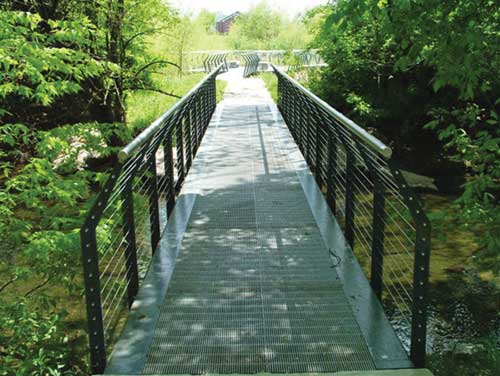
To help combat flooding issues on walkways, the architectural firm involved in Beargrass Creek Nature Preserve in St. Matthews, Kentucky, needed material that could be slip resistant when wet. They chose treated metal grating that was able
to withstand installation in an outdoor environment while allowing for drainage of debris and liquids to help prevent flooding on the walkways.
 |
|
Photo courtesy of SlipNOT® |
|
The variable of motion as part of slip resistance is also measured using COF. When looking at dynamic COFs for some common materials, it is worth noting that some materials might exhibit very high COF properties at rest, but less so in motion. Glass against glass for example when measured in a static condition (at rest) exhibits a COF on the order of 0.9 to 1.0, which is quite good. But measure it in a sliding or moving condition and that value drops down to the Teflon range of 0.4. Perhaps that helps explain why it can be very difficult to walk on glass.
The process for determining these various COF numbers comes from test procedures developed by ASTM. Perhaps because of the need to address slip resistance in a variety of conditions and for a variety of materials, ASTM has a long history of many different test methods and procedures for COF. Some look at specific materials like ceramic flooring; some are suitable for either dry testing or wet testing or both, and some are limited to laboratory testing compared to others that can be used in the field. The following is a partial list:
ASTM 1679: This had been the premier testing method approved for both dry and wet testing; however it was withdrawn in 2006 since it did not address all methodological issues. Nonetheless, some manufacturers may still issue COF values based on this test. A device known as the English XL Tribometer is used for this method and operators need to be certified to use the equipment.
ASTM 1677: This testing standard is also approved for dry and wet testing. The method can be used on nearly all surfaces. The method also avoids the problem of adhesion by applying the horizontal and vertical forces simultaneously. It uses a different testing device known as the Brungraber Mark II.
ASTM 1678: This test method covers the operational procedures for using a portable articulated strut slip tester (PAST) to determine the slip resistance of footwear sole, heel, or related materials (test feet) against planar walkway surfaces or walkway surrogates (test surfaces) in either the laboratory or field under dry conditions.
ASTM F489: This covers laboratory measurement of the dry static coefficient of friction of shoe sole and heel materials on controlled walking surfaces and under controlled conditions. This method uses the stationary James Machine. This method is not used to test floor slip resistance, just shoes.
ASTM D2047: This method is for the laboratory measurement of the static coefficient of friction of floor surfaces. The James Machine apparatus is not suitable for use on wet, rough, or corrugated surfaces. Because of the leather pad specification and problem with adhesion, this method should not be used for wet testing.
ASTM F609: This test method covers measurement of the static slip resistance of footwear sole, heel, or related materials on walkway surfaces in the laboratory and in the field. Note that this method is not intended to test walkway surfaces, but the footwear material. In addition, this method would also result in adhesion problems on wet surfaces.
ASTM E303: This method is for measuring surface frictional properties using the British Pendulum Tester (exterior), which is designed primarily for wet and oily testing. This test is a dynamic slip-resistant test method.
ASTM C1028: This test method covers the measurement of static coefficient of friction of ceramic tile or other surfaces under both wet and dry conditions while utilizing neolite heel assemblies. This test method can be used in the laboratory or in the field and uses a large, 50-pound drag-sled that is constructed in accordance with the procedure. The method also would be subject to adhesion problems on wet surfaces, but is approved for this use.
ASTM F2913: This non-proprietary laboratory test method allows for reproducible testing of whole pieces of different footwear and their related sole materials for evaluating relative walking slip performance. This test method determines the dynamic COF between footwear and flooring materials under laboratory conditions that are reproducible for the purpose of evaluating relative slip performance of the tested combinations. The method is applicable to all types of footwear and to most types of indoor floorings, including matting and stair nosing, plus the presence of surface contaminants on the flooring surface such as liquid water, ice, oil or grease.
Typically, several of these tests are appropriate to determine the safety of flooring products in given building situations. The resulting COF is the relevant information that a material supplier or product manufacturer should provide. The best outcomes are those that approach a COF above the minimums of 0.5 or 0.8 and are closer to a safer but still very navigable level of 1.0.
| Keep High-Traffic Stairways Safe |
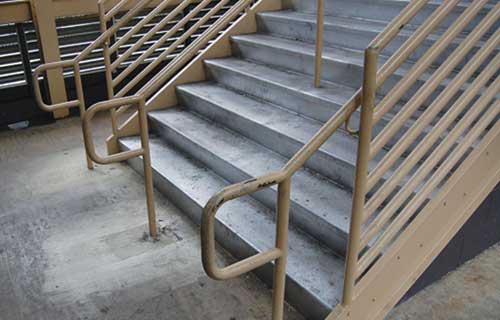
Askew Nixon Ferguson Architects chose treated metal stair treads in conjunction with concrete floors based on their design for this slip resistant stairway at the Memphis, Tennessee hub of Federal Express where over 8,000 people access their stairways on a daily basis.
 |
|
Photo courtesy of SlipNOT® |
|
Safety Flooring Material Comparisons
So, given all of the above information, what materials or products are best to use? For the purpose of this article, we will look at four very common choices of flooring in workplace settings: finished concrete, wood strip or plank flooring, plastic tile or sheet goods, and metal flooring made from either plate or open grate. Of course, it is possible to assemble these choices in combination with each other to suit different conditions in a building, but let's look at them individually for comparative purposes.
COF Comparison
We'll start with this most basic of criteria—what is the measured coefficient of friction of each of these common choices when tested as walking surfaces? Broom finished concrete is often used and tests out a fairly good 0.87 COF—even under wet conditions. Add a resin floor epoxy on top of it and it remains comparable when dry at about 0.85. Wood by comparison is a bit more slippery at 0.77 under wet conditions meaning it would not meet ADA criteria for unprotected outdoor ramps. Move on to plastic tile products, particularly those with raised domes such as tactile edges at crosswalks, etc. and some interesting variations emerge—the top of the domes perform differently than the bottom areas between the domes. When the tops are dry, they measure at a moderate level of 0.77, but get them wet and the COF drops down notably to 0.55. The area between the domes remains a fairly constant 0.85 in both the wet and the dry condition, perhaps because of its configuration in part along with the fact that shoes would have a tougher time coming into full contact with these areas.
Some similar variations can be found with metal flooring products. Diamond plate metal is commonly used in many locations for safety reasons. However, when the metal is untreated for slip resistance, it weighs in surprisingly low in wet conditions at 0.52. Using aluminum helps with a COF comparable to broom finished concrete weighing in at 0.87. Non diamond plate metal surfaces with an added slip-resistant coating or treatment in many cases are found to outperform all of the other choices above. In wet conditions, they have been tested to weigh in at an impressive range of 0.95 – 1.0. The type of treatment will vary based on the manufacturer and different levels of coarseness can be obtained (low, medium, or high). The net outcome from these treatments is the creation of an appropriately coarse finish on walking surfaces, stair treads, and nosings. In terms of overall slip resistance then, these treated metal surfaces often emerge as the safest choice.
Wear-ability Comparison
When looking at high traffic or heavy use buildings, the question naturally comes up as to how well the slip-resistant qualities of the flooring will “wear” over time. This doesn't mean what is the durability of a surface over time, but rather how well does it maintain the same coefficient of friction for multiple years compared to when it was installed. The tested COF values are done on new products or materials. Over time, the repeated walking and wear on them can make them smoother and reduce the COF notably creating a condition that is no longer as safe as it used to be. Similarly, cleaning and maintenance may wear down the original COF, particularly in work environments that require repeated intense cleanings. In any of these cases, concrete can become smooth and worn, wood may degrade, and plastic flooring can become slick. Treated metal has the highest likelihood of maintaining its original COF the longest provided the treatment is integral to the metal and not simply surface applied. For example, some treatment processes deposit molten metal in a random hatch matrix onto steel, aluminum or stainless steel substrates. This results in a very hard and durable wearing surface with a bond strength of at least 4,000 psi, that creates a very long lasting COF overall.
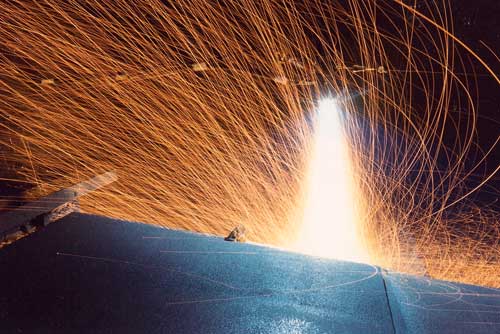 |
Treating metal, rather than coating it, in a manner that deposits molten metal in a random hatch matrix onto steel, aluminum, or stainless steel
substrates, results in an extremely hard surface with a bond strength of at least 4,000 psi.
Photo courtesy of SlipNOT® |
Life Cycle Cost Section
Many commercial and industrial operations are concerned not only with the initial cost of materials and products, but also the total dollars expended over the usable life of a flooring installation. Beginning with the installation, the product cost is coupled with the labor cost of installing safety flooring for a total installed cost. In cases of existing buildings, the removal of existing flooring plus the disruption to operations and business income will need to be factored in. Once in service, the expected service life of the flooring needs to be taken into account. A more durable product can be expected to last longer and not need replacement as often as a less durable safety flooring. Note that the life expectancy many manufacturers provide may not be accurate for all buildings. This is because products react differently in different environments; traffic in a steel mill with forklifts and heavy motorized vehicles/machinery is going to cause different wear patterns to flooring than a commercial setting with minimal pedestrian foot traffic. Further, cleaning techniques can cause products to wear, chemicals used for sanitizing can affect a product, and extreme heat or cold may hinder a products life cycle.
Ongoing maintenance expenses are often the most important and largest factor in life-cycle cost since floor care is arguably the most expensive and labor-intensive cleaning task in the professional cleaning industry. Some safety flooring products may have a low initial cost but such high maintenance costs that the lower initial cost is quickly overwhelmed. Floor maintenance costs are normally a major portion of total operating costs in most plants and have been observed to double in recent years.
At the end of the service life of the flooring, it must be removed, disposed of or recycled, and replaced. Adding up all of these various costs and dividing by the number of expected years of service will yield a sense of the real cost per year of different types of flooring.
Green Building Design
Flooring can constitute a very significant amount of material in a building hence its impact on green building design can be equally significant. That impact begins with the nature of the flooring material and the processes used to produce and transport it. Materials with recycled content are preferable to those that use only virgin materials. Manufacturing processes that require less energy to create finished products are preferable to those that are more energy intensive. The less energy used in the manufacturing process typically means lower carbon emissions and a smaller carbon footprint. And, products that don't need to go to a landfill at the end of their useful life, but can be recycled into other useful products are also highly preferred since they start the green process all over again.
Designing and Specifying Safety Flooring
The first step in addressing safe flooring and walkway design is to determine the areas that need to be slip resistant. Not all areas necessarily need to be treated equal if they aren't all walked on. Walkways and aisles between equipment clearly need attention but the area under that equipment or machinery may not. Wet areas need more attention than dry areas and heavy use area do too. Stair nosings are more critical than the full stair treads, but both can be treated to different extents. In existing buildings, employees can be a very good resource when it comes to determining the best areas to place non slip flooring since they likely walk the same areas day after day and are very familiar with their surroundings. Hand in hand with the flooring need is the identification of a flooring budget. What can the project or the owner afford? Non-slip flooring products drastically range in price and quality. It is good to have a sense of what amount of money you can spend on this project after determining how extensive the safety flooring needs to be.
Next, determine how long you need the product to last. Are you looking for a permanent flooring solution that will remain in place for a long time or would the owner be happy with a product that will need to be frequently replaced driving up the long term costs? Either way, it is important to research your options and find a product that at least meets the standards and recommendations for co-efficient of friction in the building being addressed. Specify the appropriate ASTM tests and or other standards and request submittals based on the product meeting or exceeding those requirements. If there is any doubt, request a sample of the products you have in mind. Generally samples are small however some companies will fabricate a piece of flooring for you to actually install in a slippery area of an existing facility to evaluate its suitability.
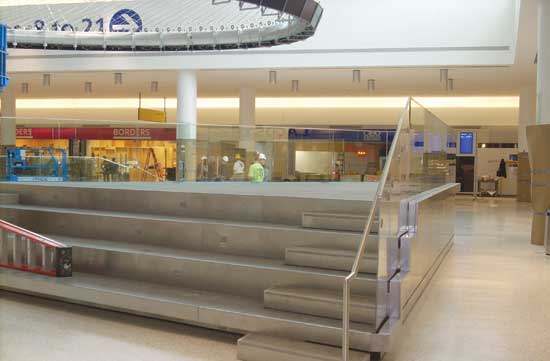 |
Gensler Architects worked with Jet Blue airlines on the design of the new terminal in John F. Kennedy Airport in New York City. New
stepped seating fabricated from treated metal was part of the design that required long-term slip resistance for safety as well as corrosion resistance, easy cleaning, and strong aesthetic appeal.
Photo courtesy of SlipNOT® |
From here, the specification process can focus on choices and options that can help these materials present an architecturally distinctive presence or blend into the surroundings. The green attributes should be reviewed and specified related to recycled content, recyclability, or low or no VOC content.
In the case of specifying metal safety flooring, the common choices include steel, galvanized steel, aluminum, and stainless steel. Most are produced in a standard mill finish. In that case, there are no additives or paints applied to the product besides the slip-resistant treatment or coating. Mill finish will be the raw material color. Steel products can also be specified with a hot-dipped galvanized finish to prevent corrosion. Galvanizing should be performed in accordance with ASTM A123 or other appropriate specifications. Alternatively, metal products can also be painted however care must be taken so the slip-resistant properties of the surface are not compromised.
Metal safety flooring can be fabricated in a variety of configurations. Treated flat plate is commonly used for walkways and stair treads. Metal products that are perforated or fabricated in a grating style are common for wet areas where water or other liquid can be drained away. Diamond plate surfaces are also common, but as previously noted, may not provide as high a COF as some other options.
 |
Slip-resistant metal can be fabricated in many shapes and forms as appropriate to different locations.
Photos courtesy of SlipNOT® |
When instructing contractors or owners on proper cleaning and maintenance of metal flooring, note that most products can be cleaned by using standard cleaning agents but the manufacturer should be consulted for any specific restrictions. Slip-resistant flooring products should definitely be cleaned on a regular basis to prevent any build up or residue that can cause the flooring to otherwise smooth over. Small debris can usually be dislodged with compressed air or a soft bristle brush but greasy or oily environments will likely require cleaning with a stiff bristle brush or power washing to bring back the optimal surface texture. Some specific recommendations follow below:
Care for steel products: Mill finish steel products will rust if exposed to moisture or humidity therefore, they should be primed and painted or hot dipped galvanized to prevent corrosion. (Note that hot dipped galvanizing is the ideal method for corrosion resistance.) Use a power washer and stiff bristle brush to remove any debris lodged in peaks and valleys. Organic based stains, such as grease or oil, can be removed with standard organic solvents. The most common is commercially available brake cleaner but any organic solvent will most likely work. Some scrubbing may be required to remove grease buildup.
Care for stainless steel products: Be aware that certain organic enzyme and alkaline based cleaning agents can blacken stainless steel which will bleed through the surface layer. Otherwise, stainless steel is the most chemically resistant product and withstands nearly all other cleaning or environmental situations from alkaline to acidic. As with regular steel products, organic based stains, such as grease or oil, can be removed with standard organic solvents. Should the stainless steel product be contaminated with surface rust, it is generally recommended that this be removed with diluted muriatic acid. Note that acid treatments must be immediately rinsed from stainless steel surfaces in order to prevent discoloration. Concentrations should not exceed 1 part acid to 1 part water.
Care for aluminum products:Aluminum materials should be handled with care since aluminum is a soft alloy that can be damaged if not handled properly. Organic based stains, such as grease or oil, can still be removed with standard organic solvents as with steel, and some scrubbing may still be required to remove grease buildup. Some manufacturers recommend that a stiffened bristle brush be used in conjunction with a power washer since too much pressure can lead to degradation of the surface. Standard aluminum cleaning products such as Tri-Sodium Phosphate solutions also work well.
Properly specified and maintained metal slip-resistant flooring and walkway areas such as stair treads, nosings, and ramps will contribute notably to the overall slip resistance of the work place and the safety of those who work or visit there.
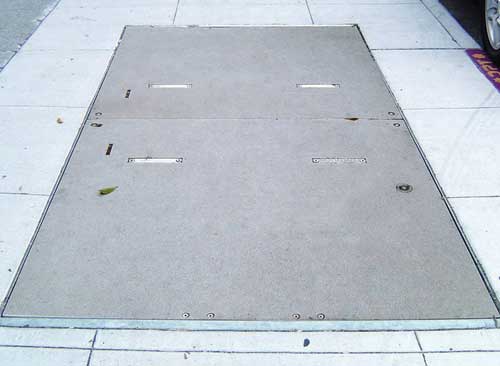 |
Seattle City Light recently sought a slip-resistant solution for electric vault covers located in walkway areas. They found a successful choice in slip resistance treated galvanized steel.
Photo courtesy of SlipNOT® |
Conclusion
Facilities with improved safety conditions, which also use sustainable, long-term, and economical flooring choices lead to competitive advantages for property owners/operators. With increased safety, longer-wear, efficient, eco-friendly products incorporated into designs, projects have lower insurance rates, regulatory compliance fees, monitoring costs, and loss-time/accident costs.
CASE STUDY #1
Slip-Resistant Aluminum Grating Utilized at Innovative,Environmentally Friendly Green Roof for the American
Society of Landscape Architects Headquarters
|
The Situation
ASLA's headquarters in Washington, D.C., needed a new, environmentally friendly grating for their rooftop flooring surface, which allowed plants to grow up through the grating. The green roof is part of ASLA's commitment to promote environmentally friendly designs to make green roofs a more widely accepted option for architects and contractors. The 3,000-square-foot green roof will grow a variety of plants and also have a viewing area for the public. ASLA was looking for a walking surface that would allow plants to grow up and through the floor surface to maximize the roof space, allow people to walk on the space without damaging the plants, and would remain slip resistant against transpiration from the growing plants.
The Solution
Slip-resistant aluminum grating was chosen as the optimal grating for the project. Slip-resistant aluminum was the ideal substrate because it is a lightweight material that reduced the overall weight of the grating on the roof while still being extremely durable. The aluminum coating also remains slip resistant against transpiration from plants and other outdoor elements, providing a safe walking area for pedestrians. The slip-resistant aluminum grating is corrosion resistant and will be able to withstand installation in an outside environment with minimal maintenance.
The Impact
The aluminum grating has provided the American Society of Landscape Architects with an aesthetically pleasing slip-resistant walking surface for the green roof. The aluminum grating has proven to be the ideal solution to help ASLA showcase their green roof.
Owner: American Society of Landscape Architects
Location: Washington, D.C.
Industry: Commercial
Number of Employees: 500
Website: www.asla.org |
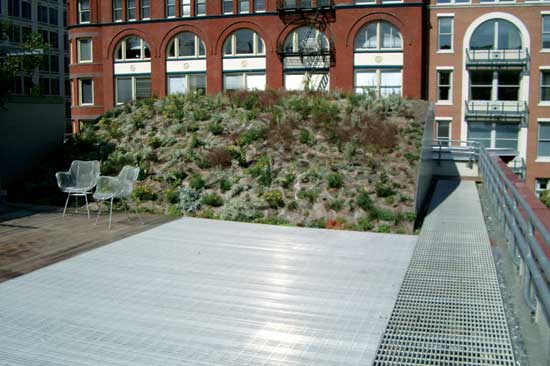 |
Photo courtesy of SlipNOT® |
|
CASE STUDY #2 Stainless Steel Slip-Resistant Coating used for Vacuum
Chambers at Smokeless Tobacco Plant |
 |
|
Photo courtesy of SlipNOT® |
Owner: United States Smokeless Tobacco Company
Location: Hopkinsville, Kentucky
Industry: General
The Situation:
The United States Smokeless Tobacco Company (USSTC) is the world's leading producer of moist smokeless tobacco products. Skoal and Copenhagen are the two major brands produced from their facility in Hopkinsville, Kentucky, as well as other brands that include Red Seal and Husky. Due to the moisture and humidity in the air, particularly in vacuum chambers at the facility, safety issues such as slips, trips and falls became a major concern for employees. USSTC required a slip-resistant solution for those slick flooring areas that needed to be chemical and corrosion resistant, as well as sanitary to be consistent with manufacturing standards at the facility.
The Solution:
The moisture adding process in the chambers, allows for the tobacco to expand and increase in volume by adding and removing vapor into the air. A structural metal fabricator which specializes in tobacco machinery contacted a metal safety flooring company for a solution to the dangerous working areas at USSTC. After thoroughly discussing the options available, the best workplace safety solution was found to be stainless steel floor plate. Stainless steel was the preeminent answer for the slippery areas, due to its ability to withstand heat, chemicals, moisture and still remain sanitary and clean. Stainless steel products are corrosion resistant and this was a necessity to avoid tobacco product contamination. The metal fabricator supplied fifteen (15) pieces of ⅜” stainless steel plates pre-cut to specific sizes needed for the vacuum chambers. A Grade 2 (Medium) slip-resistant stainless steel coating was then applied to the customized stainless steel pieces per the requirements of USSTC. A one inch margin around the perimeter without the slip-resistant coating was requested for welding purposes to allow for a complete closed seal to avoid contamination.
The Impact:
The stainless steel plate provided by the fabricator not only provided a sure fit, it also created an aesthetically pleasing, clean and sanitary environment for the smokeless tobacco products. Employees no longer had to worry about slick flooring during the moisture adding process. |
CASE STUDY #3 Slip-Resistant Stainless Steel Steps and Platforms for Stuyvesant High School
|
 |
|
Photo courtesy of SlipNOT® |
Owner: Stuyvesant High School
Location: Battery Park, New York, New York
Industry: Education
Website: http://stuy.enschool.org/
The Situation:
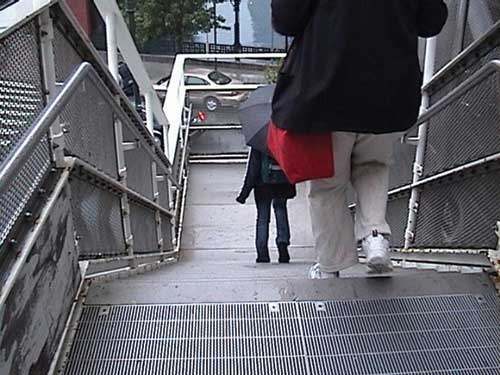
Stuyvesant High School in New York City was founded in 1904 and since then has served as a premier school for the development of talent in science, mathematics and technology. The many students are selected through a competitive examination and represent every socioeconomic level of New York City. In 1992, Stuyvesant High School moved from a building on East 15th Street in New York City to a new construction building in Battery Park, NY located on the southern point of Manhattan Island. The new building offers students an innovative learning environment and includes state of the art classrooms, athletics and a sky lit cafeteria. However, a concern for school officials was the dangerous walk for students at the intersection of the high volume traffic area at West Street and Chambers Street where the school is located. The school district decided to invest in a $10 million dollar project to build a bridge that would provide students with safe access to the school. In the process, the school district was looking for a material that would be slip resistant against outside elements to provide a safe walking area, be long lasting and require minimal maintenance.
The Solution:
The designers provided the school with slip-resistant stainless steel steps and platforms. Stainless steel was the optimal choice for the project because it is corrosion resistant. Therefore, the stainless steel steps and platforms are extremely durable and will remain slip resistant for years in a high volume traffic area. Slip-resistant stainless steel is also easily cleaned and requires minimal maintenance in the outdoor environment. The steps were an aesthetically pleasing choice and were easily incorporated into the designs of the new high school to create a cohesive look.
The Impact:
Slip-resistant stainless steel steps and platforms have provided Stuyvesant High School with the safety needed for students, teachers and pedestrians. The slip-resistant stainless steel steps and platforms are long lasting and easily cleaned. The steps and platforms remain slip resistant against outside elements and have provided Stuyvesant High School students, faculty and parents with safe access to and from the school. |
Peter J. Arsenault, FAIA, NCARB, LEED AP, practices, consults, and writes about sustainable design and practice solutions nationwide. www.linkedin.com/in/pjaarch
 |
SlipNOT® Metal Safety Flooring, Division of the W.S. Molnar Company, manufactures slip-resistant metal flooring products that are designed to increase safety and decrease your risk exposure. SlipNOT® products meet the needs of the most complex projects, regardless of scope or schedule. SlipNOT® products have a long, low-maintenance life cycle and are simple to install. www.slipnot.com |