This CE Center article is no longer eligible for receiving credits.
Design innovation in educational facilities at all levels is undergoing a revolution. Evidence-based design—making design decisions based on research about how aspects of the physical environment directly influence human performance and well-being—has transformed health-care architecture, measurably improving outcomes for patients, families, and staff. Now, the same principles are being applied to the design of spaces for learning. A growing body of research and many impressive examples around the country show an exciting range of new products and ideas for learning environments that give students what they will need to succeed as global citizens in a complex, technological world.
In the K–12 market, for instance, 24 percent of public school buildings were rated as being in fair or poor condition in the 2017 Infrastructure Report Card by ASCE, and 53 percent of public schools need to make repairs/renovations to be considered in “good” condition.1 A federal law, the Every Student Succeeds Act aims to use chronic absenteeism as a factor in identifying the worst schools.2 U.S. Environmental Protection Agency (EPA) studies indicate human exposure to indoor air pollutants can be two to five times higher than outdoor levels, which is a critical fact when you consider that we spend 90 percent of our time indoors. In schools, developing young adults are more susceptible to environmental exposures.3
And when it comes to the higher-education segment, the majority of buildings constructed before 1975 have passed key thresholds for renewal. Capital investment to renew these older buildings has been postponed in favor of new construction. As a result, maintenance backlogs are reaching a level that keep
campus facilities managers on a reactive footing.
Campuses implement policies and practices in four specific areas, providing greater success in navigating the relentless trials of facilities management. These steps are:
- Lower capital and operational demands.
- Make the problem smaller for decision makers.
- Make a greater impact with capital funding.
- Manage operational resources more effectively.

All images courtesy of nora systems, Inc.
Wright State University
The materials selected for these new spaces—from K–12 to higher education—are key to the success of the most innovative designs but also to ensuring the most fundamental needs—healthy air, good light, clear sound, physical safety, and comfort. Even the best decisions about curriculum, assessment, teaching methods, and other important issues can be instantly undermined in the classroom by inferior materials; for example, if students can’t hear or teachers have to repeat themselves, if the air quality is unhealthy, or if the floors are hard and unsafe.
On the flip side, physical environments with properly selected materials, effective light, and forward-thinking design have been shown to improve student, teacher, and faculty success on a wide range of measures from test scores to absenteeism to reduction in headaches and asthma.
As with other materials in educational settings, flooring has to perform in new ways. Rubber as a flooring material has many inherent advantages, but there are significant differences even among resilient flooring products (see Figure 1). Premium rubber flooring differs in quality of ingredients, manufacturing, surface density, and performance characteristics that allow it to respond to new demands. The most functional rubber flooring products can stand up to collaborative floor plans and moveable furniture, foster communication by reducing unwanted sound, and provide the comfort and safety that aids concentration and reduces distraction. The performance characteristics help maintain healthy indoor air quality and can be thoroughly cleaned with little more than water, eliminating fumes and the associated man-hours for cleaning and maintenance. In tandem with disruption caused by stripping, waxing, and recoating.
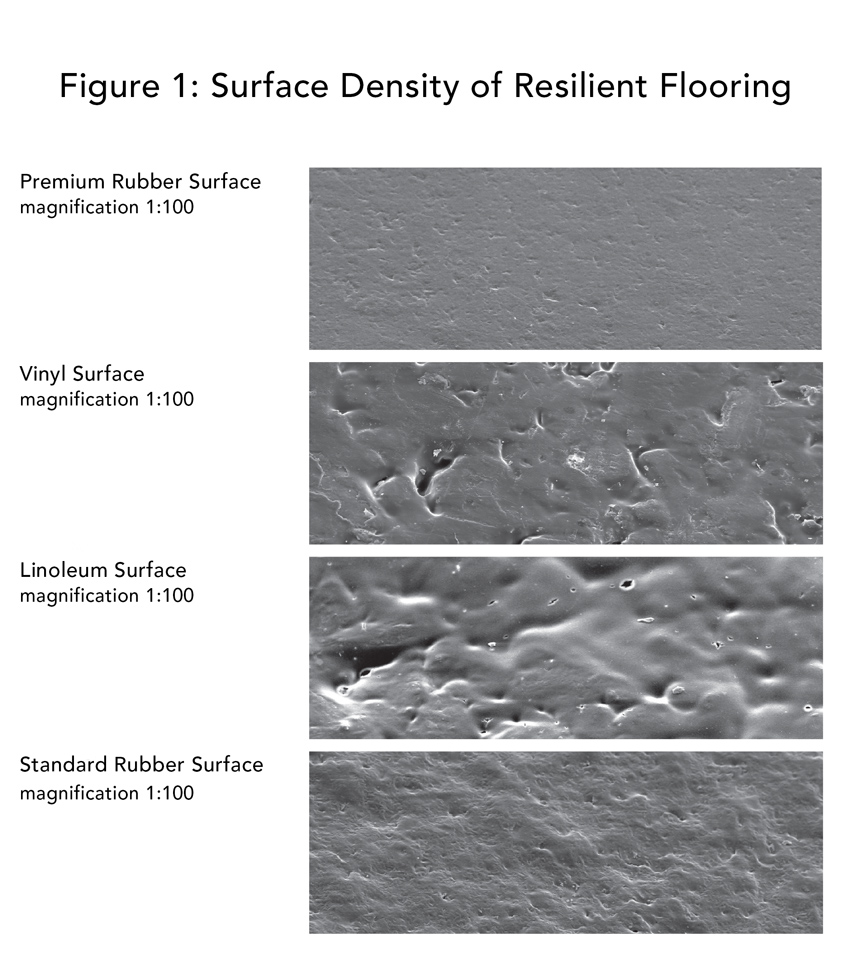
The advantages of high surface density include improvements in safety, acoustics, resistance to dirt and microorganisms, and ease of maintenance.
The large majority of schools are not built to optimize learning, health, and comfort, but to achieve minimum performance at the lowest cost. Many older classrooms are actually working against basic health and safety. Whether for brand new spaces or badly needed renovations, decisions about flooring will have a direct impact on the success of students, teachers, and faculty for many years to come.
This course will illustrate how premium rubber flooring supports some of the most important new concepts in the creation of exceptional learning environments for students of every age—from the littlest learners in daycare and pre-K spaces to higher-education facilities and technical and career spaces for lifetime learning.
FACILITY IMPACT ON HEALTH
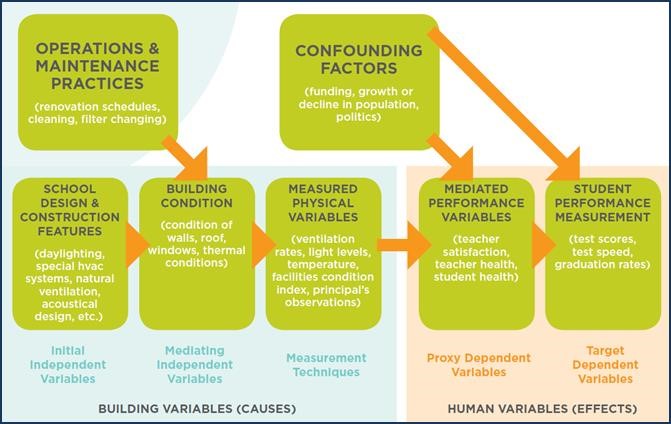
The concept of the “causal chain” refers to the idea that building variables (causes) lead to various human variables (effects). Research shows that “the cause-effect issue is one of the largest challenges faced when attempting to define impacts of building design decisions on health.”4 In fact, the majority of educational facilities don’t optimize learning, health, and comfort but instead try to achieve top performance at the lowest cost. Learning infrastructure is oftentimes plagued by funding and maintenance backlog, and studies have found a correlation between building conditions and student achievement. Research shows teaching methods can be undermined by inferior finish materials, with many facilities having been constructed 50 or more years ago.
Relevant findings include:
- School environment has a “substantially significant” effect on retention, satisfaction, and ability to teach.5
- In K–12, 14 million students attend schools considered below standard, with almost two-thirds of schools in need of extensive repair or replacement, leading to health related-problems.6
- In higher education, the constraint on resources means more for the renovation and daily upkeep of existing facilities given maintenance and custodial staffs have not expanded adequately to cover newly constructed space.7
The physical environment has to be up to the challenge of these new ideas. In a classroom of the “old” model—which unfortunately still exists in most schools—the rich, active, agile learning environment described above, with its moving kids and moving furniture, would lead to a noisy, chaotic atmosphere. Floors could be scratched at the very least, and often slippery with hard, unforgiving surfaces.
To provide a safe and effective foundation for a good learning environment, when a coated resilient product is specified, the flooring must perform well in several key areas discussed in the following sections: physical safety, healthy air quality, improve acoustic performance, visual and ergonomic comfort, and the practical realities of today’s educational buildings requiring low maintenance, durability, and sustainability.

Exceptional learning environments emphasize movement and collaboration. In early grades especially, students need a comfortable, safe, healthy, and easy-to-clean floor.
SAFETY AND ENHANCED LEARNING IN NEW CONFIGURATIONS
The best new designs in learning environments emphasize movement. Research discussed in the multi-author book The Third Teacher: 79 Ways You Can Use Design to Transform Teaching & Learning continues to confirm a deep connection between movement, learning and brain development. When students are allowed to move around more, the ability to concentrate actually improves. In one example, ergonomic chairs that could swivel, rock, and otherwise respond to adjustment resulted in better test scores. Even “fidgeting” is more productive for learning than sitting for long periods in rigid furniture.
In a space where teachers and students are often in motion, the slip-resistant surface of rubber flooring reduces the likelihood of falls. Its ability to absorb energy can help prevent or reduce injuries when falls inevitably occur. Rubber floors are not only safer to move on, they are safer to fall on. Added traction is particularly important in areas where large numbers of people are moving quickly most of the day, such as hallways, stairwells, cafeterias, and gymnasiums.

Nazareth College
Slip resistance can be increased by texture of the surface, but at some point there are trade-offs with cleanability, and maximum traction isn’t desirable in places where people need to be able to walk easily or move equipment. An optimum level of slip resistance for the use of the space is required. When people have confidence that the flooring is not slippery, the stress of walking and standing is reduced.
But slip resistance in flooring is complex to evaluate. Slips are often caused by the floor’s coated or waxed surface, as opposed to trips caused by factors like changes of level, damage, or obstacles. The pattern and transitions in flooring surfaces have an effect on perception. The flooring material’s surface density directly affects the posture and balance of people walking or standing on it.
Premium rubber flooring never requires a coating or finish, so the surface does not have gloss level issues that can cause visual acuity issues. When a floor is coated, we are now walking on the coating and no longer walking on the floor. Products are also available in a range of thicknesses and textures to provide precise balances of energy absorption, adequate cushioning, and firmness.
Coefficient of friction (COF) represents the resistance an object encounters in moving over another—in this case, a foot over the floor. High COFs indicate greater friction and less slip potential. For example, ice, which has a COF of 0.2, is more slippery than swept concrete, which has a COF of 0.9.
COF is often considered the only relevant component of slip resistance, but it is complicated to measure effectively and consistently. Although OSHA has no mandatory standard for COF, it has published guidelines in the past that recommend a COF greater than 0.5 as a reasonable level, while noting that there are many applications where greater slip resistance is needed. This is also the minimum value of the commonly used James Test (so named because it uses a slip-resistance machine developed by Sidney James at Underwriters Laboratories; it is also the basis for ASTM Standard D2047: Standard Test Method for Static Coefficient of Friction of Polish-Coated Flooring Surfaces as Measured by the James Machine). But not every floor is subjected to this test. In fact, there is currently no single slip-resistance test method applied consistently to both coated and non-coated resilient flooring.
As a result, two rules of thumb are useful when evaluating slip-resistance test results. First, check to see if the test was conducted by an independent company, which helps ensure accurate results. Second, flooring should be tested with its intended use in mind. For example, if the flooring requires five coats of polish, then it should be tested after five coats of polish have been applied. If the manufacturer states that no coating is required, then the floor should be tested without a coating. Some premium rubber flooring products achieve high slip-resistance ratings even immediately after cleaning, which ensures safe use of the space without delay.
The option considered most useful for comparing the COF of resilient flooring is to test using a modified version of ASTM D2047, without polish (unless the flooring requires it) and using a sensor made of dry neolite (the material of most of today’s shoe soles). This test method is currently being developed by the ASTM F06 committee. Most resilient flooring manufacturers already use this method and publish the values. The flooring manufacturer should provide testing reports, including the test method and the machine and sensors used, and if possible, testing information on pre-aged samples of the product to indicate long-term performance.
Design Affects Engagement
Recent Steelcase Education studies8 show that classrooms for active learning have a significant effect on student engagement. In the universities studied, participants reported that the new classrooms improved active learning practices and had more positive impact on engagement compared to the old classrooms. In fact, the majority of students rated the new classroom better than the old classroom; impact of the physical space significantly improved in the new classrooms for both students and faculty; and the majority of students and faculty reported that the new classrooms contributed to higher engagement, better grades, increased motivation, and more creativity.
Health, Performance, Success
Once a student graduates from high school, he or she will have spent more than 15,000 hours in school.9 This comes into focus when you consider that the specification of interior materials, especially flooring, have a direct impact on indoor air quality. Considerations include basic composition, maintenance protocol throughout the product life-cycle (need to never finish, strip, or recoat), and the inherent advantages of premium rubber flooring, which differs in quality of ingredients, manufacturing, process, surface density, and performance characteristics responding to the demands of learning—from test scores to absenteeism to reduction in allergy and asthma.
AS BASIC AS AIR
It may seem extreme to question the very air that students and teachers are breathing, but unfortunately the problems in many of today’s classrooms do start there. Research has shown that asthma is the most common chronic disorder in childhood—currently affecting 16.2 million children under the age of 18. Asthma is the leading cause of absenteeism, responsible for more than 20 million missed school days in the United States per year. The air is unfit to breathe in an estimated 15,000 American schools.
Physical products and materials in the classroom, including flooring, have a direct impact on indoor air quality in two important ways: first in their basic composition, and then in their maintenance profile throughout their product life.
First, many materials emit large quantities of volatile organic compounds (VOCs), a hazard not only to occupants of the space but also to the environment at large. The VOC emissions of an interior floor product are related to the material’s composition. Creating products that perform well but contain low or no VOCs is a challenging engineering and chemical problem that flooring manufacturers have worked to solve, with varying success.
Some materials are inherently less hazardous than others because they contain fewer synthetics, chemicals, and petroleum. Premium rubber flooring is composed of ingredients including natural rubber, a sustainable resource, and does not include previously used materials, such as tires or chemicals like plasticizers. Even very common materials, such as some forms of polyvinyl chloride (PVC), have become controversial for containing components like phthalates, which can be dangerous during manufacturing and disposal and as they age in place in buildings. Some of these ingredients are implicated in asthma and other diseases. Their use has been banned in some countries.
The second major threat posed by materials to indoor air quality is maintenance. For many flooring materials, extremely harsh chemicals are required both for daily routine cleaning and for more extensive stripping and waxing, once a year or more, when spaces must be closed for weeks at a time to complete the work. Teachers, faculty, and students are constantly exposed to strong lingering fumes, which is not healthy for anyone but especially problematic for anyone with asthma. Children in general are much more sensitive to chemical exposure than adults.
Flooring products in educational settings should contain low to no VOCs, including the adhesives used, and be completely free of substances like phthalates, halogens, and chlorine. Exceptional indoor air quality and green cleaning requirements can contribute to LEED credits.
GREENGUARD Gold certification is part of UL Environment, a business unit of Underwriters Laboratories (UL). GREENGUARD certification helps manufacturers create and buyers identify interior products and materials that have low chemical emissions.
GREENGUARD Gold Certification is one of the most stringent and rigorous indoor air quality (IAQ) certification programs in the world.
All GREENGUARD Gold certified products exceed California’s Department of Public Health Services Standard Practice for Specification Section 01350, which also tests for an additional 330 chemicals and total volatile organic content (TVOC).
Green cleaning protocol improves IAQ and can contribute to LEED credits.
Premium rubber flooring products are inherently antimicrobial, bacteriostatic, and fungistatic, providing additional protection for the health of students, staff, and visitors by inhibiting the growth and reproduction of harmful microorganisms.
In the Grand Valley School profiled in this course (see Case Study), one more unexpected benefit from the rubber flooring has been observed by district authorities over the 10 years since its installation: a significant improvement in the efficiency of the school’s HVAC system. The ability to clean the floors easily and thoroughly has translated to less dust and debris accumulating in the HVAC system, a cost saving and another contribution to exceptional indoor air quality.
CAN YOU HEAR ME?
Another basic but often unmet requirement in the learning environment is the ability of everyone to hear and be heard clearly: teachers, other students, and in most classrooms today, audio from a range of devices. Classrooms have become multimedia communication environments, further increasing the importance of classroom acoustics. Yet noise levels in classrooms are often so high that they significantly interfere with teaching and learning. The Acoustical Society of America (ASA) estimates that many classrooms feature a speech intelligibility rating of 75 percent or; it recommends a 95 percent speech recognition level.12 That means listeners with normal hearing can understand only 75 percent of the words read from a list. Students with hearing difficulties or without fluency in English will have even more severe problems. Studies show that up to 60 percent of classroom activities involve speech.13 Not surprisingly, a growing body of research links acoustics to student learning and achievement.14
Good acoustics for learning enable easy verbal communication, which requires low noise levels and very little reverberation. Flooring, along with other materials in the classroom, can have a positive impact on communication and the ability to hear and learn. It may not be realistic to create a concert hall in every classroom, but new findings about the nature of unwanted noise and how to deal with it are suggesting practical solutions.
The ASA recommends background noise exposure levels of 35dB for unoccupied core- learning spaces and maximum reverberation time of 0.6- 0.7 seconds = hard to understand.15
Acoustic performance is derived from a combination of sound absorption, reverberation, and transmission of impact sound. Materials selection, particularly of ceilings, walls, and flooring, plays an important role in reducing the unwanted noise that interferes with an effective learning environment. Most common building materials transfer noise throughout a space, but premium rubber flooring reduces the amount of sound being generated, which helps to control unwanted ambient noise and in-room impact noise reduction.
The term for a range of common sounds caused by normal activity in a space is “footfall sound.” Footfall sound, which can result in unwanted noise and clatter, is transferred into classrooms through slabs, walls, and other structures; for example, from students talking or walking through adjoining corridors or hallways. The use of thicker rubber flooring (for example, 3–4 millimeters) and premium products designed for acoustic performance can dampen this excess noise. A common misconception is that carpets offer the only solutions to noisy environments. A recent third-party test comparing measurements of 10 different floor coverings, including four premium rubber products and common carpets, showed nearly identical acoustic ratings.
Evaluating Acoustic Testing
Testing and measuring a material’s acoustic performance is complex, so it is helpful to look at what different test results mean for a flooring’s actual performance in the built environment.
- ASTM E2179 Standard Test Method for Laboratory Measurement of the Effectiveness of Floor Coverings in Reducing Impact Sound Transmission through Concrete Floors is the test that specifiers should reference and the one used by resilient floor manufacturers marketing their products’ acoustic performance.
- Results of this test include both impact insulation classification (IIC) and delta IIC (∆IIC). (See below for further explanation of these values.)
- ASTM E2179 results are relevant if noise is a concern from either the room above or below. The entire ceiling and subfloor assembly on its own will typically reduce the sound transmission above or below the room. Ask for the ∆IIC Test Report to make a meaningful comparison.
- ASTM E492 Standard Test Method for Laboratory Measurement of Sound Transmission Through Subfloor-Ceiling Assemblies Using the Tapping Machine does not allow for ∆IIC. It is important that the specifier and client partner are informed as to the differences between IIC and ∆IIC.
Understanding IIC and ∆IIC
- Results of ASTM E2179 include IIC and ΔIIC values (Delta Impact Insulation Classification).
- It is important to test with and without flooring installed to calculate out ceiling and subfloor.
- The resulting value for flooring only is stated as a Δ (Delta) IIC value.
- The ASTM E2179 baseline reference for concrete floors is an IIC of 28 (deduct for Δ).
How to Compare IIC & ∆IIC Results
ΔIIC value of 14 or IIC value of 34-28 (per ASTM concrete deduct) = 6 ∆IIC. Now with both in equal results, you have a ΔIIC of 14 and ∆IIC of 6. The higher value represents less sound transfer.

Background noise levels in unoccupied classrooms should not exceed 35 dBA.
Comfort for Concentration
Discomfort is a distraction. There is already stress enough in today’s intense learning environments; it is completely unnecessary to add the stress of hard floors, noisy interiors, and uncomfortable glare. In addition to providing a quieter atmosphere for learning, as discussed above, flooring can contribute to comfort and greater concentration in two other major ways: ergonomic and visual.
Comfort Underfoot: Musculoskeletal disorders account for one-third of all occupational injuries and illnesses reported by employers, constituting the largest job-related injury and illness problem in the United States. Indirect costs, such as lost productivity, retraining, and sick or administrative time, can be at least four to 10 times more than the direct costs. Teachers in particular spend most of their work day on their feet. Discomfort from fatigue, headaches, back pain, foot pain (not to mention from students) is common, but teachers, like most people, tend to take it for granted that the floor is going to be hard and standing for long periods is going to be uncomfortable, so they underestimate the difference that properly designed resilient flooring can make—until they stand and work on it for the first time.
As noted by Bob Cervi, director of facilities, maintenance, and operations for the Eanes School District in Austin, Texas, the premium rubber flooring installed in their schools has had a positive effect on reducing fatigue for teachers.

Eanes Independent School District (ISD) recently completed three projects, including the gymnasium at Valley View Elementary, corridors at Hill Country Middle School, and the cafeteria at Eanes Elementary. The district wanted a long-range, standardized flooring solution to use in all its classrooms, hallways, cafeterias, and gyms to eliminate problems experienced with its old flooring. A premium rubber flooring product was selected to replace existing VCT and carpet tile.
The comfort of rubber flooring was also a factor in its selection by Kentucky’s Scott County School District, says Mike Luscher, director of facilities. “We visited another school here in Kentucky that used the product in its cafeteria and lobby. I liked the feel under my feet. The floor had noticeable cushion.” The product was recently selected for the new 70,000-square-foot Lemons Mill Elementary School in Georgetown, Kentucky.

Blue Valley
Unlike most hard floor coverings, rubber is a flexible material that absorbs the pressure of footsteps differently. Although “underfoot comfort” is often discussed, it has seldom been objectively measured. Numerous studies going back decades have focused almost entirely on the measurement of subjective fatigue due to prolonged standing on different types of floors and mats. As research technology rapidly evolves, more targeted testing is being developed, such as the use of near-infrared spectroscopy (NIRS) to measure oxygenation levels in the muscle as indicators of the stress of standing or walking on various surfaces.
A test recently developed by the University of Pittsburgh Bioengineering Department and a leading premium rubber manufacturer is designed to measure the direct impact of the forces experienced by the human body through the foot. As part of an extensive graduate study on human fatigue attributed to prolonged standing or walking on different flooring surfaces, this test method measures the reduction of ground reaction force (GRF) of floor-covering materials. When the foot strikes the ground during walking or running, the ground produces an opposite and equal force directed back to the foot. Using state-of-the-art pressure mapping equipment molded into a test shoe that is free of cushioning, this test allows the measurement of the return force imparted on the foot, through the floor covering, without the variable of footwear.
The test compared four premium rubber floor coverings and three other common resilient floor coverings (2.5-millimeter linoleum, 2-millimeter sheet vinyl, and 2-millimeter wood-look sheet vinyl) under identical conditions. Each floor covering was tested for 50 cycles, and the average GRF measured at the foot was calculated for each. Average GRF is calculated over one entire cycle of walking, from the time the heel first hits the floor through to when the foot is lifted from the floor. Flooring surfaces with lower measured GRF are reducing the impact on the body through the foot with each step.
Test results are shown in the graph below.
Note that the relative reduction in ground reaction force will vary depending upon the mass of the person and the walking gait. For example, the force of a 216-pound person's foot impacting the 3-millimeter premium rubber floor only impacts the body as if the person were 156.84 pounds.
Light and Learning: Natural daylighting is a keystone of the most effective and innovative learning environments. While the roles of windows, walls, and ceilings in daylighting design have been studied extensively, the impact of flooring has received less emphasis. That said, however, careful selection of flooring in educational settings does have an important influence on daylighting. For instance, glare caused by glossy coatings can cause annoyance, discomfort, fatigue, eyestrain, and headaches. An uncoated floor, on the other hand, supports visual comfort and safety, as there is little to no glare from the floor surface.
Additionally, premium rubber flooring options can help support the objective in the learning environment of increasing available light while preventing glare.
These considerations have also made their way into the LEED rating system, and the light reflective value (LRV) of surfaces is now referenced in LEED v4 for educational facilities.

Lathrop High School
DURABLE FLOORS FOR DEMANDING SPACES
As discussed above, flooring in advanced learning environments has to stand up to more stress, accommodating multimedia, multipurpose spaces, moving furniture, and moving students. It should be resistant to scratches and other damage, and have a surface that does not require constant removal of scuffs and stains in order to provide a clean, appealing appearance.
Most of today’s school buildings, from neighborhood K-12 schools to community colleges to large university facilities, operate almost year-round. Regular classes might go into June and start back in August, with summer school in between. Schools are also increasingly used for community activities, extension classes, research and faculty training, even disaster response centers. People are in the buildings for many hours a day, most days of the year. Floors that require spaces to be closed for long periods of time for stripping, chemical cleaning, and waxing are becoming operationally inefficient, both in terms of cost and disruption. One of the key advantages of uncoated premium rubber flooring products is that they can be cleaned with little more than tap water. Buildings can remain open and functioning, with much less down time. But even more important, toxic chemicals and the associated fumes, disposal issues, and negative environmental impact are avoided.
The surface density of the flooring product in large part determines its maintenance profile, stain resistance, and durability, and there are significant differences among resilient flooring types. Many resilient floors require finishing due to their porous surface. If left unsealed, the factory-applied coating becomes scratched and dull, and the coating wears off due to daily foot and equipment traffic. Even some lower-quality rubber flooring products require finishes.
However, premium rubber products have extremely dense surfaces (see Figure 1). Their surfaces and dimensional stability are maintained without the need for additional coatings. In fact, premium rubber flooring has no factory-applied coating and never needs coating. It is an excellent choice for education, as it resists staining and wear caused by such factors as cleaning chemicals, mundane daily spills and liquids, high-traffic footfall and rolling equipment, and furniture and people moving due to changing room configurations.
Premium rubber flooring products are highly durable and should be selected after reviewing examples of facilities where the product has been installed in high-traffic educational settings and performed well over decades (for example, see the Grand Valley School Case Study).
The Resilient Floor Covering Institute (RFCI) EPDs state that premium rubber has a 35-year reference service life (RSL), an important component of a product’s overall sustainability and environmental impact. Wear-resistant rubber flooring provides a cost-efficient industrial flooring solution. Rubber flooring is reparable, also, so damage to a small part of the floor that would require complete replacement with other materials can be easily welded if gouged or scratched.
Maintenance & Operational Costs
Do hard (premium rubber) floors fare better than soft (carpet) floors? The answer is yes! When cleaned, carpeting has a 4-hour downtime and a resilient product that has to be coated is 2 1/2 hours, while a resilient product without coating is only about 20 minutes—a significant savings from an operational standpoint.16 (See graphic above.)
Although cost savings in operational optimization and efficiency are always top of mind with administrators and school boards, as with all the issues discussed above, the most important costs to be considered are those borne by teachers and students when less-costly materials detract from a healthy learning environment.
WHAT’S AT STAKE
In summary, the 2017 Education Operations Health Index states, “The average life of school buildings, in higher education and K–12, is 40 years.” Architects, designers, and product manufacturers play a central role in helping client partners make informed decisions in performance characteristics, operational savings, and health and wellness, given facilities are faced with:
- aging infrastructure issues,
- increased pressure to reduce operational costs,
- diminishing resources and available man-hours,
- rising deferred maintenance programs, and
- overdue capital need.
Since it is true that advances in educational thinking and in design make new demands on flooring (as with other materials), high-quality flooring is an essential component of today’s best possible learning environments. The quality of the flooring will have an impact on the space’s air quality and sustainability, and will stand up to the stress of multiple uses, quick turnover, changing furniture configurations, and constant movement. The right flooring supports the effective use of light, the creation of a quiet space that enhances communication and reduces the distraction of discomfort from glare and fatigue. Perhaps most important, flooring should be selected on the basis of safety from accidents and falls.
The physical environment of the classroom is working constantly, all day every day, either for or against the adults and children who spend their hours there. A big part of the difference is right under their feet.
END NOTES
12017 Infrastructure Report Card. American Society of Civil Engineers (ASCE). 2018. Web. 4 June 2018.
2Brown, Emma. "Long rated by test scores, schools may soon be judged on student absenteeism too." The Washington Post. 19 April 2017. Web. 4 June 2018.
3"A Study in K–12 Facility Design." Facility Design. June 2016. Web. 4 June 2018.
4Baker, Lindsay and Bernstein, Harvey. "The Impact of School Buildings on Student Health and Performance." McGraw-Hill Research Foundation and The Center for Green Schools. Web. 4 June 2018.
5"A Study in K–12 Facility Design." Facility Design. June 2016. Web. 4 June 2018.
6Kats, Gregory. "Greening America’s Schools: Costs and Benefits." A Capital E Report. October 2006. Web. 4 June 2018.
7"2016 State of Facilities in Higher Education." Sightlines, a Gordian Company. Web. 4 June 2018.
8"How Classroom Design Affects Engagement." Steelcase. June 2014. Web. 4 June 2018.
9"Schools for Health: Foundations for Student Success." Healthy Buildings Program, Center for Health and the Global Environment, Harvard T.H. Chan School of Public Health. Web. 4 June 2018.
10Althen, Aline. "State of our Schools: America’s K–12 Facilities." Center for Green Schools. USGBC. 23 March 2016. Web. 4 June 2018.
11Baker, Lindsay and Bernstein, Harvey. "The Impact of School Buildings on Student Health and Performance." McGraw-Hill Research Foundation and The Center for Green Schools. Web. 4 June 2018.
12“Classroom Acoustics.” Acoustical Society of America. web. 4 June 2018.
13“Acoustics in Schools.” Ceilings and Interiors Systems Construction Association. November 2009. Web. 4 June 2018.
14“National Survey of Public School Teachers.” Beth Schapiro & Associates. March 2001. Web. 4 June 2018.
15Acoustical Society of America, 2010
16Barnes, Suzanne R. "How to Make Business Decisions for Facility Flooring.” Symposium on Healthcare Design. 18 September 1999.
Layne Evans is a writer specializing in architecture, construction, the building industry, energy, and the environment. She has created more than 50 print and multimedia continuing education courses.
Sandra Soraci, EDAC, LEED AP, NCIDQ, IIDA, Marketing Leader, Education Solutions, nora systems, Inc., is an education specialist who champions a market smart approach in support of informed decision-making for nora systems, Inc.’s client partners. Flooring is the foundation of the built-environment, through education, partnering, research and support, Soraci provides actionable, measurable, and sustainable results that drives operational optimization and promotes health, safety, and wellness.