This CE Center article is no longer eligible for receiving credits.
Resilient flooring is often installed over concrete, whether on a slab on grade or an elevated concrete floor. That concrete can provide a smooth, durable, and desirable substrate for the finish flooring, but there are inherent concerns related to the quality of the surface and the presence of moisture or water vapor within or migrating through the concrete. Hence, the flooring industry has worked together with the concrete industry to identify ways to address and overcome these concerns so that finished floors can be properly installed. This ensures that the floors qualify for warranties, remain durable over time, are safe to walk on, and have an attractive aesthetic. Accordingly, this course will look at some of the basic issues, testing standards, and technical points to incorporate into project designs and specifications for the preparation of concrete before any resilient flooring is installed.

All photos courtesy of nora
Proper preparation of concrete floors is critical to the successful installation of resilient flooring placed on top of the concrete.
The Primary Issue: Water and Vapor Movement
In order to understand the nature of the issues that resilient flooring over concrete can create, we first need to be clear on the specific sources of water and the nature of the problems it causes.
Water Sources
There are two common sources of water in concrete slabs. The first is found inside the concrete itself in the form of residual water and moisture within the concrete mix. Concrete slabs are poured in place in the field, meaning that they are subject to variation in makeup, differences in weather and temperature conditions, and differences in the quality produced by tradespeople on the job site. All of that means that the amount of water introduced into the concrete mixture itself could be just right, too little, or too much. Slump tests are used to determine anticipated strength based on the ratio of water to other ingredients, but they don’t tell the whole story. In particular, there is a focus on the concrete curing to the specified strengths, typically by 7 and 28 days following the pour. Hence, the amount of water that is used to chemically interact with the other ingredients is important in predicting and achieving those strengths. In many cases, though, the needed strength can be achieved within a range in the amount of water used with safety factors often built in. From a flooring standpoint, keeping the amount of water on the lower end of that range is preferable.
Once the concrete is cured and achieves its full potential strength and durability, there is likely still residual water in the concrete. That is another way of saying that there is a definitive difference between the amount of water required for curing concrete and the amount suitable for achieving a “dry” condition in regard to moisture content. The criteria for each can be very different. Hence, if flooring is simply installed placed on a “cured” slab but the concrete it is not “dry,” then there is residual moisture in the slab that can interfere with a successful flooring installation.
The second source of moisture can come from outside of the slab, such as in a slab-on-grade condition. Concrete is a porous material due to the normally occurring tiny (even microscopic) voids and openings in the makeup of cured concrete. Water that exists outside of the slab, such as occurs naturally in the ground, will follow the laws of physics and seep, wick, or otherwise simply migrate into and through the concrete slab. In order to stop that moisture transfer, a continuous layer of a material that will prevent or at least slow the moisture movement is needed. If a material can be shown to stop virtually all vapor, then it can be called a true vapor barrier. In many cases, however, the material still has some porosity and is simply a vapor retarder. Hence, it is important to know which type of product is needed or considered acceptable when dealing with a slab-on-grade construction and resilient flooring.

Moisture and bulk water that gets trapped between the concrete subfloor and the finished resilient flooring can cause a range of problems and issues with the floor.
The Problems
Bulk water and vapor in floors has been studied by professional and industry experts since the early 1950s. As such, the effect on floor coverings from residual moisture in concrete slabs or moisture passing through concrete slabs from underlying soil has become understood and well documented. Leading some of that effort has been the Resilient Manufacturers Association (RMA), which, among other things, has provided research and documentation widely adopted by the flooring industry.
The presence of water anywhere brings with it the characteristics and capabilities to dissolve, interact with, or deteriorate other materials. When moisture emanates from or through a concrete slab and then gets trapped between the concrete and the resilient flooring, there are several common adverse impacts that can occur.
- Adhesive failure: Some flooring adhesives are soluble in water, therefore the presence even of water vapor will weaken the bond between the flooring and the concrete. That can produce floor tiles that become loose and pop or slide out of place. Similarly it can cause adhered sheet flooring to move, buckle, or otherwise deform.
- Spalling and cratering: Water on the surface of concrete surfaces can degrade the surface over time. As moisture emits from or passes through a slab, it can carry with it alkaline salts from the ground or the concrete itself, which are left behind as the water evaporates. The vapor from salt-bearing groundwater is technically incapable of carrying salts through the concrete, but it has been found that alkaline salt can build up cyclically at the top of the slab due to chemically pure vapor attracting salts through osmosis. These salts then create the damage to the concrete surface by chemically interacting with the concrete. With a damaged concrete surface, imperfections, voids, and irregularities occur beneath the flooring and telegraph through it. Besides being unsightly, such conditions can be hazardous if they cause people walking on the floor to trip and fall.
- Fungal growth and odors: Water promotes organic life, which is good when that is desired. But in construction assemblies, including floors, keeping organic growths away, or at least in check, is needed. In flooring, trapped water or moisture can build up and find some organic material in the flooring or adhesive and cause fungus or mold to grow. Different types of such mold have been attributed to causing a number of health concerns, including allergic and respiratory reactions. Similarly, organic growth under a resilient floor can produce unpleasant smells or odors and reduce the desirability of the building for use.
There are certainly other potential problems with moisture trapped under resilient flooring, but these are the main ones cited by those who have studied the condition. With all of the above in mind, we can turn our attention to the standards and best practices that help overcome some of these challenges and problems in construction.
Resilient flooring is often installed over concrete, whether on a slab on grade or an elevated concrete floor. That concrete can provide a smooth, durable, and desirable substrate for the finish flooring, but there are inherent concerns related to the quality of the surface and the presence of moisture or water vapor within or migrating through the concrete. Hence, the flooring industry has worked together with the concrete industry to identify ways to address and overcome these concerns so that finished floors can be properly installed. This ensures that the floors qualify for warranties, remain durable over time, are safe to walk on, and have an attractive aesthetic. Accordingly, this course will look at some of the basic issues, testing standards, and technical points to incorporate into project designs and specifications for the preparation of concrete before any resilient flooring is installed.
All photos courtesy of nora
Proper preparation of concrete floors is critical to the successful installation of resilient flooring placed on top of the concrete.
The Primary Issue: Water and Vapor Movement
In order to understand the nature of the issues that resilient flooring over concrete can create, we first need to be clear on the specific sources of water and the nature of the problems it causes.
Water Sources
There are two common sources of water in concrete slabs. The first is found inside the concrete itself in the form of residual water and moisture within the concrete mix. Concrete slabs are poured in place in the field, meaning that they are subject to variation in makeup, differences in weather and temperature conditions, and differences in the quality produced by tradespeople on the job site. All of that means that the amount of water introduced into the concrete mixture itself could be just right, too little, or too much. Slump tests are used to determine anticipated strength based on the ratio of water to other ingredients, but they don’t tell the whole story. In particular, there is a focus on the concrete curing to the specified strengths, typically by 7 and 28 days following the pour. Hence, the amount of water that is used to chemically interact with the other ingredients is important in predicting and achieving those strengths. In many cases, though, the needed strength can be achieved within a range in the amount of water used with safety factors often built in. From a flooring standpoint, keeping the amount of water on the lower end of that range is preferable.
Once the concrete is cured and achieves its full potential strength and durability, there is likely still residual water in the concrete. That is another way of saying that there is a definitive difference between the amount of water required for curing concrete and the amount suitable for achieving a “dry” condition in regard to moisture content. The criteria for each can be very different. Hence, if flooring is simply installed placed on a “cured” slab but the concrete it is not “dry,” then there is residual moisture in the slab that can interfere with a successful flooring installation.
The second source of moisture can come from outside of the slab, such as in a slab-on-grade condition. Concrete is a porous material due to the normally occurring tiny (even microscopic) voids and openings in the makeup of cured concrete. Water that exists outside of the slab, such as occurs naturally in the ground, will follow the laws of physics and seep, wick, or otherwise simply migrate into and through the concrete slab. In order to stop that moisture transfer, a continuous layer of a material that will prevent or at least slow the moisture movement is needed. If a material can be shown to stop virtually all vapor, then it can be called a true vapor barrier. In many cases, however, the material still has some porosity and is simply a vapor retarder. Hence, it is important to know which type of product is needed or considered acceptable when dealing with a slab-on-grade construction and resilient flooring.
Moisture and bulk water that gets trapped between the concrete subfloor and the finished resilient flooring can cause a range of problems and issues with the floor.
The Problems
Bulk water and vapor in floors has been studied by professional and industry experts since the early 1950s. As such, the effect on floor coverings from residual moisture in concrete slabs or moisture passing through concrete slabs from underlying soil has become understood and well documented. Leading some of that effort has been the Resilient Manufacturers Association (RMA), which, among other things, has provided research and documentation widely adopted by the flooring industry.
The presence of water anywhere brings with it the characteristics and capabilities to dissolve, interact with, or deteriorate other materials. When moisture emanates from or through a concrete slab and then gets trapped between the concrete and the resilient flooring, there are several common adverse impacts that can occur.
- Adhesive failure: Some flooring adhesives are soluble in water, therefore the presence even of water vapor will weaken the bond between the flooring and the concrete. That can produce floor tiles that become loose and pop or slide out of place. Similarly it can cause adhered sheet flooring to move, buckle, or otherwise deform.
- Spalling and cratering: Water on the surface of concrete surfaces can degrade the surface over time. As moisture emits from or passes through a slab, it can carry with it alkaline salts from the ground or the concrete itself, which are left behind as the water evaporates. The vapor from salt-bearing groundwater is technically incapable of carrying salts through the concrete, but it has been found that alkaline salt can build up cyclically at the top of the slab due to chemically pure vapor attracting salts through osmosis. These salts then create the damage to the concrete surface by chemically interacting with the concrete. With a damaged concrete surface, imperfections, voids, and irregularities occur beneath the flooring and telegraph through it. Besides being unsightly, such conditions can be hazardous if they cause people walking on the floor to trip and fall.
- Fungal growth and odors: Water promotes organic life, which is good when that is desired. But in construction assemblies, including floors, keeping organic growths away, or at least in check, is needed. In flooring, trapped water or moisture can build up and find some organic material in the flooring or adhesive and cause fungus or mold to grow. Different types of such mold have been attributed to causing a number of health concerns, including allergic and respiratory reactions. Similarly, organic growth under a resilient floor can produce unpleasant smells or odors and reduce the desirability of the building for use.
There are certainly other potential problems with moisture trapped under resilient flooring, but these are the main ones cited by those who have studied the condition. With all of the above in mind, we can turn our attention to the standards and best practices that help overcome some of these challenges and problems in construction.
Standards for Concrete Floor and Slab Construction
Usually, the primary issue in the field related to flooring over concrete is the coordination between the trades doing different parts of the work. Flooring contractors do not usually do concrete work; that is the purview of the general contractor or specialty concrete subcontractors. Similarly, those trades do not commonly do flooring installations, which is typically the realm of a specialized flooring trade, often with training and certification in the types of flooring they install. In recognition of this division of labor, communication and cooperation between the trades is clearly important. Equally so is the specification-writing process, which can directly influence that cooperation.
The most recognized source for reliable information related to good concrete design and construction is the American Concrete Institute (ACI). Founded in 1904 and headquartered in Farmington Hills, Michigan, ACI today has a worldwide reach in the “development, dissemination, and adoption of its consensus-based standards, technical resources, educational programs, and proven expertise for individuals and organizations involved in concrete design, construction, and materials.” As a trade organization, it engages those who “share a commitment to pursuing the best use of concrete.”
ACI 302.1
When it comes to concrete floors, the most widely recognized standard that is typically part of most concrete floor specifications is ACI 302.1: Guide to Concrete Floor and Slab Construction. This long-standing document is continuously reviewed by a large and diverse committee of professionals from across the industry. As such, it has gone through a number of updates and revisions over time, but the core purpose remains to help concrete installers (i.e., “concreters”) achieve “a hard and durable surface that is flat, relatively free of cracks, and at the proper grade and elevation.” Recognizing that achieving this quality is dependent on both the mixture proportions and the quality of the concreting and jointing operations, this document addresses both materials and labor processes. In particular, it points out that the timing of concreting operations is critical, especially pertaining to concrete finishing, jointing, and curing. Lack of attention to any of these aspects of concrete work contributes to undesirable characteristics in the concrete floor surface. Therefore, the first quality standard for any concrete floor, including those that will receive resilient flooring, is to follow the guidelines and specifications of ACI 302.1.
Using this standard as a basis, high-quality concrete floors for different classes of service are meant to be achieved, whether slabs on ground or suspended floors. The standard focuses on different aspects of construction, beginning with site preparation all the way through final finishing and curing. It also outlines ways to measure and account for the flatness or levelness of the concrete floor.
One key aspect of this standard that is focused on a successful outcome is based on the need for coordination between trades, specifiers, and construction managers. ACI 302.1 is very clear in stating “a thorough preconstruction meeting is critical to facilitate communication among key participants and clearly establish expectations and procedures that will be employed during construction to achieve the floor qualities required by the project specifications.” Similarly, it calls for adequate supervision and inspection of the concreting work, particularly when it comes to finishing. If resilient flooring is planned to go over the concrete floor, then it would be logical that a representative of the flooring trade be present at the preconstruction meeting to voice expectations and needs. Similarly, a flooring trade representative should be able to inspect the concrete floor as it is being finished to provide feedback and input for further coordination between the trades.
Moisture Protection
Chapter 3 of ACI 302.1 addresses design considerations such as the soil support system, concrete characteristics, and tolerances. It also, quite significantly, addresses moisture protection for “any slab on ground where the floor will be covered by moisture-sensitive flooring materials such as vinyl, linoleum, wood, carpet, rubber, rubber-backed carpet tile [etc.],…” Clearly, there is a recognition by the concrete industry that resilient flooring (including those specifically listed) requires the proper moisture protection for a successful floor assembly condition.
Moisture protection in ACI 302.1 is based on other recognized standards such as ASTM E1745: Standard Specification for Plastic Water Vapor Retarders Used in Contact with Soil or Granular Fill under Concrete Slabs. This standard covers “flexible, preformed sheet membrane materials to be used as vapor retarders in contact with soil or granular fill under concrete slabs. The materials shall be subject to tests for water-vapor permeance, tensile strength, and puncture resistance.” With this as a basis, ACI 302.1 states that an appropriate vapor retarder should have a permeance (water-vapor transmission rate) of less than 0.3 perms. The recognized test that they reference for determining such permeance is ASTM E 96: Standard Test Methods for Water Vapor Transmission of Materials.
There is also very clear language in ACI 302.1 regarding the advice given for proper moisture protection, stating, “The selection of a vapor retarder or barrier material should be made on the basis of protective requirements and the moisture-related sensitivity of the materials to be applied to the floor surface.” For resilient flooring, this means the sensitivity to moisture is high and should be addressed accordingly. The standard also addresses the common—although not always sufficient—construction practices, stating, “Although conventional polyethylene film with a thickness of as little as 6 mils (0.15 millimeters) has been used (as a vapor retarder), the committee strongly recommends that the material be in compliance with ASTM E 1745 and that the thickness be no less than 10 mils (0.25 millimeters). The increased thickness offers increased resistance to moisture transmission while providing greater durability during and after installation.” Hence, the thicker vapor retarder and the compliance with ASTM E 1745 should be a critical part of any specification that calls for resilient flooring being placed over a concrete slab on grade. The difference in cost is negligible in the overall construction budget but can save a lot of time and money by avoiding problems later.
ACI 302.1 points out an important consideration for designers, stating, “A number of vapor-retarder materials have been incorrectly referred to and used by designers as vapor barriers. True vapor barriers are products that have a permeance (water-vapor transmission rating) of 0.00 perms when tested in accordance with ASTM E 96.” This might seem like a minor point, but in actuality, for consistency, the term vapor retarder should be used in specifications particularly since 0.3 perms is the standard, not 0.0. It goes on to point out, “The laps or seams in either a vapor retarder or barrier should be overlapped 6 inches (150 millimeters) (ASTM E 1643) or as instructed by the manufacturer.” This is a very critical point since there is great risk of moisture penetration if the edges of the sheets of a vapor barrier do not overlap and seal properly. Placing sheets adjacent to each other without this overlap simply creates gaps where moisture from the ground will migrate up and make the vapor retarder quite compromised rather than truly continuous.
There is one other crucial aspect to vapor retarders covered by ACI 302.1, namely their placement. Most designers assume that the vapor retarder should be placed directly under the concrete slab and over the granular fill that is the typical base of any concrete slab on ground. For most conditions, this is correct and in fact is the placement preferred by resilient-flooring manufacturers. This location will typically limit the flooring to moisture exposure from the slab only, not from the gravel base. However, in some cases, placing the vapor retarder directly below the slab can affect the drying and curing of the concrete, such that the conditions on the top and bottom are sufficiently different to cause problems. Hence, ACI 302.1 shows an option to install the vapor retarder below the granular surface, such that ground moisture is still restricted but the impacts on the concrete are lessened during curing. Based on all of this and the understandable variation in design and field conditions, the committee that wrote the standard recommends that “each proposed installation be independently evaluated as to the moisture sensitivity of subsequent floor finishes, anticipated project conditions, and the potential effects of slab curling, crusting, and cracking.” These last three conditions are the types of problems that can be anticipated if the concrete cures improperly due, in part, to the incorrect placement of a vapor retarder. Hence the recommendation is made that “the anticipated benefits and risks associated with the specified location of the vapor retarder should be reviewed with all appropriate parties before construction.” This would include a resilient-flooring representative to weigh in on the sensitivity of the flooring to moisture.
Overcoming Problems
Most of the other chapters of ACI 302.1 address the proper means and methods to achieve acceptable quality of concrete floor under resilient flooring in a variety of conditions. Chapter 11 focuses on providing the readers with information on the “causes of floor and slab surface imperfections.” The intent of this section is to help inform everyone involved of potential problems and provide some reasonable means to avoid them based on the long-standing experience of the ACI. Some of the relevant issues related to resilient flooring include the following:
- Cracking: Concrete cures by incorporating water, which engages in a chemical reaction with portland cement and other ingredients of concrete. In so doing, the volume of the concrete reduces slightly, causing shrinking. If that is not planned for, cracking results due to this shrinking. It should be noted that a perfectly crack-free concrete floor is never achieved since all concrete will shrink, with some cracking occurring. ACI302 points out that the goal is to control that cracking so that the end result is an acceptable amount that does not diminish the integrity of the floor. The goal is not perfection since it is not attainable.
The standard goes on to indicate some of the reasons for cracking. One of the biggest and most common ones is too much water being introduced into the concrete before, during, or after it is poured. Hence, the importance and significance of the water-to-cement ratio is highlighted along with references back to places in the standard that address that.
Other causes of cracking include the inability of the slab to overcome restraint from forms, other structural members, etc. Therefore, the proper use of control and expansion joints is needed to channel the forces of the concrete-curing process and minimize any cracking. If cracking is limited to a spider-web network of very tiny, shallow cracks on the surface of the floor slab, this is referred to as crazing. This phenomenon usually occurs as a result of too much water remaining on the surface when the concrete is curing and/or drying.
For resilient-flooring installations, some limited amount of cracking is certainly to be expected and is workable using appropriate floor patching or filler. However, large, wide cracks or cracks that run across a large section of the floor can be a problem since that irregularity may telegraph up through the flooring material and be visible. Crazing will be less of an issue unless it causes the top surface of the floor slab to deteriorate and break apart, thus losing its value as a resilient flooring underlayment.
- Low wear resistance: This aspect of concrete is more typically a problem when the concrete also acts as the finish flooring. In the case of adding resilient flooring over the top, it is an issue only to the extent that the concrete breaks down under the flooring and creates problems for the resilient flooring. This can happen primarily when too much water is present in the concrete mix. In this case, the heavier, denser aspects of the concrete settle to the bottom and the lighter, more watery portions settle on the top. This creates a condition where the least wear-resistant concrete is in the worst possible place: on the surface. Hence, careful attention to the water-cement ratio and the amount of water used in curing is an important consideration to avoid this problem.
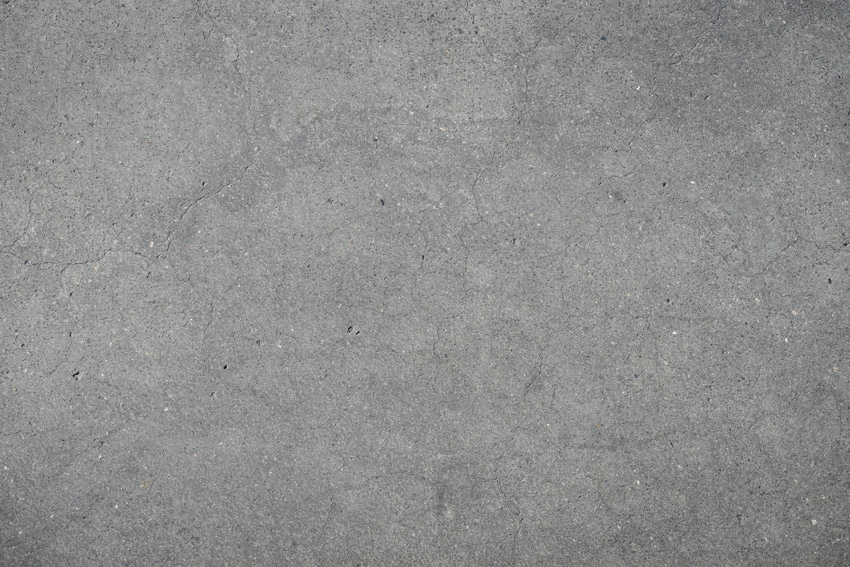
The surface of a concrete floor needs to be examined and assessed for conditions that could cause potential problems with resilient flooring placed over it.
- Dusting: When the poor surface conditions described above occur, it can also cause dusting of the surface. Dusting is defined as “the development of a fine, powdery surface that easily rubs off the surface of hardened concrete.” This is an obvious problem for adhered flooring in that the adhesives will stick to the powdery dusting but not necessarily the hardened concrete below it.
- Scaling: This condition is described as “the loss of surface mortar and mortar surrounding the coarse-aggregate particles.” This irregular surface can cause issues with flooring in that the coarse texture may cause irregularities in the flooring surface and also complicate any adhesion. Scaling is often caused by freezing within the concrete, not a chemical reaction. It may also occur if entrained air is not present to absorb pressure changes or if de-icers are used that rapidly deteriorate the concrete.
- Popouts: This is a condition that occurs primarily when impurities are found in the concrete mix, creating a small area that does not bond properly and literally pops out of the surface. It can be an obvious problem for resilient flooring in that it will leave the concrete surface with holes and pock marks that may not be tolerated by the flooring. This situation is avoided by careful attention to the mix for purity and, in some cases, by using wet-curing methods that have been shown to greatly reduce popouts caused by alkali-aggregate activity.
- Blisters and delamination: If air is trapped between the surface of the concrete and the remainder of the slab, then blisters (air pockets at the surface) or even delamination of the slab can occur. That will cause problems for resilient flooring if the blisters pop or the flooring is not fully attached to the concrete. ACI 302.1 provides eight ways to avoid blistering depending on the conditions encountered, and they should be followed accordingly.
- Spalling: This is a deeper condition than those described so far and can lead to breaks along the lines of reinforcing steel or layers of concrete in multi-layer construction. It can also occur along joint lines where the joint construction is improper. Any of these conditions can create inferior conditions for a finished slab intended to receive resilient flooring. Therefore, the advice contained in this part of ACI 302.1 should be reviewed and implemented.
- Curling: This is defined as “the distortion (rising up) of a slab’s corners and edges due to difference in moisture content or temperature between the top and bottom of a slab.” Curling may make it appear that there is a problem with the resilient flooring, but in fact it is a concrete floor issue. ACI 302.1 provides a variety of ways to help avoid this problem related to the materials, slab pouring conditions, and workmanship.
- Analysis of surface imperfections: In the event that any of the above problem conditions are believed to be occurring, ACI 302.1 recommends the use of a petrographic (microscopic) analysis on 4-inch-diameter samples of the concrete. Based on a review and analysis by a petrographer, designer, or concrete technologist, the proper problem can be identified and remedies determined to make the slab suitable to receive resilient flooring.
Overall, perhaps the most notable significance of ACI 302.1 is that it is well-known, followed, and understood by those trades that provide concrete work. However, it is equally important that those involved in flooring understand that this is the basis for most concrete floor work in terms of construction quality and suitability for construction.
Preparing Concrete Floors to Receive Resilient Flooring
Once the concrete floor is constructed, the flooring subcontractor is then faced with the task of evaluating the suitability of the slab for receiving the resilient flooring. As noted previously, it is better if a flooring representative is involved before, during, and after the construction of the concrete floor slabs. However, regardless of the project and site circumstances, the flooring contractor’s scope of work typically includes some preparation work on the concrete before the flooring is installed. In this case, the standard-practice guideline is ASTM F710-17: Standard Practice for Preparing Concrete Floors to Receive Resilient Flooring. This standard, like most ASTM standards, is developed by a committee of people representing different parts of the flooring industry. It is regularly updated based on the latest technical information and feedback from users, manufacturers, and others in the industry.
ASTM F710-17 essentially defines the ways to assess the suitability of a concrete floor and some remedial action if needed for the installation of resilient flooring. It includes suggestions for the construction of a concrete floor that are generally in sync with ACI 302.1 and are intended to help assure that the concrete floor is acceptable from the outset. Note that ASTM F710 does not cover structural performance of the floor but is focused on the necessary preparation of concrete floors prior to the installation of resilient flooring. It is also not intended to supersede the instructions or recommendations of manufacturers of specific resilient flooring or adhesives.
After some introductory information on scope, referenced standards, and terminology, ASTM F710 is broken down into four primary sections:
- General guidelines: Some general guidelines are provided that are fundamentally applicable to all concrete floors–both slabs on ground and above grade. The first of which is a “permanent, effective moisture vapor retarder…as described in [ASTM] E1745 is required under all on- or below-grade concrete floors.” This reiterates and reinforces the stance described ACI 302.1 above on the proper use of vapor retarders.
Other general guidelines relate to things like the surface of concrete floors being dry, clean, smooth, and structurally sound in order to be acceptable for resilient flooring. They also include proper filling and patching of any surface irregularities (cracks, grooves, depressions, etc.) with a latex patching or underlayment compound as recommended by the resilient flooring manufacturer. In general, the goal is to have a floor that is smooth and flat within 3/16 of an inch across 10 feet. Note that expansion joints, isolation joints, or other “moving” joints that are part of the structurally designed floor slab should never be filled, covered with resilient flooring, or otherwise restricted. Rather, they should be covered with an expansion-joint covering system. The final general guideline has to do with acclimation of the flooring products, meaning they should be delivered and stored in the space where they will be installed for at least 48 hours before the actual installation occurs. Temperature and humidity guidelines are provided with the intent that those conditions continue during and after the installation as well.
- Testing procedures for moisture and PH levels: The standard recognizes that no matter how good the specifications and workmanship might be, the only way to be sure about the conditions of the floor slab is to test them. Therefore, it provides detailed information in the standard and appendices on how to test for acceptable pH levels in the concrete to be sure they are compatible with the resilient flooring materials. For testing of moisture levels, it references other ASTM standards, including ASTM F2170-18 (discussed more in subsequent paragraphs below). In all cases, they defer to manufacturers guidelines for their own products and indicate that in the case of any conflict, the most stringent requirements shall apply.
- Guidelines for preparing new concrete floors: The primary focus of the guidelines for newly constructed floors is to be sure that the concrete is completely dried, not just cured. The standard provides some general and detailed information on this topic, indicating that differing conditions will produce differing drying times before moisture testing should be considered in advance of the installation of resilient flooring.
- Guidelines for existing concrete floors: When approaching a project with an existing slab and finishes, there has to be careful analysis of the proposed substrate. Existing adhesives, underlayment, and flooring may pose a health risk during the removal process. Mechanical removal is preferred by most resilient flooring manufacturers since chemical residue may “adversely affect” adhesives, primers, underlayments, and new flooring. Once the existing finishes and adhesives have been removed, the inspection of the concrete should entail the same process as one would follow for new concrete floors.
- Remedial measures: In the event that the conditions found are not suitable, some type of remedial measure is needed to correct the situation. This does not mean breaking up and removing the concrete floor and starting over; rather, ASTM F710 suggests that an additive material can be placed on top of the slab. This can take the form of an acceptable patching material, a continuous underlayment layer, or a topical finish. These options can help correct deficiencies in the surface or even add a layer of moisture protection between the slab and the flooring.
ASTM F710-17 includes three appendixes that, while designated “non-mandatory,” contain valuable information all geared toward additional understanding and inspection of concrete floor slabs for the installation of resilient flooring.
Testing for Concrete Floor Moisture Levels
With the multiple references to the problems and significance of moisture as a critical concern for resilient flooring, manufacturers of such flooring often require actual moisture testing be performed on a concrete floor slab before the flooring is installed. The recognized procedure for conducting that testing is ASTM F2170: Standard Test Method for Determining Relative Humidity in Concrete Floor Slabs Using in situ Probes. Its designated scope is to provide a test method that “covers the quantitative determination of percent relative humidity in concrete slabs for field or laboratory tests.” In this case, the standard defines relative humidity as the “ratio of the amount of water vapor actually in the air compared to the amount of water vapor required for saturation at that particular temperature and pressure, expressed as a percentage.”
- Summary of test methods: The basis of the testing in all conditions is the use of a small relative-humidity probe that is inserted into a hole in the concrete slab. Such holes are generally ¾ inch in diameter or less and 20–40 percent of the depth of the concrete slab measured from the top (actual size recommended depth vary based on construction conditions). The holes can be drilled using a rotary hammerdrill in hardened concrete or formed using a hollow cylindrical tube placed during forming in fresh concrete. Either way, the resulting hole is intended to receive a plastic or metal liner open only at the bottom and top, into which a humidity probe and digital meter are placed according to the specific parameters listed in ASTM F2170.
The standard indicates that three tests shall be performed for the first 1,000 square feet of floor and at least one additional test for each additional 1,000 square feet of floor. Locations should take into account potential high-moisture areas, and at least one should be within 3 feet of an exterior wall. Once the concrete is deemed ready and all probes are properly in place, the relative-humidity readings are taken and recorded, all according to the instruction in F2170. When complete, the hole liners and probes are removed and the small remaining holes filled with patching compound rated for the depth of the patch.
- Reporting: The final step of the testing is to provide a written report of the findings. This will be important not only for deciding whether to proceed with floor covering but also if other problems arise that are not related to moisture as documentation of the acceptability of relative moisture conditions. F2170 lists eight items that are needed at a minimum in the report, including project name and location, testing dates/times, and people involved. It then seeks the specifics of the tests, including location and depths of each probe, the measured relative humidity in each, the temperature in each, the ambient air temperature, and the details of the probe itself. Finally, it requires that any observations that would impact the interpretation of the results to be disclosed and discussed.
The full details of this testing along with stated limitations and cautions are all described in the F2170 document and should be referred to for a complete understanding.
Options for Moisture Membranes and Vapor Retarders
Recognizing the need for an effective means to control moisture and pass the needed testing before flooring is placed, there are three basic options to consider:
- Vapor barriers/retarders: For slab-on-grade conditions, this is the most widely used and preferred solution. Recall that ACI 302.1 is very clear about recommending a more substantial barrier (10 mils) than is commonly used (6 mils).
- Admixtures: For concrete floors either on grade or elevated, silicate admixtures have sometimes been viewed as a solution to control moisture. However, there is a good bit of confusion and misunderstanding on how effective these are. That is because adding in a silicate-based admixture into the concrete or coating the slab with a topical silicate sealant can cause a series of other issues. The first is the possibility of creating a carbonation layer over the top surface of the slab. This can interfere with the adhesion of the flooring or otherwise react negatively. Second, any interruption in the surface treatment creates a breach in that sealant layer. Hence, things like normal saw cuts or expansion/contraction joints interrupt these topical sealers and create a porous condition not only on the top of the slab but on the sides of all of those cuts and openings as well. Therefore, if this option is selected, it must be carefully reviewed with the manufacturer of the product with additional on-site work identified to address the continuity of the system.
- Moisture mitigation: In cases where the moisture levels are determined to be too high to be acceptable, a mitigation strategy is needed in the form of a topical treatment. Note that in a slab-on-ground condition, if it is confirmed that no vapor retarder is present, such a mitigation strategy should automatically be incorporated. If a vapor retarder is present and the results of ASTM F2170 show unacceptable levels of moisture, mitigation is also needed. In some cases, mitigation can take the form of continued drying and retesting, but that will require time and possible construction delays. An alternative is to provide an applied membrane to isolate the resilient flooring from the high-moisture content concrete. The standard in this case is ASTM F3010-18: Standard Practice for Two-Component Resin Based Membrane-Forming Moisture Mitigation Systems for Use Under Resilient Floor Coverings. Two-component resin-based systems are generally considered to be more effective and more reliable than other methods as a means of mitigation.

Moisture mitigation for concrete floor slabs includes using a two-part resinous coating to isolate any moisture in the concrete from resilient flooring.
ASTM F3010 covers the properties, application, and performance of this approach. It provides detailed recommendations and procedures but is not meant to supersede manufacturers’ instructions. It states clearly that this type of membrane-forming, two-component resin system is intended for use only after obtaining high results of relative-humidity testing, such as ASTM F2170 or other relevant or applicable tests. As a product, the membrane needs to provide a very low permeance with a perm rate of 0.1 perms, thus effectively providing a higher degree of protection from moisture than called for in ACI 302.1 at 0.3 perms.
The nature of such membrane systems is that they will exert some stress on the surface of the concrete. Therefore, in addition to moisture testing, the concrete slab surface needs to be tested for tensile strength according to the test method in ASTM C1583: Standard Test Method for Tensile Strength of Concrete Surfaces. Using this testing protocol, the slab to receive the mitigation membrane needs to achieve a tensile surface strength of at least 200 psi. Any area that does not needs to be ground and reworked until it does.
Once ready, the slab then needs to be prepared using shot blasting or scarification. In places where that equipment can’t reach, grinding may be used as a last choice. Any cracks or other irregularities shall be patched or repaired according to the F710 standard and manufacturer’s recommendations. All isolation, expansion, and contraction joints must be maintained. Then, the membrane products should be installed according to manufacturer’s instructions, with or without sand broadcast into the top as appropriate. For quality control, environmental conditions must be maintained, the proper thickness of the material must be achieved, any needed repairs to the membrane must be done properly, and the membrane must be protected until the installation of the resilient flooring.
Specifying the proper option for moisture control in floor slabs will help assure better performance of the flooring over the long term.
Best Practices
Based on all of the foregoing, there are three best-practice recommendations for consideration by design and construction teams:
- Inspections: The flooring contractor and/or design professional needs to inspect the concrete floor before, during, and after its construction. Input should be made to help inform and clarify requirements and conditions for the resilient flooring. If conditions are not met, the concrete floor may be rejected it for suitability unless some appropriate mitigation is performed.
- Testing and core sample access: The flooring contractor should have complete access to all testing processes and results. Similarly, access to core samples of the concrete should be made available in order to be aware of any additions or not to the concrete mix.
- Chain of custody: In a project with many stakeholders, some of the information can get passed to many different hands without a clear understanding of who has what documentation. Therefore, a clearly established chain of custody of all information related to the concrete floor slab will help everyone involved to access the relevant information whenever it is needed.
Conclusion
Providing resilient flooring over concrete necessarily requires different trades with different tasks and priorities. Yet the proper construction conditions must exist for the successful installation and long-term life of the flooring, especially when it comes to moisture and concrete surface conditions. The key to that success is a good understanding of the interplay of the performance requirements between concrete floors and the finished resilient flooring. Full cooperation and coordination between design professionals, concrete trades, and flooring trades can help assure the best results overall.
Peter J. Arsenault, FAIA, NCARB, LEED AP, is a nationally known architect, consultant, continuing education presenter, and prolific author advancing building performance through better design. www.pjaarch.com, www.linkedin.com/in/pjaarch