This CE Center article is no longer eligible for receiving credits.
Potential Glare Issues
The light source in a bollard is typically high enough off of the ground to avoid obstruction by snow or leaves, reducing the likelihood that the light from the bollard will be entirely blocked by environmental debris. However, the height of the fixture places the light source more directly in the field of view of most occupants as they enter or exit the building, which means that bollards must be considered carefully, because they pose a serious risk of causing glare and discomfort.
Glare occurs when a source of light, or reflection of a light source, creates an excessively bright spot in the visual field which can cause distraction and discomfort. The IDA and the IES recognize that the potential of a bollard to create glare is dramatically reduced if the fixture does not emit spill light above the horizontal plane. Keeping light below the horizontal plane also limits the potential light pollution that could be contributed by the fixture.
Even if the selected bollard is designed not to emit light above the horizontal plane, it could still create glare, especially in applications with steps, where occupants could look directly up into the light source of the fixture as they climb the stairs. This potential threat of glare becomes even greater if the intensity of the light source is increased due to the need to increase the level of illumination the fixture provides at the walking surface.
Potential Spacing Issues
Attempting to use a bollard that was designed to meet traditional minimum illumination requirements to deliver the increased illumination levels at the walking surface will require a re-evaluation of the necessary spacing between the bollards. Generally speaking, using traditional bollards in this manner is not advised, because the fixtures would need to be placed so much more closely together that it would require a great deal more physical fixtures to complete the project. This approach could create visual clutter in the simple number of fixtures that would be installed in a space and it may be cost prohibitive.
Pedestrian Zone Pole Lights
Pedestrian pole lights are the most common way to illuminate exterior steps, ramps, and paths of egress. These pedestrian pole lights are distinguished from the pole lights typically specified for parking lots and roadways, because they are somewhat shorter, often measuring between 10 feet and 16 feet tall. The luminaire on a pole light sits atop the pole and is often more decorative than the luminaire found at the top of a pole in a parking lot or roadway, because it is thought that a passing pedestrian would be able to appreciate the greater aesthetic detail.
 |
Intense Lighting
Photo courtesy of Intense Lighting |
Pole lights typically have a much larger distribution area than bollards or step lights and are available in CFL, high-intensity discharge (HID), high-pressure sodium (HPS), and LED lamp types.
Potential Glare Issues
The height of a pedestrian pole light, which places these light sources well within the visual field of most passersby, make glare control an important consideration. Where bollards can help control glare by not emitting light above the horizontal plane, and, instead, limiting the light distribution to the area that needs illumination, glare control in pole lights is slightly more involved. The challenge is that the pedestrians occupy the same area that needs to be illuminated, the area underneath the pole light. As designers begin to want greater illumination levels on the walking surface, it may require that the light source generate much more light, making the lamp even brighter, which will put it at an even greater risk for creating glare. Selecting pole lights with effective shielding is an important aspect of creating glare-free steps, ramps, and paths of egress and will become even more important if designs demand increased levels of illumination at the walking surface.
The Energy Use of Taller Exterior Fixtures
In terms of selecting energy efficient exterior fixtures, the selected light source, whether CFL, metal halide, LED, or something else makes a monumental impact on how much energy is required to provide the necessary illumination on the surface. The efficiency of the fixture, often impacted by the optical system within the fixture, also plays an important role. There is a variable, outside of the fixture components, that can also dramatically affect the energy required to meet illumination design goals, it is the distance of the light source from the surface it is illuminating.
Typically, it will require less energy to reach a particular illumination level the closer the light source is to the surface that needs to be illuminated. This is due, in large part, to the fact that as light travels, it illuminates everything in its path. If the light travels a shorter distance, less energy is spent illuminating the space between the light source and the intended surface.
Unfortunately, the height of a pole light can challenge the overall efficiency of the solution when compared to a shorter exterior fixture that positions the light source significantly closer to the walking surface it needs to illuminate.
An Illuminated Handrail
A relatively new innovation in exterior light fixtures is the illuminated handrail. This solution combines the handrails necessary at steps, ramps and paths of egress and the light source to provide the illumination on the walking surface into one exterior fixture. The illuminated handrail is a solid-state luminaire that uses LEDs to deliver uniform light on the walking surface in levels that exceed the 10 fc minimum now recommended by life safety codes written by ANSI and the NFPA.
 |
Sprint Campus: Kansas City, Missouri
Photo courtesy of Intense Lighting |
Technological advancements and design know-how now make it easier to specify lighting systems that provide the right amount of light, in the right location, at the right time, in the right energy footprint; however, the guidelines that define the objectives of the lighting system continue to be modified. One change that has received much attention over the past few years is the continuous whittling of the energy footprint considered allowable for a lighting system. Another change starting to appear in various model codes calls for an increase in the levels of illumination that should be provided by exterior egress lighting, up from 1 foot-candle (fc) at the walking surface to 10 fc.
This article will examine how a recommended change to the lighting system can move from a voluntary recommendation to an enforceable part of a building code that regulates the design and construction in a particular jurisdiction. It will also explore the journey of the recommended increase in illumination levels for exterior paths of egress, stairs, and ramps, including the motivations behind the change, the model codes that have incorporated it, and the states where those codes have been adopted. Various exterior lighting solutions will be compared in their ability to meet these new illumination levels, while remaining within the shrinking energy footprint now required.
Comparing Mandatory Building Codes and Model Codes
Building codes detail mandatory minimum requirements for a variety of building materials, systems, and construction processes that must be satisfied for a building to be legally constructed and occupied in the United States. Violations of building codes can be detected by local buildings or fire inspectors, who can then levy fines or delay necessary certifications, which could postpone building occupancy.
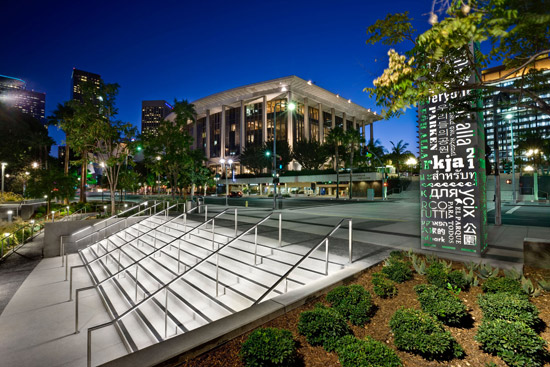 |
|
Grand Park: Los Angeles, California
Photo courtesy of Intense Lighting |
It is interesting to note that mandatory building codes are rarely written by a governmental agency. Instead, organizations such as the American Society of Heating, Refrigerating, and Air-Conditioning Engineers (ASHRAE) or the National Fire Prevention Agency (NFPA) convene committees of experts who review available data and relevant recent events and make recommendations on how building and design practices should be tweaked to improve the safety, energy efficiency, environmental impact, or some other characteristic of the built environment.
The resulting model standards are published and distributed. At this point, compliance with a particular model standard is not mandatory, it is voluntary. The standards are reviewed by governmental bodies at the federal, state, and local level. When, or if, the standard is adopted by a government body, it becomes an enforceable mandate that applies to the buildings that will be constructed within that government’s jurisdiction. For example, in 2011 the Department of Energy (DOE) recognized the ASHRAE/IES Standard 90.1-2010 as the new national energy standard. All states in the United States must be in compliance by October 18, 2013, which means that every state must put a commercial building energy code that is at least as stringent as the ANSI/ASHRAE/IES 90.1-2010 energy standard into place by that date.
Because the ASHRAE/IES Standard 90.1-2010 was adopted by a federal agency, the DOE, it uniformly affected every neighborhood in the nation, but not all code adoptions result in such sweeping change. There are over 30,000 individual jurisdictions in the United States. While there is some degree of hierarchy, federal mandates can override state mandates and states can override municipalities, there can still be significant variability, even between neighboring jurisdictions. It is the responsibility of the designer to find out what the minimum building standards are required by the local authorities.
Beyond the autonomy that can be exercised at even the most local level, there is another reason why keeping track of the applicable codes is an ongoing challenge for design teams. The standards are periodically reviewed by committee, updated, as needed, and published, where they are again reviewed by various government bodies and either adopted or not. Simply keeping track of which version of which standards have been implemented in a particular jurisdiction often requires some investigation.
Typical Illumination Requirements for Means of Egress
There are a few different standards that address design minimums for means of egress. Arguably the most widely adopted standard was written by the International Code Council® (ICC). The ICC was formed to combine many model code committees into one basic body. The ICC issues the International Building Code (IBC), which covers a broad scope of design topics that include: interior finishes, structural design, plumbing systems, elevators and conveying systems, means of egress and much more.
The IBC is revised every three years. Most recently, versions of the IBC were published in 2006, 2009, and 2012, with the next edition of the code coming in 2015. As of October 2013, 38 states had recognized the IBC 2009 or IBC 2012 as either effective statewide, adopted statewide with limitations, or adopted by local governments within the state. That adoption rate puts the 2009 IBC in contention as one of the most widely adopted and implemented construction codes in U.S. history.
 |
Grand Park: Los Angeles, California
Photo courtesy of Intense Lighting |
Due to the wide-scale adoption of the IBC 2009, the requirements outlined in the standard for means of egress could be assumed to be the most typical requirements for means of egress in place in the United States. Chapter 10, section 1006, entitled Means of Egress Illumination states that lighting system along the path of egress must provide “at least an average of 1 foot-candle and a minimum at any point of 0.1 foot-candle, at the floor level.” The standard sites a few exceptions, which include auditoriums, theaters, concert halls, etc., where “illumination levels at the walking surface is permitted to be reduced during performances to not less than 0.2 foot-candles, provided that required illumination is automatically restored upon activation of a premises fire alarm, where such a system is provided.”
The Movement to Put More Light on Exterior Steps, Ramps and Paths of Egress
Buildings cannot be designed to prevent every type of unforeseeable emergency or life threatening event, but providing passageways that enable building occupants to exit a building safely, even if it must be done quickly, in a crowd, or under duress is critical. Unfortunately, the rare, but catastrophic building events, such as the attack on the World Trade Center in 2001, highlight the importance of safe stairs, stairwells, and emergency exits in the built environment. In addition, the National Safety Council reports that over 200,000 people visit hospital emergency rooms annually to treat injuries that occurred on steps, which has lead many in the business of building safety to wonder if there is something else that could be done to provide safer exterior steps, ramps, and paths of egress.
Stair and stairwell safety have been the subject of detailed scientific research that has generated a respected body of published results and general speculation that has generated some interesting anecdotal evidence. Time and time again it has been proven that improving the illumination levels around the stairs, improved the visibility of the stairs, which improved the public’s ability to safely navigate the stairs.
Whether in response to these findings, or simply in addition to them, some of the expert committees for organizations like the NFPA and the American National Standards Institute (ANSI) have decided to increase the minimum level of illumination recommended at the floor surface, also referred to as at the tread.
2009 NFPA 1, Fire Code
The 2009 NFPA 1, Fire Code addresses fire protection and life safety issues, providing requirements necessary to establish a reasonable level of fire safety and property protection. The code was developed in collaboration with fire service, fire safety, manufacturers, and insurance and building professionals.
The life safety codes in this standard have been updated to recommend that steps, ramps, and paths of egress be illuminated with a minimum of 10fc at the tread during occupancy.Specifically, the 2009 NFPA 1, Fire Code, Section 14.12.1.3 states that “during conditions of stair use, the minimum illumination for new stairs shall be at least 10 foot-candles, measured at the walking surface.”
Section 14.12.1.3, states that the floors and other walking surfaces within an exit and within the portions of the exit access and exit discharge designated in 14.12.1.1 shall be illuminated:
During conditions of stair use, the minimum illumination for new stairs shall be at least 10 foot-candles (108 lux), measured at the walking surfaces.
|
Pull quote of 2009 NFPA Fire Code requirement.
|
At least 18 states have adopted this version of the NFPA 1, Fire Code, including: Wisconsin, Hawaii, Maryland and Delaware.
2009 NFPA 101: Life Safety Code
The 2009 NFPA 101® Life Safety Code® is the source for strategies to protect people as it relates to building construction, fire protection and occupancy. The standard includes requirements for egress, fire protection, sprinkler systems, alarms, emergency lighting, smoke barriers, and other protective measures for special hazards.
Regarding illumination requirements for stairs, section 7.8.1.3 states, “During conditions of stair use, the minimum illumination for new stairs shall be at least 10 foot-candles, measured at the walking surface.”
Regarding the emergency illumination along paths of egress, section 7.9.2.1 states that “emergency lighting facilities shall be arranged to provide initial illumination that is not less than an average of 1 foot-candle and, at any point, is not less than 0.1 foot-candle, measured along the path of egress at floor level.”
The Life Safety Code is a widely used resource. It is used, in some respect, in all fifty states in the United States and has been formally adopted by 43 state legislatures.
2009 NFPA 5000® Building Construction and Safety Code®
The NFPA 5000 code addresses building design for the safety of the occupants. Chapter 11 includes Means of Egress and section 11.8.1.3 states that “floors and other walking surfaces within an exit shall be illuminated as follows: during conditions of stair use, the minimum illumination for stairs shall be at least 10 foot-candles, measured at the walking surface.”
2003 ICC/ANSI A117.1
The ANSI standard A117.1 outlines criteria for accessibility and the 2003 edition attempted to improve the coordination between the requirements of this standard and the Fair Housing Accessibility Guidelines (FHAG) and the Americans with Disabilities Act Accessibility Guidelines (ADAAG).
Section 504.8.1, titled Illuminance Level states, “Lighting facilities shall be capable of providing ten foot-candles of illuminance, measured at the center of tread surfaces and on landing surfaces within 24 inches of the step nosing.”
In summary, recent versions of fire and life safety model codes penned by the NFPA and model codes written by ANSI recommend that stairs, ramps, and paths of egress receive a minimum level of illumination of 10 fc at the walking surface, up from the 1 fc traditionally recommended. Other model code organizations are also reassessing their requirements as it relates to illuminating steps, ramps and paths of egress and are currently reviewing proposals to increase the recommended illumination levels to 10fc at the tread, during occupancy.
Typical Designer Concerns
When designers learn of this recommendation to increase minimum illumination levels at the treads on paths of egress, stairs and ramps, there are two typical concerns that are raised.
 |
Packing House: Anaheim, California
Photo courtesy of Intense Lighting |
The Shrinking Energy Footprint
One is the feasibility of providing the extra illumination, while remaining within the ever-shrinking lighting energy footprint that is allowed for these areas. For example, the ASHRAE/IES Standard 90.1-2010, adopted by the DOE as the national energy standard, has reduced the allowable watts per square foot for stairways to 1 W/f2.
The improved efficiency of available light sources, such as the light emitting diode (LED), and the continuing improvements in the optical systems now found in fixtures make it increasingly possible to meet the seemingly disparate goals of increasing illumination levels, while decreasing the total energy used to provide the illumination. An LED can produce between 50 and 120 lumens per Watt. The new recommended minimum illumination level of ten footcandles is equivalent to 107.6 lumens, well within the amount of illumination that an LED can generate from one Watt. Depending upon the efficiency and distribution pattern of the specific fixture selected, it is certainly possible for an exterior lighting fixture to provide the recommended illumination levels within the more stringent energy footprint.
Preventing Light Pollution
The other concern is the potential for light pollution that the increased levels of exterior illumination could pose.
The International Dark-Sky Association (IDA) is a non-profit organization dedicated to the preservation of the night sky and the elimination of light pollution. The IDA defines light pollution as any adverse effect of artificial light, including sky glow, glare, light trespass, light clutter, decreased visibility at night and energy waste.
The IDA has identified quality, environmentally responsible outdoor lighting as one of the most critical components in their combat of light pollution. To help designers identify and promote the specification of these quality fixtures, the IDA has developed a Fixture Seal of Approval program. The program employs a third party rating system that uses photometric readings to determine the dark-sky-friendly nature of a particular fixture. Over 100 manufacturers currently offer over 300 IDA-approved exterior lighting fixtures and the IDA expects participation in the Fixture Seal of Approval program and the number of approved fixtures to continue to grow.
A Fixture Seal of Approval is not the only way to identify an exterior fixture that would be deemed dark sky friendly. In 2011, the IDA and the IES collaborated on a model code entitled the Model Lighting Ordinance (MLO). The MLO introduced a new classification system for exterior fixtures, referred to as the Backlight-Uplight-Glare (BUG) rating system. This new rating system is intended to replace the cutoff classifications, previously used by the IES, where an exterior fixture was identified as full cutoff, cutoff, semi-cutoff, and non cutoff. While the cutoff classification system was initially focused on brightness and glare control, increasing demand for control of uplight and light trespass led the IES to determine that a more comprehensive rating system was necessary and so the BUG rating system was developed.
Evaluating Options for Illuminating Exterior Steps, Ramps, and Paths of Egress
Four solutions that can be used to provide exterior illumination on steps, ramps, and paths of egress are step lights, bollards, pedestrian pole lights and illuminated handrails. These solutions can vary dramatically in the size of the light distribution pattern and the possibility that environmental elements may totally obstruct the illumination from the fixture. There are also notable differences in the possibility that the fixture could cause glare in the exterior environment and the overall efficiency of the system.
Step Lights
Steps lights are a common solution used to illuminate steps in both indoor and outdoor applications. These light fixtures are small and located in the steps or in the walls at step level. Step lights are typically designed to illuminate a relatively small area near the fixture. They come in a variety of shapes and finishes and are available in a wide range of light sources, including compact fluorescent (CFL), metal halide, halogen, and LED. The availability of highly efficient light sources, such as LED, indicates that step lights are good candidates to be able to provide increased levels of illumination, without exceeding allowable energy limits. While there are step lights that provide illumination levels that exceed the current requirement of 1fc at the floor surface, the products available to provide 10fc at the floor surface may be limited.
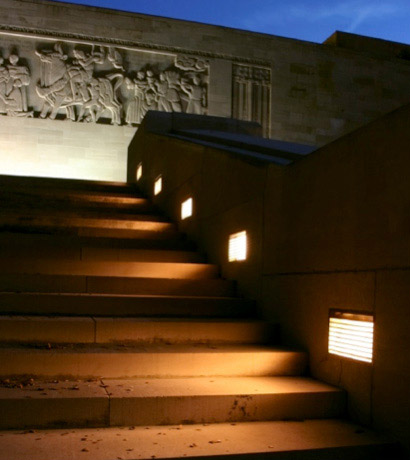 |
Intense Lighting
Photo courtesy of Intense Lighting |
Maintenance Considerations
Many of these step light fixtures have gaskets. Over the years, maintenance personnel routinely ruin, lose, or discard the gasket, allowing water to seep into the fixture and ruin the electrical components inside the fixture housing.
Potential Obstruction
One of the greatest weaknesses of the step light solution is that the light from these fixtures can be blocked by any obstacle on the steps. People walking up the stairs holding onto a handrail would potentially walk close enough to block the light with each step. Also, any debris on the steps, such as snow or leaves piled along the wall would prevent the step lights from illuminating the steps as intended.
Bollards
Bollard lighting fixtures are short, vertical posts often used to illuminate exterior steps, ramps, and paths of egress. Typical lighting distribution patterns of bollard lighting fixtures are much larger than the distribution patterns provided by step lights. The larger distribution pattern enables bollards to be spaced further apart than step lights, while still providing the necessary level of illumination on the walking surface.
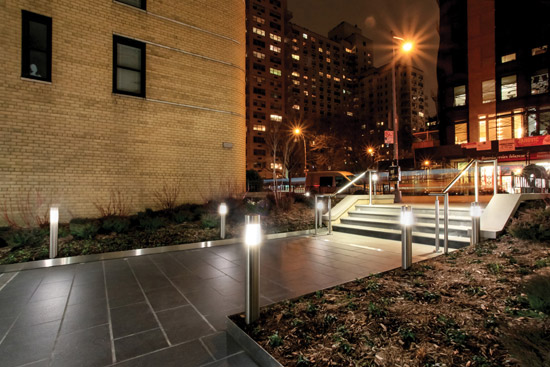 |
85 4th Ave: New York, New York
Photo courtesy of Intense Lighting |
Bollards are available in a variety of materials and with a wide range of light sources, including CFL, incandescent, metal halide, and the highly efficient LED.
Potential Glare Issues
The light source in a bollard is typically high enough off of the ground to avoid obstruction by snow or leaves, reducing the likelihood that the light from the bollard will be entirely blocked by environmental debris. However, the height of the fixture places the light source more directly in the field of view of most occupants as they enter or exit the building, which means that bollards must be considered carefully, because they pose a serious risk of causing glare and discomfort.
Glare occurs when a source of light, or reflection of a light source, creates an excessively bright spot in the visual field which can cause distraction and discomfort. The IDA and the IES recognize that the potential of a bollard to create glare is dramatically reduced if the fixture does not emit spill light above the horizontal plane. Keeping light below the horizontal plane also limits the potential light pollution that could be contributed by the fixture.
Even if the selected bollard is designed not to emit light above the horizontal plane, it could still create glare, especially in applications with steps, where occupants could look directly up into the light source of the fixture as they climb the stairs. This potential threat of glare becomes even greater if the intensity of the light source is increased due to the need to increase the level of illumination the fixture provides at the walking surface.
Potential Spacing Issues
Attempting to use a bollard that was designed to meet traditional minimum illumination requirements to deliver the increased illumination levels at the walking surface will require a re-evaluation of the necessary spacing between the bollards. Generally speaking, using traditional bollards in this manner is not advised, because the fixtures would need to be placed so much more closely together that it would require a great deal more physical fixtures to complete the project. This approach could create visual clutter in the simple number of fixtures that would be installed in a space and it may be cost prohibitive.
Pedestrian Zone Pole Lights
Pedestrian pole lights are the most common way to illuminate exterior steps, ramps, and paths of egress. These pedestrian pole lights are distinguished from the pole lights typically specified for parking lots and roadways, because they are somewhat shorter, often measuring between 10 feet and 16 feet tall. The luminaire on a pole light sits atop the pole and is often more decorative than the luminaire found at the top of a pole in a parking lot or roadway, because it is thought that a passing pedestrian would be able to appreciate the greater aesthetic detail.
|
Intense Lighting
Photo courtesy of Intense Lighting |
Pole lights typically have a much larger distribution area than bollards or step lights and are available in CFL, high-intensity discharge (HID), high-pressure sodium (HPS), and LED lamp types.
Potential Glare Issues
The height of a pedestrian pole light, which places these light sources well within the visual field of most passersby, make glare control an important consideration. Where bollards can help control glare by not emitting light above the horizontal plane, and, instead, limiting the light distribution to the area that needs illumination, glare control in pole lights is slightly more involved. The challenge is that the pedestrians occupy the same area that needs to be illuminated, the area underneath the pole light. As designers begin to want greater illumination levels on the walking surface, it may require that the light source generate much more light, making the lamp even brighter, which will put it at an even greater risk for creating glare. Selecting pole lights with effective shielding is an important aspect of creating glare-free steps, ramps, and paths of egress and will become even more important if designs demand increased levels of illumination at the walking surface.
The Energy Use of Taller Exterior Fixtures
In terms of selecting energy efficient exterior fixtures, the selected light source, whether CFL, metal halide, LED, or something else makes a monumental impact on how much energy is required to provide the necessary illumination on the surface. The efficiency of the fixture, often impacted by the optical system within the fixture, also plays an important role. There is a variable, outside of the fixture components, that can also dramatically affect the energy required to meet illumination design goals, it is the distance of the light source from the surface it is illuminating.
Typically, it will require less energy to reach a particular illumination level the closer the light source is to the surface that needs to be illuminated. This is due, in large part, to the fact that as light travels, it illuminates everything in its path. If the light travels a shorter distance, less energy is spent illuminating the space between the light source and the intended surface.
Unfortunately, the height of a pole light can challenge the overall efficiency of the solution when compared to a shorter exterior fixture that positions the light source significantly closer to the walking surface it needs to illuminate.
An Illuminated Handrail
A relatively new innovation in exterior light fixtures is the illuminated handrail. This solution combines the handrails necessary at steps, ramps and paths of egress and the light source to provide the illumination on the walking surface into one exterior fixture. The illuminated handrail is a solid-state luminaire that uses LEDs to deliver uniform light on the walking surface in levels that exceed the 10 fc minimum now recommended by life safety codes written by ANSI and the NFPA.
|
Sprint Campus: Kansas City, Missouri
Photo courtesy of Intense Lighting |
Eliminate Potential Glare
The illuminated handrail offers an interesting solution to the potential glare that can be an issue when specifying bollards or pole lights, especially on stairs or areas with dramatically changing elevations. The handrail is designed, so that it will not emit light above the horizontal plane, but many bollards are designed to offer the same cutoff angle. The difference between the glare protection offered by a bollard and an illuminated handrail results from the ability of the handrail to travel along the stairs, instead of being positioned, like a bollard, where it will be above some points on the stairway and below others. The illuminated handrail matches the changes in elevation step by step. This improved fit can significantly reduce the risk that an occupant would ever find themselves underneath the illuminated handrail in a way that would expose them to a direct view of the light source and potentially cause them discomfort.
An Energy-Efficient Exterior Lighting Solution
The illuminated handrail packages the most energy-efficient light source, the LED, in a way that minimizes the excess distance between the walking surface and the light source, because the handrail is essentially an important element of the path of egress itself. This combination of an efficient light source and unparalleled proximity to the path enables the illuminated handrail to provide an illumination solution that is as efficient, if not more efficient, than other pole light and bollard solutions considered for the same space.
Using Illuminated Handrails Beyond Paths of Egress
Illuminated handrails also offer a unique fit for healthcare settings and multi-level atriums. In healthcare settings, handrails are used commonly throughout the facility, because of the often-compromised mobility of the patients. Using illuminated handrails in corridors with patient rooms adequately illuminates the walking surface, without filling the space with excess light that may seep into patient rooms and disturb their sleep. In multi-level atriums, the illuminated guardrails provide the desired light levels around the perimeter of the atrium and they are easy for maintenance personnel to access and maintain.
 |
Alabaster Caverns State Park: Freedom, Oklahoma
Photo courtesy of Intense Lighting
|
When specifying the right exterior light fixture for a step, ramp, or path of egress, the ideal level of illumination may be the first design objective that should be identified. Depending upon the applicable building codes, and the liability concerns of the client, exterior fixtures may be tasked with illuminating the walking surface in a minimum 10fc. Luckily, new innovations in exterior fixtures, such as illuminated handrails will enable design teams to provide the right amount of light, in the right location, at the right time, and within the allowable energy footprint.
 |
Intense Lighting, (Anaheim, CA) is recognized as a solutions-based manufacturer of award-winning, sustainable lighting products. Our innovative and efficient luminaires offer a variety of specification grade lighting solutions for commercial, hospitality, retail and residential markets. It’s our mission to deliver quality products, quick shipping lead times, competitive pricing and excellent service. http://www.intenselighting.com/ |