This CE Center article is no longer eligible for receiving credits.
The project was complete for several years. It was an impressive design with vast expanses of vision area and windows. Soon, the building owner begins to notice a clouded effect in between the panes of some of the insulating glass units. On closer inspection, the architect finds something missing on the windows: the certification stamp on the window spacer materials within the insulating glass units that indicate testing and certification to current industry standards. The owner, architect, specifier and contractor begin a tug-of-war over who is responsible and worse yet, who will replace the windows and eat the cost to install new units which meet third- party testing and certification programs.
Fast forward to ongoing efforts by the Insulating Glass Manufacturers Alliance (IGMA), the North American organization representing certified insulating glass manufacturers. One of IGMA's primary strategic initiatives is to harmonize industry standards and raise the bar on quality. IGMA was formed in October 2000 as a result of the merger between the Sealed Insulating Glass Manufacturers Association (SIGMA) and the Insulating Glass Manufacturers Association of Canada (IGMAC).
|
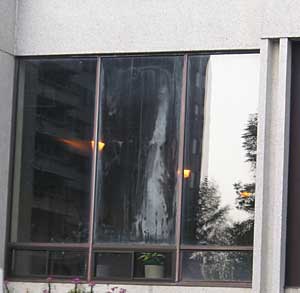
| Failed Insulating Glass Unit
Showing Volatile Fogging |
IGMA was one of the leaders in merging ASTM E 773/E774 (also known as CBA) with the CGSB (Canadian General Standards Board) 12.8 standard to successfully complete a new document across the U.S. and Canada (ASTM E 2188, E 2189, E 2190); one that expands the global marketplace for insulating glass units and provides a single cohesive and consistent updated certification program for manufacturers to test their products. This new test specification has been published as ASTM E 2190 Standard Specification for Insulating Glass Unit Performance & Evaluation.
IGMA is on a mission to rid the specification community of non-certified and un-tested insulating glass units, and the first accomplishment in that direction is the recent release of the IGMA Certification Program for the ASTM E 2190 standard.
History Holds Evolution
Margaret Webb, IGMA executive director, takes the effort quite seriously, almost personally. On the job, visiting members, attending meetings, she is quick to examine any and all windows during her travels, searching relentlessly for that stamp on the spacer bar indicating the IGU has met the certification program requirements. That "seal of approval" is an etched marking on the window spacers between the glass or a label on the glass itself and identifies the IGU manufacturer, plant location, certification program and date of manufacture.
"Without proper third-party certification, there's a chance IG units will fail, and that leaves a bad taste in the mouth of the industry and the end-user," Webb says. "The mechanism for scientific testing and procedures has now been carefully established and documented by a consensus of industry members and third-parties and much time and effort has been spent by IGMA and other organizations to bring this document to market. There's not a single reason to not test to this new standard−it brings a higher level of understanding, credibility and performance to the manufacturing process in the creation of IG units in the U.S. and Canada.
"Why should the architect care? Because it's up to them to bring to their end-user the best performing products on the markets, ones tested to certified standards in real-world performance applications and with the longevity of the individual unit first and foremost," she said. "No one", she adds, "wants to see insulating glass units that fail, leak or worse yet, look like an eyesore in an otherwise reputable building façade."
Field Correlation Study Provides Backbone
In 1980, SIGMA and HUD (Housing and Urban Development) funded a 25-year field study to determine the correlation of field failures to ASTM E 774 Class C, vs. Class CB, vs. Class CBA with the CBA class representing the most stringent level of testing. ASTM E 773 and E 774 were predecessor standards to the new harmonized standards identified as ASTM E 2188, E 2189 and E 2190. This study was completed in December 2005 with the final report covering the 25 year period published by December 2006. (Final reports Preliminary data results on the study were due out presented in February 2006.)
The study included 140 buildings in 40 cities containing a total of 40,000 certified IG units of which 2/3 were field-glazed commercial units and 1/3 were residential window units. Of this total sample, the field failure rates of 2,400 IG units in 140 buildings in 14 cities were actually studied.
Performance varied little from hot to cold climates, wet to dry climates or sea level to mountain exposures. Eighty percent of the buildings had no failures at all and glazing systems that held water at or near the edge sealant had accelerated sixty percent of the failures that did occur in the remaining buildings.
The 25-Year Field Correlation Study actually encompasses two separate studies. The original study, co-funded by SIGMA and HUD, was started in 1980 and included sampling from 140 buildings in 40 cities containing 40,000 certified insulating glass units with representative constructions. Locations of the units were supplied by 28 manufacturers with multiple plant locations. 2,400 units were selected of which 2,100 were accessible at 10 years; 1,952 at 15 years and 1,714 at the 25 year mark.
The second study started in 1990 included newer technologies and a larger sample size of which over 10,000 units were accessible at the 15 year mark. The second study only looked at CBA units from 102 buildings representing 52 manufacturing plants.
Of interest to the industry is that the failure rate observed from the 1990 study representing units at the 15-year mark (1.0%) corresponded to the failure rates of the original 1980 study at the 15-year mark (1.2%) providing further validation of the findings of the first study.
25 Year Field Correlation Study
Summary Survey Failures Rates at December 2005 |
| |
1980 Study |
1990 Study |
| |
25 Years |
15 Years |
15 Years |
| |
C+CB |
CBA |
C+CB |
CBA |
CBA |
| Failure rate |
14.0% |
3.6% |
5.9% |
1.2% |
1.0% |
| # of Units |
917 |
797 |
786 |
760 |
10.944 |
|
The results of this study were provided to the ASTM E06 task group that worked on the harmonization of the ASTM E 773 / E 774 (CBA) and the CGSB 12.8 (Canadian General Standards Board) standards with the recommendation to eliminate the lower levels of testing (i.e., Class C and Class CB). This recommendation was adopted and the new standard was published in April 2002, (ASTM E 2188, E 2189 and E 2190). The predecessor standard, ASTM E 774 was withdrawn by ASTM in February 2006, so it will no longer be considered part of the documentation for the current standard. One specific recommendation from the study was that ASTM certified units should be glazed with systems that keep water ingress at a minimum and weep water that gets in the glazing system away from the edge sealant.
The results of the survey also formed the basis for recommending to the U.S. Department of Energy the requirement to include insulating glass certification as a requirement for Energy Star Windows to address long term durability and energy performance. This recommendation is currently under review by both the U.S. Department of Energy and the National Fenestration Rating Council (NFRC).
Best, Healthy Practices
The importance of managing water in the glazing cavity is a critical factor in the performance and longevity of certified insulating glass units. Water held at or near the edge seal of an insulating glass unit will result in premature failure, cause structural damage to the glazing system, and may result in the formation of mold. The formation of mold and its effect on the occupants of a structure continues to be a prime health and safety concern for architects when designing buildings.
The IGMA Field Correlation Study included two buildings with poorly designed glazing systems and while the certified units performed better, these units failed prematurely to their counterparts held in properly weeped glazing systems. A properly weeped glazing system is another integral factor in insulating glass unit performance. Again, IGMA encourages the industry to adhere to best practices to help do its part to encourage the highest level possible certification, and as such, address the mold issue in buildings and especially, the envelope openings.
IGMA and the Insulating Glass Certification Council (IGCC) have endorsed and agreed to move forward toward certification and testing to the ASTM E 2190 standard only. It's a simpler way for manufacturers to meet testing criteria and bring the best certified product to market.
The IGMA Certification Program removes the requirement for manufacturers to certify to two jurisdictions, effectively eliminating an artificial "trade barrier" between Canada and the U.S. With an increased emphasis on a global marketplace, the harmonized standard sets the stage for certification and recognition in Europe. Together, these efforts are designed to encourage the production of an insulating glass unit that will provide greater longevity and less chance of failure and is easier to specify and market across the window industry's ever-expanding borders.
Additionally, IGMA and the IGCC have agreed to work together to "standardize" the certification process in North America, harmonizing requirements to provide cost-effective certification programs with the long-range goal to completely synchronize the two programs.
Of course, insulating glass units will not last forever and never is not in the vocabulary of the standard. Rarely is there a product in any market that can last forever or remain problem-free for life. But with this updated and rigorous test standard, insulating glass units are designed to last longer than ever, avoiding the same problem that the fictitious building owner and his contractors faced in the scenario described above.
"The significance to the architect is that ultimately, the certification results in insulating glass units with greater longevity," said Mike Burk, training manager for GED Integrated Solutions, Twinsburg, Ohio. Burk chairs the IGMA Certification and Education Committee and is a past member of the organization's Technical Services Committee.
"We know when manufacturers' product lines are third-party certified, the end-result is better performing insulating glass units," Burk said. "In many respects, the new standard has tougher criteria, such as stricter accelerated environmental testing and allowable frost points, for example," he stated.
In the past, and with multiple standards for IG units, manufacturers had to test to one or more, presenting a logistical and financial burden. Code officials were equally confused with regard to which standard to follow.
"The harmonized certification program gives the architect a system that is up to date with current testing and procedures," says Bill Lingnell P.E., owner of Lingnell Consulting Services, Rockwall, Texas, and IGMA Technical Consultant. "In essence, we are assisting manufacturers on how to make a long-term insulating glass unit and that benefits the industry, architect, specifier, contractor and end-user," he continued.
Lingnell added that updated test methods and specifications have been added to the standard, some more stringent than predecessor documents. "For architects, the specification and use of certified insulating glass allows them to serve the client with proven tested products. There have been major changes and the standard has been updated overall and IGMA and others are doing their best to disseminate that information. Now, manufacturers have one standard, one test and one certification protocol to adhere to, rather than trying to decide which of several to follow," he said.
During the process, IGMA and its members have been actively involved in the harmonization of insulating glass standards not only between Canada and the U.S. but also through the Committee for Standardization (CEN) and International Organization for Standardization (ISO). Lingnell is the convener of the ISO Technical Committee 160, Subcommittee 1, Glass in Buildings, Working Group 4, Insulating Glass. This group is working on the acceptance of two approaches for the ISO standard, with one incorporating ASTM E 2190 (North American) and the other EN 1279 (European) Standard under the ISO development process. "The working document has been accepted by the ISO committee. It is anticipated that the standards governing insulating glass will be in an ISO document internationally in early 2007," he added.
Certification and testing to a current and state of the industry standard is critical to the longevity of any product and especially, insulating glass units.
"Overall, the goal of the standard is to simplify the procurement, purchasing and specification of insulating glass units," said David W. Bailey, P. Eng. and Operations Manager, Engineering & Transportation, Bodycote Materials Testing Canada Inc., Mississauga, Canada. Bailey participated in reviewing Harmonized Insulating Glass Standard (HIGS) Committee work and currently holds a position on the IGMA Technical Services Committee. "With the harmonized standard, the manufacturer can test to one standard and deliver product to the U.S. and to Canada. Instead of lab testing to three standards, they can test to one," he said.
Bailey said tests were conducted side-by-side of each standard's criteria to make certain the new standard was at a minimum as rigorous as the standard it replaced. "The standard brings quality, proven products to market, bottom line. A lot of units are not certified, and some of that is a direct result of confusion about which applicable standard to certify to. This harmonized standard will also result in getting more certified IG units to market. In addition, it will be easier for one consistent standard to be recognized by building code bodies, who will also begin to realize the benefits. Architects need to be warned that they can quickly get into problems using a unit that is not certified."
Bailey said architects need to look for the label inside or on the windows and only specify sealed insulating glass units that are certified. The glass spacer is marked or other labels make this designation. "It's the architect's checkpoint for quality," he said.
Who Certifies and Why?
IGMA and the IGCC continue to move the industry forward to testing to the ASTM E 2190 Standard. As a manufacturer, user, buyer or certifier of insulating glass units, products tested and certified to the ASTM E 2190 should be equal to or improved over ASTM E 774 (CBA) or CGSB 12.8 IG units (see Harmonized IG Standards Comparison Chart). IGMA has made it easy for manufacturers, architects and others to get this information and provides a host of support materials and other documentation in support of the standard as well as a non-member Technical Advisory service.
The standard is designed to provide the same or greater tolerances for the tests listed, i.e., it at least meets the standard it replaces and in many cases exceeds it. IGMA has the most stringent quality assurance requirements for certification; 16 of the 20 elements required for ISO 9000. For more detailed information on the differences between the ASTM E 774 (CBA) and the CGSB 12.8 standards and the new harmonized insulating glass standards, contact the IGMA offices or visitwww.igmaonline.org/certification/IGMA.
"It is expected that irrespective of industry affiliation, the certification is obtained by insulating glass manufacturers who are committed to their customers and their products," Webb added.
As an architect, there are things which can be done to play a positive role in the use of insulating glass units. Ask the window manufacturer about certification before specifying IG units. Although they rarely make the glass, they are aware of or have access to the standards that their glass and glazing suppliers follow.
In the Field
Architects and specifiers in the field count on manufacturers to help them determine the proper insulating glass for the application, and also to ensure the units they select are tested and certified to current industry requirements. Architectural firms that work on large commercial projects are conscious of the positive attributes of insulating glass units and want to ascertain that the proper specification is made.
Nuts & Bolts of IGMA Certification |
The Certification Cycle consists of three areas, all under the mandate and direction of an administrator.
Manufacturers fabricate insulating glass (IG) units;
Independent auditors, accredited to ANSI or equivalent, inspect units to ensure conformity to the manufacturers specifications and the program requirements;
Approved laboratories (accredited to ISO 17025) ensure conformance to the applicable test standard.
Three industry publications provide technical support to insulating glass manufacturers: TM-4000-02, The Insulating Glass Manufacturing Quality Procedures Technical Manual, TM-4100-03 Preventing Insulating Glass Failure Technical Manual and TM-3000-90(04) North American Glazing Guidelines For Sealed Insulating Glass Units For Commercial and Residential Use.
IGMA only accepts laboratories with third party accreditation to ISO 17025, Calibration and Testing Laboratories. Program administrators inspect each laboratory to the ASTM E 2188, E 2189 and E 2190 standards.
Certified product lines are identified by a permanent mark on the inside of the insulating glass unit bearing the IGMA trademark, identification of the manufacturer, the plant location and the year of manufacture. |
|
Gunny Harboe AIA, Director of Preservation Architecture at Austin/AECOM in Chicago, and a past president of the American Institute of Architects, has used insulating glass when visual impacts were minimal and the structure allows. Harboe comments that even on historic work they have used insulating glass to take advantage of energy savings. "If it can improve the insulating qualities of the façade with minimal impact to the historic integrity of the building we will use it," Harboe adds. "Each building and window type presents its own situation but there are always many small details that need to be addressed for it to be done successfully," he says. Harboe and Austin/AECOM architects were responsible for the award-winning restorations of the Reliance Building-Hotel Burnham and The Rookery, two late nineteenth century buildings and recent National Historic Landmark projects in Chicago. In the Reliance Building, Austin/AECOM preservation architects had to replace the all-wood windows and were able to specify insulating glass units while meeting historic guidelines.
For Tom Engstrand AIA, manager of Quality Assurance at Austin/AECOM one important consideration with glass specification is solar heat gain coefficient or SHGC. On projects where glass and aluminum are combined in a curtain wall trying to obtain an overall SHGC for the glazing system, the manufacturer provides aids in determining the overall rating. "Much of the information we obtain comes from the manufacturer," says Engstrand.
Mark Sexton AIA and principal of Krueck & Sexton Architects in Chicago concurs that finding the right supplier is key to properly specified insulating glass. "You have to partner with good manufacturers," Sexton says. "There are a lot of things to look at from both an aesthetic and architectural perspective with regard to insulating glass, including the spacers and other materials. We're able to specifically pick materials with our particular glass supplier."
Krueck & Sexton Architects continues to receive recognition and accolades for its designs, which often involve expanses of glass facades and innovative curtain walls. The company received a 2005 Landmark Award for Preservation Excellence from the Commission on Chicago Landmarks for the Mies van der Rohe S.R. Crow Hall on the Illinois Institute of Technology's College of Architecture campus. Gunny Harboe of Austin/AECOM served as preservation architect on that project as well.
"We continue to push the envelope with material selection and glass," Sexton adds. The reason for certification, generally within any standard, is to provide end users, whether window and door manufacturers, building code officials, architects and specifiers or home buyers, the assurance that they are buying a product that meets or exceeds the applicable code or standard. A certification program can be both simple and complex. In simplistic terms, a product is certified to the applicable standard, such as ASTM E 2190 and a process of initial and ongoing inspection and testing is implemented to ensure it conforms to the standard. The maintenance of the program may be more complex, and involves a formal code cycle and the certification program requirements such as on-going adherence to the quality assurance program, especially if technology changes and the standard requires revision. In addition, some products may need to be recertified as lines change.
History and Relevance
In 1996, a group of leaders in the Insulating Glass industry recognized a need for the North American insulating glass testing and certification processes to harmonize requirements. The Harmonization of Insulating Glass Standards (commonly referred to as HIGS) initiative was formed in early 1997 and the ASTM E 2190 standard was approved in June 2002.
Specifically, the ASTM harmonized standards are:
- E 2188 Standard Test Method for Insulating Glass Unit Performance,
- E 2189 Standard Test Method for Testing Resistance to Fogging in Insulating Glass Units, and,
- E 2190 Standard Specification for Insulating Glass Unit Performance and Evaluation.
This last referenced standard provides the testing protocol for insulating glass units. There are some minor differences in some of the temperatures used and sample sizes required in the ASTM E 2190 Standard. These differences are mostly attributed to conversions from English to metric units. The main differences can best be described by separating the standard into three parts: the high humidity test, the accelerated weathering test and the volatile fog test.
High Humidity Test
In this test, IG samples are subjected to high humidity and temperature. The objective is to force moisture into the hermetically sealed cavity of the IG unit. All three standards use the same type of box and similar high temperatures. The CGSB 12.8 cycles the units from 22°C to 55° C. E 773 and the ASTM E 2190 test method have no cycling. However, both the ASTM
E 2190 and E 773 have 50% more time in the high-humidity box. Furthermore, CGSB 12.8
uses separate samples for the high humidity test and the accelerated weathering. The ASTM
E 2190 and E 773 test require the same samples be used in both high humidity and accelerated weathering.
|
| Insulating glass samples are subjected to high
humidity and temperature tests. |
Accelerated Weather Cycling
This test is used to simulate weather cycling from hot to cold extremes with moisture added during the hot cycle. The cycling boxes are essentially the same for all three methods. However, both ASTM E 2190 and E 773 have UV radiation during cycling. The CGSB 12.8 test has no UV. As noted previously, ASTM E 2190 and E 773 are required to test the same units in both the high humidity and accelerated weather cycling, while CGSB 12.8 allows separate samples for each test. CGSB 12.8 has more cycles (320 versus 252) but the cycles are of shorter duration than ASTM E 2190 and E 773 (63 days versus 53.3 days). The criterion for passing this test is a frost point of -40°C for both ASTM E 2190 and CGSB 12.8. For E 773, the criterion is warmer, -20° C.
 |
|
| Scientific testing procedures are part of the standard's requirements. |
Volatile Fog Test
This test is used to show that the components in an insulating glass unit will not out-gas a volatile fog, which could result in a deposit on the interior glass surfaces. All three tests use UV radiation and elevated temperatures to accelerate the effects. ASTM E 1887 has a slightly higher UV output than ASTM E 2190 or CGSB 12.8, but it does not place the test samples in a box. In ASTM E 1887 only one corner of the sample sees the UV radiation and elevated temperature. ASTM E 2190 and CGSB 12.8 uses a temperature that is 10°C higher than ASTM E 774 (60 versus 50° C). However, ASTM E 2190 uses stricter evaluation criteria for viewing the fog. ASTM E 2190 has the observer view the fog at any angle with the sample at arms length. CGSB 12.8 uses a complicated viewing box with the observer at 2 m from the sample looking "normal" to the glass surface.
|
| This test shows that insulating glass unit components will
not out-gas a volatile fog. |
Argon and Krypton Certification
Since 1997, IGMA has offered certification for initial gas fill such as argon and krypton in addition to the conventional durability certification testing to the ASTM E 2190 specification.
To participate in this part of the IGMA Certification Program, the insulating glass manufacturer must gas fill all test samples and achieve an initial gas fill level of 90%, averaged over 10 test specimens in order to achieve this certification designation. Manufacturers who gas fill and want to mark their insulating glass units as IGMA certified must have completed the initial gas fill certification program requirements. Insulating glass manufacturers who elect to certify to the conventional durability testing only may not mark their units as IGMA certified if they have only achieved the durability testing certification and they gas fill their production units. Much like the conventional durability testing requirements, the manufacturers are being tested on their ability to fill to a known level (90%) creating an apple-to-apple platform for the industry. Insulating glass manufacturer's actual production units may or may not be gas filled to this level. The percentage of gas fill required for a particular IGU is dependent on the thermal performance values the IG manufacturer wants to achieve. Other factors such as the window frame construction materials greatly influence the thermal performance of fenestration products.
|
| A simulation of weather cycling from hot to cold extremes
with moisture added provides accelerated weather
cycling testing under the standard. |
Full testing to the current published version of the applicable standard is required before IGMA Certification is granted to a product. Units fabricated and submitted by the manufacturer for certification testing must reflect the manufacturer's actual product unit configuration in all respects.
For initial argon gas certification for the Canadian market, sample units for testing must be constructed in a gas fill configuration and subsequently filled with argon or applicable gas for testing under CGSB 12.8 test method for argon gas fill concentration. The average initial fill concentration over the ten test unit samples must meet the 90% initial fill concentration. If the manufacturers production units have a Low-E coating then the test specimens must also have the Low-E coating. An additional ten test unit samples must be manufactured for gas fill certification in addition to the number of test unit samples for conventional testing. The test unit samples that will undergo the conventional testing must also include argon or applicable gas fill and be manufactured with Low-E glass if applicable irrespective of whether these units are tested for initial gas fill. Additionally, the auditor will select at random an actual production unit that will accompany the test unit samples to the testing facility. The production unit must meet the minimum 90% initial fill level manufacturer's stated fill concentration level.
For initial argon gas fill certification in the U.S. the manufacturer must specify his initial fill level. If the manufacturer's production units have Low-E coating then the test specimens must also have the Low-E coating. An additional ten units must be manufactured for the initial gas fill concentration test. The average fill level over the ten test unit samples must meet at a minimum the manufacturers specified fill level. The test unit samples that will undergo the conventional testing must also include gas fill and be manufactured with Low-E glass if applicable irrespective of whether these units are tested for initial gas fill. Additionally, the auditor will select at random an actual production unit that will accompany the test unit samples to the testing facility. In addition to the pass criteria for the ten samples undergoing initial gas fill certification, the production unit must meet the minimum manufacturer's specified initial fill level in order to complete the pass criteria for argon certification.
Quality Assurance Program and Quality Control Records
As a participant in good standing, IG manufacturers must maintain an in-house quality assurance program and detailed quality control records. These records are reviewed and verified during the unannounced, semi-annual compliance audit.
Program Pluses |
Why Certify to IGMA's Certification Program for the ASTM E 2190? IGMA has researched other certification programs plus analyzed industry data from IGMAC to offer a premier certification program which provides the following value-added service and support, including:
- The most stringent quality control requirements of all other program offerings, incorporating 16 of the 20 quality assurance items required for ISO 9000 certification.
- Initial gas fill certification program requirements.
- A formal appeals process, which other programs do not have.
- A formal auditor-training program.
- Technical educational seminars and active promotion of leading edge research dedicated to improving the durability and performance of insulating glass units.
- Three industry publications supporting insulating glass manufacturers: theInsulating Manufacturing Quality Procedures Manual and, the Preventing IG Failure
Manual and theNorth American Glazing Guidelines For Sealed Insulating Glass Units For Commercial and Residential Use.
- IGMA only accepts laboratories who have third−party accreditation to ISO 17025,
Calibration and Testing Laboratories.
- IGMA's program administrators inspect each laboratory facility to ensure compliance to ASTM E 2188, E 2189 and E 2190 standards.
All IGMA certified product lines are identified by a permanent mark on the inside of the insulating glass unit bearing the IGMA trademark, identification of the manufacturer, the plant location and the year of manufacture. |
|
IGMA's quality assurance program is based on the IGMA technical manual, TM-4000-02, Insulating Glass Manufacturing Quality Procedures Manual, which contains 16 of the 20 elements required for ISO 9000 certification. IG manufacturers are required to maintain a quality assurance program, properly documented with corrective actions on all components of their insulating glass unit construction such as the glass, spacer, sealant systems, desiccant, gas fill and on all finished products prior to shipping to the customer. Failure to comply in this area is grounds for de-certification.
Certified and tested insulating glass units are the products that have been developed to perform as expected in the field, and that's just the architects, specifiers and users want.
IGMA, the Insulating Glass Manufacturers Alliance, was formed as the result of the merger of IGMAC (Insulating Glass Manufacturers Association of Canada) and SIGMA (Sealed Insulating Glass Manufacturers Association) in October 2000 to establish and advance insulating glass technologies and quality processes in order to create a standard of excellence that provides value to the insulating glass industry. IGMA administers a voluntary certification program for insulating glass units. For more information, telephone 613-233-1510 or visitwww.igmaonline.org.
|
IGMA is an ISO 9000:2000 registered organization, a registered Standards Development Organization (SDO) and the North American association of certified insulating glass manufacturers, suppliers of component material and other industry-related professionals dedicated to upgrading product performance in both the residential and commercial sectors through the development of industry technical publications, undertaking leading edge research on new methodologies and promoting awareness of technological developments in the industry. IGMA is the consummate technical authority on insulating glass. |
|