This CE Center article is no longer eligible for receiving credits.
The design of K–12 schools continues to be studied, reviewed, and assessed, all with the intention of creating better learning and work environments for students, teachers, and staff. This is exemplified by the AIA Committee on Architecture for Education (CAE), which includes more than 8,000 architects and allied professional members nationwide. The CAE serves as an active and dedicated knowledge community of the AIA serving design professionals specializing in educational facilities. The Research Subcommittee of the CAE is supported by the CAE Foundation and has recently put forward a bold idea, namely “it is time to create a value proposition for data-driven evidence to help inform and influence design strategies for architects and educators around the human impact of buildings.” The impetus behind this idea is to go beyond post-occupancy evaluations of school designs and move forward into more academic-based, scholarly research that can be disseminated across the professions to drive better design decisions. Toward that end, its invites broad participation to help the industry focus on the value of the relationship between human performance and building design.

Photo courtesy of LPAdesignstudios.com
Using up-to-date information based on research and testing can inform the innovative design of school buildings to boost the health, safety, and general welfare of students, teachers, and staff.
While the concept of such evidence-based research may sound abstract, it is still manifest in some very practical decision-making during the design of school buildings. In some geographic locations, the focus is on new construction to accommodate population growth or changing demographics. In other locations, renovations and additions are much more the norm, where innovation is needed to improve and modernize the existing school facilities. In this course, we will use several aspects of school design as examples of common areas of concern for any of these project types or locations. We will also explore some of the performance issues that need to be addressed to keep school designs focused on better outcomes for all of the people who use them.
Flexible Space as a Design Concept
Collaborative teaching and group learning are concepts in education that have received a lot of attention and investigation in recent times. In fact, it is generally understood that next-generation school design requires a more open and shared use of space to help foster such communal learning. Moreover, budgetary concerns often drive the need to utilize constructed space as efficiently and completely as possible. As a result, school boards and educators often request architects to consider ways to incorporate spaces that can be flexible in terms of usage by transforming them in size and character. Of course, that has to be easy to do and still allow for the spaces to function properly in each mode. After all, the goal is to enhance teaching and learning, not detract from it.
Among the solutions to meet these design challenges in schools are innovative operable glass walls. These products are made of panels that can be easily moved to define smaller spaces when they are closed and larger spaces when they are open. From a learning perspective, this solution allows the creation of defined areas for focused learning or the opening up of larger common areas where multiple students can work together on a range of activities utilizing shared resources, such as technology centers or presentation areas. Not only does this approach offer the sought-after variety for student programming, but it also means that teachers can support each other, fostering a better managed classroom environment. From an overall design perspective, creating such a flexible classroom configuration with operable glass walls can optimize or even reduce the needed floor space within a building envelope, which can translate into reduced construction costs.
This flexible space design approach using operable glass walls can address all of the following common needs articulated by teachers and administrators:
- Variable-sized work groups: Operable glass wall systems enable the separation of smaller groups that can engage effectively in discussions, separate teaching plans, or group projects while also providing opportunities for quiet zones, test centers, advanced or remedial work areas, etc.
- Multiple concurrent activities: Dividing the space with clear glass systems allows teachers to monitor multiple activities in separated spaces.
- Outside volunteer space: When parents or visitors volunteer in the classroom, they can use this area to work independently with students.
- Shared resources: Flexible access offers common storage space for shared books, supplies, or computers, thus reducing redundant purchases.
- Teamwork: Joining two or more classrooms with shared space allows teachers to configure space to meet their needs.
- Class management: One teacher can temporarily monitor two classes if another teacher has an emergency or needs a break.
- Minimized visual distractions: Use of mixed transparent glazing in the upper portion of the glass wall and opaque glazing in the lower portion allows seated students to be isolated from excessive distraction beyond the wall, while a standing teacher can monitor multiple spaces.
- Cool-off/recovery areas: Separated areas offer isolated, private space for behavioral and emotional issues or disciplinary actions.
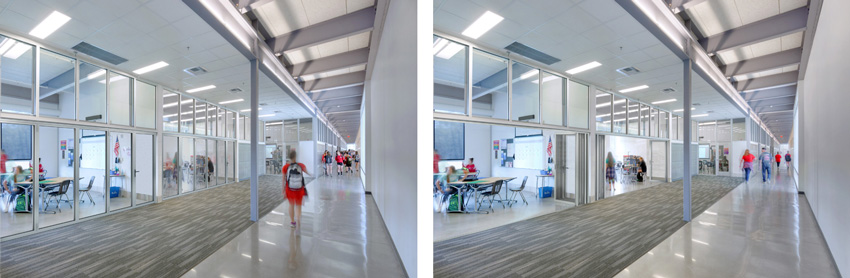
Photos courtesy of NanaWall Systems
Operable glass walls separate private spaces from a common area when the panels are closed (left) and connect the spaces together when the panels are open (right).
Acoustics and Flexible Space
There is a growing recognition that schools need good acoustical control to promote well-being and facilitate learning. This means that any wall system, including opening glass walls, needs to properly address the control of sound in and between the spaces where they are located. In particular, sound isolation is needed in flexible space designs so students can properly focus on their work or understand instruction from their teachers. The design challenge in schools can sometimes be finding a way to incorporate the flexible spaces being sought for classrooms and other spaces while still meeting the acoustical needs of those spaces.
Fortunately, manufacturers of operable glass walls have found ways to deliver impressive acoustical properties so designers can feel confident that incorporating such systems into school designs will not be seen as any type of a compromise. The best way to determine acoustical performance in walls is to have them tested to determine their sound transmission class (STC) rating. This common index provides a way to help determine how much sound (measured in decibels) is restricted from passing through a wall or similar assembly. The higher the rating, the less sound that passes through. Ratings on the order of STC 25 to STC 30 allow most speech to be heard or understood through the wall. A better condition that is often cited as a design goal is STC 35–45, which makes most speech illegible or inaudible. This is important not only within schools but also between inside and outside spaces, since not all schools are located in quiet surroundings.

Photo courtesy of LPAdesignstudios.com
Flexible learning spaces can be connected directly to the outdoors using operable glass walls, thus enhancing learning, exploration, and access control.
Connections to Outdoor Spaces
In addition to creating flexible spaces that combine interior environments, there is a growing recognition of the importance of having students connect with outdoor areas too. This can mean either a visual connection through the use of clear glass or a physical connection that can be achieved by operating a door or wall system. Operable glass walls allow for both conditions by providing brighter interior spaces with natural daylight and creating simple, controllable transitions between the indoors and outdoors. This direct connection to the outdoors is part of a growing trend to use outdoor spaces for instruction and exploration, not just for recreation and physical exercise. This is true even in areas that have winter weather since there are still opportunities then too.
John Brown, AIA, partner with Hollis + Miller Architects, speaks from experience on the schools his firm has designed. “Connectivity, flexibility, and visibility were all very important concepts in the design of the spaces within these schools. While we still needed the capability of closing off spaces for more traditional classroom and learning spaces, we needed the capability of opening up the walls to accommodate larger groups, which would then allow for collaboration.” The opening glass walls they have incorporated into their designs achieve all of these needs.
Sun Controls
Adding natural daylight to a school building is fundamentally a good thing for many reasons, not the least of which is the documented cases of increased student performance and well-being that come about from it. However, the penetration of that daylight and/or direct sunlight into a school needs to be controlled. Too much concentrated daylight can create uncomfortable glare or interfere with computer and audio-visual images. Further, depending on the compass orientation of the building or the time of day, the sunlight could add more solar heat gain than desired, creating spaces that are uncomfortably warm. For all of these reasons, providing a solution for controlling or directing daylight into interior spaces is important for a successful outcome.

Photos courtesy of Inpro
Interior cordless window shades with textured fabric can provide privacy or maintain connections to the exterior while helping with energy performance by reducing solar heat gain.
Interior Cordless Sun Shades
Controlling daylight and glare from the inside rather than the outside of a building is a design necessity in many cases for school buildings. Teachers and staff need to be able to quickly and easily make adjustments to suit periodic or daily changes in classroom needs for presentations and activities or simply to reduce distractions. In response, roller shades have commonly been placed in school room windows to create a great deal of flexibility and control. Fully open, they can allow for full penetration of daylight and clear views to the outside for students. For times when solar control is needed to reduce light, glare, or heat gain, they can be closed fully or partly. While historically, the shades have been made simply of room-darkening, opaque material, there are now a myriad of other options available to suit differing needs that improve the quality of the indoor school environment.
Textured roller shades can be used that allow diffused daylight to pass through a fabric appearance that reduces the total light transmission. In this way, they reduce glare, add comfort, and produce a favorable light quality inside the building. At the same time, they provide a degree of privacy or muted views through to the outdoors as may be desired. The particular characteristics of any such shade can be customized based on the particular weave and percentage of the area that is open versus closed in the fabric. Textured, partial light-transmitting shades can be used alone or in combination with other shades that are fully opaque to provide the greatest degree of flexibility and control.
Shade systems are available that use chains or cords to raise and lower them, but there are also products available that are completely cordless. Such cordless window shades are a logical choice for school buildings since the presence of dangling cords can be a safety hazard for children. Rather than trying to contain or conceal the cords, the elimination of them dispels any potential problem. Cordless shades commonly use a spring roller system that allows for direct and easy manual adjustment of the shade with capability to raise and lower it to any height. A privacy track can also be included along the sides to keep the shades in place and provide additional light blocking at the window edges.
Any product used on the interior of a school building needs to be durable to be practical. Since schools are areas where damage or tampering is often a concern, it is worth noting that there are self-contained cordless window shade systems specifically designed to resist such damage. This type of system features side channels and an extremely durable security box fascia to protect its mechanical components, making it tough to inflict damage. The shade material itself can also be specified from available, non-organic, resilient fabrics that are durable and easy to clean.
Beyond these functional features, it is possible to design and create a theme from room to room by custom printing the shades with a graphic design selected by the designer. Printed shades can create a welcoming atmosphere in addition to hiding unsightly outdoor scenery. They are also less likely to be damaged or vandalized. It is entirely possible to add custom landscapes, artwork, educational themes, or even mascots and logos to the shades. Of course, standard fabric patterns can also be applied to a shade for simplicity.
In terms of energy performance impact, interior sun shades can help with the rejection of solar heat and have a positive impact on reducing energy needs for cooling as a result. For example, independent research using computerized energy models run for a medium-sized, two-story building in the midwestern United States compared a baseline building with no window shades to a building design that incorporated interior sun shades. Different types of shades were modeled that ranged in the percentage of openness in the fabric (i.e., less openness equals more shade fabric per square foot). The results of the modeling and analysis showed that annual energy savings related to space cooling, heat rejection, and ventilation fans could be realized between 5 to 9 percent. These savings were attributed to the ability of the fabric to reflect solar heat and keep the building from overheating on sunny days. Hence, this data shows that it is possible to provide controlled daylighting while still having a positive impact on overall energy use in a building.
Designing Roofing for Safety
School buildings typically have large areas of roofing with predictable lifespans. In new construction, the type of roofing specified can be selected based on aesthetic appeal, lifespan, and initial cost as primary decision points. For reroofing projects, the same criteria come into play, but there may be limitations posed by the existing building construction. In addition to these common factors, though, the overriding criteria should be the long-term protection of the building and the safety of the building occupants. Keeping water out of a building is understandably important by itself, but the short-term and long-term damage to the building from slow, undetected water leaks can cause deterioration of construction assemblies to the point of rendering them unsafe. At the same time, the presence of water in building cavities can lead to the growth of mold and mildew, causing health concerns for the building occupants. Similarly, in the event of severe weather, roofing needs to be able to withstand wind uplift and other forces so as not to lose its protective properties or cause a hazard from windborne debris.
There are, of course, many options in the market that can keep water out of a building, but there is a need in school design to ensure that the selected system is addressing the myriad of weather and safety conditions to which it could be subjected. These concerns need to be addressed both at the time of installation and for the entire lifespan of the roofing. Given the significant cost of replacements, the longer that lifespan can be, the better. With all of these points in mind, here are a few common roofing system types that are being used in both new construction and roof retrofit designs.
PVC Roofing Systems
Single-ply polyvinyl chloride (PVC) roofing membranes have been in common use for some time. They can be mechanically fastened or fully adhered to a variety of substrate materials, but for most roofing systems, mechanical fasteners often provide the best resistance to wind uplift. Unlike seams with some single plies that use adhesives or tapes to seal the seams, the seams of PVC membranes are typically heat welded, creating a continuous, watertight seal that has proven itself repeatedly. In cases where there are budgetary constraints, a system surfaced with PVC roof membrane provides a high-quality, long-lasting alternative. Further, if it is being compared to other roofing types such as a standing-seam metal roof, then it should be noted that PVC products with welded ribs are available that create a standing-seam metal appearance with less hit to the budget. Over the long term, PVC roofing products are regarded as durable and long lasting so they continue to effectively protect the building and its occupants for decades.

Photo courtesy of SOPREMA, Inc.
PVC roofing membranes are currently used on schools to provide a long-lasting, durable, and aesthetically pleasing roofing solution that protects both the building and people inside.
PVC roofing is available from different manufacturers, but not all products are manufactured equally. Some offer superior performance over other PVC membranes by holding to minimum standards compared to nominal standards. There are also PVC products that are classified as high performance with thicknesses up to 80 mils (2 millimeters), polyester reinforcing, and high degrees of flexibility. With mechanically fastened options, no VOCs need to be present in these installations. Such high-performance membranes also provide verified fire and chemical resistance, helping to assure the safety and protection of people and the building compared to other single-ply membranes in the market. Their superior weldability and workability make it easy to conform to complex roof geometries. The underside of such membranes commonly incorporates a heavy fleece-backing, while the topside is available in ENERGY STAR labeled white colors to create a “cool roof” surface. There are also a variety of other colors, including gray and tan, and some with a silver or copper appearance that mimics the look of real metal.
For fully adhered systems, a coordinated and approved bonding adhesive must be used, usually available from the same manufacturer as the PVC membrane. It is best to refer to the specific adhesive data sheet for application guidelines and requirements. For mechanically attached systems, the manufacturer’s representative should be consulted for specific fastening patterns to achieve the desired wind uplift performance. In all cases, all laps and seams must be heat-welded to ensure a watertight seal and meet the needed classifications such as CRRC, FM, or UL.
SBS Roofing Systems
Another popular choice for low-slope roofing membranes on school projects is styrene butadiene styrene (SBS) modified bitumen roofing. The modification provided by SBS copolymer gives the asphalt bitumen membrane a rubber-like characteristic by forming a polymer network inside the bitumen material. The SBS allows for increased flexibility and durability, while the asphalt provides proven waterproofing capabilities. This combination makes SBS a premier solution in terms of providing long-term protection to the building.

Photo courtesy of SOPREMA, Inc.
SBS modified roofing is used very successfully and economically on school buildings including the Hazel Harvey Peace Elementary School in Fort Worth, Texas, shown here.
SBS membranes can be applied in many ways, but two methods of particular importance for schools are mechanically fastened and the use of self-adhering products. Mechanically fastened SBS provides the highest wind uplift in its class, which is especially important in places like Florida and coastal areas that experience high-wind events. Combining a mechanically fastened SBS base sheet in a two-ply SBS system achieves superior performance with the longevity of SBS. Self-adhered SBS has been developed to create extremely strong interply adhesion with no open flames, hot kettles, or VOCs and odors.
Adhesives are also available for field installation between layers of membranes or applied directly to concrete roof decks. While applied directly to a concrete roof deck, the resulting “ribbon pattern” creates natural venting for the concrete and provides extremely high bond strength. This helps the moisture in the concrete leave the roof system over time without affecting the integrity of the assembly or its components. As a high-performance, single-component polymeric adhesive, when used as an interply adhesive, it provides an additional layer of elastomeric waterproofing protection beneath or between plies of membranes once the adhesive is cured. Also, these adhesives are solvent free and extremely low in VOCs, providing superior performance while ensuring a safe installation for the contractor, occupants, and environment.
Coating/Liquid-Applied Membranes
There are plenty of situations where special roofing conditions arise that are not easily addressed by membrane solutions. These can include atypical conditions along roofing edges or intersections with other surfaces, areas of premature aging, or areas needing special waterproofing attention, such as flashings. In these cases, the use of liquid-applied coatings or membranes is ideal since they can conform to any shape and cover the needed area seamlessly when cured. These types of products are also well suited for roofs that require a roof “extension” by covering overworn or problem areas until a complete, new roof can be installed. In some cases, liquid-applied membranes can even serve as a completely new system for a total roof area. Depending on the chemistry of the products being used, low-odor options are available that cause very little, if any disturbance to the building below, such that occupants may not even know roofing work is going on above. The use of these specialized products requires careful consultation with the manufacturer for suitability on surfaces and conditions required for application. In many cases, a primer may be needed to be sure the coating adheres properly to the substrate. Installed correctly, these types of systems provide considerable, reliable, and long-lasting protection to selected new or existing roof areas.
Restrooms and Locker Rooms
Recent cultural shifts have moved architects and designers to think less about large school restrooms with ganged fixtures and more about providing greater privacy and gender-neutral options. There is also a need to be sure that accessible design is being incorporated into school facilities in appropriate and sometimes innovative ways. Such creative solutions can defuse otherwise contentious situations and in some cases conserve square footage in buildings. This can be manifest in several ways, discussed as follows.
Shower Stall Privacy
School gymnasiums with locker rooms and showers have been common programmatic elements of educational facilities. For decades, the norm has been to provide communal showers in situations like this. The concept made sense since multiple showering “stations” within a given space increased efficiency and capacity while reducing mechanical first costs in new construction. But, as we have noted, times and culture have changed. There are new norms about bathing privacy that have raised concerns and challenges related to bathroom and shower design. Further, additional risks of serious bacterial infections for athletes and other users puts new focus on the design and surface cleanliness of communal shower installations.
One answer for increased privacy in showering is to use separated shower stalls or compartments. To be effective, they need to include spaces not just for showering but also adequate dry-floor changing space that allows bathers to disrobe and get dressed within that space. In designs where space may not allow the combined shower and changing area, then a more inline approach with individual showering spaces can be used.
Disease Control
Selecting a material for the shower stalls can be important in the health of students. Methicillin-Resistant Staphylococcus Aureus (MRSA, pronounced “mer-sah”) is a bacteria of concern here. MRSA is classed by the Centers for Disease Control (CDC) and the medical profession as one of the deadly “superbugs,” with infections considered extremely serious. There have been outbreaks of this bacteria in a variety of sports locker rooms, which has prompted a number of recommendations for cleaning and disinfecting them regularly. The recommendations also include avoiding tile and grout that can be damaged and harbor bacteria. Instead, the use of solid-surface material can be an effective way to avoid any potential MRSA buildups and facilitate cleaning. Hence, in the interest of healthier showers, many designers are choosing solid-surface material for the shower enclosure, eliminating the need for grout lines.

Photo courtesy of Inpro
Private shower stalls with private changing areas, all made out of solid-surface materials, offer safer, cleaner alternatives, reflecting the changing design needs in schools.
Solid-surface shower enclosures have become popular because they offer aesthetic design options in addition to their practical performance aspects. They are available in a range of colors and patterns to blend with a variety of interior design concepts. By selecting large-sized sheets, there are fewer seams, which means less cutting, waste, and cost in addition to the hygienic benefit. The material is typically nonporous too, which means it does not support the growth of mold, mildew, or bacteria.
Accessible Showers
Shower stalls are also an area where accessibility is paramount in school facilities. ICC ANSI 117.1 Section 608: Shower Compartments is the governing standard here and offers guidance based on the type of shower being provided. Three specific types of showers are covered: transfer showers where a wheelchair-bound person can transfer to a (usually) L-shaped seat; roll-in showers that may or may not include a rectangular fold-down seat; and an alternate roll-in shower with a partially enclosed configuration. For each of these options, minimum clearances, sizes, and dimensions are identified for adequate accessibility by a person in a wheelchair.

Photo courtesy of Inpro
Accessible shower stalls made from durable solid-surface material can be fabricated in advance to meet project requirements.
Beyond the physical makeup of the shower stalls, there are specific requirements for some details too. These include requirements for grab bars showing the locations, dimensions, orientation (horizontal or vertical), and details of the size and shape of the grab bars provided. Additionally, requirements for the different types and shapes of shower seats are spelled out in detail. All of these parameters are fairly straightforward to address but need to be coordinated based on the type and size of the shower being designed.
Additionally, there are several notable design considerations for accessible showers. One is the use of a trench drain along the leading edge of the shower base to allow for a true roll-in condition with a minimum threshold. Another consideration is the use of shower curtains instead of doors. One advantage of employing shower curtains is the potential for easier compliance where space may not allow for shower doors. Employing a shower curtain with a wide lip and Velcro side-seals edge can lessen the occurrence of overspray, thus reducing slip-fall risk for the bather and any attending staff. Further, the location of convenience items such as soap dishes and caddies is important. The key here is to be aware of and avoid any conflicts with other elements in the shower space, specifically grab bars. Also, remember to take into account ADA Section 308 regarding unobstructed forward and side reach ranges when positioning soap dishes and caddies.
In the interest of simplifying the design of accessible shower stalls, there are fully prepared and assembled shower stalls available that have taken all of these things into account. Some of the preferred ones use solid-surface panels as a shower enclosure and shower base material. Solid surface also offers a great alternative to tile, as there is no grout to trap mold and mildew. Where grout cracks or falls out, there is risk of water getting behind the tile, leading to tiles failing or moisture seeping into the substrate. Further, installation of solid-surface shower surrounds can be finished in one-third the time of traditional tile.
Flexible Space Performance Criteria
We have discussed how operable glass walls can replace the fixed walls of traditional classrooms by opening up interior spaces to common, shared areas or being closed off to create quieter, separated spaces. Operable glass walls can also open up to outside spaces, creating an indoor/outdoor class that provides multiple health and instructional benefits for students. All of these are great attributes for a school building as long as the operable glass walls perform well in a number of key areas, including the following.
- Acoustical performance: There are now folding glass wall products on the market able to achieve unprecedented sound control. They utilize sleek, aluminum framing and acoustical glass to achieve optimal sound isolation with a range of STC 35–45. It is important to recognize that the STC rating of any piece of fenestration, such as operable glass walls, depends not only on the STC of its glass but of all of the other materials it is made from as well. Further, the means and methods of assembling the component parts and materials will have an impact as well. Since most fenestration materials are more limited in their ability to reduce sound transmission, the rating of the fenestration as a whole will likely be lower than or equal to the rating of just the glass. The best systems, therefore, are very well detailed to combine acoustically separated aluminum framing and specialized gaskets to hold the glass in place and seal around the perimeter. They also incorporate either insulated tempered glass or multilayer laminated glass with proven high STC ratings to achieve optimized performance. Keep in mind, however, that higher STC ratings in operable glass walls often mean more weight and increased cost. Therefore, it is important to balance the proper acoustical performance needs with these other considerations.
- Maximized transparency: Panel frames can be selected that are slim and contemporary, particularly where two adjacent folding panels meet, which means that transparency and visibility are maximized. Of course, if the interior design scheme calls for smaller scaled elements, then horizontal and vertical mullions are also possible. Either way, natural daylight can penetrate through exterior walls, or shared lighting can be achieved in interior spaces.
- Folding panel support: With floor-supported systems, the main weight of the unit is carried by the lower wheel assembly gliding on top of a stainless steel floor track. Floor-supported systems are ideal for applications where load-bearing capability of the header is a concern, but they also assist with sound isolation when appropriate gaskets and other components are in place.
- Ease of operation: Operable glass walls need to be engineered to be intuitive and quick to operate, allowing staff to easily open or close the system on demand. For a common folding panel design, the running carriage typically rolls on a stainless steel wheel design supported by ball bearings. With a two-point contact of each wheel to the floor track, the system glides quietly and smoothly with less friction by providing an equal distribution of weight on a stainless steel track.
- Surface mounted flush sill: A minimal surface-mounted flush sill is one that is ADA and ANSI 117.1 compliant. When installed with finished flooring, it should not only have little if any raised surface, but the gap in the floor track should be minimal as well—as little as 15/16 inch (23.5 millimeters) is available. For easy installation, the shallow sill can be installed on a concrete slab or other subfloor. For design consistency, finished flooring can butt up to the floor track, creating seamless integration between interior spaces.
- Integral swing doors: There are times when an operable glass wall is closed, but easy passage through a swinging door is needed for access or code egress. It is thus quite common to specify operable glass walls with swing doors integrated into the side jamb at one end or both to accommodate traffic flow. The height of the doors can match the rest of the operable glass wall, while the width can be any standard dimension up to 3 feet 3 inches (1,000 millimeters). These swing doors may or may not have lower STC ratings than the rest of the system due to their fabrication details. Nonetheless, all other common aspects of a swinging access door can be accommodated, including panic hardware, closers, kick plates, etc.
- Energy performance: When operable glass walls are used on outside walls, then energy performance is important both for comfort and minimum code compliance (or better). Testing of the units is available from the National Fenestration Rating Council (NFRC) to verify U-factors, air infiltration, visible light transmittance, and solar heat gain coefficients. Hence, operable glass walls should be specified to meet the same energy performance criteria as other fenestration in a project.
- Customization: Most operable glass walls are made to order, which means a variety of customizable options are available. This includes systems that open to the left or right or can be split both ways, either symmetrically or asymmetrically. Of course, the glass type and any visual treatments (translucent portions, etched designs, etc.) can be specified to meet both performance and aesthetic requirements. The panel frames are most commonly made from aluminum for use in schools and are available in many standard anodized or durable paint colors. There are also adjustment features available to assure proper fit in the opening over time should the building settle or other normal movement occur.

Photos courtesy of NanaWall Systems
Spaces separated by folding glass walls no longer need to suffer acoustically, especially in loud spaces like gyms, since new products are available that are designed and detailed to achieve ratings on the order of STC 35–45.
David Esely, AIA, is a project architect with Hollis + Miller Architects. He has observed the performance aspects of the folding glass doors the firm has specified, saying, “When closed, very little sound penetrates, which allows for diverse learning opportunities on both sides of the panels simultaneously. When the panels are open, the opportunities within the space transform and can then be tailored to specific instructors’ needs and requirements. This is all done with ease, speed, and frequency.”
Conclusion
The design of schools requires both a sensitivity to research-driven design concepts and an understanding of the practical details related to the performance of products and systems. Operable glass walls have been shown to provide innovative, flexible spaces while still meeting needs for acoustical privacy and light. Sunlight provided in schools for daylight and well-being can be controlled through the use of cordless shades. Privacy and health concerns in showers can be addressed with innovative solid-surface materials and ready-made shower enclosures. Roof design requires safety as much as anything else and can be achieved through the selection of the most appropriate membrane and system to suit a particular project. Accessibility in schools comes about by paying attention to details and options provided by manufacturers. Approaches such as these allow architects to employ the best use of materials and systems to achieve the intended design and performance outcomes.
Peter J. Arsenault, FAIA, NCARB, LEED AP, is a nationally known architect, consultant, continuing education presenter, and prolific author of more than 210 continuing education courses. www.pjaarch.com, www.linkedin.com/in/pjaarch