This CE Center article is no longer eligible for receiving credits.
Engineered products for building interiors have evolved rapidly over recent decades, with notable advances in materials and performance in only the last few years. These changes have helped architects improve the performance of interior spaces overall and the spaces' contributions to sustainability, resiliency, and productivity—the ultimate design goals.
While interior materials, finishes, and systems have generally brought significant benefits, specific techniques for the ceiling have been especially valuable. With its high visibility—and high potential for improving such design variables as acoustics, light reflectance (LR), and system integration—treatment of the ceiling plane has taken on renewed importance in design circles. Many of the newer solutions employ hybrid materials as well as lightweight, engineered surface systems with carefully calibrated acoustical insulation, joint treatments, and structural supports.
Metal composite finish systems are in the modern vocabulary of architectural surface techniques, a reliable and resilient material well suited to alternative finishes. While some of these use thin film or real veneers laminated to metal or printed simulated wood-grain finishes, all of the techniques dramatically reduce the need for timber, and the simulated products allow unusual visual effects, such as colored wood grains.
The history of alternative, simulated finishes used for interior systems is longer than many realize. Crude plaster and stucco mixes used in ancient Mesopotamia as long as 5,000 years ago were used to reproduce the look of naturally occurring textures and patterns, including wood, marble, and other stones. The ability to color the surface expanded the use of polychromatic finishes in dwellings and larger structures. Later, classical architecture enjoyed a surge in the use of faux stones—mainly marble—and trompe l'oeil spot images and murals, as well as simulated wood.
The use of alternatives mimicking wood-grain finishes continued through the millennia, but had perhaps its greatest revivals for neoclassical buildings in the 1800s and in modern architecture styles, notably Art Deco, in the early part of last century. The glaze and plasterwork employed to achieve the effects remains a valuable craft today, especially for commercial and public buildings.
|
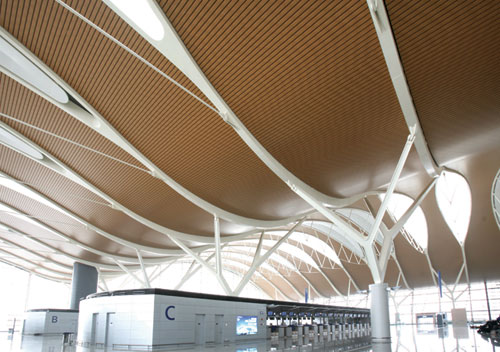
Linear slats inside Pudong Airport in Shanghai add dramatic curves in a
simulated wood finish printed on a lightweight metal, covering more than
1 million square feet without any actual timber.
Photo courtesy of Hunter Douglas Contract |
During the premodern and early modern eras, however, manufacturing methods and new classes of coatings began to change the simulated finish landscape. Pre-engineered, mass-produced systems were shop finished with stamping, rolling, and spraying applications—many approaches borrowed from the aerospace and consumer products industries.
Benefits of Faux Wood
Faux wood finishes, for example, offered a few obvious advantages over the real thing for the manufacture of one particular American classic: the woody station wagon.
Automobiles constructed in steel alone beat out the true veneer-paneled vehicles in strength, cost, and durability. (Makers of furniture were pleased with this outcome, as the carmakers had been outbidding everyone for timber supplies with the most visually appealing grains.) Coated steel, plastics, and vinyl materials like Di-Noc—a self-adhesive, flexible laminate film first used in the 1920s—became the standards for American woody wagons. In architectural settings, such wood-look metals were seen as ideal because they easily attain the Class A fire ratings needed for interior finish materials.
At about the same time, hybrid materials were being produced that built on the success of plywood, a material invented a century earlier by Swedish architect, engineer, and industrialist Immanuel Nobel. (He was also father of the famous prize creator, Alfred.) Nobel invented the rotary lathe, which made the manufacture of plywood feasible. Plywood's cross-grained layers, each set at a right angle to the grain of the adjacent ply, gave it strength and resistance to shrinkage and warping. Later in the 1900s, however, newer composites became preferred backup materials for high-quality wood veneers.
Sandwiches of thin veneer and backups such as particleboard, medium-density fiberboard (MDF), and oriented strand board (OSB) provided a dense, uniform substrate without knots but retaining their attractive, consistent grain patterns. After its introduction as a specialty material, wide use of MDF took hold in the 1980s. OSB, with its layered, directional wood strands, grew dramatically in use around the same time. These linear wood composites offered improved structural and dimensional stability ove&r resin#45;saturated wood-look laminates and certainly over pure veneers, which often had paper or fleece backings to protect the delicate ⅛-inch slices of solid flitches—flat cuts of logs with natural edges.
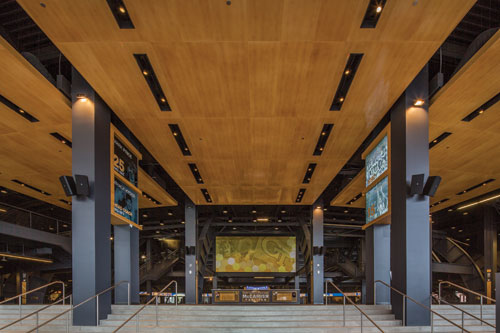 |
Powder-coated large-format ceiling panels simulate wood at the entry area for the new Georgia Tech arena designed by Populous. The panels conform to the ASTM E-84 Class A fire rating required by code and required less time to install than heavier composite wood panels.
Photo courtesy of Hunter Douglas Contract |
Particleboard and chipboard, made with wood flakes, are similar substrate materials in that they require a binding agent, typically a resin. However they are more sensitive to moisture effects than fiberboard. MDF and OSB formulations have migrated over the last decade from urea-formaldehyde (UF) resins, which have noxious emissions, to non-emitting phenol-formaldehydes and also vegetable starch binders, which have no formaldehyde at all.
Innovations in Wood-Look Ceilings
These wood-look composites, however, have been adopted widely for nonstructural ceiling applications, reducing costs associated with high-quality full timber while providing good workability with standard tools. Innovations such as fire-rated particleboard, or FRPB, have improved applicability in situations where interior construction must comply with building codes and other public safety considerations.
More so, a large range of wood substitutes have been introduced for architectural applications. These include innovative wood-look composites made with veneering on plastic substrates, as well as blended composites of wood fiber or wood flour mixed with thermoplastics such as polyethylene, polypropylene, and polyvinyl chloride (PVC), which don't look like wood. To get the look of wood, veneers may be adhered with contact cements to expanded PVC board, which cuts like wood. Porcelain and ceramic tiles have also been introduced with simulated wood finishes, typically applied in tile mortar or thinset to the ceiling. Similarly, some glass panels are treated with a faux wood grain and can be used for a ceiling.
As went the woody wagons, however, so did many architectural applications of wood, moving from the real thing to simulacra. Metal substrates, including steel and aluminum, grew quickly after their introductions in the 1930s, to bear a wood look. Some are made to be adhered to the ceiling surface—similar to pressed tin ceilings of the Victorian era (see sidebar below), while others are produced for dropped-ceiling grids or other suspended configurations. Again, theses materials were prized for a number of characteristics, including their fire resistance and ability to earn Class A material ratings. Three techniques are used to produce the wood grain appearance:
Profile wrapping. In this linear process, a specialized machine laminates a decorative surface onto a substrate, such as coil metal or planks of solid composite.
Because it was more efficient than manual laminating, the profile-wrapping machine emerged in Europe in the 1960s driven by demand in the furniture industry. It quickly migrated to industries requiring decorative applications to substrates. Metals including aluminum and steel have been profile-wrapped for decades.
| Evolution of Metal Ceilings |
Metal ceilings have long been attractive since the pressed tin of Victorian-era U.S. interiors came to replace ornate plasterwork as the “modern” alternative of the late 1800s. The treatment is fireproof and durable, and easy to install thanks to its light weight and hidden nail rails. Almost a century after these stamped sheets dropped out of favor, a small revival is underway for this authentic, old-timey material—not just for ceilings but also for backsplashes and wainscoting. Tin-plated steel or corrosion-resistant aluminum can be specified.
Yet the pressed metal was originally always white, to simulate plaster. Today’s sheet metal products include metallic finishes but also imitation surfaces that are hardly recognizable as the steel or aluminum sheets they are. With numerous production techniques available to simulate wood, today’s interiors increasingly share a cost-effective look of finish carpentry—an idea that would have been very attractive in the Victorian era, too. |
Vinyl films, laminates, and paper can be profile wrapped on a range of substrates. The use of wood veneer, however, created a valuable composite combining the strength, durability, and light weight of metal with the warmth and human biophilic attraction of wood. Both rotary-cut and sliced veneer can be used in profile wrapping, often with a fleece backing to improve flexibility of the veneer for the wrapping process. Finger-jointed veneer can be used to prevent variance in the finished look. Rolls of veneer with an aluminum indicator strip along the joint lines can be used in place of finger joints. The aluminum strips also help automate the process of aligning the substrate and veneer.
Profile wrapping can also be accomplished with paper layers of backers and finish papers treated with patterns and colored dyes, known as base and décor papers, which are also used as the final layers in laminate manufacture. A transparent overlay may also be applied. Wood-look décor papers and other specialized patterns have been on the market for some time now, and they can be applied to fairly complex profiles and sharp angles that may not be suitable for actual wood veneer.
Typical adhesives for profile wrapping include hot-melt glue, such as polyurethane, ethylene vinyl acetate (EVA), and amorphous poly-alpha-olefins (APAOs)—all known simply as polyolefins—including PE and PP, mentioned previously. Water-based glues such as PVA have some applications, though its performance may suffer as compared to hot-melt glues due to the high water content; in particular, wrapping on highly profiled substrates may not hold as well. Solvent-based glues, while effective, tend to be high in volatile organic compounds (VOCs) and for that reason may not be ideal for interior surfaces such as ceilings unless they are aqueous solvents.
However, significant strides have been made in the area of adhesives that dramatically improve bond strength. Moreover, many sustainable design projects are using profile-wrapped metals materials in place of solid wood, particularly for the cost savings and other performance advantages.
Film. This is typically a thin, decorative vinyl or PVC sheeting adhered to a metal substrate. As far as ceiling applications go, it is relatively recent as a faux-wood finish but based on a well-established technology.
Architectural vinyl finishes are durable and cleanable, but their flexibility has also attracted industry groups to use of the films. Three-dimensional surfaces and substrates with tight angles or complex curves can also successfully use the vinyl film. Another benefit is that, on properly treated metals, the films can be used outdoors, providing for a consistent design statement, though some films may change in color if exposed to direct ultraviolet (UV) rays from sunlight. Applications are common for both new construction and renovation projects.
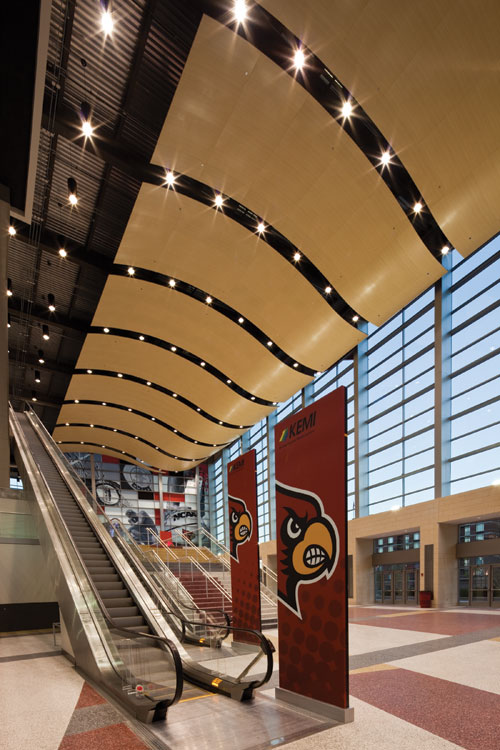 |
A film-on-metal ceiling system provides the look of maple veneer at Louisville, Kentucky's
KFC Yum! Center, designed by Populous.
Photo courtesy of Hunter Douglas Contract |
Not all films are formulated for the same applications or environmental conditions. Some of them can shrink over time. For these, the strips of film may be lapped, with a substrate primer applied at the joints. A number of films work well for three-dimensional surfaces, but not all of them: Their adhesion strength ranges from 5-12 pounds per inch, depending on which metal substrate is specified and whether a primer is used. Metal substrates suitable for film adhesion include PVC-coated steel, aluminum, stainless steel, galvanized steel, and metals with a baked enamel coating.
Coatings. Coating processes that can simulate wood grain on metal and other surfaces include powder coating, ink sublimation, and other painting processes. Powder coating, which produces a fully cured, resilient surface, is also a sublimation process, meaning that it uses pressure and heat to transfer decorative patterns including simulated wood to a substrate.
Sublimation techniques typically use a drawing or photograph—of a wood grain sample, for example—printed on film, which is pressed and heated on the target surface. Specific powders are applied to the metal substrate and partially baked in; after cooling, the wood grain transfer is overlaid on the surface with a vacuum process to remove any air between the two. The piece is heated again to fuse the decorative coating; dye on the transfer begins to volatilize, creating the grain look with a portion of the powder film, yielding a photorealistic reproduction.
Unlike typical liquid paints, powder coating involves thermoplastic or thermoset polymers that are applied electrostatically and then heated, rather than the liquid techniques where the coatings typically require solvents. The resulting finish is durable and resilient, typically more so than the shells created by liquid paints. Many formulations of powder coats include polyester resins and other additives to allow transfer films to be removed easily and to keep the resulting wood-grain images sharp and realistic.
Powder coating is typical for metal substrates, although more recent techniques allow for its use on MDF and other building materials.
Green and Aesthetic Benefits
In general, these three classes of simulated wood ceiling materials—profile wrapping, vinyl films, and powder coating—have successful track records. They can also be used for a variety of surfaces, not just ceilings, allowing architects to match their metal ceilings with identical faux-wood window coverings, chair rails, wainscoting, acoustical wall panels, and other specialties.
Like pressed tin before them—actually, the old ceilings were almost always painted sheet iron or steel, not tin—today's light-gauge steel and aluminum ceiling systems tend to be durable and sustainable substrates. The metal ceilings are light and easy to transport, and they have good life-cycle characteristics. With stamped perforations or insulation backing (or both), the ceiling systems can be engineered and specified for optimal acoustical performance. Briefly, the main green attributes of veneer-wrapped and wood-look steel and aluminum ceilings that are sustainable include:
Recycled and recyclable. Metal ceilings have the most recycled content of all material types, with up to 85 percent recycled aluminum and up to 75 percent post-consumer content, both contributing to LEED Credit MR-4. Steel panels and suspension systems may be up to a third recycled materials.
Certified wood and local materials. Depending on the source, a profile-wrapped ceiling system may use a veneer certified by the Forest Stewardship Council (LEED Credit MR-7), or it may be produced local to the project (LEED Credit MR-5).
Low-emitting materials. Profile-wrapped composite wood products and metals treated with powder coating or vinyl films may be very low in VOCs and other emissions (LEED Credit EQ-4.4). The ceiling panels, cores, and glues are free of urea-formaldehyde resins.
Life safety and fire ratings. Some ceiling materials are inherently combustible, but metal ceiling panels are generally considered incombustible in architectural settings. Coatings, films, and acoustical backings can contribute to fire development, so metal ceiling systems—including simulated wood alternatives—are tested as installed assemblies to verify Class A performance.
These benefits—and the growth in manufacturing techniques that help produce a millwork look without finish carpentry costs—have created an attractive set of opportunities for modern architecture. First and foremost is the value proposition of preserving forests and tree species by using efficient, thin veneers or by using only transferred images of beautiful wood grains. Wood in architecture is a longstanding tradition, and today's use of films, veneers, and powder coat on metal and plastic substrates has set off a profession-wide rethinking of wood finishes for ceilings, wall panels, and window treatments.
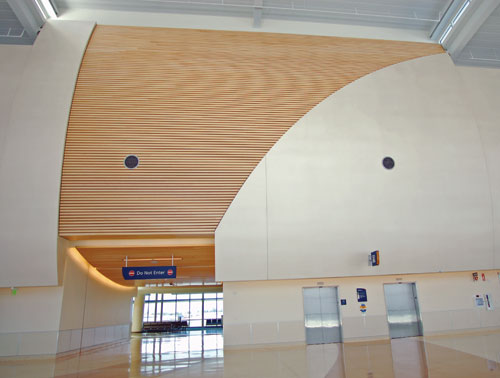 |
To expand San Jose Mineta International Airport, the client's desire for natural wood finishes led
to the choice of a profile-wrapped veneer on metal for wall and ceiling treatments. Designed by Fentress Architects, the low-toxicity ceiling system contains at least 70 percent recycled content.
Photo courtesy of Hunter Douglas Contract |
Examples of these opportunities are everywhere. For large-scale design gestures like the KFC Yum! Center arena in Louisville by the architecture firm Populous, a simulated wood finish can span a monumental arabesque hung from a torsion-spring grid three stories above sports fans' heads. In high schools and universities, similar large-scale uses of real timber would prove untenable; recently, Perkins+Will employed a linear metal ceiling that simulates wood planks across a 100-foot expanse at Chanhassen High School in Minnesota.
Longstanding users of faux finishes such as casinos and resorts are now adding lightweight, simulated wood ceilings to interiors of ersatz plaster and gold-plated metals, as at Lumiere Place Casino in St. Louis by Las Vegas-based Marnell Architecture. Around the world in airports, cultural venues, civic buildings, and even the graceful Zaragoza Church designed by Úrsula Heredia y Ramón Velasco, architects are creating the look of solid, dimensional timbers across large surfaces in a cost-effective, sustainable manner.
The aesthetic benefits of wood are both intuitive and well studied, with recent years bringing a better understanding of how wood elicits responses such as biophilia—literally the human love of living systems—and other ameliorative effects proven in evidence-based design. According to Michelle Kam-Biron, P.E., S.E., director of education at the American Wood Council, “Wood makes people feel good,” thanks to its “visual variety, natural irregularity, and expressiveness.” Wood brings warmth, softness, and a calming effect to buildings and interiors, says Kam-Biron, noting clinical studies showing occupants responding positively to exposed wood grains. Anecdotal proof can be seen in long-held customs, for example in Japanese and Finnish schools where wood is favored because it elicits a positive student response.
| Manufacture & Contractor Advice |
As for any project, architects consult with suppliers and manufacturers—as well as competent contractors—to review priorities for ceiling system selection. Installer preferences for materials and methods are a factor in the selection criteria. GCs and CMs may be well-placed to help compare, for example, the costs and schedule impacts of linear wood composite against a wood-look metal system, whether it is powder-coated, profile-wrapped or film on metal.
The ceiling types are installed with common woodworking and sheet-metal tools. A typical engineered wood is heavier and requires more time to install than metal-backed systems; the panels are finished on both sides to allow two-sided applications and to ease installation.
Veneer on aluminum and simulated wood metal systems tend to reduce schedules due to the techniques involved. Interlocking components help assure a tight, rigid assembly, and the panels may be cut, curved, and prepped for install by the manufacturer or fabricator.
Metal ceilings can also be pre-engineered for various ceiling configurations, including square, rectangle, and pattern cell designs. For these reasons, some GCs and CMs say that project risks can be lower using the metal, and project profitability higher. |
For reasons of tradition, culture, and construction history, building professionals tend to like wood and associate it with high-quality, humane environments. Yet solid stock and even many veneers are costly. Moreover, the demand for wood is rapidly outpacing global resources; the need is urgent to transition to next-generation materials that sustain productive capacity while limiting extraction rates, according to the World Wildlife Fund. Green-building advocates like Mara Baum, AIA, a healthcare sustainable design leader with HOK, add that the ecological and human value of forests are undervalued, bringing economic benefits and reducing carbon footprints.
Where sustainability prerogatives recommend it—and where it is not possible to use solid stock or laminate hardwood for costs or design reasons—architects are choosing profile-wrapped veneers, wood-look films and powder coats to provide some of wood's human benefits at a fraction of the cost. In terms of life-cycle assessment (LCA), both wood and the faux-wood ceiling systems offer good return on investment over a typical operational period. The initial costs vary considerably, however: A solid-stock linear ceiling may cost about four times as much to install as a box-profile metal system with a wood-grain finish.
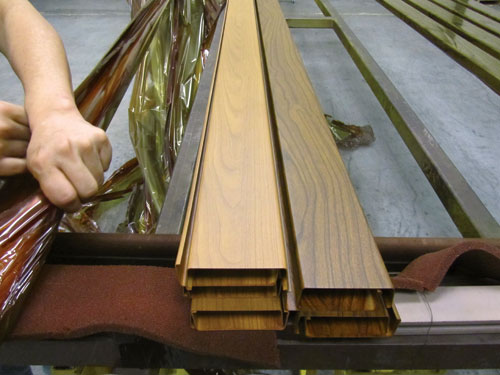 |
Unlike typical liquid paints, powder coatings are thermoplastic or a thermoset polymers that are applied electrostatically and then heated, rather than as a liquid requiring solvents. The resulting finish is durable and resilient, typically more so than the shells created by liquid paints, keeping the wood-grain images sharp and realistic.
Photo courtesy of Hunter Douglas Contract |
In addition, very thin materials such as light-gauge steel and aluminum sheets afford a range of architectural details and system options. Lay-in and adhered modular panels have been used for many years; newer forms include linear systems, planks, and curved panels. The selected wood finish can be replicated on other architectural metals, such as wall panels, column covers, light coves and the like.
The benefits of real wood, on the other hand, include workability, visual and actual heft, tactile qualities and even smell. Many contractors also like working with finish carpentry, a hallmark of construction excellence.
In addition, there were notable quality issues with some of the early faux-wood products, such as poor adhesion of laminates and some veneer delamination, mainly in the 1970s. The faint memory of those failures—most in the consumer products realm—are overshadowed by the successful track record of the veneer-metal, film-metal and powder-coat systems that are made today. Next-generation enhancements to materials, adhesives and coatings and new production techniques have increased installed performance well beyond typical warranty periods.
One new challenge for ceiling systems is soiling—including dark stains that may occur on ceiling surfaces near supply air diffusers. “This type of soiling does not necessarily mean that the ductwork needs to be cleaned,” according to Indoor Environmental Engineering of San Francisco. But it may mean “that the concentration of fine dark particles (i.e., combustion particles from motor vehicles, stationary sources, copier or printer toner, etc.) in the air are high.”1 The effect is common on cellulose and fibrous ceiling panel types with porous surfaces, and it is more likely with high-velocity supply air as opposed to displacement-type HVAC.
In some interiors, the pressure difference between the room and the plenum will draw air through the porous ceiling, turning the lay-in tiles into a kind of unintentional air filter. This effect can be reduced by perforated panels or trims, grilles, or other accessories—even ceiling lighting fixtures—to equalize pressures between the room and ceiling void.2 This can compromise energy efficiency, however, as conditioned air enters the unoccupied plenum spaces.
Ceiling Product Tests and Standards
To determine the soiling resistance of a ceiling product, some manufacturers use a testing protocol that simulates soiling from supply-air diffusers. This is one of a myriad of new tests, many defined as industry standards by ASTM, ISO, NEMA, and others to compare ceiling materials. Other valuable standards include methods to evaluate a material's stability in the presence of humidity and bulk moisture, the ability to reflect light and absorb sound, and resistance to physical forces such as impact, flexural stresses, and scrubbing or scratching.
The testing regimens have benefited all classes of ceiling systems including metal ceiling products and linear veneer composites. Specifications for building projects in most jurisdictions will require a Class A rating for flame and smoke spread, which is tested using the standard ASTM E 84. As mentioned, metal ceiling systems can often attain these Class A ratings. Light reflectance (LR), defined in ASTM E 1477 on a scale of LR1 to LR3, is a two-edged sword; a rating of LR1 ensures the most light reflected back into the space, but a glossy surface may also produce unwanted glare. Diffuse, nonspecular surfaces may reflect less light but also reduce interior glare.
Other standards are used to classify acoustical ceiling products more generally, such as ASTM E1264. This multi-component method considers acoustical ceiling type, pattern, and certain ratings for acoustical performance, light reflectance, and fire safety, according to ASTM, but it does not cover their use as a component of an assembly tested for fire endurance or floor/ceiling sound transmission. Nor does it cover physical properties—sag, hardness, linear expansion and contraction—in which wood composites and metal profile panels have excelled.
ASTM provides for a range of strength tests, including ASTM C367 “hardness” evaluation for lay-in and acoustical ceiling panels, which describes how well they resist indentations caused by impact. The Falling Ball Impact Test, known as Modified ASTM D 1037 Procedure, is a useful measure, as is the Hess Rake Test for assessing scratch resistance. In the area of profile-wrapped veneers and film on metal, new tests including boiling, exposure to water and heat, and other accelerated wear simulations to demonstrate effective adhesion and resistance to delamination.
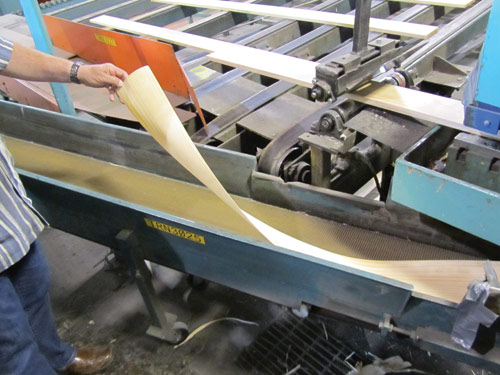 |
The physical properties of veneer-wrapped ceiling panels have improved dramatically, including hardness and resistance to sag and linear expansion or contraction. New tests for profile-wrapped veneers and film on metal include accelerated wear simulations to demonstrate resistance to delamination.
Photo courtesy of Hunter Douglas Contract |
Ceiling Performance Criteria
In general, however, there is a short list of ceiling performance properties that should be reviewed for every project. These are:
Acoustical performance. Ratings for acoustical properties are given by STC (sound transmission class), which defines a barrier's ability to block sound, as well as CSTC—the ceiling STC—which quantifies sound passing from one room to another through a shared plenum space. This sound path can be rated using CAC, or ceiling attenuation class, which is given by the protocol ASTM E1414.3 The noise reduction coefficient, or NRC, describes how much sound energy is absorbed by a material or assembly, on a scale of 0 to 1.0, where 1.0 is the most absorption.
For metal ceiling systems including simulated and veneer wood finishes, perforations and open reveals between panels are used to enhance and fine tune ceiling surface acoustical performance. Using novel technologies to engineer the panels, acoustical perforations can be varied in size, spacing and design. The panels may be backed by acoustical insulation material. In some cases, perforation openings are sufficient to allow fire sprinklers installed above the suspended ceiling grid.
Energy performance. Thanks to the light reflectance and plenum treatment of suspended ceiling systems, simulated wood ceilings can contribute to improved energy efficiency indoors (LEED Prerequisite EA-2 and Credit EA-1).
Indoor environmental quality. Many of the ceiling systems are engineered to improve room acoustics and boost light reflectance, which can improve IEQ as required in various LEED credits.
Life safety and fire ratings. The Class ratings based on ASTM E 84 are shorthand for ceiling fire resistance and life-safety performance. Other fire ratings include ASTM E 1264 (the general standard classification for ceilings mentioned above), and the Canadian national standard CAN/ULC S102. Groups like FM Global (formerly Factory Mutual) certify products according to the tests.
Some ceiling materials are inherently combustible, but metal ceiling panels are generally considered incombustible in architectural settings. Coatings, films, and acoustical backings can contribute to fire development, so metal ceiling systems—including simulated wood alternatives—are tested as installed assemblies to verify Class A performance.
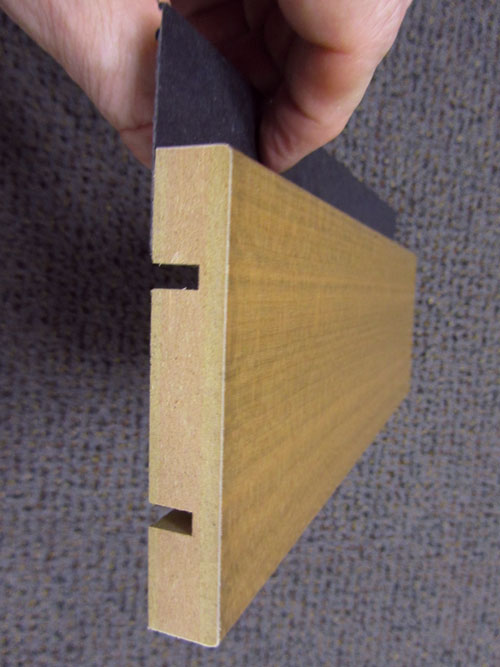 |
IEQ considerations for evaluating veneer composites such as those with MDF substrates include light reflectance, finish composition, and presence of VOCs or use of ureaformaldehyde in manufacture.
Photo courtesy of Hunter Douglas Contract |
IEQ properties. In addition to acoustics considerations describe above, other indoor environmental quality (IEQ) considerations are important for evaluating wood-look metal ceilings and veneer composites such as with MDF substrates. These properties include light reflectance (LR) ratings but also indoor air quality (IAQ) impacts, such as finish composition and presence of VOCs or use of urea-formaldehyde in manufacture.
Ratings such as GREENGUARD and the specialized GREENGUARD Children and Schools have listed various products that are certified as low-emitting formulations for these critical air-quality factors. The “certificates of compliance” confirm that certain ceiling products have less than allowable limits for total VOCs (TVOC), formaldehyde, total aldehydes, and individual VOCs. The certifications have been awarded to products in all categories of wood-look composites, including powder-coated metal, vinyl films on metal, and profile-wrapped veneers. Composite wood substrates with veneer or faux-wood laminate are also available to meet strict criteria for low-emitting materials and finishes.
Structural system and weight. Lightweight metal ceiling systems may be well-suited to many project types, in part due to structural considerations. For example, seismic events produce lateral forces that stress the suspension systems and may loosen or dislodge ceiling panels. This can be exacerbated when the ceiling grid extends wall to wall; panels at the perimeter wall or abutting columns are more likely to fall. Some designs will modify the perimeter moldings or other conditions to anticipate seismic damage, and they may include seismic separation joints.
The chief code criteria for seismic codes in the 2009 International Building Code (IBC) model codes derive from the Uniform Building Code (UBC) Standard 25-2. About 15 years ago, the Federal Emergency Management Agency issued seismic regulations for buildings that cover ceiling assemblies, and the new codes as well as product evaluation reports have been influenced by that work done for the National Earthquake Hazards Reduction Program, or NEHRP. Today, the Ceilings & Interior Systems Construction Association (CISCA) provides recommendations for CISCA Zones 0-2 for projects in IBC's Seismic Design Category (SDC) C, and CISCA Zones 3-4 in the SDCs D-F, which are for high earthquake risk.
Durability and life-cycle performance. The challenges facing the life-cycle of a ceiling system include moisture issues (organic vs. inorganic materials), abuse and scratching caused by plenum maintenance, as well as the needs for maintenance and replacement of the ceiling system components themselves.
Depending on the ceiling type selected, maintenance and replacement can be straightforward given availability of replacement parts and matching panels. The need for replacement is varied, however: Metal wood-look ceilings tend to provide a robust solution for these areas of concern for building operations. For example, organic ceiling materials such as cellulose may be more susceptible to microbiological contamination than inert and inorganic materials. Abuse is less likely to impact metal surfaces, which have relatively high resistance to abrasion and scratch marks. These considerations are useful when planning for facility maintenance related to lighting and HVAC systems accessed overhead.
These operational considerations—failure rate, maintenance and mold, among others—factor into life-cycle assessment (LCA) studies that may be undertaken as part of an interiors ROI analysis or as part of the pilot credit available through LEED-NC 2009. Considerations that affect life-cycle cost include:
- Type of building and space use.
- Support services located above the ceiling.
- Integration with ambient lighting systems and MEP systems.
- Desired acoustical control.
- Speed of installation and repair.
- Typical maintenance schedules.
- Retention of desired visual condition.
Of these, integration is worthy of careful consideration. First, the ceiling height has an effect on how much daylight will enter the space as well as its energy use profile. Second, some ceiling systems provide for integration with specific lighting systems and diffuser types, affecting the overall look. Third, open-type ceiling systems, such as hung beams or grids, allow for use of unlimited lighting and diffuser types with unrestricted access; the tradeoff is that they are open systems that do not limit or fully define the ceiling plane.
The use of a suspended ceiling to reduce the volume of a conditioned space is a contentious topic, pitting architectural intent and whole-building energy design. For example, a suspended ceiling has been shown by CISCA to effectively pay for itself in reductions to conditioned interior volume. However the ceiling system must be permanent for those life-cycle gains to accrue over the life of the building, and the energy-use reductions must also outweigh other benefits from alternate ceiling designs, including daylight propagation, acoustical performance, ceiling reconfigurability and the perceived value of increased ceiling height.
Greener Approaches for Wood Ceilings
A number of issues play into the selection of composite ceiling systems including engineered wood and faux-wood metal products. One is the interest in lightweight, resilient interior systems that can be transported inexpensively and installed quickly. Light-gauge metal walls, ceilings and even raised-floor systems are increasingly valued for their reconfigurability—an aspect of long-term performance—as well as reduced initial costs and schedule impacts. In addition, the lighter systems often allow larger panel sizes, which require fewer visible joints and provide an uninterrupted, clean look.
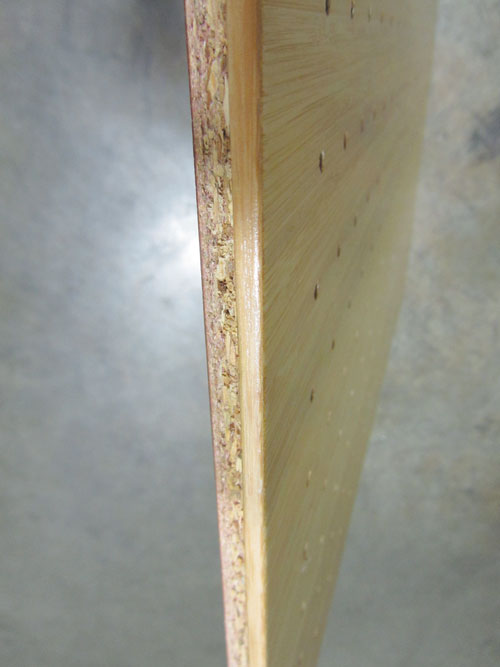 |
Composite wood panels faced with veneer may contain recycled wood waste, though not typically post-consumer wood. The particleboard may be FSC-certified for LEED's MR Credit 7.0.
Photo courtesy of Hunter Douglas Contract |
Material reduction and reuse are also a benefit of the metal composites. Some aluminum and steel ceiling panels are factory-cut to size, significantly reducing field cutting and scrap. In addition, steel and aluminum are typically produced with substantial recycled content; for aluminum ceilings, industry levels range from about 70% to 95% recycled content, and in some cases 50% may be post-consumer content. These attributes may help contribute LEED credits toward project certifications for the Materials & Resources (MR) credits 2.1 and 2.2 as well as MR 4.1 and 4.2 for recycled content.
Composite wood panels also typically contain recycled wood waste, though not typically post-consumer wood. Some manufacturers provide the option of solid wood panels, MDF and OSB certified by the Forest Stewardship Council (FSC), which contributes to LEED's MR Credit 7.0. FSC-certified wood veneer and wood panels can also count toward the same credit; the decorative veneer can be laminated to a metal substrate or to one of several FSC-certified wood substrates, including MDF, veneer core, particleboard or a phenolic-based fiberboard. Wood species and finished thicknesses vary depending on the region of the product's origin.
Certified wood panels are typically documented and invoiced with one of three designations: FSC Pure, FSC Mixed % or FSC Mixed Credit. When these is available, the manufacturer and key suppliers should provide a chain-of-custody certificate number to demonstrate FSC certification and approved practices.
The final area of consideration for green building is IEQ, which includes the contribution of the ceiling system to the project's total VOC and formaldehyde emissions loads. Ideal product specifications will include products with no reportable VOCs, which is typical of metal ceiling panels and grids. For engineered wood composites, systems should be reviewed to ensure the specified MDF and OSB, as well as veneer finishes have minimal levels of chemicals and toxics.
The LEED EQ credits 3.1 and 3.2 (Construction IAQ Management Plan) cover maximum contaminant concentrations of total VOCs (TVOC), which include exempt VOCs and reportable VOCs (RVOC), the terms first used in California to distinguish how much VOC emission is caused by comparable products. Oils and waxes may have high VOC content but are of very low volatility, according to a Thomas Bruce More;4 those with higher volatility tend to have more impact on human health. The EPA followed this regulatory approach, says More, adding a sensitivity analysis to adjust VOC estimates for more accurate understanding of the impacts of architectural coatings and materials.
Last, the Energy & Atmosphere credit 1 for optimizing energy performance can include the light reflectance measure of the ceiling to evaluate the efficacy of daylight and electric lighting. A good rating is LR1, which can contribute to overall energy performance.
Considering the varied performance benefits of wood-look ceiling systems is worth the effort, say many architects, based on the need for high-performance interiors in schools, hospitals, workplaces and other settings. A broad array of aesthetic techniques are possible with profile-wrapped, film-applied and powder-coated lightweight metal panels. Many, including the large-format panels, linear profiles, grills and curved elements, are difficult to achieve in a cost-effective manner with wood composites and solid lumber. Varied trim systems and support grids are available to customize the architectural effect.
Even more so, the veneer composites make good use of all wood species—particularly rare species—with veneers as thin as 1/30 of an inch made from cherry, mahogany and ebony. The realistic looking printed wood grains require no wood at all, and may be modified for a startling visual effect, such as a blue-stained wood grain.
Once installed, these manufactured composite products can accommodate industry-standard service devices, such as lighting, diffusers and the like. They are produced with specific methods for plenum access and other maintenance needs. As compared to some acoustical suspended ceiling materials, the composite and metal systems adequately resist abrasion and abuse as well as soiling related to air supply and plenum effects.
As discussed in the article, ceiling and wall panels are available that are Class A fire rated and designed for seismic performance, to contribute to safer interiors. Various acoustical levels, light reflectance abilities, and low-VOC formulations are on the market, lending support for healthier interiors. Other sustainability benefits—including the lightweight and recyclable nature of the metal systems, and the ability to spare limited wood resources or to use certified woods—improve the contribution of the ceiling system to overall environmental goals.
Chris Sullivan is principal of C.C. Sullivan, a communications consulting and marketing agency focused on architecture and building products.
 |
For more than 60 years, the architecture and design community has specified contract products from Hunter Douglas, the world leader in window coverings and a major manufacturer of architectural products. A tradition of bringing breakthrough products to market makes Hunter Douglas the choice for an array of innovative contract solutions. www.hunterdouglascontract.com |