This CE Center article is no longer eligible for receiving credits.
The demand for interior architectural glass is on the upswing in the U.S. Sliding glass units for facades and room partitions, long everyday features in Europe, are now hitting North American shores with force. The reasons are compelling: Sliding glass doors are space savers, they are consistent with green building goals, they offer modular interior systems that can be moved to accommodate different office functions and easily demounted for office relocations—and they offer a unique visual that is striking and endlessly modern.
In terms of aesthetics and operation, the effectiveness of a sliding glass door depends on the right hardware. Because glass is about transparency, hardware should be invisible to the extent possible, and limited, say, to a suspension profile or integrated cover cap. Usability is also a key factor in the strict requirements of the American market, and hardware should be suitable for ceiling mounting, ceiling integration, and wall mounting and capable of maximizing room design options. In projects in the business, hospitality, institutional, and health-care fields, high-end hardware stands out from its technically less sophisticated and inexpensive counterparts. This article will cover the dynamics of quality hardware as well as trending sliding glass solutions and innovative, sustainable options for commercial spaces.
Transparency in Demand
Today's businesses and institutions demand transparency, a value that implies openness, communication, and accountability—in short, operating in a way that others can see. Architecturally that concept is increasingly being expressed in glass, on both building exteriors and interiors, meeting philosophical tenets as well as sustainability goals including greater use of green materials, building occupant health and well-being, and energy efficiency. Over the past decade, these principles have precipitated a change in the amount and location of glass in commercial settings. In building interiors, sliding glass door and wall systems are being used for a number of purposes, among them, connecting interior and exterior spaces, creating striking floor-to-ceiling views, and configuring private enclosures. Not only is less space and clearance needed for sliding versus swinging doors, glass offers sleekness and style that can transform a space, easily merging several smaller spaces into one and vice versa.
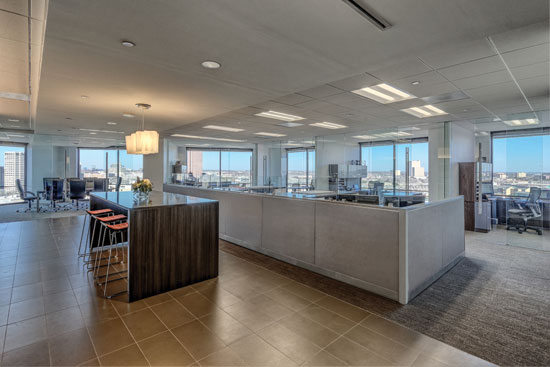 |
Interior architectural sliding-glass systems meet sustainability goals while providing a striking aesthetic.
Photo courtesy of Hawa |
Interior glass promotes daylight, and with proper positioning can pull sunlight to the center of the building, minimizing the need to run the lights and often the thermostat—energy savers that effectively decrease energy costs. Increased natural light has been shown to generate salutary effects including greater productivity, higher test scores, and an improved sense of well-being—a phenomenon that has been well documented, particularly in the work of the Heshong Mahone Group and its groundbreaking Daylighting in Schools: An Investigation Into the Relationship Between Daylighting and Human Performance. A more recent study about the positive effects of daylight interviewed more than 260 people in new offices that had achieved LEED Gold or Platinum status. The new green workplace, which featured daylight and views, as well as ergonomic design, safety, and acoustics, correlated with less depression and stress and greater productivity. According to study findings presented in Commercial Building Products Magazine, green building occupants who previously experienced stress and depression totaled an additional 202 hours of work, with an overall productivity improvement of 2.6 percent. While a desirable result in itself, an increase in productivity can work to confer additional benefits. In fact, The Whole Building Design Guide from the National Institute of Building Sciences states that even a 1 percent savings in productivity can help to offset annual energy costs.
A Range of Options
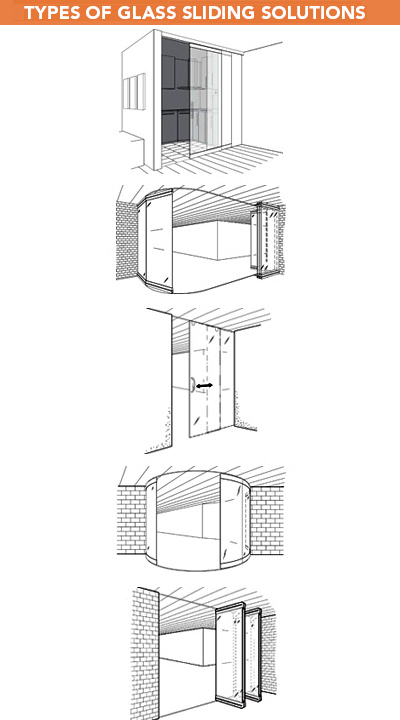
Sliding glass wall systems and doors bring new possibilities to commercial environments, and as shown in the accompanying figure, come in a variety of solutions.
Sliding glass options include a straight sliding door; a symmetric arrangement, in which two panels slide simultaneously in the opposite direction; and a telescopic version, in which two panels slide simultaneously in the same direction into the recess and park one behind the other, enabling the opening to be twice as wide as the parking solution. This arrangement is particularly suitable for tight environments where transparency makes rooms seem bigger such as kitchens, bathrooms, and offices. Glass sliding solutions can also be curvilinear, or feature accordion walls in which the wall folds.
Glass sliding partitions, which imbue a space with a contemporary look, open up, and can be stacked in a parallel or perpendicular parking area. Adding light, function, and style to any environment, moveable walls are increasingly gaining market share in the interior wall industry. They can be quickly and easily installed offering flexibility in space configuration with minimal structural modifications, and are effective at dispersing natural light. Acoustically, glass partitions can help decrease noise levels, creating a private space in a busy environment.
Types of Glass
Nearly all commercial glasses for architectural use fall into one of several basic categories or types based on chemical composition and/or production process.
 |
|
Images courtesy of Hawa |
Tempered glass, sometimes known as toughened glass, is a thermally pre-stressed float glass, which is heated to about 1,200 degrees F during production and cooled quickly after heating. Tempering creates imbalanced internal stresses which cause the glass, when broken, to crumble into small granular chunks instead of splintering into jagged shards, making it less likely to cause injury.
Laminated glass is much harder to penetrate than tempered glass. It is produced by bonding layers of glass together under pressure and heat, with a resin called PVB (polyvinyl butyral) in order to create single sheets of glass with multiple layers. The PVB keeps the glass from breaking apart and provides high sound insulation. The glass contains an interlayer of foils. In case of damage to the glass, the broken pieces stick to the foils.
Some manufacturers recommend heat-strengthened glass, in connection with laminated safety glass only. This glass has a similar production method as tempered glass. The difference is that the glass is not heated as much and it is cooled down at a much slower rate. As a result, there is less tension and hence, in case of damage to the glass, the broken pieces remain larger. In connection with laminated safety glass, the rigidity can be maintained.
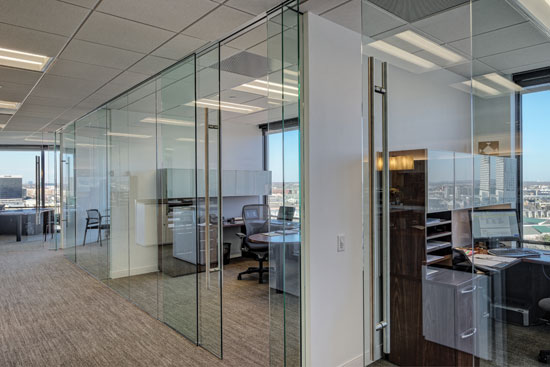 |
Hardware that enables full transparency creates a compelling visual effect.
Photo courtesy of Hawa |
Architectural Hardware for Sliding Glass Doors—Enabling Maximum Transparency
Hardware systems for sliding glass systems vary widely by manufacturer, but hardware that works with all types of glass and enables full transparency offers architects the greatest design freedom.
An important consideration in hardware selection is top- versus bottom-hung systems. It is widely recognized that compared to bottom-rolling systems, top-hung systems offer smoother movement, more versatility in accommodating curved panels, and a cleaner look. Top-hung panels also make it easier to deal with uneven floor conditions. There are a number of additional advantages as well. The top track can be concealed in the ceiling, and minimal force is required to move the panel. Top-hung systems also allow for a clear threshold, and the trolley always stays in contact with the track. While bottom-rolling systems provide a very high load capability, they do require a bottom track, and are prone to rolling elements jumping the track. There are also the drawbacks of the mere presence of the track in the threshold, and the difficulty of controlling the leveling of the track on uneven surfaces.
A consistently smooth operation depends on the type of track used in top-hung systems and making the ceiling, rather than the floor, the track foundation.
Another issue is whether to specify a sliding door assembly that utilizes a mechanical fastening system or a clamping system. Some manufacturers use mechanical connections exclusively rather than clamping systems due to safety reasons, maintaining that with mechanical fastening connections the chances of the glass slipping out over time are greatly reduced. Typically mechanical systems can also handle higher weight capacities than a clamping system, with the former accommodating up to 880 pounds with glass thicknesses up to 5/8 inch. Also, mechanical systems can handle laminated glass, which dramatically increases design possibilities. Clamping systems are not recommended for use with laminated glass.
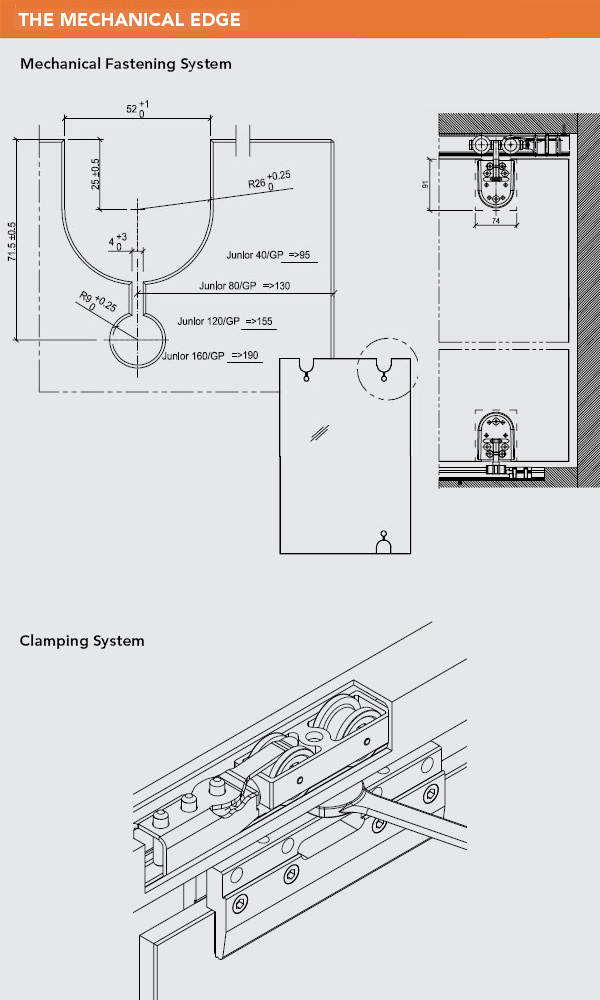 |
Mechanical fastening systems eliminate the possibility of glass slipping out of the hardware and allow the usage of laminated glass.
Images courtesy of Hawa |
Types of Hardware
A variety of hardware systems exists to promote design flexibility.
Glass sliding doors with concealed suspension. Sliding glass doors with hidden suspension and a top track that is either surface-mounted or concealed within the ceiling offer optimum transparency. Both systems enable the glass doors to glide through the ceiling with no visible hardware components, for a light and spacious room design. The top track is especially suitable for integrating into concrete ceilings and suspended lightweight ceilings with ceiling connecting angles. The top track can be plain anodized aluminum or specified for a stainless steel effect with matching cover caps. The detachable cover and accessory profiles can be painted to match the ceiling, thus avoiding unsightly transitions. Some designers, however, prefer the unembellished cubic top track, which can be visually striking when not integrated into the ceiling. This top track can be more than 3 inches wide. While some argue that this is too wide, most architects and designers maintain that transparent room design takes priority. The wide track design allows for optimal and simple installation and enables access to components even in ceiling flush installations.
Hardware that incorporates high-quality, hard-wearing ball-bearing technology and plastic-coated roller bearings provides superior running properties, allowing doors to be easily opened and shut with very little operational force. A two-part punctiform and rattle-proof floor guide can also facilitate hanging the sliding glass doors and provide very low roll resistance while preventing rattling noise, such as that from drafts.
Systems with concealed hardware can handle sliding panel weights to approximately 300 pounds. Recently introduced new products offer the option of concealed hardware systems with soft-closing mechanisms for the sliding profile, which enables room partitioning solutions when bolted to the top track. This hardware can handle sliding panel weights up to roughly 175 pounds. With the soft-closing option, a hydraulic damper gently decelerates the door and pulls it in to its final position; progressive damping is designed for the prescribed maximum door weight, optimizing the sliding speed so that the door decelerates and closes very gently, while increasing protection against pinching. A soft-closing mechanism is long-lasting and maintenance-free, and installing the mechanism is consistent for every application. The hardware can dampen doors on the left, the right, or on both sides. Track stops with adjustable retention springs allow the retention force to be adapted to the door weight for even greater operating convenience. Sliding door locks are optional features.
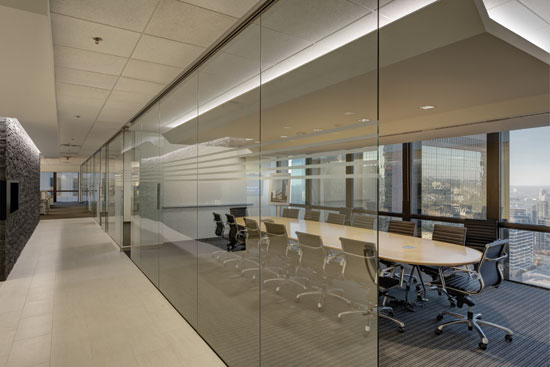 |
Concealed suspension hardware maximizes the transparency of the glass.
Photo courtesy of Hawa |
Both types of concealed suspension offer a form-fitting connection between glass and hardware, resulting in superior safety during use as the potential for glass panes to shift out of place is eliminated. In addition, centric sliding door suspension simplifies installation and prevents lateral pressure on the floor guide. Either toughened safety glass or laminated safety glass can be used, with the latter offering a wide scope of design freedom in conjunction with decorative film. Laminated safety glass is burglary-resistant and provides a high degree of protection against splintering.
In order to simplify logistics, architects should look for product lines in which the same profiles can be used for glass panels of different weights. When the same hardware system can be used for sliding doors with tempered glass thicknesses of 8, 10, 12, and 12.7 mm, and laminated safety glass thicknesses of between 8 to 13 mm, planning and procurement is made easier.
Installation is another consideration and favors hardware systems that utilize the same top track for customized installations with stationary components made of glass or wood, a feature made possible by top track cover profiles detachable from the underside. With some concealed hardware systems, all relevant components including trolley, height adjustment, track stop, bumper, and soft-closing mechanism are installable and removable from underneath without having to displace any ceiling elements. Because the installer has access to the glass suspension system, glass doors or stationary elements can be easily changed out, or added to, without having to remove parts of the ceiling or make any constructional alterations. In some systems, patent-pending wedge suspension facilitates speed of installation and height adjustment of sliding glass doors.
Other types of accessories can prove valuable in certain situations. A vertical aluminum profile with a rubber seal, for example, closes the gap between the stationary glass element and the sliding door and protects not only the glass edges but also against draft—a scenario that in contrast to conventional brush seals, will still look impeccable after many years. In short, locks, wall connection profiles, and profiles for integration into concrete or suspended ceilings are all useful features as they allow a cost-effective installation of sliding glass doors and stationary elements without requiring any improvisation from the installer during installation and adjustment.
Glass sliding systems with patch suspension. Less expensive than concealed hardware systems, patch suspension features some, but minimally visible hardware. Installation, vertical adjustment, and tightening of bolts can be done from the inside of the installation.
Glass sliding doors with suspension / retainer profiles. The suspension/retainer profiles facilitate a precise adjustment of the glass. The mounting keys prevent any subsequent slippage of the profiles. These systems provide the uniform aesthetics most architects desire. The glass suspension and retainer profile can be used on several different systems to provide a consistent look throughout large projects. For example, doors that open simultaneously with the same rails (suspension/retainer profiles) can be used both on stackable wall systems as well as on straight sliding systems. These hardware systems can accommodate laminated safety and toughened safety glass panels that weigh over 500 pounds.
Glass folding / center folding accordion walls. These systems are essentially folding partition systems. The panels are all connected together which allows the operator to easily open and close the system, facilitating flexible, transparent subdivision of rooms. However, these systems are designed for straight applications only.
| Keeping a Loggia Livable All Year |
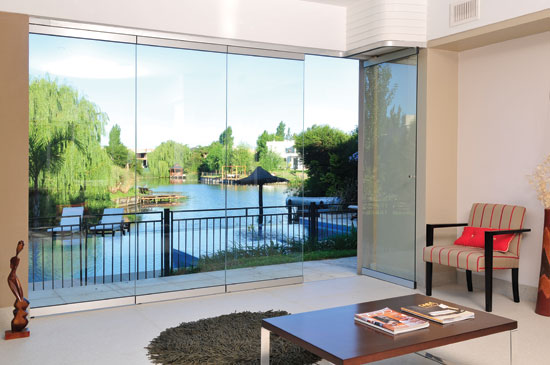 |
Discreet sliding system elements with a large glass surface keeps rooms lighter at the Nordelta gated community in Argentina.
Photo courtesy of Hawa |
At the Nordelta gated community near Buenos Aires, Los Castores II boasts two glass sliding wall installations with an overall length of just under thirty feet that have been in use since 2011. The opened elements of the loggia are stacked at an angle of 90 degrees to the sliding axis. The glass front benefits from the small installation dimensions of the filigree glass suspension and retainer profile. The glass not only protects the loggia from the coastal winds and allows it to be fully used in the mild winters. While the hardware is generally used in indoor applications, the corrosion resistant materials and wind resistance certified to international standards permits an outdoor application.
|
Glass sliding partitions. These systems create a flexible, modular track. The top tracks can be bent according per the customer's desires. Cornering technology in which all turns of the track are curved rather than sharp promote ease of running and use. In comparison to glass folding walls systems, each panel is independently operated, enabling integration of pivot doors into the system design.
Testing. Many sliding glass assemblies are European manufactured, and may adhere to different safety and durability regulations than those in the US. A key criterion to look for is whether the product has been tested by the LGA (Landesgewebeanstalt Bayern), which is a neutral and independent institution that works in accordance with the requirements of the European EN 45011 series of standards. The LGA certification confirms the compliance of products and quality management systems. Architects should note that rigorous internal endurance tests are also suggestive of a quality product, particularly important for the new weight category of up to 550 pounds. While in-house testing varies, some of the higher end manufacturers have testing departments in which sliding doors are moved backwards and forwards more than 150,000 times, travelling more than 186 miles over a course of ten weeks.
Trending Glass Solutions
Architects are using sliding glass doors and partitions to create new looks and sustainable solutions in interior spaces.
The Glass Office
Open work spaces, fewer boundaries, and a team approach rather than a traditional hierarchical organization, combined with a sleek, stylish aesthetic are uppermost in designers' minds as they configure today's corporate offices.
Per current space planning trends, private offices, once red-carpeted, mahagony-doored and arranged around the periphery of the building, have given way to glass enclosed spaces that promote an open collaborative work style, admit light, and meet the needs of today's more mobile workforce that values office spaces that can be shared and easily reconfigured to suit changing workloads or staffing profiles. The Wall Street Journal, in fact, recently reported that four out of four architects given unlimited budget and tasked with designing a 15 foot by 15 foot work space suitable for a midlevel executive built in at least two glass walls; in two cases, designers specified one glass wall to fold or slide open to create shared space. Space planners maintain that this openness allows the executive to earn trust and show leadership, while facilitating communication, collaboration, and interaction between the office team, and defusing psychological barriers between various levels of employee.
Glass offices don't have to be a fishbowl, however. They can provide the privacy and quiet, and a dedicated work space that employees require. The glass itself can be frosted, smoked, or treated with other semi-opaque surfaces. For working spaces or other environments that require privacy, the acoustical properties of glass should be considered. Acoustical properties of glass walls vary according to several factors, including wall height and type of material used. Typically, the thicker the glass, the better its sound buffering qualities. Because of its interlayer which acts to dampen vibration, laminated glass may have the edge over other types of glass in acoustical properties.
Modularity and customization are other key concepts in contemporary space planning that address changing needs in a cost-effective, sustainable manner. Glass walls and partitions are far more conducive to repositioning and relocation than traditional offices built of drywall, gypsum board or plaster and covered in a face material such as wood; relocating these types of spaces can often be a lengthy, slow, unsettling, dusty process that entails temporary displacement of employees to interim quarters. Modular glass systems also offer a tax benefit—because they're considered furniture they carry an accelerated depreciation rate.
Branding potential is another popular glass feature. Glass is increasingly utilized to brand a logo, name, or other features into the physical space, reinforcing a company's or organization's identity and values to employees and customers in reception areas or other parts of the premises. Acid-etching, sandblasting, laminating and back painting—or combinations thereof—are among the many techniques available to develop a distinctive visual statement.
| Transparency and Privacy in an Italian Spa |
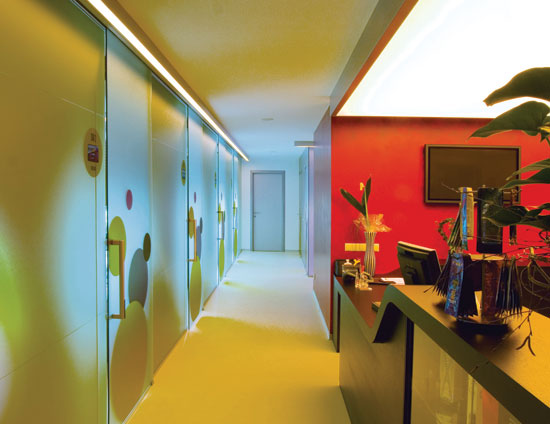 |
Sliding glass doors help achieve articulation of functional areas with a visually appealing ambience.
Photo courtesy of Hawa |
European architect Christian Moser designed a 2900-square-foot beauty salon with just one window front. Moser achieved maximum light transmission from a continuous wall of .39 inches thick TSG float glass to separate the solariums behind the windowfront from the reception area. The wall consists of room-high frameless, all glass sliding doors measuring more than three feet in width and fitted with concealed suspension hardware. The design concept for the glass included a translucid film to ensure transparency does not intrude upon intimacy.
|
Bed and Bath in One
In homes and hotels, a current trend is to have the bathroom open directly into the bedroom, via large sliding glass doors. The toilet is typically situated in a separate compartment but the shower/bath is positioned so that guests can bathe in full view of the room and have a view out the windows. Initiated in resorts, the trend is being embraced by hotels and the residential market. Guests get the benefit of scenery, and designers use the technique to make smaller rooms feel larger. Transparent and thin, glass doors are well known for their ability to take up less space both actually and visually.
Case in point is the 26-year-old Sheraton Hotel and Spa in Edinburgh which recently renovated its 269 rooms. Realizing that the bathroom has gained importance over the past 20 years, designers increased the amount of space for the hotel's wet rooms. They installed four-level shower units, generous bathtubs and separate toilets, surrounding the entire area with elegant glass walls. As a result, the bathroom feels larger, but the actual hotel room no smaller. By using a sliding door with concealed suspension hardware, the designers saved space in the bathroom, and created space with an all-glass design. Ease of assembly, greater sliding convenience for the guest, and complete transparency were the tipping factors in the choice of sliding door.
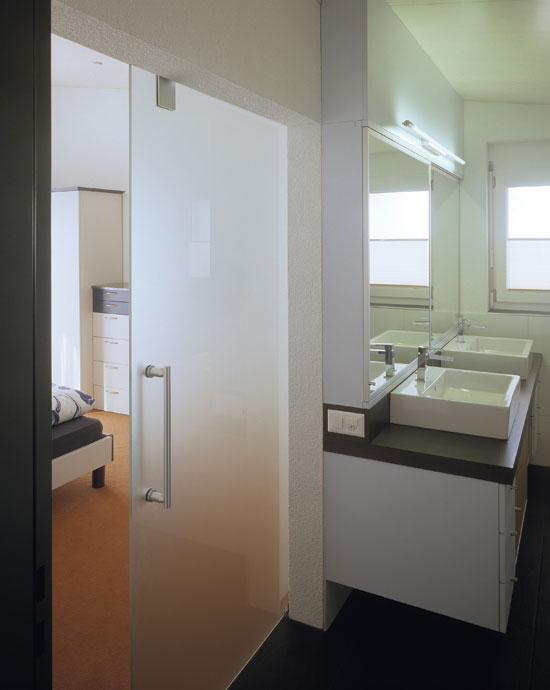 |
Large glass areas make the bathroom larger, lighter, and more elegant, which has an effect on bookings.
Photo courtesy of Hawa |
Shutter Scenarios—A European Trend Gaining Traction
As facade designers become more ambitious, window surfaces are increasing. While large windows can be a dramatic design element that admits light and warmth, unadulterated exposure can impact the potential for low energy buildings and passive houses. Modern designs incorporate folding/sliding shutters as sun screens and weather protectors that are also stylistic elements of design, and have been used in large residential developments and hotels in Europe for many years. For large projects, architects may find it valuable to involve a hardware manufacturer in the planning phase as no two facades are exactly the same and customized solutions are often necessary. Manufacturers can often come up with recommendations and a parts list based on initial sketches.
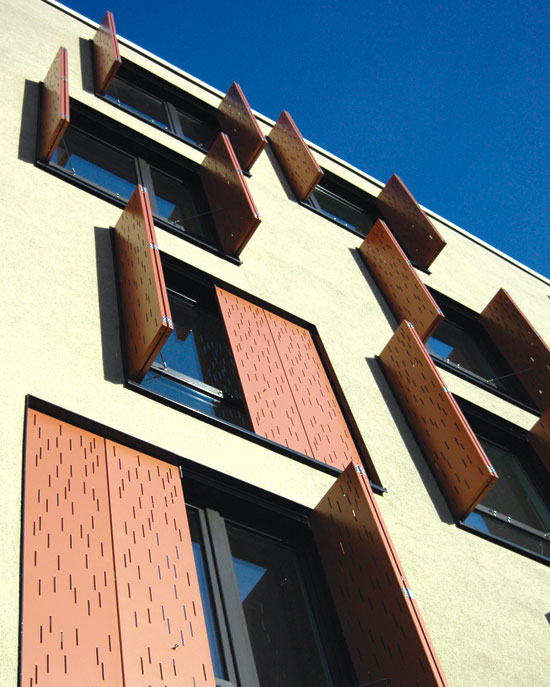 |
A German apartment complex utilized a customized shutter solution based on its unique façade.
Photo courtesy of Hawa |
Standard hardware systems move shutters made of wood, metal, or plastic up to 130 pounds, with classical hardware moving the entire element, a symmetrical arrangement moving the left and right panel simultaneously, and a telescopic model parking two to four panels in front of each other.
In a residential development in Paris that required shading windows with a large glass surface area but only limited parking space for opened shutters, the recommendation was a system that folded the shutters, slid them to one side and parked them at an angle of 90 degrees to the window front. For a Swiss hotel that required heavy wooden shutters, the solution was based on guide rollers that run in a guide channel open on the bottom side, with adaptation to the trolleys and control system that allow the shutters to be opened and closely more slowly.
The Many Faces of Glass
Glass is a versatile material that can be treated for a wide range of effects that maximize privacy as well as the overall visual appeal of an interior space. Glass can be engraved, lacquered, glazed, printed, dyed, painted, and decorated with film. Decorative film in particular opens up new avenues of design thanks to modern reproduction technology. Laminated safety glass is an ideal base for advanced designs as the embedded foil lends glass elements a three-dimensional depth. Architects can specify colors and patterns of their choice by means of a special film, with a variety of materials, customizable designs and even partial metalizing all possible. Wood imitation film is the classic method of designing laminated safety glass, though glass specialists can apply any digital image to a foil or directly to the glass surface, with textile structures, drawings, patterns, logos, photo-quality pictures all available. With this technology, sliding doors can be designed as a standalone eye catcher or as an integrated element that relates to the walls, floors, or other aspects of room design.
| Sliding Glass is Multifunctional at Stockholm’s Exhibition Center |
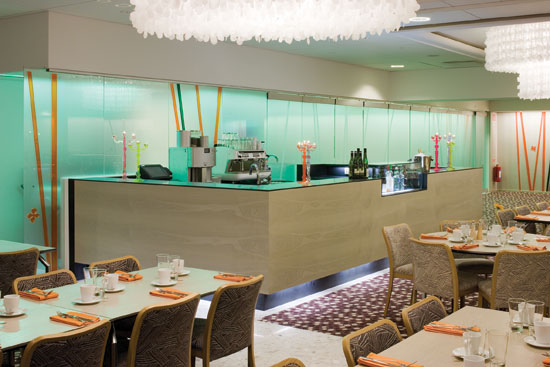 |
Door elements slide effortlessly through the systems of track and curves to the parking space, even with heavy glass. Glass walls serve as projection surfaces, capturing a spectrum of colored light.
Photo courtesy of Hawa |
The exhibition center in Stockholm features a restaurant called The Parkside which seats 850. The greatest challenge faced by architect Ivan Akabeliev lay in making the huge expanse flexible in use and light and airy. The solution consists of a mobile partition wall with 53 glass panels which is separates the large area into small zones. A sliding swinging door separates the room from the lounges, and a flexible wall separates the verandah area where the restaurant opens up to the park through sliding doors. Architects Office Rosenbergs opted for transparency, selecting glass as the dominant design element. Sliding glass walls create an aesthetic quality and enable the greatest possible flexibility—the sliding glass doors can open partially or fully, or remain closed, just as the situation requires. Room size, atmosphere and climate are purposefully adjustable.
Glass also functions as a projection surface. The glass walls can be used as projection surfaces for all kinds of images, and back illumination also offers interesting variations. Staff control the light via touch screens. The illumination concept compliments the flexible room portioning system. Color splashed walls define boundaries between rooms, and milky frosted glass lets the light through, with light staged throughout the restaurant to create atmosphere. A chameleon like “wallwasher” creates special effects. For example, the machine is able to generate millions of different shades of color or white light through fluorescent tubes to immerse walls and furnishings in the desired color tones.
|
Clearly Sustainable
Architectural glass combines several advantages in sustainability—transparency, natural day-lighting, blending of exteriors with interiors and acoustic control, along with many others. A wholly recyclable material, glass plays a noteworthy role in accomplishing greater indoor environmental quality and energy efficiency, and it supplies occasions for architects as well as designers for the innovative applications in buildings.
As compared to drywall, glass decreases the amount of materials and on-site finishes needed, with a corresponding decrease in toxicity and improved interior air quality. Glass sliding systems do not need to be painted and typically require minimal maintenance without the need for harsh chemicals. Glass arrives from the manufacturer in the right size to fit the opening whereas drywall is typically cut on site, generating construction waste that ends up in landfills.
Because sliding glass doors and partitions are easily demountable, they are consistent with the modular, flexible interior systems that are part of a sustainable esthetic. As companies grow they don't have to continually reinvent their space—capital investment can be preserved as glass systems can be downsized, reconfigured or added to an existing space or moved to new quarters.
The sustainability inherent in glass sliding door systems is rewarded in several of the U. S. Green Building Council's LEED categories, notably those of Energy and Atmosphere, where glass minimizes the need for conventional lighting and in Materials and Resources, which rewards sustainable building materials and reduced construction waste. Credits are also possible within the Indoor Air Quality category which favors low-emitting materials and access to daylight and views, and in the Innovation and Design process which recognizes the modularity, flexibility and smaller room footprints, all afforded by glass systems.
Transparency and Sustainability
As the trend toward sustainable buildings grows ever stronger, glass will figure as a preferred building material. Interior sliding glass systems will play a key part in the movement, representing a proven way to meet contemporary space planning objectives and green building goals while providing a compelling aesthetic. Hardware systems that allow maximum transparency, economy, and usability will make the greatest contributions to the ability of glass to realize its full potential.
 |
Hawa Americas Inc. is the U.S. subsidiary of Hawa AG, a Swiss company renowned internationally as a specialist and leading
manufacturer of innovative sliding hardware. Hawa systems can be seen at some of the best addresses in the world. The company
has a high-quality solution for virtually any requirement, any material, and any door weight, from sliding doors for furniture and
buildings to sliding shutters and highly complex sliding wall systems. Over the past 40 years, Hawa has developed a multitude of
technically high-class systems for folding, sliding, or stacking doors and walls made of wood, glass, and metal. www.hawa.com |