This CE Center article is no longer eligible for receiving credits.
This course is part of the Glass in Architecture Academy
Introduction to Glass
Glass is a physically unique product that is made from sand, soda ash, and salt cake. The basic formula for glass is 75 percent silica sand, then soda ash, salt cake, dolomite, rouge/iron oxide are added. Metal oxides are added to the formula to obtain a variety of colors. For example, adding iron can change the glass to a green color. Iron and sulfur or selenium make the glass bronze. Copper and cobalt turn glass blue. Selenium, cobalt and iron turn glass gray.
During processing, glass is melted and cooled with care. The result is rigid but distorted molecules that resemble what we readily recognize as glass which can be used to not only provide occupants with views of the outside world, but also enhance the facade of a building or structure.

Photo ©Tim Griffith
The selected glass coating for Salesforce Tower is a high-performance, low-e coating on clear bent and flat glass with a visible light transmission of about 50 percent.
Glass for commercial and residential construction is typically manufactured as sheet glass. Sheet glass is often created using a float glass process. Float glass is made by floating molten glass on a bed of molten tin. This allows the sheet to be uniform in thickness and flatness. The float glass process makes clear and tinted glass in standard thicknesses ranging from 1.7 millimeters to 12 millimeters, and various sizes commonly up to 130 inches by 204 inches (also known as jumbo glass). Some manufacturers offer thicker and larger glass sizes.
After glass is floated, any specified glass treatments or coatings are applied in a separate process. Simply put, glass is floated, then coated. Over time, technological advances in glass treatments and coatings have made glass a much more chemically and mechanically stronger product. To improve the performance of glass, low-e coatings and heat treatments are specified depending on the needs of the building and occupants. Low-e coatings provide reflectivity, transparency, and energy efficiency. These will be discussed in more detail throughout the course.
Picking the Perfect Glass for Any Project
After determining how glass will be used to execute the design intent of the building, the architect or designer can examine which high-performance glass will deliver on the needs of the occupants. Building orientation, the window-to-wall ratio, and shading elements can impact glass needs for the overall building objective, including light transmittance and energy performance.
Building orientation refers to the direction the building faces. By understanding building orientation, the architect or designer can accommodate for glare, while also taking into consideration the fluctuations of light transmittance from summer to winter months.
Heat transference is another consideration. Depending on the climate, it may be preferable to keep outside heat from entering the building in order to limit the strain on cooling systems. However, in cooler climates, it may be more energy efficient and cost-effective to allow heat from the sun to enter the building and help warm interior spaces.
After determining the building orientation and how it will be affected by sun exposure, the architect or designer should consider the window-to-wall ratio and shading elements. Shading elements can include natural structures such as trees and cliffs/mountains, or it can include nearby buildings or other outside man-made structures. The ratio of windows to the wall and shading elements directly affects the amount of sunlight that enters a building.
In the past, to make a building more energy efficient, smaller windows were specified for projects. The idea was that the smaller the window, the less chance there was for solar heat gain. Thanks to vast improvements in glass technology and fabrication, buildings can be very energy efficient (sometimes up to 100 percent efficient) with large expanses of glass, which allow for vast exterior views and more daylighting reaching occupants, which has been proven to improve well-being.
Considering Thermal Heat Transfer When Specifying Glass
Desired design aesthetic, building orientation, and window-to-wall ratio are all variables used to determine potential thermal heat transfer within the building. Thermal heat transfer occurs when sunlight enters a building through the building envelope. In the context of glass and the building envelope, the amount of heat allowed into the building is measured as the solar heat gain coefficient (SHGC). Heat loss means heat is transferred from a warmer area to a colder area while moving through the material—in this case, glass. The rate of the heat flow is measured as the rate of heat transfer, or U-value. The resistance to the heat flow is measured by the reciprocal, or R-value.
When sunlight hits a material, the material will reflect or absorb the light and energy or allow it to pass through. Glass’s ability to manage solar energy is measured as SHGC. The SHGC equation (or RAT equation) is:
100% = R(%) + A(%) + T(%)
In this equation, R is reflection, A is absorption, and T is transmission of heat. The solar heat gain coefficient is the percentage of solar energy that is transmitted. A related concept is emissivity, which is the material’s ability to take the heat that is absorbed from the sun and either disperse it inside or outside the building.

Image courtesy of Guardian Glass
Shown is a visual account of the how sunlight and glass interact. The percentages of light that are reflected, absorbed, and transmitted are represented in the RAT equation.
Understanding Glass Coatings
When light hits the glass, the specified coatings will determine what percentages of thermal heat are reflected, transmitted, or absorbed. The glass plus the coating create a complete glass product that includes the specified color, reflectivity, and energy performance.
Glass that reflects or absorbs more thermal stress on the exterior side of the glass will prevent heat from the sun from entering the building. However, in rare instances it may be preferable to have more heat transmitted than reflected. That’s why it’s vital for the architect or designer to understand the needs of the occupant as well as environmental factors that will affect heat and light transmittance.
Coatings can be applied a few different ways; however, the most popular method is through an “offline” process that occurs after the float glass is produced, using a magnetron sputter vacuum deposition (MSVD) coater. This is more commonly known as “sputter coating.” The sputter coating technology process applies coatings in a vacuum after the float glass process, allowing multiple thin layers of metals and oxides to be applied to the glass in a very uniform manner. Sputter coatings consist of multiple layers of metals and oxides; their combined thickness is one-thousandth the thickness of a human hair. By using various gasses such as argon, nitrogen, and oxygen, and by layering metallic and dielectric layers in different sequences, a wide variety of coatings are produced to meet most design and performance requirements.
This course is part of the Glass in Architecture Academy
Introduction to Glass
Glass is a physically unique product that is made from sand, soda ash, and salt cake. The basic formula for glass is 75 percent silica sand, then soda ash, salt cake, dolomite, rouge/iron oxide are added. Metal oxides are added to the formula to obtain a variety of colors. For example, adding iron can change the glass to a green color. Iron and sulfur or selenium make the glass bronze. Copper and cobalt turn glass blue. Selenium, cobalt and iron turn glass gray.
During processing, glass is melted and cooled with care. The result is rigid but distorted molecules that resemble what we readily recognize as glass which can be used to not only provide occupants with views of the outside world, but also enhance the facade of a building or structure.
Photo ©Tim Griffith
The selected glass coating for Salesforce Tower is a high-performance, low-e coating on clear bent and flat glass with a visible light transmission of about 50 percent.
Glass for commercial and residential construction is typically manufactured as sheet glass. Sheet glass is often created using a float glass process. Float glass is made by floating molten glass on a bed of molten tin. This allows the sheet to be uniform in thickness and flatness. The float glass process makes clear and tinted glass in standard thicknesses ranging from 1.7 millimeters to 12 millimeters, and various sizes commonly up to 130 inches by 204 inches (also known as jumbo glass). Some manufacturers offer thicker and larger glass sizes.
After glass is floated, any specified glass treatments or coatings are applied in a separate process. Simply put, glass is floated, then coated. Over time, technological advances in glass treatments and coatings have made glass a much more chemically and mechanically stronger product. To improve the performance of glass, low-e coatings and heat treatments are specified depending on the needs of the building and occupants. Low-e coatings provide reflectivity, transparency, and energy efficiency. These will be discussed in more detail throughout the course.
Picking the Perfect Glass for Any Project
After determining how glass will be used to execute the design intent of the building, the architect or designer can examine which high-performance glass will deliver on the needs of the occupants. Building orientation, the window-to-wall ratio, and shading elements can impact glass needs for the overall building objective, including light transmittance and energy performance.
Building orientation refers to the direction the building faces. By understanding building orientation, the architect or designer can accommodate for glare, while also taking into consideration the fluctuations of light transmittance from summer to winter months.
Heat transference is another consideration. Depending on the climate, it may be preferable to keep outside heat from entering the building in order to limit the strain on cooling systems. However, in cooler climates, it may be more energy efficient and cost-effective to allow heat from the sun to enter the building and help warm interior spaces.
After determining the building orientation and how it will be affected by sun exposure, the architect or designer should consider the window-to-wall ratio and shading elements. Shading elements can include natural structures such as trees and cliffs/mountains, or it can include nearby buildings or other outside man-made structures. The ratio of windows to the wall and shading elements directly affects the amount of sunlight that enters a building.
In the past, to make a building more energy efficient, smaller windows were specified for projects. The idea was that the smaller the window, the less chance there was for solar heat gain. Thanks to vast improvements in glass technology and fabrication, buildings can be very energy efficient (sometimes up to 100 percent efficient) with large expanses of glass, which allow for vast exterior views and more daylighting reaching occupants, which has been proven to improve well-being.
Considering Thermal Heat Transfer When Specifying Glass
Desired design aesthetic, building orientation, and window-to-wall ratio are all variables used to determine potential thermal heat transfer within the building. Thermal heat transfer occurs when sunlight enters a building through the building envelope. In the context of glass and the building envelope, the amount of heat allowed into the building is measured as the solar heat gain coefficient (SHGC). Heat loss means heat is transferred from a warmer area to a colder area while moving through the material—in this case, glass. The rate of the heat flow is measured as the rate of heat transfer, or U-value. The resistance to the heat flow is measured by the reciprocal, or R-value.
When sunlight hits a material, the material will reflect or absorb the light and energy or allow it to pass through. Glass’s ability to manage solar energy is measured as SHGC. The SHGC equation (or RAT equation) is:
100% = R(%) + A(%) + T(%)
In this equation, R is reflection, A is absorption, and T is transmission of heat. The solar heat gain coefficient is the percentage of solar energy that is transmitted. A related concept is emissivity, which is the material’s ability to take the heat that is absorbed from the sun and either disperse it inside or outside the building.
Image courtesy of Guardian Glass
Shown is a visual account of the how sunlight and glass interact. The percentages of light that are reflected, absorbed, and transmitted are represented in the RAT equation.
Understanding Glass Coatings
When light hits the glass, the specified coatings will determine what percentages of thermal heat are reflected, transmitted, or absorbed. The glass plus the coating create a complete glass product that includes the specified color, reflectivity, and energy performance.
Glass that reflects or absorbs more thermal stress on the exterior side of the glass will prevent heat from the sun from entering the building. However, in rare instances it may be preferable to have more heat transmitted than reflected. That’s why it’s vital for the architect or designer to understand the needs of the occupant as well as environmental factors that will affect heat and light transmittance.
Coatings can be applied a few different ways; however, the most popular method is through an “offline” process that occurs after the float glass is produced, using a magnetron sputter vacuum deposition (MSVD) coater. This is more commonly known as “sputter coating.” The sputter coating technology process applies coatings in a vacuum after the float glass process, allowing multiple thin layers of metals and oxides to be applied to the glass in a very uniform manner. Sputter coatings consist of multiple layers of metals and oxides; their combined thickness is one-thousandth the thickness of a human hair. By using various gasses such as argon, nitrogen, and oxygen, and by layering metallic and dielectric layers in different sequences, a wide variety of coatings are produced to meet most design and performance requirements.
Low-e Glass
A popular and effective type of coating is low emissivity, or low-e glass, which refers to glass containing a surface condition that emits low levels of radiant thermal energy, such as heat from the sun. Low-e glass is a generic term that refers to coatings added after manufacture to improve energy efficiency. Low-e glass was designed to minimize ultraviolet (UV) light and heat that comes through the window without minimizing the amount of light that enters the building. Without these coatings, there is no reflectivity or absorption, only the transfer of light and heat.
Low-e glass is created by using low-e coatings, which are microscopically thin layers that are deposited on the glass surface to keep the heat on the same side of the glass where it originated. It can keep heat from the sun out on summer days while also keeping heat generated by the heating and cooling system in the building during winter. Low-e coating application happens immediately following the float glass process. Low-e glass reduces heat gain or loss by reflecting infrared energy (heat) while letting in larger amounts of visible light.
This heat gain and loss is measured through a U-factor or U-value. The U-value is a measurement of how effectively a window can stop heat from passing through it and is comprised of the transfer of heat (in Watts) through 1 square meter of glass divided by the difference in temperature across the structure. A lower U-factor indicates better insulating properties. Low-e glass consistently lowers U-value and is therefore frequently specified.
Understanding High-Performance Glass
As previously discussed, glass contributes to the facade as well as the daylighting and energy performance of modern buildings. This is in part due to the technological advancements that have been made with regard to high-performance coatings applied to glass. The latest coating technologies can help better control environmental factors such as heat, light, and sound.
Identify Design Intent
While glass provides views of the outside world while also reducing solar energy gain from the sun’s rays, glass can also contribute to the aesthetics of the building. The first step in any design process is to identify the design intent. What is the desired exterior appearance? How will the material selection of the exterior impact the overall aesthetics and performance of the building? Does the glazing need to perform in the face of potential hazards, such as hurricanes or earthquakes? Does it need to insulate occupants from bothersome noise such as vehicular or air traffic? When selecting glass, consider color, transparency, reflectivity, as well as the building shape and orientation.
Color choices vary greatly and include more than just the basic colors that can be achieved by adding additional minerals to the glass compound by mixing and matching glass substrates and coatings. Additional variations include clear versus tinted glass and reflective color versus transmitted color. Adding tints can also improve the quality of glass due to tints being created by the addition of multiple coatings.
The color rendering index (CRI) is used to determine the neutrality of the transmitted light through the glass.
Color Rendering Index (CRI)
| Product |
CRI |
| Low Iron Insulating |
98 |
| Clear Insulating |
97 |
| Bronze Insulating |
95 |
| Clear Low-e Insulating |
95 |
| Gray Insulating |
95 |
| Light Gray Insulating |
93 |
| Green Insulating |
88 |
| Dark Green Insulating |
85 |
| Blue Insulating |
85 |
For example, blue insulating glass which has a CRI rating of 85 allows in a lower quality of light than a clear insulating glass, which has a CRI rating of 97.

Images courtesy of Guardian Glass
Shown is a view through clear glass versus a view through (blue) tinted glass.
Once the color is selected, the percentage of transparency and reflectivity can also be selected. When determining glass design intent, the architect or designer should also consider the privacy of the occupants. Reflective materials may be preferable in some cases where occupants do not want to be visible from the street or sidewalk. In other cases, a business owner may prefer coatings that enhance visibility of what’s inside the building to lure in potential customers as they pass.
Other variables that must be considered include sun glare, which can be determined based on the building’s orientation. Coatings can be used to mitigate glare, thus improving the health and welfare of occupants. Architects and designers have many available combinations of coatings. Professionals are available to help identify and test different glass makeups as needed.
The amount of visible light transmission desired should also be considered. How much visible light transmission is too much for the occupants or the building’s HVAC system? If occupants are disturbed by too much light transmittance, they may install shading systems such as blinds or curtains, which not only shut out natural light but can also be unevenly opened/closed in windows visible to the street, thus making the building unpleasant to view from the exterior.

Photo courtesy of Guardian Glass
This building's shades are unevenly drawn due to inadequate light and glare protection.
Architects also have a choice with regard to the reflectivity of a building’s exterior. Lower reflectivity provides a whisper-soft, or muted reflectance, while higher reflectivity produces a livelier, crisp reflection on the side of a building.
Quality
The quality of glass is determined by a number of factors, both during the manufacturing process and subsequent fabrication process.
Annealed glass is glass that has been cooled slowly to prevent any residual stress in the body of glass. Annealed glass can be cut, machined, drilled, edged and polished, unlike tempered or heat-strengthened glass. Annealing is done during the float glass manufacturing process.
Annealed glass is popular in residential construction and is sometimes used in commercial construction applications. Most heat-treated and tempered glass that is manufactured is used in commercial applications because these treatments provide added strength.
Heat strengthened (HS) glass is subjected to a specifically controlled heating and cooling cycle that generally makes it twice as strong as annealed glass of the same thickness and configuration. According to ASTM C1048, heat strengthened glass must have a residual surface compression (RSC) level between 3,500 and 7,500 PSI for a thickness of up to 6 millimeters. Due to its greater resistance to thermal loads (when compared to annealed glass), it can resist most wind and thermal stress loads. However, when broken, the fragments are typically larger than pieces of thermal glass that are broken and may remain in the glazing opening. It’s important to note that because it breaks into large pieces that can cause injury to occupants, HS glass is not a safety-rated glazing as specified by building codes. Because it can withstand wind load and thermal stress, HS glass is intended for general glazing and is often used in commercial applications. HS glass cannot be cut or drilled after heat strengthening.
Tempered glass is approximately four times stronger than regular annealed glass of the same thickness and configuration. Per ASTM C1048, its RSC level must exceed 10,000 PSI for thicknesses up to 6 millimeters. Tempered glass is often referred to as a “safety glass” because it meets the requirements of various code organizations for safety glazing. If fractured, the glass will break into smaller pieces, thus making it less likely to cause serious injury in most applications. Tempered glass is often used in sliding glass doors, storm doors, building entrances, bath and shower enclosures, interior partitions, and in windows near floors. Tempered glass cannot be cut or drilled after tempering. Like heat-strengthened glass, any alterations made to tempered glass can cause premature failure.
While HS and tempered glass are much stronger than annealed glass, there are some aesthetic challenges that arise during production. The heat-treating process can create optical distortion or optical quality and flatness, which can be reduced by using the latest technology, but not eliminated.
Four of the main forms of optical quality and flatness impacted by the heat-treatment process include roll waves, a bow in the material, warped material, or a strain pattern.
Roll waves can be caused by ceramic rollers in the furnace. During the heating process, glass will sag very slightly between the carrier rolls that transport the glass through the furnace. After heating, the glass passes through the rapid cooling process, or quench process, which “freezes” the glass, creating the compression and tension that provides either HS or fully tempered glass. However, this process can sometimes result in slight deviations that look like ripples, or roller waves. These waves can be more prominent in reflective glass; however, high-quality specs and high-quality fabrication practices with peak-to-valley tolerances will help minimize distortion. The recommended distortion limits from peak to valley are 0.003 inch to 0.005 inch.
The heat-treatment process can impact the flatness of glass. Glass can become bowed or warped during the manufacturing process. Bowed glass will have a curvature up or down from the horizontal plane. Warped glass will have a twisted bend or curvature. Bow and warp limits are specified by ASTM C1048.
Sometimes glass can have a strained pattern that looks like iridescence or dark shadows that appear under certain light conditions. These are particularly visible in polarized light and are referred to as “quench marks” or “leopard spots.” A strain pattern is caused by the slight difference in glass density within the same lite during the quench process where the high-velocity air is quickly applied through air nozzles. Glass surfaces directly opposite the quench nozzles achieve a slightly higher level of surface compression than adjacent areas. This creates a very slight change in density between the glass area directly under the nozzles and the area away from the nozzles. These slight differences in density result in light and dark areas observed in the heat-treated glass. Because strain pattern is characteristic of heat-treated glass, it is not considered a defect.
To improve optical quality and flatness of heat-treated glass, many factors must be taken into consideration when optimizing the heat-treatment process. The conveyor system, furnace temperature uniformity, and quench design will affect the optical quality of the heat-treated glass. Also, quality inspection methods are necessary to ensure that these systems are functioning properly and that the glass that’s used in construction is top quality.
Laminated glass is another type of glass that is especially popular in applications where extra protection is required. Laminated glass consists of two or more lites that are permanently bonded by heat and pressure with one or more plastic interlayers of polyvinyl butyral (PVB).
Both the glass and the interlayers can be supplied in a variety of colors and thicknesses to provide the desired appearance. Laminated glass can be used in a host of different design applications.
Project applications include areas prone to hurricanes, earthquakes, or explosions as well as areas that require bullet- or impact-resistant glass. Laminated glass can also be used in areas where sound reduction is preferred, such as in buildings near the freeway or an airport. It can also be used in glass storefronts, providing protection from smash-and-grab thefts from storefront window displays.
This protective glass is great for entrance doors, glass floors, glass stairs, aquariums, and display cases. Even if the glass does break, it tends to remain in its frame, thus minimizing the risk of injury from sharp edges. Laminated glass is designed to be more protective to provide added safety for occupants, allowing them more time to safely escape in the event of a natural or man-made disaster that could cause damage or breakage to the glass. Varying levels of tolerances are available for different applications.
In addition to being a “safety glass,” laminated glass can also reduce the fading of interior objects that is often caused by excessive sun damage and exposure. It can also provide sound resistance, which can be useful in areas prone to noise from traffic, airplanes, or industrial noise. Lastly, laminated glass can improve acoustic performance and be useful in facilities where occupants may want to limit outside sound as well as limit sound transfer throughout the building.
The acoustic performance of glazing assemblies is expressed in two terms: sound transmission class (STC) and outdoor-indoor transmission class (OITC). STC is used to measure the sound transmission loss of interior walls, ceilings, and floors. OITC measures the sound transmission loss of exterior glazing applications. Laminated glass and insulating glass tend to produce higher OITC ratings because the laminate dampens the vibrations and the air space limits sound transmission.
Coatings
As discussed earlier, a full glass product is made up of float glass plus the coatings that are applied after the glass is manufactured. Coatings are added to provide tints, reflectivity, transparency, and to limit thermal heat transfer. The goal is to achieve a lower U-value, which is the value used to determine potential heat gain. By having a lower U-value, the energy efficiency of the glass is improved.
Low-e coatings are growing in popularity due to their relatively neutral appearance. The image below shows how low-e coatings increase the amount of solar heat that is reflected while decreasing the amount of heat that is absorbed.

Photo: © 2018 LaCasse Photography
Combining a subtle blue hue with superior solar control, a high-performance, low-e, triple-silver coating on clear bent and flat glass clads Hanover Buckhead Apartments.
Heat-Absorbing versus Low-Emissivity Coatings
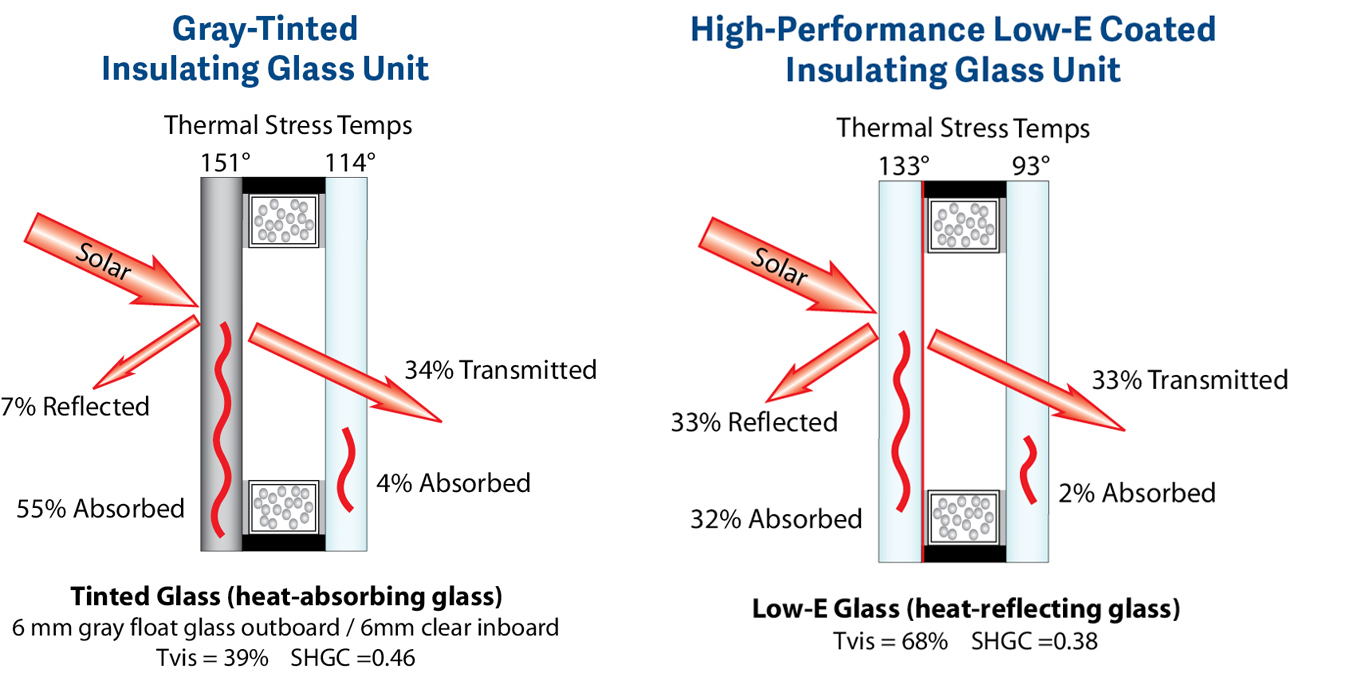
Images courtesy of Guardian Glass
A visual account of how heat-absorbing coatings compare to low-emissivity coatings.
To achieve a lower U-value in a double or triple glazed unit, Low-e glass coatings can be added to various surfaces depending on the application. The diagram below shows four surfaces in an insulating glass setup. Low-e coatings are typically applied to the #2 surface for aesthetics and improved performance. Performance can also be improved even more with the addition of a fourth surface coating, providing an enhanced thermal barrier.

Images courtesy of Guardian Glass
Shown is a visual representation of the surfaces where low-e glass coatings can be applied.
Advanced Glazing Technologies
When considering the light-to-solar-gain ratio, or how efficiently the glazing is letting in light but blocking solar heat gain, triple-silver (three layers of silver sandwiched within other metal layers in a low-e coating) offers best-in-class performance. These coatings are very durable and are designed to be exposed to the interior of the building. Triple-silver coatings can have up to 18 layers.

Image courtesy of Guardian Glass
Illustration of coatings and layers that can be applied to glass.
Standards and Performance
In addition to building codes and standards that provide minimal requirements for buildings to ensure physical safety for occupants, additional standards provide minimal requirements for environmental and health safety.
An environmental product declaration (EPD) is a standardized way of quantifying the environmental impact of a product or system. EPDs are verified and registered documents that communicate transparent and comparable information about the life-cycle environmental impact of a product.
Health product declarations (HPDs) disclose the potential chemical concerns of products in accordance with the Health Product Declaration Standard, which provides a consistent reporting format to increase the quality and availability of product content and health information.
Many glass products can be included in global green building programs, such as LEED and Living Building Challenge and Passive House, to help meet that particular program’s guidelines.
Two organizations that are active in the glazing community are Glass Association of North America (GANA) and the National Fenestration Rating Council (NFRC). GANA sets industry standards and provides leadership, guidance, education and knowledge to flat glass manufacturers, fabricators and glaziers. NFRC is a non-profit that establishes objective performance standards for windows, doors, and skylights.
While new coatings do an excellent job of letting in light and lowering solar heat gain, energy codes and LEED requirements may dictate even greater solar control. Fortunately, there are many options, including medium light transmitting coatings (40-50 percent) as well as various options to achieve any requirements assigned to the project.
By selecting products that meet or exceed these standards and minimum requirements, architects and building designers can provide optimal solutions for their clients while also building and designing more energy-efficient structures.
Hands-on Approach to Specifying High-Performance Glass
Specifying glass and glazing systems can be complicated for architects and designers, who must maximize energy performance and balance occupant comfort and well-being while achieving desired design aesthetics. When specifying high-performance glass with the intent of improving both comfort and energy efficiency in the building, there are many best practices that architects and designers can use.
The first is to evaluate samples using natural lighting. Coated glass is normally selected based on reflected color, as this is typically seen in outdoor/natural lighting conditions. For the most accurate rendering of transmitted and reflected color, it’s preferable to test samples outside in a slightly overcast condition. When viewing the sample, consider various lighting conditions. To see the reflected color of glass, it is best to view samples with a black background. Look through the glass to provide the best indication of the appearance of installed glass.
Using Tools to Specify Glass
Glass manufacturers have developed easy-to-use tools using advanced software for glass and glazing system analysis combining performance and visualization to aid in the glass specification process. Users can explore the aesthetic and functional possibilities of building with glass while meeting complex energy, daylighting and LEED requirements.
Various types of “calculators” can be used to determine the best product. Three types of calculators are a performance calculator, a building energy calculator, and a sustainability calculator. A performance calculator provides comprehensive center-of-glass performance metrics and color information on largely open-ended glazing compositions. A building energy calculator offers schematic-level direction on the comparative whole-building energy-efficiency influences of prospective glazing selections. A sustainability calculator facilitates the generation of application-specific reports on prospective LEED and other sustainability credits associated with the use of one manufacturer’s products.
Another option is to use a building information modeling (BIM) content generator, which allows one manufacturer’s products to be integrated into 3-D project models that offer rendering, coordination, analysis, takeoff, and building operation advantages.
A final option is a glass visualizer which provides photorealistic digital renderings of many prospective glazing compositions in a range of project application and sky conditions.
Getting the Right Light Inside
Studies show an increase in performance as well as health and safety of occupants in well-lit buildings. However, there’s a common misperception that attaining the highest visible light is always the right choice. Excessive glare can negatively impact the health, safety and welfare of occupants. Direct sun can cause eyestrain as well as disability glare, which prevents an occupant from being able to see, much less work. Disability glare happens anytime the brightness of the background exceeds the brightness of the task. These factors can affect occupant health by causing eyestrain, fatigue, tension, and headaches.
In addition to affecting occupant health, safety, and welfare, too much visible light can also allow for unnecessary solar heat gain, which can reduce energy efficiency.
It may seem that 50 percent visible light is too dark, when in reality 50 percent visible light allows a lot of bright natural light in the building without being overwhelming or harmful to occupants.
When visible light transmission is lower, it reduces glare and improves occupant comfort. A lower amount of visible light transmission also eliminates, or reduces, the need for blinds. When blinds become closed they tend to stay closed which defeats the purpose of the window, and electric light becomes the substitute, using valuable energy and raising energy costs. Specifying the right glass for a project is key to allowing the right amount of light inside without the need for blinds, curtains, or other shading materials.
Visible light transmission also affects building design and aesthetics. A lower amount of visible light transmission tends to cloak the window treatments and therefore provide a more uniform appearance to the building when viewed from the exterior. A lower amount of visible light transmission also tends to create a better visual color match between spandrel and vision glass and actually increases the potential for daylighting. High visible light transmission creates glare and the need for window treatments, such as curtains or blinds. These window treatments are often closed by occupants and therefore there is no light transmission from the window into the space, which defeats the purpose of the original design.
When specifying glass and coatings for the glass, architects and designers must consider the needs of the occupants as well as the facade and the intentions for the building’s aesthetics. In some cases, the building’s exterior is designed to provide symbolism for what occurs within the building. Modern architecture not only provides the latest technological advancements for lighting and occupant safety and comfort but it can also be a means of expressing great symbolism
In the following case study, the German Bundestag in Bonn was intentionally designed to not only house the government but also make a statement.
Conclusion
When considering glass for a project, architects and designers must understand the benefits of high-performance glass and best practices for specifying glass. The transparency of high-performance glass allows for abundant daylight and views, which can promote the health and well-being of occupants; at the same time, the material can manage solar heat gain for a range of climate zones. With a high-level understanding of glass manufacturing and coating processes, as well as knowledge of the tools available to help with the specification process, architects and designers can achieve their desired aesthetic while providing performance solutions that allow daylighting and views that have been proven to improve the health, safety, and welfare of occupants.
End Notes
1Schittich, Christian; Staib, Gerald; Balkow, Dieter; Schuler, Matthias; and Sobek, Werner. Glass Construction Manual. Birkhäuser. 1999.
2Foster+Partners. Web. 24 Oct. 2018. www.fosterandpartnerns.com
Resources
List of Approved Software for Calculating the Energy Efficient Home Credit. Office of Energy Efficiency & Renewable Energy. U.S. Department of Energy. Web. 24 Oct. 2018 www.energy.gov/eere/buildings/list-approved-software-calculating-energy-efficient-home-credit
"Green schools are better for budgets." The Center for Green Schools. U.S. Green Building Council. 1 Aug. 2018. Web. 24 Oct. 2018. www.centerforgreenschools.org/green-schools-are-better-budgets