This CE Center article is no longer eligible for receiving credits.
The next hot water heater you specify may be among a number of smart appliances in a residential project that will tell the owner when the price of electricity is high and silently choose the lower rate for its heating mode. It may be able to exchange information about usage needs such as vacation plans or guest schedules. Your next water heater decision should be efficient, smart, sustainable and just one of the many new residential and commercial 21st century products to advance the ENERGY STAR goal of water and energy conservation. The technology to achieve this efficiency is the well proven electric heat pump that is designed to absorb heat from the ambient air, and transfer it into stored water to a desired temperature. By contrast, conventional electric water heaters use direct electric radiation to heat the water which uses more energy, although it responds faster. When an electric hot water heater uses both of these technologies in one unit, it is referred to as a hybrid heat pump water heater and will be the focus of this article.
Smart appliances like hybrid heat pump water heaters are just one of the results of funding provided by the U.S. Department of Energy (DOE) and the Department of Environmental Quality (DEQ) to stimulate research and development to manufacture sustainable, energy efficient products. Government, universities, businesses, researchers have also been working on a complementary "Smart Grid" initiative for the past decade. They met to discuss creating national programs even before being spurred on by the 2003 blackout that left Americans from New York to Michigan in the dark and demonstrated the flaws in the U.S. electric grid.
This article will also discuss the EPA and ENERGY STAR programs and research criteria that made electric hybrid heat pump water heaters possible. The components of this super-efficient product will be discussed, including the smart electric meters that make it an intelligent part of a home's energy budget plan. Professionals will also review the ENERGY STAR energy factor (EF) rating that helps them select the most efficient appliances. The advantages of smart appliances that work with a smart grid network for a home and business will include a discussion of the incentives and savings available.
It should be noted that there is a strong relationship between energy savings to heat water and the conservation of water as a sustainable design strategy. Recognizing this, the AIA has provided a guide to assist professionals with readily available tools and techniques to achieve significant savings in buildings. In the 50to50 program for example, professionals can find guidelines that include the use of energy saving appliances and equipment as a tool to achieve sustainable design. In addition, ENERGY STAR labeled heat pump water heaters will contribute towards credits in rating systems such as the USGBC LEED V3® for homes and commercial buildings for innovation and energy efficiency.
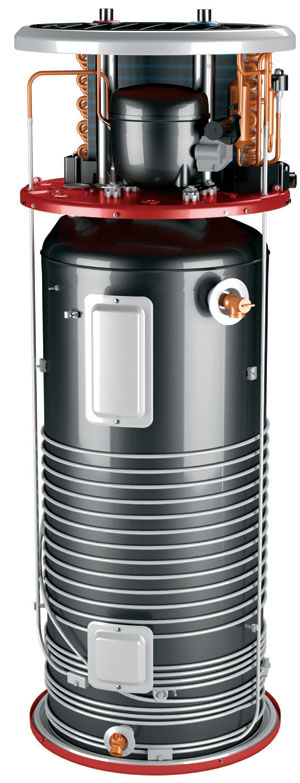
|
An ENERGY STAR electric hybrid water heater is designed to absorb
heat from the ambient air, and transfer it into stored water to a desired
temperature for homes or commercial heating.
Photo courtesy of GE Appliances |
The ENERGY STAR Challenge
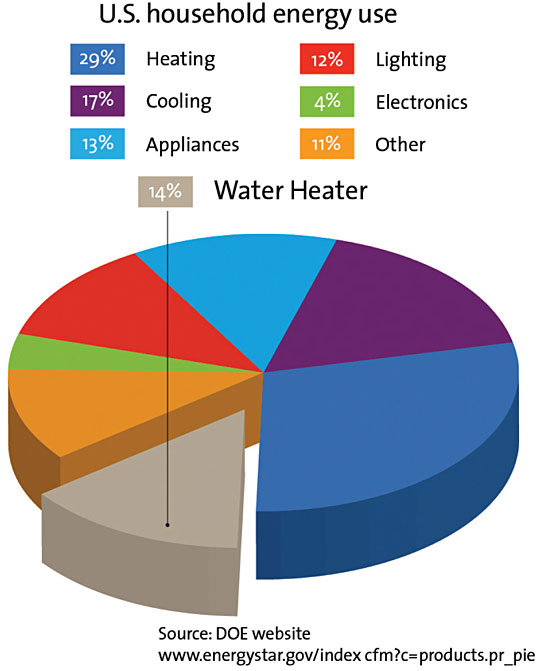
According to the US Department of Energy (DOE), water heating currently represents up to 17 percent of the overall national residential energy consumption. The water heater by itself, is the second highest single energy user in the home, behind heating and cooling. Water heaters make up somewhere between 14% and 20% of the energy usage in the average home. However, as of 2008, water heating was the only major residential appliance that ENERGY STAR had not classified for an energy rating.
Smart Grid: A 2030 Vision Plan |
 |
In 2003, senior executives representing the electric utility and the Department of Energy (DOE), published "Grid 2030" A National
Vision for Electricity's Second 100 Years. This document outlines a vision for a new electrical power grid that will provide "affordable, clean efficient and reliable electric power anytime, anywhere." This is the electronic superhighway that is planned to modernize all communications.
It was clear to these planners that the entire network that included cables, transformers, storage devices and meters needed to provide intelligent and smart power systems. They created a roadmap that provided timelines and incentives for new technology. In this document are numerous charts, data and fact sheets that forecast the shortage in the U.S. utility capacity and future supply for a growing electrical demand. Through regional meetings of stakeholders, convened under the Modern Grid Strategy project of the National Energy Technology Laboratory (NETL), the modern grid was identified to provide the following characteristics or performance features:
- Self-healing from power disturbance events
- Enabling active participation by consumers in demand response
- Operating resiliently against physical and cyber attack
- Providing power quality for 21st century needs
- Accommodating all generation and storage options
- Enabling new products, services, and markets
- Optimizing assets and operating efficiently
Currently, some of the first products from this analysis, assisted with stimulus funding have arrived to market, including the electric hybrid heat pump water heater. Future grid meters will monitor the electricity usage across the smart grid to distribute electricity as needed to the households and businesses, avoiding the spikes and demand power surges. Demand Response electronics, such as those incorporated by some manufacturers in electric hybrid water heaters, can prevent the homeowner from paying higher rates during peak power periods, by reacting to smart meter signals and going into a maximum energy efficiency mode or cycling off and temporarily altering the tank temperature. This sophisticated form of "load control" allows the water heater to continue to function, even during peak periods.
Utilities are now receiving federal funding to develop smart grid technology that will work with home appliances such as the hybrid electric heat pump water heater. According to the Boston Globe on October 28, 2009, "Officials at Central Vermont Public Service and other utilities say the $69 million in federal funding announced Tuesday will move the state closer to having in-home displays of electrical usage and digitally controlled appliances that operate when power demand is light. The grant will pay up to half the costs of $137 million in improvements across Vermont." Over one hundred utilities applied for this stimulus funding this year forecasting a future where smart grid technology will be part of every residential as well as commercial utility metering system. |
ENERGY STAR is a division of the DOE and its goal is to drive technological change in the market to support the national efforts to reduce electrical consumption. ENERGY STAR products ensure that the established criteria:
- Provide meaningful differentiation between ENERGY STAR
qualified products and those that just meet the Federal standard.
- Will result in significant energy savings, both for consumers and
the nation as a whole.
- Are cost-effective for consumers as well as manufacturers.
- Provide consumer choice, both in terms of number of
models and a wide range of manufacturers.
- Do not compromise functionality or performance of the
qualified product.
- Do not rely on proprietary technologies.
When a product manufacturer is registered as an ENERGY STAR partner, they can submit products for testing. Once the product is qualified through third party testing, the manufacturer can place the ENERGY STAR label on the product, a sign to the consumer that they are receiving an approved and tested energy efficient appliance.
Water heating can be provided through a number of technologies, solar, electric and gas and ENERGY STAR, categorizes each separately. Energy consumption is based on DOE test procedures and the criterion includes a minimum energy factor, a minimum first hour rating requirement, a minimum warranty and compliance with the appropriate codes.
The Energy Factor (EF) indicates the overall efficiency of a water heater based on the ratio or useful energy output from the water heater to the total amount of energy delivered to the water heater. Energy factors help the consumer know the recovery efficiency, percentage of standby and water cycling losses of a water heating system. EF is determined by the DOE test procedure, Code of Federal Regulations, Title 10, Section 430. A high Energy Factor rating means a more efficient water heater. To qualify as an ENERGY STAR heat pump water heater, the EF must be 2.0 or greater, one of the highest EF ratings of all types of water heaters. Recovery efficiency is a measure of how quickly hot water will be available after use. Standby losses are the percentage of heat loss from stored water compared to the heat content in the storage tank. Water cycling losses determine how much heat is lost as the water circulates through the tank, inlets and outlet pipes.
The next hot water heater you specify may be among a number of smart appliances in a residential project that will tell the owner when the price of electricity is high and silently choose the lower rate for its heating mode. It may be able to exchange information about usage needs such as vacation plans or guest schedules. Your next water heater decision should be efficient, smart, sustainable and just one of the many new residential and commercial 21st century products to advance the ENERGY STAR goal of water and energy conservation. The technology to achieve this efficiency is the well proven electric heat pump that is designed to absorb heat from the ambient air, and transfer it into stored water to a desired temperature. By contrast, conventional electric water heaters use direct electric radiation to heat the water which uses more energy, although it responds faster. When an electric hot water heater uses both of these technologies in one unit, it is referred to as a hybrid heat pump water heater and will be the focus of this article.
Smart appliances like hybrid heat pump water heaters are just one of the results of funding provided by the U.S. Department of Energy (DOE) and the Department of Environmental Quality (DEQ) to stimulate research and development to manufacture sustainable, energy efficient products. Government, universities, businesses, researchers have also been working on a complementary "Smart Grid" initiative for the past decade. They met to discuss creating national programs even before being spurred on by the 2003 blackout that left Americans from New York to Michigan in the dark and demonstrated the flaws in the U.S. electric grid.
This article will also discuss the EPA and ENERGY STAR programs and research criteria that made electric hybrid heat pump water heaters possible. The components of this super-efficient product will be discussed, including the smart electric meters that make it an intelligent part of a home's energy budget plan. Professionals will also review the ENERGY STAR energy factor (EF) rating that helps them select the most efficient appliances. The advantages of smart appliances that work with a smart grid network for a home and business will include a discussion of the incentives and savings available.
It should be noted that there is a strong relationship between energy savings to heat water and the conservation of water as a sustainable design strategy. Recognizing this, the AIA has provided a guide to assist professionals with readily available tools and techniques to achieve significant savings in buildings. In the 50to50 program for example, professionals can find guidelines that include the use of energy saving appliances and equipment as a tool to achieve sustainable design. In addition, ENERGY STAR labeled heat pump water heaters will contribute towards credits in rating systems such as the USGBC LEED V3® for homes and commercial buildings for innovation and energy efficiency.
|
An ENERGY STAR electric hybrid water heater is designed to absorb
heat from the ambient air, and transfer it into stored water to a desired
temperature for homes or commercial heating.
Photo courtesy of GE Appliances |
The ENERGY STAR Challenge
According to the US Department of Energy (DOE), water heating currently represents up to 17 percent of the overall national residential energy consumption. The water heater by itself, is the second highest single energy user in the home, behind heating and cooling. Water heaters make up somewhere between 14% and 20% of the energy usage in the average home. However, as of 2008, water heating was the only major residential appliance that ENERGY STAR had not classified for an energy rating.
Smart Grid: A 2030 Vision Plan |
|
In 2003, senior executives representing the electric utility and the Department of Energy (DOE), published "Grid 2030" A National
Vision for Electricity's Second 100 Years. This document outlines a vision for a new electrical power grid that will provide "affordable, clean efficient and reliable electric power anytime, anywhere." This is the electronic superhighway that is planned to modernize all communications.
It was clear to these planners that the entire network that included cables, transformers, storage devices and meters needed to provide intelligent and smart power systems. They created a roadmap that provided timelines and incentives for new technology. In this document are numerous charts, data and fact sheets that forecast the shortage in the U.S. utility capacity and future supply for a growing electrical demand. Through regional meetings of stakeholders, convened under the Modern Grid Strategy project of the National Energy Technology Laboratory (NETL), the modern grid was identified to provide the following characteristics or performance features:
- Self-healing from power disturbance events
- Enabling active participation by consumers in demand response
- Operating resiliently against physical and cyber attack
- Providing power quality for 21st century needs
- Accommodating all generation and storage options
- Enabling new products, services, and markets
- Optimizing assets and operating efficiently
Currently, some of the first products from this analysis, assisted with stimulus funding have arrived to market, including the electric hybrid heat pump water heater. Future grid meters will monitor the electricity usage across the smart grid to distribute electricity as needed to the households and businesses, avoiding the spikes and demand power surges. Demand Response electronics, such as those incorporated by some manufacturers in electric hybrid water heaters, can prevent the homeowner from paying higher rates during peak power periods, by reacting to smart meter signals and going into a maximum energy efficiency mode or cycling off and temporarily altering the tank temperature. This sophisticated form of "load control" allows the water heater to continue to function, even during peak periods.
Utilities are now receiving federal funding to develop smart grid technology that will work with home appliances such as the hybrid electric heat pump water heater. According to the Boston Globe on October 28, 2009, "Officials at Central Vermont Public Service and other utilities say the $69 million in federal funding announced Tuesday will move the state closer to having in-home displays of electrical usage and digitally controlled appliances that operate when power demand is light. The grant will pay up to half the costs of $137 million in improvements across Vermont." Over one hundred utilities applied for this stimulus funding this year forecasting a future where smart grid technology will be part of every residential as well as commercial utility metering system. |
ENERGY STAR is a division of the DOE and its goal is to drive technological change in the market to support the national efforts to reduce electrical consumption. ENERGY STAR products ensure that the established criteria:
- Provide meaningful differentiation between ENERGY STAR
qualified products and those that just meet the Federal standard.
- Will result in significant energy savings, both for consumers and
the nation as a whole.
- Are cost-effective for consumers as well as manufacturers.
- Provide consumer choice, both in terms of number of
models and a wide range of manufacturers.
- Do not compromise functionality or performance of the
qualified product.
- Do not rely on proprietary technologies.
When a product manufacturer is registered as an ENERGY STAR partner, they can submit products for testing. Once the product is qualified through third party testing, the manufacturer can place the ENERGY STAR label on the product, a sign to the consumer that they are receiving an approved and tested energy efficient appliance.
Water heating can be provided through a number of technologies, solar, electric and gas and ENERGY STAR, categorizes each separately. Energy consumption is based on DOE test procedures and the criterion includes a minimum energy factor, a minimum first hour rating requirement, a minimum warranty and compliance with the appropriate codes.
The Energy Factor (EF) indicates the overall efficiency of a water heater based on the ratio or useful energy output from the water heater to the total amount of energy delivered to the water heater. Energy factors help the consumer know the recovery efficiency, percentage of standby and water cycling losses of a water heating system. EF is determined by the DOE test procedure, Code of Federal Regulations, Title 10, Section 430. A high Energy Factor rating means a more efficient water heater. To qualify as an ENERGY STAR heat pump water heater, the EF must be 2.0 or greater, one of the highest EF ratings of all types of water heaters. Recovery efficiency is a measure of how quickly hot water will be available after use. Standby losses are the percentage of heat loss from stored water compared to the heat content in the storage tank. Water cycling losses determine how much heat is lost as the water circulates through the tank, inlets and outlet pipes.
In a 2008 report, standard electric resistance water heaters were not eligible for an ENERGY STAR label. According to ENERGY STAR stakeholders "electric resistance technology is highly inefficient over the fuel cycle and it potentially increases total energy consumption and emissions." Although typical electric resistance heaters have energy factors up to .95 percent, the additional energy savings of the perfect resistance water heater would only provide a savings of electricity between 4.8 and 8.7 percent and consume 4,622 kilowatt-hours per year. This did not offer enough savings to meet the new ENERGY STAR challenge for rating hot water heaters. Electric Resistance storage hot water heaters represent about half of all hot water heating appliances and the DOE wanted to drive the largest energy savings possible by creating incentives for new technology.
As part of a national strategy to conserve water and save energy as fuel costs rise, the DOE challenged manufactures to develop new products with much more aggressive energy targets. The DOE provided research grants as an incentive. Some manufacturers entered into a Cooperative Research and Development Agreements (CRADA) with Oakridge Laboratories in Oakridge, Tennessee and the DOE. A CRADA is a written agreement between a federal research organization and one or more federal or non-federal parties to work together as partners on a research project of mutual interest.

|
Annual Energy cost comparison between standard electric heaters and ENERGY STAR
qualified heat pump heater
Chart courtesy of GE Appliances |
As a result of the ENERY STAR incentives and discussions with stakeholders, on April 1, 2008, Richard H. Karney, P.E. ENERGY STAR Products Manager, reported the new criteria for energy efficient heat pump water heaters that use vapor compression refrigeration systems to transfer heat from the surrounding air. DOE includes residential as well as commercial drop-in or integrated heat pump water heaters in the program. The final criteria for these systems are:
- A minimum Energy Factor of 2.0.
- A minimum First-Hour Rating requirement of 50 gallons-per-hour.
- A minimum six-year limited warranty on the sealed system.
- Compliance with UL 174 and UL 1995.
ENERGY STAR requires that the heat pump unit has a
maximum current rating of 24 amperes, with voltage no greater
than 250 volts. In addition, these units must have the heat pump
integrated into the storage tank as a stand-alone unit. Units must
have extended warranties that can be as high as ten years for some
products.
Using the DOE test procedure for calculations, a fifty-gallon heat pump water heater with a 2.0 Energy Factor would consume an estimated 2,195 kilowatt-hours per year. This is a savings of nearly 55%, or 2,662 kilowatt-hours, in comparison to the typical electric resistance water heater." Some manufacturers have already surpassed this goal hitting as high as 2.4, or 240% efficient, with a 50-gallon water heater. This equates to about a 62% savings as compared to a standard resistance electric water heater and can mean cost savings of up to $325 per year or $3,250 over the 10 year life of the unit. Even more amazing is the DOE report that "If just 10% of the nation's 4.8 million electric water heater shipments were heat pump water heaters with an Energy Factor of 2.0 instead of conventional models with an Energy Factor at the Federal standard, the aggregate energy savings would amount to nearly 1.3 billion kilowatt-hours per year.
Sustainability: Using nature as a heat source

|
ENERGY STAR approved water heaters are designed to fit in the same locations as a
traditional water heater.
Photo courtesy of GE Appliances |
Designed to work with the natural process of heat exchange, an
electric hybrid heat pump water heater has at least two modes
of operation. It can either work through traditional electrical
resistance heaters drawing 4500 watts, or in the heat pump mode
drawing as little as 550 watts of electricity. This new
product may appear in size, shape and installation
requirements, to be similar to the typical family water tank
however, it operates on very different principles.
Janine Benyus, author of Biomimicry, discussed the study of nature to find solutions for new technology. She asks designers to think about how to use nature as a resource. Heat pumps extract heat, energy savings and peak load reduction literally from the surrounding thin air. Engineers use the thermodynamic properties of nature to compress air through an environmentally safe refrigerant, capturing residual heat and creating condensate. Through heat transfer, whether from the earth as in a geo-thermal heat pump or from air temperature used for the opposite effect in air conditioning and refrigeration systems, heat pumps use nature as a source for this technology.
This electric hybrid heat pump water heater is designed to absorb heat from the ambient air to transfer it into stored water to a desired temperature for home or commercial heating. It uses less energy to transfer heat than it does to generate heat, thus creating energy savings. A smart meter monitors the flow of electrical consumption across the grid to maintain the temperature at the most efficient price to the consumer. A combination of thermodynamics and economic planning makes this system work for energy savings.
Hybrid Electric Heat Pump Components that
Maximize Energy Efficiency
An ENERGY STAR electric hybrid heat pump water heater must be an integrated unit. The goal is to provide hot water in the same way as a traditional water heater, but without sacrificing energy efficiency. Hot water is delivered without a warm up period and the units can work either in the heat pump mode or as a resistance water heater. To maximize savings, this hybrid controls water heating through "smart technology." It should be noted that warranties on these hybrid water heaters vary depending on the manufacturer. Some have a parts only warranty, some include a year of labor, and some warranties are transferable in residences while others are not. Regardless, the components of an electric heat pump water heater include the following.
The water tank
The hybrid tank is typically an insulated residential fifty gallon tank using the same footprint as common existing heaters with water and electrical connections in the same area, key to an easy change out. The unit will fit in the same locations as a traditional water heater, often in the basement near a floor drain. In California, the law requires that residential water heaters must be braced, anchored or strapped to resist falling or horizontal displacement due to earthquake motions. All tank installations should follow local codes and installation is similar to that of a traditional resistance water heater.
The heat pump
In an integrated unit, the heat pump is factory installed on top of the tank and can have easy access for repair as necessary. Some heat pump water heaters have the heat exchange coils immersed in the water tank or circulate water through a heat exchanger. Others are integrated into insulation around the tank housing allowing heat transfer through the tank. Separating the heat exchange from the water source reduces the effect of hard water and corrosion that can dramatically reduce efficiency. It also avoids additional maintenance in areas with hard water.
Condensate collector and filter
The output of a heat pump includes heat exchange and condensate.
The typical heat pump water heater can dehumidify up to two quarts
of water a day and will require a gravity drain line. A small tube
may be provided to tie into a floor drain for condensate collection
in existing homes or routed into new drains in new construction. A
filter that helps prevent the evaporator from dirt or dust will need to
be cleaned periodically to maximize efficiency. Some units provide a
filter sensor that determines a restricted airflow, illuminating a "red"
light when the filter needs to be cleaned or replaced.
Electrical and plumbing connections and safety
Some manufacturers provide the same plumbing and electrical connections in the same location as a regular electric water heater. Others require plumbing changes either to the side or much higher than a regular water heater. The size, weight, and ease of installation varies by manufacturer. Further, some, but not all, can be laid on their side for transportation and installation while others must remain upright, a significant concern for basement installations. Regardless of these variations, the water heater must be installed in accordance with local codes, utility codes, and the latest version of the National Electrical Code ANSI/MFPA 70. Plumbers must meet the approved plumbing codes and all installation should be in accordance with the manufacturer's instructions. A separate branch circuit is required with copper conductors, overcurrent protective devices and suitable disconnection safety devices as provided by a qualified electrician.
Plumbing requirements include hot and cold water connections 3/4" NPT on most models. Plumbers will need to determine if a check valve exists in the inlet water line. As water is heated, it expands in volume and creates an increase in the pressure within the water system. In an open water system, thermal expansion may cause water which exceeds the capacity of the water heater to flow back into the city main where the water pressure can be dissipated. In a closed water system, the expanding water is prevented from flowing back into the main supply line. This thermal expansion can create a rapid and dangerous pressure increase in the water heater and system piping. The constant increase in pressure can result in a premature failure of the relief valve and possibly the heater.
One suggested method of controlling thermal expansion is to
install an expansion tank in the cold water line between the water
heater and the check valve. The expansion tank is designed with an
air cushion built in that compresses as the system pressure increases,
thereby relieving the over-pressure condition and eliminating the
repeated operation of the relief valve. The pressure rating of the
relief valve must not exceed 150 PSI, or the maximum working
pressure of the water heater as marked on the rating plate.
Demand Response and Energy Savings:

|
Electric heat pump hybrid water
heaters have control panels that
provide multiple operating
functions.
Photo courtesy of GE Appliances |
Many utilities are now utilizing smart meters that allow two-way
communication between the utility and their customer. Often this
is used for "Load Control" allowing the utility to shed load during
peak times by turning off the water heater for a period of time.
Some manufacturers of hybrid heat pump water heaters incorporate
this technology into the electronics on the water heater, which
opens the door for the utility to communicate with the heater. This
can include load control that is more consumer-friendly by allowing
the water heater to continue operation at a lower energy draw
using only the heat pump mode.
Enhanced electronic controls provide an "appliance" feel to the operation of the water heater. For example, the temperature of the water in the water heater can be regulated using the electronic touch pad, much like a microwave. To comply with regulations, the default heating mode is set at 120 degrees F; however, the temperature range can be from 100 degrees Fahrenheit to 140 degrees F. Water temperature over 125 degrees F can cause severe burns instantly. ENERGY STAR recommends a temperature setting of 120 degrees F for both energy saving and cleaning efficiency as well as safety.
Some hybrid heat pump water heaters come factory set in the hybrid -operating mode to ensure an adequate volume of hot water and energy savings. Other modes include the following:
- Heat pump only mode. This mode is the most energy efficient.
In this mode, the water heater takes heat from the surrounding
air to heat the water. The time it takes to heat the water is
longer in this mode, so it may not be sufficient if you have a
high-demand situation such as a
large household or visitors.
- Standard electric mode.This
mode uses only the upper and
lower heating resistance elements
to heat the water. The time it
takes to heat the water is less in
this mode, but it is the LEAST
energy-efficient mode.
- Hybrid mode.Recommended
Mode Hybrid mode combines
the energy efficiency of the heat
pump mode but can also utilize
the resistance heaters for a faster
recovery for hot water delivery.
- High demand. This mode is
only necessary if your household
has a higher-than-average
water usage. In this mode, the
unit will react faster and use
the electric heating elements
instead of the heat pump when
the water demand is higher than
normal. When using the heating
elements, the water temperature
will recover at a faster rate but it
will take more energy to heat it.
Unlike standard electric mode,
it will use the heating elements
only when needed.
As described above, a hybrid
water heater can act in dual modes
depending on the demand for hot
water. In the hybrid mode, some
water heaters are estimated to use
550 watts of electricity versus 4,500 watts in a standard electric
mode. That could be a reduction of up to 3,000 kilowatt hours per
year. A smart water heater can be set to accommodate the size
of your household, a vacation, or a visitor. When it is set for a
vacation, it will know to turn on the day before the homeowner
returns.
One by-product of having a heat pump water heater in
addition to dehumidification is a slight cooling affect. While this
will be beneficial in the summer, it may not be welcome in the
winter. Some manufacturers have incorporated a "stop cold air"
control that can allow the user to switch off the heat pump for
a prescribed period of time during the winter. The water heater
would then automatically switch back into the hybrid mode at
the end of the setting, up to 99 days. For water heaters installed
in a basement or garage, the cooling affect may not present
a concern.
Utilities often charge their customers based on the peak load.
These are the times when more consumers require electricity from
the utility. On a very hot day air conditioning loads can mean an
increased power requirement for the utility. The smart controls
on some hybrid water heaters can respond to utility smart meters
to help shed some of this load during critical times while still
maintaining the hot water needs of the home.
Clean Air Act 1990 Amendment -
Refrigerants and the Ozone Layer
|
Refrigerants are used in the heat cycle when compressing air in a phase change from a gas to a liquid, raising or cooling the temperature of an element and creating condensate. For over fifty years, Chlorofluorocarbons, or CFC's were the refrigerant of choice as they were nontoxic, non-flammable, and inexpensive to produce. Unfortunately, in the 1980's, scientists confirmed that CFC's also depleted the Ozone layer. World wide concerns led to the signing of the Montreal Protocol in 1987 which formalized the reduction and later the ban on the production and use of CFC's.
The purpose of the Clean Air Act of 1990 was to protect public health and welfare from harmful air pollution and emissions, while insuring economic growth. Title 42, Chapter 85 - Air Pollution Prevention and Control/subchapter VI - specifically addresses Ozone Protection. The DOE created the Significant New Alternatives Policy (SNAP) Program that reviews and identifies ozone safe substitutes. Most refrigerants used in household appliances are a blend of chemicals that are safe for the environment.
Heat pumps use refrigerants that are identified by class and
identified by their molecular structure, the number of carbon,
hydrogen and fluorine atoms. The US Environmental Protection
Agency recognizes the refrigerant used in hybrid electric water
heating, R407 A class of refrigerants, also referred to 134A as an
acceptable substitute for CFC's.
Because of these regulations, there is good news for us and the
environment. According to the US EPA, the hole in the ozone layer is
recovering from the use of CFC's because of the response to this crisis
in our environment. |
Incentives - National and State
The American Recovery and Reinvestment Act of 2009 extended many consumer tax incentives originally introduced in the Energy Policy Act of 2005 (EPACT). Federal Income Tax credits were eligible to be applied dollar for dollar and deducted to taxes paid or owed. For 2012, most of those credits have expired, although the possibility remains for new tax credits to emerge. It is more likely, however, that new regulations will simply mandate higher performance for all water heaters. For example, a proposed 2015 energy mandate will essentially outlaw resistance water heaters below a .95 EF and require all water heaters 55 gallons and above to have a minimum EF of 1.964 just to be manufactured (i.e. Energy Star qualified product).
Despite the loss of tax credits, Energy Star qualified heat pump water heaters are commonly eligible for rebates from local electrical utility companies. The initial cost and installation of a heat pump water heater ranges between $1500 and $2,000. Professionals can search The Database of State Incentives for Renewables & Efficiency (DSIRE) to find dollar saving programs. DSIRE is "a comprehensive source of information on state, local, utility, and federal incentives and policies that promote renewable energy and energy efficiency. Established in 1995 and funded by the U.S. Department of Energy, DSIRE is an ongoing project of the N.C. Solar Center and the Interstate Renewable Energy Council." By choosing the energy efficient database and their state, the professional will receive up to date information on numerous financial incentives. Many of the utility rebates benefit both the builder as well as the owner for new construction and replacement in an existing home. For example DSIRE currently shows $1,000 rebate for residents of Massachusetts and Rhode Island who are customers of National Grid, NStar, Western Massachusetts Electric, Unitil, and Cape Light Compact. Similarly, a $650 credit on the energy bill is available for customers of the Orlando Utility Commission (OUC) and $700 for Gulf Power customers.
In many cases, the operating cost savings alone will eventually pay for the heat pump water heater in a few years. . Obviously, the use of rebates and other incentives not only offset the initial cost of the units, they also dramatically shorten the payback period. Given an estimated energy savings of $320 per year, the payback could be as little as 1 -2 years, providing pure additional household savings in the following years.
Sustainability - Conserving water and Energy
USGBC LEED V3®
After twenty years and thousands of volunteer hours, in 2009, the U.S. Green Building Council (USGBC) transformed the LEED® rating system to include weighted credits, new online services and new LEED® professional requirements. In addition, the Green Building Certification Institute (GBCI) now monitors the certification process for LEED® buildings. With a growing membership, U.S. Green Building Council solicited comments and listened to numerous contributions from designers, climatologists, engineers and technical specialists to transform the LEED® green building rating system. The impetus for this change was to make the credit rating system more accurately reflect the mitigation of negative impacts on the environment and to encourage the use of design strategies that promote positive impacts.
Fundamental Commissioning of buildings, Minimum Energy Performance and Fundamental Refrigerant Management, are the prerequisites for the Energy and Atmosphere Category in LEED V3®. Domestic hot water systems is one of the items listed as required for commissioning activities as an energy-related system in Pre-Requisite One. Domestic service water heating is to be considered as part of the regulated process energy to be accounted for when calculating whole building simulations as stated in Pre-requisite Two. In addition, heat pumps with approved refrigerants also meet Pre-requisite Three in LEED V3®. Since heating water represents up to seventeen percent of national residential energy consumption, and water heating is the second highest energy user in the home, the design professional is encouraged to use smart, energy saving appliances when managing a LEED® project. In the new LEED® for homes, water heating is also listed as a credit under the Energy and Atmosphere Water Heating, Credit 7.3 Efficient Domestic Hot Water Equipment and appropriately, using an efficient domestic hot water equipment will provide the highest credits points in this category. In terms of Regional Materials, specifiers now have the choice of using American made units instead those manufactured outside of the US for this potential additional green building advantage. Even if the plant location is further away than 500 miles, selecting such units supports green jobs in the USA.
The American Institute of Architects created the AIA 50 to 50 WIKI, as a how-to resource for architects and the construction industry as well as a way to promote strategies to reduce fossil fuel consumption by fifty percent. The AIA encourages an integrated approach to energy savings and recommends that professionals choose efficient appliances like those with the highest ENERGY STAR rating. In addition to the energy saving potential, water heating also plays a role in water conservation. Maintaining a constant hot water temperature by using the least amount of energy, means less water is lost during a warm-up period in older storage tanks. Specifying ENERGY STAR electric hybrid heat pump water heaters will save water as well as energy.
"Mechanization Takes Command "
In 1948, Seigried Giedion, a noted historian and architectural critic published Mechanization Takes Command, a contribution to anonymous history. In this study of technology which includes a description of bathing, he questions whether or not humans can harness technology to be in balance with nature and the environment. He asks how the new mid-twentieth century inventions can be integrated with the social implications of their making. The inventions of the twentieth century are becoming obsolete as the cost to the environment of inefficient machines become apparent. Sustainability requires that the design of buildings go beyond just the need to save fossil fuels but also assists the designer as a means to find equilibrium within the triple bottom line of economy, environment, and social equity. New technologies and appliances are part of the next industrial revolution that will allow professionals to "take command of Mechanization" for the benefit of the environment and society.
Besides being efficient, electric hybrid water heaters provide the same hot water that clients are accustomed to, but they require only half the energy to produce it. Hybrid electric heat pump water heaters are designed for easy installation because they use the existing water and electrical connections and they occupy the same footprint as a traditional tank water heater. They are affordable and qualify for incentives and rebates in many locations. They are good for both new constructions as well as for renovations of existing buildings. They are the first of the new ENERGY STAR smart technologies to provide super-efficient appliances for twenty-first century Smart Grid meters that are soon to be part of US utility planning for all homes and businesses.


 |
The GE brand is easily identified for our distinguished heritage and our dedication to quality, forward-thinking products. And, for more than 125
years, GE has earned the trust of builders and homeowners around the world.
www.geappliances.com |
|