Unwanted sound is a public health hazard that can be minimized by savvy flooring specification
Sponsored by Ecore USA | By Kathy Price-Robinson
This CE Center article is no longer eligible for receiving credits.
Inside a building, nobody loves noise. But in certain environments—among them health-care facilities, multifamily housing, and fitness centers—the noise of clanging, banging, footfall, voices, and machinery can be pervasive and seemingly uncontrollable.
Noise is what Whitney Hendrickson expected to find when she toured the renovation of an intensive care unit (ICU) in Pennsylvania Presbyterian Hospital in Philadelphia. Instead, what she found was an unusual quiet.
All images courtesy of Ecore
Noise generated within a building is a problem that the flooring specification can help solve.
“As soon as we walked into that unit, it was so eerie because it was unexpectedly quiet,” says Hendrickson, an interior designer and registered nurse. “My eyes and ears did not match up. I thought they must not have had many patients—but they did. You could see staff moving around, carts being pushed down the corridors, and yet I did not hear what I normally hear in an ICU.”
This is because Hendrickson was experiencing the acoustic benefits of a next-level engineered flooring made just for medical settings where vinyl is fusion bonded to a vulcanized composition rubber backing. The specialized flooring not only reduces noise, but it also provides an ergonomic and resilient surface for both staff and patients.
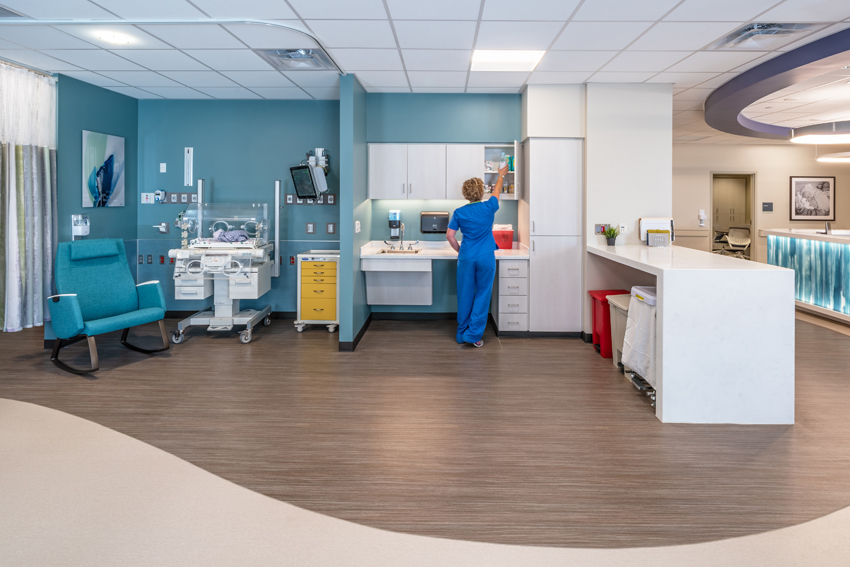
And so, when Hendrickson was designing the expansion and renovation of the neonatal intensive care unit (NICU) at Methodist Mansfield Medical Center in Mansfield, Texas, she knew she wanted to specify the same noise-reducing flooring.
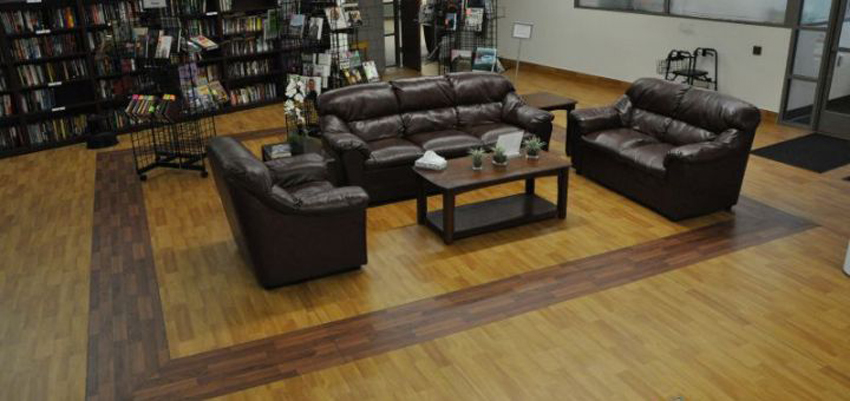
Advanced noise-dampening flooring was also specified for a library in Las Vegas, a fitness center at the University of Southern California (USC), and a fitness center in a multifamily building in San Diego, among many other noise-challenged settings.
To understand why and how to specify flooring for noise reduction, it is important to understand the massive negative impact noise has on public health, how noise travels throughout a building, and how flooring stops it at the source. With this knowledge, specifying flooring to reduce noise at the source emerges as the most straightforward and cost-effective solution to the problem of impact noise generated inside buildings.
Noise is not just annoying, but it is also actually damaging to public health.
Noise is a Public Health Hazard
Noise can be described as unwanted sound. We might think about noise as annoying and somewhat irritating, but the effects of noise go way beyond just this. They are actually dangerous to our health and well-being.
Consider studies on the environmental burden of disease (EBD) that are used to assess the health consequences of various environmental risk factors.
An EBD is often calculated in terms of “disability-adjusted life years,” or DALYs. DALYs are calculated by 1) potential years of life lost due to premature death and 2) equivalent years of healthy life that are lost because of being in a state of poor health or disability.
According to the World Health Organization (WHO) study titled “Burden of Disease from Environmental Noise,” up to 1.6 million healthy life years are lost every year just from traffic noise in the EU cities.1 Sleep disturbance and annoyance related to road traffic noise comprise the main burden.
The report states that noise contributes to these conditions that cause lost life years:
61,000 healthy life years lost for heart disease;
45,000 healthy life years lost for cognitive impairment for children;
903,000 healthy life years lost for sleep disturbance;
22,000 healthy life years lost for tinnitus (a continual ringing in the ears); and
587,000 healthy life years lost for annoyance.
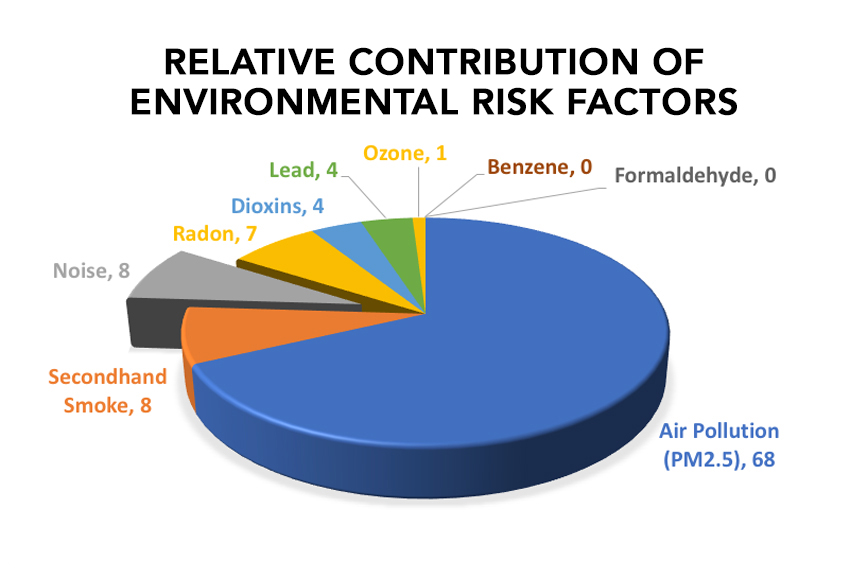
Of course, noise is not the only environmental factor that diminishes health, but its impacts are far more significant than most of us realize. An analysis of the EBD in Europe from nine risk factors indicates that the negative impacts of environmental noise are higher than for exposure to such toxins as radon and lead.2 Environmental noise is second only to air pollution in terms of negative impacts, and it is tied with secondhand smoke.
As a society, we have become accustomed to the idea that secondhand smoke is bad for health. While once common, the sight of someone smoking in a restaurant now seems highly inappropriate, at least in the United States. But while noise accounts for the same number of disability-adjusted life years as secondhand smoke, we do not generally think of excess noise as a significant public health issue. Few of us appreciate how endemic and widespread the exposure to noise is, and this makes the problem harder to solve.
Noise is equal to secondhand smoke in terms of environmental risk factors.
Noise Within a Building
Studies on environmental noise tend to focus on traffic noise and include airplane and train noise. But what about noise that is generated within a building, and specifically neighbor noise? A WHO survey titled “Large Analysis and Review of European Housing and Health Status (LARES)” surveyed more than 3,300 households in eight European countries. In this study, neighbor noise was a close second to road traffic noise for annoyance—and the health impacts of this annoyance are significant.
“Adults who indicated chronically severe annoyance by neighbour noise were found to have an increased health risk in the cardio-vascular system…as well as increased risk of depression and migraine,” the study states.3 In other words, neighbor noise equals stress, and this leads to health issues.
Acoustics have a profound effect on not just occupant satisfaction but also the mental and physical health of the building occupants. Therefore, good acoustics is a vital part of a public health and wellness strategy.
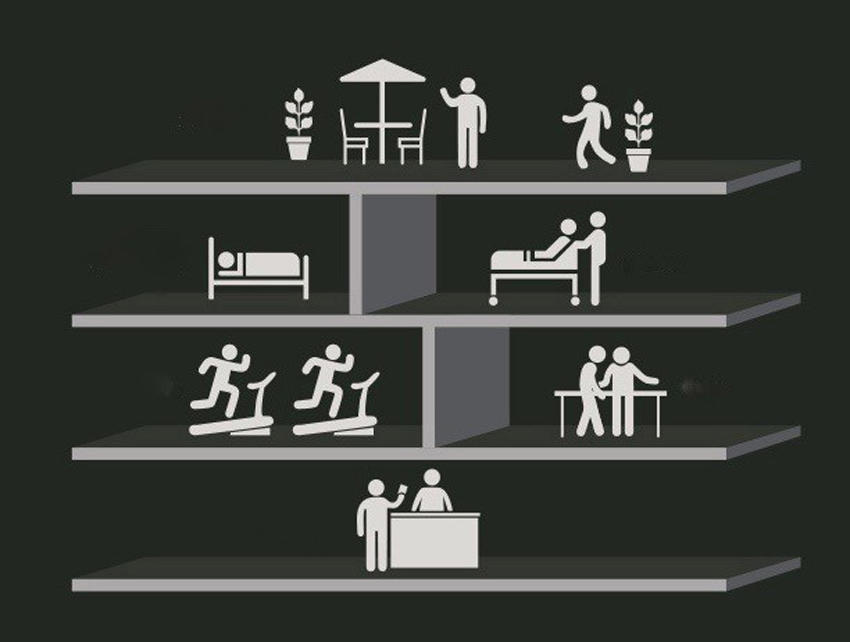
Noise generated within a building includes walking, exercise, rolling carts, etc.
Efforts to Control Noise: How are we Doing?
Many public and private efforts seek to control noise. Let us review the efforts promoted by codes and guidelines, testing standards, acoustical experts, and manufacturers.
Codes and Guidelines
Current codes and guidelines include:
Building codes: minimum sound transmission class (STC) and impact insulation class (IIC) of 50 for multifamily;
Facility Guidelines Institute (FGI) guidelines for hospitals;
Hotel brand design standards;
Acoustical Society of America (ASA) design guide for schools; and
American Society for Heating, Refrigeration, and Air Conditioning Engineers (ASHRAE) guidelines for noise from HVAC equipment.
Building codes address neighbor noise, which is usually ameliorated by sound isolation between apartment and condominium units. For hospitals and the health-care facilities, FGI has developed guidelines for maximum levels of noise for various types of hospital spaces, operating rooms, patient rooms, etc. Most of the big hotel brands—such as Hyatt, Marriott, Hilton, and so on—have their own design standards for maximum noise levels for outdoor-to-indoor sound transmission and sound transmission within the buildings. ASA offers design guidelines for schools, and ASHRAE has guidelines for air-handling equipment, such as air conditioners.
Testing Standards
Current ASTM Standards include:
E492 (IIC): lab, impact noise insulation;
E1007 (AIIC): field, impact noise insulation;
E2179 (IIC): lab, improvement in impact noise insulation;
E966 (OITC): field, airborne sound attenuation, facades; and
WK57850: field, heavy-weight impact noise (in development).
In the attempt to reduce noise, testing standards offer guidance. The ones listed here deal with building acoustics and noise transmission, though there are many more ASTM standards that deal with sound and noise, and the way we measure it and evaluate product performance.
Acoustical Consultants and Manufacturers
Also involved in noise control are acoustical consultants, manufacturers, and other experts. Consultants help design buildings to minimize noise and the negative health effects of excess noise. They do field testing, help with design, offer guidance and recommendations, assist with standards, and help educate clients and the public at large.
Manufacturers do product testing and provide data about the noise-reduction performance of their products. They help with standards development and education. Noise-reduction efforts are taken for doors, windows, flooring, and other building materials.
Urban living and a sleek aesthetic can contribute to excess noise within buildings.
Inside a building, nobody loves noise. But in certain environments—among them health-care facilities, multifamily housing, and fitness centers—the noise of clanging, banging, footfall, voices, and machinery can be pervasive and seemingly uncontrollable.
Noise is what Whitney Hendrickson expected to find when she toured the renovation of an intensive care unit (ICU) in Pennsylvania Presbyterian Hospital in Philadelphia. Instead, what she found was an unusual quiet.
All images courtesy of Ecore
Noise generated within a building is a problem that the flooring specification can help solve.
“As soon as we walked into that unit, it was so eerie because it was unexpectedly quiet,” says Hendrickson, an interior designer and registered nurse. “My eyes and ears did not match up. I thought they must not have had many patients—but they did. You could see staff moving around, carts being pushed down the corridors, and yet I did not hear what I normally hear in an ICU.”
This is because Hendrickson was experiencing the acoustic benefits of a next-level engineered flooring made just for medical settings where vinyl is fusion bonded to a vulcanized composition rubber backing. The specialized flooring not only reduces noise, but it also provides an ergonomic and resilient surface for both staff and patients.
And so, when Hendrickson was designing the expansion and renovation of the neonatal intensive care unit (NICU) at Methodist Mansfield Medical Center in Mansfield, Texas, she knew she wanted to specify the same noise-reducing flooring.
Advanced noise-dampening flooring was also specified for a library in Las Vegas, a fitness center at the University of Southern California (USC), and a fitness center in a multifamily building in San Diego, among many other noise-challenged settings.
To understand why and how to specify flooring for noise reduction, it is important to understand the massive negative impact noise has on public health, how noise travels throughout a building, and how flooring stops it at the source. With this knowledge, specifying flooring to reduce noise at the source emerges as the most straightforward and cost-effective solution to the problem of impact noise generated inside buildings.
Noise is not just annoying, but it is also actually damaging to public health.
Noise is a Public Health Hazard
Noise can be described as unwanted sound. We might think about noise as annoying and somewhat irritating, but the effects of noise go way beyond just this. They are actually dangerous to our health and well-being.
Consider studies on the environmental burden of disease (EBD) that are used to assess the health consequences of various environmental risk factors.
An EBD is often calculated in terms of “disability-adjusted life years,” or DALYs. DALYs are calculated by 1) potential years of life lost due to premature death and 2) equivalent years of healthy life that are lost because of being in a state of poor health or disability.
According to the World Health Organization (WHO) study titled “Burden of Disease from Environmental Noise,” up to 1.6 million healthy life years are lost every year just from traffic noise in the EU cities.1 Sleep disturbance and annoyance related to road traffic noise comprise the main burden.
The report states that noise contributes to these conditions that cause lost life years:
61,000 healthy life years lost for heart disease;
45,000 healthy life years lost for cognitive impairment for children;
903,000 healthy life years lost for sleep disturbance;
22,000 healthy life years lost for tinnitus (a continual ringing in the ears); and
587,000 healthy life years lost for annoyance.
Of course, noise is not the only environmental factor that diminishes health, but its impacts are far more significant than most of us realize. An analysis of the EBD in Europe from nine risk factors indicates that the negative impacts of environmental noise are higher than for exposure to such toxins as radon and lead.2 Environmental noise is second only to air pollution in terms of negative impacts, and it is tied with secondhand smoke.
As a society, we have become accustomed to the idea that secondhand smoke is bad for health. While once common, the sight of someone smoking in a restaurant now seems highly inappropriate, at least in the United States. But while noise accounts for the same number of disability-adjusted life years as secondhand smoke, we do not generally think of excess noise as a significant public health issue. Few of us appreciate how endemic and widespread the exposure to noise is, and this makes the problem harder to solve.
Noise is equal to secondhand smoke in terms of environmental risk factors.
Noise Within a Building
Studies on environmental noise tend to focus on traffic noise and include airplane and train noise. But what about noise that is generated within a building, and specifically neighbor noise? A WHO survey titled “Large Analysis and Review of European Housing and Health Status (LARES)” surveyed more than 3,300 households in eight European countries. In this study, neighbor noise was a close second to road traffic noise for annoyance—and the health impacts of this annoyance are significant.
“Adults who indicated chronically severe annoyance by neighbour noise were found to have an increased health risk in the cardio-vascular system…as well as increased risk of depression and migraine,” the study states.3 In other words, neighbor noise equals stress, and this leads to health issues.
Acoustics have a profound effect on not just occupant satisfaction but also the mental and physical health of the building occupants. Therefore, good acoustics is a vital part of a public health and wellness strategy.
Noise generated within a building includes walking, exercise, rolling carts, etc.
Efforts to Control Noise: How are we Doing?
Many public and private efforts seek to control noise. Let us review the efforts promoted by codes and guidelines, testing standards, acoustical experts, and manufacturers.
Codes and Guidelines
Current codes and guidelines include:
Building codes: minimum sound transmission class (STC) and impact insulation class (IIC) of 50 for multifamily;
Facility Guidelines Institute (FGI) guidelines for hospitals;
Hotel brand design standards;
Acoustical Society of America (ASA) design guide for schools; and
American Society for Heating, Refrigeration, and Air Conditioning Engineers (ASHRAE) guidelines for noise from HVAC equipment.
Building codes address neighbor noise, which is usually ameliorated by sound isolation between apartment and condominium units. For hospitals and the health-care facilities, FGI has developed guidelines for maximum levels of noise for various types of hospital spaces, operating rooms, patient rooms, etc. Most of the big hotel brands—such as Hyatt, Marriott, Hilton, and so on—have their own design standards for maximum noise levels for outdoor-to-indoor sound transmission and sound transmission within the buildings. ASA offers design guidelines for schools, and ASHRAE has guidelines for air-handling equipment, such as air conditioners.
Testing Standards
Current ASTM Standards include:
E492 (IIC): lab, impact noise insulation;
E1007 (AIIC): field, impact noise insulation;
E2179 (IIC): lab, improvement in impact noise insulation;
E966 (OITC): field, airborne sound attenuation, facades; and
WK57850: field, heavy-weight impact noise (in development).
In the attempt to reduce noise, testing standards offer guidance. The ones listed here deal with building acoustics and noise transmission, though there are many more ASTM standards that deal with sound and noise, and the way we measure it and evaluate product performance.
Acoustical Consultants and Manufacturers
Also involved in noise control are acoustical consultants, manufacturers, and other experts. Consultants help design buildings to minimize noise and the negative health effects of excess noise. They do field testing, help with design, offer guidance and recommendations, assist with standards, and help educate clients and the public at large.
Manufacturers do product testing and provide data about the noise-reduction performance of their products. They help with standards development and education. Noise-reduction efforts are taken for doors, windows, flooring, and other building materials.
Urban living and a sleek aesthetic can contribute to excess noise within buildings.
Where Noise is Especially Troublesome
So, with all of these guidelines, all of these standards, all of these people working on them, how are we doing?
“Maybe not so great,” says acoustic expert Mike Raley, who now works in-house for a flooring manufacturer. He points to the indoor environments where noise is especially troublesome: hospitals, green buildings, and housing.
Noise in Hospitals
Noise problems in hospitals have been studied at great length, including widespread surveys of patient satisfaction in hospitals, as indicated by the Hospital Consumer Assessment of Healthcare Providers and Systems (HCAHPS) data. HCAHPS (commonly pronounced H-caps) is a national, standardized, publicly reported survey of patients’ perspectives of hospital care.
One of the questions in the HCAHPS survey asks about noise, and specifically about how quiet the hospital was at night. Since the HCAHPS survey began, the noise at night question has been the lowest or second lowest scoring category in terms of patient satisfaction. In other words, patients are not satisfied. That dissatisfaction on the survey can hurt hospitals financially, as low scores can cause funds to be withheld by the Centers for Medicare & Medicaid Services (CMS).
This is not new knowledge. Florence Nightingale, who is considered to be the mother of modern nursing, wrote in the mid-1800s a book titled Notes on Nursing that states, “Unnecessary noise is the most cruel abuse of care which can be inflicted on either the sick or the well.”
“Though we have been working on this problem for a long time, it does not seem to be getting much better overall,” Raley says.
Green Buildings
Over the past few decades, there has been a focus on “green” buildings. As a result, we now see these improvements: higher energy efficiency, improved indoor environments, reduced toxins, added natural light, biophilic design, and other occupant-focused design strategies. But, according to studies, the satisfaction with the acoustics in green buildings is actually lower than it is in the non-green buildings.4
“As design trends have moved to harder surfaces and more open-plan office environments, we have actually degraded the acoustics rather than improved them,” Raley says.
Housing
Housing is another area that needs acoustical help, with footfall noise from neighbors being cited as a major health hazard and not just an annoyance. A paper titled “Health effects of annoyance induced by neighbour noise” that was published in Noise Control Engineering Journal states, “Neighbour noise induced annoyance is… a highly underestimated risk factor for healthy housing.”5
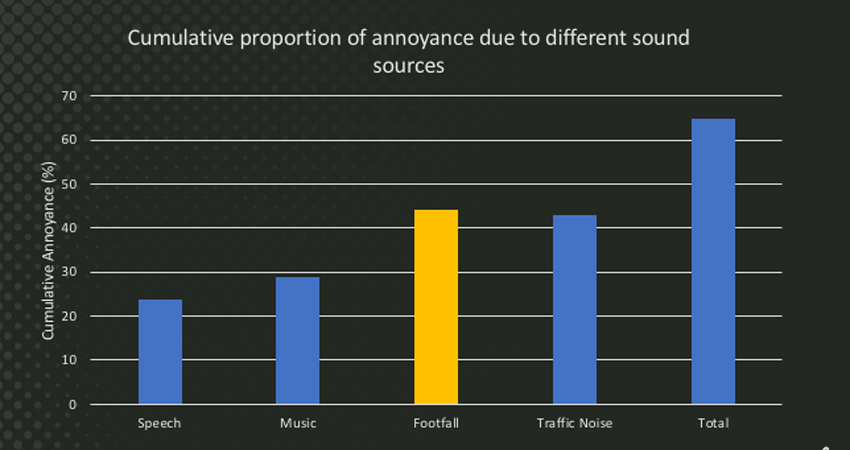
The chart above shows the cumulative proportion of annoyance due to different sound sources in a study that looked at sound quality in dwellings located in Norway. Footfall had a higher cumulative annoyance than did traffic noise.6
So, considering all situations in which noise is a health hazard, these questions arise: Why are our efforts with testing and standards not working? Are we testing and measuring what we really care about? It appears that common sound measurements do not really measure the human experience. It could be that acceptable amounts of noise transmission, according to the building code, is actually not acceptable when the goal is human health and well-being. To understand why more noise-control measures should be considered, particularly in flooring, it is important to understand noise itself.
Footfall noise from neighbors can generate a high level of annoyance.
Understanding Noise
To design a building that does not create excess noise, and thus excess stress and diminished health for occupants, it helps for the architect, designer, or specifier to understand how sound works, how it moves through a building, and how it can be stopped.
What actually makes a sound a noise? Think about a marching band of bagpipes. This might be music to some people’s ears, but maybe not for everyone. Sound versus noise is in the ear of the beholder. Both acoustic factors and non-acoustic factors affect whether or not someone might consider a sound to be a noise.
Acoustic Factors
Acoustic factors include the following:
Frequency content: Consider white noise used as masking noise to help people sleep. This has a broad frequency range. But an alarm, such as a backup beeper on a big truck, uses a narrow frequency range. This is specifically meant to be annoying and grab your attention.
Loudness: This is a whisper versus yelling issue. Something that is loud is more likely to be disruptive and considered annoying than something less loud.
Duration: A sound that goes on for a long time is more likely to annoy people than a sound that is short lived.
Occurrence rate: How often are there loud sounds? Is the soundscape fairly smooth without many changes? Or are there a lot of short-duration sounds, with alarms and beeps going off, someone talking over here, and someone talking over there? This drop, this bang, this clang? If it is fairly consistent, it is easier for people to adjust to it and tune it out. But if the noise is always changing, with spikes and low points, it is much harder to tune it out.
Both acoustic and non-acoustic factors contribute to turning a sound into unwanted noise.
Non-Acoustic Factors
Non-acoustic factors include the following:
Control: If it is a sound that people control, it is probably less likely to be annoying than a sound they do not control.
Attitude toward the source of the sound: How people feel about the source of the sound plays a part in its annoyance level. If a person lives in an apartment adjacent to a neighbor they have bad relations with, any sound that neighbor makes will be considered noise. But if an occupant has good relations with an adjacent neighbor, the occupant will be more tolerant of any sound the neighbor makes. As a measure to control annoying sounds, this strategy is sure to fail, as relations can change quickly.
Predictability: If the sound is predictable, if an occupant knows it is coming, such as the 6 o’clock train, the sound can be prepared for, and it causes less annoyance. But if a sound is less predictable and is not expected, then it cannot be prepared for, and it is more likely to be annoying.
IIC Ratings for Floor/Ceiling Assemblies Measure Quantity, Not Quality
Understanding that human perceptions cause a sound to become a noise is important when specifying flooring and other products to reduce sound. From a building-code perspective, the tendency may be to reach the minimum ratings necessary and leave it at that. But ratings measure the quantity of sound, not the quality of sound.
Consider the IIC ratings for floor/ceiling assemblies. Most codes call for a minimum IIC rating of 50. This rating is typically achieved in a laboratory test using a tapping machine on the floor above and then measuring the sound reaching the room below. This is the quantity of sound. But the quality of sound may include many of the factors discussed above, including frequency, duration, predictability, etc.
A higher IIC rating than is required by code helps cut down on unwanted sound inside a building, a function that is not reliant on perceptions. Less sound transmission means less annoyance, and this means better health for the occupants.
Two assemblies that have the same IIC rating can still sound markedly different.
For instance, in wood-framed construction, low-frequency thumps and thuds from footsteps are very noticeable, even with plush carpet and padding for the flooring, but in heavy concrete construction, thumps and thuds generally are not noticeable. Ultimately, single-number ratings like the IIC do not fully describe the quality of the sound, and they therefore limit the ability to design spaces that minimize the adverse effects of noise.
Three Ways to Control Noise: Source, Path, and Receiver
When considering how to control noise, consider how sound moves from source to path to receiver. The designer, architect, or specifier can provide noise control:
At the source of the noise;
Along the path of the noise; or
At the receiver of the noise.
Which option makes the most sense depends on where the noise originates, the noise-control measures available, and their cost and complexity.
Some noise cannot be controlled at the source. Consider an apartment building that is constructed along a busy highway. Controlling the noise at the source (noise from cars and trucks) is not possible. This is outside the jurisdiction of the architect or designer. However, this leaves two remaining ways to control noise: the path and the receiver. The freeway noise can be controlled along the transmission path with the construction of a sound wall along the highway. Higher-STC walls and windows are common ways of stopping the noise at the the receiver.
For our purposes, we will discuss sound that originates inside the building. Building-generated noise is well within the jurisdiction of the designer or architect, and a savvy design program can prevent this noise from causing annoyance to everyone in the building or those adjacent to the space where noise is generated. In fact, when properly designed, sound-control measures and products can potentially bring benefits and increased well-being to building occupants for decades.
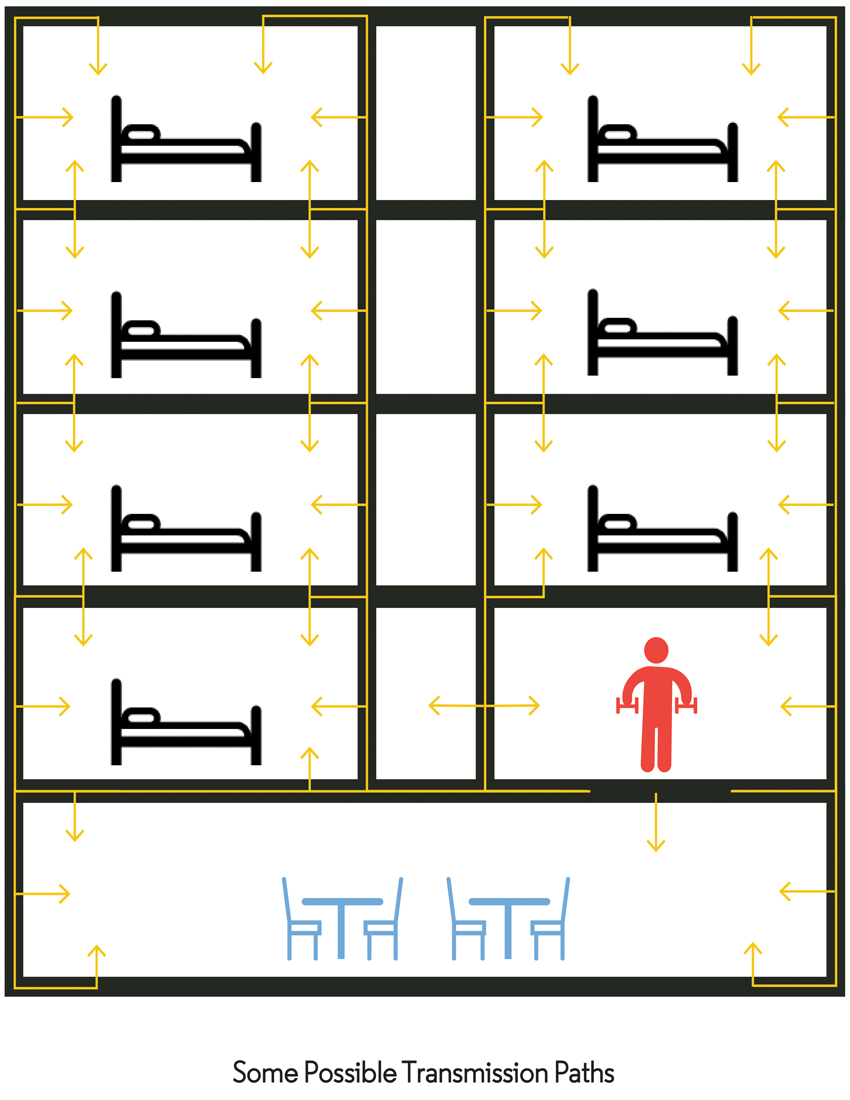
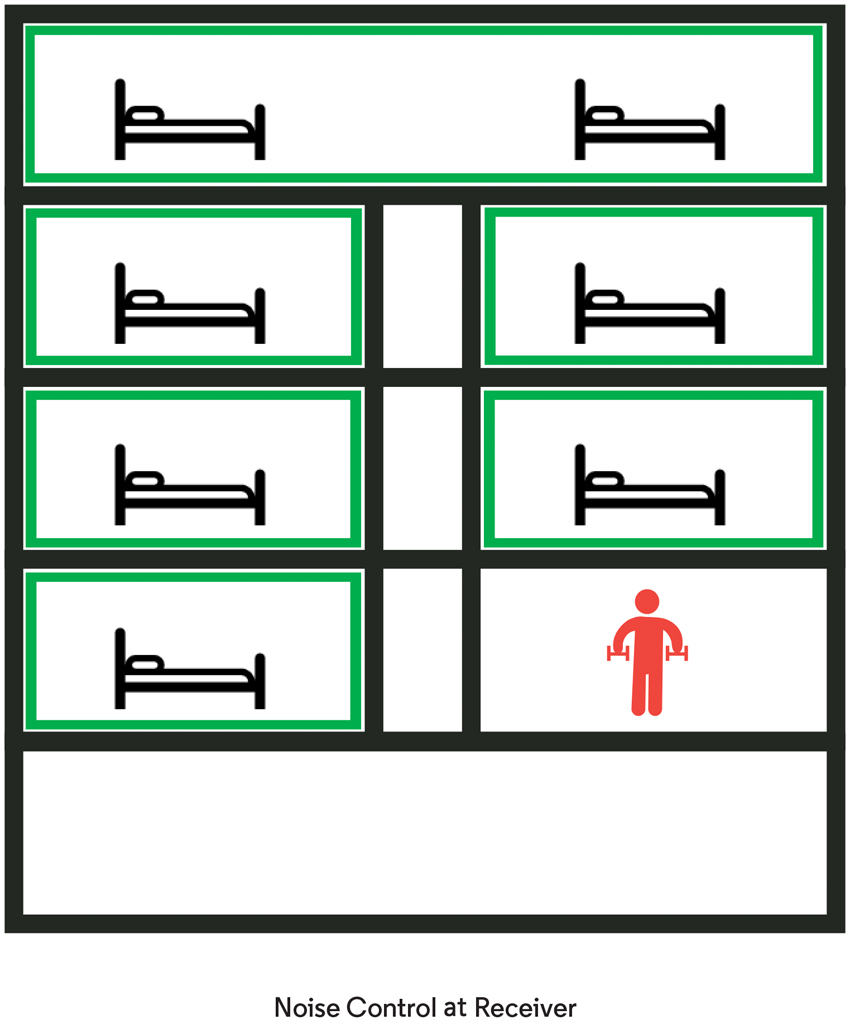
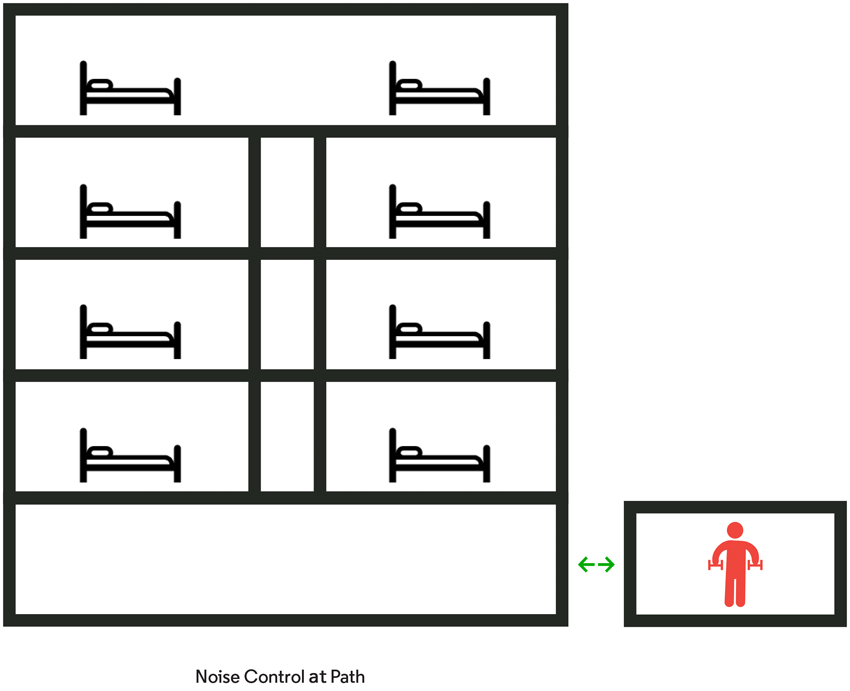
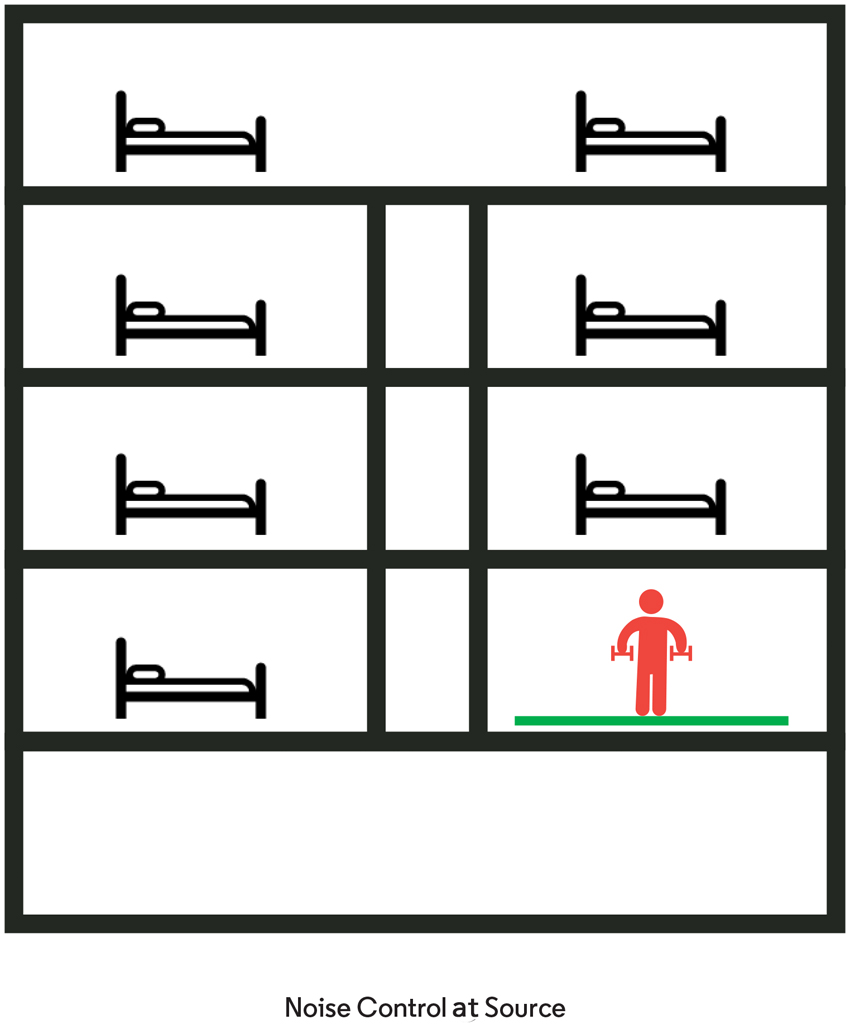
Consider a gym at a hotel. The source of the noise is the gym user, shown in red in the graphic below. The structural paths for the noise are shown in yellow. The receivers of the noise, represented by hotel room beds, are shown in green. Which option makes the most sense to prevent the noise from the gym user getting to—and causing annoyance to—the receivers?
Let us look at potential noise-control measures for all of these areas.
In this example, the source of unwanted sound is the gym user in a hotel.
Providing impact sound insulation at the receiver is costly and complicated.
Receiver
In a hotel or in multifamily housing, there are multiple rooms, apartments, and condominiums, and thus multiple receivers. The solution to excess noise requires isolating the noise from the recipients. You cannot require occupants to wear earplugs to stop unwanted noise from reaching their ears. And isolating the noise from the recipient by soundproofing all the walls would be complicated and costly. Every hotel room, every apartment, every condo is a receiver that needs to be addressed. This is particularly relevant with heavy weight impacts, such as would be generated in a gym, causing structure-borne sound. The vibration can travel very far, many, many floors up, across an entire floor, and many floors down. The solution requires the isolation of many transmission paths.
In addition, once impact energy gets into the structure and causes the main structural elements to vibrate, everything connected to it is susceptible to the vibration. This includes the vibration of light fixtures, plumbing fixtures, furniture, wall hangings, and many other building elements. Isolating the many transmission paths, the floors, the walls, the ceilings, and everything attached to them is not practical.
Path
Separating the source of the unwanted noise from the receiver can certainly be done with path isolation. A fitness facility, for instance, can be located away from the building that houses the receivers. Put the facility somewhere else, and path isolation is achieved. This is often the solution in suburban multifamily housing situations that are low-rise and spread out horizontally rather than vertically.
But in high-density areas—such as San Francisco, Seattle, Portland, New York, and Boston—land to spread out horizontally is generally not available. So, when the noise generation is inside the building, such as the basement, ground floor, or penthouse, isolating all the potential transmission paths can be complicated and costly, if it can even be done at all.
Isolating impact sound from the building is not always possible in a high-density location.
Providing impact sound isolation at the source is often the simplest and most cost-effective solution.
Source
This brings us to the final option for eliminating unwanted noise: stopping noise at the source. If there is a single source of unwanted noise, and it occupies a relatively small area, which is generally the case with a fitness facility or in-house restaurant or nightclub, isolation of the source of the noise is often the simplest and most cost-effective noise-control option. The same could be said of individual apartments, condominiums, hospital rooms, or rooms in long-term care facilities. Stopping the transmission of sound where it happens is simple and cost-effective.
In this option, one noise source is addressed instead of potentially hundreds of receivers or transmission paths.
Video: The Remarkable Difference that Flooring Makes
To hear the difference that flooring with acoustic performance can make in preventing the transmission of noise, view the video below. The sound engineer in this video plays a music box on a hard surface typical of hard flooring. The sound is both airborne and structure borne. When the music box is placed on a section of engineered flooring with acoustic properties, the radiated noise is strikingly lower.
It is important to distinguish here that the sound is not reflected from the hard surface, but rather the noise is radiated by the hard surface, like a speaker. The acoustic flooring or underlayment isolates the music box from the surface rather than absorbing the sound that would otherwise reflect off of the hard surface.
USC Village Fitness Center’s New Acoustic Flooring Solution
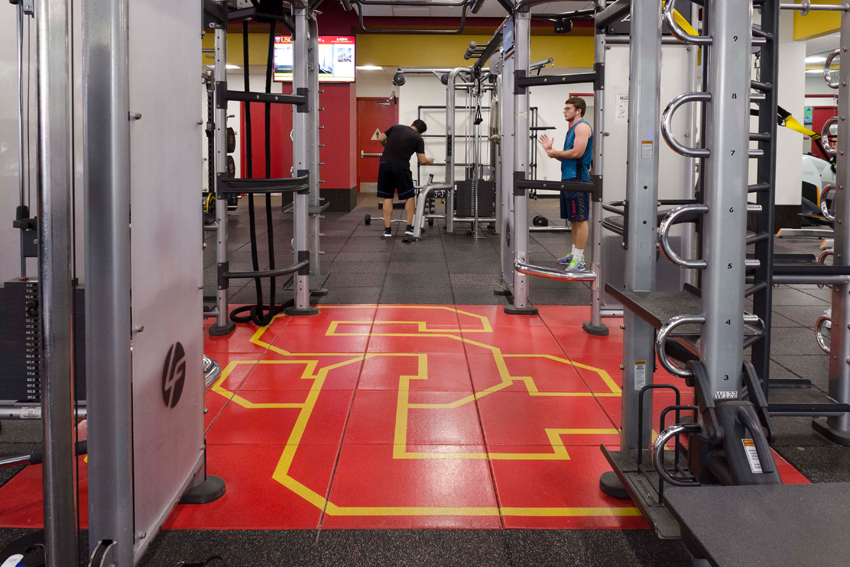
Controlling noise at the source was the strategy used by designers of the new USC Village Fitness Center, which nearly doubled the total indoor recreational space available to the Trojans. The new state-of-the-art fitness center is part of a sprawling addition to the Los Angeles university that extends across 15 acres and is part of the school’s efforts to expand student housing and increase academic space.
The 30,000-square-foot fitness center features numerous fitness and wellness options for students. A key component of the upgrade was the addition of innovative flooring to improve ergonomics and safety for students and reduce noise between the facility and the resident floors above it.
“Noise reduction was a major component of this project,” says Justine Gilman, senior director, USC Recreational Sports. “We sought durable flooring that would reduce noise in the free weight and cardio equipment areas, especially with students living right above the fitness center.”
With student housing above, the University of Southeren California's new Village Fitness Center needed to provide sound control at the source with performance flooring.
To meet flooring specifications, Gilman and the design team selected various flooring products with acoustical benefits for installation in various areas of the facility. For the cardio and functional training areas, Gilman selected an engineered performance flooring product that is 14.5 millimeters thick, combining a 2.5-millimeter wear layer with a 12-millimeter shock-absorbing base layer, which is engineered to absorb the impact force related to aggressive functional training. A strip of engineered turf next to the cardio and functional training area features a dense, textured nylon wear layer fusion bonded to a 12-millimeter performance backing. It is ideal for footwork drills, sled work, and tire flips.
The free weights, plate-loaded machines, squat racks, and Olympic lifting area of the facility were outfitted with an engineered surface featuring a 2.5-millimeter performance layer fusion bonded to a 10-millimeter dense vulcanized composition rubber backing that is then field united to a 12-millimeter shock-absorbing rubber pad. Also, a synthetic wood-grain engineered surface that is fusion bonded to a 5-millimeter performance base layer was specified in the group exercise rooms.
“We are very pleased with the functionality of the floors,” Gilman says. “We have received numerous compliments about the design of the Village Fitness Center space, and the flooring has definitely contributed to the overall positive experience.”
Specifying Flooring to Reduce Noise and Affect the Bottom Line
A flooring specification to reduce noise and impact energy is a lasting intervention that will perform in all situations. This is unlike an administrative control, such as instituting quiet hours, that can wane over time. Flooring can also affect the bottom line as buildings perform better, adjacent occupants complain less, and occupants move less often.
Consider the implications in the following settings where flooring lessens sound and impact transmission.
Apartments
When sound-reducing and impact-absorbing flooring is installed in multifamily housing, occupants will be less aggravated from hearing footfall and noise from adjacent units. The occupants may never know the superior flooring contributes to their health and sense of well-being; but they may stay longer in the unit, thus reducing the turnover that is so costly to landlords.
The design team selected an engineered performance flooring product that is 14.5 millimeters thick, combining a 2.5-millimeter wear layer with a 12-millimeter shock-absorbing base layer.
Hotels
For most of us, the mark of a quality hotel is a quiet environment with no sound whatsoever emanating from neighboring rooms. When sound is blocked and absorbed at the source, it equates to improved guest satisfaction from less neighbor noise.
Hospitals
A peaceful, quieter hospital setting is enormously significant when patient healing and staff health are considered. Less noise helps the hospital fulfill its reason for existing, to help patients get better. Less noise can also have a financial impact, as improved HCAHPS scores can mean higher reimbursements from the CMS.
Dissatisfaction with noise can create financial problems for hospitals, gymnasiums, multifamily housing, and other applications.
Fitness Facilities
With fitness facilities, the stakes are higher than just annoying the neighbors. In some cases, the impacts and sounds coming from a gym are so egregious that legal action is taken or the facility has to move. There are good reasons why fitness centers and gyms are seen so often in industrial areas. The noise and impacts may be too disruptive for adjacent neighbors in residential or business locations. Moving a gym is costly and disruptive. When sound-reducing and impact-absorbing flooring is specified in fitness centers that cannot be separated from adjacent properties, disruption to neighbors is decreased.
Material Properties of Flooring that Reduce Noise
When a falling weight hits a hard floor, it slows down rapidly. The more quickly the weight slows down, the higher the maximum force the weight and floor experience. If the time for the weight to slow down is increased, the maximum force that it and the floor experience is reduced. This is why airbags and crumple zones in cars exist, why rock climbers use crash pads, why there is foam in our running shoes, and why thick rubber surfaces are placed on playgrounds.
This is the goal of performance fitness flooring: to increase the amount of time it takes for a falling weight to slow down. Generally speaking, the more “squish” something has, the longer that “slowdown” time is.
Think about the difference between someone falling onto a carpet floor, a foam mattress, or a pit full of soft foam blocks.
This has all focused on the force on the falling object. But if we reduce the force on the falling object, we also reduce the force on the thing it hits. Generally, the harder something is hit, the more noise it makes. Pounding on a desk is ample demonstration. When floors are designed to reduce impact noise, they are designed to reduce the maximum impact force.
A giant pit of foam blocks would dramatically reduce impact noise, but it would not be a great surface to work out on. When flooring is selected to reduce impact noise, how it will be used must be considered to find the right balance between force reduction and stability. As an analogy, a sports car like a Lamborghini has a stiff suspension that allows it to go around corners extremely fast, but it could be miserable to drive on a bumpy road. On the other hand, the softer suspension on a Lexus sedan allows it to float over bumps but hampers its ability to go fast around turns.
When a flooring surface is designed to reduce the impact force, and thus the amount of impact noise, there are several basic parameters that we can control to affect the performance. They are stiffness, thickness, and shape. All three are related and can affect each other. To look at the interplay between them, consider the following example.
Stiffness, Thickness, and Shape
To reduce impact noise from a falling weight, we need a soft floor, so let us start with a common soft flooring: a typical residential carpet and pad. A carpet and pad feel soft, and they generally do a good job of reducing noise from smaller impacts like footsteps. However, when the floor is hit harder, such as when a dumbbell is dropped on it, the carpet and pad are quickly and fully compressed, or squished, and the weight comes to an abrupt stop.
To keep the floor from bottoming out, a stiffer floor of a similar thickness can be used. This reduces the chances of the weight bottoming out, but there is still a limited distance over which the weight can slow down, so the ability to reduce the impact force, and thus impact noise, is limited.
To provide for a longer “slowdown,” the thickness can be increased. Think of the difference between falling on a thin foam mattress topper and a thick foam mattress. With the thin foam pad, the slowdown is quick, but with the foam mattress, the slowdown is gentler. A thick foam mattress can significantly reduce the impact force and noise, but it is too soft to be used as a floor surface, and it is soft enough that heavier weights might still cause it to bottom out.
This is why stiffer and thicker flooring is needed, such as rubber fitness flooring. Rubber flooring provides a wide range of thicknesses, and the stiffness can change based on its density, or how much rubber is packed in the same space. Sometimes though, just changing the density will not reduce the stiffness as much as is needed. This is where shape comes into play.
If a floor cannot be made soft enough just by reducing the density, some of the material can be removed to change the shape. This is why rubber fitness tiles have a solid top surface but individual feet underneath instead of them being solid all the way through. The space between the feet gives the rubber more room to squish, which further reduces the impact force.
By varying these parameters, stiffness, thickness, and shape, flooring can be created that provides a good balance between stability and force/noise reduction. Each manufacturer of flooring with acoustical benefits can recommend the best product for the application based on its products’ properties.
Flooring with acoustical performance is a precise combination of material properties.
Measuring Flooring’s Impact on Sound
To compare the effect of different flooring materials on flooring-impact sound in health care, two senior acoustical engineering students in the University of Hartford’s Acoustical Engineering and Music program conducted an independent research study titled “Contribution of Floor Treatment Characteristics to Noise Levels in Healthcare Facilities.” The project aimed to quantify the influence that different flooring materials can have on hospital corridor noise.
While there are many noise sources within a hospital, one potentially significant source can come from the hallways and corridors, where regular traffic can include both footfall from staff and visitors and rolling noises from medical carts and gurneys. The University of Hartford recognized that addressing these noise sources could positively affect the acoustic environment in patient rooms.
As such, the students conducted three different tests on each surface material:
An absorption test (ASTM C423);
A tapping machine test; and
A rolling cart test.
The materials tested included:
Carpet tiles with a vulcanized composition rubber (VCR) backing;
Sheet vinyl;
Sheet vinyl with a VCR backing;
Virgin rubber sheet; and
Virgin rubber sheet with a VCR backing.
A research study at the University of Hartford’s Acoustical Engineering and Music program tested flooring’s impact on sound.
Three of these surfaces were engineered and featured patented technology, whereby a wear layer was fusion bonded to a VCR backing. The goal was to determine how effective this technology is in reducing noise when added to vinyl and rubber surfaces, and comparing these results to standard commercial floors, such as carpet and other traditional resilient sheet products.
The study found that when a VCR backing was fusion bonded to a vinyl surface layer, it was as quiet as commercial carpet when rolling a medical cart across a room or with standard footfall, yet more conducive to meeting the sanitary maintenance requirements of the healing environment with a hard, resilient surface. This solves a multitude of problems in health-care settings.
Acoustic Flooring in New Trauma Center Promotes Healing
Balancing performance criteria was certainly front and center when plans were made for the new trauma center at Pennsylvania Presbyterian Medical Center. Each year, the trauma program treats more than 2,200 patients with life-threatening injuries.
To serve all stakeholders, including both staff and patients, much would be asked of the flooring in the new center. Among the priorities were:
Superior acoustic properties to assure a quiet, healing environment;
Patient safety; and
Enhanced ergonomic benefits for the staff.
Among the top priorities of the new trauma center was creating a quiet, healing environment. The flooring specification played a big role in achieving that objective.
“Noise was a critical concern,” says project designer Colleen Harrington with Ewing Cole, the architectural firm involved with the project. “We focused on footfall and corridor-activity-generated noise.”
The hospital selected 45,000 square feet of an engineered surface that features a vinyl wear layer fusion bonded to a VCR backing and provides ergonomic, safety, and acoustic benefits in the patient bays, treatment areas, corridors, and nurses’ stations. This product also reduces the risk of injury associated with falls.
With regard to the acoustic benefits, the vinyl wear layer fusion bonded to a VCR backing produces a flooring-radiated impact sound level of 77 dBA (per ASTM E3133). For comparison, typical VCT and LVT are tested at 90 dBA, or 2.5 times louder than the vinyl with the VCR backing.
Balancing Quiet and Resiliency in a Library
What could test the acoustic properties of a floor more thoroughly than a library setting? There is nothing like grabbing a warm cup of coffee and cozying up on a couch with a good book. At least that was the idea behind the Paseo Verde Library in Henderson, Nevada.
The problem was that the library planners had to take into account the commercial space of the library, the noise of its cafe, and the food and drink that would be traveling throughout the space. This unique library needed a flooring solution that created a cozy, inviting space that was easy to clean and, most importantly, was as quiet as a library is expected to be.
Prior to the installation, the front entrance of the library had 12-year-old carpeting that was shredding and discolored; it was not the type of first impression that the library was looking to create. Beyond aesthetics, the library needed flooring that was quiet and could withstand the daily wear and tear of foot traffic, coffee spills, food crumbs, and heavy book carts rolling back and forth.
This library flooring needed to be durable, easy to clean, and quiet. An advanced flooring with acoustical properties fit the bill.
“We wanted something that was easier to clean and would last longer than carpet. We were willing to sacrifice a bit of the noise to have this,” says Joan Dalusung, manager of the Paseo Verde Library. Fortunately, the library did not have to sacrifice any of its needs with the selection of 3,300 square feet of an engineered surface that features a vinyl wear layer fusion-bonded to a rubber backing.
“It is just as quiet as carpet, and we have been very happily surprised about this. It is not just people walking across it; we are constantly rolling book carts and small furniture over it, and it has not only held up wonderfully, but the space has also remained quiet. It has surpassed our expectations on an acoustic level,” Dalusung says.
Conclusion
As we have seen, noise is more than just an annoyance—it is a public health hazard. Despite all the expertise and strategies to reduce noise in housing, health-care, fitness, and other settings, the problem persists.
New standards developed and in development consider the different factors of noise and not just the level of noise. As perception of noise becomes clearer, designers must be educated on how noise is generated and how it moves in buildings and adjacencies to prevent it from occurring. While impact noise in a building can be mitigated along the transmission path or at the point of the receiver, often the simplest and most cost-effective strategy is to mitigate noise at the source with the use of impact- and sound-reducing flooring.
When the impact or noise is contained at the source, those inhabiting the surrounding environment experience quieter spaces, and thus more well-being. Building owners and operators also experience stronger bottom lines. When it comes to eliminating noise, learning to serve both building users and owners should be the most important goal of the design community.
End Notes
1Kim, Dr. Rokho. “Burden of Disease from Environmental Noise.” World Health Organization (WHO) Regional Office for Europe. European Centre for Environment and Health. 25 May 2011. Web. 4 January 2021.
Kathy Price-Robinson writes about building and design. Her remodeling series “Pardon Our Dust” ran 12 years in the Los Angeles Times. She specializes in buildings that are durable and resilient to climate disruptions, as well as products and designs that provide shade in hot climates. www.kathyprice.com
At Ecore, we are driven by this question: Can a floor do more? We believe the answer is YES! We are building our company and the products we offer based on the simple notion that floors should elevate beyond current expectations. We engineer performance well beyond industry standards related to acoustics, ergonomics, and safety.
Originally published in Process Cooling
Originally published in January 2021
LEARNING OBJECTIVES
Explain how noise is a major public health issue comparable to secondhand smoke.
Discuss current noise-control approaches in the United States that are not adequately addressing the issue or leading to significant improvements.
Describe how noise is perceived versus how it is measured, as well as how it moves through a building.
Define the role of flooring in reducing noise in the built environment.
Review case studies that illustrate the specification of flooring to create a superior acoustical environment.