This CE Center article is no longer eligible for receiving credits.
Alternatively, repairs in the center of a large flooring area can also be made by cutting out the tongue and grooves along the edges of the damaged piece and installing a new piece with the edges similarly cut off. In this case, instead of relying on the interlocking mechanism for this piece, double sided carpet tape can be used to hold the replacement piece in place.
Conclusion
Properly specified, installed, and maintained, interlocking floating vinyl resilient flooring can be a superior choice for many design installations. It provides a durable and versatile flooring option for many high traffic areas without the need for any glue or adhesive. It meets or exceeds code and safety standards for fire and egress requirements. Installation can be scheduled at the very end of construction to avoid scheduling and work conflicts and can be carried out quickly and efficiently. Installation over existing floors is possible, further reducing installation time and expense. Care and maintenance are similar to any vinyl flooring allowing maintenance staff to work with a familiar product. And if changes are ever needed or desired, it is inherently easier to do so with a floating system than with an adhered system. Overall, designing with and specifying this premium flooring system contributes to good design, efficient construction, and satisfaction by the building owners or users who can look forward to many years of reliable and attractive flooring performance.
T-Mobile Cafeteria Flooring Upgrade
|
 |
Vinyl Plank flooring with a natural wood look and feel provided a dramatic change in the indoor environment at the T-Mobile call center
Photo courtesy of Earthwerks |
Location: T-Mobile call center in Thornton, Colorado
Flooring Upgrade: Change from a common commercial sheet vinyl to a locking floating vinyl plank system with a wood floor appearance
Completed: February 2011
Cost: Approximately $30,000 ($6/ sq. ft.)
Analysis: T-Mobile operates this large national call center as a 24 hour a day /7 day a week operation employing approximately 4,000 people. The original flooring installed in the 5,000 square foot cafeteria area was a sheet vinyl that was a basic off-white color with multi-colored speckles. The condition of the existing sheet vinyl was nearly new and in exceptional good condition, but created a rather “institutional” look and feel that was unwelcomed. The goal was to change the look and feel of this interior environment by replacing the existing floor covering with a wood look to provide a "warm and home-like" feeling.
Challenges - The cafeteria was required to be fully functional and operational during the process. Because of round the clock functioning of the building there could be no closure or disruption to the operation. The cafeteria area included several vending machines, a beverage dispensing counter and numerous tables and chairs, most of which needed to be accessible to employees during the flooring upgrade work.
Solution - After investigating several options, it was determined that a floating, glueless vinyl plank system with a wood grain appearance would be best suited for the scope of work. Deciding factors for using this type of flooring included:
- The new flooring could be installed directly over the existing sheet vinyl - no demolition or tear out would be needed, hence the mess and cost of normal flooring removal / demolition could be avoided
- Minimal disruption of the business operations would occur - the new flooring could be installed quickly during non-peak business hours
- Zero adhesives meant that employees would not experience any of the odors or indoor air quality concerns normally associated with flooring adhesives
- The flooring could be used immediately following installation
- The right wood looks and appearance were available
- The flooring would be highly durable and easy to clean meaning it would be a low maintenance floor compared to other options
Outcome - Installation of the new floating vinyl plank flooring was completed in just 2 days. During the installation, the vending machines were temporally relocated to a nearby hall-way while tables and chairs were stacked and placed on an outlying wall. As soon as the flooring was in place the tables and chairs were immediately placed back into the dining area. Vending machines were also put back into place after base trim was installed.
The realistic appearance and feel of real wood provided the exact "warm and home-like" feeling the customer wanted to achieve with minimal disruption. Several employees expressed how impressed they were to have such an immediate change to the environment by just changing the flooring. Many found it hard to believe it was not real wood.
Maintenance- Daily/weekly - sweep and mop the floor per manufacturer’s recommendations
Final thoughts - This was a solution-based job with several key factors that needed to be understood and addressed during the decision making process. In the end, there was no other product that could have achieved or addressed all these concerns so completely with such an elegant and efficient solution. |
The Resilient Floor Covering Institute (RFCI) is an industry trade association of leading resilient flooring manufacturers and suppliers of raw materials, additives, and sundry flooring products for the North American market. The institute was established to support the interests of the total resilient floor covering industry – as well as the people and communities that use its products
(www.rfci.com)
 |
EarthWerks® -- Flooring Inspired by Nature is a major flooring supplier headquartered in Houston, Texas and distributed widely in the United States and in over 40 countries worldwide. The magic of Mother Nature is captured in their distinctive branded line of designer flooring -- luxury vinyl planks and tiles that vividly capture nature’s realism in hardwoods, stones and slates. www.earthwerks.ca |
According to the Resilient Floor Covering Institute, resilient flooring is second only to carpet in floor covering sales in North America. Vinyl tile and plank in particular are a popular choice in almost any application because it is durable, easy to maintain, and available in many different colors and patterns. Installation processes have continued to change and evolve in recent years with the emergence of flooring that does not require adhesive to stay in place. Such adhesive free installations have been available for some time in the form of sheet vinyl flooring, but now, the same is also true for vinyl tile and plank. In this case, instead of relying on the interlocking mechanism for this piece, some manufacturers offer either a tape or glue solution that allows the piece to fit in place yet remain a floating floor.
Design Overview
Architects, interior designers, and facilities managers have commonly relied on vinyl tile for floor covering in commercial, institutional, and some residential buildings due to its versatility and durability. Such tile is commonly available in 12, 16, or 18 inch square shapes in a wide variety of colors and patterns. From a design standpoint, this allows for a great deal of creative possibilities by mixing and matching different colors and patterns in layouts appropriate to their location. Similarly, vinyl planks have been introduced to the market in recent years that emulate the look of wood or other natural flooring materials. These products are available in 3, 6 or 7 inch wide planks that can be 36 – 48 inches long. For many buildings, this is a useful size particularly in long narrow spaces such as corridors or in large areas where the look of square tiles is less desirable.
Since the use of vinyl tile and plank use is so widespread, they have become fairly economical choices within a range of quality and types. Further, their installation and maintenance have become well known and fairly standard. That doesn’t mean they are without issues or concerns, however. Some of the most common worries come from adhering the tile or plank to a clean, flush, substrate. Material that is adhered improperly will come loose or can be damaged due to only a portion coming loose. The adhesive itself is a common source of volatile organic compounds (VOCs) that are a known concern for indoor air quality. Therefore, they are being reduced if not excluded altogether in green building design. In terms of the substrate, irregularities can telegraph through the tile or cause the flooring to bend or crack over a ridge particularly since the adhesive doesn’t allow any other movement. Over time, when vinyl flooring needs to be replaced, it is a significant undertaking to do the removal since the adhesive will need to be overcome to release the tiles. The old flooring is essentially no longer usable and needs to be recycled or discarded. Similarly, the existing substrate will need attention to clean it of adhesive or be covered over with a new substrate.
 |
|
Photo courtesy of EarthWerks |
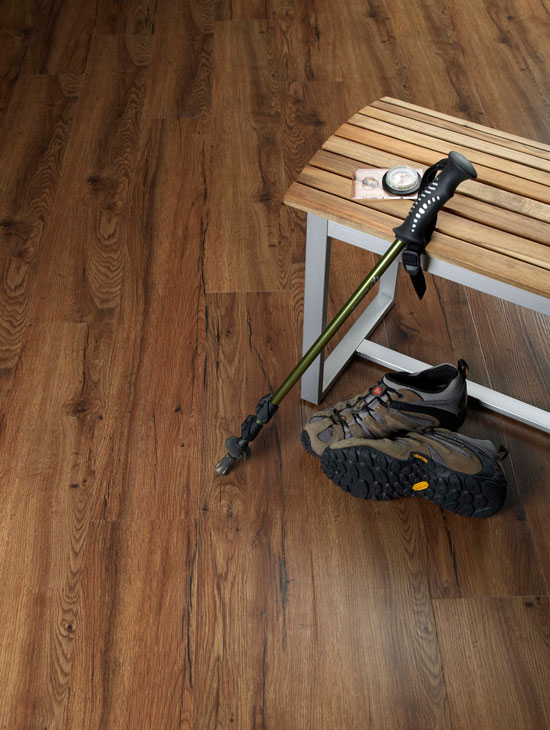
One of the ways to retain all of the benefits of vinyl flooring while overcoming some of the issues described above, is to specify interlocking tiles or planks that allow the floor to float above the substrate without being adhered. The term floating is simply meant to imply that it is not adhered - once the pieces are locked together, laid in place, walked on and furniture set down, it is not about to float or move anywhere. Further, such flooring is often made of a premium grade that is usually thicker and heavier than other vinyl flooring contributing to its ability to function well without the need for adhesive. The elimination of the adhesive obviously eliminates any concerns associated with adhesives for flooring meaning that no additional VOCs are introduced, and the flooring can move and breathe easier without being constrained by the adhesive.
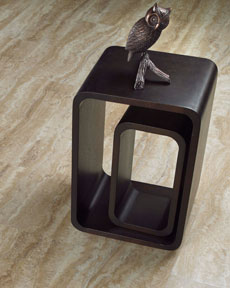 |
Floor tile can be made to look like wood, stone, or other natural materials.
Photo courtesy of EarthWerks |
Substrate preparation is still important, but in many cases is simpler and less time consuming than for adhered vinyl floors. Even typical problem substrate conditions are more easily addressed as well due to the thicker flooring material and its floating installation. Renovation projects offer an especially good opportunity when dealing with the substrate. In many cases, existing hard surfaced flooring can be left in place with only some basic preparation. This eliminates the need to remove the existing flooring and adhesive thus saving considerably on time and removal costs. Further, in spaces which are prone to regular design changes such as retail or office locations, non-adhered flooring can be easily removed and reconfigured. This is true whether new flooring is being put down or if the existing floating floor is to be removed and re-used elsewhere. A building owner or manager that is concerned about long term costs of the floor will find the cost savings associated with this approach to be very attractive. These savings will certainly help justify the slight premium that is paid initially for the higher quality material.
Selecting a color or pattern is usually a key issue in the design of a space. Despite all of the advantages of traditional vinyl, the appearance and colors are sometimes seen as limiting or too institutional in appearance. Happily, some manufacturers are now offering a real alternative with patterns and colors that emulate natural materials such as hardwood flooring or stone.This means that the flooring brings all of the benefits of vinyl but provides a look that can be warmer or more consistent with the overall design intent.
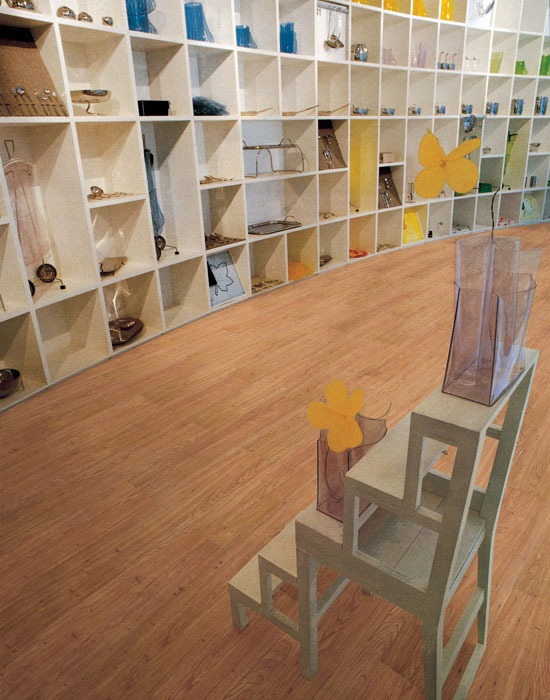 |
Interlocking floating vinyl flooring stays in place by virtue of its own weight, furniture, and foot traffic.
Photo courtesy of EarthWerks |
All of these design attributes make locking floating vinyl floors well suited to a variety of building types but this is particularly true in high foot traffic areas such as corridors, assembly spaces, meeting rooms, classrooms, etc. With more thickness and more flexibility, it lives up to the overall intent of being truly resilient flooring.
Physical Characteristics
Material Make-up
Premium vinyl flooring is typically made from all virgin PVC material without the use of any recycled content. The material itself can be 100% recycled at the end of its service life, but in order to maintain consistent quality manufacturers start with new material. ASTM F1700-04 Solid Vinyl Floor Tile is the governing quality control standard. The specifications in this standard establish the material and performance characteristics that determine serviceability and recommended applicability in commercial, light commercial, and residential buildings. Flooring tile is classified with Class I used for monolithic vinyl tiles, Class II for surface-decorated vinyl tiles, and Class III for printed film vinyl tiles. Furthermore, these classes are sub-grouped as Type A for tiles with smooth surfaces, and Type B for those with embossed surfaces. The manufactured tiles or planks are tested based on their compositions of binder, filler, and pigments plus lubricants and processing aids, the composition for all of which is dictated by their respective classes. So, for example, a vinyl tile or plank that is printed and embossed to look like wood or stone would be a Class III, type B under this standard. When tested, the tiles must meet physical requirements for binder content, dimensional consistency (including size, thickness, squareness, and dimensional stability), residual indentation, flexibility, resistance to chemicals, resistance to heat, and resistance to light. Therefore any tile or plank that has been tested and met this ASTM standard has risen to a high level of quality. In fact, many interlocking floating floor tiles and planks have been found to provide superior dimensional stability within the product beyond the testing standard which is improves the useful life and maintenance ease of the flooring.
Loading
In terms of static loading on the flooring, ASTM F970 Standard Test Method for Static Load Limit is the testing standard that applies. This test method is used to determine the recovery properties of resilient floor covering after a 24 hour indentation test under a specified load. The resulting value indicates residual indentation which is the depth of the depression still remaining 24 hours after the specified load is removed. It is realistic to specify up to 2000 psi load performance with minimal or no indentations remaining.
Fire Safety
All interior flooring products need to be concerned with fire and smoke ratings and that includes vinyl flooring. Flammability ratings need to be specified and products that pass ASTM D2859 - 06(2011) Standard Test Method for Ignition Characteristics of Finished Textile Floor Covering Materials are usually required by building codes. Similarly, smoke density performance under ASTM E662 - 09 Standard Test Method for Specific Optical Density of Smoke Generated by Solid Materials is required. It is possible to specify ratings at less than 450 under this test. Finally, ASTM E648 - 10e1 Standard Test Method for Critical Radiant Flux of Floor-Covering Systems Using a Radiant Heat Energy Source is a relevant and commonly required standard for determining overall fire safety. The fundamental assumption inherent in the test is that critical radiant flux is one measure of the sensitivity to flame spread of floor-covering systems in a building corridor. The imposed radiant flux simulates the thermal radiation levels anticipated on the floors of a building whose upper surfaces are heated by flames or hot gases, or both, from a fully developed fire in an adjacent room or compartment. The standard was developed to simulate this important fire exposure component of fires that commonly develops in corridors or exit ways of buildings. This test is not intended or applicable for areas other than corridors or exit ways. Therefore, if the vinyl flooring being specified is called for in egress corridors and exit ways, then this ASTM standard is relevant and should be specified at levels greater than or equal to 0.45.
 |
Interlocking floating plank (left) and tile (right) floors meet stringent testing requirements for indentation, fire, and smoke safety.
Photo courtesy of EarthWerks |
Slip Resistance
Slip resistance is always a safety concern for flooring, particularly in high foot traffic areas. When it comes to vinyl flooring surfaces, interlocking systems help guard against loose tiles sticking up and causing tripping hazards. However, it is the surface characteristics that are important when it comes to simply slipping on any flooring materials with a variety of results possible. ASTM C1028 - 07e1 is the Standard Test Method for Determining the Static Coefficient of Friction for a variety of tile types. Building codes, ADA, and OSHA all indicate minimum levels of slip resistance based on this or similar standards for walking surfaces and particularly in egress corridors. Of course a variety of factors can come into play on slip resistance, but the basic make-up of the flooring should be acceptable to begin with. Vinyl flooring can indeed meet those demands both through the inherent slip resistant qualities of the material itself and the potential for surface treatments. Therefore, specifying flooring that meets or exceeds the minimum standards is clearly possible and recommended.
Handicapped Accessibility
The Americans with Disabilities Act (ADA) establishes specific requirements for barrier free environments including unobstructed paths of travel along walkways and floors. Much of this has been codified in American National Standard ICC A117.1 (the Accessibility Standard) which is appended to most building codes as the prescriptive requirements to achieve such barrier free environments. Chapter 3 of this Standard specifically addresses Floor Surfaces. Section 302 indicates that flooring must first be stable, firm and slip resistant. Floating flooring readily meats all of these criteria since it is firmly supported by the underlying substrate, stable when installed, and the surface can be properly slip resistant.
Changes in level are addressed in Section 303 of the Accessibility Standard. This would apply to the edges of flooring systems where people are walking or riding a wheelchair over. The maximum allowed vertical rise is ¼” which can be increased to ½” if the edges are beveled with a slope of no more than 1:2 on the bevel. Floating flooring systems can readily accommodate these handicapped accessibility requirements, since the locking mechanism between tiles or planks is designed to produce a smooth, flush surface. Where the floating floor system adjoins other types of flooring, the use of a beveled transition strip may be needed consistent with the requirements of the Accessibility Standard. There are of course other accessibility requirements for paths of travel including doorways, obstructions, etc. and those will need to be coordinated in the overall design. There is nothing about the floating flooring system, however, that should impair or impede that coordinated design effort.
Installation Procedures
The installation of a locking floating vinyl floor can usually occur unhampered by other trades. This is true since it can be installed quickly and easily at the very end of construction thus avoiding other construction traffic. Further, since there is no setting time required for adhesive, scheduling and coordinating with the larger construction schedule is simplified. It is important that the space is fully enclosed, however, and has been heated or cooled to room temperature (65 – 85 degrees F) just prior to the installation beginning. It is also important and advisable to acclimate the flooring materials for 48 hours inside the conditioned space prior to the start of installation to avoid any potential expansion and contraction issues.
The basis for any good installation, of course, is good preparation. Once a designated area is deemed ready for the flooring to be installed, the first step is to clean and prep the subfloor. This is true for any flooring product, but it is important to recognize and address the differences of some common types of subfloors. Concrete subfloors must be smooth, clean, and thoroughly dry. Vinyl floating flooring should only be installed if the concrete slab is completely cured (i.e. 6 weeks from pouring). It is also ok to install the flooring over concrete slabs that contain radiant heating as long as the floor slab does not heat up beyond 90 degrees F.
Wood subfloors are appropriate for locking floating vinyl as long as several things are taken into account. First, the wood surface must be smooth otherwise a suitable underlayment needs to be used. Wood floors over crawl spaces must include ventilation and vapor barriers in those crawl spaces to avoid unwanted moisture from penetrating the wood and potentially impacting the flooring. Wood subflooring that rests on wood sleepers over concrete slabs seems like a good idea, but generally is recommended to be avoided. It would be better to prepare the concrete surface and install the flooring directly over that.
When existing floors form the substrate, then the existing flooring must already be smooth or be able to be made so. Existing resilient flooring can usually be covered easily and will likely form a good base for the new flooring. Exceptions are deeply embossed resilient flooring, which will need a leveler, or cushioned resilient flooring which is not suitable for covering over. If the existing flooring is ceramic tile, the grout lines need to be filled with patching or leveling compound to create a smooth surface.
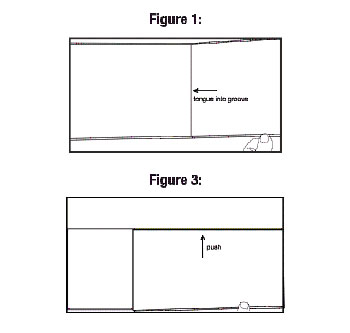 |
Installation process of sliding one edge into a groove then pushing forward to engage the rest of the interlocking mechanism.
Image courtesy of EarthWerks |
Once the subfloor is ready, the interlocking flooring installation can begin. It is important that the installer remembers not to apply any glue or adhesive since this is a completely floating floor by design. Instead, they begin by planning ahead and centering the flooring pattern in the room. This will result in cutting pieces only as needed to fit along the sides of the room. In doing so, expansion gaps of 5/16” should be left on each side along walls, etc. which is usually covered over by the wall base trim. One exception is between corridors and adjacent flooring areas which will need resilient transition strips installed in typical fashion. Once laid out, installation usually begins in the upper left corner of the room and moves to the right and down to allow for the interlocking tongue and groove process to work. Essentially, the first piece is placed down then the next piece is held and installed at an angle to engage the interlocking pieces along the short edge.With the short edge in place, the flooring is laid flat and pushed forward to engage and lock into the adjacent piece ahead. This pattern simply continues until all of the pieces are laid in place across the entire area. In all cases, installers should follow manufacturer’s instructions carefully for the proper interlocking process and the recommended means for cutting pieces.
Cleaning and Maintenance
Once installed, the flooring can be cleaned with warm water and any common vinyl floor cleaners. Soap based detergents or abrasive cleaners should be avoided however, since they can damage the surface and alter its appearance or other characteristics. If furniture is scheduled to be placed on the floor soon after installation, then indentations in the flooring can be avoided by using protective devices under the legs or supports of that furniture.
Over time, changes or repairs may need to be made to any flooring and here is where the benefits of the interlocking floating floor become highly appreciated. Changes to the flooring can be readily made by removing furniture and disassembling the flooring tiles or planks starting from the lower right corner and taking the pieces up in reverse order from the installation. Similarly, repairs can be made by removing the tile or planks starting from one side and working over to the area of the damage. A new piece can be installed to replace the damaged piece(s) and then the removed pieces can be re-installed.
Alternatively, repairs in the center of a large flooring area can also be made by cutting out the tongue and grooves along the edges of the damaged piece and installing a new piece with the edges similarly cut off. In this case, instead of relying on the interlocking mechanism for this piece, double sided carpet tape can be used to hold the replacement piece in place.
Conclusion
Properly specified, installed, and maintained, interlocking floating vinyl resilient flooring can be a superior choice for many design installations. It provides a durable and versatile flooring option for many high traffic areas without the need for any glue or adhesive. It meets or exceeds code and safety standards for fire and egress requirements. Installation can be scheduled at the very end of construction to avoid scheduling and work conflicts and can be carried out quickly and efficiently. Installation over existing floors is possible, further reducing installation time and expense. Care and maintenance are similar to any vinyl flooring allowing maintenance staff to work with a familiar product. And if changes are ever needed or desired, it is inherently easier to do so with a floating system than with an adhered system. Overall, designing with and specifying this premium flooring system contributes to good design, efficient construction, and satisfaction by the building owners or users who can look forward to many years of reliable and attractive flooring performance.
T-Mobile Cafeteria Flooring Upgrade
|
|
Vinyl Plank flooring with a natural wood look and feel provided a dramatic change in the indoor environment at the T-Mobile call center
Photo courtesy of Earthwerks |
Location: T-Mobile call center in Thornton, Colorado
Flooring Upgrade: Change from a common commercial sheet vinyl to a locking floating vinyl plank system with a wood floor appearance
Completed: February 2011
Cost: Approximately $30,000 ($6/ sq. ft.)
Analysis: T-Mobile operates this large national call center as a 24 hour a day /7 day a week operation employing approximately 4,000 people. The original flooring installed in the 5,000 square foot cafeteria area was a sheet vinyl that was a basic off-white color with multi-colored speckles. The condition of the existing sheet vinyl was nearly new and in exceptional good condition, but created a rather “institutional” look and feel that was unwelcomed. The goal was to change the look and feel of this interior environment by replacing the existing floor covering with a wood look to provide a "warm and home-like" feeling.
Challenges - The cafeteria was required to be fully functional and operational during the process. Because of round the clock functioning of the building there could be no closure or disruption to the operation. The cafeteria area included several vending machines, a beverage dispensing counter and numerous tables and chairs, most of which needed to be accessible to employees during the flooring upgrade work.
Solution - After investigating several options, it was determined that a floating, glueless vinyl plank system with a wood grain appearance would be best suited for the scope of work. Deciding factors for using this type of flooring included:
- The new flooring could be installed directly over the existing sheet vinyl - no demolition or tear out would be needed, hence the mess and cost of normal flooring removal / demolition could be avoided
- Minimal disruption of the business operations would occur - the new flooring could be installed quickly during non-peak business hours
- Zero adhesives meant that employees would not experience any of the odors or indoor air quality concerns normally associated with flooring adhesives
- The flooring could be used immediately following installation
- The right wood looks and appearance were available
- The flooring would be highly durable and easy to clean meaning it would be a low maintenance floor compared to other options
Outcome - Installation of the new floating vinyl plank flooring was completed in just 2 days. During the installation, the vending machines were temporally relocated to a nearby hall-way while tables and chairs were stacked and placed on an outlying wall. As soon as the flooring was in place the tables and chairs were immediately placed back into the dining area. Vending machines were also put back into place after base trim was installed.
The realistic appearance and feel of real wood provided the exact "warm and home-like" feeling the customer wanted to achieve with minimal disruption. Several employees expressed how impressed they were to have such an immediate change to the environment by just changing the flooring. Many found it hard to believe it was not real wood.
Maintenance- Daily/weekly - sweep and mop the floor per manufacturer’s recommendations
Final thoughts - This was a solution-based job with several key factors that needed to be understood and addressed during the decision making process. In the end, there was no other product that could have achieved or addressed all these concerns so completely with such an elegant and efficient solution. |
The Resilient Floor Covering Institute (RFCI) is an industry trade association of leading resilient flooring manufacturers and suppliers of raw materials, additives, and sundry flooring products for the North American market. The institute was established to support the interests of the total resilient floor covering industry – as well as the people and communities that use its products
(www.rfci.com)
|
EarthWerks® -- Flooring Inspired by Nature is a major flooring supplier headquartered in Houston, Texas and distributed widely in the United States and in over 40 countries worldwide. The magic of Mother Nature is captured in their distinctive branded line of designer flooring -- luxury vinyl planks and tiles that vividly capture nature’s realism in hardwoods, stones and slates. www.earthwerks.ca |