This CE Center article is no longer eligible for receiving credits.
Introduction
There are 86 billion square feet of commercial office space
in the United States. The business of these offices is vast
in scope: law, advertising, government, finance, and manufacturing.
The legacy of these offices ranges from the most established
banking firms to budding e-Commerce companies. Despite these
wide variations in business scope and organizational structure,
the purpose of every square foot of commercial office space
is the same—facilitating communication and serving as
a place where work can be accomplished and organizational
needs met.
While the purpose of an office space may be clearly defined,
office space design remains, by necessity, much more fluid.
Businesses trying to succeed are forced to constantly change
and adapt in the fast-paced and dynamic arena of corporate
competition. The design of the office space must transition,
in order for the space to remain relevant and functional for
new organizational needs.

Office design today
aims to create spaces that are flexible and
efficient, and work environments that are
comfortable and productive. |
|
|
Transition of Office Space Design
In the 1960s, the number of available office jobs was growing
rapidly as the American economy shifted from agrarian, to
industrial, to office buildings and knowledge workers. Most
office spaces were carbon copies of the offices across the
hall or down the street. Advertising agencies were indeterminable
in appearance from legal offices. The design template of the
time was bland and neutral. Office spaces were mostly private,
their sizes defined by seniority and clout with cookie cutter
precision. The office design reinforced the rigid formality
of the business world. Walls and doors prevailed. Communication
was carried out in memos. Employee interaction occurred in
planned meetings with agendas. Typewriters and telephones
were hot technologies whose weight and wires kept employees
tethered to their desks. Corporate cultures were functional,
framed by the 9-5 workday, and intensely loyal. People typically
remained with the same company until retirement.
Office space design in the 21st century must accommodate
a very different corporate landscape. Information technologies
like mobile phones, laptop computers, and the Internet have
created an atmosphere where a person’s office is really
wherever that person happens to be, anywhere in the world,
and at any time, frequently available 24/7. Traveling to the
office is no longer required to get work done.
The office building has become a flagship communicative hub
reinforcing corporate culture, collaboration, and development.
Office space design increasingly incorporates elements of
branding and corporate identity into a structure with colors,
credos, and furnishings. Open office spaces, atria, and cafeterias
encourage informal communication between teammates that is
invaluable for keeping people informed and generating ideas.
Communication frequently occurs face-to-face or over cyberspace.
AV presentations, intercontinental teleconference calls, e-mails,
and text messages are important mediums that the office space
must be able to accommodate. Office buildings provide a medium
to communicate corporate identity and brand. Office design
builds bridges between employees, facilitating communication,
information transfer, and interpersonal collaboration.
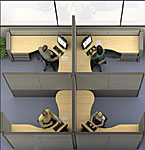
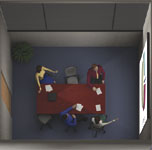
The popularity of rigid private-office-heavy floor plans
has waned in favor of highly adaptable, partitioned spaces
with modular office furniture systems. This new design allows
spaces to be quickly and easily reorganized to match changes
in corporate strategies and initiatives. Individual cubicles
merge to create a collaborative team environment. Longer tables
and whiteboards are partitioned off to quickly create project
rooms or other needed conference areas. The International
Facilities Management Association (IFMA) quoted the current
inter-corporate churn rate at 41%, which means that almost
half of the employees in an office space are physically moved
to a different location within the same company every year.
|
 |
| Ensure
that the office space will be able to accommodate
changing organizational needs and floor plans
by including a reconfigurable lighting control
system in the design. Reconfigurable lighting
control systems easily support a space that
may be a conference room today and a team
environment tomorrow. |
|
|
Perhaps the most fundamental difference between the organizational
needs of 1960 and today is the fierce competition to hire
and retain quality employees. Talent is viewed as the most
scarce and valuable resource that a company can obtain. Subsequently,
employees’ salaries and benefits are by far the largest
expense that an office building incurs. Office spaces are
tasked to provide productive and interactive work environments,
and to serve as tools for employee comfort, satisfaction,
and retention. It is essential that the design of the office
space support these efforts, simultaneously communicating
to employees that they are important and valued by the firm.
Amidst the tumult of intense competition, quick strike and
counterstrike initiatives, continuous reorganization, and
a team roster that is constantly in flux, concrete and glass
provide the semblance of stability, purpose, and success.
The employees and floor plans will change, that is the nature
of business. The office building will stand, that is the nature
of architecture.
Benefit from the Building
Keeping an office building capable of supporting organizational
needs is an essential element of good business, underscored
by the fact that, for many companies, the physical building
is the most expensive capital asset on the balance sheet.
In fact, the significant investment required to construct,
operate, maintain, and repair an office building (an investment
that often represents between 10-20% of a company’s annual
revenue) creates a strong demand from building owners and
shareholders to pinch every last benefit out of the built
environment. “Failure to wring every benefit out of the
most expensive capital asset most companies have would not
be countenanced in any other aspect of corporate life”
(Seiler, John A. 1984. Architecture at Work. “Harvard
Business Review,” September/October, 120).
Reducing the amount of money required to operate the building
can significantly affect the bottom line and is often easily
accomplished by improving the efficiency of various building
systems, like lighting, heating, or cooling. But opportunities
to squeeze the maximum benefit from a building asset exist
beyond improving its operational efficiencies. Buildings can
be designed to create value for the company, one square foot
at a time.
Efficiency vs. Value
Efficiency is highly quantitative. It describes the cost
of producing something—in energy, time, money—in
a manner that gets more of something for less. To create system
efficiencies, the current performance of the lighting system
or HVAC system must be examined and improved. Achieving better
system efficiency will reduce operational expenses, but a
more efficient building is not necessarily a better place
to work. The impact of system efficiency on the office environment
depends upon the methods employed to achieve it.
Value is a relative term that provides a comparison for buildings
and the ways they are designed. The value of an office building
to an organization can describe the cost/square foot, productive
capacity, sustainability, and its overall ability to facilitate
communication and meet organizational needs. An office space’s
value is defined by whether it creates an enjoyable, productive
work environment, while sending the right corporate message
to clients and employees.
Multiple methods for achieving greater system efficiencies
have been employed over the years. While each of the following
was successful in reducing operational expenses, the value
of the space was damaged as a direct result of its more efficient
design.
HVAC Efficiency
Originally, windows provided the climate control in buildings.
With the introduction of HVAC systems, fewer windows were
designed into commercial projects, reducing the potential
of leaks and thermal transmittance. This self-contained environment
allowed buildings to heat and cool themselves more efficiently,
without being forced to accommodate the influence of outdoor
elements. Improved HVAC efficiency was achieved, but it cost
the commercial space the presence of daylight and outdoor
views.
In office buildings, the presence of daylight and views has
been linked to improved employee mood, motivation, satisfaction,
health, and productivity. In European commercial buildings,
the access to daylight and the connection to the outdoors
is a fundamental design element that has been manifested in
the construction doctrine “no employee office area can
exist more than 6 meters away from a window.” In the
United States, the incorporation of daylight and views is
recognized by the LEED™ (Leadership in Energy and Environmental
Design) rating system as an element of sustainable design,
enhancing the sustainability of the space by making it a more
productive and healthy environment for building occupants.

Lighting control
equips buildings to operate more efficiently
and adds value to the floor space by making
it a healthier and more productive place to
work. |
|
|
An office space with few windows may have a lower heating
bill, but it may also have higher absenteeism and turnover
ratios, less healthy employees who are less excited to come
to work every day and are less productive when they get there.
This space is efficient, but its value to the organization
and its ability to support organizational needs is low.
|
Electricity
Use in Office Buildings
|

|
 |
|
In a typical office building,
lighting consumes more
electricity than heating or cooling systems.
|
|
|
Space Efficiency
Rent is another big expense for office buildings. Space equals
money, as buildings are charged dollars for every square foot.
The pursuit of space efficiency aims to improve how well a
building is using the space it is paying for to create revenue
for the company. Studies of sales organizations, accounting
firms, consulting firms and others concluded that in many
office environments an employee’s desk may be unoccupied
60% of the year.
The discovery of the empty, yet expensive, workspaces drove
the development of the organizational concepts: hot-desking
and desk pooling. The term hot-desking is borrowed from the
Naval term “hot-bunking,” which is a practice on
submarines where one cot is used by multiple sailors—one
after the other. Hot-desking is a strategy that aims to rotate
employees in and out of community desks so efficiently that
the chair is reoccupied before it has time to cool down. Desk
pooling provides employees who are normally elsewhere with
a group of standard and unpersonalized desks to use during
those rare visits to the office. The desk is equipped with
all usual accouterments: stapler, phone, power for laptop
and an Internet link. But it is devoid of personalized touches
and an everyday owner.
The reaction to the loss of a personal office space was negative
across the board. Employees, even those who do not spend much
time at their desk, associate their workstations with feelings
of importance, security, and ownership. In the 21st century,
office spaces have become more important than functional spaces;
they provide a sense of identity and represent, in square
feet and ergonomic furniture, an investment in the individual
by the company.
Hot-desking and desk pooling increased the space efficiency
of the building. They also generally upset the company’s
most valuable asset (its employees), reduced productivity,
and communicated to the workforce that their contributions
were minimal and their importance marginal.
Achieve Efficiency and Add Value with
Lighting Control
Improving system efficiencies can negatively affect the value
of a space, but efficiency and value are not mutually exclusive.
Opportunities exist to create system efficiency, and at the
same time, make an office space more flexible, productive,
healthy, and valuable to an organization.
One such opportunity exists in the design of the building’s
lighting system—or, more specifically, the design of
the building’s lighting control system. The lighting
control system specified in a building determines how occupants
are able to use the lights in the space. In the most minimal
capacity, light control allows lights to be switched on/off
either independently or in larger groups. Dimming technologies
allow light fixtures to provide a range of light output—often
ranging from 1 or 10% to the full 100%. Lights can be controlled
manually with a handheld remote or from wall stations, or
programmed to automatically turn on and off at certain times
or when rooms are empty. Light control can even be preset
to recall specific light levels—much like the presets
programmed into a car radio—based on the activities in
the space. Light controls enable a building to save energy
and allow employees to select a comfortable light level that
is best suited to their tasks.
Lighting systems represent a significant operational expense.
Today, more electricity is used to light a typical building
than is used to heat, cool, secure, or otherwise operate the
structure. It is estimated that roughly 10% of all of the
electricity consumed in the United States is used to light
commercial buildings and, in 2005, that electricity cost Corporate
America over $7 billion.
Rising energy costs have spurred a re-examination of how
commercial spaces are using their kilowatt-hours. Systems
designed to provide more light than necessary, minimal light
control, and few light level options have been identified
as three reasons why the lighting bills are unnecessarily
high.

Design office spaces
to be able to provide unique lighting
levels to match individual preferences and
tasks. |
|
|
While the presence of light is essential for an office space
to be functional, lighting systems are often designed to provide
more light than necessary for typical office tasks. The Illuminating
Engineering Society of North America (IESNA) recommends that
the office building should be equipped to provide between
30-50 footcandles on a workspace. Fluorescent lamps are highly
efficient and currently the industry standard in commercial
construction. However, as fluorescent lamps age, their light
output diminishes. Lamp output is also reduced when the lamps
become dusty and dirty. To ensure that there is always enough
light present in the office space, many lighting systems are
designed to compensate for the diminished output and, subsequently,
regularly provide more light than is needed.
Lighting control can be a design tool that promotes space
flexibility and energy savings. Incorporating only the most
basic or minimal light control on a project locks the building’s
lighting resource into a rigid and uncompromising structure
that wastes energy as unused lights are kept on. For example,
in private offices light switches are often placed conveniently
near the door. This switch location makes it easier for employees
to turn the lights off before they leave their office space,
saving energy and money. In the shift from private office
spaces to open office spaces, switches now control large groups
of lights located over desks that may be vacant for a significant
portion of the day. A lighting control system that ties 20
light fixtures to one light switch unnecessarily wastes energy
by keeping all of the lights on, even if only half of the
people are in their seats.
Beyond the operational expense of keeping overhead lights
on when the desk is empty and providing more light than necessary
on the workspace, providing no available light range between
100% and off can unnecessarily tax the human element of the
office. Too much light exposure has adverse affects on people’s
health, mood, and performance. The squinting and strange postures
employees strike to avoid glare and unnecessarily bright conditions
cause headaches, fatigue, and muscle aches.
Although the reactions to the wrong light level may be fairly
routine, the light levels considered right and wrong differ
from person to person. Health conditions, preferences, age,
and task are factors that combine to create the unique visual
environments ideal for each individual employee. Providing
inappropriate lighting levels in the workplace have been linked
with productivity losses, reduced attention spans, and dissatisfaction.
Lighting systems in office spaces can be easily designed to
match employee preferences by incorporating dimming technologies
in the overhead lights. This improved controllability has
been credited with improving individual employee productivity
4-7%, reducing eyestrain, and improving worker satisfaction.
Incorporating more lighting control and offering a wider
range of light levels throughout the office space saves energy,
improving the efficiency of the lighting system, and adds
value to the space by making it a more comfortable and productive
place to work. Designing lighting control into an organizational
space simultaneously supports environmental interests and
sustainable design guidelines, equips the building to work
smarter and be more profitable, and accommodates the company’s
most valuable asset.
Lighting Control Strategies
The key to achieving the best fit between an office building
and its lighting control system is to first determine how
the space should function and how it will be used, then identify
which lighting control strategy delivers the functionality
that supports the intent of the space. Each different lighting
control strategy offers a unique blend of energy savings potential
and controllability. Five strategies popularly employed in
office buildings are: tuning, occupancy sensing, daylight
harvesting, personal control, and preset control.
Tuning is a strategy that uniformly lowers the high-end light
level available throughout a space or building. Instead of
switching fluorescent lights between 100% on and off, tuning
lowers the high-end light level to 90%, for example, so lights
switch between 90% and off. This strategy provides energy
savings to the building every time the lights are turned on,
automatically reducing the amount of electricity used for
lighting by 10%. Tuning is often employed in corridors, hallways,
stairwells and other areas of the floor plate where lights
are constantly on, but occupants do not require a high level
of personalized control for task or comfort.

Lighting control
strategies need to support sustainable design,
improve building efficiency, and accommodate
the individual. |
|
|
Occupancy sensing is a lighting control strategy that equips
a building to turn lights off when rooms are empty. Occupancy
sensing can create an average energy savings of between 25-40%
and is typically employed in private offices and ancillary
areas like copy rooms, kitchenettes, and bathrooms, where
occupancy is sporadic.
Daylight harvesting balances the electric light and natural
light in a space, automatically lowering electric light levels
when daylight is present and increasing electric light levels
in a space as daylight wanes. Daylight harvesting saves energy
by using electric light as a complement to available daylight
and protects the visual ergonomics of the space by ensuring
that the appropriate amount of light is always present at
the desktop. Daylight harvesting has been credited with reducing
lighting energy consumption by almost 40% and can be incorporated
into any office area that receives daylight exposure.
Personal control allows employees to select their own overhead
light level and modify the light level throughout the day.
Personal control gives employees the option to turn their
overhead lights on, off, or to select a light level in between.
This light control strategy has been credited with lighting
energy savings of over 60% and is often applied in open office
areas, private offices, and team environments.
Preset control provides a space with different pre-selected
lighting scenarios. For example, a conference room wall station
may be marked AV presentation, Meeting, Cleaning, and Off.
Each of these scenarios is tied to a different light setting
in the room. The AV presentation button lowers the light levels
to accommodate the AV technology and makes it easier for people
to see the screen. The meeting button engages overhead lights
at a level that is on, but less intense than 100%, perhaps
75%. Cleaning provides 100% light so that staff can see dust
and dirt. This lighting control strategy is most beneficial
in areas that host many different employees for numerous types
of tasks. Preset control makes it easier for the space to
best fit the needs of the group, without being prohibitively
difficult to use.
Incorporating the appropriate lighting control strategy in
commercial buildings improves system efficiency and adds value
to the space, but lighting control systems are able to further
support office space design. Lighting control systems are
available that provide tuning, occupancy sensing, daylight
harvesting, personal control and preset control in a package
that is easy to reconfigure, easy to maintain, easy to understand
and use.
These features ensure that a system that was once the best
fit for the office design will continue to fit organizational
needs, even as those needs change.
 |
|
The new generation of
lighting control system provides the flexibility
to
control a single fixture, an entire floor,
or an entire building or campus.
|
|
|
Adaptable Lighting Control Systems
As office buildings mature the companies within them develop—departments
are added and moved, floor plans are reconfigured, and neighboring
structures are built that modify the daylight available to
the office space. Traditionally, lighting control systems
have been designed and installed to fit the existing office
building layout. These lighting control systems could not
adapt to the inevitable changes, and so offered limited long-term
value to the building. In recent years, first-generation addressable
dimming ballasts have solved flexibility issues, but they
have been even more complicated to commission, and they have
not adapted easily to daylighting. Additionally, when these
ballasts fail they need to be re-commissioned. However, a
new generation of lighting control systems is able to adapt,
mirroring floor plan modifications and meeting evolving organizational
needs efficiently.
The Technology
The technology and capabilities of this new generation is
much more sophisticated, but the design is even simpler. The
lighting system of entire floors—whole buildings—can
be equipped to provide tuning, occupancy sensing, daylight
harvesting, personal control and preset control with only
a few key components. The fundamental components for a highly
efficient and adaptable fluorescent lighting control system
are:
- A new generation of multi-input addressable dimming ballast
- Simple, low-voltage sensors
- Occupancy sensors
- Daylight sensors
- IR receivers with remotes
- Wallstations
- A wireless handheld programmer
 |
|
The new
generation of multi-input addressable dimming
ballasts
|
|
|
Multi-input addressable dimming ballasts replace non-dimming
ballasts in fluorescent fixtures. From inside each fixture,
these ballasts make it possible for the fluorescent lamp to
dim. They are the energy-saving apparatus, tuning the fluorescent
lamps to have a lower high-end light level. These addressable
dimming ballasts also act as the communicative hubs for the
entire fluorescent lighting control system. Incorporating
intelligence into each fixture significantly increases the
system’s flexibility. Fixtures can be addressed individually,
or they can be grouped together, so multiple light fixtures
respond to the same sensor—like communities within the
larger lighting control system. Since each fixture containing
an addressable dimming ballast can be controlled by itself
or as a group, the fixtures can be readdressed as floor plans
change.
Simple, low-voltage sensors
Sensors attach to the addressable dimming ballast directly.
A sensor is assigned to one fixture or a group of fixtures
and can be re-assigned without any rewiring.
Occupancy sensors
 |
Occupancy sensors turn lights off when rooms
are empty. When the sensor identifies a space as unoccupied,
the occupancy sensor will automatically shut off all of
the fixtures to which it is assigned. |
|
Daylight sensors

|
Daylight sensors detect the
presence of daylight in a space and adjust the overhead
light levels of its appropriate fixtures accordingly,
lowering electric light levels to complement available
daylight, and raising them as daylight recedes. |
IR receivers
 |
IR (Infrared) receivers with remotes give
employees personal control of their overhead light levels
in both private offices and open office spaces. |
|
Wallstations

|
Wallstations can provide switching,
dimming, or preset control for private offices, team environments,
and conference rooms. |
|
Wireless handheld programmer

|
The wireless handheld programmer is a PDA-like device
that addresses the daylight sensor, occupancy sensor,
and wallstation to their respective fixture groups.
It helps program how the sensors will function. The
wireless programmer also can change the programming
for all of the sensors and ballasts on a project without
rewiring.
For a lighting system with this level of control, no
power packs or interfaces are required. It’s one
of the biggest differences between the new generation
of fluorescent lighting control systems and less adaptable
predecessors.
|
But the more adaptable new generation offers an office space
more than just improved system efficiency. These systems ensure
the lighting system installed to fit the floor plan today
will fit just as easily tomorrow.
Specifying for an adaptable fluorescent
lighting control system
To ensure a reconfigurable lighting control system is included
on a project, specify digital addressable ballasts, sensors
that can be assigned to groups of fixtures, and wireless handheld
programmers.
Specifications can also be made to ensure that the adaptable
fluorescent lighting control system designed on a project
is easy to install, easy to maintain, and easy to use.
Ease of installation
- Specify for the absence of power packs and interfaces.
Fewer system pieces mean lower installation costs and the
ability for installers to get on and off the job more quickly.
- Specify that control wiring accommodates the Class 1 or
Class 2 preference of the installer. Dozens of studies confirm
that installers prefer control wiring that can be run in
the conduit with the power wiring (Class 1)—eliminating
the need for extra conduit or wiring time. Modular cable
(all-in-one prefabricated cable) can be used to quickly
connect fixtures and drastically reduce wiring time in new
construction. If desired, Class 2 control wiring is wired
in a cable tray or with other harmless communication wiring.
- Control wiring can also be specified to be both topology-free
and polarity-free. Topology-free control wiring allows the
system to be wired in any format that the
installer selects, such as daisy chain, star method or T-tap.
With polarity-free control wiring, the digital addressable
ballasts will work even if the wires are reversed.
 |
|
Daisy
chain
|
Star Method
|
T-tap
|
|
|
Ease of maintenance
- Specifying that the sensors and wallstations connect to
the system via Class 2 wiring allows sensors and wallstations
to be installed and relocated without calling an electrician,
which also helps during installation.
Ease of use
- Some adaptable fluorescent lighting control systems generate
instant reports of lamp and ballast information. These reports
clearly communicate where failed ballasts or lamps exist
throughout the facility, so an employee does not have to
seek them out at night.
Ultimately, there are three basic methodologies for reducing
the electricity used by a lighting system:
- Reduce the amount of time that the lights are turned on.
- Use more efficient light sources.
- Allow the electric lights to be on at less than 100%.
Lighting control can provide more to a building than system
efficiency. It creates value for the office by accommodating
the employee, making office spaces more productive and making
buildings more sustainable. Plus, adaptable lighting control
means a building will always have the functional lighting
it needs as its organizational and system efficiency requirements
change.
|
Today's conference room
|
Tomorrow's open office
|
 |
|
The
new generation of lighting control system
can easily adapt
to the reconfiguration needs of an organization
or a space.
|
|
|