This CE Center article is no longer eligible for receiving credits.
Harnessing the sun’s free energy in the form of daylighting, the benefits of natural light are numerous indeed. But only carefully calibrated shading designs will optimally deliver the potential health and wellness benefits from natural daylighting as well as occupant comfort and productivity and energy savings.
With a goal of optimizing solar control and mitigating unwanted heat gain and glare, exterior shading systems are a proven and highly recommended strategy for optimizing performance.
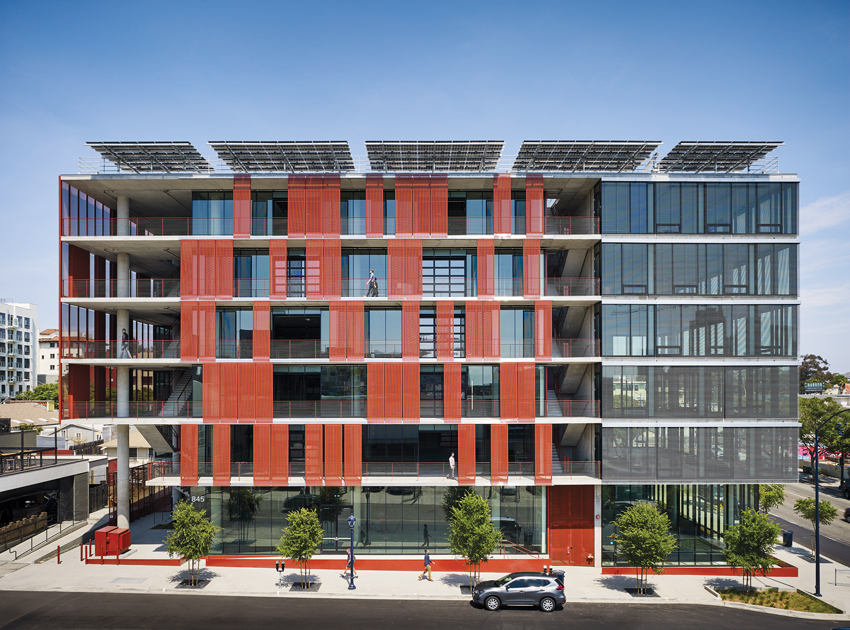
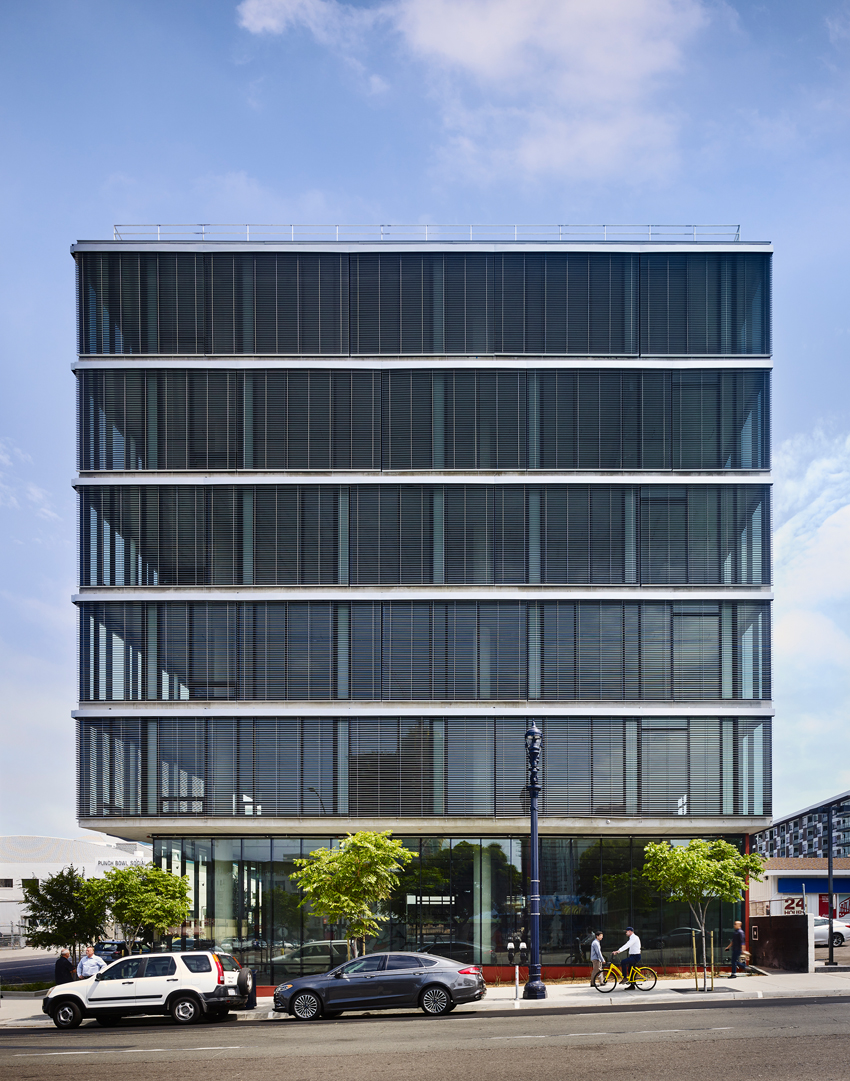
Photo: Nick Merrick, Hall + Merrick
Exterior venetian blinds, like the ones on this LEED Platinum project in San Diego, are a classic shading option with lowering, raising, and tilting capabilities.
Daylighting Benefits
In a recent study, Cornell University researchers reported a high 84 percent decrease in eyestrain, headaches, and blurred vision symptoms that often result from prolonged computer and device use at work, which can detract from productivity.1 The study also found that workers sitting close to a window that optimized daylight exposure were 2 percent more productive, which equates to an additional $100,000 per year of value for every 100 workers.
Similarly, a 2018 poll of 1,614 North American employees by the human resources advisory firm Future Workplace discovered that access to natural light and outdoor views is the number-one most important attribute of the workplace environment.2 On the contrary, the absence of natural light and views actually hurts the employee experience, as more than a third of workers feel that they do not get enough natural light in their workspace, 47 percent acknowledge feeling tired in the absence of natural light or a window, and 43 percent report feeling gloomy without daylight.
As for cost savings, the National Institute of Building Sciences’s (NIBS’) Whole Building Design Guide (WBDG) states that a combination of reduced electric lighting and associated building cooling energy usage through the use of shading and daylighting strategies can reduce total energy costs by as much as one-third.3
Defining Terms
To better understand the variables involved in achieving good quality shading and daylighting design, some definitions are in order.
Solar control is the ability to manage the sun’s energy. To optimally benefit from the sun’s energy, a solar control system seeks to maximize the use of natural daylight in a building, while ensuring that problems do not occur as a result of excessive heat gain and glare.
Sunlight is made up of energy with a range of different wave lengths covering what is known as the solar spectrum. The solar spectrum is divided into three main sections—ultra violet, visible light, and infrared—and all have a short wavelength, with the latter carrying very little heat.
When sunlight reaches the earth and hits a surface, however, some of it is reflected back into the atmosphere, while the balance is absorbed into the ground, vegetation, water, and people, for example. The absorbed part of the solar energy is then emitted as long wave energy, and this is what produces heat.
The solar equation is as follows: Total solar energy = As + Rs + Ts = 100 percent, where As is absorption, Rs is reflection, and Ts is transmittance. To minimize heat gain inside of the building, the Rs component needs to be as high as possible, and the As and Ts components should be as low as possible.
The solar equation determines what happens to the solar energy when it reaches a glazing assembly and defines the solar heat gain coefficient (SHGC). The value of SHGC ranges from 0 to 1; the lower the SHGC, the more effective the system. With an exterior venetian blind, the SHGC can be 0.10 or lower, meaning that more than 90 percent of the solar energy is prevented from entering the building and generating heat gain.
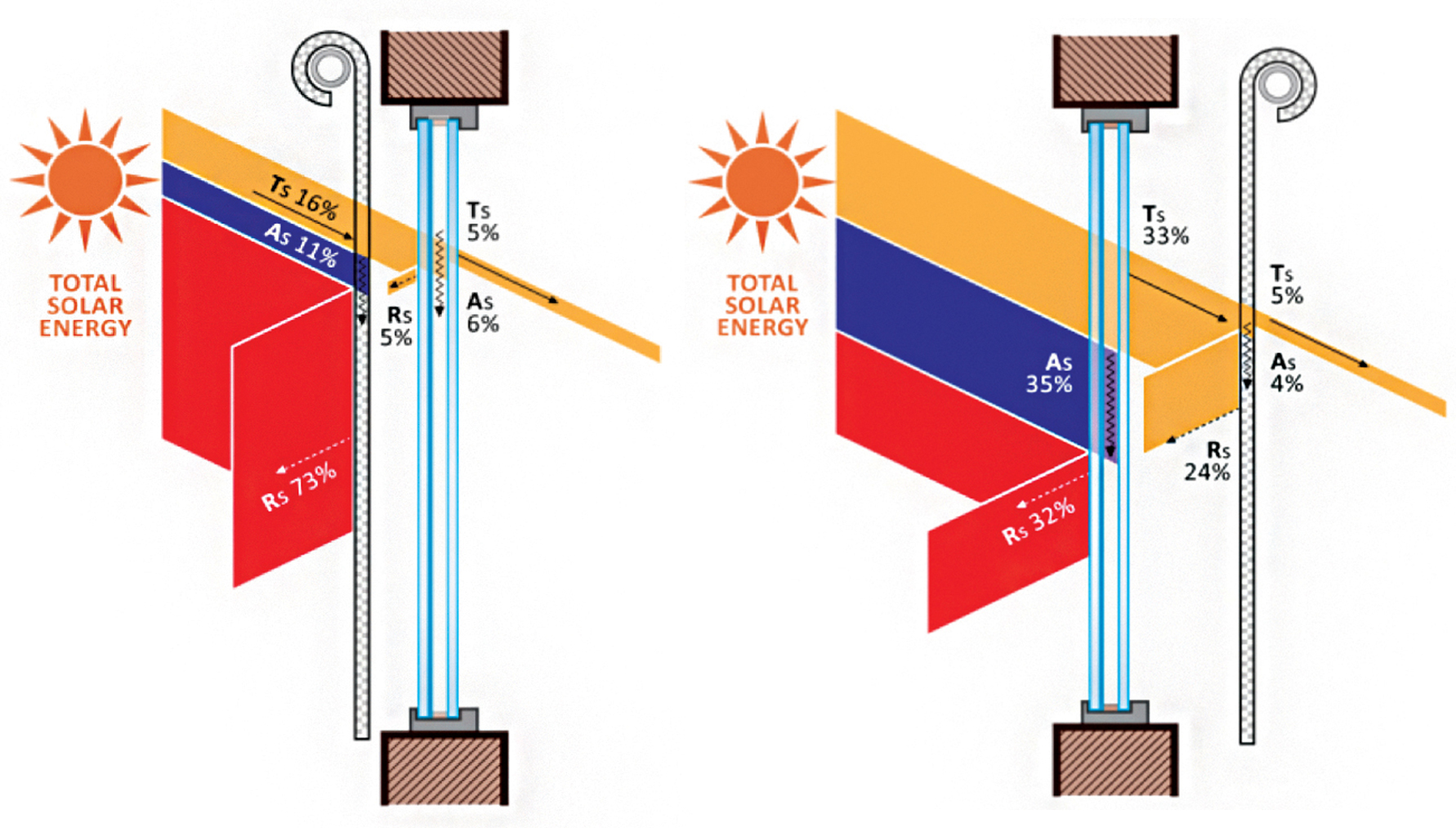
Image courtesy of Mermet USA
To minimize solar heat gain inside of a building, the reflection (Rs) must be as high as possible, while the absorption (As) and transmittance (Ts) must be as low as possible (left). Upon adding a basket-weave 3 percent interior white shading system, the solar heat gain coefficient (SHGC) entering the glass into the interior drops down to 0.16 for a 58 percent reduction. If the shading is located on the exterior, the SHGC comes down further to 0.10 for a 74 percent decrease (right).
Interior versus Exterior Shading
To minimize unwanted heat gain and drive down the SHGC inside a space, as noted, shading systems can be very effective, particularly exterior shades.
Consider a double-glazed unit with a high light transmittance of 68 percent and a low-e coating on surface 2, which is the inner side of the outer piece of glazing. Without shading, the SHGC registers quite high at 0.38.
Now add a basket-weave 3 percent white shading system on the interior, and the SHGC drops down to 0.16 for a 58 percent reduction. By placing that same shading fabric on the exterior, the SHGC comes down further to 0.10, which is a 74 percent decrease compared to the glazing without shading.
In analyzing the transmittance in these three cases, 33 percent of the total solar energy passes through the glazing and enters the room when there is no shading. After adding internal or external fabric, this declines to just 5 percent.
In terms of absorption, however, there will actually be an increase when shading is added to the interior, as an additional 4 percent is absorbed into the fabric, bringing the As value from 35 percent to 39 percent. With an exterior shading system, however, the As value is cut in half to 17 percent.
In addition to controlling solar heat gain and providing thermal comfort, an effective shading system will also assist in achieving good daylighting, which, as shown by many studies, is essential for occupant productivity and job satisfaction, not to mention energy savings. To this end, NIBS’ WBDG states that electric lighting accounts for 35 percent to 50 percent of the total electrical energy consumption in commercial buildings.
Consequently, potential cost savings from effective daylighting strategies—which can be optimized by well-designed shading devices—is very significant.
Controlling Glare
An important aspect of solar control is controlling glare, particularly bright windows. Glare is the result of excessive contrasts of luminance in the field of view. The discomfort is associated more with interiors and refers to discomfort or distraction caused by bright windows or luminaires.
Studies have shown that glare and direct sunlight can make it difficult for employees to perform basic work functions.
Case in point, the Boca Raton, Florida-based market research firm Amplitude Research surveyed 400 employees at a Minnesota office and found that 49 percent were affected by sun glare at least periodically in their workplace.4 Of this group, 30 percent complained that the glare caused eye pain, 24 percent reported headaches, 23 percent stated that the glare was annoying, and another 23 percent said it created a distraction.
By using shading systems to modulate light at the window, the contrast between the window and the immediate surroundings where occupants are working can be reduced, thereby eliminating or significantly reducing the glare’s impact.
The use of operable shading systems, particularly in conjunction with automated controls, makes them very effective in managing daylight and glare. While an exterior shading system’s main function is managing heat gain entering into the building, it can be effective in managing daylight and glare, although in some cases, an interior shading system will also be needed to control the glare.
Harnessing the sun’s free energy in the form of daylighting, the benefits of natural light are numerous indeed. But only carefully calibrated shading designs will optimally deliver the potential health and wellness benefits from natural daylighting as well as occupant comfort and productivity and energy savings.
With a goal of optimizing solar control and mitigating unwanted heat gain and glare, exterior shading systems are a proven and highly recommended strategy for optimizing performance.
Photo: Nick Merrick, Hall + Merrick
Exterior venetian blinds, like the ones on this LEED Platinum project in San Diego, are a classic shading option with lowering, raising, and tilting capabilities.
Daylighting Benefits
In a recent study, Cornell University researchers reported a high 84 percent decrease in eyestrain, headaches, and blurred vision symptoms that often result from prolonged computer and device use at work, which can detract from productivity.1 The study also found that workers sitting close to a window that optimized daylight exposure were 2 percent more productive, which equates to an additional $100,000 per year of value for every 100 workers.
Similarly, a 2018 poll of 1,614 North American employees by the human resources advisory firm Future Workplace discovered that access to natural light and outdoor views is the number-one most important attribute of the workplace environment.2 On the contrary, the absence of natural light and views actually hurts the employee experience, as more than a third of workers feel that they do not get enough natural light in their workspace, 47 percent acknowledge feeling tired in the absence of natural light or a window, and 43 percent report feeling gloomy without daylight.
As for cost savings, the National Institute of Building Sciences’s (NIBS’) Whole Building Design Guide (WBDG) states that a combination of reduced electric lighting and associated building cooling energy usage through the use of shading and daylighting strategies can reduce total energy costs by as much as one-third.3
Defining Terms
To better understand the variables involved in achieving good quality shading and daylighting design, some definitions are in order.
Solar control is the ability to manage the sun’s energy. To optimally benefit from the sun’s energy, a solar control system seeks to maximize the use of natural daylight in a building, while ensuring that problems do not occur as a result of excessive heat gain and glare.
Sunlight is made up of energy with a range of different wave lengths covering what is known as the solar spectrum. The solar spectrum is divided into three main sections—ultra violet, visible light, and infrared—and all have a short wavelength, with the latter carrying very little heat.
When sunlight reaches the earth and hits a surface, however, some of it is reflected back into the atmosphere, while the balance is absorbed into the ground, vegetation, water, and people, for example. The absorbed part of the solar energy is then emitted as long wave energy, and this is what produces heat.
The solar equation is as follows: Total solar energy = As + Rs + Ts = 100 percent, where As is absorption, Rs is reflection, and Ts is transmittance. To minimize heat gain inside of the building, the Rs component needs to be as high as possible, and the As and Ts components should be as low as possible.
The solar equation determines what happens to the solar energy when it reaches a glazing assembly and defines the solar heat gain coefficient (SHGC). The value of SHGC ranges from 0 to 1; the lower the SHGC, the more effective the system. With an exterior venetian blind, the SHGC can be 0.10 or lower, meaning that more than 90 percent of the solar energy is prevented from entering the building and generating heat gain.
Image courtesy of Mermet USA
To minimize solar heat gain inside of a building, the reflection (Rs) must be as high as possible, while the absorption (As) and transmittance (Ts) must be as low as possible (left). Upon adding a basket-weave 3 percent interior white shading system, the solar heat gain coefficient (SHGC) entering the glass into the interior drops down to 0.16 for a 58 percent reduction. If the shading is located on the exterior, the SHGC comes down further to 0.10 for a 74 percent decrease (right).
Interior versus Exterior Shading
To minimize unwanted heat gain and drive down the SHGC inside a space, as noted, shading systems can be very effective, particularly exterior shades.
Consider a double-glazed unit with a high light transmittance of 68 percent and a low-e coating on surface 2, which is the inner side of the outer piece of glazing. Without shading, the SHGC registers quite high at 0.38.
Now add a basket-weave 3 percent white shading system on the interior, and the SHGC drops down to 0.16 for a 58 percent reduction. By placing that same shading fabric on the exterior, the SHGC comes down further to 0.10, which is a 74 percent decrease compared to the glazing without shading.
In analyzing the transmittance in these three cases, 33 percent of the total solar energy passes through the glazing and enters the room when there is no shading. After adding internal or external fabric, this declines to just 5 percent.
In terms of absorption, however, there will actually be an increase when shading is added to the interior, as an additional 4 percent is absorbed into the fabric, bringing the As value from 35 percent to 39 percent. With an exterior shading system, however, the As value is cut in half to 17 percent.
In addition to controlling solar heat gain and providing thermal comfort, an effective shading system will also assist in achieving good daylighting, which, as shown by many studies, is essential for occupant productivity and job satisfaction, not to mention energy savings. To this end, NIBS’ WBDG states that electric lighting accounts for 35 percent to 50 percent of the total electrical energy consumption in commercial buildings.
Consequently, potential cost savings from effective daylighting strategies—which can be optimized by well-designed shading devices—is very significant.
Controlling Glare
An important aspect of solar control is controlling glare, particularly bright windows. Glare is the result of excessive contrasts of luminance in the field of view. The discomfort is associated more with interiors and refers to discomfort or distraction caused by bright windows or luminaires.
Studies have shown that glare and direct sunlight can make it difficult for employees to perform basic work functions.
Case in point, the Boca Raton, Florida-based market research firm Amplitude Research surveyed 400 employees at a Minnesota office and found that 49 percent were affected by sun glare at least periodically in their workplace.4 Of this group, 30 percent complained that the glare caused eye pain, 24 percent reported headaches, 23 percent stated that the glare was annoying, and another 23 percent said it created a distraction.
By using shading systems to modulate light at the window, the contrast between the window and the immediate surroundings where occupants are working can be reduced, thereby eliminating or significantly reducing the glare’s impact.
The use of operable shading systems, particularly in conjunction with automated controls, makes them very effective in managing daylight and glare. While an exterior shading system’s main function is managing heat gain entering into the building, it can be effective in managing daylight and glare, although in some cases, an interior shading system will also be needed to control the glare.
Exterior Shading Systems
As previously noted, an exterior system is the most effective way to deal with solar heat gain. If the shading system is designed to significantly reduce the level of solar energy entering the building and resulting heat gain levels, then such a design will also reduce the building’s cooling requirements.
“Once solar heat gain has passed through glazing, it is difficult to reflect it back out to prevent reflection on the interior glazing surface,” explains Erik Olsen, managing partner, Transsolar KlimaEngineering, New York. “This is critical not only to reducing cooling load or cooling energy from mechanical systems but also maximizing the usefulness of passive measures, such as natural ventilation or night flushing, which are more effective with very low cooling loads.”
By downsizing the HVAC system, these savings can help offset the cost of the shading system. Further, as the cost of energy continues to increase, the ongoing savings from the reduced running costs of a smaller HVAC system becomes even more significant.
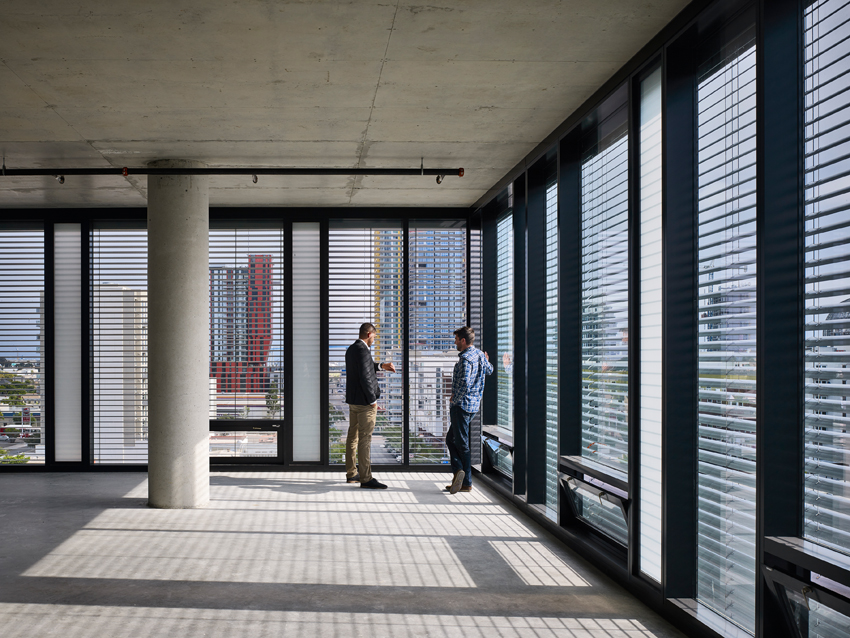
Photo: Nick Merrick, Hall + Merrick
A well-designed exterior venetian blind system and controls at Makers Quarter Block D in San Diego enable the building to operate at 66 percent less than baseline energy levels.
Like a greenhouse effect, glazing essentially traps solar energy. As Robert Matthew Noblett AIA, NCARB, partner, Behnisch Architekten, Boston, explains, interior shading systems by definition are already operating after-the-fact in that the solar energy is in the building and has to be extracted by other means. “Further, the shade material itself tends to heat up and re-radiate solar energy to the building's interior,” he adds.
Bringing in another point, Nikolaus Arnold, director of envelope technical services, CNY Group, New York, says, “Interior shading systems, even more superior blackout options, are not repurposing the absorbed energy in the way exterior systems have been developed to do. Not only are exterior solutions more effective, but they are also more sustainable.”
Another issue driving exterior shading system specifications is building regulations. Building codes around the world are placing greater emphasis on the facade’s energy performance levels, and a number of codes specifically reference these systems as a strategy for meeting code requirements.
As previously noted, health and productivity are major factors as well. People like working in buildings with access to natural daylight and contact with the outside. Excessive heat gain, however, can cause discomfort for building occupants, particularly if they work adjacent to the glazing.
Exterior shading devices can therefore contribute toward producing a better working environment. As proven in many studies, natural light improves peoples’ mood, their general well-being, and perhaps most important to building and company owners, it increases productivity and reduces the number of sick days. This is significant, as energy consumption and rent/ownership in cost per square foot are significantly less than employee costs per square foot. Increasing productivity through effective daylighting can therefore have a significant impact on a company’s bottom line.
In addition to improving productivity and energy performance, well-designed exterior shading systems can lend a nice aesthetic, significantly impacting the building’s appearance.
“We often find the use of exterior shading systems to not only be more efficient, but it also adds to a more appealing architectural design,” confirms Luciana Fragali, Design Solutions, Miami. “We find the full automation, durability, and versatile designs of exterior shading systems make them an essential part of any project.”
Furthermore, LEED credits are available for daylighting strategies that incorporate shading and, as a result, optimize energy performance and thermal comfort. For example, for the EA Credit 2: Optimize Energy Performance, projects can earn up to 20 points. In addition, exterior shading systems can be integrated into a whole building simulation demonstrating enhanced daylighting, mitigated solar heat gain, and a decreased electrical lighting and HVAC load to earn LEED points.
As another example, EQ Credit 7: Daylight compliance offers up to three credits by connecting building occupants with the outdoors, reinforcing circadian rhythms, and reducing electrical lighting use. To qualify for these points, projects must include manual or automatic glare-control devices. Further, simulations or measurements must prove that the design achieves certain daylighting objectives.
Selecting the Right Shading Option
There are many different fixed and operable exterior shading systems from which to choose.
However, not all systems will provide the same level of solar control. For instance, fixed exterior systems such as brise soleil systems and fixed louvers are purely designed for heat control. They may provide some light control, but this is not their intended function.
At the same time, operable louvers can be rotated to provide an increased level of solar control. This will translate into some daylight control, even though this in not their main purpose. With venetian blinds, roller shades, and rack arm systems, the inherent adjustability of the systems means that higher levels of light and glare control can be achieved, in addition to heat gain control. A rack arm system in particular is often used in museums and art galleries where precise light control is critical.
In choosing the right system for a project, specifiers should consider the following issues.
Building Location and Orientation
The shading requirements for east, south, and west facades vary because of the different sun angles that must be addressed. In addition, geographical location is very important.
In Miami, for example, the sun is almost vertical in the sky at midday on June 21 when the peak sun angle is just over 86 degrees. Even in winter, the sun angle in Miami is almost as high as the peak summer sun angle in Helsinki, Finland, for instance. In Miami, therefore, relatively short projections can provide effective shading, particularly on the south elevation. But in places such as Helsinki, a much more adjustable system will be required to deal with the varying conditions and low sun angles. In summer in Helsinki, the sun sets almost due north; in the winter, however, it does not set very far to the west. Retractable shading systems are therefore appropriate for the west elevation, and it may also be necessary to provide some shading on northwest and north elevations to control glare.
As well as considering latitude and longitude, it is also important to understand the context of a building. In an urban environment, overshadowing from surrounding buildings could have a significant impact and may mean that certain parts of the building that should be exposed to the sun are, in fact, permanently shaded. The effect of the building being close to water might also need to be considered. For example, light reflected from water can cause glare issues that could be addressed by a fabric system but not venetian blinds or horizontal louvers, which can allow reflected light to pass through them.
Climatic Conditions
All shading systems have to cope with climatic conditions. Fixed systems must be designed to address the maximum wind, snow, and ice loads, whereas operable exterior roller shades and venetian blinds systems can be retracted in adverse weather conditions. Depending on the wind and ice conditions, however, certain operable systems may not be the best choice. It might be better to select a fixed system or one that is adjustable but not retractable.
Heating and Cooling Requirements
Exterior venetian blinds may be retracted and left in this position over the winter months to allow sun and the associated heat gain into the building, as this is a free source of heat and will reduce energy costs over this period. If this is the case, however, interior glare control systems, such as roller shades, will almost certainly be required.
Architectural/Aesthetic Requirements
For some projects, large-scale louvers are used to provide a strong aesthetic. In other situations, shading systems might be on the interior or in a double facade to allow the building to have a clean glazed appearance. Projecting systems (e.g., brise soleil systems) are often used to shade south elevations. While they do not work well with low sun angles on the east and west elevations, they may be used there to provide a consistent look to the building. In this case, however, it is important that the end user and design team understand that the shading systems will not function very effectively and a secondary interior system will almost certainly be required as well on these elevations.
Performance Requirements
Depending on the level of solar control required, one system may be more appropriate than another.
Exterior Zip Shading
Having spent some time looking at solar control and the choice of an appropriate shading system, a number of specific shading options can be considered: exterior fabric zip systems, exterior venetian blinds, and the rack arm system that incorporates operable louvers.
Whereas standard exterior fabric systems can be used to provide shade, they must be retracted at relatively low wind speeds. Though less known to architects, exterior zip systems are significantly more robust than a regular exterior roller shade due to the way in which the fabric locks into side guide tracks.
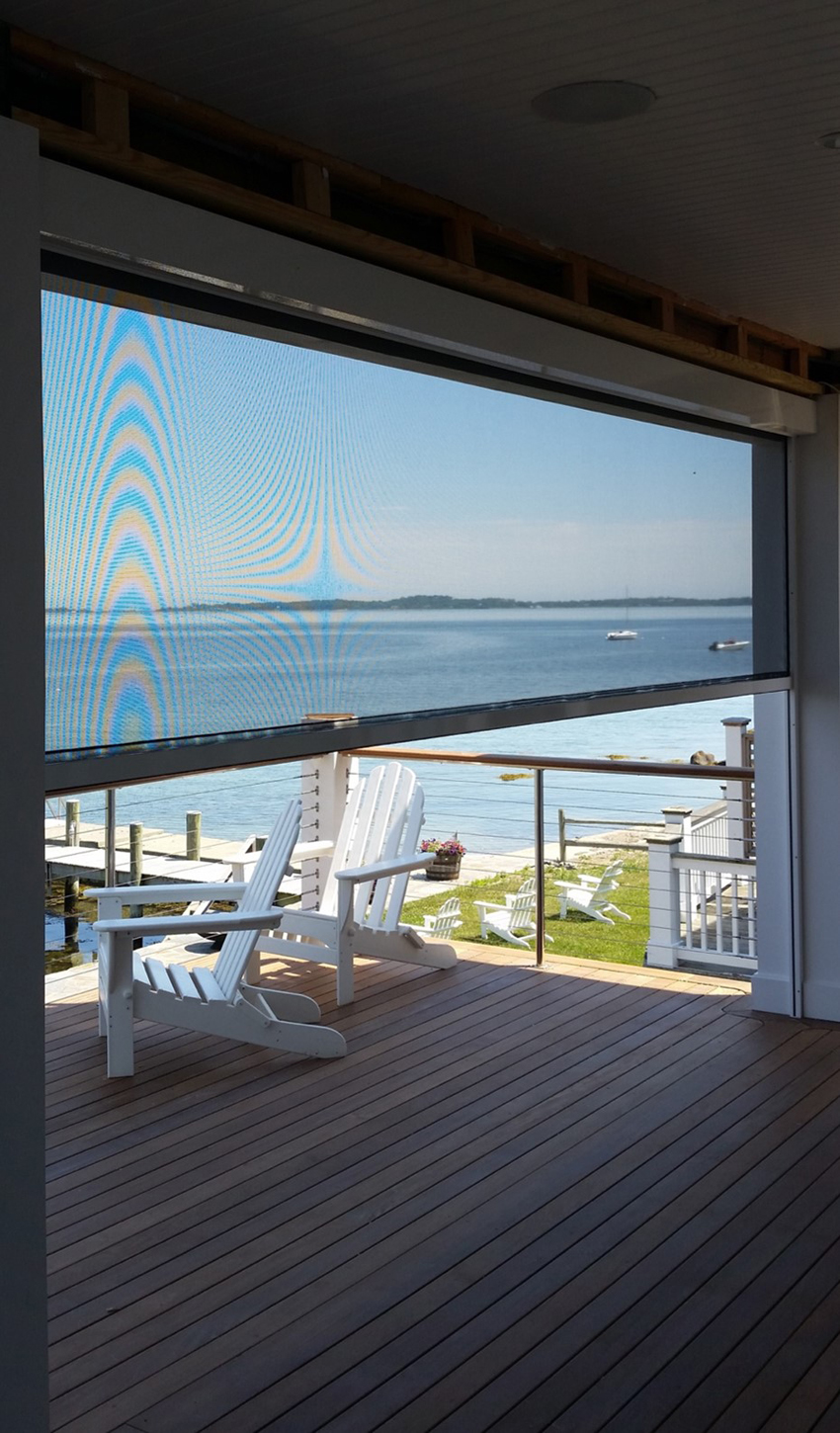
Photo courtesy of Draper, Inc.
Durable and robust, exterior zip shading systems are well suited for a variety of applications, including balconies, terraces, and porches.
“Exterior zip shading tends to be popular due to its lower cost of initial installation, but these systems are also very efficient in solar heat transfer reduction of up to 95 percent,” Arnold reports. “Many high-performance fabric options available provide interesting aesthetic opportunities on the exterior and interior, while providing excellent protection of furniture, finishes, and artwork from UV damage.”
“Advantages of exterior zip shading are full automation, durability, improved comfort via sun protection, and glare control,” Fragali adds. “They form an insect barrier when fully lowered and offer wind mitigation when partially or fully deployed.”
Two-piece side guides incorporate fabric retainer strips, and a half zipper is welded to each fabric edge, allowing them to lock into the side guides. Consequently, the zip system can withstand significantly higher wind loads than a regular exterior roller shade.
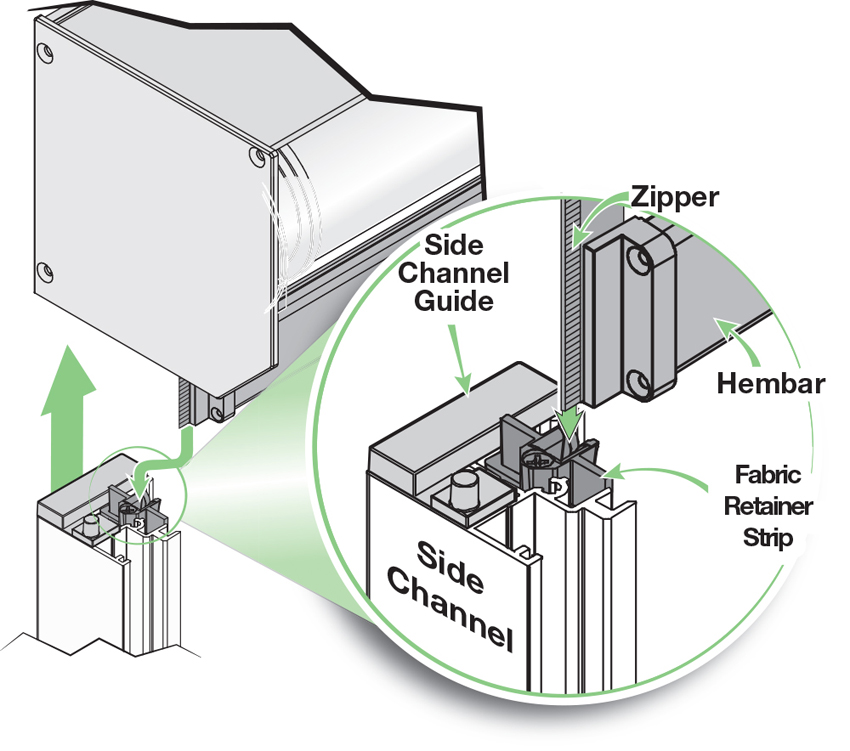
Image courtesy of Draper, Inc.
A zip system is made with a two-piece side guide, with fabric retainer strips and a half zipper welded to each fabric edge.
The zip system is available in a wide range of fabrics, it raises and lowers, and it works for all elevations.
Generally, zip systems are gravity drop ones. The hem bar is weighted as required to ensure that the systems operates satisfactorily and the fabric is under tension. In certain instances, where there is a requirement for bottom-up systems as well as horizontal or sloped shading, tension is required. This, however, significantly increases system cost.
Though wind tunnel testing found that the system can withstand very high wind speeds, it is recommended that the zip system be retracted at around 40 mph as to not risk damaging the system, particularly from flying debris. Further, it is rare for sun conditions requiring shading to occur at such high wind speeds, and so retracting them should generally not be an issue.
When under wind load, significant suction forces occur that try to rip the shading system from the facade. Consequently, adequate side track fixings are essential to ensure that they are not a point of failure. There are projects, however, where architects prefer not to use side guides. In these cases, a cable-operated tension shade would be the most appropriate alternative.
Another issue that must be addressed is ice buildup, which can occur because the zippers run in plastic retainer inserts inside the side guide track. In most cases, the weight of the hem bar will prevent ice buildup, but there are potential issues in locations where freezing rain occurs. In any case, the system should be inspected and cleaned on a yearly basis, and the tracks should remain clear.
Originally developed as an exterior system to mitigate solar control, zip systems can be used in a wide variety of applications, the most common being enclosing an outdoor space. For example, restaurants that offer outdoor dining when the weather is pleasant can be zipped closed in cold or rainy conditions.
“Exterior zip shading systems are used for any outdoor living space with an overhead ceiling, windows, balconies, terraces, and porches,” Fragali explains. “They are well-suited for these areas, as they fit into these spaces where they remain protected and are easy to maintain.”
Assuming that the side channels are properly installed, the closed zip system offers a climate-controlled interior environment. Furthermore, the rain will not mist nor come through the mesh. At the same time, the closed system will cut off the fresh air ventilation.
In addition to enclosing spaces, zip systems can be used to divide rooms and are capable of providing a very high level of light exclusion (i.e., near blackout).
The product can also be used as a tension system, which enables more complex shading requirements to be addressed.
Exterior Venetian Blinds
Exterior venetian blinds are a well-known and popular shading option. Operating similar to interior ones in the way they are raised and lowered, and how the slats are tilted, this provides an additional level of controllability as compared to a roller shade system. Further, the system can be used on any facade, as the slats can be adjusted to provide solar control at all sun angles.
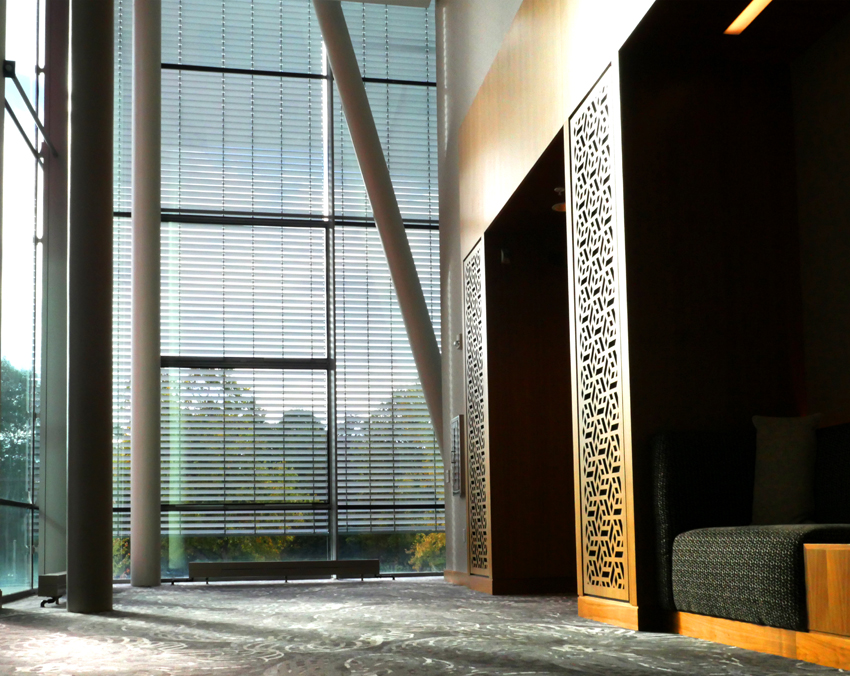
Photo: Hal Stata, Stata Productions
Exterior shading systems like these venetian blinds maximize ambient light entering the building while preventing direct sun penetration.
“Exterior venetian blinds add a more classical appearance to any surface and are suitable for all window sizes, easy to install, highly durable, and affordable, making them an optimum choice for exterior shading while adding a taste of elegance,” Fragali explains.
Noting that these systems have been highly engineered over the past 30 to 40 years and provide a high degree of flexibility, Noblett explains that they can be set up as daylighting systems where the upper one-third of the slats are more open than the lower two-thirds, thereby optimizing daylighting even in the deployed condition. He adds that they can be fully retracted for viewing out when not required for solar protection, can be perforated to lighten their appearance, and are available in very robust models suitable for use in high-wind applications.
Exterior venetian blinds have a shading coefficient of less than 0.10 and can therefore prevent more than 90 percent of the solar energy from coming through the glazing and being converted into heat.
Available in a variety of sizes, from 2 inches up to 6 inches, the systems—and particularly the slats—can appear lightweight but are in fact very durable and can withstand wind speeds of up to 38 mph, which means that the blinds are suitable for most building locations.
In addition to wind, it is also important to protect the blinds from ice. As a result, blinds must retract into a watertight pocket or head box when not in use.
Blind slats can be fully perforated, highway perforated (where the central strip is left unperforated), half perforated, or solid. The most standard openness factors are 3.8 percent, 6 percent, or 9.2 percent.
Perforated slats have the advantage of allowing a view through, even when the blinds are in the closed position. The blinds are generally closed during the early morning or late afternoon when the sun is low in the sky, and set in a horizontal position or partially tilted during most of the day.
Depending upon facade orientation, perforated slats can cause glare, so this must be taken into consideration. Additionally, in comparison to solid slats, perforated slats will add to the cost of the system.
Like zip systems, exterior venetian blinds must be retracted under high wind conditions. The control system will incorporate a wind sensor and when wind gusts exceed 38 miles per hour, the automatic wind-retract system overrides all other controls to ensure that the systems are not deployed when there is a risk of damage through strong winds.
A standard venetian blind is deployed with the slats in the closed position and retracts into an open, horizontal position. Sometimes there are concerns that there will be a sudden loss of light in the building when blinds are deployed and before the slats are tilted to a more open position. To address this, it is also possible to specify the system with a ‘work angle’ setting. In this case, the slats deploy at approximately 35 degrees open, but cannot be tilted to fully closed until the system is completely deployed.
Venetian blind slats tilt through approximately 70 degrees between open and closed. At the 70-degree rotation, there is horizontal cutoff—the bottom of one slat overlaps the top of the one below—that prevents any direct sun penetration while allowing some ambient light into the building. When under automatic operation, it is normal to program three intermediate slat angles, 17.5 degrees, 35.0 degrees, and 52.5 degrees, in addition to the open (horizontal) and closed (70-degree tilted) positions.
Aesthetically, venetian blind systems offer clean lines, pockets/cavity protection, cables or tracks, and a wide range of slat colors. The slats are generally manufactured from aluminum, but wood slats (generally manufactured from western red cedar) are also available.
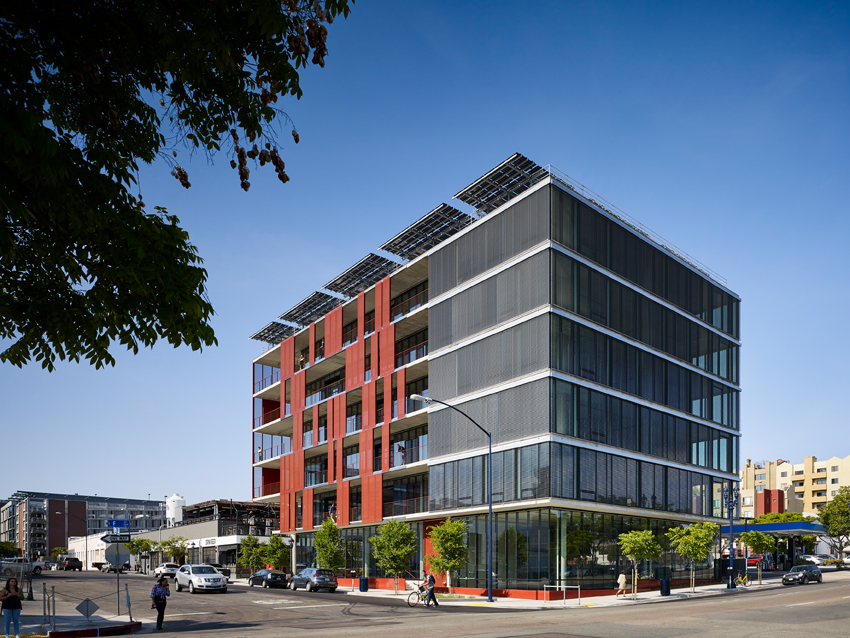
Photo: Nick Merrick, Hall + Merrick
Exterior venetian blinds offer clean lines and a beautiful aesthetic, as pictured here at Makers Quarter Block D.
“Venetian blinds have seen a resurgence in use for their timeless appearance,” observes Fragali.
Although venetian blinds are most effective in achieving solar control when installed on the exterior, some building owners are hesitant for concerns of durability, maintenance, and adverse weather. Consequently, many opt to install these systems on the interior or in a double facade.
As Noblett has highlighted, it is also possible to consider daylighting blinds where the upper section of the blind is more open than the lower section. The upper section allows more light into the building while the lower section controls light at a work level. Care must be taken with this approach, however, due to the risk of glare issues.
He goes on to say that due to their inherent flexibility and ability to be individually controlled, they are highly suitable for office and institutional environments where individual offices with more discreet window components might be involved. Their unitized nature also makes them more suitable for this kind of repetitive facade module.
As a partner with a firm that has undertaken many projects with exterior venetian blinds, Noblett adds that the systems are a great fit for larger exterior applications. And when the design is well integrated into the building envelope, the impact on the building’s appearance can be minimal.
Rack Arm Systems
Highly versatile, rack arm systems can effectively shade any type, shape, or glazing orientation and provide very effective solar control. In fact, for applications with unique configurations and shapes, rack arms may be the only option for solar control. The system also offers high levels of light exclusion, with the exception of a full blackout, particularly if an interlocking slat is used. Available in a range of sizes, the slats can be opened and closed, but does not retract. Additional applications include facades, rooflights, and pergolas.
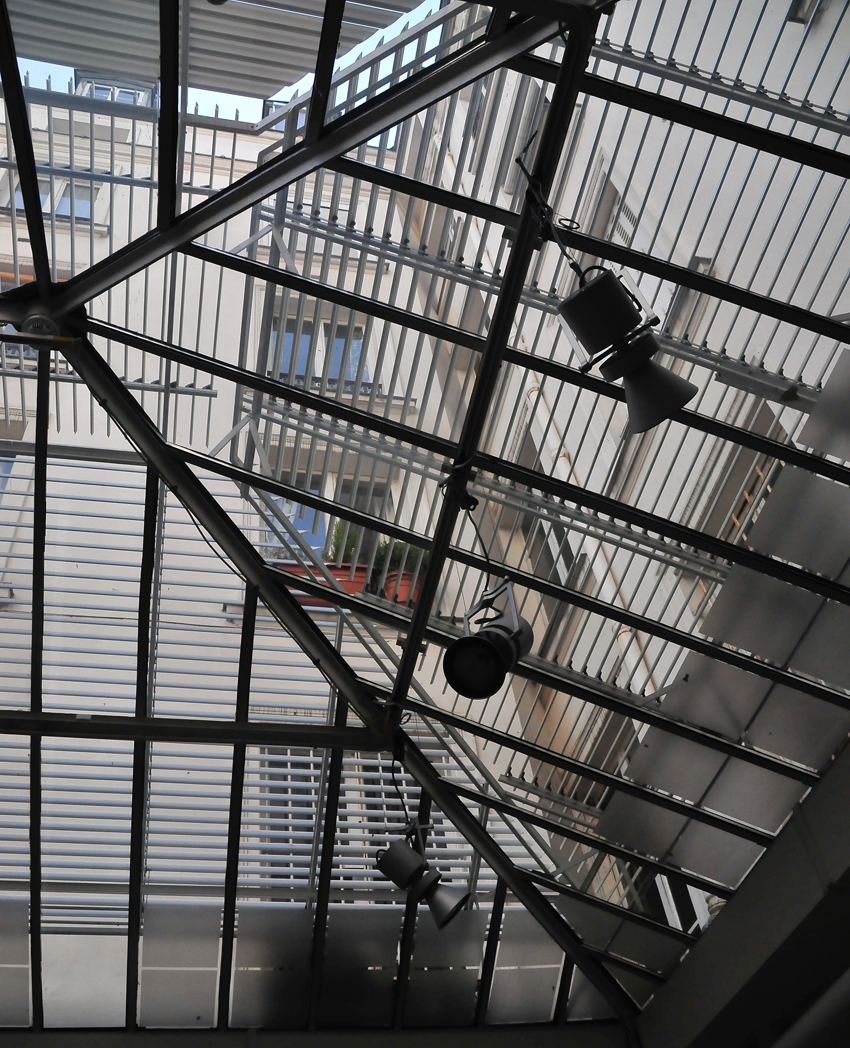
Photo courtesy of Draper, Inc.
Rack arm shading systems offer a high level of versatility and can therefore match any type of shape or glazing orientation.
Singing the technology’s praises, Arnold describes rack arm systems as the “Rolls Royce” of exterior sun-shading systems, which can be installed for vertical, horizontal, and inclined applications and offer superior automation options for smart buildings.
“Their main advantage is that they can span larger distances and be used on skylights,” Olsen says. “Like venetian blinds, they allow the louvers to track the sun and block direct sunlight while maintaining view and admitting diffuse daylight.”
“Compared with the other two systems, they are probably the most robust, even if they are designed to articulate based on sun angle,” Noblett adds. “However, they cannot stack like exterior venetian blinds or zip shading, so they always remain in place and part of the view through the glazing.”
The rack arms are installed on the glazing structure and are connected to the operator by a drive shaft. Slats are mounted onto the rack arms, the spacing of which is dependent on the slat size and whether the installation is interior or exterior.
Developed and designed for exterior use, a rack arm system can withstand wind speeds in excess of 100 mph. In exposed locations, the use of baffles to protect the slats around the edge of the system is recommended. It is also recommended to use a wind-control device and that the slats are moved to the open position in strong winds to allow for an equalization of pressure. This reduces slat movement and makes the system much more stable.
Because the rack arm system has a large number of small rotating parts, this makes ice a potential issue, particularly with motorized systems. As a result, the application of rack arms should be carefully considered and in some locations, an interior installation is probably the only realistic option. In many parts of the United States, however, the system is viable as an exterior system.
Control Systems
Operable exterior shading systems do require a control system. As a minimum, the controls must be able to protect the shading device from the wind, and, as noted, systems such as venetian blinds and roller shades will need to be retracted if the wind speed is too high.
Given that exterior systems are designed to control heat gain into the building, they are usually automated, allowing them to respond to the sun conditions. This means that systems will automatically deploy and retract, and the slats of venetian blind systems will adjust between different tilt angles to prevent any direct sun penetration. Because this is the case, it is important that the building users understand the function of the systems and are given initial training about how the systems work, and how they help control the building environment and create good working conditions.
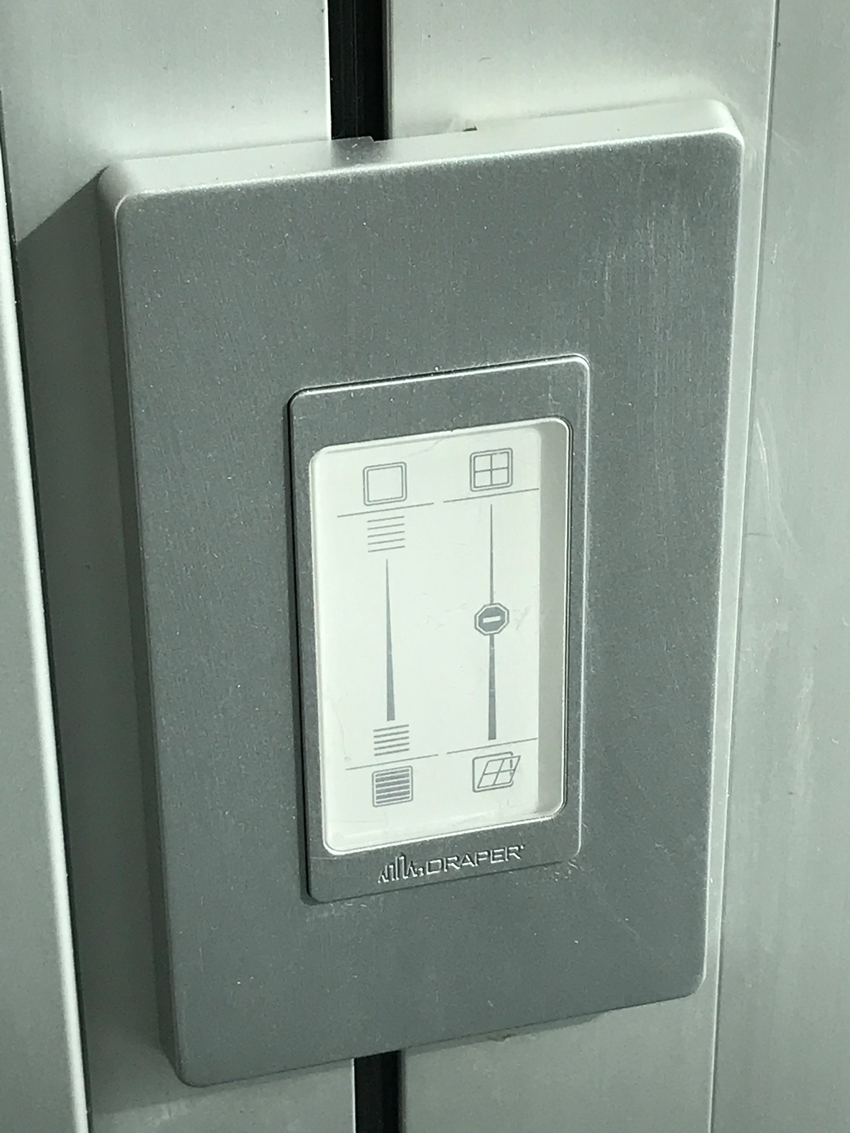
Photo courtesy of Draper, Inc.
Exterior shading with an integrated control system helped DIALOG deliver a net-zero design for the University of Calgary’s MacKimmie Tower.
Where to locate the sensors is an important consideration. For example, solar radiation sensors need to be located with the correct orientation(s) and in a location where they will not be shaded. Wind sensors should be located in a place where they will not be disrupted by other local wind effects, such as from a rooftop penthouse, explains Olsen. “The location of local shade controllers also needs to be identified and specified so that they are in an architecturally acceptable location and reasonably accessible for maintenance,” he instructs.
Another question is whether user interaction is desired and how it will be accomplished. For instance, are users allowed to override and control the shade position, and if so, are the controls being located in a place where they are easy to find and intuitive to use?
Olsen adds some additional questions that must be addressed: Is it aesthetically acceptable to have shades in different positions, controlled by users? Is overheating possible if users are allowed to control the shades, and if so, is this acceptable? If the shades are accessible from the outside, is there any potential for vandalism? Does the shade movement have any impact on an adjacent occupied space?
Noblett brings up an interesting point, which is the fact that while automation is designed to enhance user comfort and optimize building performance, it is not always well received by occupants. “When someone is comfortable and enjoying the state of his or her environment, and some automated building component decides that it is time to alter that environment, this tends to be a source of frustration,” Noblett explains.
“So it is important that when automation occurs, people understand why it is happening, and intuitive controls that allow them to return to their preferred state or modify certain aspects of their environment are critical to maintaining occupant confidence in building systems,” he recommends. “If people understand that an automated shade is deploying to maintain conditions of comfort in their space, yet they can still act to modify it within some boundary condition, they will have a better relationship to the technology.”
Along these lines, Fragali says it is important to determine the building owner’s daily needs and expectations of their individual shading system. “Location and exposure are essential to consider when selecting the ideal materials and finishes, as well as educating your client on the required maintenance for each individual material selected,” she says.
Controls generally allow for varying degrees of user override and are also designed to capture systems back into automatic after a period of time to ensure that solar control of the building is maintained. User override can be achieved through switches and can interface with other systems, such as the building management system/building automation system (BMS/BAS) or audio visual (AV) system.
In the United States, the BACnet protocol is generally used for integration with the BMS/BAS, although other communication protocols can be used as well. BACnet over IP is the predominant BMS/BAS integration method. The head end of the shading control system is connected to the building IP network. This allows two-way communication, with the BMS/BAS being able to obtain information about the status of the shading devices as well as providing commands to move the shading systems as appropriate, for example if there is a fire alarm.
It is also possible to customize the control system to meet the specific requirements of a project. For example, the design team can specify when and to what extent the shading system will be deployed. In addition, operations at deployment and overrides are site-configurable components of a wel-engineered control system. Overrides are particularly important in terms of setting priorities for the various lighting, AV, fire protection, and other systems that may be integrated with the shading control system. A proper control system that is automated and comissioned correctly requires little end-user override and makes shading operations much less noticeable.
Control systems can allow for a wide range of methods of integration, including a BMS/BAS interface, as noted, an RS 232/485 AV interface, or an interface with other systems by means of contact closures.
On the topic of aesthetics for the interface, there is generally standard artwork for the switches, but this can be customized on larger projects.
Enhanced end-user interaction can include a custom switch to allow both the shading systems and operable windows to be controlled from the same interface. Switches can also incorporate status LEDs.
Conclusion
In summary, properly controlled exterior shading systems are a key strategy for optimizing the benefits of daylighting, controlling solar heat gain, and mitigating glare. While there are a number of options, architects and designers regard fabric zip systems, venetian blinds, and rack arm systems as effective shading solutions in achieving these requirements.
“We find that all three systems are easily maintained and can be customized to fix any project needs. They offer a wide range of colors and finishes for any design we wish to achieve, making them well suited for any project,” reports Fragali.
In conclusion, she emphasizes the effectiveness of exterior over interior systems. “Unlike interior shading systems, exterior examples maximize the amount of ambient light into the building while preventing any direct sun penetration, which is essential to the design of any project.”
END NOTES
1“Study: Natural Light Is the Best Medicine for the Office.” 31 January 2018. Web. 20 July 2020.
2Meister, Jeanne C. “The #1 Office Perk? Natural Light.” Future Workplace. 3 September 2018. Web. 20 July 2020.
3Ander, Gregg D. “Daylighting.” World Building Design Guide. 15 September 2016. Web. 20 July 2020.
4Malmquist, Derek. “A Glaring Issue: The Negative Implications of Glare in the Workplace.” 12 May 2016. Web. 20 July 2020.