This CE Center article is no longer eligible for receiving credits.
Good building envelope design has received a great deal of attention in recent years for good reason. Creating wall, roof, and floor systems that are durable and long lasting as well as aesthetically and economically appropriate is the usual starting point. But there is also the critically important need to control what flows through those systems, such as heat, air infiltration, moisture, and sound. This is compounded by the fact that different building categories such as commercial, industrial, residential, or institutional will often have different requirements for the degree of control required for any one or all of these things. Further variations occur when looking at buildings in different climate zones or with different operating conditions. The key to a successful building envelope then becomes finding ways to combine the right materials into assemblies that can meet all of these varied requirements. Among the critical choices to be made, the selection of an insulation material used in an assembly will have a significant impact on the total performance of that assembly. In particular, the selection of spray foam insulation systems has been shown to be a very attractive and effective choice that can address all of the control issues related to heat, air, moisture, and sound transmission. Further, it is appropriate for use in wall, roof, and floor assemblies in buildings of all types from low-rise residential, through large-scale industrial or institutional, and mid- to high-rise commercial with equal abilities to perform very effectively in all cases.
Overview of Spray Polyurethane Foam Insulation
As the name indicates, spray polyurethane foam (SPF) insulation is a polyurethane product that is sprayed into openings or cavities in building envelope assemblies. It is in fact a two-component system of liquids that are mixed in the field and then spray applied where the resulting foam expands in place to fill cavities completely. This foam also has an adhesive quality that means it readily sticks to the substrate where it is applied. This combination of adhesive and expansion properties creates a very effective sealant against air infiltration as well as providing very good thermal performance. In fact, according to the Air Barrier Association of America (ABAA), many spray foam insulations, regardless of type, are classified as air barrier materials and recognized as the key component in tested air barrier assemblies.
SPF insulation is generally regarded as an environmentally responsible product primarily due to its excellent energy-efficiency benefits both as an effective thermal insulation and air sealant. The manufacture and application of these products is also accomplished with a zero-ozone depletion process, meaning that the outdoor environment is not unduly impacted. When it comes to indoor environmental quality, SPF insulation is in fact a type of in-organic plastic, so it has no food value for mold or mildew to grow and develop. This reduces the chance of mold occurring in the first place which cannot be assured with organic materials.
The field application process is really quite comparable to typical in-plant applications that have been used since the 1960s to insulate appliances such as dishwashers, refrigerators, and freezers. The only difference is that the equipment is placed into trucks and trailers to essentially make mobile factories. This highly specialized equipment commonly includes things like plural component proportioning units, compressors, a generator, and 200-300 feet of hose for applications in the field. These mobile factories can range from $60-$100K and the applicators that operate them need to be highly skilled technicians, definitely not from the local day labor shop. Across the spray foam insulation industry, quality control standards and training programs have been developed to train applicators, improve installation quality, and help SPF installations meet design and specification requirements.
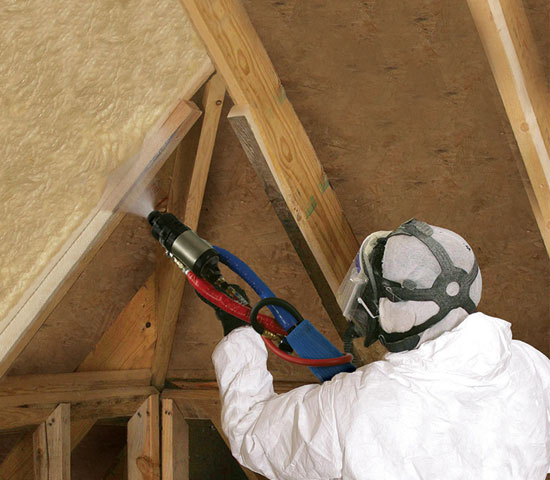 |
Spray Polyurethane Foam (SPF) insulation installs readily, completely, and easily in buildings of all types.
Photo courtesy of Demilec (USA) LLC |
While all SPF insulation shares these general qualities, there are two distinct product types that are used in buildings: Low-Density, and Medium-Density. Each one has their own specific set of characteristics as described:
Good building envelope design has received a great deal of attention in recent years for good reason. Creating wall, roof, and floor systems that are durable and long lasting as well as aesthetically and economically appropriate is the usual starting point. But there is also the critically important need to control what flows through those systems, such as heat, air infiltration, moisture, and sound. This is compounded by the fact that different building categories such as commercial, industrial, residential, or institutional will often have different requirements for the degree of control required for any one or all of these things. Further variations occur when looking at buildings in different climate zones or with different operating conditions. The key to a successful building envelope then becomes finding ways to combine the right materials into assemblies that can meet all of these varied requirements. Among the critical choices to be made, the selection of an insulation material used in an assembly will have a significant impact on the total performance of that assembly. In particular, the selection of spray foam insulation systems has been shown to be a very attractive and effective choice that can address all of the control issues related to heat, air, moisture, and sound transmission. Further, it is appropriate for use in wall, roof, and floor assemblies in buildings of all types from low-rise residential, through large-scale industrial or institutional, and mid- to high-rise commercial with equal abilities to perform very effectively in all cases.
Overview of Spray Polyurethane Foam Insulation
As the name indicates, spray polyurethane foam (SPF) insulation is a polyurethane product that is sprayed into openings or cavities in building envelope assemblies. It is in fact a two-component system of liquids that are mixed in the field and then spray applied where the resulting foam expands in place to fill cavities completely. This foam also has an adhesive quality that means it readily sticks to the substrate where it is applied. This combination of adhesive and expansion properties creates a very effective sealant against air infiltration as well as providing very good thermal performance. In fact, according to the Air Barrier Association of America (ABAA), many spray foam insulations, regardless of type, are classified as air barrier materials and recognized as the key component in tested air barrier assemblies.
SPF insulation is generally regarded as an environmentally responsible product primarily due to its excellent energy-efficiency benefits both as an effective thermal insulation and air sealant. The manufacture and application of these products is also accomplished with a zero-ozone depletion process, meaning that the outdoor environment is not unduly impacted. When it comes to indoor environmental quality, SPF insulation is in fact a type of in-organic plastic, so it has no food value for mold or mildew to grow and develop. This reduces the chance of mold occurring in the first place which cannot be assured with organic materials.
The field application process is really quite comparable to typical in-plant applications that have been used since the 1960s to insulate appliances such as dishwashers, refrigerators, and freezers. The only difference is that the equipment is placed into trucks and trailers to essentially make mobile factories. This highly specialized equipment commonly includes things like plural component proportioning units, compressors, a generator, and 200-300 feet of hose for applications in the field. These mobile factories can range from $60-$100K and the applicators that operate them need to be highly skilled technicians, definitely not from the local day labor shop. Across the spray foam insulation industry, quality control standards and training programs have been developed to train applicators, improve installation quality, and help SPF installations meet design and specification requirements.
|
Spray Polyurethane Foam (SPF) insulation installs readily, completely, and easily in buildings of all types.
Photo courtesy of Demilec (USA) LLC |
While all SPF insulation shares these general qualities, there are two distinct product types that are used in buildings: Low-Density, and Medium-Density. Each one has their own specific set of characteristics as described:
Low-Density SPF
Low-density SPF is first defined by its installed weight which is commonly 0.5 – 1.0 pound per cubic foot or rather light. The make-up of the foam is in the form of many air cells that are open to each other in their configuration—simply referred to as “open cell” insulation. This creates a resultant installed material that is semi rigid, very soft, and easily cut or manipulated. It is also recognized as a green building product because the blowing agent used during installation is typically water with zero ozone depletion potential. These products also do not contain any CFCs, HCFCs, urea-formaldehyde, asbestos, or any cellulosic material.
The make-up of low-density SPF insulation gives it several appealing characteristics. First, the cost of open cell spray foam insulation is generally very attractive and competitive when compared to labor and materials for other types of insulations. From a thermal standpoint it achieves an R-value of approximately 3.2 – 4.5 per inch of depth. This makes it comparable to or better than most other lightweight insulation materials commonly used in cavity wall construction. Its comparatively softer make-up means that it effectively air seals around the edges and perimeter of stud cavities and any penetrations, thus making it an effective air barrier in a wall assembly. It also means that it can flex and adjust to continue to provide an ongoing effective air seal even as the building may settle, expand, or contract.
Excellent sound attenuation properties have also been achieved with low-density open cell foam because it has a tendency to absorb sound waves, thus reducing typical airborne noise. Specific tested assemblies by different manufacturers offer STC ratings from 49 to 52. So, for example, a wall assembly with a 2x6 common base plate with staggered 2x4 studs and 3½ inches of open cell foam, has been shown to obtain an STC 50 rating. Similarly, a floor assembly with 2x12 joists, 3½ inches of open cell foam with resilient channels also achieves an STC 50 rating.
One thing to be aware of with low-density, open cell insulation is that, while it can serve as an air barrier, it does allow water vapor to permeate through it. This can be an advantage in that any moisture that finds its way into an assembly can migrate out. Nonetheless, in cold climates a warm side vapor retarder such as vapor retardant paint over gypsum board will be needed to control vapor diffusion in an exterior assembly. Some approved vapor retarders can be painted directly onto the insulation.
Medium-Density SPF
As would be easy to guess, medium-density foams are a bit heavier than low-density foams, typically ranging from 1.7 to 2.5 pounds per cubic foot with 2.0 pounds being the norm. They also differ from low-density foam in that medium-density SPF is produced in a “closed cell” configuration such that each air cell is isolated from the others around it. This configuration and weight makes medium-density SPF much more rigid and stronger than low-density SPF. Due to their rigid nature, these products are very popular in metal framed buildings or installations where they might be exposed during construction or even occupancy. Medium-density SPF is also recognized as environmentally friendly in that they use non-ozone depleting blowing agents (not water in this case) and can also be manufactured with agricultural oil and recycled content in some cases.
 |
The two types of SPF insulation have different physical properties. Low-Density Open
Cell SPF is suitable for interior and above-grade applications only. Medium-Density Closed Cell
SPF is suitable for all interior and exterior applications.
Image courtesy of Demilec (USA) LLC |
Medium-density SPF has some notably different characteristics from low-density foam. Thermally it is actually superior with R-values available up to R-7.4, meaning that higher building energy performance can be achieved in thinner assemblies. This trait can help make up for the fact that, not surprisingly, denser foam costs more per cubic foot than lower-density foam. Also helping the cost performance, medium-density foam does not require a separate air barrier since it is also an effective air sealing foam. Perhaps most notably different, medium-density SPF has tested as a class II vapor retarder meaning it has very low permeance, much more so than open cell low-density spray foam. That means that the cost of installing a separate vapor barrier can be eliminated.
In considering which type of spray polyurethane foam insulation to select, there are some notable limitations on its use that need to be recognized. First, low-density foam is not a flotation foam, it should not be used as a vapor barrier and it is not designed for contact with bulk water. If any of these concepts are design parameters, then medium-density closed cell foam is the product of choice. Second, low-density foam has no inherent structural capability while medium-density SPF can actually add some rigidity and structural strength to a framed assembly.
When installing SPF, regardless of type, it should not be used on wet, dirty, or oily substrates in order to avoid potential adhesion issues. In ceiling applications, it needs to be carefully installed around recessed can lights, even those designated “IC” for insulated installations. The reality is that the excellent thermal properties of the foam compared to other insulation may not allow enough heat from the light to escape and can lead to overheating and flickering of the lamps. This is typically only an issue in vaulted ceiling applications, where fiberglass can be used in contact with the IC cans to provide the typical 3-inch gap between the can and the foam.
A few other general limitations include avoiding any spray foam from finding its way inside of electrical boxes—the boxes will have to be properly prepped or cleaned to remove all necessary foam. Finally since the maximum continuous operating temperature for most spray polyurethane foams is approximately 180 degrees Fahrenheit, this typically means no direct contact with fireplace flues, but domestic hot water pipes are usually acceptable since they are typically about 120 degrees F.
Applications of SPF Insulation
One of the benefits of SPF insulation is that the same material is suitable for all building types including commercial, industrial, institutional, residential, and even agricultural buildings. The places within the buildings where it can be installed make it equally versatile. It has been shown to perform effectively in wall assemblies, roofing systems, and below grade, including under concrete slabs. And from a construction ease standpoint, it has the ability to provide multiple levels of control in one layer of only one installed product. Hence, low-density SPF will insulate, air seal, and provide sound control all in one properly installed application. Medium-density SPF will provide greater thermal control per inch of thickness, a complete air seal, a full vapor barrier, and in certain cases will contribute to the rigidity and durability of the assembly.
To gain a greater insight on this versatility, common applications of SPF insulation are discussed further.
Interior Applications
Wood and metal stud framing cavities are normally insulated from inside the building after the building is closed in and mechanical/electrical work is roughed-in. This is the ideal time to install SPF insulation as well. The exterior wall sheathing or roof deck acts as the outermost surface for the SPF to be sprayed against with the studs commonly defining the depth of the sprayed material. When sprayed between structural framing or trusses, the SPF can be sprayed to the depth required and any additional structure depth can simply remain outside of the insulation.
 |
Spray foam insulation
can completely fill the
available space between
metal framing and
trusses in buildings.
Photo courtesy of Demilec (USA) LLC |
One of the differences between SPF insulation and other types of insulation (batt, board, etc.) is the ability of the SPF to completely fill and seal around all openings and penetrations in the cavity. This assures that the cavity can perform to its full design potential receiving the fully intended thermal value as well as completely sealing against unwanted air infiltration. Further, traditional batt insulation is often compromised by the presence of mechanical and electrical lines, boxes, etc. Insulation is often compressed, cut away, or pushed aside in those cases. Spraying the SPF after the mechanical/electrical rough-in is complete means that the insulation covers fully and appropriately around them. This further helps to assure that the full performance of the wall as designed is actually being constructed.
Exterior Applications
The number one growing application for closed cell foams are exterior encapsulations, or insulation applied to the outside of wall sheathing or a roof deck. In addition to providing insulation values at desired levels, this exterior application creates complete monolithic control systems on the outside of buildings with no seams, no joints, and no tape.
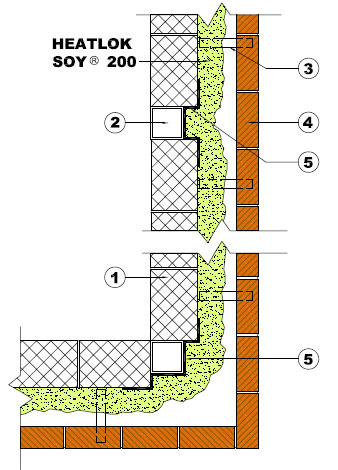
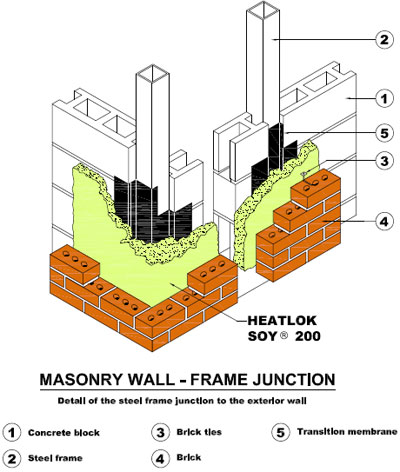
In exterior walls, medium-density SPF can serve as a four-in-one application, providing an exterior thermal insulation, an air barrier, a vapor retarder, and a drain plane all in a single application. In this case, the SPF would be sprayed on last just before the final cladding material is installed. In the case of a typical brick and CMU cavity wall, it would be installed after the CMU back-up wall had been constructed and brick ties put in place, but before the actual outer brickwork was performed. Because of its more dense and durable nature, medium-density SPF can be left exposed to the elements during a normal construction time frame without experiencing a degradation in performance.
The latest building and energy codes and standards have recognized that it is this continuous insulation layer that improves the overall performance of an exterior wall or roof assembly. They typically give more credit for the effectiveness of this continuous insulation (ci) compared to insulation that is interrupted by studs or other framing members. Further, they recognize that these framing members and other structural elements act as significant “thermal bridges” where there are essentially gaps or holes in the layer of insulation as it is installed around the building. This approach is well founded in building science through both calculated/computer modeled analysis as well as actual testing of assemblies and buildings. Hence, by continuously insulating with SPF over the outside of a stud wall, the temperature difference across the studs is less, thus reducing the rate of heat transfer.
The effectiveness of the exterior insulation application becomes even more pronounced on multistory buildings where a stud wall assembly is used on multiple floors. The studs commonly rest on and get anchored to a floor structure that for example could be 4 to 6 inches of concrete in a metal deck or a 10-inch to 12-inch wood framed structure. In this type of construction, the insulation in the wall studs stops above and below the floor structure, meaning the floor edge is exposed along the full length and width of the building. It is therefore a very significant thermal bridge since there is nothing to prevent heat from being transferred between the inside and the outside of the building along the entire perimeter of the floor construction. The obvious means to overcome this deficiency is to insulate this edge as part of the overall SPF insulation scheme of the building envelope.
The same type of thermal bridging phenomenon occurs elsewhere in the building envelope as well. Structural elements such as columns or beams made of steel or concrete can create very significant thermal breach if they are not insulated on the outside. This applies not only to walls but to roof elements too, such as roof parapets which can act in the vertical plane the same way exposed walls act in a horizontal plane. The ideal solution is to make sure that continuous insulation connects at the critical juncture between wall and roof. Of course, that also implies that the roof and the wall are continuously insulated as well.
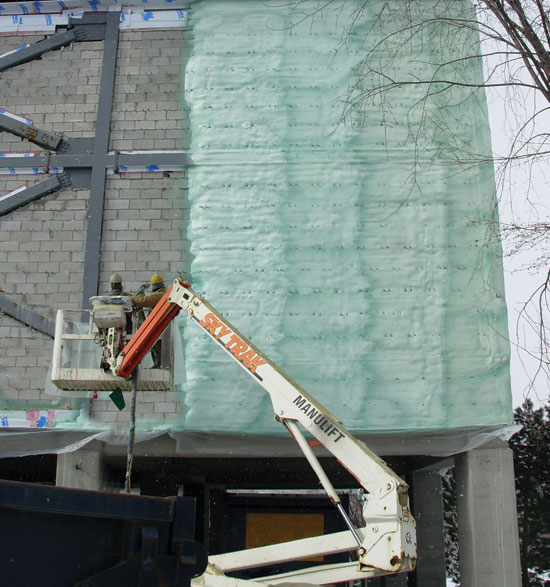 |
SPF applied to the exterior of a multistory wall system provides complete continuous insulation.
Photo courtesy of Demilec (USA) LLC |
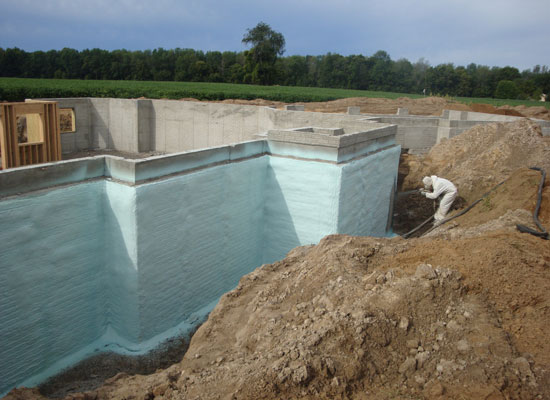 |
Medium-density closed cell SPF insulation is effectively used on the exterior of foundation walls or under concrete slabs on grade.
Photo courtesy of Demilec (USA) LLC |
Below-Grade and Under-Slab Applications
A conventional below-grade occupied space or a residential basement typically requires multiple layers to control water penetration and heat loss. Commonly, a damp proof or a water proof layer is applied over concrete or CMU on the outside. Insulation is then added either inside or outside. In some cases additional membranes and layers are added to accommodate local design conditions.
By contrast, medium-density SPF insulation can be used on the exterior side of below-grade walls to provide all of the same benefits as above grade walls. The single layer application of foam can provide an effective damp proofing layer, an effective air seal, and a fully continuous insulation layer from the top to the bottom of the wall. For any portion exposed above grade, it will need to be protected from sunlight to prevent discoloration and potential degradation. Individual manufacturers' information will need to be consulted to properly address any of these conditions.
When it comes to under-slab construction, medium-density SPF insulation can provide an effective alternative to the commonly used rigid board insulation. Open cell insulation is not well suited for under-slab construction so using medium-density closed cell insulation is the logical choice since it will help avoid potential problems later on. Since the spray foam can be installed inside formwork and below reinforcing bars it can completely fill the allotted space beneath the slab and seal all edges of formwork or foundation walls. Once it is ready, the concrete can be poured on top of the SPF and the two will form a tight seal together. This can create a superior performance particularly if the slab is heated since the complete, uninterrupted layer of insulation will avoid the problems of multiple joints present when using individual boards. Further, it will provide a full and continuous layer as a vapor barrier between the slab and the ground.
Building Code Compliance With SPF Insulation
Fire safety testing and compliance has been a consistent part of building codes for decades for good reason. When it comes to SPF, it is important to recognize that the building code treats all foam plastics the same. Hence polyurethane, polyisocyanurates, extruded polystyrene all fall under the same code sections even though the fire characteristics of these products are vastly different. For example, extruded polystyrene (used in some foam board or coffee cups) will melt and drip when it burns since it is a thermoform material that will create a flame. By contrast, polyurethane chars and flakes when exposed to fire, meaning that it will burn but will not propagate a flame.
Regardless of these actual variations in foam plastics, the International Construction Codes don't differentiate one foam plastic from another. Instead, code provisions require that all foam plastic must be separated from the interior of buildings by a 15 minute thermal barrier. Specific requirements for these provisions for commercial buildings are found in section 2603 of the International Building Code and for residences in Section 316 of the International Residential Code. As a practical matter, meeting these fire separation provisions usually means providing a half-inch thick layer of gypsum board over foam plastic used in wall, roof, or ceiling framing.
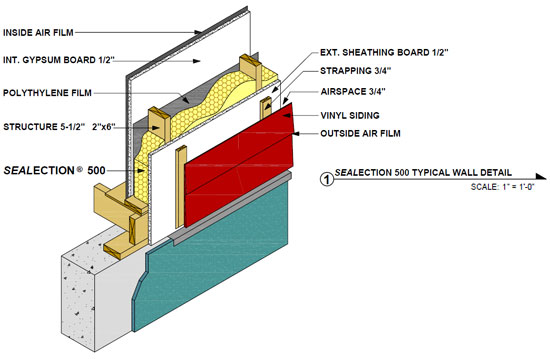 |
Building codes typically require wall assemblies with 15-minute fire separations between any type of plastic foam product and the interior of the building.
Image courtesy of Demilec (USA) LLC |
It should be noted that there are some exceptions to this thermal barrier requirement including applications in attics and crawlspaces. In attics and crawlspaces an ignition barrier is called for (instead of the 15 minute barrier) over the inside face of the foam, specifically 3/8-inch gypsum, ¼-inch plywood, ¼-inch hardboard and a few other board products. However, this type of application would likely be very difficult and expensive in most buildings.
Luckily the code also allows for specific approvals, based on large scale fire tests related to the actual end use configuration of a product. This is performance based compliance as opposed to prescriptive based compliance for fire safety. Essentially, if a product can be tested to demonstrate that it will outperform a code compliant methodology then it can be designated as code compliant. In this regard there are a number of important tests that can be referenced or required as part of a product specification. For attics and crawlspaces that use SPF insulation a modified NFPA 286 (AC 377) test can be performed in addition to ASTM E970. For interior finish testing, NFPA 286 and UL 1715 would be applicable to determine that the interior is appropriately protected. Exterior walls in buildings of Type I to IV would rely on NFPA 285 as the preferred test. Finally, for testing a full fire rated assembly that uses SPF insulation, ASTM E119 could be performed. It is important to specify the appropriate testing and request submittals documenting compliance as appropriate to a particular building application. The design of the full assembly is important in order to assure not only code compliance, but protection of the health, safety, and welfare of the occupants, therefore it is crucial to always ask the manufacturer for proof of compliance with these fire safety standards and tests.
Beyond fire safety, SPF insulation can be a particularly good ally in showing compliance with many provisions of the International Energy Code. Since the Energy Code is very specific about insulation values, air infiltration, and vapor barriers, the documented traits of SPF insulation can be used to create and demonstrate buildings with high energy performance. In particular, the use of exterior continuous insulation helps a building meet and exceed the R-value or U-factor requirements for insulation or wall and roof assemblies respectively.
The Energy Code requirements related to air infiltration are intended to be met by a combination of design mandates and in field testing. The US Department of Energy (DOE) has indicated that up to 40% of residential energy loss is directly associated with unwanted air infiltration. The overall concept, then, is to seal the building as tight as possible, lower the air changes per hour caused by poor air sealing, and thus eliminate the negative impacts of the exterior environment on the interior conditioned spaces. The air sealing qualities of SPF insulation help create tighter building envelopes that can limit the inefficiencies of traditional construction and produce better performance all around.
By reducing air infiltration, any moisture in that air is also limited from travelling through the building assembly. The significance of moisture laden air was rather dramatically presented in a recent study by the Building Science Corporation. Researchers conducted a test showing that direct air infiltration can allow up to 90 times more moisture to pass through building materials when compared to simple diffusion of vapor through those materials.
 |
Air infiltration into a wall system brings significant amounts of moisture that can get trapped in a wall assembly and cause mold growth and damage in traditional construction.
Photo courtesy of Demilec (USA) LLC |
Diffusion is simply the principle of vapor passing through a material based on its permeability to water. When testing a 4 foot by 8 foot sheet of gypsum board sealed around the edges and exposed to a humid condition the diffusion of moisture through it yielded 1/3 quart of water over time. By comparison, when a 1 inch square hole was cut in that gypsum board allowing moisture laden air through the gypsum board, a full 30 quarts of water was collected over the same time period. In other words, the air infiltration accounted for 90 times more water vapor than simple diffusion—a very dramatic difference. Thus tighter building envelopes using SPF insulation allow us to more easily control the movement of air and therefore dramatically limit moisture transfer through walls. Eliminating that moisture means eliminating the possibility of damaging condensation and the detrimental effects it can have on building materials. It also means that moisture doesn't make its way to organic materials in the building that could feed the growth of mold.
Life Cycle Analysis of SPF Insulation
All building products require energy for production, delivery and installation. It is becoming more and more common for manufacturers to conduct a Life Cycle Assessment (LCA) of the energy used and other environmental impacts of their products over the full life cycle of that product. Such an LCA typically includes the various stages of a product including:
• Raw Materials and manufacturing
• Transportation, distribution, and installation
• Use over time
• End of service life re-use, re-cycling, or disposal
In the case of SPF insulation, it is significant to note that it is a product that not only consumes energy during its lifecycle but it also reduces energy use in buildings. In fact the amount of energy saved in buildings usually dramatically exceeds the amount of energy used during its life cycle. By way of example, a typical residential installation using open cell low-density SPF insulation could be expected to contain on the order of 47 – 73 mega-joules (MJ) of embodied energy.
The ratio of energy avoided versus this embodied energy could result in an energy payback balance occurring in only a few months in cold climates but still about a year in warmer climates. If medium-density closed cell foam is used the embodied energy is a bit higher at 93-144 MJ so the energy payback takes a little while longer to balance out, but could still be expected to range from about 7 months to 2 years depending on the climate. Over the course of say a 60 year life expectancy for a residential installation, anywhere from 3,000 to 14,000 MJ of energy could be saved because of the insulation which helps to explain the quick energy payback balance. If medium-density closed cell insulation is used for commercial roofing, then the energy payback is also strong coming in between 1 – 2 years depending on climate.
When looking at the initial cost of installing spray foam insulation, it is appropriate to view it in the context of high performance building design. That means the performance and design of the building should be looked at based on a variety of interrelated factors. One of the important points to consider in creating a high performance building envelope is the potential to reduce the size of the mechanical equipment needed to heat and cool that building. This essentially becomes a “cost transfer” approach whereby any additional cost of increasing the performance of the insulation is offset by a reduced cost in mechanical systems. Over the life of the building that cost savings is compounded to the benefit of the owner in reduced energy costs, reduced maintenance costs, and replacement cost savings at the end of the service life of the equipment.
The Merrimack Valley High School in Penacook, New Hampshire, is an excellent example of this principle at work. The building was designed to be very energy-efficient addressing the multiple interrelated areas to achieve that goal. When the costs of the final built result was compared to the baseline comparable building costs, the savings were found to be dramatic as follows:

This fairly simple study shows that by utilizing SPF as an air impermeable insulation in a high performance, energy efficient building, the increased cost to the building shell was actually more than negated by the reduction in sizing and cost for the HVAC system. In fact the analysis in this case shows a net savings of initial construction costs of over 22% less than the standard construction cost. The end result is a higher performance building that will reduce the monthly and annual energy costs all at a lower initial construction cost.
Candlewood Suites Hotel, Rolla, Missouri
The award-winning Candlewood Suites® hotel in Rolla, Missouri, provides guests with the highest level of quality and service for an extended stay or short-term visit. This 37,000 square foot facility is part of the Intercontinental Hotel Group (IHG) worldwide chain of hotels and is located near Fort Leonard Wood, Missouri, Interstate Highway 44, and some of the area’s leading companies. This location makes it easy for guests to visit the exciting museums on-Post, including Fort Leonard Wood Museum and the US Army Engineer Museum. Additionally, it is also about 35 miles from the popular Lake of the Ozarks State Park, where visitors enjoy fishing, hiking, camping and mountain biking.
As part of IHG’s commitment to sustainability, they have implemented a program termed “Green Engage.” This innovative sustainability effort is based on an advanced online tool which measures the day-to-day environmental impact of participating IHG hotels. The online system monitors energy, water and waste usage of individual hotels while providing recommended actions to improve the property’s energy conservation and carbon footprint score. IHG created Green Engage to ensure that their hotels are designed, built and run for optimal sustainability.
This commitment to sustainability was important in the design and construction of the Rolla, Missouri, hotel. The design team employed computerized energy modeling to compare design options using DOE 2.1 Energy Modeling Software. The areas of interest that were incorporated into the computer model included:
• The Building Envelope
• Insulation
• Natural Air Changes
• Lighting
• HVAC
• Hot water
As with all computer modeling, a baseline or reference building is
modeled based on meeting minimum baseline requirements. In this
case that reference building design yielded an annual energy cost of
approximately $95,100. An initial design using conventional insulation
and air sealing tactics plus a conventional HVAC system reduced that
annual energy cost by over 23% down to approximately $72,650 per
year.
Moving one step further, the design team looked at improving
the performance by using spray foam insulation. This meant that the
insulating values were increased while the air infiltration values were
able to be decreased. It also meant that the HVAC system size could
be reduced and operate more efficiently. The energy model for this
design scenario showed a dramatic 55% decrease in annual energy cost
compared to the baseline reference case coming in at only $42,350 per
year. That is a $30,300 decrease or nearly 42% improvement over the
initial conventional design approach.
Given these energy modeling results, it was an easy decision for
the architects to specify spray foam insulation. This choice not only
met initial design goals and objectives, it also created a thermally high
performing facility that allows this IHG property to meet its Green
Engage goals year after year. |
Conclusion
Spray Polyurethane Foam insulation has been shown to provide a high performance solution for a full variety of building types in multiple locations in those buildings. It has also been shown to readily and easily meet or exceed code requirements for fire safety and energy performance.
When specifying SPF insulation, it is important to include all of the following:
• Indicate the design thickness or the total installed R-value required on the drawings and in the specifications.
• Specify either low-density open cell SPF or medium-density closed cell SPF
• Identify the air barrier requirements
• State if the product is also acting as a vapor retarder in the assemblies where it is applied
• Request submittals showing that Building Code Approved Products are being used
• Require that trained applicators are used as recognized by industry groups
• Similarly require that applicators are authorized by the SPF insulation manufacturer
Designed and specified properly, SPF insulation can meet many performance requirements and provide the owner with a high performance, cost effective building over its full life span.
|
The proper design and specification of SPF insulation ensures a high performance building envelope with continuous control of thermal, moisture, and air sealing properties in one product.
|
| Image courtesy of Demilec (USA) LLC |

|
Demilec (USA) LLC is an industry-leading manufacturer of spray polyurethane foam insulation and coatings. using world-renowned technology and science, Demilec USA helps architects and designers create energy-efficient, quiet, and comfortable buildings. www.DemilecUSA.com |