This CE Center article is no longer eligible for receiving credits.
Door Frames
Beyond the manufacture of the door panels, most manufacturers offer both pultruded fiberglass frames and Resin Transfer Molding (RTM) frames for their door systems. Pultruded fiberglass frames can be butt mounted or wrapped for most wall conditions, including insulated panel walls. RTM frames due to their solid profile can only be butt mounted. Frames are commonly available with a variety of mounting systems.
Pultruded fiberglass frames are typically constructed of ¼-inch-thick material. Fiberglass pultrusions were invented in the late 1940s and 1950s and are commonly in use in buildings of many types around the world. The AAMA describes the specific process as glass strands being pulled through resin baths and then shaped through a die or a mold to create a finished lineal material. The die is the key to the final shape and in this case will form the profile of the door frame. The lineal frame is then cut into sections for the head and jamb pieces and installed in the field.
By design, pultruded frames typically conform to Steel Door Institute and other industry standards for shape and installation methods. The corners of the fiberglass frames are usually mitered with no exposed fasteners, thus creating a desirable “clean” finish. Additional reinforcement can be added if required by the application or to accommodate specialty hardware. Most frames come standard with a satin finish in white, gray, tan, or brown. A variety of configurations and mounting options are also available, allowing products to be installed on concrete, brick, block, foam panel, drywall, and tilt-up wall systems.
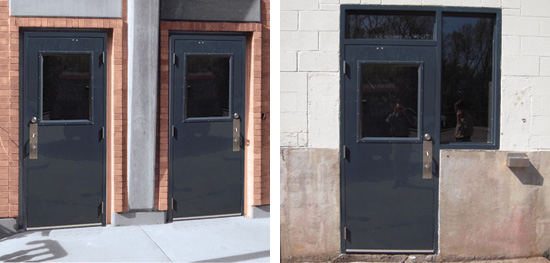 |
Exterior door locations that are exposed to salt air or heavy moisture conditions are logical places to use fiberglass doors.
Photos courtesy of Chase Doors |
When selecting a door, frame, and hardware, be aware that in some cases a manufacturer may offer a “pre-hung” fiberglass door and frame package. In this case, the entire door system (including hardware) can be factory assembled and shipped ready for installation in the opening. Installation time of the door system can be reduced by as much as 70 percent in this manner. Note that double doors are typically pre-hung to ensure a proper fit and that hardware functions properly, then broken down for shipping purposes.
Design Considerations Using Fiberglass Doors
We have been making the point that it is important to match the right door material to the building application where the door is installed. It does not serve anyone well to have an inferior door in a demanding environment any more than it makes sense to have an over-designed door system in a moderate environment. Therefore, it is important to be clear during the design stage about the things that different doors may be exposed to, sometimes varying significantly in the same building.
Door Locations
In medium-duty rooms, building portions, or entire buildings, hollow metal doors may still be the most appropriate design choice. This might be true in general offices, warehouses, dry manufacturing facilities, general industrial buildings, restaurants, retail stores, and dry storage locations. It might also be necessary in locations that require more than a 1-½-hour fire rating since metal doors can be rated up to 3 hours.
In both interior and exterior applications where corrosion or damage is a concern, fiberglass doors are usually the more appropriate design choice. As we have seen, fiberglass doors do not break down or corrode the way steel doors do when exposed to water, corrosive materials, or heavy usage. Hence fiberglass doors are logically selected for virtually any building type with exterior doors that are exposed to high moisture or salt levels due to their location near salt water, process water, or particularly rainy locations.
Note that fiberglass door cores are typically electrically non-conductive and therefore eliminate galvanic corrosion, including concerns connected with coastal environments. They can also be appropriate for indoor water exposure in buildings such as car washes or facilities that require regular wash-downs.
Other building types by their nature are corrosive environments that place high demands on doors due to the processes carried out in those buildings. These can include chemical manufacturing plants, pharmaceutical manufacturing facilities, pulp and paper mills, and wastewater treatment plants. Other locations require diligence for compliance with federal regulations regarding health and cleanliness such as USDA and FDA Regulated Facilities including cGMP and GMP Regulated Facilities. Many fiberglass doors are suitable for use in these locations and in fact may be one of the only appropriate choices. The processes being performed in these locations might include food manufacturing and processing including fruit and meat processing.
Finally, fiberglass doors can be the appropriate choice in coastal environments, especially hurricane-prone regions. Fiberglass doors can be manufactured with considerable strength of the skins and core; therefore, can meet and exceed the stringent wind and large missile impact requirements of the Florida Building Code.
Beyond the location, some design options and considerations are rather universal. Obviously the needed door sizes need to be determined either for functional, code, or preferential reasons. Similarly, their operation needs to be determined as swinging, sliding, double acting, etc. In the event that fire ratings are needed, keep in mind that fiberglass doors can achieve up to a 90-minute rating.
When selecting or specifying doors, architects commonly have four materials to choose from—namely wood, aluminum, metal, or fiberglass. Wood doors are commonly regarded as suitable for lighter-duty interior or exterior applications where the wood grain appearance is desirable. Aluminum doors are typically found in exterior storefront or interior applications where extensive glass or glazing is used. For many other commercial, industrial, and institutional settings, hollow metal doors and frames are often seen as the default door system. However they have limitations particularly in high-use, heavy-duty, or corrosive environments. In those cases, rust, denting, and deterioration become ongoing maintenance issues that can reduce performance and notably shorten their useful life. In response, fiberglass reinforced polymer (FRP) doors and frames have become widely used to overcome the limitations of other door systems, thus providing a preferred choice.
Door Systems Overview: Comparing Choices
One of the keys to a successful building design is the selection and specification of the best material for a particular application. For many buildings that includes the best door material. For purposes of this article we are going to focus on buildings that have high demands either because of high usage or their surrounding interior or exterior environment. In those cases, the choices narrow down to door materials that have been tested and shown to perform well in those situations. Wood and aluminum do not commonly perform well in those situations, so we will focus our comparison on metal and fiberglass door systems.
Metal Doors and Frames
Historically, metal was more commonly used as a cladding for protecting wood doors than an independent door material. In the mid 1800s, for example, contractors began cladding wood doors with steel to protect them from impact by livestock. It wasn't until 1879 that the “hollow metal door” was invented by the Mesker Door Co. in St. Louis, Missouri. It clearly caught on, becoming a popular choice and has evolved dramatically since then.
 |
Selecting doors made from materials appropriate to the environment where they are installed is key to the long-term success of a design project.
Photo courtesy of Chase Doors |
As the number of metal door manufacturers grew, so did the need for standards for the use of metal doors in buildings. The Chicago-based National Association of Architectural Metal Manufacturers (NAAMM) established in 1938, with roots reaching back to 1907, emerged as a preeminent organization representing members engaged in metal manufacturing. In 1969, they created a separate division known as the Hollow Metal Manufacturers Association (HMMA) which is today its largest division. HMMA is a voluntary, non-profit business association comprised of more than 60 member companies throughout North America that manufacture hollow metal doors and frames. In addition, the Steel Door Institute (SDI) was established in 1954 as a voluntary, unincorporated, non-profit business association whose mission is to promote the use of steel doors and frames in the construction industry. Representatives of SDI member companies create and publish manufacturing, quality, and performance standards and distribute them to licensed architects and construction specifiers at no charge.
With this history and level of development, hollow metal doors are fairly predictable in their types, styles, and elements of their systems. The door panel itself is actually less “hollow” today and typically incorporates an internal framework, reinforcements for hardware, and a core material beneath steel skins on each side. The core material used can vary based on desired door performance criteria and can include honeycomb cardboard spacers, urethane or polystyrene insulating cores, gypsum for fire doors, and even wood. The steel door skins are attached to the internal core and framework, and are most commonly joined together around the perimeter of the door panel creating a visible lock seam. In cases where the aesthetics of that seam are undesirable, it is filled, ground, or welded to cover it.
Similarly, metal door frames have evolved to be fairly simplified and predictable. They are usually manufactured by the same companies that manufacture the doors and are intended as a matched set. There are a variety of profiles possible to accommodate a wide range of wall thicknesses and design conditions in both rigid, welded frames and “knock-down” frames that assemble on site. These have become fairly standard and relatively easy to incorporate into many building projects.
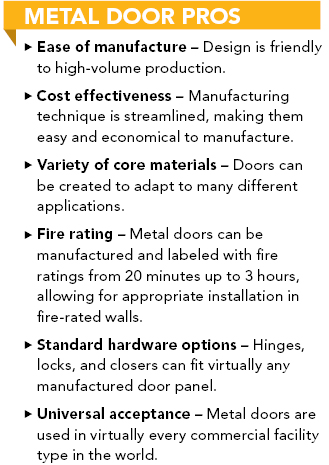
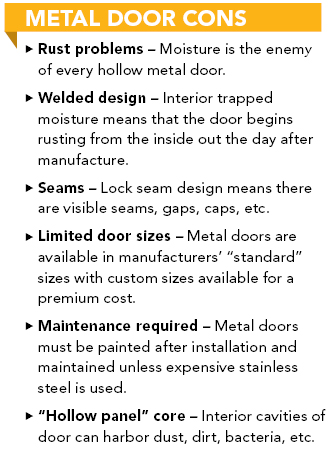
Based on the aforementioned, hollow metal doors can be evaluated for use in buildings with the following common pros and cons:
Acknowledging these pros and cons of metal doors helps to determine when it is appropriate to use them and when it may not be.
Fiberglass Doors and Frames
Unlike metal, fiberglass is a newer, although well-proven material for doors. The first fiberglass doors were manufactured nearly 40 years ago in 1975—almost 100 years after the first hollow metal door. Initially they were developed for the petrochemical industry where the focus was chemical resistance to replace hollow metal doors in highly corrosive environments. The metal doors were not holding up in these locations and an alternative was needed.
Although its history may be shorter, there are indeed organizations and standards that have been developed for them as well. The American Architectural Manufacturers Association (AAMA) has been in existence since 1936 with a goal to develop standard test methods and performance specifications for the fenestration industry in order to protect customers by providing them a basis for an “apples to apples” product comparison. As a material-neutral organization, AAMA brings together window, door, skylight, curtain wall and storefront manufacturers, suppliers, and test labs to represent individual and shared concerns. Their membership is comprised of large and small companies that are both residentially and commercially focused. They have created a Fiberglass Material Council as well as a Door Council, both of which provide relevant information and standards for fiberglass doors. They point out that since fiberglass doors are often mechanically assembled in the factory through chemically welded or bonded assemblies, they provide a high degree of quality, consistency, and reliability
Functionally speaking, fiberglass doors are conceptually very predictable and similar to hollow metal door systems. They are manufactured with fiberglass door skins that are produced first using a full gel coat finish in a pre-selected color and then laminated to a solid core material. Similar to a metal door, that core material can be selected based on performance needs from lightweight balsa, durable polypropylene, insulating urethane, or fire-resistant gypsum. The perimeter of fiberglass doors are then filled with a fiberglass matrix, giving the door a clean, monolithic finish.
 |
The exterior faces of a fiberglass door are manufactured first in the process and provide the long-lasting gelcoat finish when installed.
Photo courtesy of Chase Doors |
FRP frames are made using either FRP pultrusion or RTM (Resin Transfer Method) technology. FRP doors can also be used with existing standard hollow metal frames, although they are not usually recommended since they will corrode in a very short period of time in most applications where fiberglass doors are commonly used. Frames can be installed in a variety of ways either as butt-mount system against a wall assembly or can be sized and selected to wrap around the jamb wall.
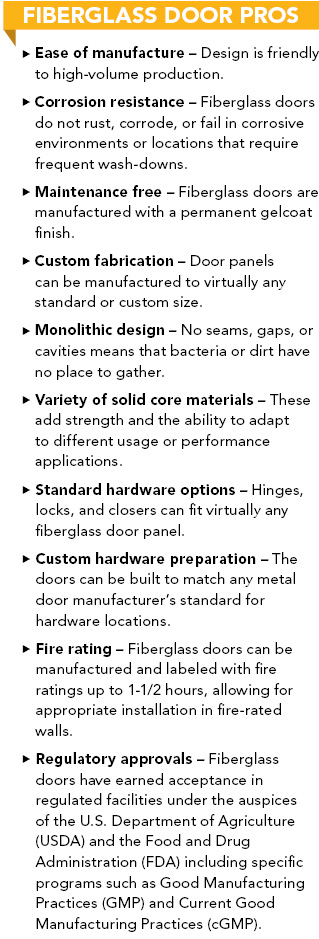
Similar to metal doors, fiberglass doors have pros and cons as well. However, when it comes to evaluating them in situations that require durability and corrosion resistance, the pros are more prevalent than the cons. Perhaps the most significant difference is that fiberglass doors are impervious to dirt, moisture, chemicals, bacteria, salt solutions, sea water, and other contaminants.
The listing of pros and cons makes it clear that fiberglass doors are particularly well suited to locations and environments that are demanding or corrosive. In fact, fiberglass is often used in underground mines for everything from bolts to doors.
Fiberglass Door Manufacturing Process: Creating Longevity
While the details of manufacturing fiberglass doors may vary a bit between individual manufacturers, the basic process is necessarily the same across all of them. Essentially, the process is rather unique in that it works from the outside in where the outside of the door is manufactured first. This process follows these four basic steps:
1. Door Skins
Fiberglass door skins are created utilizing mold technology. The pre-selected color of gelcoat is then applied uniformly over the mold and allowed to cure. Next, a coat of resin is applied to the “back” surface (inward side of the door) of the gelcoat followed by a layer of fiberglass matting. Additional resin is then applied which saturates the fiberglass matting. The layered material is rolled out, ensuring that the skin is smooth and eliminating any air pockets in the surface. Once the resin cures, the resultant skin is trimmed as needed. The release agent allows it to then be removed from the mold. The result is a very smooth durable fiberglass door skin that is 1/16” to 1/8” thick. The gel coat side has an aesthetically consistent mirror-like colored finish while the resin side is in its natural unfinished state. Note that the skin is commonly sized a little larger than the actual finished door to allow for it to be precisely trimmed to the exact size needed once the door is complete.
2. Lamination to Core
One skin is placed inside a press with the finished face down. The interior side is coated with resin and the core material is placed on top of the coated skin. The interior side of the second skin is then coated with resin and placed on the opposite side of the core. The resulting combination is a three-layer assembly with the gelcoated skins facing outward and the central core covered by the resin side of the skins. The combined panel (core and skins) is then placed inside a press and allowed to cure. The end result is a solid panel with a smooth finish. Note that the core is deliberately sized to be slightly smaller than the skins so that there is an intentional overhang of the skins all the way around the panel. This creates a recessed edge condition on all four sides that allows for the next steps.
3. Edge Filling
Once the panel is laminated and cured, the recessed edges are ready to be filled with fiberglass resin material, thus creating the door’s monolithic appearance. First the panels are placed on edge and reinforcements are placed at hardware connection points. Fiberglass matting is then wrapped around the perimeter of the panel to reinforce the edges. Next, resin is poured into the cavity between the skins along the edge of the core, creating a chemical bond with the skins and the core. The end result is a continuous fiberglass perimeter on all sides of the door panel without a seam. The solid reinforced resin around the perimeter provides continuous support for the skin edges while the chemical bond assures that it will remain secure and intact.
 |
The process of filling the edge of the doors with matching fiberglass and resin creates a smooth and continuous edge detail around the door.
Photo courtesy of Chase Doors |
4. Final Detailing
The final manufacturing step involves several exacting processes to assure that the panel is finished to the exact dimensions required and prepared for any remaining items. First the panel is machined to its final size and shape, including cutouts and preparations for hardware. When it comes to final detailing for hardware, there are as many options as any other door type. Similarly, preparation and detailing work for locksets, deadbolts, flush bolts, passage hardware, etc. are all undertaken to match a specific manufacturer. In some cases, the door manufacturer may offer complete installation of the hardware, thus saving time in the field with its installation and assuring complete coordination and compatibility.
|
Door Frames
Beyond the manufacture of the door panels, most manufacturers offer both pultruded fiberglass frames and Resin Transfer Molding (RTM) frames for their door systems. Pultruded fiberglass frames can be butt mounted or wrapped for most wall conditions, including insulated panel walls. RTM frames due to their solid profile can only be butt mounted. Frames are commonly available with a variety of mounting systems.
Pultruded fiberglass frames are typically constructed of ¼-inch-thick material. Fiberglass pultrusions were invented in the late 1940s and 1950s and are commonly in use in buildings of many types around the world. The AAMA describes the specific process as glass strands being pulled through resin baths and then shaped through a die or a mold to create a finished lineal material. The die is the key to the final shape and in this case will form the profile of the door frame. The lineal frame is then cut into sections for the head and jamb pieces and installed in the field.
By design, pultruded frames typically conform to Steel Door Institute and other industry standards for shape and installation methods. The corners of the fiberglass frames are usually mitered with no exposed fasteners, thus creating a desirable “clean” finish. Additional reinforcement can be added if required by the application or to accommodate specialty hardware. Most frames come standard with a satin finish in white, gray, tan, or brown. A variety of configurations and mounting options are also available, allowing products to be installed on concrete, brick, block, foam panel, drywall, and tilt-up wall systems.
|
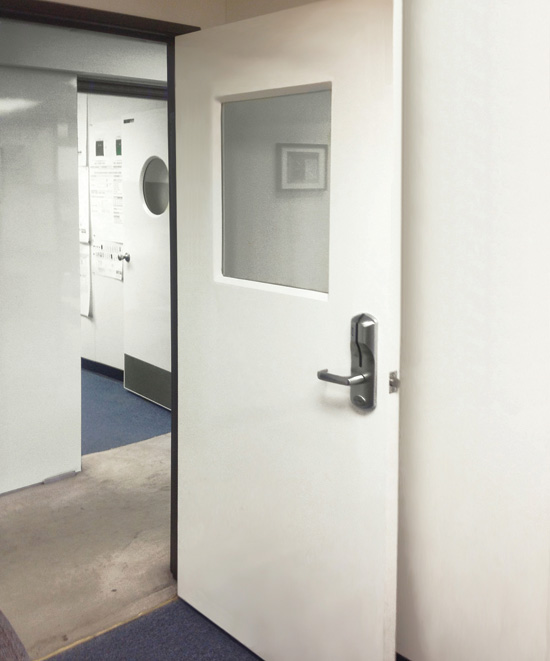
Exterior door locations that are exposed to salt air or heavy moisture conditions are logical places to use fiberglass doors.
Photos courtesy of Chase Doors |
When selecting a door, frame, and hardware, be aware that in some cases a manufacturer may offer a “pre-hung” fiberglass door and frame package. In this case, the entire door system (including hardware) can be factory assembled and shipped ready for installation in the opening. Installation time of the door system can be reduced by as much as 70 percent in this manner. Note that double doors are typically pre-hung to ensure a proper fit and that hardware functions properly, then broken down for shipping purposes.
Design Considerations Using Fiberglass Doors
We have been making the point that it is important to match the right door material to the building application where the door is installed. It does not serve anyone well to have an inferior door in a demanding environment any more than it makes sense to have an over-designed door system in a moderate environment. Therefore, it is important to be clear during the design stage about the things that different doors may be exposed to, sometimes varying significantly in the same building.
Door Locations
In medium-duty rooms, building portions, or entire buildings, hollow metal doors may still be the most appropriate design choice. This might be true in general offices, warehouses, dry manufacturing facilities, general industrial buildings, restaurants, retail stores, and dry storage locations. It might also be necessary in locations that require more than a 1-½-hour fire rating since metal doors can be rated up to 3 hours.
In both interior and exterior applications where corrosion or damage is a concern, fiberglass doors are usually the more appropriate design choice. As we have seen, fiberglass doors do not break down or corrode the way steel doors do when exposed to water, corrosive materials, or heavy usage. Hence fiberglass doors are logically selected for virtually any building type with exterior doors that are exposed to high moisture or salt levels due to their location near salt water, process water, or particularly rainy locations.
Note that fiberglass door cores are typically electrically non-conductive and therefore eliminate galvanic corrosion, including concerns connected with coastal environments. They can also be appropriate for indoor water exposure in buildings such as car washes or facilities that require regular wash-downs.
Other building types by their nature are corrosive environments that place high demands on doors due to the processes carried out in those buildings. These can include chemical manufacturing plants, pharmaceutical manufacturing facilities, pulp and paper mills, and wastewater treatment plants. Other locations require diligence for compliance with federal regulations regarding health and cleanliness such as USDA and FDA Regulated Facilities including cGMP and GMP Regulated Facilities. Many fiberglass doors are suitable for use in these locations and in fact may be one of the only appropriate choices. The processes being performed in these locations might include food manufacturing and processing including fruit and meat processing.
Finally, fiberglass doors can be the appropriate choice in coastal environments, especially hurricane-prone regions. Fiberglass doors can be manufactured with considerable strength of the skins and core; therefore, can meet and exceed the stringent wind and large missile impact requirements of the Florida Building Code.
Beyond the location, some design options and considerations are rather universal. Obviously the needed door sizes need to be determined either for functional, code, or preferential reasons. Similarly, their operation needs to be determined as swinging, sliding, double acting, etc. In the event that fire ratings are needed, keep in mind that fiberglass doors can achieve up to a 90-minute rating.
Cost Comparisons
Of course, the cost of fiberglass doors versus metal doors will likely enter into the design and decision making process. Therefore, let's do a set of cost comparisons between metal and fiberglass doors using the following example door criteria:
• Door and frame size: 3'-0” x 7'-0”
• Vision panel in door: 10” x 10”
• Hardware: 1-½ pair of 4-½” x 4-½” butt hinges plus a passage set
In order to take into account the life-cycle costing of the doors, we can assume some things that will remain constant regardless of the choice of hollow metal or fiberglass:
• Installation: Same process and cost between metal and fiberglass – $400/door
• Removal and disposal at end of life: Same between metal and fiberglass – $245/door
• Painting: If required, assumed at $150 per painting
With all of this in mind, we can now compare four different cost scenarios and determine whether hollow metal doors or fiberglass doors are more economical based on different building and environmental locations:
1) Interior Warehouse Application – No Wash-Down: In this general purpose case we can estimate the material cost of a metal door with vision lite and painted hardware at $575 compared to a comparable fiberglass door with vision lite and stainless steel hardware at $1,200. Adding in installation and painting for the metal door produces an installed cost of $1,125 compared to installation without painting for the fiberglass door at $1, 600. Since both doors in this scenario can be expected to last 25 years before incurring disposal costs of $245, the total 25 year cost of one hollow metal door comes in at $1,370 compared to one fiberglass door at $1,845. That produces an average cost per year of $54.84 for the hollow metal door versus $73.80 for the fiberglass door making the hollow metal door more economical in this case over the life cycle of the doors.
2) Exterior Warehouse Door – Normal Weather Conditions: In this case, the only thing that would be expected to change from the scenario above is the need for additional painting of the hollow metal door during its 25 year life cycle. That would increase the total 25 year cost of a metal door to $1,520 or an average cost per year of $60.84. Since nothing about this scenario would change the fiberglass door with an average cost per year of $73.80, the hollow metal door appears to be more economical in this general purpose use as well.
3) Exterior Warehouse Door – Saltwater and High Humidity: In this case, hollow metal doors are anticipated to suffer from the exposure to salt and humidity while the fiberglass doors are not. The hollow metal doors in fact would only be expected to have a 10 year service life before needing to be replaced which would include the need for three paintings during those ten years. Hence the cost of one door would increase to $1,670 with the increased painting while the 25 year cost would jump to $4,178 to account for replacements after the 10 and 20 year points compared to the one-time $1,845 for the fiberglass door. That creates an average cost per year of $167.12 which is now 2-¼ times more than the $73.80 for the fiberglass door. In simple comparative dollars, the fiberglass door costs 55% or $2,333 less than the hollow metal door in this case without adjusting for inflation.
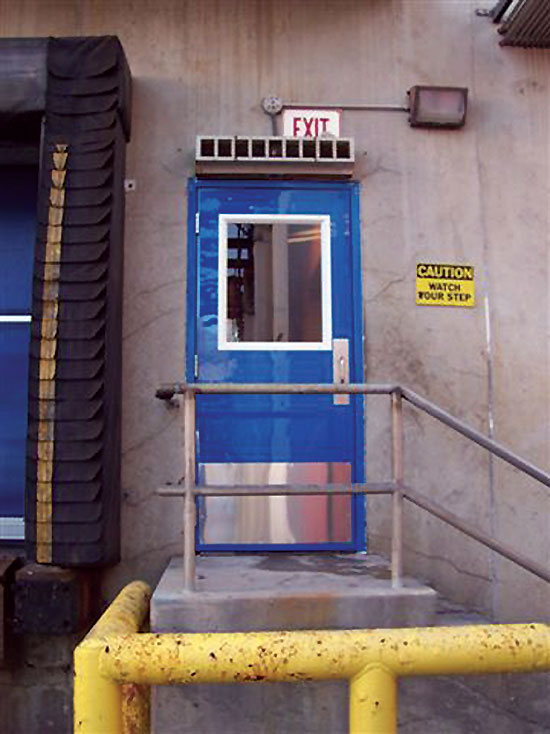 |
High-usage, difficult environments such as industrial loading docks are common places where cleanliness, durability, and corrosive resistance make fiberglass doors a more economical choice over metal doors over the life cycle of the product.
Photo courtesy of Chase Doors |
4) Food Processing or Pharmaceutical Facility – Chemical Wash Down: Hollow metal doors can be used in these settings but they will likely need even more periodic painting than the scenario just above. Assuming a 2 year painting cycle, that will push the single door total cost up to $1,970 which is now higher than the single door fiberglass cost which has remained the same at $1,845. Further, as above, the metal door is only expected to survive in this setting for 10 years before needing replacement while the fiberglass door would be expected to last the full 25 years. Hence the 25 year cost of hollow metal doors is $4,925 with an average cost per year of $197. By contrast, the fiberglass door is still at an average cost per year of $73.80 or approaching a third of the cost of a metal door in this situation.
Clearly comparing the cost of the two types of doors is directly dependent on the location where they will be used and the conditions that will affect their maintenance and longevity. Based on the above comparative analysis, it would be inappropriate to assess them based on first costs alone.
Specifying Fiberglass Doors
When specifying fiberglass doors and frames, there are certain specification details to pay attention to so that the right products are specified and are appropriate to the location where they will be installed. The 2012 Master Format section number commonly used in 08 16 13 for Fiberglass Doors (1995 version previously used Section 08221) and relevant items in a standard 3-part specification format are highlighted below.
Part 1: General Section
All fiberglass doors need to show evidence of compliance with nationally recognized performance standards. The relevant fiberglass finish standard is ASTM D 523 – Standard Test Method for Specular Gloss and is probably the most universal requirement. Frames are often cited to comply with SDI 100 – Recommended Specifications for Steel Doors and Frames. To satisfy most building codes, the doors and frames will also likely need to comply with ASTM E 84 – Standard Test Method for Surface Burning Characteristics of Building Materials and achieve an acceptable burn and smoke developed rating. They may also need to achieve a self-extinguishing rating based on ASTM D 635 - Standard Test Method for Rate of Burning and/or Extent and Time of Burning of Self-Supporting Plastics in a Horizontal Position. Depending on the location and the need to provide a labeled fire rating, then any or all of three standards may need to be called out with the required fire rating indicated either in the specifications or on the drawings: ASTM E 152 – Standard Methods of Fire Tests of Door Assemblies, NFPA 252 - Standard Methods of Fire Tests of Door Assemblies and UL 10C – Standard for Fire Tests of Door Assemblies. Finally, if some degree of blast resistance is required by code, then testing results from ASTM F 1642-04 – Low Level Blast Resistance may be required.
Submittals for fiberglass doors should follow the same submittal information needed for any other door types. At the architect's discretion, that may include manufacturer's data sheets, shop drawings, and samples.
Fiberglass doors do not require any unusual storage or handling requirements except that it is commonly recommended that they are stored on end in order to prevent damage to faces, corners, and edges. With regard to warranty, it is reasonable to expect a lifetime warranty against failure due to corrosion.
Part 2: Products Section
Standard information should be selected regarding preferences or requirements for manufacturers and basic materials. However, there are clearly some choices that need to be made to be sure that the correct fiberglass doors are specified. Assuming a standard door thickness of 1-¾”, the choices in the doors will focus on first selecting the core material. If different doors need to have different cores, then all of the choices should be identified in the specification and identified where they apply in the door schedule. The door skins should also be specified for thickness and color and shown on the door schedule to differentiate any variations in those choices. Criteria for fire ratings (i.e. label classification or rating in minutes) or thermal performance (i.e. U-factor or R-value) should also be stated and scheduled.
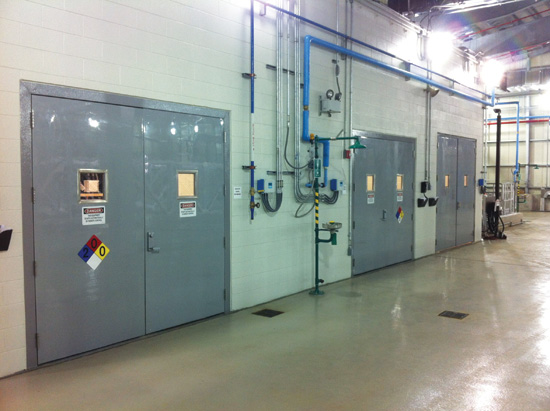 |
When specifying fiberglass doors, the make-up of the core and other features should be identified so they match the needs of the individual locations where they are used.
Photo courtesy of Chase Doors |
Beyond the basic doors, non-rated fiberglass frames are commonly specified in the same specification section. The specification should indicate the basic information related to their construction, profile, and other pertinent fabrication details. Sizes should be shown on the drawings or in the door schedule.
Information related to non-fiberglass items such as optional lite kits, hardware or accessories should be addressed in this specification section, but the actual details of glazing, hardware, etc. should be covered in their appropriate sections and cross referenced here. Any special fabrication instructions related to fiberglass doors or frames accommodating those items should be clearly spelled out to assure proper coordination. This would include mortise, recesses, or reinforcements needed for hardware. In the event that there are questions or concerns about specialty items or common fabrication techniques, then consultation with manufacturer's representatives may be an appropriate way to resolve them.
Part 3: Execution
Fiberglass door installation is very similar to hollow metal door installation. The usual door opening inspection, preparation and 24 hour acclimation of the doors should be included. Doors should then be installed in accordance with the drawings and specifications, approved shop drawings, SDI 100, and manufacturer's instructions all as appropriate. Exterior doors should be installed so as to maintain thermal and air seal barriers at the frames and any special conditions for other installations should be noted as well. Hardware should be installed per manufacturer's instructions and the door hardware specification section. Doors and hardware should be adjusted as needed to assure that all operate correctly in accordance with project needs and normal tolerances. Any labels that do not relate to identifying fire ratings should be called out to be removed and the doors should be given a final cleaning when installation is complete. Any damage should be touched up, repaired, or replaced following manufacturer's instructions.
Conclusion
When reviewing design options for a facility, fiberglass doors have been shown to be the most appropriate choice for high usage and corrosive environments in both new and existing building construction. Compared to metal doors, rust will never be an issue with fiberglass doors meaning that the high cost of replacing and maintaining hollow metal doors is eliminated. Fiberglass doors are molded in a permanent color that never needs painting, even in coastal applications, but if ever needed it can be repaired in place. The manufacture of fiberglass doors is based on durable, long lasting construction with products that are custom built to meet specific project requirements including choices of colors, options and sizes. Further, they are readily accepted for use in USDA, FDA, and other Regulated Facilities. For all of these reasons, fiberglass doors have grown in their relatively short history to earn a reputation for high-quality products that are reliable, durable, and competitively priced.
Peter J. Arsenault, FAIA, NCARB, LEED AP, is a nationally known architect, sustainability consultant, technical writer, and continuing education presenter. www.linkedin.com/in/pjaarch
 |
Founded in 1932, Chase Doors is the global leader and most recognized manufacturer of high-quality, made-to-order specialty door systems including corrosion-resistant doors, fiberglass doors, cold storage doors, sliding fire doors, pharmaceutical doors, and impact traffic doors. Chase Doors’ manufacturing capabilities and exceptional customer service have earned them a reputation for premium products that are reliable and durable. www.chasedoors.com |